A Nerd Dad’s Review of Dungeons and Dragons 2024 Player’s Handbook

Most players of Dungeons and Dragons within the last couple of years are probably aware that an updated ruleset was on the horizon, to coincide with the 50th anniversary of the game. This new ruleset has included names such as “One D&D”, or jokingly “5.5 edition” and so on. Nonetheless, the new Player’s Handbook came out, and I got a limited edition copy at my local game store a couple weeks ago. My kids and I hadn’t really played any TTRPG in many months, both due to demanding schoolwork for the oldest, busy schedule for the family, malaise with Pathfinder Second Edition1 and just unhappiness with Hasbro shenanigans.

But we all agreed that we missed our old family D&D sessions during the early Pandemic, and my oldest child’s school schedule this year is much lighter now. So, we agreed to block out a time on weekends and start playing again.

We bought the alt-cover 2024 Player’s Handbook early, since FLGS’s were allowed to sell it a week before online release.

Further, my kids wanted to try the new rules, so I went to the local FLGS (friendly local gaming store), skimmed over the new 2024 Player’s Handbook, felt it was intuitive enough that I could adapt, and within a couple weeks, we were running a basic Forgotten Realms campaign, borrowing elements from R.A. Salvatore’s original Icewind Dale trilogy.2

I have my old copy of the Sword Coast Adventurer’s Guide to help with the world-building. old resource books for the Sword Coast. Also, before the game, I tested the new rules by creating a couple characters using 2024 rules to help provide sidekicks to our small party.

Our “session zero” with the new 2024 campaign.

The kids, having experience with 2014 5th Edition D&D quickly picked up the new rules and were able to get a couple fun characters created in an hour:

  • a dragonborn paladin (my son)
  • a tiefling cleric (daughter)
  • plus sidekicks I made: dwarf druid of the sea, and drow eldritch knight.

From there we’re back on familiar turf, having a good time, enjoying a classic bar fight opening and subsequently getting thrown out. Wulfgar and Regis from the Icewind Dale trilogy made a cameo too.

In short, getting up to speed with the 2024 rules was easier than expected. The character creation processed has definitely changed in a couple essential ways :

  1. Character race no longer determines stats, it’s based on chosen background now. The result doesn’t really change the process all that much, but it is a philosophical shift.
  2. The racial subclasses get net abilities to help with “flavor” more: elves for example are still divided by wood, high, and drow elves, but each one gets different innate spells at certain levels. Same with Tieflings, and so on. I found this change more fun than expected.
  3. Many character class paths are homogenized to match other class paths. This means that clerics now choose their domain at level three, not level one for example. Wizards similarly choose school on wizardly later than before. However, even at level one there are choices you can make with character creation, so this isn’t as limiting as one might expect. However, clerics and wizards as of writing only have 4 subclasses only versus 8 previously.

Because classes and backgrounds are so strongly emphasized, these sections comprise most of the book by a long shot. The book covers species (character races), spells and equipment toward the end which is different from the classes 2014 PHB. The intro includes a nice, updated walkthrough of how a typical D&D session looks like so if you’re new to D&D, this is a good read.

Most of the other rules have not drastically changed, so in most cases they will feel familiar. There is a comprehensive list here as well.

Spells have often changed and take some careful reading to get re-acquainted. Many of these updates provide much-needed fixes and balance updates. For example the 3rd level Daylight spell now actually counts as sunlight for mechanics purposes (handy for vampires). The classic Cure Wounds spell heals 2d8 damage, not 1d8.

In short, some spells are weaker or more limited now than before. Spells that were seldom used such as Barkskin now have a new life. Again, if you played fifth edition before, you should definitely reread your spell list and familiarize yourself with the new spells.

All in all, despite my personal misgivings toward Hasbro, I must admit that the 2024 Player’s Handbook is a welcome update. It fixes a number of oddities, balance issues and deficiencies of the original while keeping its essence more than I expected. I can still use my old resource books without much effort to convert, which is greatly appreciated. Meanwhile, new players will have enough to get started with the PHB without needing to refer to older material.

I am eager to see what the 2024 Dungeon Master’s Guide brings as well.

Edit: I “butt-published” this too early. I had to write the last third of the post in a hurry. Apologies for the rushed effort. 🤦🏼‍♂️

P.S. another reason for investing in the 2024 PHB is that Adventurer’s League requires rebuilding characters to conform to 2024 rules anyway. I don’t play AL too often these days but I don’t want to get left behind.

1 While we did have a good time initially, especially with character creation, the biggest challenges with maintaining the Pathfinder campaign was a lack of coherent fantasy settings. Most of the research and prep I did as a DM was to pore over Wiki fan pages, which inevitably referred to modules I never bought (and weren’t interested in purchasing). There just wasn’t enough compelling lore, characters or story modules to get immersed in to replace classic D&D lore, plus they are scattered across so many books anyway that it was impossible to find anything. Plus the fatigue in keeping up with the constant stream of new classes, new ancestries, and so on. A TTRPG hobbyist has the time to keep up with this, but not a working parent who just wants to spend a weekend with the kids. Pathfinder 2e Remaster has good rules, and good design, but outside of this and the Beginner Box there is not enough support for more casual players especially those who have some nostalgia about classic TTRPG lore.

2 I’ve been reading the Icewind Dale trilogy shard to my son at night, after we finished the Lord of the Rings Trilogy, the Hobbit, and the original Dragonlance chronicles. LOtR was great, the Hobbit was great, Dragonlance wasn’t as good as I remember, but the Crystal Shard has been a solid read, though I have to skim over certain scenes that are inappropriate for younger audiences. He loves the main cast, even more so in teh second book Streams of Silver. It does feel like a D&D adventure for him, and he enjoys listening to the story, and (in his opinion), my voice acting.
A Nerd Dad’s Review of Remastered Pathfinder 2e

Edit: I wrote this post almost a year ago and my thoughts have changed somewhat in that time. While we did have a good time initially, especially with character creation, the biggest challenges with maintaining the Pathfinder campaign was a lack of coherent fantasy settings. Most of the research and prep I did as a DM was to pore over Wiki fan pages, which inevitably referred to modules I never bought (and weren’t interested in purchasing). There just wasn’t enough compelling lore, characters or story modules to get immersed in to replace classic D&D lore, plus they are scattered across so many books anyway that it was impossible to find anything. Plus the fatigue in keeping up with the constant stream of new classes, new ancestries, and so on. A TTRPG hobbyist has the time to keep up with this, but not a working parent who just wants to spend a weekend with the kids. Pathfinder 2e Remaster has good rules, and good design, but outside of this and the Beginner Box there is not enough support for more casual players especially those who have some nostalgia about classic TTRPG lore.

The debacle in January 2023 with the OGL license and Wizards of the Coast pushed a lot of people away from Dungeons and Dragons, towards other role-playing games, particularly Pathfinder 2nd edition. I reviewed PF2e here and here. Recently, I also picked up the new Remastered edition:

The Remastered edition is Paizo’s clean break from the OGL license and anything related to Dungeons and Dragons mechanics. Classic staples such as alignment, and ability scores, are simply gone, and with it some aspects of Pathfinder 2e have been streamlined. The old ability scores (0-18) are simply replaced with ability bonuses, starting at 0. This actually makes a lot of sense. The only thing we care about are the bonuses anyway, and the old numerical ability scores were more relevant in older versions of D&D where the number didn’t just dictate a bonus, but also dictated other factors (ability to be resurrected, chance of failure to cast a spell, avoid traps, etc).

Removing alignment also makes sense, since it’s been 40+ years, and still no one can agree on how to interpret alignment anyway. 😁 But it also removes some of the artificial guardrails placed on characters and allows greater diversity in motivations and personalities.

With the removal of alignment, this also affects religiously-inclined character classes such as clerics, and focuses on the particular anathemas and religious edicts of each deity. As with character motivation, this does breathe more life into each deity and religious characters path, but it’s also a bit of an adjustment for old-school players like myself.

Further, these changes also mean that some aspects of the Pathfinder character sheets have been streamlined. Previously, my kids character sheets were up to 6 pages long, but the newly designed sheets are 4 pages at most. This is on par with D&D 5th edition.

Finally, let’s talk about the book formats.

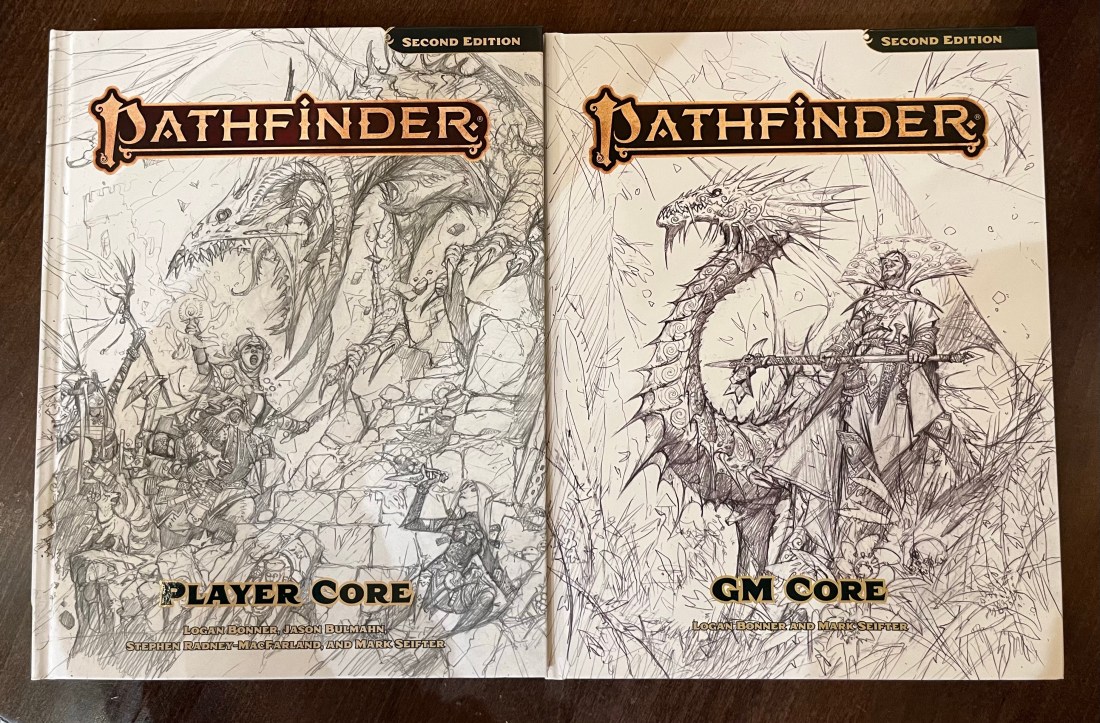
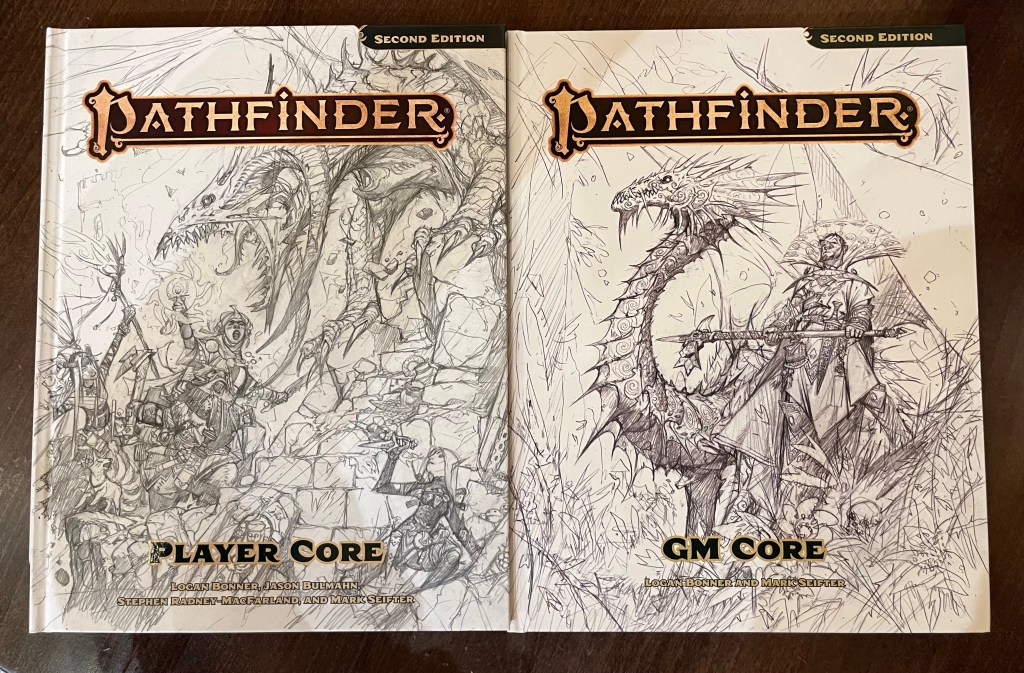
The old Core Rulebook, Advanced Player’s Guide, and GameMastery Guide have been all sliced up and recombined into different books. For example, the new Player Core book (special edition cover shown above), combines elements of the old Core Rulebook and Advanced Player’s Guide. By default, one can play a Witch for example, but remastered Champions (paladins) aren’t available yet, pending further remastered publications. The GM aspects of the old Core Rulebook have been combined with the GameMaster Guide to form the new GM Core book.

What you get is a more logical division between the two books: a player-centric handbook and a GM-centric one. The old tome, the Core Rulebook, thus has been broken up into two logical divisions with newer content added into them.

Further, the format of the books themselves is way more readable than before. Much of the content will look familiar, but is significantly easier to find thanks to book structure, and also due to the handy sidebar on each page. Some rules have been slightly modified to address inconsistencies that have arisen. Other rules have been simply rewritten for better clarity. I can’t tell you how much easier it is to find things on the fly as a GM now rather than stopping the game to flip through a book for 10 minutes then give up and search online. The GM Core in particular does provide more helpful content for planning and designing campaigns, and I found this part particular fun to read. It was previously scattered elsewhere (and similar tough to find), but now I know exactly where to turn to.

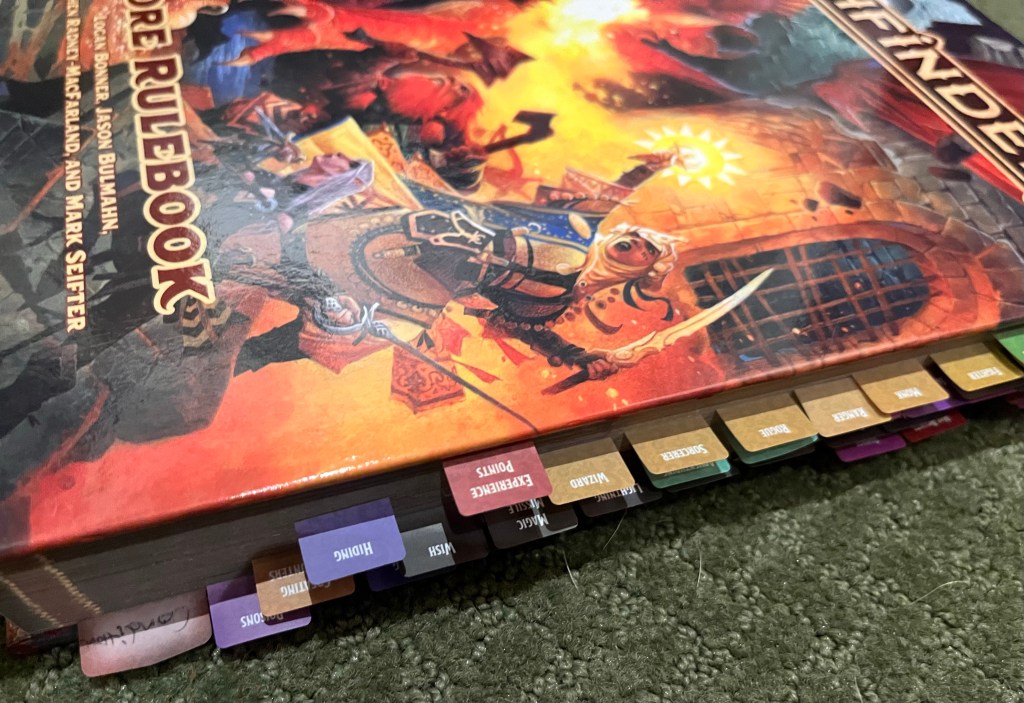
No joke, I struggled a lot with the old Core Rulebook to find things so I had to buy some tabs at a game store to mark the chapter out:

The updated books make this task a lot easier.

Finally, the spell list. In order to make a clean break from the OGL, many classic D&D spells have been renamed to non-OGL ones. For example, the iconic Magic Missile is now Force Barrage. Magic Weapon is given a cooler name of Runic Weapon, and some spells are given names that are more intuitive such as Gentle Repose becoming Peaceful Rest. Mechanically, very little if anything changes, but having to remember a new set of names is probably the biggest challenge for both GMs and magic-using players.

In any case, part of me misses the Pathfinder tie-back to old D&D, so it’s bittersweet that this connection is finally severed at last, but on the other hand, the remastered Pathfinder 2e is a significant improvement over the original 2e in terms of streamlined mechanics and streamlined publications.

On the other hand, it does feel like Pathfinder is finally getting out of the shadow of D&D and maturing as a role-playing game in its own right, and I salute these updates, and will be looking forward to more games with the kids (or maybe finally getting off my seat to check out the local Pathfinder Society).

Fushimi Inari Shrine and O-Inari-San

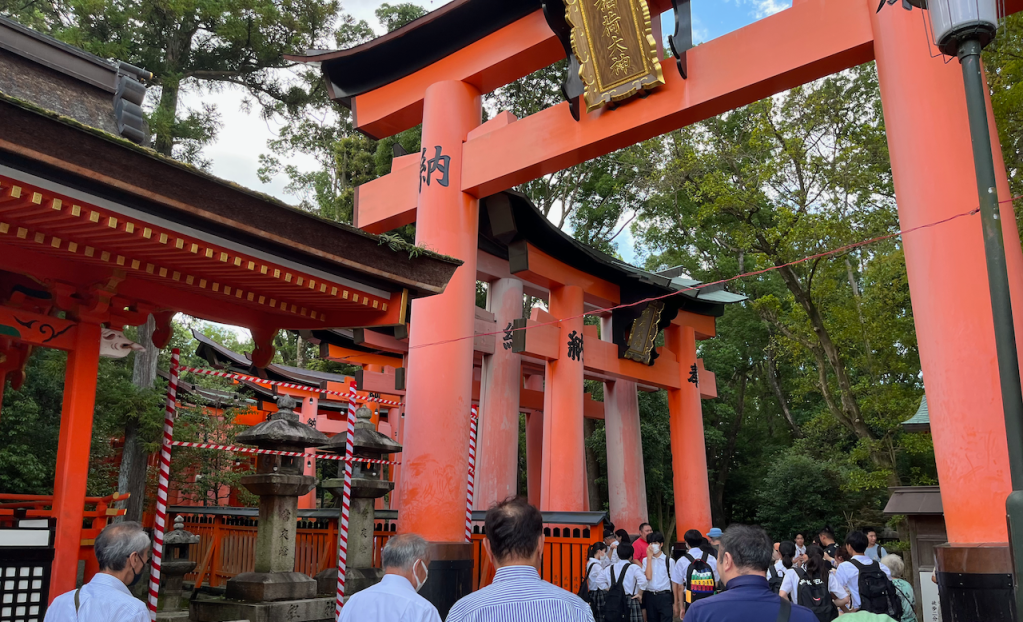
On the list of unexpected surprises during our recent trip to Kyoto/Nara was another place we visited: Fushimi Inari Grand Shrine (English / Japanese homepages) also called Inari Taisha (稲荷大神) in Japanese. The Fushimi Inari Grand Shrine, located in south-east Kyoto, is the head shrine devoted to a very popular Shinto kami named Inari Ōkami (稲荷大神). However, he also known more colloquially as O-Inari-san (お稲荷さん).

Shinto religion reveres and recognizes, many, many kami, and oftentimes these kami are often tied to a certain place, or even to just a single shrine. Many are quite obscure, too. For example, while Kasuga Grand Shrine is considered one of the most sacred, its deities are not well-known in popular culture. However, a few kami enjoy an almost universal popularity within Japan. This includes O-Inari-san and Tenjin, among others. You’ll find branch shrines throughout Japan, all descended from the main one, and in the case of O-Inari-san, the head shrine is at Fushimi.

Even to visitors to Japan, O-Inari-san is often recognizable because his shrines are often decorated bright red, and white foxes. Why foxes? Foxes were thought to be messengers of O-Inari-san, hence they adorn his shrines. Technically, O-Inari-san is not a god of foxes, however. They just happen to be his messengers. Instead, what makes O-Inari-san so popular is that he was a kami associated with commerce, travel, and the harvest of the year rice crop. For the latter, foxes, were often dispatched by O-Inari-san to report on the status of the harvest across Japan. Thus, foxes often have a “fey” image within Japanese folklore.

Even in modern businesses and shopping malls, if you look carefully, you’ll often find a small shrine to O-Inari-san tucked away somewhere.

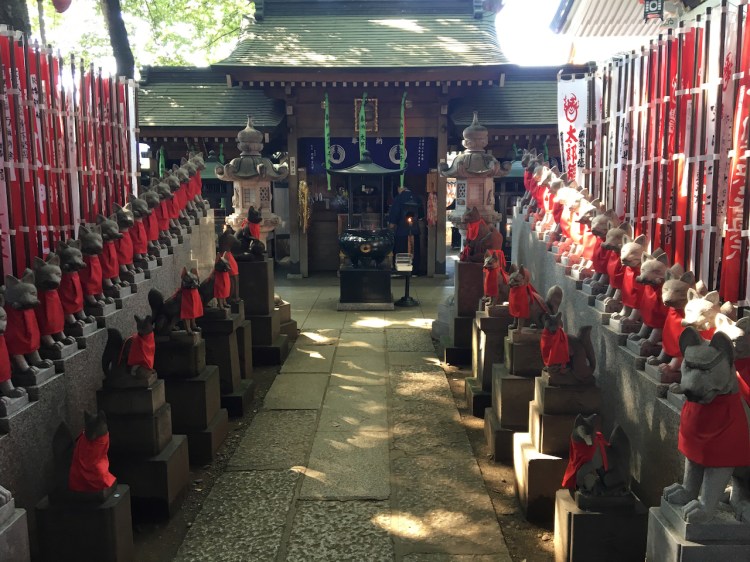
Further, when Buddhism and Shinto blended in the middle ages, it was assumed that O-Inari-san was a divine protector of Buddhism, and sometimes conflated with certain obscure Buddhist figure named Dakini. In downtown Tokyo is a Shrine I’ve visited before called Toyokawa Inari devoted to O-Inari-san, and was a hybrid Zen temple and Shinto shrine:

Anyhow, that’s the lengthy explanation of O-Inari-san; let’s look at the shrine. Chances are, you’ve probably seen photos of it, because the tunnel of red torii gates is so iconic, but there’s a lot more to the temple too.

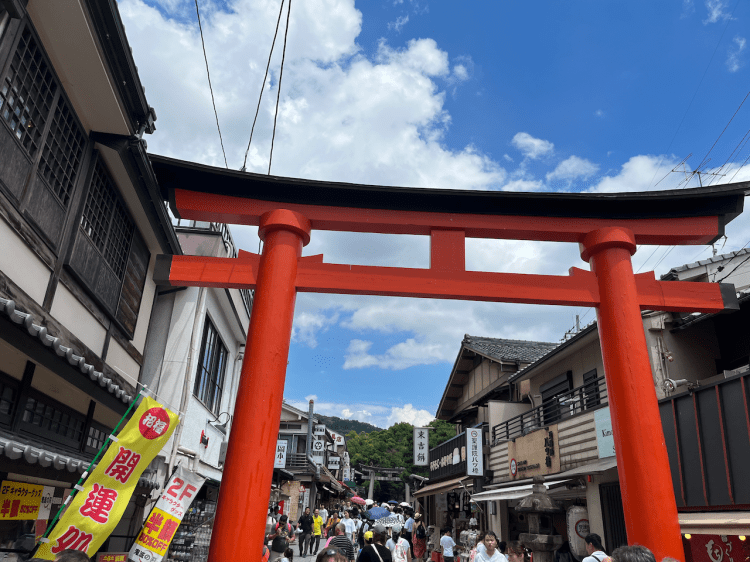
From the Fushimi-Inari train station in Kyoto, you can find the shrine very easily (it’s a huge tourist draw):

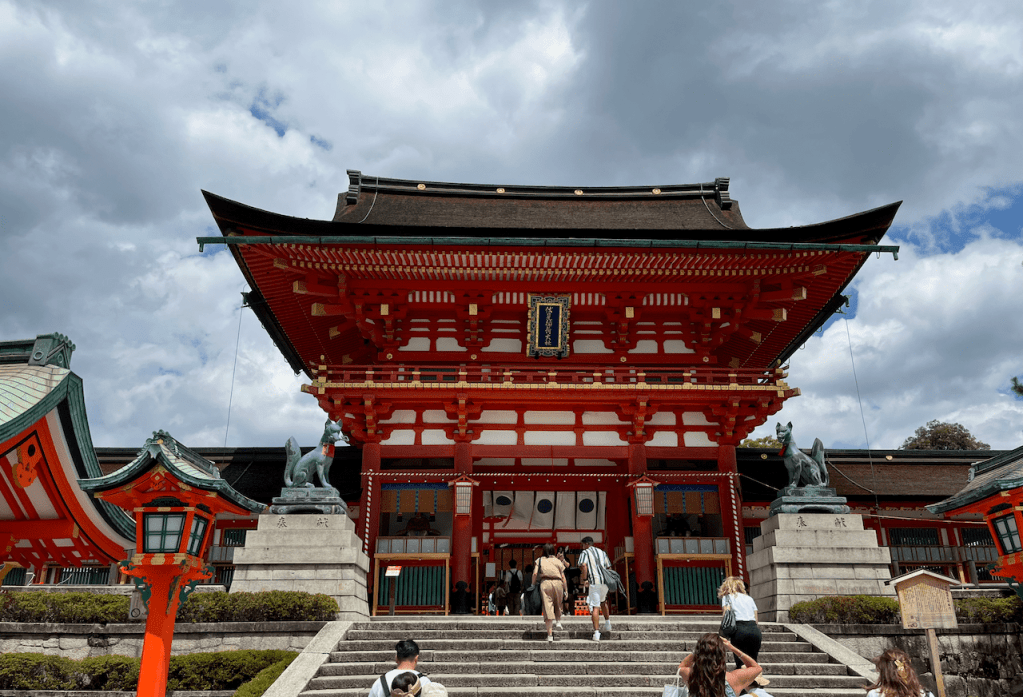
… until get to the front entrance:

From here, the shrine splits into two places. Ahead, is the main, inner sanctum, however, the path also splits left and follows up the mountain:

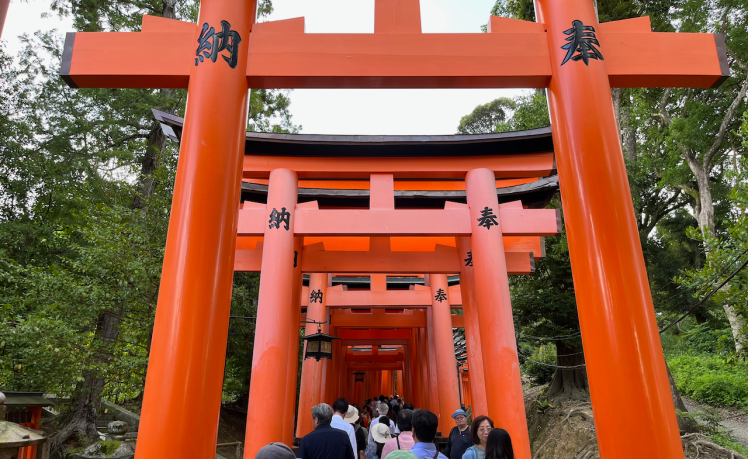
As you go up these stairs, the iconic tunnels begin to the right:

Each of these red torii gates is a donation by someone either praying for something, or an offering torii in gratitude for past blessings. This is a very common practice in Japanese Shinto (and Japanese religion in general): a cycle of supplication, and offerings of gratitude. This cycle is thought to deepen the connection (縁, en) between the particular kami and the supplicant over time.

Anyhow, the torii are pretty neat:

The tunnel branches off into a few side paths, but generally it loops up the mountain and back down again. There are other shrines at certain places up the mountain, and we visited a few, too many to post here (to be honest, I also got a bit lost without a map).

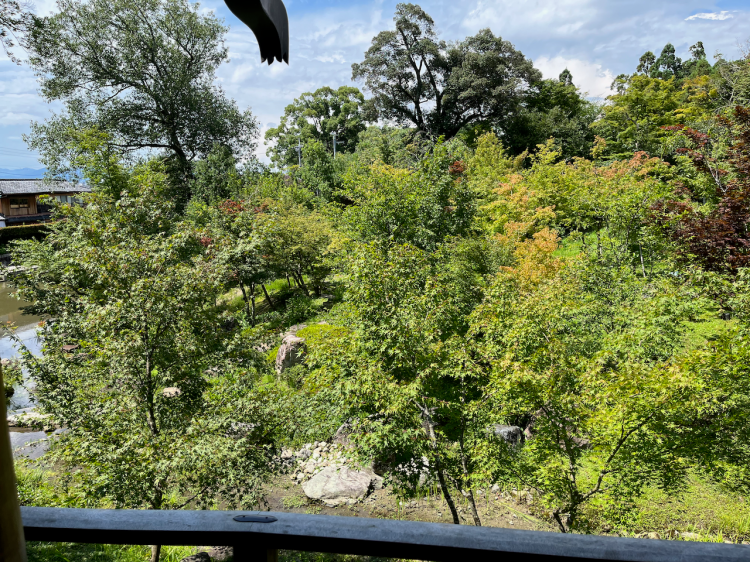
In any case, as you come down the mountain, there is a nice viewing spot here, to the right:

The veranda inside has a nice view, which I am told is especially lovely in Autumn:

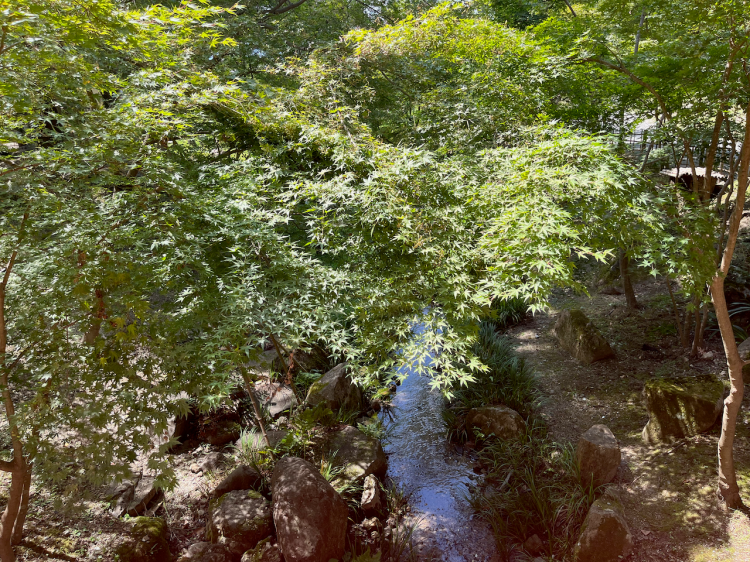
Finally, just before returning to the front gate, there is a nice little bridge with a small stream running under it:

I took a very brief video of the stream as well (apologies for the background noise):

Fushimi Inari Grand Shrine was quite a bit of fun, and a great place to spend half a day. It’s comparatively easy to get to in Kyoto, and there’s more than enough there to keep one busy. Further, my son, who loves foxes,1 really enjoyed himself. He even got a few fox (kitsune) toys. The photo at the top of this blog is his favorite, overlooking the famous Kamo River running through Kyoto.

P.S. the name o-inari-san is also used to describe those little fried tofu pockets with rice in them.

1 In our current Pathfinder 2nd ed campaign, my son is playing a Kitsune character.

Yuki-Onna: A Japanese a Scary Story (sort of)

In the 19th-century book Kwaidan, a collection of strange and scary Japanese stories, one of the most famous stories is called Yuki-Onna (雪女, lit. “Snow Woman”). Unlike other stories that Lafcadio Hearn collected, he claimed that this one was told to him directly by a local who somehow passed on the tale. I’ve posted it here verbatim from Project Gutenberg.1

Unlike other stories in Kwaidan, Yuki-Onna is less of a scary story than it is a weird story, but also if you play D&D/Pathfinder, I think the idea of a beautiful snow spirit wandering the woods and killing people by stealing their warmth, would make an interesting, albeit short, campaign setting too.2

Of the stories in Kwaidan, it is one of the most popular, and frequently shows up in Japanese media. One of my favorite comedy shows did a 3-minute summary of it in Japanese (sorry, no English, but the animation is great), joking how the identity of “O-Yuki” was painfully obvious:

As this is Obon Season in Japan, it’s a great time to enjoy another scary story or two…

In a village of Musashi Province (1), there lived two woodcutters: Mosaku and Minokichi. At the time of which I am speaking, Mosaku was an old man; and Minokichi, his apprentice, was a lad of eighteen years. Every day they went together to a forest situated about five miles from their village. On the way to that forest there is a wide river to cross; and there is a ferry-boat. Several times a bridge was built where the ferry is; but the bridge was each time carried away by a flood. No common bridge can resist the current there when the river rises.

Mosaku and Minokichi were on their way home, one very cold evening, when a great snowstorm overtook them. They reached the ferry; and they found that the boatman had gone away, leaving his boat on the other side of the river. It was no day for swimming; and the woodcutters took shelter in the ferryman’s hut,—thinking themselves lucky to find any shelter at all. There was no brazier in the hut, nor any place in which to make a fire: it was only a two-mat[1] hut, with a single door, but no window. Mosaku and Minokichi fastened the door, and lay down to rest, with their straw rain-coats over them. At first they did not feel very cold; and they thought that the storm would soon be over.

The old man almost immediately fell asleep; but the boy, Minokichi, lay awake a long time, listening to the awful wind, and the continual slashing of the snow against the door. The river was roaring; and the hut swayed and creaked like a junk at sea. It was a terrible storm; and the air was every moment becoming colder; and Minokichi shivered under his rain-coat. But at last, in spite of the cold, he too fell asleep.

He was awakened by a showering of snow in his face. The door of the hut had been forced open; and, by the snow-light (yuki-akari), he saw a woman in the room,—a woman all in white. She was bending above Mosaku, and blowing her breath upon him;—and her breath was like a bright white smoke. Almost in the same moment she turned to Minokichi, and stooped over him. He tried to cry out, but found that he could not utter any sound. The white woman bent down over him, lower and lower, until her face almost touched him; and he saw that she was very beautiful,—though her eyes made him afraid. For a little time she continued to look at him;—then she smiled, and she whispered:—“I intended to treat you like the other man. But I cannot help feeling some pity for you, because you are so young... You are a pretty boy, Minokichi; and I will not hurt you now. But, if you ever tell anybody even your own mother—about what you have seen this night, I shall know it; and then I will kill you... Remember what I say!”

With these words, she turned from him, and passed through the doorway. Then he found himself able to move; and he sprang up, and looked out. But the woman was nowhere to be seen; and the snow was driving furiously into the hut. Minokichi closed the door, and secured it by fixing several billets of wood against it. He wondered if the wind had blown it open;—he thought that he might have been only dreaming, and might have mistaken the gleam of the snow-light in the doorway for the figure of a white woman: but he could not be sure. He called to Mosaku, and was frightened because the old man did not answer. He put out his hand in the dark, and touched Mosaku’s face, and found that it was ice! Mosaku was stark and dead...

By dawn the storm was over; and when the ferryman returned to his station, a little after sunrise, he found Minokichi lying senseless beside the frozen body of Mosaku. Minokichi was promptly cared for, and soon came to himself; but he remained a long time ill from the effects of the cold of that terrible night. He had been greatly frightened also by the old man’s death; but he said nothing about the vision of the woman in white. As soon as he got well again, he returned to his calling,—going alone every morning to the forest, and coming back at nightfall with his bundles of wood, which his mother helped him to sell.

One evening, in the winter of the following year, as he was on his way home, he overtook a girl who happened to be traveling by the same road. She was a tall, slim girl, very good-looking; and she answered Minokichi’s greeting in a voice as pleasant to the ear as the voice of a song-bird. Then he walked beside her; and they began to talk. The girl said that her name was O-Yuki;[2] that she had lately lost both of her parents; and that she was going to Yedo (2), where she happened to have some poor relations, who might help her to find a situation as a servant. Minokichi soon felt charmed by this strange girl; and the more that he looked at her, the handsomer she appeared to be. He asked her whether she was yet betrothed; and she answered, laughingly, that she was free. Then, in her turn, she asked Minokichi whether he was married, or pledged to marry; and he told her that, although he had only a widowed mother to support, the question of an “honorable daughter-in-law” had not yet been considered, as he was very young... After these confidences, they walked on for a long while without speaking; but, as the proverb declares, Ki ga aréba, mé mo kuchi hodo ni mono wo iu: “When the wish is there, the eyes can say as much as the mouth.” By the time they reached the village, they had become very much pleased with each other; and then Minokichi asked O-Yuki to rest awhile at his house. After some shy hesitation, she went there with him; and his mother made her welcome, and prepared a warm meal for her. O-Yuki behaved so nicely that Minokichi’s mother took a sudden fancy to her, and persuaded her to delay her journey to Yedo. And the natural end of the matter was that Yuki never went to Yedo at all. She remained in the house, as an “honorable daughter-in law.”

O-Yuki proved a very good daughter-in-law. When Minokichi’s mother came to die,—some five years later,—her last words were words of affection and praise for the wife of her son. And O-Yuki bore Minokichi ten children, boys and girls, handsome children all of them, and very fair of skin.

The country-folk thought O-Yuki a wonderful person, by nature different from themselves. Most of the peasant-women age early; but O-Yuki, even after having become the mother of ten children, looked as young and fresh as on the day when she had first come to the village.

One night, after the children had gone to sleep, O-Yuki was sewing by the light of a paper lamp; and Minokichi, watching her, said:—

“To see you sewing there, with the light on your face, makes me think of a strange thing that happened when I was a lad of eighteen. I then saw somebody as beautiful and white as you are now—indeed, she was very like you.”...

Without lifting her eyes from her work, O-Yuki responded:—

“Tell me about her... Where did you see her?”

Then Minokichi told her about the terrible night in the ferryman’s hut,—and about the White Woman that had stooped above him, smiling and whispering,—and about the silent death of old Mosaku. And he said:—

“Asleep or awake, that was the only time that I saw a being as beautiful as you. Of course, she was not a human being; and I was afraid of her,—very much afraid,—but she was so white!... Indeed, I have never been sure whether it was a dream that I saw, or the Woman of the Snow.”...

O-Yuki flung down her sewing, and arose, and bowed above Minokichi where he sat, and shrieked into his face:—

“It was I—I—I! Yuki it was! And I told you then that I would kill you if you ever said one word about it!... But for those children asleep there, I would kill you this moment! And now you had better take very, very good care of them; for if ever they have reason to complain of you, I will treat you as you deserve!”...

Even as she screamed, her voice became thin, like a crying of wind;—then she melted into a bright white mist that spired to the roof-beams, and shuddered away through the smoke-hole.... Never again was she seen.

Enjoy!

1 Note: This eBook is for the use of anyone anywhere at no cost and with almost no restrictions whatsoever. You may copy it, give it away or re-use it under the terms of the Project Gutenberg License included with this eBook or online at http://www.gutenberg.net

2 At least, it would make a good one-shot adventure?

Building a Sohei Warrior in Pathfinder 2e

Greetings role-players! A while back, I wrote a piece about making a sohei warrior, a Japanese soldier-monk, in Dungeons and Dragons 5th edition. Since I have transition away from D&D, I have been tinkering with a similar build concept in Pathfinder 2e, and wanted to share. This is just a suggestion, but it’s based on historical precedence as much as possible, while still retaining elements of high fantasy and heroism (important since sohei were often zealots and scallywags). Your mileage may vary, but I’ve enjoyed my character so far.

A statue of Benkei, the archetypal sohei warrior, in Tanabe city in Wakayama, Prefecture. shikabane taro, CC BY 3.0, via Wikimedia Commons

To recap my D&D post, sohei warriors were very similar to samurai despite name “monk” (which is an overloaded term anyway), but they were bodyguards and field-armies for powerful medieval Buddhist temples. In time, they attained a legendary status especially around a semi-legendary figure named Benkei. So many of modern tropes in Japan about sohei warriors are inspired by Benkei.

As soldiers, they frequently are depicted using naginata weapons (similar to a glaive) and katana, as well as wearing typical armor for the time underneath their white cowls. As devotees to a temple, they were not clerics and generally not ordained as priests, but did protect priests and temples, and further political/ecclesiastical issues as needed.

In a fantasy role-playing context, this feels like something akin to a Champion in Pathfinder 2nd-edition. For my character, I chose the Cause of the Paladin (lawful-good)1 since he would not only get Retributive Strike feat (very handy with a naginata), but also from a character-standpoint it made sense to be a protector figure, and also since Buddhism in real-life is a lawfully-inclined religion anyway. I play my character, Shinji, as a straight-laced, through trigger-happy and somewhat clueless character. He is blinded by his devotion at times, but means well.

Shinji as shown on the Nexus site. I couldn’t find the export link, and since the service is still in Beta, many things might change.

For the Retributive Strike feat, if you combine that with 2nd-level feat Ranged Reprisal, the 10-foot range of the naginata now becomes 15 feet.

As for equipment, shields in the Western sense were never really used in Japanese combat, so I didn’t equip Shinji with one, even if he has the option. Instead, I focused on offense by equipping with both a naginata and a katana. If you don’t have the necessary source books, the stats are freely available on Archives of Nethys links above. By second level, I equipped Shinji with scale mail armor.

In the current story, my kids and are playing a small 3-person party exploring the city of Absalom, and Shinji had been dispatched here from Minkai to protect a local priest at the branch temple in Absalom. However, upon arriving, the priest is nowhere to be seen, and the temple is barred shut. So, part of his side story is to unravel what happened, while finding something else useful to do in the meantime (i.e. helping my kids’ characters).

All the guidance above are build suggestions, but if you read the history of the sohei, it is probably (in my opinion), the closest fit I can come up with while still keep it fun for a high-fantasy setting. Your mileage may vary, but I hope you have fun and good luck building a sohei warrior of your own!

1 I know that in the latest Pathfinder updates the alignment system is being deprecated, but for simplicity’s sake, I am mentioning it here.

Learning Pathfinder 2e as a D&D Player

In the past couple of months, starting with the Beginner Box, I have been learning how to play Pathfinder, second edition, which came out in 2019. It is a successor to the original Pathfinder edition, which in turn was based on Dungeons and Dragons 3.5 through the Open Gaming License (the same one under attack recently by Wizards of the Coast).

Speaking from personal experience, Pathfinder has suffered from a bit of an image problem…

But I picked up the Core Rulebook lately, which has been a fun read. The artwork is top-notch, and the guide does a pretty careful job walking you through the rules. However, the sheer size of the rulebook makes it hard to mentally absorb all at once, so I found this excellent series of videos by Jason Buhlman, lead game designer, that walk through all the essential aspects of playing Pathfinder.

First lesson, character creation
Second lesson: understanding magic
Lesson three: designing encounters
Lesson four: combat

I enjoyed this series, and it really helped the rules Pathfinder 2e “gel” in my mind. It also made it easier to go back and make sense of the text in Core Rulebook without having to reread multiple times.

So, I went ahead and made a first-time character to get used to the new ruleset: Tharivol a Wood Elf Druid. Pathfinder does not yet have an equivalent online character sheet storage system like D&D Beyond, but it has been fun to make on paper.

Transitioning from D&D

But, what’s it like going from Dungeons and Dragons 5th edition, which I have played since 2017, to Pathfinder 2nd edition?

Mechanically speaking, many of the rules, especially combat rules, make a lot more sense in Pathfinder than they did in 5e. The feel is more or less the same, but when you get into the grey areas, the Pathfinder approach often makes more sense, and there’s usually a contingency for everything a player wants to do. Some rules look more familiar to old time players like me (for example the spell “slots”) who played older editions, others look like fresh design improvements over older games. It’s an interesting mix of complexity with novelty.

Weapons also make more sense. For example, I complained previously about the lack of Asian-style mundane items, weapons and magic items in 5th edition and I was surprised to find, for example katana weapon stats in Pathfinder right in the Core Rulebook. This means, my old elf-samurai character, if adapted for Pathfinder, would probably look a bit more realistic (as much as fantasy elves in a Japanese-style setting would 😅…) than before.

Speaking of character creation the Pathfinder system relies less on character “tracks” to follow as one levels up, and more on a kind of buffet where one picks feats over time. Sometimes, the feat choices and skill increases are limited in scope, but you still usually have room to choose. This makes it hard to create the same character twice, and means each one will have a bit more individuality.

In the Advanced Player’s Guide and Lost Omens: Ancestry Guide there are quiet a few more character races and classes to choose from beyond the Core Rulebook. I was surprised to see a more diverse set of options. My son who is half-Japanese, was excited to be able to play a Japanese-style kitsune (fey fox) character, for example.

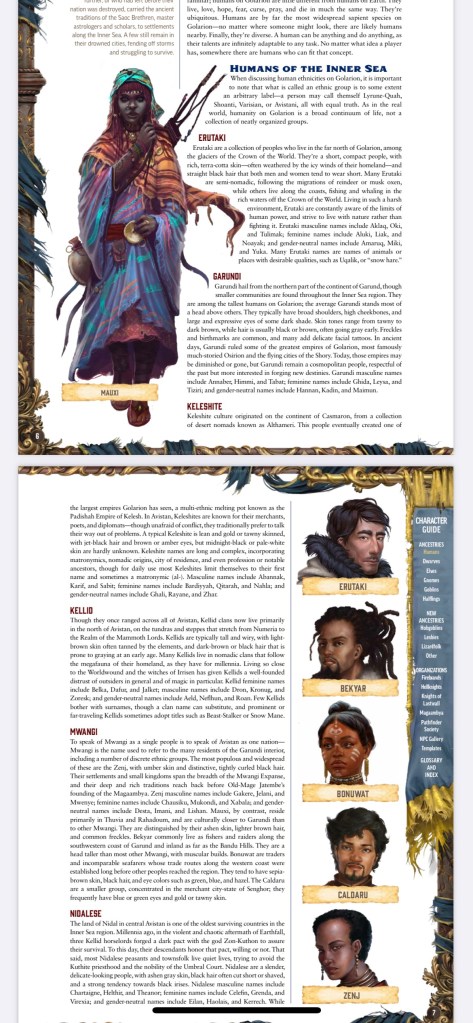
Even the human characters, unlike 5th edition Dungeons and Dragons, get a lot of attention and care and are a lot more compelling to play. The artwork alone depicting humans in Pathfinder is amazingly diverse and fascinating. Take a look at a couple pages from the Lost Omens: Character Guide

Holy cow, the amazing detail and artwork really brings the various cultures of Pathfinder to life, and makes it much easier to find cultures you can identify with. Paizo really needs to pat itself on the back for this effort. Speaking of artwork, the Lost Omens Travel Guide is simply amazing. The Guide is written as a travel guide for players who might venture in the default setting of Absalom and surrounding areas, but provides amazing detail about everything from fashion, to card games, and even recipes that you can try out in real life.

Speaking of which, the fact that Pathfinder is not limited to hardcover books (which are fairly expensive) and openly available online through PDFs, or just through official reference sites makes a lot of this easy to fit your budget level. You can start as you are and learn pretty quickly and cheaply, but if you’re like me and like physical books, you can easily order those either through your local game store or directly through paizo.com.

For all these wonderful aspects of Pathfinder, there is one area I have personally been frustrated and that’s the world building and lore.

A lot of the familiar old settings that I knew from Dungeons and Dragons, such as Eberron and Barovia, both of which predate 5th edition, simply don’t exist in Pathfinder. There are probably good reasons for this due to licensing issues, intellectual property, and so on, but the loss is definitely felt. Fan created conversions for such settings do exist, but they ran the gamut in terms of support and quality. It would have been nice if Pathfinder had found a way to provide more official versions that were maybe similar to the D&D settings, but obviously not carbon copies. Such things may exist, but it’s a bit hard to sift through all the different adventure packs and settings that are printed already.

Some of my Ravenloft novels, along with Sazh from Final Fantasy XIII.

It isn’t all that hard for an enterprising DM to also just convert 5th edition settings into Pathfinder ones, but I do miss being able to just have the reference books handy, for lore if nothing else. Pathfinder focuses on the Lost Omens setting as its introductory setting, and if you played 5th edition, this will feel in some ways like the classic Forgotten Realms Sword Coast. Beyond that though, things get a bit muddier in terms of lore that’s familiar to old D&D players.

Conclusion

In short, compared to Dungeons and Dragons, I have found that Pathfinder has more to learn up front due to slightly more complicated rulesets, and the vast array of books that Paizo has printed for 2nd edition already in the last 3-4 years. But Paizo recognizes this and provides a number of choices and options to help ease the transition. It took me about 2-3 weeks reading Core Rulebook and watching the videos in my spare time, but once I got past that initial hurdle, the rest of Pathfinder 2nd edition just made sense.

I’ve played a bit with my kids, but I would like to find other groups to play in the near future, but as with any TTRPG, finding players is…. challenging.

In any case, Pathfinder is dynamic, exciting and has a lot of offer. They are hungry for customers and are making great efforts to help educate people, and stay responsive to their needs. Where 5th edition has lost its luster for me, Pathfinder is a lot more exciting and compelling.

Of course I still enjoy 5th edition, and it has a lot of memories for me and the kids, but it also feels increasingly like it’s run it’s course, the corporate greed has homogenized the game to the point of being moribund.

A Nerd Dad’s Review of Pathfinder 2e Beginner Box

The recent fiasco by Wizards of the Coast (who owns Dungeons and Dragons) has left me pretty bitter toward 5th edition1 and the company that owns it. If Mordenkainen’s Tome of Foes wasn’t frustrating enough (“buy your $50 book again!”), this was the final straw.

I decided it was time to try Pathfinder again.

Again, you say? Allow me to explain.

Aeons ago, circa 2016, my coworkers and I played an after-work campaign of Pathfinder, 1st edition. The campaign lasted about 2-3 months but it was a miserable, stressful experience for me. The DM pushed us to optimize (e.g. “min-max”) our characters for awesome battles, using lots of custom 3rd party content, feats and builds that made really confused even as I was still to wrap my head around the basic rules. The DM knew the rules and feats like the back of his hand, but frankly wasn’t very empathetic to new players, and just wanted to host cool battles. Looking back, I believe the issue was more with the DM than with the game.2

I gave up, but I always felt someday that I should give it another try … someday.

Enter Pathfinder, 2nd edition (Pf2e): a major update to Pathfinder that came out in 2019. It streamlined and updated a lot of challenges with 1st edition, and includes a lot of good introductory material to help new players ease into this. A prime example is the Beginner Box which I ordered direct from Paizo.com after my local game store already sold out (believe me, I am not the only one locally who is mad at WotC).

My goal was to learn Pathfinder 2e properly, and at my own pace, so I could avoid the unnecessary stress of learning a new system, and actually keep things fun.

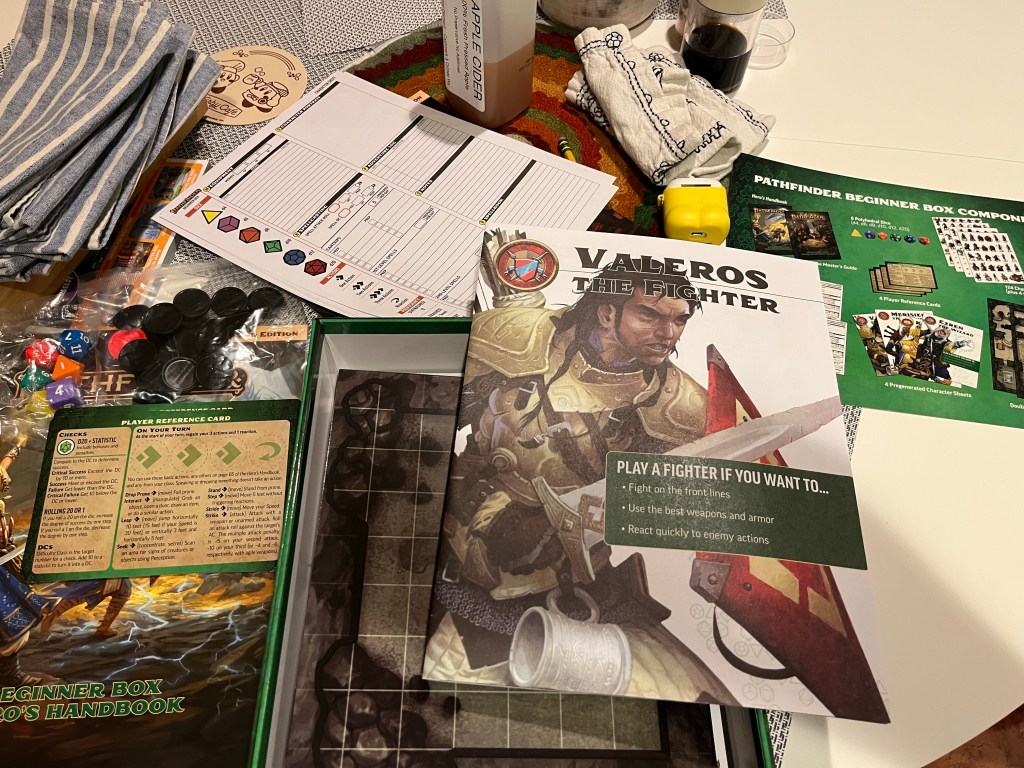
A week later, my box came in the mail:3 🎉

Yay, new package in the mail! Sadly, the little Starfinder figurine that was included was already smashed upon delivery.

The Beginner Box contains everything you could possibly need for both a DM and a group of players to start from scratch:

  • a self-contained adventure (more on that later): Troubles in Otari.
  • a full set of dice, color-coded to match the symbols on the character sheets
  • pre-made character sheets with very easy to read stats, plus blank sheets if you still want to make your own. These look really nice by the way.
  • Two step by step guide adventure guide for Troubles in Otari, one for the DM and one for the players. These two books also function as a very slimmed down core Rulebook for Pathfinder 2e, including character building options, combat rules, etc.
  • fold-out adventure map for Troubles in Otari.
  • monster stand-up cardboard “tokens” for map, both a variety of player characters and all the monsters necessary for the adventure.
  • laminated “action cards” to help players decide what they can do during their turn
(please pardon the messy table…)

My kids, both experienced 5e players, were a bit hesitant to try Pathfinder since the only game system they knew and grew up with was D&D 5th edition, and as a busy parent I didn’t have much time to prepare Troubles in Otari either. So, both the kids and I essentially went into this first adventure blind.

I let my kids each pick from the pre-made character sheets for now, and I ran any character not chosen (Valeros the Fighter in my case) to ensure the party was rounded out. I read over the adventure guide for a couple minutes to get my bearings and off we went.

As a stand-alone adventure Troubles in Otari is a good, classic dungeon crawl. What makes it genius though is how each encounter teaches you another aspect of gameplay, each one slightly more advanced than the previous. So it is also a tutorial to the game.

The adventure guide for Troubles in Otari walks you through each step of the way: what happens if players do X, what happens if they hit a skeleton with Y, etc. Experienced DMs can gloss over if they want, but it helped me a ton in making the mental transition from 5th edition to Pf2e and keep things running along. I hand-waved a few spots for pacing, but what DM hasn’t?

Also, the DM and Players Guide both can standalone as introductions to Pathfinder 2e without having to invest in the Core Rulebook. Since it is a minimal introduction, a lot of character build options and combat details are missing, but this does ease new players up into the game, without having to read all the rules upfront.

My kids loved the “3-action” combat system, the change to perception rules, and the pre-made character sheets. Pathfinder 2e, as a whole, was familiar enough for kids who’ve played 5e to quickly adapt, but also fresh enough to keep their attention. The cardboard tokens were also popular as they made the combat fun, without investing a ton in figurines that I may or may not have.

We completed most of the 1st floor of Otari in about 2.5 hours before we got tired and took a break (my teenager also had homework to do). We will try to finish next weekend, and the kids are already looking forward to generating their own characters using the Core Rulebook (which I purchased at the same time, and will review separately).

As an introduction to Pathfinder, this was a pleasant experience and a useful teaching mechanism to myself and my kids. It was a far cry from the stress-inducing experience I had ages ago, and a fresh start to Pathfinder, as well as a great alternative to 5th edition Dungeons and Dragons.

Even if you are a pretty experienced TTRPG player, it really helps to have a nice hand-holding tool like the Beginner’s Box, to help with the mental transition in rules. Also, the materials included are re-usable in other contexts as well, so it’s not a one-and-done investment either.

P.S. Basic Liches did a really nice review of the Beginner Box here too, and it pretty much lines up with my experiences as well:

1 My kids had to talk me down from selling most of my D&D 5e books to the local used bookstore. It was a sunk cost, and doesn’t do much good to sell now, as we might still play in the future. Instead, we agreed that we’d buy no more D&D products for the foreseeable future. In any case, One D&D doesn’t interest me anyway, so I see little point in that either. My D&D Beyond subscription has already been cancelled too.

2 The same DM also took us through a D&D 5th edition play-through of the Mines of Phandelver, which started out well enough but eventually spiralled out of control too. So, there might have been a pattern.

3 Given that I live about 45 minutes by car from the Paizo headquarters, it’s quite amusing to watch my package go through an elaborate, Byzantine series of handoffs with one carrier to another before it finally arrived. In theory, I could have driven down to pick it up myself, and saved a week of waiting. I don’t blame Paizo for this, but I do blame the amazingly inefficient shipping process. Also, to be fair, I did pick the cheapest shipping option, and well, you get what you pay for…

Adventurers League: Starting Over

Recently, the admins of Adventurers League made a major rules announcement:

You can also read here for a detailed explanation as to why.

This a pretty exciting change after Season 10 introduced some pretty controversial changes (which have effectively been reversed) in 2020, which led to a lot of grumbling among D&D players on Discord. I remember some people talking about taking their business over to Pathfinder official play instead.1

The AL admin community evidentially did some serious thinking and finally, finally gave us an updated, compact, easy to understand set of player rules. I for one am genuinely excited to play again.

However, I also have a problem. When the transition from Season 9 to Season 10 began, a number of rules were introduced for character conversions, and such, and now with another move to a standard set of rules for the Forgotten Realms, some of my old characters are converting twice. Technically, no conversion is strictly required, but with the end of Season 9 players were encouraged to rebuild for either “historic” or “seasonal” and I did that for at least some of my old characters. Other old characters just got forgotten.

Breathing life back into some of my old AL characters, thanks to the new rules.
Binder above purchased at the Rook and the Raven

With the new rules, a lot of options opened up and rebuilding again is an option:

Whenever you could gain a level (even if you decline), you may rebuild any aspect of your character.

Adventure’s League Player’s Guide for the Forgotten Realms

With this in mind, I’ve been looking at all my AL characters up to this point, old and new. Some were too old and haven’t been played in so long that I decided retire2 them. I decided to keep my oldest character, Qisandoral, after dragging him out of retirement in season 10 during a brief window when they allowed a one-time rebuild. Using the rule above, I tweaked him a bit more but adjusting his feats a bit (he uses ice magic a lot, so I gave him Elemental Adept). In one case, I decided to rebuild my favorite Nature cleric from scratch, new name, level one, etc.

For newer characters, I have also taken advantage of the rules above, plus new options for character backgrounds and such to rebuild them as well. My elf-samurai Heian Amakiiro got the Far Traveller background now, which fits his character better. In the end, I wanted to have at least 1-3 characters per tier (I have no tier-4 characters as of writing), and it has been nice to finally “clean house”.

I, like many other players, are excited by the new ruleset, which will hopefully stay somewhat stable going forward. I have seen the rules change a number of times since I started in Season 8, and keeping up with the changing rules has been exhausting. However, my sense is the the AL admins want to come up with a simpler, more flexible set of rules that can run on auto-pilot going forward. And I for one fully support that. 😄

1 Needless to say, I did Pathfinder once and don’t plan on doing it again. To some degree, I blame that particular DM, who just wanted cool combat campaigns without any real plot. But I also got tired of the complicated character creation, tracking feats, and pressure to min/max.

2 “Retirement” here isn’t as dramatic as it sounds. I just exported and backed up their character sheets from DnD Beyond, and saved their logs into a different folder. If I really wanted to, I could still bring them back. Unlikely, though. I would more likely build a fresh, new version of that character instead.

A Nerd Dad’s Review of Eberron: Rising from the Ashes

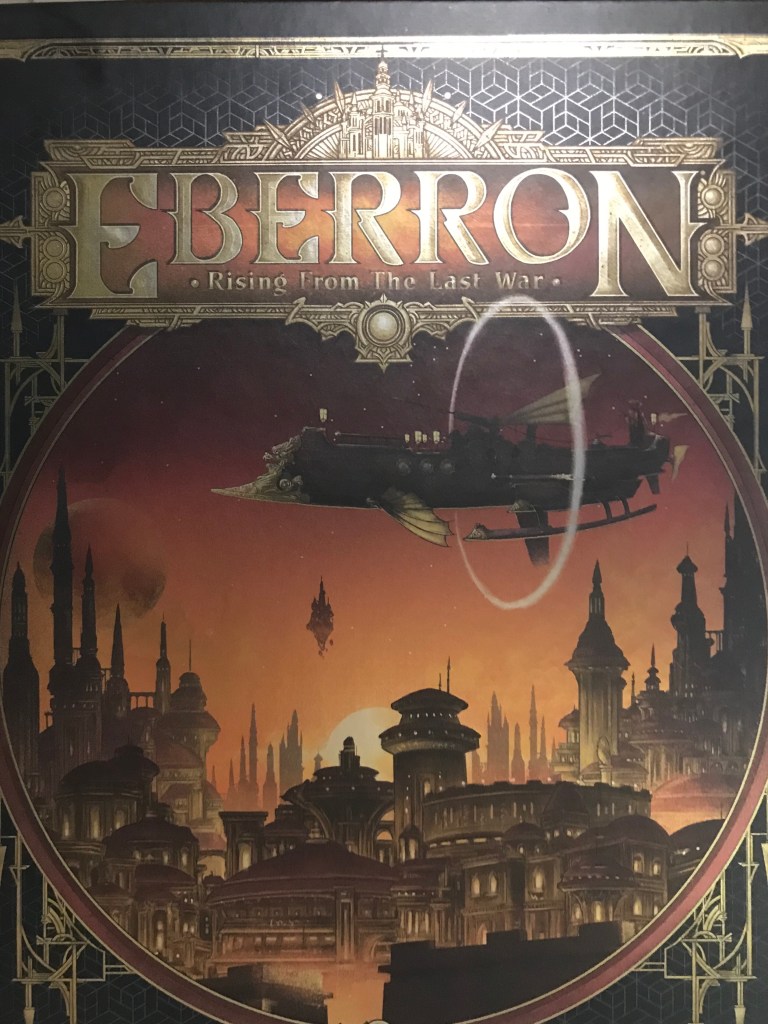
The alternate-art book we purchased last Thanksgiving weekend

Late last year during a fun extended Thanksgiving weekend, my kids and I picked up another D&D sourcebook: Eberron: Rising from the Last War. The setting of Eberron came out during Dungeons and Dragons 3.5, so I missed it completely until now,1 and wanted to try it out with the kids. Taking advantage of lockdown, I finally had some time to look into this book and start planning out a campaign for my kids.

Eberron, as a setting, seems to attract a pretty devoted audience due to its unusual magic-steampunk atmosphere which differs from the more typical high-fantasy of the Forgotten Realms or Greyhawk settings. If you like trains powered by lightning, flying ships powered by fire elementals, and plenty of noir atmosphere, there’s a lot to work with.

The sourcebook is dense even by the standards of D&D sourcebooks, and if you have never played Eberron before, the amount Eberron-specific lore in the book is pretty daunting. I feel pretty familiar with the Forgotten Realms setting, its lore and such, and almost none of it translates into Eberron. It is its own world, its own history, people and even terminology. I still have only a vague idea what Quori are, and who the Daelkyr were, but they feature prominently. Then there is a whole new pantheon of gods (which for some reason have no alignment defined in the sourcebook), new religions, etc.

The history of Eberron alone is amazingly detailed, as it covers various empires that have risen and fallen. Demonic kingdoms existed in antiquity, as did dragons, and later goblinoid empires. Then there’s the Last War which is what the current setting is pinned on: a great continental war that resulted in the total destruction of one of its kingdoms (Cyre) leaving behind a kind of magic post-apocalyptic nightmare. All of this makes for pretty fascinating backstory, and the richness of Eberron probably helps explain its enduring popularity.

However, for all this impressive backstory, culture and extra features (for example “dragonmarks”) a couple problems confront a new DM totally unfamiliar with Eberron:

  1. The learning curve for such material is kind of steep, and unless you’ve played in a campaign before, it might be hard to retain it all.
  2. Due to density, it’s hard to know what’s essential information, and what’s not. How much can you afford to cut out for a smaller campaign taking play in, say, Sharn, vs. the Shadow Reaches?

Another challenge presenting DMs who are making campaigns for kids is adapting the grim noir setting into something more lightweight and fun. My youngest is much too young to appreciate dark backstories, or the horrors of war, he just likes to fight cool monster battles. When I started out making a campaign for my kids, I sat there with an open notebook, read through a few chapters and hours later still had a blank notebook. I had no idea how to come up with quick intro-level adventure.2

Thankfully, Keith Baker, the genius behind Eberron wrote an article recently for D&D Beyond that helped address this very question. He suggested 4 possible types of adventures to start with, among others:

  • An urban adventure in Sharn, particular in the “underbelly” (literally and figuratively) of the city.
  • A wilderness adventure on assignment with the Clifftop Adventurer’s Guild.
  • A gritty, frontier adventure at the mining colony of Hope.
  • Go back a bit in time to the last days of the War and various adventure opportunities that presents.

The article helped me finally come up with a good starting adventure hook, and some much-needed context around the vast lore of Eberron: Rising from the Last War. My kids and I played a small two-episode campaign in the Shadow Reaches as a “contract” with Clifftop Adventurer’s Guild to clear some monsters, plus I added some sidekicks: a Warforged fighter (who, little do they know, has some Manchurian Candidate-style programming in his mind), and a Hobgoblin cleric of Aureon who longs to fit into high-society. Once things settled in, the campaign felt like any old fun adventure around the dinner table. It was D&D through and through, just with a different campaign. We’ve since started to branch off into a second adventure taking place in Sharn doing some relic scavenging.

As my family’s first experience with Eberron, once we got over the hurdle of absorbing a whole new world’s worth of lore, the rules and gameplay are just as fun as any other D&D game.

In closing, I think one of the biggest challenges of Eberron: Rising from the Last War is its format: dense, and not organized around getting started. My impression was that the target audience is the existing Eberron fanbase, and the interest in adapting Eberron in a more official 5th-edition capacity than before. Thus, as an official sourcebook for all things Eberron, this book passes with flying colors. As an onboarding guide for new players this book is a bit intimidating, but if you can work your way through it, it’s quite fun.

Good luck and happy adventuring!

P.S. I realize most D&D players are probably focused on the latest adventure book, Rime of the Frostmaiden, but I as a busy nerd dad, I move kind of slow. 😉

1 For those keeping score, my first experience with D&D was 2nd edition AD&D, which I played a bunch in high-school with friends. None of us knew what we were doing, but we had a lot of fun, I devoured books about Drizzt Do’Urden, and played some Dark Sun as well. By the time 3rd edition came out, though, I was in college and had forgotten all about D&D for a long time until _4th edition_ came out. I played one game of that and said no thanks. It wasn’t until 5th edition that I seriously played again. So, I missed everything related to D&D 3rd and 3.5 edition. I played Pathfinder for a bit as well, and I would be up for playing it again (especially Pathfinder 2), but I have just barely enough time for 5e as it is.

2 As other reviews have pointed out, there is an introduction adventure included in the book, but due to its density, I wasn’t able to find it. Descriptions of Sharn the City of Tower were nice and detailed, but how to turn this into a fun intro story weren’t readily apparent.