Gender in Ukrainian Language

As my studies of Ukrainian continues, one pattern that definitely appears over and over is the clear presence of grammatical gender. I’ve touched on this a bit in a recent post on how it relates to classical languages, but wanted to provide more context here.

Screenshot from my Duolingo session

The concept of grammatical gender is something that’s endemic to Indo-European languages (as far as I know),1 and is not related to the actual gender of a word. In Latin, the word miles means solider and is masculine (makes sense), but the Roman legion, legiō, had a feminine grammatical gender.

Modern western European languages such as Spanish and French tend to have shed and streamlined some aspects of grammatical gender. Neuter words no longer exist, so there’s only masculine and feminine genders left. Languages like English barely have any grammatical gender at all, even though it still exists in German to some degree.

Ukrainian language keeps the three classic genders: masculine, feminine and neuter, and like Spanish, French and Latin, nouns and adjectives have to agree with case (nominative, genitive, etc), number (singular and plural) and gender.

Here are three words:

Ukrainian (Romanization)MeaningGender
Кіт (kit)A male cat
(more on this later)
Masculine
машина (mashyna)A carFeminine
місто (misto)A cityNeuter

As far as I can tell, there is no definitely article like “the” or “a” in Ukrainian, but let’s use the word for “my/mine” in front of these and you can see how grammatical gender:

Ukrainian (Romanization)Meaning
Мий кіт (miy kit)My cat
Моя машина (moya mashyna)My car
Моє місто (moye misto)My city

You can see how in all three cases the same word, “my”, changes according to grammar, and it’s not a small change. In the screenshot above from my Duolingo session, you can see that the adjective “older” changes the same way depending on whether it’s a sister (feminine) or brother (masculine).

Another example of gender in Ukrainian where all the words in the sentence end in “а” because the word for daughter, донька (donka), is feminine.

Further, I was surprised that there are many words for living beings that are also divided by gender. For example кіт above means “cat”, but implies a male cat. The word for a female cat is кішка (kishka). For “friend” there are separate words for a male friend (друг, “druh”) and a female friend (подруга, “podruha”). Note that these are platonic friends, not boyfriend and girlfriend. There are separate words for those.

Also, from what I can tell, the plural friend has only one gender: друзі (druzi) means “friends” for example, though I am pretty fuzzy so far.

So far, I think I have only learned the nominative case (e.g. nouns as the subjects of sentences), so I suspect that these forms will also change depending on what part of the sentence a word is. This makes conjugation pretty tricky (just like Latin and Greek), but also means that you can upfront glean many details quickly once you get familiar with it.

Another example is in describing people. Ukrainian frequently identifies gender in a person through endings such as ець (ets) for masculine and ка (ka) for feminine. Thus, українець means a Ukrainian person, masculine, while українка means a Ukrainian person, feminine. Even words like “vegetarian person” have different endings: вегетаріанець (vegetarian, masculine) versus вегетаріанка (feminine).

P.S. I had my first actual conversation in Ukrainian recently, and I did a pretty lousy job. My mind blanked on words, and I mispronounced things. It’s been a long while since I learned a new language, and it’s easy to forget how little you actually know at first. But it also is a reminder to focus on fundamentals and nail those down before getting too hung up on the finer details. Easier said than done, but it’s been an interesting journey so far.

1 I have practically never seen any examples of it in languages like Japanese, Korean or Chinese or Vietnamese. Of course, there are gender-specific words, but inflections based on grammatical gender definitely do not exist. Bear in mind that the above Asian languages are in separate language families (despite being geographically next to one another).
How Not To Teach Japanese Language

In addition to using Duolingo for learning Ukrainian, I went back and dabbled in using it for learning Japanese. My Japanese is somewhere in an intermediate area where I can have conversations and read books, but I don’t do either one particularly well. So, any effort to shore up those skills is help, and Duolingo is frankly a pretty fun app to use. It doesn’t really help with my efforts toward the JLPT, but there’s no reason why I can’t do both (time permitting).

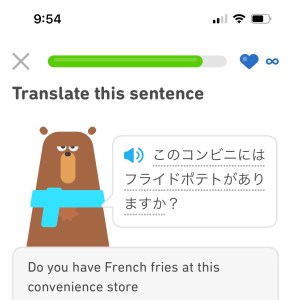
However, at times using Duolingo for Japanese has been a little frustrating, such as this question:

which I got wrong for (in my opinion) nitpicky reasons:

The problem is, in my opinion, not with Duolingo. It’s a terrific service and app, and I would recommend it to anyone. The trouble is how Japanese is taught, and by extension non-European languages are taught.

The way that Duolingo teaches Japanese strongly resembles the same college courses I took way back in college in the late 1990’s, when we memorized similarly staid phrases, and textbook-style sentences that aren’t really used. It’s grammatically correct to say このコンビニにはフライドポテトがありますか, but it’s not how it’s naturally used.

Japanese has a tendency to be very contextual compared to English. This drove me nuts for a long time until my listening skills caught up just enough to know what the gist of the conversation was, and I didn’t hvae to explicitly know who did what and where.

For example, using the sentence above, if the context is known, it’s perfectly fine to say ありますか which would mean “[this convenience store] are there [french fries] [here]?”.

But suppose the person at the counter didn’t know which item you were asking about. Is what thing here? In such a case, use the particle が (ga) to specify who, what, which or where. Is what thing here? French fries, are they here (e.g. do you carry french fries)? Hence フライドポテトありますか If you’re talking to an employee at the convenience store, this would be sufficient because you’re obviously standing in the convenience store, and obviously not talking about some other store.

Suppose the listener doesn’t know which store you’re talking about. Then, you’d have to clarify what store you’re talking about, hence use the particles に (the target particle) and は (the subject of your sentence) together コンビニにはフライドポテトありますか。Depending on context this can mean either “do convenience stores carry french fries” in general or “does the (mutually understood) convenience store carry french fries?”

Maybe you’re standing outside with a buddy and you’re wondering if this Lawson convenience store has fries, vs. that 7-11 across the street. Then after all we’ve discussed so far, you’d have to specify THIS store, to the exclusion of others, is the one you’re inquiring about. Hence このコンビニにはフライドポテトありますか

You can see why a textbook sentence like this can feel really wordy to Japanese speakers. It makes sense in English, and probably other European languages as well,1 but feels pretty unnatural in Japanese.

Similarly, a normal conversation that I literally just had with my wife as I was typing this is:

Mrs: 今日は寒いね。
(today, compared to other days, is cold, isn’t it?)

Me: でも、暑くなると思う。
(but, [I] think it will get hot)

My wife did specify a topic (today’s weather), but if you notice I never said “I” anywhere in reply. Simply by context, using the word 思う (omou, “to think”), it’s obvious that i am stating my opinion.

It’s not limited to casual conversation either between spouses. A similar sentence in a more formal setting, such as with one’s boss might sound something like:

Boss: 今日は寒いね。
(today, compared to other days, is cold, isn’t it?)

Underling: でも、暑くなると思いますね。
(but, [I] think it will get hot)

The boss, being of higher social rank, is free to use more casual speech to his/her underlings, but the underling would reply back using more polite speech (思います, not 思う), and yet still would not need to specify “I” such as 私は or whatever.

This is the sort of thing that I really, really wish I had learned in Japanese classes ages ago, but hard to learn the hard way. Again, this isn’t informal, casual Japanese necessarily, it’s common-place skills you have to learn to speak Japanese and unlearn habits that happen with European languages: not specifying things you don’t know need (i.e. context matters), and being sensitive to social rank and politeness.

P.S. I’ve dabbled in Korean ages ago during the “KPop wave” a few years back, and I believe what I said above also applies to Korean as well.

1 I don’t know enough Ukrainian yet to know how accurately the “textbook” Ukrainian matches real life conversation, but thanks to Duolingo, I know more about “Auntie Toma” and her family than I ever wanted to know. 😅