Що таке буддизм чистої землі

(Dear readers, I wanted to try and summarize the Pure Land Buddhist teachings in Ukrainian. There isn’t much information, so I wrote this post for Ukrainian audiences. It summarizes teachings from other posts. Thank you for your patience)

Привіт, я радий мати українських читачів, які цікавляться буддизмом. Тому я хотів написати цей блог саме для українців. Зверніть увагу, я трохи вивчив українську, але точно недостатньо, щоб писати блог. Тому мені доводиться часто користуватися Google Translate. Вибачте за будь-які помилки. Насолоджуйтесь цим постом і слава Україні

Буддизм Чистої Землі є вірною традицією в буддизмі. Багато людей в Азії та світі дотримуються буддизму Чистої Землі. Це просто, легко зрозуміти та легко застосувати на практиці. Для цього не потрібен ні гуру, ні храм. Ви можете почати як зараз.

За словами Будди Шак’ямуні, життя подібне до річки. На цьому березі розбрат, розчарування, невігластво, страх і так далі. На іншому березі — мир, доброзичливість і задоволення. Таким чином, буддизм вчить, як перепливти цю річку на інший берег.

Photo by Oleg Magni on Pexels.com

Крім того, Будда Шак’ямуні навчив багатьох методів і «інструментів», щоб перетнути річку. Різні люди вважають за краще використовувати різні інструменти, але всі вони будують плоти, щоб переплисти річку. Буддизм чистої землі є одним із інструментів.

Буддизм Чистої Землі вшановує Будду Аміду (あみだ, 阿弥陀), Будду нескінченного світла.

Примітка: Про буддизм Чистої Землі я дізнався через японську секту «Джодо Шу» (じょうどしゅう, 浄土宗). Отже, я використовую японсько-буддійські терміни. Інші буддистські країни використовують інші терміни, але основне вчення те саме.

Аміда Будда — легендарний, або космічний, Будда, який обіцяє допомогти всім істотам дістатися іншого берега. Аміда Будда кличе людей зі своєї Чистої Землі, яка є притулком. Цей притулок доступний для всіх людей, ким би вони не були, якщо вони просто продекламують Нембуцу (ねんぶつ, 念佛).

Що таке нембуцу?

Нембуцу означає такі речі, як «думати про Будду» або «прославляти Будду» тощо. Зазвичай люди декламують нембуцу усно.

Японською мовою це вимовляється як наму аміда буцу (なむあみだぶつ, 南無阿弥陀仏).

У буддизмі існує священний текст під назвою Сутра безмежного життя, також відомий як Велика сутра Сухаватівюха. Ця сутра представляє Аміду Будду та його походження.

Давним-давно Аміда Будда був королем, який зустрів іншого Будду. Вчення Будди справило на нього таке враження, що він зрікся престолу і став буддійським ченцем. Він поклявся допомагати всім живим істотам, створивши безпечну гавань під назвою Сукхаваті («Остання радість»), а також став Буддою.

Це «Мандала Тайма», японсько-буддійський твір мистецтва VIII століття. Він показує Чисту землю Аміди Будди.

Цих обітниць насправді було 48 обітниць. 18-й обітниця є найважливішою. Це простий переклад:

Коли я стану Буддою, розумні істоти в усіх напрямках, які хочуть народитися в моїй Чистій Землі, повинні просто сказати моє ім’я принаймні 10 разів, і вони там народяться. Якщо це неправда, нехай я не стану Буддою.

Таким чином, якщо світ надто складний або людина не може слідувати традиційним буддійським шляхом, можна вибрати переродження в Чистій землі, промовляючи Нембуцу (наму аміда буцу). Це особистий вибір.

Засновник секти «Джодо Шу» Хонен (法然, 1133 – 1212) описав співчуття Аміди Будди як місячне світло. Він сяє скрізь, але лише деякі дивляться вгору:

ЯпонськоюКоваленко Переклад
月かげのцукі kaґе ноНемає такого села,
いたらぬ里はітарану сато ваде б не світило
なけれどもнакередомомісячне світло,
眺むる人のнаґамуру хіто ноале воно живе в серцях тих,
心にぞすむкокоро ні дзосумухто його бачить.

Так само в Сутрі безмежного життя є така цитата:

Якщо розумні істоти стикаються зі світлом Аміди Будди, їх три скверни усуваються; вони відчувають ніжність, радість і насолоду; і виникають добрі думки.

Але чим буддизм чистої землі відрізняється від християнства?

Фундаментальне вчення все ще є буддійським: живі істоти повинні «перепливти річку», щоб досягти короткого просвітлення. Аміда Будда просто допомагає на цьому шляху.

У VII столітті в Китаї жив чернець на ім’я Шандао (善導, 613–681). Він написав відому притчу під назвою «Притча про дві річки та білий міст». Ви можете побачити приклад ілюстрації нижче:
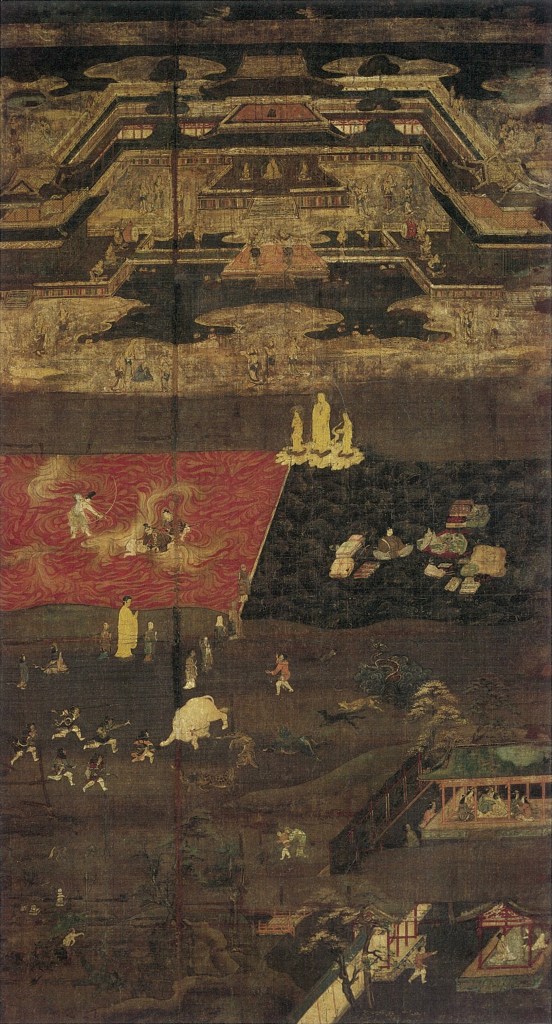
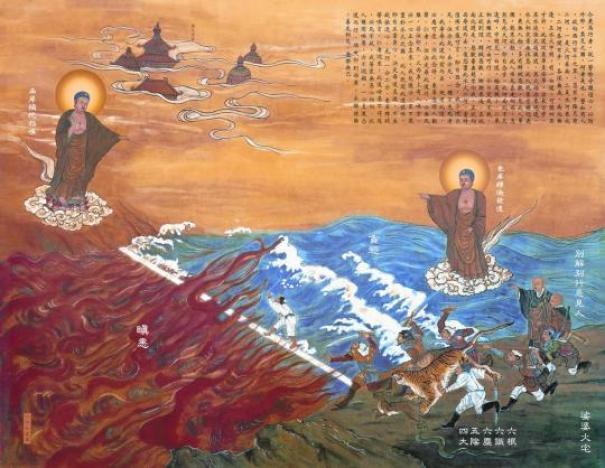
Підсумовуючи, притча вчить, що на цьому березі Будда Шак’ямуні вказує на міст. На іншому березі річки Аміда Будда кличе нас перепливти. Шлях вузький, але якщо ви прислухаєтесь до слів Будди Шак’ямуні та заклику Будди Аміди, ви пройдете безпечно.

Це базовий вступ до буддизму Чистої Землі, особливо до секти Джодо Шу. Якщо ви цікавитеся буддизмом, але відчуваєте розгубленість або самотність, просто спробуйте продекламувати Нембуцу. В якості основи використовуйте нембуцу.

У секті Джодо Шу існує традиція декламації нембуцу під назвою цзюнен (じゅうねん, 十念, «десять декламацій»). Звучить так:

наму аміда бу
наму аміда бу
наму аміда бу
наму аміда бу
наму аміда бу
наму аміда бу
наму аміда бу
наму аміда бу
наму аміда буцу
наму аміда бу

Дев’ята декламація має додаткове “цу” в кінці. Крім того, люди зводять руки разом у молитві, коли вимовляють нембуцу. Це називається «гасшо».

Ви можете побачити приклад тут, у храмі Зодзідзі в Токіо, Японія:

Вибачте, що мені довелося скористатися Google Translate, але я сподіваюся, що ви знайшли щось корисне, і я сподіваюся, що побачите світло Аміди Будди.

наму аміда буцу

Rhythm in Japanese Language

Japanese language, on its own terms, isn’t that difficult a language to learn I believe, but it does have some things that are pretty different from English, and require re-learning. One of them, surprisingly, is rhythm and lack of stress accents. I’ve talked about the “flat” sound of Japanese, but I haven’t really talked about its rhythm before.

Since Japanese is usually written using hiragana syllabary, it’s important to note that each kana “letter” is actually a self-contained syllable, and represents one “beat”. So, if you take a word like the city of Yokohama, it has four beats:

Yokohama

Once you grasp this concept, and get familiar with hiragana, Japanese is fairly easy to spell. However, there is one wrinkle that’s really important to pay attention to.

In Japanese the letters ō and o are not the same. They both sound like “oh”, but one of them is two beats, and the other is a single beat. In Romanization, the sound ō is actually two beats, comprising of o, followed by u “ooh”. Many words in Japanese use this combination. For example, the city of Tokyo, is actually Tōkyō. If pronounced correctly, it actually has 4 beats, not 2:

きょ
Toukyou

It really helps if you clap to the beat to help you adjust to this. For a native English speaker, it’s really hard to tell the difference between ō and o in conversation, but a native Japanese speaker can and does. A good example is the word ryokō (旅行, “travel”) which has both:

りょ
ryokou

The “ryo” is pronounced as a single beat (not 2, as in English), while the kō is pronounced as two beats.

In Japanese, the ū and u, both pronounced as “ooh” as in “soup” similarly are distinguished by two beats vs. one. The word for shumi (趣味, “hobby”) has only two beats:

しゅ
shumi

But compare with shūmatsu (週末, “weekend”) which has two beats for shū (4 total):

しゅ
shuumatsu

This is also why relying on Romanization of Japanese is a bad idea: it’s hard to convey this. IF you can read hiragana, then the pronunciation is super obvious because it’s a WYSIWYG writing system: what you see is what you get. Take this book cover for example (which I talk about in my other blog):

I’ve highlighted in green the interesting characters. The word 百 is pronounced as ひゃく which is two beats:

ひゃ
hyaku

And the word 道 in this context is pronounced as しゅ (shu) which is a single beat, like English “shoe”. Romanization can convey this, but if you can read hiragana, it is just so much easier.

Slight tangent, but Korean Hangeul works much the same way: Romanization doesn’t convey the sounds very well, but like Japanese hiragana, native Hangeul is also a WYSIWYG system. My wife and I have a children’s book in Korean from a friend:

I’ve highlighted each Hangeul syllable, but as you can see, Hangeul neatly divides each syllable by blocks anyway. Thus, you can easily tell who to read each one:

seonraedonghwa

If you try to write the title in Romanized Korean: seonraedonghwa, it’s hard to distinguish syllables. Is “seon” actually “se” and “on”, or is it one syllable? If you write with spaces in between words, it’s still hard to tell what’s what.

Also, this need to learn the native script isn’t limited to Asian languages. Ukrainian is much easier to read and learn once you grasp the Cyrillic alphabet. It is a pain upfront due to overlap with English, but it also makes it much easier to read words like the surname of the current president: Зеленський. In Ukrainian, there is only one way to read/pronounce Зеленський, but in Romanized Ukrainian it is written as Zelenskyy, Zelensky or Zelenskiy. Close, but not quite. The same goes with reading Greek (both modern and ancient), and so on.

Think of learning Hiragana, Hangeul, Cyrillic, Devanagari, or Greek as a one-time investment. It seems like a hassle upfront, but once you get past that barrier, a whole new world opens up.

Anyhow, back to the original point of this post. When it comes to learning Japanese, it’s important to pay attention to rhythm, because your pronunciation will sound much better, and you’re likely to reduce your foreign “stress” accent in the process. It’s perfectly fine to have some lingering accent (that’s life as a foreigner in any country), but your ability to clearly convey what you want to say to native speakers will go a lot smoother, and be less tiring to the listener.

Good luck!

Palatization Nation

One of the challenges of pronouncing Ukrainian language is the pronouncing the “soft-sign” ь. It is not an independent sound, but simply softens the letter before it through a process called palatization. I’ve struggled to understand this concept even after watching some helpful Ukrainian introduction videos.1

However, it turns out that other languages use palatization, including Sanskrit. The venerable Sanskrit language has been thoroughly studied for countless centuries and has developed (similar to Latin) well-structured learning methods, both ancient and modern:

So, palatization is just a way for taking sounds like “s”, “t” and “d” and changing them like so:

  • An English “t” sound becomes “ch” or something similar.
  • An English “s” sound becomes “sh”.
  • An English “d” sound becomes more like a “j” sound.
  • An English “n” sound becomes more like “ñ” as in canyon.

And so on.

Going back to Ukrainian in particular, the sounds change like so:

  • Ба́тько (father) sounds roughly like “bachko”, instead of “batko” without the soft sign.
  • Будь ласка (please) sounds roughly like “booj laska” instead of “bood laska”.
  • До́нька (daughter) uses the same nasally “n” as in “canyon” rather than regular English “n”.
  • Similarly, the “l” sound in сіль is a softer, more nasally “l” sound.

These are explanations by a non-native Ukrainian speaker but comparing the same process with other languages, such as Sanskrit or English, hopefully will provide another way to make sense of soft signs in Ukrainian language. Enjoy!

1 I think the issue, at heart, is that Ukrainian language hasn’t been a widely studied language until very recently. People are finally taking it seriously, and that’s a good thing. I look forward to seeing Ukrainian resources increase over time, just as Japanese language resources increased and have greatly improved since my days in college.

Ukrainian-Ukrainian, Russian-Ukrainian and Polish-Ukrainian: language and cultural influences

In recent weeks, as my study of Ukrainian language continues, I was fortunate to find a coworker at my company who is a native Ukrainian speaker, and happy to help me. As we’ve been talking, I’ve come to learn some interesting things about how various cultural influences have affected it.

The Saint Sophia Cathedral, in Kyiv, modeled after the Hagia Sophia cathedral in Constantinople at a time when Kyivan Rus and the Byzantine Empire had close relations. Rbrechko, CC BY-SA 4.0, via Wikimedia Commons

For example, the greeting I learned in Duolingo for “good morning” was добрий ранок (sounds like “dobree ranohk”), but then my Ukrainian co-worker explained that there are actually two common greetings. The first one is the aforementioned добрий ранок, and the other is доброго ранку (“dobroho ranku”). What’s the difference? The first one (добрий ранок) is a more Russian-style greeting, while the second (доброго ранку) is more native Ukrainian. Similarly, добрий день vs. доброго дня

To clarify, both are very common greetings in Ukraine, and no one would look at you weird for using either one. It’s just that one shows considerable Russian influence, while the other doesn’t. Also, since Ukraine is a relatively big country in Europe, it has some regional variation, so you might hear one more commonly in one regions versus another.

It turns out there’s a lot of this Ukrainian. There’s a lot of words and phrases that come from Russian, but not actually Russian-language, while other similar words and phrases show a more native Ukrainian background.

Another example my friend explained to me is how Ukrainian language frequently derives words from Russian, especially when translating from Russian sources. For the ongoing war, a common term is понесли втрати (ponesly vtraty, “suffered loses”), which derives from the similar Russian term понесли потери (poniesli potieri). However, in a more native Ukrainian way, you can also say зазнали втрат (zaznaly vtrat). The native, Ukrainian way is noticeably different than Russian, but it’s sometimes more expedient to use Russian-derived terms instead.

Sometimes this difference in phrasing reflects generational gaps too, with older generations often using more Russian-influenced terminology and phrasing versus the younger, post-Soviet generation more keen on using native Ukrainian more, to say nothing of the politics behind it all.

However, I didn’t want to just talk about Ukraine and Russia, another interesting thing that I found is that I noticed a lot of words that sounded vaguely like Latin to me, or Latin-derived. A prime example is Вино (sounds like vih-noh) for “wine”. This sounds fairly close to the Latin “vinum”, and not the Ancient Greek term οἶνος (“oinos”), which is surprising given how much closer Greece is to Ukraine. This may be due to influence from nearby Polish, a Catholic culture, despite its Orthodox heritage which derived from the Byzantine Empire.

Numbers, too, reflect some interesting patterns:

No.UkrainianLatinGreekRussianPolish
1один (odin)unusένα (ena)один (odin)jeden (ye-den)
2два (dva)duoδύο (duo)две (dve)dwa (dva)
3три (trih)tresτρία (tria)три (tri)trzy (tshih)
4чотири (chotihrih)quattuorτέσσερα (tessera)четыре (četyre)cztery (chte-rih)

The number four in Ukrainian, Russian and Polish more closely resembles Latin than Greek. Could this reflect some kind of eastward influence from the West? Honestly, I wish I knew more about the subject, but it’s fascinating how various cultural centers in Europe, both near and far, converged in places like Kyiv, and how the language reflects these layers of influence.

Handwriting Across Languages

My studies of Ukrainian continue, albeit slowly, and as part of this, I’ve been working hard to learn the cursive script which differs from printed Cyrillic on some key ways, but also differs from American cursive (obviously). My approach has been to write out new sentences I encounter in Duolingo in my little notebook:

I decided to also use the opportunity to re-learn American cursive after decades of neglect, and found a great example video here:

Since I’ve been practicing handwriting for both Ukrainian and English, I figured maybe I should practice Japanese as well. However, it’s a bit different with Japanese. There is no cursive in the sense that European languages have, though older Japanese writing had a loose system called hentaigana (not to be confused with hentai … this isn’t that kind of blog). Tofugu has a nice write-up here.

Japanese does have a pretty sophisticated calligraphy tradition both inherited from Chinese culture, plus local innovations. Typically, when writing calligraphy in Japanese, there’s three broad styles to choose from:

  • Regular script (楷書 kaisho) – based on Chinese calligraphic tradition, this is just the standard way of writing Chinese characters.
  • Cursive (草書 sōsho) – as the name implies, this is the cursive form of Chinese characters, often done to abbreviate and write things more easily, while keeping the brush (wet with ink) on the paper. Just like Western cursive.
  • Semi-cursive (行書 gyōsho) – this was a particular style that flourished in Heian Period Japan onward, but also has its roots in Chinese tradition, and represents a halfway point between regular script and cursive.

You can also see a nice comparison of the three here:

My wife has training in Japanese calligraphy, and knows how to write in all three styles, but I can’t even write standard Japanese well:

Me practicing a sentence from my son’s Japanese textbook

But the point is is that as with any handwriting, practice makes perfect. Find a pen you like writing with, and don’t be afraid to practice a little every day. You’d be surprised how much easier it gets within a few days, weeks, etc. When I was self-studying Ancient greek, I kept writing sentences out, and after a time, my handwriting got pretty good:

The weird thing was that I wasn’t even trying to improve. I was so focused on studying and writing things out in my notes, that after a while it got easier, smoother, etc. Plus, it’s good stimulation for the mind, which is handy as you get older. 😏

So, whatever language interests you, pick up a pen and start writing out interesting sentences and see where it takes you.

Sutras, сутри and お経

Every once in a while, I get some crazy boondoggle idea in my head, and it won’t let go until I am done.

A photo of a Buddhist sutra (okyō お経 in Japanese, or сутра in Ukrainian). I took this photo from one of my sutra books.

My latest boondoggle project started a couple weeks ago, when out of idle curiosity, I started exploring the Ukrainian-language Wikipedia and I noticed that articles about Japan and Buddhism were very few. The Russian Wikipedia site had a reasonable number of articles to offer, but the Ukrainian-language Wikipedia site had far less. Russian language is far more widely spoken than Ukrainian due to population size and history. As I learned later, Ukrainian people sometimes have to rely on Russian sources for more information, even if it’s not their first language.

Then, after meeting a Ukrainian co-worker who’s greatly interested in both Japanese culture and Buddhism, I decided it was time to try and start posting more content in Ukrainian? Am I fluent in Ukrainian? No. Am I competent in Ukrainian? No. I am just a beginner.

But I was motivated for a few reasons:

  • The current war highlights the fact that Russia is trying to subsume Ukrainian culture and language. This isn’t a new thing either. So, anything I could do to give Ukrainian language more credibility and clout is worth it.
  • Although Ukrainian culture is deeply influenced by its Orthodox roots, I realized through my co-worker that there are plenty of Ukrainians who might also be curious about Japanese culture and/or Buddhism. Since that’s practically the only thing I ever blog about, why not help share that information in their native language?
  • Finally, as someone who has admired Japanese culture since I was a kid in the 80’s, why not share it with other cultures if I can?

So, I started by making updates and edits to the Ukrainian article on the Heart Sutra. I added some photos, cleaned up some text, linked some things, etc. I had to cheat and use Google Translate, but hopefully a native speaker can then clean up what I typed. Better to make mistakes and get the information out there, than not provide any information at all, I figured.

Also, I know just barely enough Ukrainian now that I can kind of tell if the translator was right or not, plus I can check other articles in Ukrainian Wikipedia to make sure spelling and other details are right.

Then, I realized that there’s no chanting guide to the Heart Sutra at all in Ukrainian language. So, I made one. I first made an English language version chanting guide (using Japanese-style liturgy), then changed the chanting phonetic pronunciation to use Cyrillic. Fun fact, I also learned that there is a Cyrillic alphabet equivalent for Japanese romaji (Japanese romanization) called кірідзі (Kiriji).1

Thus, there is now a Ukrainian-language (Українською) chanting guide for the Heart Sutra in Japanese. It’s amateur work, and there’s still no translation of the text itself, but it’s a start.

Finally, this work, and the recent Juseige chanting guide I wrote, is still not great, but it is a growing effort to add more resources.

So, that’s all for now. I still have one more chanting guide I am making, this time to replace the Amitabha Sutra with a better version. Then I can go back to the other 12 projects I have sitting around. 😜

1 Some things are spelled slightly unusual. There’s no letter “j” in Cyrillic, as in “ji”, but apparently you can spell it in Cyrillic as дзі (lit. “dzi”) which is pretty close. Also, “wa” has no equivalent, so it is spelled as ва (lit. “va”).

Early Ukraine History: Of Scythians, Thracians and Greeks

Hello Readers,

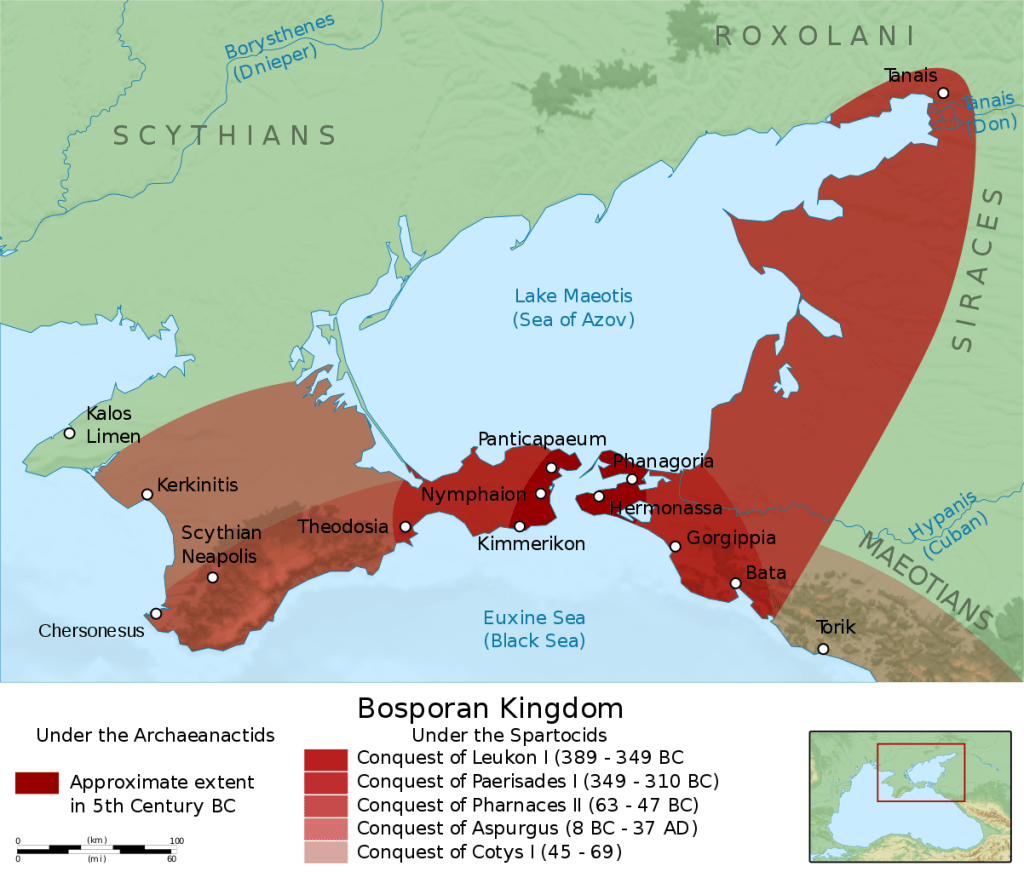
My continued read about the Scythians, especially the Scythians in the west, has lead to a fascinating period of time in early history, overlapping with the Hellenistic Period called the Kingdom of the Bosporus. The Kingdom of the Bosporus, later part of the Kingdom of the Pontus, survived in one form or another from the 5th century BC to the late Roman Imperial period in the year 370 AD (roughly 800 years). As you can see from the map, it started very small, just a collection of Greek colonies bound by mutual defense, and grew in size into a much larger kingdom that included the Crimean peninsula and parts of modern-day Ukraine.

The Bosporan Kingdom at various points in history, File:Bosporan Kingdom growth map-pt.svg: Sémhur (talk · contribs)derivative work: Morningstar1814 (talk · contribs), CC BY-SA 4.0, via Wikimedia Commons

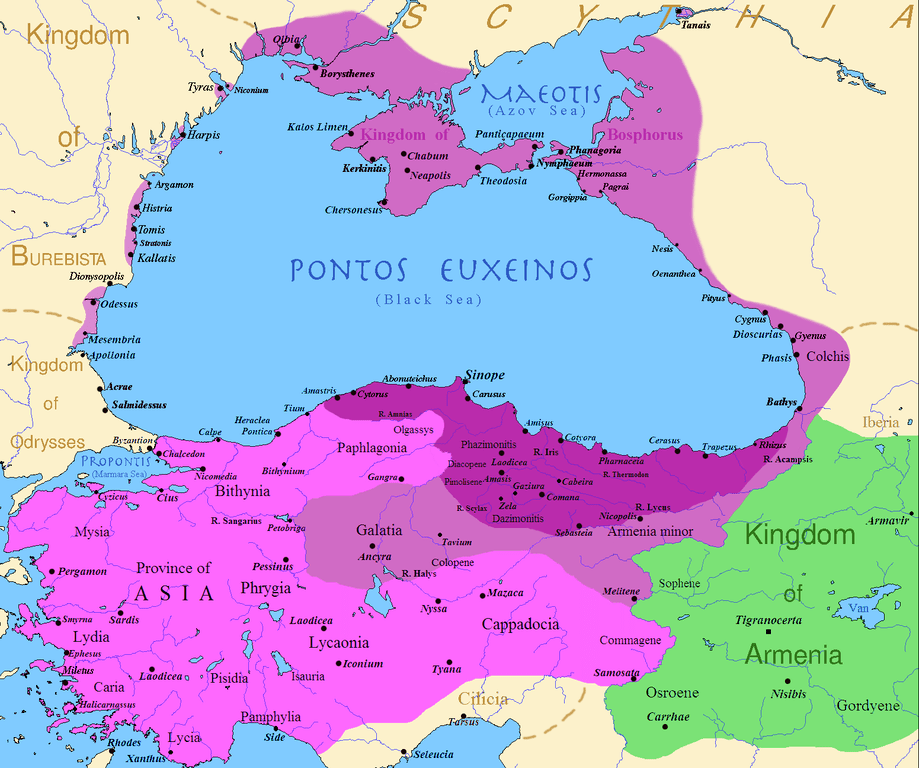
Later growing into a much later kingdom that went to war with Rome:

Javierfv1212, Public domain, via Wikimedia Commons

What makes the Kingdom of the Bosporus / Pontus fascinating is the convergence of Greek, Thracian, Scythian and other cultures, and the exchanges between them. Let’s take a brief look at each…

The Greek Colonies

The humble beginnings of the Kingdom of the Bosporus began as a hodge-podge of Greek colonies in the Black Sea. The ancient Greeks were prolific colonizers in the Mediterranean because the lands of Greece have low agricultural output, and as populations grew, they needed places to grow and stretch. Famous colonies include Syracuse on the island of Sicily (home of Archimedes!), southern Italy a.k.a. Magna Graecia, Cyrene in modern-day Libya, as well as countless colonies in Spain, southern France, Asia Minor and so on.

Colonies in the Black Sea, including the modern Ukrainian city of Odessa,1 mostly originated from the Greek city-state of Miletos which had been aggressively colonizing all around the Black Sea. Even now, old Greeks relics can be found. The Greeks were colonizing hostile territory, so they tended to build fortresses on off-shore islands, or just inland from a river. From the inland communities, the Greeks would get raw materials, grain and other foodstuffs to ship back to the Greek metropolises back home. In turn, they would bring wine (much prized by the Scythians), crafted luxury goods and spread Greek culture.

From the perspective of the Greek world, the Black Sea and colonies around the Crimean peninsula were the very edge of civilization. This was the frontier, where only the bravest, or the punished would go.

The Native Thracians

The Thracians are an influential people who lived north and east of Greece proper, but are not well-attested in history. Thracian culture shows considerable Greek influence, but they spoke a different language (now lost), and had a more loose, more tribal political structure than the classic Greek polis.

But the Thracians weren’t slouches either. They frequently combated with the northern Greeks, especially Phillip II of Macedon and his son, Alexander the Great, and the Odryzian Kingdom was a serious attempt by the Thracians to unify and challenge their Greek neighbors.

The Kingdom of the Bosporus, the subject of this post, was perhaps their most important contribution, though, because the founder of that kingdom was a man named Spartacus. No, not this Spartacus:

The name “Spartacus” is a distinctly Thracian name, and the founder of the ruling dynasty of the Bosporan Kingdom was a Thracian man named Spartokos I, first as the strongman or “tyrant” of the Greek colony of Panticapaeum (modern Kerch), and then gradually uniting the nearby colonies in a system of mutual protection.

The Steppe Warriors

Starting with the Cimmerians, steppe nomads would often encroach into the steppe lands of modern Ukraine and Hungary, the westernmost extent (as well as the most hospitable) of the Eurasian steppes. Having driven out the Cimmerians, they settled and lead a confederation of tribes that dominated the lands for centuries, until they were eventually defeated by the Sarmatians.

The nomadic Scythians were at first largely hostile to the settled Greco-Thracian cities along the coast, and there is evidence of war and violence at some places, hence the colonies banded together for mutual defence. Gradually, though, the different cultures learned to get along and began mutually beneficial trade. The Scythians liked Greek commodities and helped ship raw resources from other cultures further north down to the Greek settlements.

The kurgan tombs of Scythian warriors also began to show more Greek architectural influence, such as the great kurgan at Kul-oba, and a tomb at Bliznitsa near the colony of Phanagoria that depicted the goddess Demeter, hinting at the Eleusinian Mysteries.

Further, a number of famous Greeks have (often dubious) claim to Scythian ancestry such as the Athenian orator, Demosthenes, so intermarriage did occur between the colonists and steppe nomads. Herodotus’s historical accounts of his travels in these lands also provide invaluable information about the people of the Bosporan Kingdom, the Scythians beyond it, and more.

The Wider World

How the Bosporan Kingdom fit into the wider Hellenistic and Roman world is interesting too. Because of its location, it was luckily not involved much in the power struggles between Alexander the Great’s successors, nor did it tangle with the Roman Republic until much later during the Mithridatic Wars. All three of them.

Further, the mixed ethnic composition of the Bosporan Kingdom meant that it was an unusually cosmopolitan place, and held a certain mystique among the more urban residents of the Greeks and later Roman empire. When Ovid was banished there, though, he often whined about how hard and rustic the life was, but he would, wouldn’t he?

Anyhow, even when we watch the news about events in Ukraine, especially southern Ukraine, it’s helpful to remember that these lands have a long and fascinating, multicultural history, and we haven’t even gotten to Kievan Rus’ yet.

1 Which, as of writing, remains free thankfully. Слава Україні! 🇺🇦

Ukrainian Handwriting

While Duolingo has been a pretty fun introduction to the Ukrainian language, it clearly has some limitations with respect to explaining grammar rules, pronunciation and (obviously) writing.

So, a little while back I picked up a textbook on Ukrainian and it has been vastly helpful in filling in the blanks of my knowledge. For example the letters Я (ya) and Ю (yu) become “a” and “u” if they come after a consonant. Wish I had known that sooner.

Another area that the textbook helped with was writing Ukrainian. It turns out that Ukrainian has a cursive form of handwriting, it’s fairly different than “print” Ukrainian, and it’s frequently used, unlike cursive in English.1

Here is me practicing Ukrainian handwriting in my little notebook:

As mentioned earlier, some letters are noticeably different than the print version. The letter Т looks like a cursive “m”, while cursive М looks like the Greek letter μ (mu), while И looks like cursive “u”. Small letter д looks like a cursive “g”, while small б looks like Greek δ (delta), and so on. The word for dad, тато, in cursive looks like тато in cursive. The word вегетаріанець (vegetarian male) becomes вегетаріанець in cursive.2

At first, this feels pretty confusing, and tutorials on YouTube don’t always explain the nuances and differences clearly because they are taught by native speakers who just intuitively know. Thankfully, I have some pretty helpful resources shown below under “updates”.

In any case, what I can say as a non-native speaker, is that with time, practice, and a good textbook, it does eventually get easier and easier and in time your handwriting becomes more legible. Writing practice in any language can be a nice stress-reliever too. 🥳

Update: This book has been very helpful in clarifying Cyrillic (cursive and print) handwriting for Ukrainian:

Highly recommend!

Update 2: out of all the Ukrainian cursive handwriting videos, I’ve found this one the most useful:

1 I learned cursive writing when I was in grade school, but my children barely touched it. Personally, it’s a bit sad to see it fade away, but then again I never used it very much anyway, even before the Internet. Not everything is necessarily worth preserving.

2 As I learned while writing this, using italic font for a word converts it to cursive.

Ukrainian, By The Numbers

My studies of Ukrainian language continues, alongside my efforts for the JLPT exam, and lately I have been in the weeds with numbers.

  1. один (odin)
  2. два (dva)
  3. три (trih)
  4. чотири (chotihrih)
  5. п’ять (pyach), etc.

An observant person may notice that they’re clearly similar to more familiar languages, including Latin and ancient Greek. Definitely a close relation, or mutual influence, who knows?

But the way things are counted in Ukrainian is interesting. Take the following example:

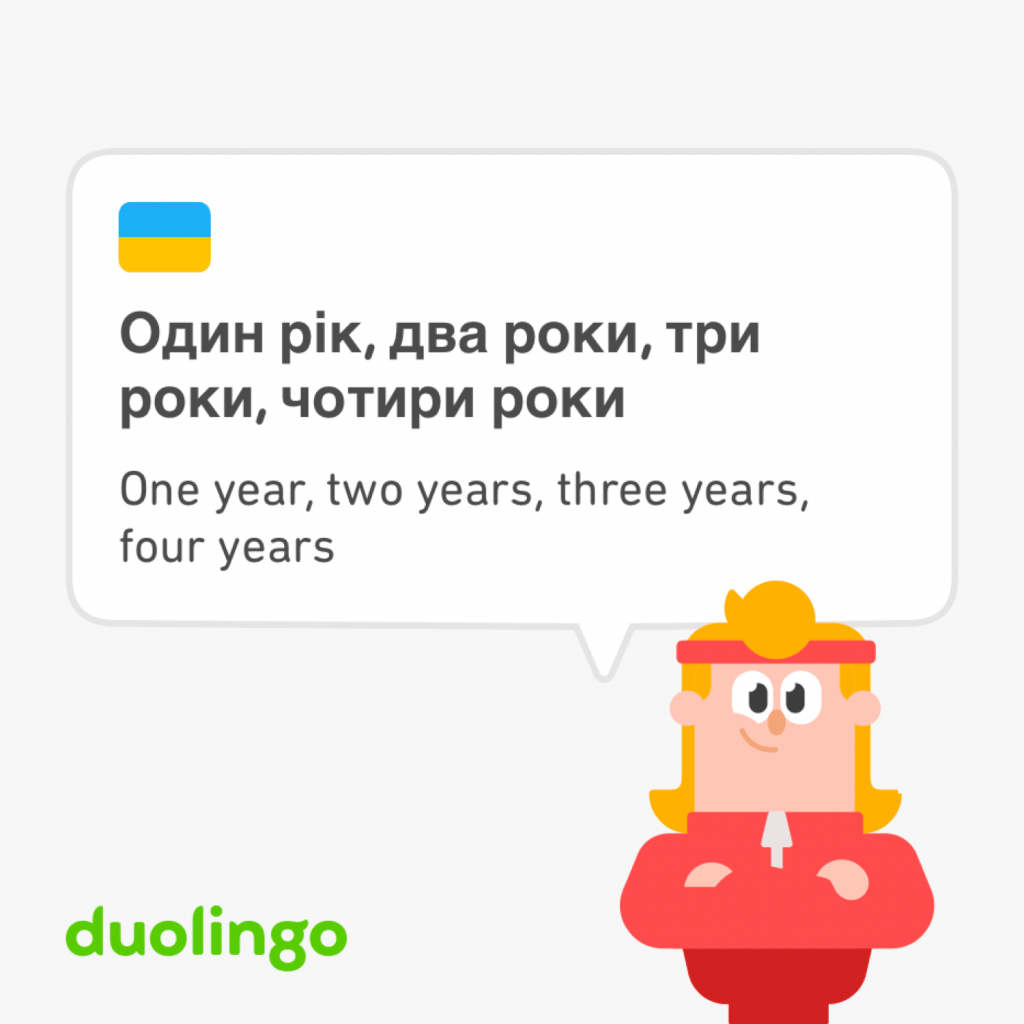
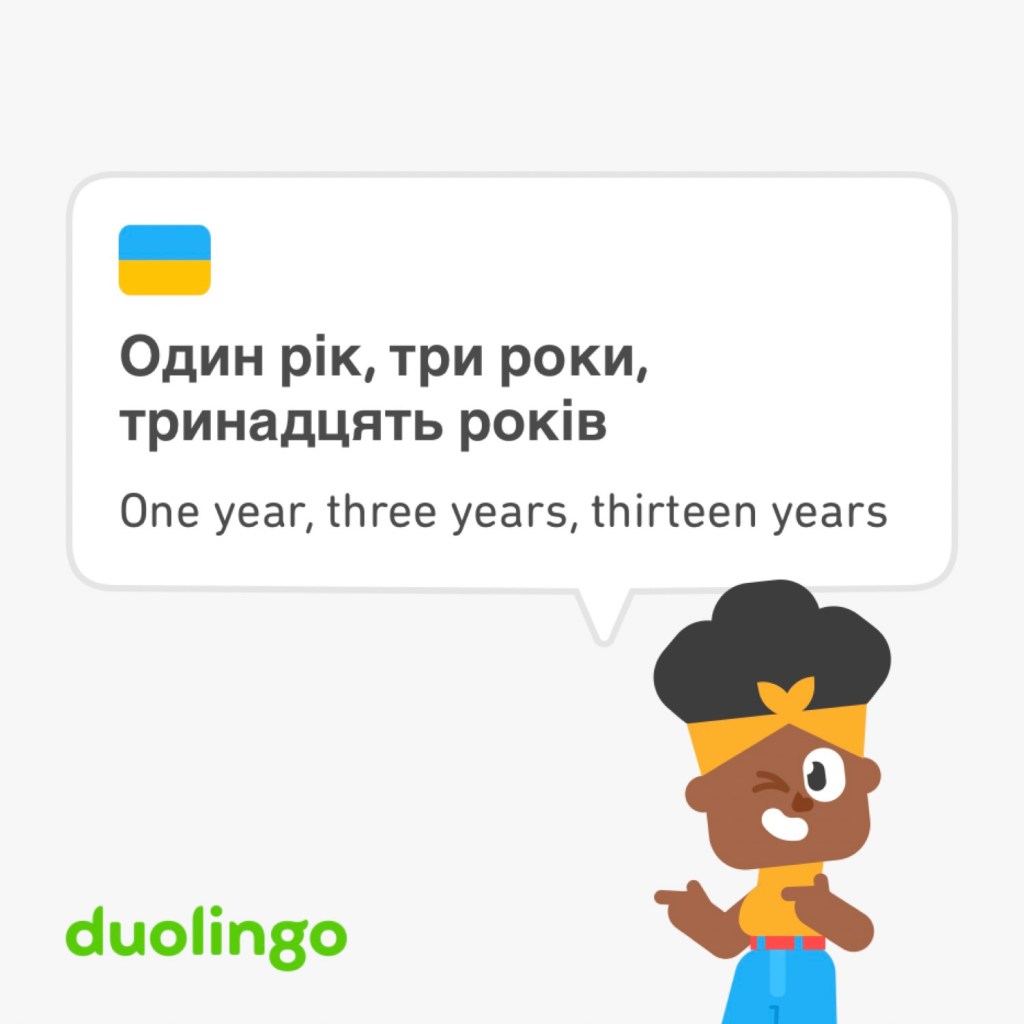
English has “singular” and “plural” endings for nouns, but Ukrainian appears to have three endings for singular, between 2 and 4, and 5 or more. One year (рік, “rik”), two years (роки, “rokih”) and thirteen years (років, “rokil”).

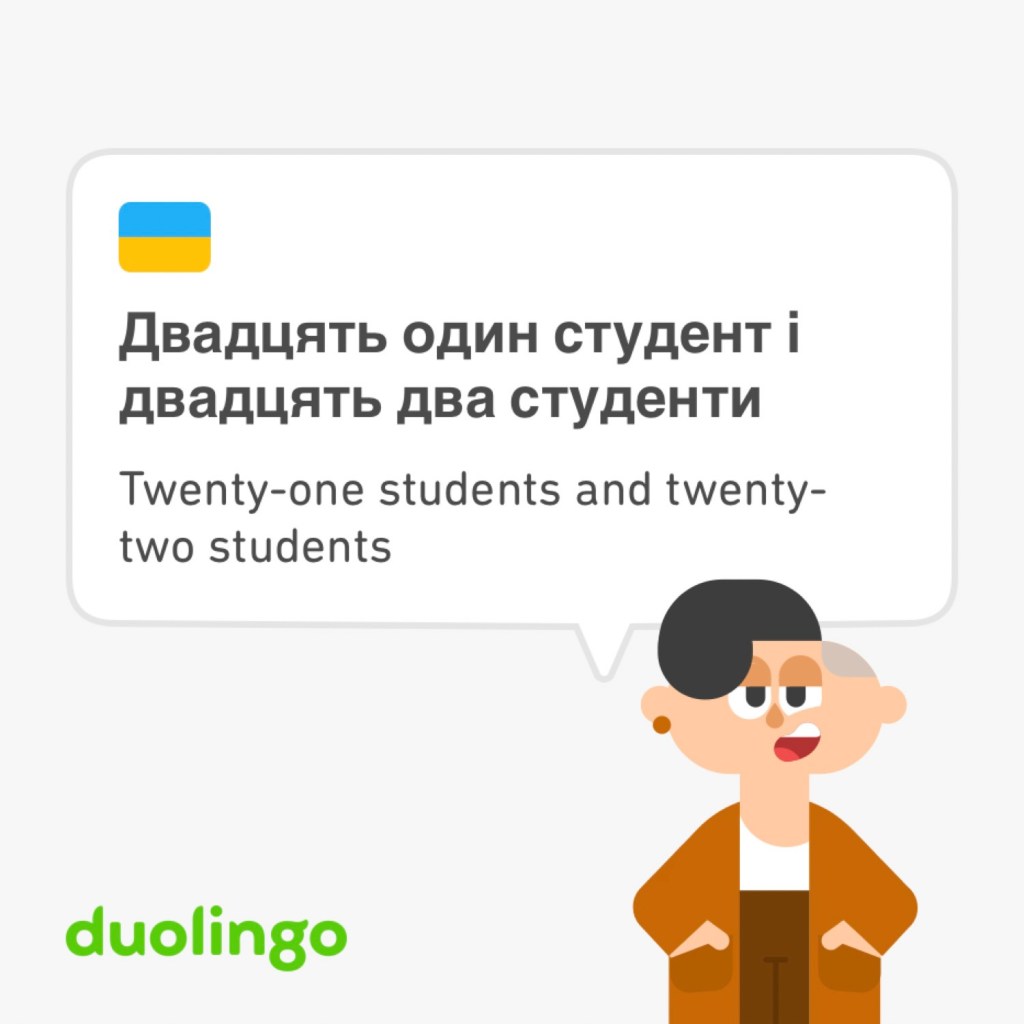
Interestingly, the conjugation from twenty onward seems to depend on the last number. In the below example, the word for student changes depending on whether it’s twenty one (i.e. “singular”) vs. twenty two (i.e. “between 2 and 4”). The twenty doesn’t factor into this.

Finally, like other inflected European languages (again, Latin is a great example), the numbers when used to count something will conjugate to match the object in terms of case and gender. The number one, depending on the grammatical gender of the word, will either be :

  • Один кіт (odin kit, “one cat”), masculine
  • Одна машина (odna mashina, “one car”),1 feminine
  • Одне місто (odneh misto, “one city”), neuter

That’s a brief look at Ukrainian numbers, and what I’ve figured out so far. Enjoy!

1 I really love the fact that the word for car is “mashina”, because it reminds me of the word machine. Are they related? I would like to know.

New Mug!

This came in the mail this morning;

This happy little mug comes from Language Mugs and includes a basic breakdown of Ukrainian conjugations and grammar. I got different mugs for my kids: French for my daughter who’s studying in school, and Japanese kanji for my son who loves learning it.

For your language nuts out there, I’ve learned a few things already from the mug;

  • Ukrainian nouns have seven declensions which is kind of a lot. Some repeat though, such as accusative and nominative.
  • Ukrainian adjectives conjugate based on grammatical gender, but are the same in plural (like German, for example).

I will be poring over its contents over the coming weeks just as I continue to pour homemade cold brew coffee.

Check out Language Mugs if you can. The mugs are great, and delivery was pretty fast.