Lately, I started taking up the Ukrainian language, which is something very outside my comfort zone. In my younger years, I’ve studied Mandarin Chinese, Vietnamese for 2 years in college, and of course Japanese, so Asian languages tend to be familiar even if I am not fluent. I have also dabbled in Latin, Sanskrit and Ancient Greek over the years, but I am not particularly good at either one.1 Even so, I have zero experience with Slavic languages, so it’s been a totally new experience for me, and yet, to my surprise an oddly familiar one.
Having spent weeks on DuoLingo practicing basic, basic Ukrainian I started to notice some patterns.
For example, the phrase моя мати (moya matih) and мій кіт (miy kit). The first means “my mother” and the second means “my cat”. After a bit of sleuthing, I figured out that “my” will conjugate depending on the gramamtical gender of the noun. In this case мати is a feminine gender word, and кіт is masculine. There are “neuter” gender nouns as well.
Side note: the Ukrainian word for “samurai” is самураї (samurayi)
Grammatical gender? Ancient Greek,2 Latin, and Sanskrit all had masculine, feminine and neuter genders for nouns. Modern Western languages tended to drop the neuter gender (e.g. modern Spanish or French), but it’s fascinating to see that Ukrainian, and Russian evidentially, retain all three. You can also see grammatical gender with words like студент (“student”, male student) vs. студентка (“student”, feminine student).
But even more fascinating is that Ukrainian nouns have seven grammatical declensions:
nominative (“the student”)
genitive (“of the student”)
dative (“to or for the student”?)
accusative (“verb the student”)
instrumental (“with or by means of the student”)
locative (“on the student”?)
vocative (“hey, student!”)
Seven declensions? The only language I know that had that many was ancient Sanskrit (eight total, including ablative)! Latin had five, and Ancient Greek only had four. Adjectives also behave like Latin, Greek and Sanskrit in that they agree with the noun in case, number and gender.
I haven’t really gotten into verbs much yet, but I do notice that they inflect too, depending on who speaks it (I eat vs. you eat), so I wouldn’t be surprised if it fits a similar pattern to other European languages.
All this is to say is that Ukrainian language, and much of the eastern European Slavic language family represents a linguistic “cousin”, with fascinating relics from much earlier Indo-European languages, and yet full of innovations and adaptations as well.
1 I confess I dabble in language study a lot, but not very good at follow-through. Japanese is the only language I’ve really committed too long enough to develop any skill, but since I married into the culture, it’s been a worthwhile experience. I suppose that’s what really keeps one going: personal value in learning a language more so than just idle intellectual curiosity. On the other hand, even learning another language a little bit is a worthwhile experience. I dabbled in Korean at one point due to the KPop craze at the time, and it’s nice to still be able to real Hangeul, and to encounter the only other language I know that has any grammatical similarity to Japanese (through convergence, not genetic origin). Similarly, my time spent learning Vietnamese, which I don’t get to use much anymore, was a fascinating time when I got to study abroad in Hanoi, Vietnam. Plus it was fascinating to see how Chinese influenced Vietnamese in the same way that Chinese influenced Korean and Japanese even though they were all unrelated languages! In that sense, any foreign language study is a worthwhile investment.
2 The term “Ancient Greek” is kind of vague and nebulous. There’s Homeric Greek (e.g. the Greek of the Iliad), Classical Greek (e.g. Attic dialect), Koine Greek (e.g. the Hellenistic Period and the New Testament), Byzantine-era Greek and so on. There’s even Archaic Greek, which is poorly attested due to lack of sources. So, when people talk about “ancient Greek” it’s important to be clear which one. Greek as a language is a fascinating continuum from the archaic period all the way to modern times. One of my co-workers is Greek American and she loves to swap tips with me as she is also learning both ancient and modern Greek.
The Silk Road, especially during the time when Buddhism first propagated out of India into the northwest and then east into China, is a fascinating point in history. Much of this is epitomized in a little-known writing system called Karoshthi.
At that time, much of the world from Europe to Asia spoke a language called Aramaic. Jesus’s native language was Aramaic, not Hebrew (though like many Jewish people at the time, he certainly knew it). Aramaic spread far and wide partly by accident, when Assyrians forced captive peoples to migrate to remote parts of their empire. Compared with the older cuneiform script, used in many Near East languages, Aramaic had a simple, straightforward alphabet that allowed people to pick it up quickly and easily.
Aramaic was also used in the Silk Road that ran from the edges of the Roman Empire, through the Parthian Empire, east to the Kushan Empire (later the Hephthalites) and across the Taklamakan Desert to Tang Dynasty China.
However, starting in the region of Gandhara (modern-day Pakistan), a new script, based on Aramaic began to appear: Karoshthi.
This video, courtesy of Vidya-mitra’s online correspondence courses, explains the Karoshthi in great detail and is worth a watch.
Some highlights from that video that I wanted to share.
First, Karoshthi was only around for a few centuries: mostly the 1st century CE to 3rd century CE. However, this overlapped with a pivotal time when Buddhism developed many characteristics in Gandhara that we now see today:
Mahayana Buddhist texts were developed and written down, not orally transmitted.
Second, contrary to what I thought, most of these Buddhist-Karoshthi scripts were composed in a prakrit language called Ghandari Prakrit, not Sanskrit.1 According to the video, Ghandhari had some unusual features compared to other prakrit languages found in India, and Karoshthi had to be adapted for this. So, it contains some letters and styles not found elsewhere.
Third, Karoshthi wasn’t just used for Buddhist literature: it was used across a large swath of the eastern part of the Silk Road, so texts written in Karoshthi can be found in western China as easily as they are found in Pakistan, though because of geography, it tends to be found in pockets, where oasis-towns and other settlements existed.
I have been playing around with it quite a bit using Unicode and HTML as well as other ancient scripts, and was able to compile the Sanskrit phrase om namo’valokiteshvarāya2 meaning “praise to [the Bodhisattva] Avalokiteshvara”:
Brahmi script: 𑀑𑀀 𑀦𑀫𑁄𑀯𑀮𑁄𑀓𑀺𑀢𑁂𑀰𑁆𑀯𑀭𑀸𑀬𑁍
Karoshthi script: 𐨀𐨆𐨎 𐨣𐨨𐨆 𐨬𐨫𐨆𐨐𐨁𐨟𐨅𐨭𐨿𐨬𐨪𐨌𐨩𐩕
The Brahmi script such as Emperor Ashoka might have used, is written left-to-right, as you’ll notice, but the Karoshthi script is written right-to-left. This makes copy and pasting on a browser really tricky by the way. 😅
Anyhow, this is a very amateur look at the ancient Karoshthi script. Karoshthi script is something that you probably wouldn’t see very often, if ever, but it’s a fascinating historical relic of a time when commerce and information was exchanged heavily along the Silk Road, bringing empires across parts of Asia and Europe briefly together. As a Buddhist, it’s also a snapshot into the earliest forms of Buddhist, particularly Mahayana-Buddhist, literature one can find anymore.
1 Buddhist texts gradually became more and more Sanskrit-like, but that took centuries, and even then it probably wasn’t pure, literary Sanskrit as one would learn in a textbook. This phenomenon was dubbed “Buddhist-Hybrid Sanskrit” by scholars.
A while back, I wrote a small post on how to express Sanskrit and Pali using diacritics in HTML and the Roman alphabet. This is handy for expressing Buddhist terms accurately, since the standard 26 letters of the English alphabet don’t always tell the whole story.
Coin of Agathokles, king of Bactria (ca. 200–145 BC). British Museum. Personal photograph 2006, courtesy of Wikipedia. The coin shows inscriptions in Greek. Upper left: ΒΑΣΙΛΕΩΣ. Upper down: ΑΓΑΘΟΚΛΕΟΥΣ. The coin also shows a Buddhist lion and Lakshmi. Note the Brahmi script on the obverse, too.
While exploring Sanskrit writing systems recently, I dabbled in using HTML to express the ancient Brahmi script, which was used to write Sanskrit a long time ago, including some Buddhist scriptures, and the writings of Emperor Asoka.
Brahmi script is available through Unicode, like many other obscure symbols. The key is to know how to type a Unicode letter in browser:
& # x(number) ;
The numerical table for each Brahmi script letter is found here and on Wikipedia. The code for “ka” (क in modern Devanagari script) is 11013, so in HTML, it would be & # x 11013 ; without any spaces. This produces 𑀓. So far so good.
But Brahmi, like other similar scripts, is an abugida. The vowels don’t usually stand alone as separate letters. Instead, they modify the base consonant. This is true with modern Devanagari as it is with Brahmi. So, in the example above, “ki” would be “ka” but modified with an “i” extension: कि in Devanagari, or 𑀓𑀺 in Brahmi. For Brahmi, I put & # x 11013 ; without any spaces, then & # x 1103a ; the code for the “i” vowel extension.
One other thing we need to cover is the consonants without a vowel. For example, in the word Buddha (buddho in Pāli language) , it would be split up into three letters “bu” “d” and “dha” with an “o” extension. The “d” here normally needs vowel, by default “a”, but if you add a virama mark, then instead of “da”, it gets cut off as “d”. In the Brahmi script, this is a & # x 11046 ; which looks like 𑀓𑁆 (k), a small line above the letter. Using the example of Buddha above, this would be 𑀩𑀼𑀤𑁆𑀥𑁄 or letters “bu” “d with virama” and “dho”.
As a bonus, the nembutsu in Sanskrit, in its simplest form, is namo’mitābhāya1 which in Brahmi script might be:
𑀦𑀫𑁄𑀫𑀺𑀝𑀸𑀪𑀸𑀬
Typing each letter by its Unicode HTML number is not a quick and easy process, but if you do it enough, it becomes somewhat easier. Soon, you’ll be typing like Emperor Ashoka in no time. 𑁍2
P.S. If you prefer to type in Devanagari, by the way, the simplest approach is to simply use the Hindi keyboard setting if you have one. You won’t need to type each Unicode letter. 😉
1 This may be a Chinese phrase rendered back into Sanskrit, not the other way around, but it does appear in the extant version of the Larger Sutra of Immeasurable Life, and something called the Dhāraṇīsaṅgraha, a collection of Buddhist dhanaris.
Recently, I’ve been delving into both the Sanskrit and Pali languages, both used for Buddhist religious scripture, and just when I thought I had things figured out, I realize the situation is even more complicated and fascinating than I thought.
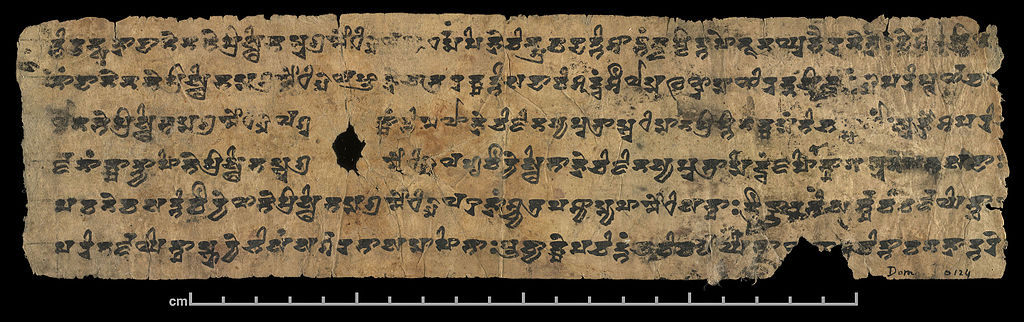
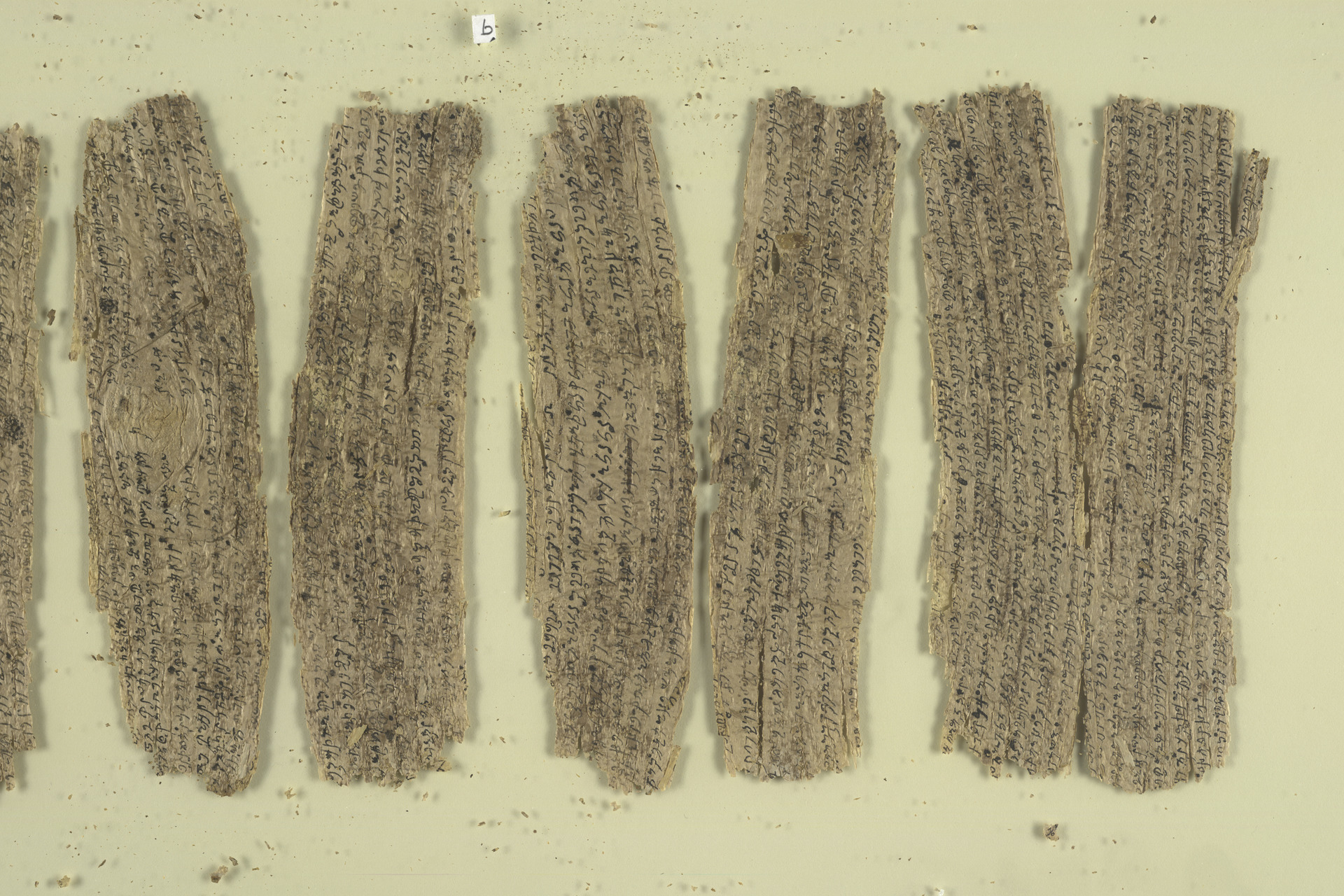
Fragmentary Kharosthi Buddhist text on birchbark (Part of a group of early manuscripts from Gandhara), first half of 1st century CE. Collection of the British Library, CC0, via Wikimedia Commons
Sanskrit is a language that was brought to India by invaders who called themselves the Arya (“the noble”), but had origins in what is now Iran. They came to India sometime after 2000 BCE and settled across northern India and surrounding areas, subjugating the native population, and bringing their religious values with them. From there, we see very early religious inscriptions such as the Rig Veda, composed in very old Sanskrit (e.g. “Vedic Sanskrit”).
But, gradually, Sanskrit and what was spoken informally “on the ground”, diverged. This diverged by regional variances, social classes, etc. They could probably understand each other’s regional dialects the same way that Americans can understand Australian English, and Australians understand American English, or Scottish English, etc, and all of them differ from “textbook English” also known as Standard English.
One might also draw an example from Latin. Classical Latin, such as the writings of Cicero, differed from “vulgar Latin” such as that spoken in the provinces. Further, vulgar Latin as spoken by the Celts in Gaul probably differed from vulgar Latin spoken by Berbers in north Africa or Egypt. Even Cicero’s spoken Latin probably differed than his writings.
Such regional dialects or variances of the original Sanskrit included:
Magadhi – A language spoken in the kingdom of Magadha, and quite likely the Buddha’s native language. It is spoken today in India as well, but like Ancient Greek has changed over time to its modern version.
Kosalan – A language spoken in the neighboring kingdom of Kosala, also mentioned in early Buddhist texts.
Arda-Magadhi – “Half-Magadhi”, a possible predecessor to Magadhi above, or at least closely related.
Paishachi – A popular, possibly literary-only language, though more research is needed.
Maharashtri – A language spoken more to the southwest of India and frequently used in poetry. Modern day Marathi and Konkani derive from it.
Gandhari – A prakrit spoken in north-west India, in the important region of Gandhara, and used in some Buddhist scriptures composed in the region, instead of Pāli. Examples of recoverd texts here.
Speaking of Pāli, what’s up with Pāli? The earliest Buddhist scriptures, or sutras, are recorded in Pāli language, but Pāli isn’t technically a Prakrit like those shown above. It seems to be a language that arose as a kind of lingua franca between Prakrits.1
It makes sense why early Buddhist sutras are recording in it then: rather than recording in each Prakrit for the benefit of local audiences, pick something that was generally understood, even if imperfectly.
Pāli may have arisen around the 3rd century BCE, two to three hundred years after the Buddha, so here’s a hypothetical (repeat: hypothetical) timeline:
The Buddha preached in his native language, Magadhi (assuming that’s what he spoke), probably around the 5th or 6th century BCE. It’s also possible he used other Prakrits as well depending on his audience, assuming they were mutually intelligible.
Disciples remembered his teachings, and per Buddhist tradition, recited them as beset as they could recollect after this death in the First Buddhist Council.
Per existing Indian tradition, the teachings were then passed down for centuries from teacher to students.
As Prakrits developed and diverged over time, it probably became harder to keep things consistent across Buddhist communities, and the communities relied on more. Since it was widely used anyway, this was probably a simple, practical move.
As Buddhist tradition changed from oral to written history, Pāli was the logical choice for some Buddhist schools, such as the Theravada. Other Buddhist school at the time stuck to local Prakrits (some of which became part of the Mahayana canon later), such as in the Gandhara region.
As Buddhism spread even further, and Pāli fell out of use in India, Sanskrit became the liturgical language of choice and Buddhist scriptures, notably in the Mahayana tradition were shoe-horned into Sanskrit in successive waves. Given the rise of Hindu religion, which relied on Sanskrit for scripture, Buddhist communities may have felt the need to “keep up”.
Anyhow, this is speculation, but seems to fit what I’ve learned so far, and shows a fascinating evolution where Sanskrit sets the foundation, but dialects flourish until a new lingua franca is needed (namely, Pāli), until things sort of come full-circle and return to Sanskrit again, at least for the Mahayana tradition.
However, a couple points should be emphasized:
The Buddha probably didn’t preach in Pāli language. We may never know exactly what the language was, but it is likely a local prakrit, or more than one.
Prakrit languages are neither Sanskrit nor Pāli, but possibly developed in this order (more research needed): Sanskrit at time of migration into India -> Prakrits -> Pāli -> Classical Sanskrit
Thanks for reading!
1 Speaking of “prakrit”, there is not a universally agreed upon standard as to which languages at the time are prakrits, and which ones aren’t. In some broader definitions, Pāli language is considered another prakrit. As an amateur, I have no opinion one way or another.
Recently, I made a lengthy rant on Twitter about my frustrations with learning Sanskrit in order to read Buddhist texts. The issue is a surprisingly complicated one, and something I wanted to explore here a bit more.
When you look at religions of the world, Buddhism is somewhat unusual in that it is not rooted in a single, sacred text. No Bible, No Quran, etc. Buddhism has many sacred texts, or sutras, all purportedly the words of the Buddha. These teachings where then passed down by his disciples, yet nothing was actually written down until centuries later. This is not as bad as it sounds. By the Buddha’s time, India already had developed a sophisticated tradition around memorizing sacred texts and teaching them disciples. Non-Buddhist examples include the Vedas (the forerunners to the Hindu religion). People believed at the time that writing sacred teachings down would put them on the same level as mundane receipts and political documents, and was thus considered profane.
Attitudes changed by 1st century CE, but by now those sermons of the Buddha that had been carefully passed down were scattered in various collections, and different Buddhist schools had slightly different collections from one another. Worse, the languages used to transmit the teachings had diverged.
Which Language?
The Buddha, in his time, warned against using the priestly Sanskrit language to transmit his teachings, preferring instead local dialects, but even at that time, India had many, many dialects. Pāli was a very popular one, and remains so for some Buddhist traditions, but as Buddhism grew, keeping track of Buddhist sermons via local dialects probably became less and less practical.
Thus, in the end, Buddhist texts began to be recorded in Sanskrit. Every educated person in India probably knew at least some Sanskrit, just like educated medieval Europeans knew at least some Latin or Greek.
This conversion to Sanskrit wasn’t an overnight swap, however. Research into “Buddhist Hybrid Sanskrit” shows that the transformation was a gradual one: Buddhists would first write things down in a way that looked “Sanskrit-ey” (but not actual Sanskrit), then later generations would write something down that actually used Sanskrit, but still peppered with local colloquialisms. Eventually, even later texts were composed in “true Sanskrit”, at least something that Pāṇini would hopefully approve of.
So, what we see is a kind of gradual spectrum from early texts being composed in local dialects (primarily Pāli) and then gradually transforming into Sanskrit.
The difference, by the way, between Pāli and Sanskrit isn’t as dramatic as it sounds by the way. Pāli, like many Prakrits, was a local languages that derived from Sanskrit, and still had much in common with it. Just like Italian, Spanish, French, etc., all derived from Latin in some way.
To illustrate this, let’s look at a basic word like “king”. In Sanskrit, it is rājaḥ, and conjugates like so (not a complete chart):
Case
Singular
Dual
Plural (more than 2)
Nominative
rājaḥ (rājo)
rājau
rājāḥ
Accusative
rājam
rājau
rājān
Instrumental (e.g. “with” or “by means of”)
rājena
rājābhyām
rājaiḥ
Dative (e.g. “to” or “for”)
rājāya
rājābhyām
rājebhyaḥ
Note: due to Sandhi rules, rājaḥ frequently becomes rājo to smooth things out. Sanskrit also has Genitive, Ablative, Locative and Vocative cases too., but I’ve omitted them for brevity.
…and so on. Pali is a bit more streamlined by comparison being a more colloquial language by nature, so one word for king is rāja (i.e. without the visarga ḥ sound at the end):
Case
Singular
Plural
Nominative
rāja (rājo)
rājā
Accusative
rājaṃ
rāje
Instrumental (e.g. “with” or “by means of”)
rājena
rājebhi or rājehi
Dative (e.g. “to” or “for”)
rājāya or rājassa1
rājānaṃ
This form appears to be more commonly used according to this Pali textbook written by Ven. Nerada Thera
At first glance, Pali kind of reads like the kinder, gentler version of Sanskrit. The dual form is almost entirely non-existent,2 and the sounds are softer, and lacking the ḥ (visarga) at the end. However, you can see they share similar grammatical structures, pronunciation, etc.
So, the first challenge with Buddhist text is this gradual transition from local dialects to literary Sanskrit, spanning hundreds of years. If you picked a particular Buddhist sutra, it might be somewhere in the middle of this transition: is it Pali? is it Sanskrit? Sanskrit with Pali terms, or Pali with a Sanskrit “polish” to it?
How Is It Written?
The second issue is the written script.
Some languages are closely tied with their script: Greek language is written in the Greek alphabet (obviously), while Korean is written in Hangeul. Other writing systems are not: the Roman alphabet is used in many languages: English, French, Vietnamese, etc. In medieval times, Chinese characters were used by a wide variety of disparate languages: Chinese, Japanese, Vietnamese, Khitan, etc.
So, languages are not always tied to a particular writing system. Also. some writing systems are not tied to a particular language.
Sanskrit (and Pali) have been written down using a wide variety of scripts across the ages. Early writings were done using Brahmi script, and Brahmi itself evolved into newer and better writings systems over time leading to the most common example today: Devanagari.3 Many, many modern languages in India and beyond are written in some script derived from Brahmi.
This includes Buddhist texts, too!
Inscriptions by Emperor Ashoka might be written in old Brahmi script:
…while texts written in palm leaf might also be written in Sanskrit, but using a derivative script:
The Lotus Sutra written in Sanskrit in an early form of South Turkestan Brahmi script, courtesy of Wikipedia.
You can see that while both are Buddhist (or Buddhist-historical) subjects, they are not necessarily written in the same script. Further examples include later Siddham script, often used in mantras and other esoteric practices by some schools:
The Heart Sutra as written in Siddham script, courtesy of Wikipedia
Then there’s other one-off, but important scripts like Karoshthi and so on.
This is not that unusual by the way when dealing with widely-used languages from antiquity, by the way. Although Greek was always written in the Greek alphabet, the style of writing could be vastly different depending on regional variations, such as those found on Egyptian papyrus vs. modern textbooks. Latin wasn’t always written in big block letters; it had its own cursive form that was more frequently used, and is pretty obtuse to modern Westerners without some training first.
Does Any Of This Matter?
For the average day-to-day practice of Buddhism? Nope.
Buddhism has always been at heart a religion of practice, not dogma. The Buddhist tripod of wisdom, conduct and practice (i.e. chanting, meditation, etc) has two “legs” which involve day to day action. Wisdom is important too but differs from dogma in that it’s not something you believe, but something you learn.
So, you could follow the Buddhist path perfectly fine if you focus on these things, and never bother with ancient languages, relying on acceptable translations instead. Studying the sutras is a helpful practice in Buddhism, but there are already plenty of good translations.
However, if you get into a more professional position either as a teacher, scholar, monk, nun, or priest, etc., knowing some command of Pali, Sanskrit, Classical Chinese, or Tibetan is really helpful. It won’t necessarily make you a better Buddhist, but may help you be a better teacher to others.
Back in 2019, I tried my hand at learning Sanskrit, with the intention of reading Buddhist texts natively, partly for fun, partly for curiosity, partly because I was frustrated by shoddy, overly sectarian translations. What I found is that modern Sanskrit courses and texts overwhelmingly focus on Hindu content, and insist on teaching Devanagari script, which makes sense, but neither of which is appropriate for the study of Buddhism.
Thus, my efforts to learn Sanskrit have languished for a long time.
These days, I would like to try again, but I believe that to effectively learn Sanskrit for the purposes of studying Buddhist texts, the following caveats might be helpful:
Learning Devanagari is not required. Buddhist texts are written in a wide variety of scripts but usually not Devanagari. There are some excellent resources for Buddhists texts preserved in Sanskrit, but using the Roman alphabet. This may sound weird, but as we discussed above, Sanskrit has never been tied to one writing system. One script is as good as another. Seriously.
Much of Buddhism’s corpus of sutras and sacred texts aren’t even “pure” Sanskrit anyway. Just as one might learn ancient Greek starting with Homeric Greek before moving onto Koine, the study of Buddhist texts may benefit by starting with Pāli and then migrating to Sanskrit as needed. Even learning a bit of Pāli might be a nice way to get back in touch with early Buddhism and as close to the Buddha’s words as we might ever get.
Alternatively, rather than trying to use a “one size fits all solution”, find a Buddhist text you are interested in, and determine how it was written, what language, etc, and start from there. Again, there are parallels to ancient Greek. The New Testament isn’t written the same way as Euripides, nor Hesiod. You have to accept that Buddhist texts are similarly written at different times by different people.
One thing I haven’t really talked about so far is Classical Chinese. Much of the Buddhist canon, now lost in India, is preserved in Chinese and epitomized in the Taisho Tripitaka formalized in Japan in the 1920’s. If you want to study ancient Buddhist texts, studying them in Classical Chinese might just be as useful, if not more useful, in some cases. The Heart Sutra, for example, was first written in Chinese and then back-ported into Sanskrit later when Xuan-zang journeyed to India.
Anyhow, this is one amateur’s look at the situation, something I’ve learned the hard way. Your mileage may vary, but if you wish to study ancient Buddhist texts, I hope this helps.
2 According to this textbook, only two words in Pāli have a dual form: dve or duve (two), and ubho (both).
3 Southern Indian languages also use scripts adapted from Brahmi, but through different evolutionary course, hence they look quite different than northern Indian languages.
Taken at Kawasaki Daishi temple (Shingon sect) in 2017. This is the Sutra Hall. Notice the Siddham script on the left plaque (with pronunciation guides) and Chinese characters on the right.
In the past, I have dabbled in learning Sanskrit, which is an ancient Indian language, and the foundation of many other modern languages. Sanskrit is to South Asia, what Latin is to western Europe.
Sanskrit is a tricky language though. Speaking from limited experience, it has many grammatical similarities to Latin and Greek (hence they’re all included in the Indo-European language family), but Sanskrit feels like an older language compared to the other two, which is saying a lot. The nouns have 8 declensions compared to 5 in Latin and 4 in Greek, plus it still uses dual-case which was obscure even in ancient Greek times. By the time Latin rolled around, much of this was “smoothed out” and simplified, and Latin in turn has been smoothed out and simplified across the centuries into what we know now as French, Spanish, Italian, Romanian, and so on. But that’s all a story for another day.
The other issue with Sanskrit is the writing system. Actually, systems. Greek and Latin both derive their writing system from the Phoenicians, and these largely did not change. Sanskrit, in a sense, has no native writing system. Instead, it has gone through multiple, separate writing systems, some also descended from the Phoenicians via Aramaic, and each one has its own complex history. Many of them are also gone now, lost to the ages.
Nowadays, Sanskrit is typically written in the beautiful Devanagari script, which is also used in Hindi and many other modern north-Indian languages to various degrees. Devanagari gradually replaced alternative Sanskrit writing systems centuries ago. This also happened roughly around this time that Buddhism died out in India,1 thus you practically never see authentic Buddhist texts composed in Devanagari. Instead, they appear in other, older scripts like Karoshthi based on Aramaic (as in what Jesus spoke natively!), Brahmi script (used by Emperor Asoka), and so on. But one such script still survives, not in India, but in Japan: Siddham script locally called bonji (梵字).
Siddham is preserved in Buddhist texts, but especially in esoteric Buddhist mantras and other practices, particularly in older Japanese Buddhist sects such as Tendai and Shingon. This was the time when esoteric Buddhism was all the rage in Tang Dynasty China, and contacts with India via the Silk Road were still alive and well, thus allowing teachers from Central Asia to come and teaching local students. Most other, later Buddhist sects in Japan use it sparingly or not at all because their approach is not really esoteric in nature (Pure Land Buddhism, Zen, and Nichiren).
But Siddham shows up in other places too. If you look carefully you can also see it in the Marvel movie Dr Strange:
The Book of Cagliostro
Here’s an example “stamp” from my pilgrimage book, which shows a mix of Japanese calligraphy and Siddham characters:
The stamp above is from the temple of Zojoji Temple in Tokyo, Japan, one of two head temples of the Jodo Shu (Pure Land) sect. Note the red stamp in the middle with the Siddham character hriḥ 𑖮𑖿𑖨𑖱𑖾 2 which I believe is symbolic of Amida Buddha (the primary devotion in Pure Land Buddhism).
Another example is a stamp I got at a Soto Zen temple named Toyokawa Inari:
This temple, which has an unusually esoteric flavor for a Soto Zen temple, uses Siddham letters in the stamp (red letters in the middle) in the form of a mandala or something similar.
Here’s a couple Youtube videos on how to write Siddham script. I like these videos because they show a simpler, more straightforward way of writing Siddham compared to the flowery, flowing calligraphy used in esoteric Buddhism. This makes it more suitable for writing on paper with a pen, not using an ink brush.
Siddham is something you’ll likely see in Japan, but it’s fascinating once you realize that this writing system from India for composing Sanskrit is now only preserved in far-flung places like Japan even after it has died out in its homeland. It’s a fascinating, often forgotten piece of religous-linguistic history.
1 For this reason, modern textbooks on Sanskrit are good for teachings the grammar of Sanskrit, but not how to read ancient Buddhist texts: the writing system doesn’t match, and culturally the books tend to focus on translating the vast corpus of Hindu literature, not Buddhist literature despite the common origin.
2 in HTML Unicode: & #x115ae;& #x115bf;& #x115a8;& #x115b1;& #x115be; with no spaces between the & and # … yes 5 characters required because it comprises of “ha”, followed by the virama mark which cuts off the subsequent “ra” to form an “r”, and finally the long “i” followed by the two dots (visarga marks). I didn’t say it was easy, but it’s totally doable if you take the time to learn HTML and Unicode and then just apply Siddham Unicode numbers to it.




 Gleanings in Buddha-Fields

,_part_31_-_BL_Or._14915.jpg)
.png)


You must be logged in to post a comment.