Sanskrit, Prakrits n’ Pali

Recently, I’ve been delving into both the Sanskrit and Pali languages, both used for Buddhist religious scripture, and just when I thought I had things figured out, I realize the situation is even more complicated and fascinating than I thought.

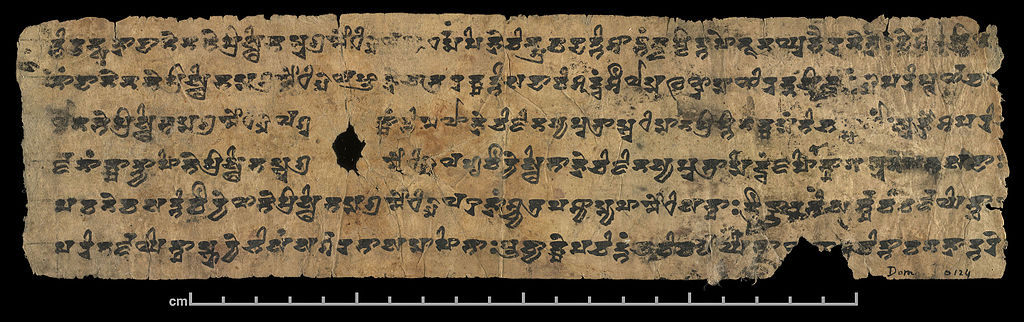
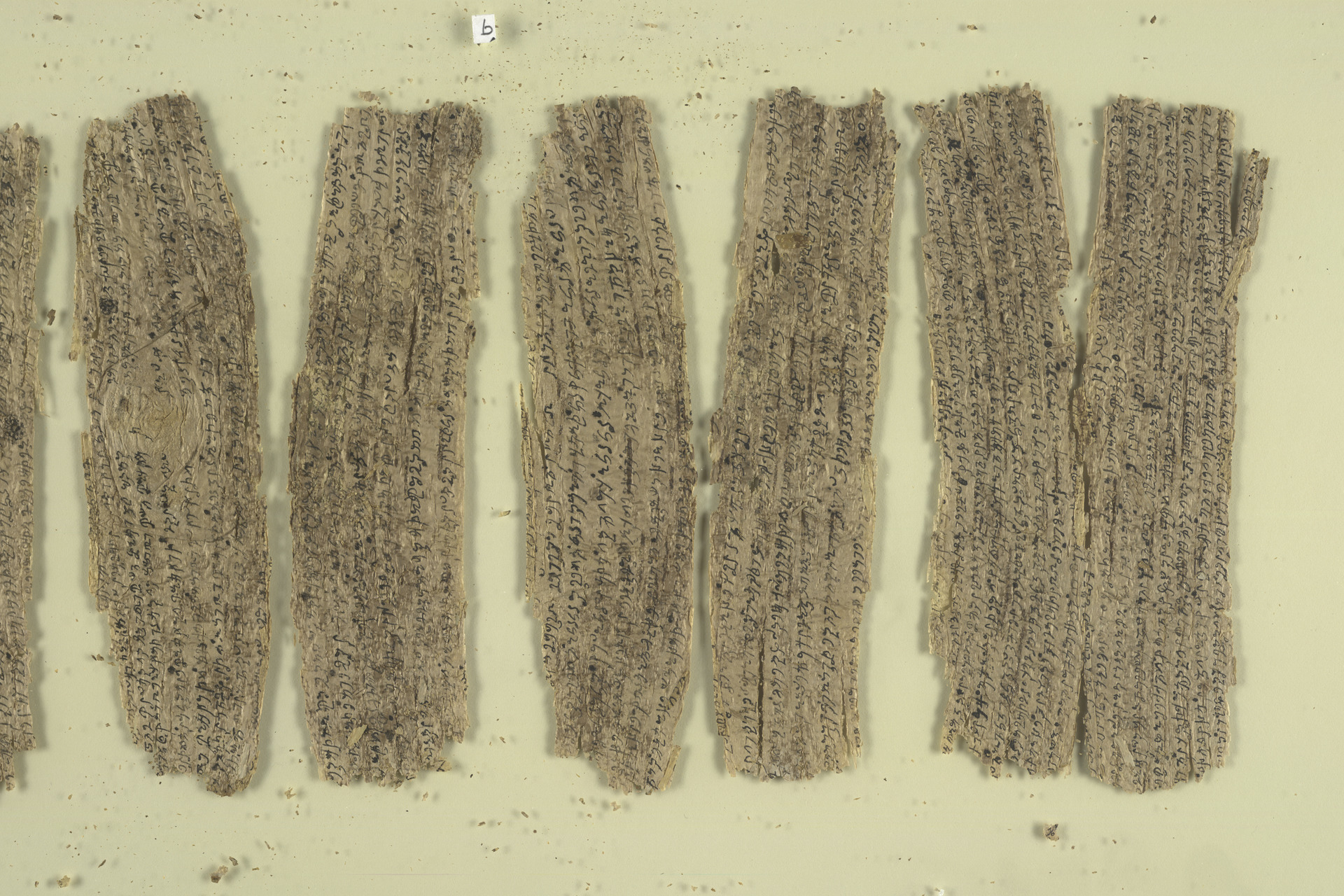
Fragmentary Kharosthi Buddhist text on birchbark (Part of a group of early manuscripts from Gandhara), first half of 1st century CE. Collection of the British Library, CC0, via Wikimedia Commons

Sanskrit is a language that was brought to India by invaders who called themselves the Arya (“the noble”), but had origins in what is now Iran. They came to India sometime after 2000 BCE and settled across northern India and surrounding areas, subjugating the native population, and bringing their religious values with them. From there, we see very early religious inscriptions such as the Rig Veda, composed in very old Sanskrit (e.g. “Vedic Sanskrit”).

But, gradually, Sanskrit and what was spoken informally “on the ground”, diverged. This diverged by regional variances, social classes, etc. They could probably understand each other’s regional dialects the same way that Americans can understand Australian English, and Australians understand American English, or Scottish English, etc, and all of them differ from “textbook English” also known as Standard English.

One might also draw an example from Latin. Classical Latin, such as the writings of Cicero, differed from “vulgar Latin” such as that spoken in the provinces. Further, vulgar Latin as spoken by the Celts in Gaul probably differed from vulgar Latin spoken by Berbers in north Africa or Egypt. Even Cicero’s spoken Latin probably differed than his writings.

A map of the kingdoms of north India roughly around the time of the Buddha. Avantiputra7, CC BY-SA 3.0, via Wikimedia Commons

Such regional dialects or variances of the original Sanskrit included:

  • Magadhi – A language spoken in the kingdom of Magadha, and quite likely the Buddha’s native language. It is spoken today in India as well, but like Ancient Greek has changed over time to its modern version.
  • Kosalan – A language spoken in the neighboring kingdom of Kosala, also mentioned in early Buddhist texts.
  • Arda-Magadhi – “Half-Magadhi”, a possible predecessor to Magadhi above, or at least closely related.
  • Paishachi – A popular, possibly literary-only language, though more research is needed.
  • Maharashtri – A language spoken more to the southwest of India and frequently used in poetry. Modern day Marathi and Konkani derive from it.
  • Gandhari – A prakrit spoken in north-west India, in the important region of Gandhara, and used in some Buddhist scriptures composed in the region, instead of Pāli. Examples of recoverd texts here.

Here’s an example I found on Wikipedia:

In Pali language (we’ll get to that shortly):

Yo sahassaṃ sahassena, saṅgāme mānuse jine;
Ekañca jeyyamattānaṃ, sa ve saṅgāmajuttamo.

Greater in battle than the man who would conquer a thousand-thousand men, is he who would conquer just one — himself.

The Dhammapada verse 103

…compare with Ardhamagadhi:

Jo sahassam sahassanam, samgame dujjae jine.
Egam jinejja appanam, esa se paramo jao.

One may conquer thousands and thousands of enemies in an invincible battle; but the supreme victory consists in conquest over one’s self.

Saman Suttam 125

Speaking of Pāli, what’s up with Pāli? The earliest Buddhist scriptures, or sutras, are recorded in Pāli language, but Pāli isn’t technically a Prakrit like those shown above. It seems to be a language that arose as a kind of lingua franca between Prakrits.1

It makes sense why early Buddhist sutras are recording in it then: rather than recording in each Prakrit for the benefit of local audiences, pick something that was generally understood, even if imperfectly.

Pāli may have arisen around the 3rd century BCE, two to three hundred years after the Buddha, so here’s a hypothetical (repeat: hypothetical) timeline:

  1. The Buddha preached in his native language, Magadhi (assuming that’s what he spoke), probably around the 5th or 6th century BCE. It’s also possible he used other Prakrits as well depending on his audience, assuming they were mutually intelligible.
  2. Disciples remembered his teachings, and per Buddhist tradition, recited them as beset as they could recollect after this death in the First Buddhist Council.
  3. Per existing Indian tradition, the teachings were then passed down for centuries from teacher to students.
  4. As Prakrits developed and diverged over time, it probably became harder to keep things consistent across Buddhist communities, and the communities relied on more. Since it was widely used anyway, this was probably a simple, practical move.
  5. As Buddhist tradition changed from oral to written history, Pāli was the logical choice for some Buddhist schools, such as the Theravada. Other Buddhist school at the time stuck to local Prakrits (some of which became part of the Mahayana canon later), such as in the Gandhara region.
  6. As Buddhism spread even further, and Pāli fell out of use in India, Sanskrit became the liturgical language of choice and Buddhist scriptures, notably in the Mahayana tradition were shoe-horned into Sanskrit in successive waves. Given the rise of Hindu religion, which relied on Sanskrit for scripture, Buddhist communities may have felt the need to “keep up”.

Anyhow, this is speculation, but seems to fit what I’ve learned so far, and shows a fascinating evolution where Sanskrit sets the foundation, but dialects flourish until a new lingua franca is needed (namely, Pāli), until things sort of come full-circle and return to Sanskrit again, at least for the Mahayana tradition.

However, a couple points should be emphasized:

  • The Buddha probably didn’t preach in Pāli language. We may never know exactly what the language was, but it is likely a local prakrit, or more than one.
  • Prakrit languages are neither Sanskrit nor Pāli, but possibly developed in this order (more research needed): Sanskrit at time of migration into India -> Prakrits -> Pāli -> Classical Sanskrit

Thanks for reading!

1 Speaking of “prakrit”, there is not a universally agreed upon standard as to which languages at the time are prakrits, and which ones aren’t. In some broader definitions, Pāli language is considered another prakrit. As an amateur, I have no opinion one way or another.

Happiness

Courtesy of Sententiae Antiquae:

Enjoy!

Learning, Not Parroting

Photo by Pixabay on Pexels.com

This is why I look on people like this as a spiritless lot — the people who are forever acting as interpreters and never as creators, always lurking in someone else’s shadow….It is one thing, however, to remember, another to know. To remember is to safeguard something entrusted to your memory, whereas to know, by contrast, is to actually make each item your own, and not to be dependent on some original and be constantly looking to see what the master said. “Zeno said this, Cleanthes that.” …. Besides, a man who follows someone else not only does not find anything, he is not even looking. “But surely you are going to walk in your predecessors’ footsteps?” Yes indeed, I shall use the old road, but if I find a shorter and easier one I shall open it up. The men who pioneered the old routes are leaders, not our masters.

The Epistulae Morales ad Lucilium of Seneca the Younger, letter XXXIII (33), translation by Robin Campbell

The Big Buddhist Headache: Language and Sacred Texts

Recently, I made a lengthy rant on Twitter about my frustrations with learning Sanskrit in order to read Buddhist texts. The issue is a surprisingly complicated one, and something I wanted to explore here a bit more.

When you look at religions of the world, Buddhism is somewhat unusual in that it is not rooted in a single, sacred text. No Bible, No Quran, etc. Buddhism has many sacred texts, or sutras, all purportedly the words of the Buddha. These teachings where then passed down by his disciples, yet nothing was actually written down until centuries later. This is not as bad as it sounds. By the Buddha’s time, India already had developed a sophisticated tradition around memorizing sacred texts and teaching them disciples. Non-Buddhist examples include the Vedas (the forerunners to the Hindu religion). People believed at the time that writing sacred teachings down would put them on the same level as mundane receipts and political documents, and was thus considered profane.

Attitudes changed by 1st century CE, but by now those sermons of the Buddha that had been carefully passed down were scattered in various collections, and different Buddhist schools had slightly different collections from one another. Worse, the languages used to transmit the teachings had diverged.

Which Language?

The Buddha, in his time, warned against using the priestly Sanskrit language to transmit his teachings, preferring instead local dialects, but even at that time, India had many, many dialects. Pāli was a very popular one, and remains so for some Buddhist traditions, but as Buddhism grew, keeping track of Buddhist sermons via local dialects probably became less and less practical.

Thus, in the end, Buddhist texts began to be recorded in Sanskrit. Every educated person in India probably knew at least some Sanskrit, just like educated medieval Europeans knew at least some Latin or Greek.

This conversion to Sanskrit wasn’t an overnight swap, however. Research into “Buddhist Hybrid Sanskrit” shows that the transformation was a gradual one: Buddhists would first write things down in a way that looked “Sanskrit-ey” (but not actual Sanskrit), then later generations would write something down that actually used Sanskrit, but still peppered with local colloquialisms. Eventually, even later texts were composed in “true Sanskrit”, at least something that Pāṇini would hopefully approve of.

So, what we see is a kind of gradual spectrum from early texts being composed in local dialects (primarily Pāli) and then gradually transforming into Sanskrit.

The difference, by the way, between Pāli and Sanskrit isn’t as dramatic as it sounds by the way. Pāli, like many Prakrits, was a local languages that derived from Sanskrit, and still had much in common with it. Just like Italian, Spanish, French, etc., all derived from Latin in some way.

To illustrate this, let’s look at a basic word like “king”. In Sanskrit, it is rājaḥ, and conjugates like so (not a complete chart):

CaseSingularDualPlural (more than 2)
Nominativerājaḥ (rājo)rājaurājāḥ
Accusativerājamrājaurājān
Instrumental
(e.g. “with” or
“by means of”)
rājenarājābhyāmrājaiḥ
Dative
(e.g. “to” or “for”)
rājāyarājābhyāmrājebhyaḥ
Note: due to Sandhi rules, rājaḥ frequently becomes rājo to smooth things out. Sanskrit also has Genitive, Ablative, Locative and Vocative cases too., but I’ve omitted them for brevity.

…and so on. Pali is a bit more streamlined by comparison being a more colloquial language by nature, so one word for king is rāja (i.e. without the visarga ḥ sound at the end):

CaseSingularPlural
Nominativerāja (rājo)rājā
Accusativerājaṃrāje
Instrumental
(e.g. “with” or
“by means of”)
rājenarājebhi or rājehi
Dative
(e.g. “to” or “for”)
rājāya or rājassa1rājānaṃ
This form appears to be more commonly used according to this Pali textbook written by Ven. Nerada Thera

At first glance, Pali kind of reads like the kinder, gentler version of Sanskrit. The dual form is almost entirely non-existent,2 and the sounds are softer, and lacking the ḥ (visarga) at the end. However, you can see they share similar grammatical structures, pronunciation, etc.

So, the first challenge with Buddhist text is this gradual transition from local dialects to literary Sanskrit, spanning hundreds of years. If you picked a particular Buddhist sutra, it might be somewhere in the middle of this transition: is it Pali? is it Sanskrit? Sanskrit with Pali terms, or Pali with a Sanskrit “polish” to it?

How Is It Written?

The second issue is the written script.

Some languages are closely tied with their script: Greek language is written in the Greek alphabet (obviously), while Korean is written in Hangeul. Other writing systems are not: the Roman alphabet is used in many languages: English, French, Vietnamese, etc. In medieval times, Chinese characters were used by a wide variety of disparate languages: Chinese, Japanese, Vietnamese, Khitan, etc.

So, languages are not always tied to a particular writing system. Also. some writing systems are not tied to a particular language.

Sanskrit (and Pali) have been written down using a wide variety of scripts across the ages. Early writings were done using Brahmi script, and Brahmi itself evolved into newer and better writings systems over time leading to the most common example today: Devanagari.3 Many, many modern languages in India and beyond are written in some script derived from Brahmi.

This includes Buddhist texts, too!

Inscriptions by Emperor Ashoka might be written in old Brahmi script:

An inscription from the Pillar of Ashoka at Sarnath, CC BY-SA 3.0 http://creativecommons.org/licenses/by-sa/3.0/, via Wikimedia Commons

…while texts written in palm leaf might also be written in Sanskrit, but using a derivative script:

The Lotus Sutra written in Sanskrit in an early form of South Turkestan Brahmi script, courtesy of Wikipedia.

You can see that while both are Buddhist (or Buddhist-historical) subjects, they are not necessarily written in the same script. Further examples include later Siddham script, often used in mantras and other esoteric practices by some schools:

The Heart Sutra as written in Siddham script, courtesy of Wikipedia

Then there’s other one-off, but important scripts like Karoshthi and so on.

This is not that unusual by the way when dealing with widely-used languages from antiquity, by the way. Although Greek was always written in the Greek alphabet, the style of writing could be vastly different depending on regional variations, such as those found on Egyptian papyrus vs. modern textbooks. Latin wasn’t always written in big block letters; it had its own cursive form that was more frequently used, and is pretty obtuse to modern Westerners without some training first.

Does Any Of This Matter?

For the average day-to-day practice of Buddhism? Nope.

Buddhism has always been at heart a religion of practice, not dogma. The Buddhist tripod of wisdom, conduct and practice (i.e. chanting, meditation, etc) has two “legs” which involve day to day action. Wisdom is important too but differs from dogma in that it’s not something you believe, but something you learn.

So, you could follow the Buddhist path perfectly fine if you focus on these things, and never bother with ancient languages, relying on acceptable translations instead. Studying the sutras is a helpful practice in Buddhism, but there are already plenty of good translations.

However, if you get into a more professional position either as a teacher, scholar, monk, nun, or priest, etc., knowing some command of Pali, Sanskrit, Classical Chinese, or Tibetan is really helpful. It won’t necessarily make you a better Buddhist, but may help you be a better teacher to others.

Back in 2019, I tried my hand at learning Sanskrit, with the intention of reading Buddhist texts natively, partly for fun, partly for curiosity, partly because I was frustrated by shoddy, overly sectarian translations. What I found is that modern Sanskrit courses and texts overwhelmingly focus on Hindu content, and insist on teaching Devanagari script, which makes sense, but neither of which is appropriate for the study of Buddhism.

Thus, my efforts to learn Sanskrit have languished for a long time.

These days, I would like to try again, but I believe that to effectively learn Sanskrit for the purposes of studying Buddhist texts, the following caveats might be helpful:

  1. Learning Devanagari is not required. Buddhist texts are written in a wide variety of scripts but usually not Devanagari. There are some excellent resources for Buddhists texts preserved in Sanskrit, but using the Roman alphabet. This may sound weird, but as we discussed above, Sanskrit has never been tied to one writing system. One script is as good as another. Seriously.
  2. Much of Buddhism’s corpus of sutras and sacred texts aren’t even “pure” Sanskrit anyway. Just as one might learn ancient Greek starting with Homeric Greek before moving onto Koine, the study of Buddhist texts may benefit by starting with Pāli and then migrating to Sanskrit as needed. Even learning a bit of Pāli might be a nice way to get back in touch with early Buddhism and as close to the Buddha’s words as we might ever get.
  3. Alternatively, rather than trying to use a “one size fits all solution”, find a Buddhist text you are interested in, and determine how it was written, what language, etc, and start from there. Again, there are parallels to ancient Greek. The New Testament isn’t written the same way as Euripides, nor Hesiod. You have to accept that Buddhist texts are similarly written at different times by different people.
  4. One thing I haven’t really talked about so far is Classical Chinese. Much of the Buddhist canon, now lost in India, is preserved in Chinese and epitomized in the Taisho Tripitaka formalized in Japan in the 1920’s. If you want to study ancient Buddhist texts, studying them in Classical Chinese might just be as useful, if not more useful, in some cases. The Heart Sutra, for example, was first written in Chinese and then back-ported into Sanskrit later when Xuan-zang journeyed to India.

Anyhow, this is one amateur’s look at the situation, something I’ve learned the hard way. Your mileage may vary, but if you wish to study ancient Buddhist texts, I hope this helps.

2 According to this textbook, only two words in Pāli have a dual form: dve or duve (two), and ubho (both).

3 Southern Indian languages also use scripts adapted from Brahmi, but through different evolutionary course, hence they look quite different than northern Indian languages.

Samsara: the Great Cosmic Rat Race

Samsara, the “aimless wandering” of Buddhism is a difficult concept to grasp, but also pretty fundamental to understanding the Dharma.

Buddhism as a religion sees the Universe in terms of huge time and huge space. This is a contrast to Western religions which tend to see the Universe in a smaller, fixed time (i.e. several thousand years, maybe some more). The gist of saṃsāra is that the Universe has existed for a near-infinite amount of time, and that beings have been migrating here and there, from one lifetime to another, in it. Not a dozen past lives, or even a hundred, more like a near-infinite number of past lives.

Further, the breadth of the past lives also varies quite a bit. In the traditional Buddhist cosmology, there were 6 broad categories of states of rebirth:

  • Devas or gods (or divine beings in general). They live in varying states of bliss, and can live very long lifespans, endowed with great powers, among other benefits. But even they must die and be reborn someday.
  • Humans.
  • Asuras or titans (another category of divine beings). The Asuras are at war with the devas, not unlike the wars between the Olympian gods and the Titans, and are prone to war, anger and violence.
  • Animals. They live in a constant state of eat or be eaten. Their existence is limited to the basic needs of survival.
  • Preta or hungry ghosts. These beings live a miserable existence marked by constant hunger and agony, slinking in the shadows, eating scraps of refuse, etc.
  • Hell. Vaguely similar to Dante’s Inferno, Hell is a many-realmed place with many different forms of torment, suited to different transgressions. As with the Devas and other realms, this is a finite torment that lasts until one’s karma is exhausted. However, depending on the severity, one can be there a very, very long time.

The nature of the six realms of rebirth is subject to many forms of interpretation, too many to go into here, but the point is that sentient beings migrating across one lifetime to another across such a long, long period of time eventually have lived all these states at least once.

This leads to a sense of malaise. One has probably been rich and famous in the past, one has probably been ugly and poor in the past, one has lost loved ones, one has fallen in love countless times, etc, etc. It’s all been done before, and there’s no sense of long-term “direction”, hence it is described as aimless wandering. Another way of describing samsara might be the “Great Cosmic Rat-Race”.

In a old, old sutra from the Pali Canon, the Buddha describes it like so:

“This is the greater: the tears you have shed while transmigrating & wandering this long, long time—crying & weeping from being joined with what is displeasing, being separated from what is pleasing—not the water in the four great oceans.

Translation by Ven. Thanissaro Bhikkhu, from the Assu Sutta (SN 15:3)
Photo by Sebastian Voortman on Pexels.com

In light of all this, this is why the Buddha teaches liberation as a means of breaking this ad nauseum cycle of rebirth. Initially, this is liberation of oneself, but as one progresses on the path, this turns outward toward liberation of others as well. Mahayana literature in particular greatly idealizes this notion of liberation of all beings, as epitomized in the Lotus Sutra and its Parable of the Burning House (chapter 3), and the vows of Dharmakara bodhisattva in the Sutra of the Buddha of Immeasurable Life, among other places.

The concept of the “bodhisattva” evolved along with it: a being who vows to rescue all beings before completing their own vows to achieve enlightenment (buddhahood).

Photo by Oleg Magni on Pexels.com

Another way to describe samsara, and also the process of liberation was to cross a river from one shore, symbolizing ignorance and strife, to the other, symbolizing wisdom, insight and peace of mind.

Anyhow, all this is to say that the Buddha perceived the rat race of life long ago, but the Dharma sees this rat race as not limited to a single lifetime, and central to the challenges of life, and the need for a long-term direction to one’s life beyond meeting basic needs.

Reading Kids Manga In Japanese

My kids and I love playing the game Splatoon 2, a quirky game with a lot of satire on Japanese society, but also some very creative backstory too. We love playing Ranked Battles, but I am consistently trying to keep up with my kids who are both B ranked, while I am still mostly C or C- rank.1 😅

Our love of Splatoon has extended into reading the manga too. My son is learning to read, and with remote learning and lockdown, it was hard to get the reading education he needed (we have great teachers, the issue was remote learning). Finding something that he wanted to read was the biggest challenge. We found the Splatoon manga, English translation, at a local bookstore, and my son instantly loved it. He kept asking me how to read this or that, and before long he was reading the issues by himself. The change in attitude and reading skill was frankly startling.

Japanese edition of issue 1

However, my kids also learn Japanese too since they are biracial. We’ve tried really hard to keep parity between both languages, and thanks to distance-learning services in Japan, we’ve been able to get the older sister to be pretty proficient in Japanese. Our son has struggled a bit more, so we decided to get the Japanese version of the Splatoon manga for him too by ordering online.

He enjoys reading them in both Japanese and English, while I have also grown to like reading them in Japanese too.

In the past, I have read other Japanese manga, my other favorite is Saint Young Men, but many of the manga that I have read are for adult audiences, and feature adult jokes and vocabulary. It’s easy to get lost, and give up. Reading kids manga is certainly easier, but the stories aren’t interesting, or it’s just a bit embarrassing to read something so elementary.

However, with the Splatoon manga, I found something that is relatively easy for me to read, while keeping my interest. I have tried not to invest too much time looking up every single word (most are kind of obvious in context anyway), so I can finish a Japanese-language version of the manga in reasonable time. It’s a nice thing to read, plus some of the gags just sound better in the original language.

Anyhow, admittedly, I’ve usually frowned upon anime and manga because they are so closely associated with diehard Japan nerds, while I am arguably a Japan nerd, it’s not something I like to advertise outside of the blogosphere. I had too many bad experiences with Japan nerds in college and beyond.

But seeing at how much my son enjoys manga in both English and Japanese, I can see that if you find a good series, it is a great medium to introduce kids (and language-learning adults) to a world of fun reading.

1 I feel a sense of irony in this. When I was a kid, and owned an NES system, I used to play Ice Hockey with my dad, who got floored every time we played. I didn’t really think about this until as a parent myself. I personally don’t mind if my kids exceed me, in fact I am kind of glad, but as a long-time gamer I also don’t plan on giving up so easily either. 😏

This One Trick Will Help You Learn Languages Faster

“Language teachers hate it when you do this!”

I couldn’t resist starting this post with some click-bait text. 😬 Recently I saw this post on Twitter:

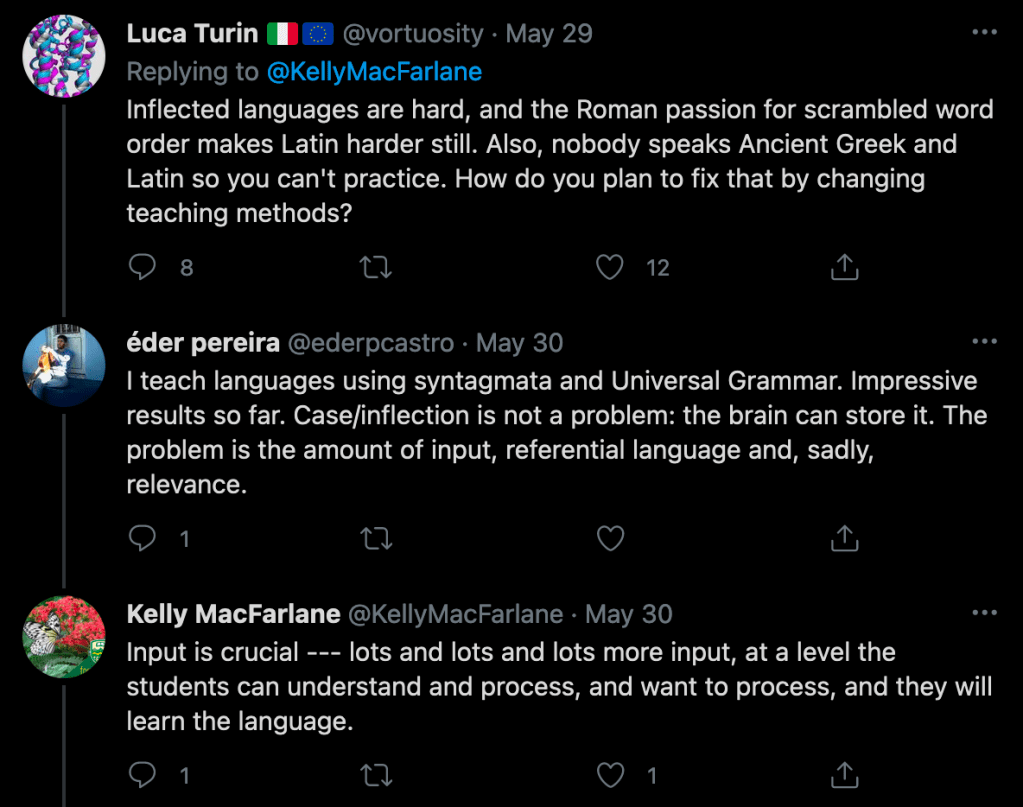
This leads to a heated exchange on Twitter, including the following:

Basically, the point here is is that if you want to learn a language and communicate smoothly, you need A LOT OF INPUT. Like, a sustained, overwhelming amount of input. It will not make sense at first, but gradually you’ll start to piece together the ineffable patterns in a language, and without thinking, you’ll know how to correctly speak your mind, or respond to someone else’s words.

It took me a long time to realize this, after I had wasted countless hours cramming and studying. The studying does serve a purpose, in so far as it helps get you on your feet, but if you’re starting out on a language, the sooner you prioritize input, the easier you will pick it up and improve. It’s not only stimulating for your mind (great for old folks like me), but also it helps bridge the gap between the “textbook” examples you first learn and real life ones, and the real life ones are the ones you should be imitating the most.

What does input mean here? Any kind of exposure you can find: movies, podcasts (my personal favorite), TV shows, just listening to other people speak in real life, etc. Soak it up like a sponge, and don’t get discouraged if none of it makes any sense even after 3 months, or 6 months. If you are learning classic languages like Latin and ancient Greek, just keep reading. Bit by bit, it’ll all become second nature.

I realized that comprehending adult conversation in real time is like catching a school of fish. If you try to reach out and catch it with your bare hands, the fish will swim away, but if you relax and just let the fish swim around you, they’ll get closer and closer and you can easily catch them. Language comprehension works an awful lot like that.

Hard to explain, but if you’ve ever learned another language well, you’ll realize that you’re mind has somehow transitioned to a state where it fluently comprehends it without having to mentally translate from your own native language, which is what a lot of new students tend to do. No conscious thought here, just comprehension.

Enjoy and happy language learning!

Siddham: The Forgotten Buddhist Script

Taken at Kawasaki Daishi temple (Shingon sect) in 2017. This is the Sutra Hall. Notice the Siddham script on the left plaque (with pronunciation guides) and Chinese characters on the right.

In the past, I have dabbled in learning Sanskrit, which is an ancient Indian language, and the foundation of many other modern languages. Sanskrit is to South Asia, what Latin is to western Europe.

Sanskrit is a tricky language though. Speaking from limited experience, it has many grammatical similarities to Latin and Greek (hence they’re all included in the Indo-European language family), but Sanskrit feels like an older language compared to the other two, which is saying a lot. The nouns have 8 declensions compared to 5 in Latin and 4 in Greek, plus it still uses dual-case which was obscure even in ancient Greek times. By the time Latin rolled around, much of this was “smoothed out” and simplified, and Latin in turn has been smoothed out and simplified across the centuries into what we know now as French, Spanish, Italian, Romanian, and so on. But that’s all a story for another day.

The other issue with Sanskrit is the writing system. Actually, systems. Greek and Latin both derive their writing system from the Phoenicians, and these largely did not change. Sanskrit, in a sense, has no native writing system. Instead, it has gone through multiple, separate writing systems, some also descended from the Phoenicians via Aramaic, and each one has its own complex history. Many of them are also gone now, lost to the ages.

Nowadays, Sanskrit is typically written in the beautiful Devanagari script, which is also used in Hindi and many other modern north-Indian languages to various degrees. Devanagari gradually replaced alternative Sanskrit writing systems centuries ago. This also happened roughly around this time that Buddhism died out in India,1 thus you practically never see authentic Buddhist texts composed in Devanagari. Instead, they appear in other, older scripts like Karoshthi based on Aramaic (as in what Jesus spoke natively!), Brahmi script (used by Emperor Asoka), and so on. But one such script still survives, not in India, but in Japan: Siddham script locally called bonji (梵字).

Siddham is preserved in Buddhist texts, but especially in esoteric Buddhist mantras and other practices, particularly in older Japanese Buddhist sects such as Tendai and Shingon. This was the time when esoteric Buddhism was all the rage in Tang Dynasty China, and contacts with India via the Silk Road were still alive and well, thus allowing teachers from Central Asia to come and teaching local students. Most other, later Buddhist sects in Japan use it sparingly or not at all because their approach is not really esoteric in nature (Pure Land Buddhism, Zen, and Nichiren).

But Siddham shows up in other places too. If you look carefully you can also see it in the Marvel movie Dr Strange:

The Book of Cagliostro

Here’s an example “stamp” from my pilgrimage book, which shows a mix of Japanese calligraphy and Siddham characters:

The stamp above is from the temple of Zojoji Temple in Tokyo, Japan, one of two head temples of the Jodo Shu (Pure Land) sect. Note the red stamp in the middle with the Siddham character hriḥ 𑖮𑖿𑖨𑖱𑖾 2 which I believe is symbolic of Amida Buddha (the primary devotion in Pure Land Buddhism).

Another example is a stamp I got at a Soto Zen temple named Toyokawa Inari:

This temple, which has an unusually esoteric flavor for a Soto Zen temple, uses Siddham letters in the stamp (red letters in the middle) in the form of a mandala or something similar.

Here’s a couple Youtube videos on how to write Siddham script. I like these videos because they show a simpler, more straightforward way of writing Siddham compared to the flowery, flowing calligraphy used in esoteric Buddhism. This makes it more suitable for writing on paper with a pen, not using an ink brush.

Siddham is something you’ll likely see in Japan, but it’s fascinating once you realize that this writing system from India for composing Sanskrit is now only preserved in far-flung places like Japan even after it has died out in its homeland. It’s a fascinating, often forgotten piece of religous-linguistic history.

1 For this reason, modern textbooks on Sanskrit are good for teachings the grammar of Sanskrit, but not how to read ancient Buddhist texts: the writing system doesn’t match, and culturally the books tend to focus on translating the vast corpus of Hindu literature, not Buddhist literature despite the common origin.

2 in HTML Unicode: & #x115ae;& #x115bf;& #x115a8;& #x115b1;& #x115be; with no spaces between the & and # … yes 5 characters required because it comprises of “ha”, followed by the virama mark which cuts off the subsequent “ra” to form an “r”, and finally the long “i” followed by the two dots (visarga marks). I didn’t say it was easy, but it’s totally doable if you take the time to learn HTML and Unicode and then just apply Siddham Unicode numbers to it.

Learning Japanese The Classics Way

Recently while stuck at the dealership waiting for my car to get fixed (flat tire), I got into a weird thought exercise about how to learn Japanese language. I started learning Japanese on my own way back in the late 1980’s (back when Japan Inc was super cool to impressionable teenagers) and then in college in a formal setting, and later again when I studied for the JLPT exam on my own (reached JLPT N2 in 2012).

Photo by Audrey Mari on Pexels.com

Needless to say, I’ve learned Japanese a number of ways over the years, and I’ve never quite liked any of them. Japanese as a language is pretty fun and interesting, but I have come to dislike most approaches to explain Japanese grammar because either they weren’t very clear (explaining the differences between particles は and が supposedly can fill a book, I was once told), or they they just didn’t produce good results. I still get the conjugations of 切る and 着る, both read as “kiru” but conjugate different, mixed up on a regular basis, and I don’t want to even mention the Heisig Method of learning kanji.

Thankfully, there are some really nice, modern approaches to Japanese. I really like Tae Kim’s excellent Guide to Japanese and I can say that it helped me to fix some old, bad habits, while also explaining grammar concepts in new, fresh ways. I just wish it had existed when I was learning Japanese.

Meanwhile, as a fun personal exercise under lockdown, I’ve been (re)studying Latin through the Great Courses class taught by Hans-Friedrich Mueller. Learning Latin, probably the most studied language in Western culture since antiquity, made me realize that Latin’s approach to learning is pretty effective in some ways. The way things are categorized, dissected and studied means that if you learn Latin properly, you can learn Latin surprisingly quick. It’s a fair amount of work upfront, but once you get past that first hill, it’s actually not that bad.

As with Japanese, I had learned a bit of Latin before ages ago, but while the books were well-respected (and fun), they were not always effective. I would quickly get bogged down by the time I got to the third-declension nouns, and I never quite recovered. Trying again with a fresh, different approach through the Great Courses really helped me get past the old hurdles, and now Latin makes a lot more sense. The issue was never the language (just as with Japanese), but how it’s conveyed, and how people build foundations.

So, while at the dealership, I got to thinking, can the same approach be applied to a totally different language like Japanese? Is there better ways to build solid foundations in Japanese to avoid future headaches and frustrations? I think “yes”. We can’t always rely on tradition to teach a fascinating language like Japanese, we as language students (and educators) should be tilling the soil over and over to find better and better ways. Latin has had the benefit of this for 2,000 years in the West and there’s no reason why we can’t do the same for other languages.

This post is a first-attempt at applying a Classics-style language course to Japanese. It’s far from perfect, but if you’re studying Japanese and have even a basic Classics education, hopefully this will make sense. And if you have never learned Latin or Greek, I highly recommend Professor Muller’s courses. They’re terrific.

Nouns and Particles

Nouns are particularly easy in Japanese because there’s no conjugation at all. What you see is what you get. The tricky issue comes with how they interact with particles. Particles have no direct analogy in Latin or English, but nevertheless, they can still be translated the same way.

For example in Latin there are five conjugations to express which part of the sentence a noun belongs to (major credit to Professor Muller for this explanation):

  • nominative (the subject) – mīles, a soldier
  • genitive (of the noun) – mīlitis, of the soldier
  • dative (to or for the noun, indirect object) – mīlitī, to or for the soldier
  • accusative (noun as the direct object) – mīlitem, something done to the soldier
  • ablative (by, with or from the noun) – mīlite, by with or for the soldier.

Ancient Greek has the first four, for what it’s worth. Plus both Greek and Latin have plural versions of these conjugations too.

Japanese particles fulfill the same roles, though, even if expressed differently. Instead of changing the ending of the noun as shown above, you take on an extra syllable:

  • nominative: use は (wa) or が (ga, more on this below) – 犬は・が, the dog …
  • genitive: use の (no) – 犬の, the dog’s, of the dog
  • dative: use に (ni) – 犬に, to or for the dog
  • accusative: use を (wo) – 犬を, something done to the dog.
  • ablative: で (de) or と (to) depending on context: 犬で, by the dog or with the dog (instrumental case), 犬と with the dog (accompanying).

As you can see, Japanese particles do not map 1:1 in usage and context as Latin/Greek cases, but you can see that between them all the essential grammatical bases are covered.

The whole は (wa) or が (ga) issue was hopelessly complicated to me when I was in Japanese language classes in college, but Tae Kim’s Guide to Japanese does a really good job of clarifying this. The particular が in particular is really just there to address three possible questions: who, which and where. By contrast, は just marks the topic, or is used for contrasting with other topics/subjects.

Verbs

Verbs are important in Japanese, especially since you can have a whole conversation in Japanese with verbs only (everything else is implied by context):

A: tabeta? (from context, “did you eat”?)

B: nn, tabeta. (“yup, I did.”)

Verbs in Japanese have their own inflections that don’t exist in Western languages, and remembering the conjugations can be tricky, especially because there are two types:

  1. ichidan (一段) verbs, sometimes called “ru-verbs”.
  2. godan (五段) verbs, which also include some “ru-verbs” (such as “kiru” above).

Example inflections for 切る (godan) and 着る (ichidan), both read as “kiru”, are as follows:

切る (kiru)着る (kiru)
dictionary formkirukiru
te-formkittekite
potential formkirerukirareru
causative formkiraserukisaseru
polite (masu) formkirimasukimasu

You can see how the subtle differences can throw of a student in Japanese.

So, in Latin (and Greek), verbs are usually expressed as a series of principal parts. The verb “to read” is expressed fully as legō, legere, lēgī, lēctum whereby legō is present active (“I read”), legere is the active infinitive (“to read”), lēgī is the past tense (“I read”) and lēctum is the perfect passive participle (“the X who’s reading”). By memorizing the entire set of principal parts up front, the rest of that Latin verb can be conjugated quick and easy.

To me, the same approach can be applied to Japanese verbs, just with different principal parts. By knowing both the dictionary form, and the te-form of a verb you can quickly identify if it is a ichidan verb or a godan verb and conjugate accordingly. I would probably also throw in the “masu” polite form and maybe something like passive form too for completeness.

So, for 着る, the principal parts in my mind are 着る、着て、着ます (kiru, kite, kimasu). The “ru” stem in dictionary form + the te-form with no small “tsu” tells me that this is an ichidan verb.

Similarly, for 切る: 切る、切って、切ります (kiru, kitte, kirimasu). The “ru” ending in the dictionary form, plus a small “tsu” in the te-form tells me that this is a godan verb, so I can conjugate accordingly.

For other verbs, for example 飲む (nomu): 飲む、飲んで、飲みます (nomu, nonde, nomimasu).

…and so on. The key here is that by memorizing a verb by its principal parts, you can easily intuit what type of verb it is, and know how to form the rest. The te-form is used in many ways, so memorizing it upfront, even you don’t know how to use it yet, saves a lot of headache.

In the case of Japanese this is less crucial in some ways than Latin/Greek because you can easily figure out the rest by converting the verb ending to the right ending for the right conjugation, but knowing the “root forms” that the other conjugations are based off of is a time-saver, especially when dealing with ichidan verbs and godan verbs with “ru” endings. There are quite a few.

Adjectives and Adverbs

Since Japanese doesn’t use grammatical gender like Latin and Greek verbs (no masculine, feminine, etc) they are fairly straightforward to conjugate. Unlike Latin, Greek or English, Japanese adjectives can express negative (not) and past-tense, but again the grammar is very consistent and easy to use.

In place of learning grammatical gender for adjectives (as in Latin/Greek), I think it would be sufficient to teach adjectives simply as their dictionary form + dictionary-negative form. For example:

  • 安い: “cheap” which has forms 安い、安くない
  • 静かな: “quiet” which has 静かな、静かじゃない

For the “na” adjectives, such as “quiet”, I don’t know if it’s proper to include the な at the end of the adjective or not, but since it’s not used in some forms, it seemed proper to leave it out but then again, as with the verbs and principal parts, knowing up front that it has a な will tell you how to apply it to modifying nouns and such based on established grammar rules. The key here is treating these as teaching aids, I think.

Adverbs of course are super easy, barely an inconvenience. You just attach them right before the verb. Voila.

Conclusion

This whole mental exercise in expressing Japanese with Classics-style teaching aids needs a lot of work, and folks who are much better at Japanese than me will understandably disagree. What I wanted to do is to stimulate thinking about how to teach Japanese more effectively, more concisely so people can establish good foundations. Japanese is different than English, a lot different, but when you come to grips with its own internal logic and structure, it’s really not that hard. The trouble is how its conveyed in language education, and I hope people will continue finding newer, better ways to overcome that hurdle.

頑張りましょう!

P.S. yes, kanji is a pain, but you shouldn’t be brute-force memorizing them anyway.

“Ondoku” Your Way to Smoother Language Skills

I have been studying Japanese language more or less since I was in college, twenty years ago, and much of that has been self-study. I have never lived in Japan, but my wife is from there, and we visit there every non-pandemic-year to see family, etc. Plus, I passed the JLPT N2 exam in 2012. As such, my language skills in Japanese are in a weird state of not being fluent, but not beginner either.

My wife and kids, who are both fully bilingual, tend to poke fun of my Japanese at times, since my grammar usage and pronunciation are kind of funny. I get mentally “gummed up” and use the wrong Japanese particle, or other funny usage, but conversely, I can read Japanese computer books without too much difficulty. So, in a way, my skills are kind of lop-sided, and the result of too much self-learning, not enough practical application.

Anyhow, my wife recently passed along some advice from my kids’ after-school Japanese-language teacher (who’s a good family friend of ours): practice reading aloud more. This is called ondoku (音読, “Ohn-doh-ku”) in Japanese.

It seemed kind of silly at first, but I realized that my kids had grown up here in the US doing that weekly as their Japanese-language homework: read an essay out loud 10 times. The essays were short, maybe 2-3 minutes of reading at a time, but reading 10 times reinforced the intuitive “flow” of Japanese, while also helping to smooth out their speaking and pronunciation skills, two things I sorely lack.

In fact, this isn’t limited to Japanese. My old Latin textbook, the famous Wheelock’s Latin one, also recommends reading Latin out loud to get used to the flow and pronunciation. Similarly, when I was dabbling in ancient Homeric Greek, the professor in my online course recommended the same thing: read aloud.

The point here is: whatever language you are learning, make a habit of reading aloud small sections of text 10 or so times to get the hang of it, then move on to other texts and repeat.

The idea is to create an easy, low-stress, sustainable routine:

  1. Find some authentic text in that language that is easy to read (if you get hung up on adult Japanese text, with its advanced Chinese Characters, move to an elementary school text and work your way up).
  2. Pick a small excerpt that you can read in 2-3 minutes, not too long, not too short.
  3. Practice reading it 10 times over a week.
  4. Find a new excerpt for next week and repeat the cycle.

For my part, my wife found this 1st grade level science book:

「10分でわかる!かがくのぎもん」(juppun de wakaru! kagaku no gimon) by Egawa Takio. Title roughly translates into “Understand Science in 10 minutes!”

The Japanese is very easy, with no Chinese Characters (even though I can read a fair amount). That way, I can focus on reading out loud. I read one essay last week 10 times, three times in front of my wife, and have started reading a second essay this week.

It’s hard to gauge results since I only started, but I know my kids had been doing it for years, and their conversational skills are quite smooth, so I know it works. And because the activity is fairly easy and low-stress, it’s frankly kind of fun, plus I learn interesting little tidbits, such as why crickets have long antennae. 🦗

To be honest, reading in front of a native speaker can be really embarrassing, but it’s really important not to personalize it, especially when they give you advice. Just roll with it, and remember it’s not meant to humiliate you. It’s meant to help you. Also, I am sure native speakers will appreciate you asking for help, so there’s that too.

So, if you’re learning a language, try reading aloud and have fun!