While Duolingo has been a pretty fun introduction to the Ukrainian language, it clearly has some limitations with respect to explaining grammar rules, pronunciation and (obviously) writing.
So, a little while back I picked up a textbook on Ukrainian and it has been vastly helpful in filling in the blanks of my knowledge. For example the letters Я (ya) and Ю (yu) become “a” and “u” if they come after a consonant. Wish I had known that sooner.
Another area that the textbook helped with was writing Ukrainian. It turns out that Ukrainian has a cursive form of handwriting, it’s fairly different than “print” Ukrainian, and it’s frequently used, unlike cursive in English.1
Here is me practicing Ukrainian handwriting in my little notebook:
As mentioned earlier, some letters are noticeably different than the print version. The letter Т looks like a cursive “m”, while cursive М looks like the Greek letter μ (mu), while И looks like cursive “u”. Small letter д looks like a cursive “g”, while small б looks like Greek δ (delta), and so on. The word for dad, тато, in cursive looks like тато in cursive. The word вегетаріанець (vegetarian male) becomes вегетаріанець in cursive.2
At first, this feels pretty confusing, and tutorials on YouTube don’t always explain the nuances and differences clearly because they are taught by native speakers who just intuitively know. Thankfully, I have some pretty helpful resources shown below under “updates”.
In any case, what I can say as a non-native speaker, is that with time, practice, and a good textbook, it does eventually get easier and easier and in time your handwriting becomes more legible. Writing practice in any language can be a nice stress-reliever too. 🥳
Update: This book has been very helpful in clarifying Cyrillic (cursive and print) handwriting for Ukrainian:
Highly recommend!
Update 2: out of all the Ukrainian cursive handwriting videos, I’ve found this one the most useful:
1 I learned cursive writing when I was in grade school, but my children barely touched it. Personally, it’s a bit sad to see it fade away, but then again I never used it very much anyway, even before the Internet. Not everything is necessarily worth preserving.
2 As I learned while writing this, using italic font for a word converts it to cursive.
My studies of Ukrainian language continues, alongside my efforts for the JLPT exam, and lately I have been in the weeds with numbers.
один (odin)
два (dva)
три (trih)
чотири (chotihrih)
п’ять (pyach), etc.
An observant person may notice that they’re clearly similar to more familiar languages, including Latin and ancient Greek. Definitely a close relation, or mutual influence, who knows?
But the way things are counted in Ukrainian is interesting. Take the following example:
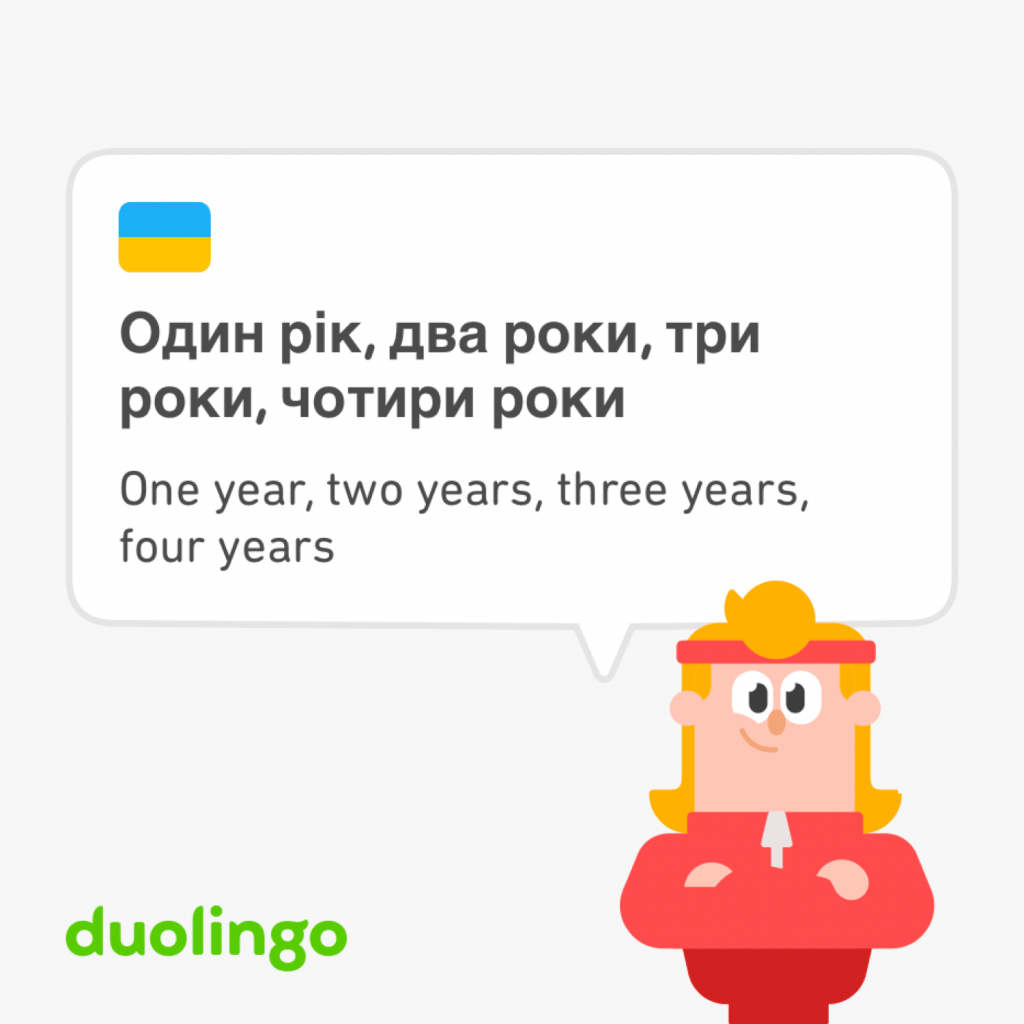
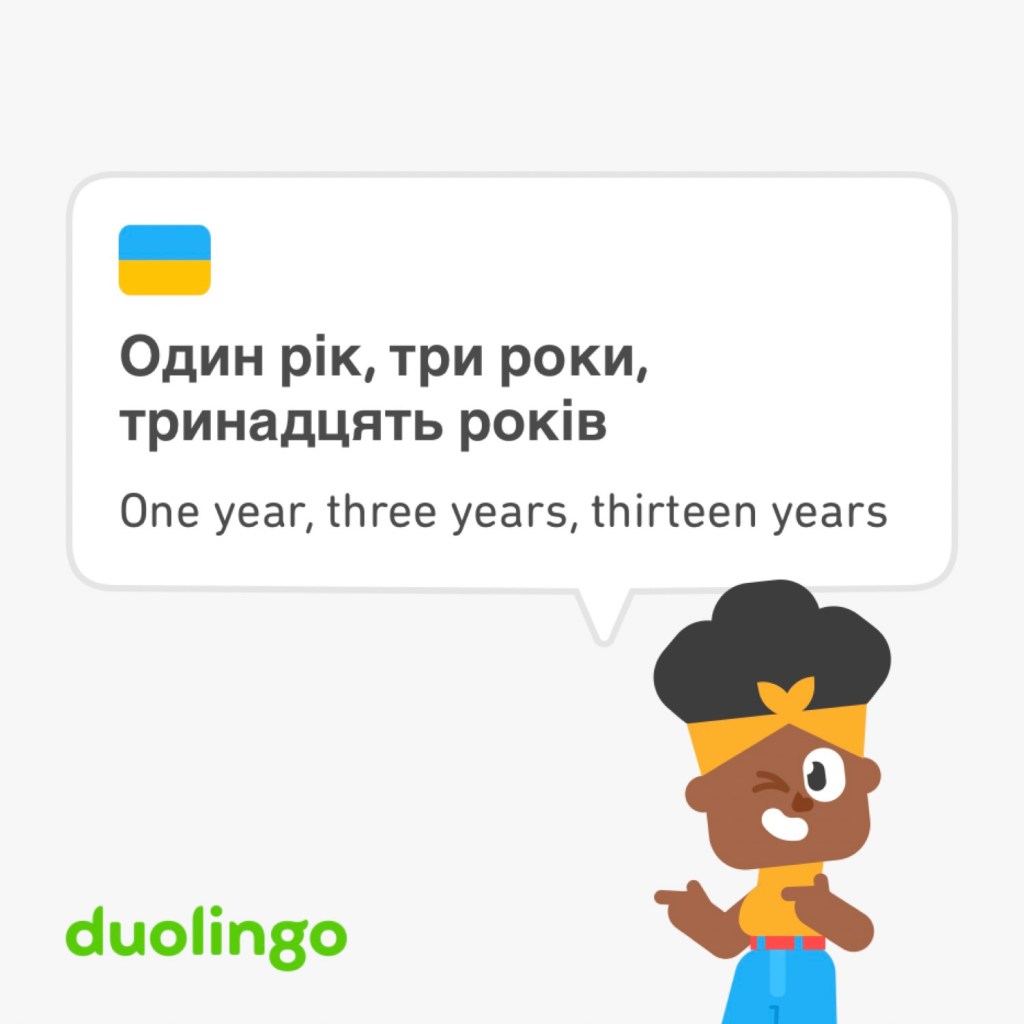
English has “singular” and “plural” endings for nouns, but Ukrainian appears to have three endings for singular, between 2 and 4, and 5 or more. One year (рік, “rik”), two years (роки, “rokih”) and thirteen years (років, “rokil”).
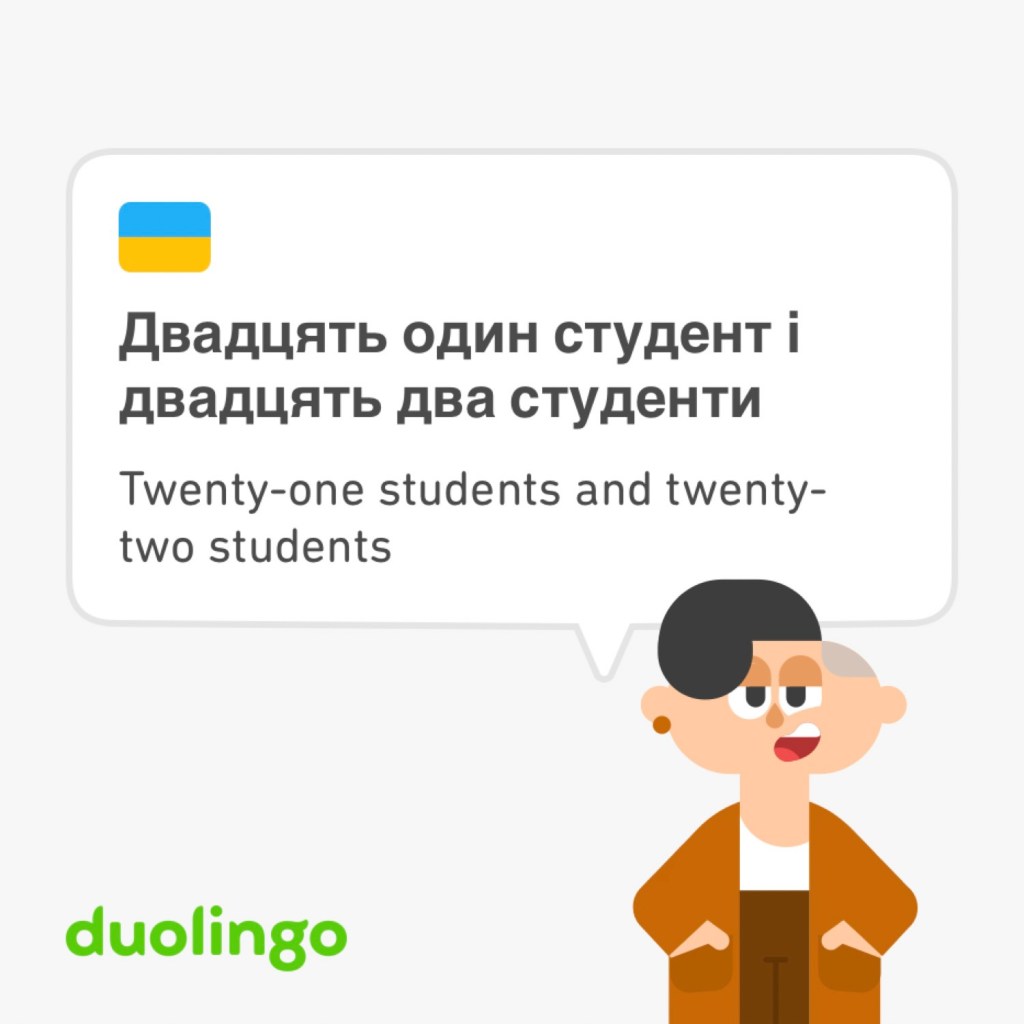
Interestingly, the conjugation from twenty onward seems to depend on the last number. In the below example, the word for student changes depending on whether it’s twenty one (i.e. “singular”) vs. twenty two (i.e. “between 2 and 4”). The twenty doesn’t factor into this.
Finally, like other inflected European languages (again, Latin is a great example), the numbers when used to count something will conjugate to match the object in terms of case and gender. The number one, depending on the grammatical gender of the word, will either be :
Один кіт (odin kit, “one cat”), masculine
Одна машина (odna mashina, “one car”),1 feminine
Одне місто (odneh misto, “one city”), neuter
That’s a brief look at Ukrainian numbers, and what I’ve figured out so far. Enjoy!
1 I really love the fact that the word for car is “mashina”, because it reminds me of the word machine. Are they related? I would like to know.
This happy little mug comes from Language Mugs and includes a basic breakdown of Ukrainian conjugations and grammar. I got different mugs for my kids: French for my daughter who’s studying in school, and Japanese kanji for my son who loves learning it.
For your language nuts out there, I’ve learned a few things already from the mug;
Ukrainian nouns have seven declensions which is kind of a lot. Some repeat though, such as accusative and nominative.
Ukrainian adjectives conjugate based on grammatical gender, but are the same in plural (like German, for example).
I will be poring over its contents over the coming weeks just as I continue to pour homemade cold brew coffee.
Check out Language Mugs if you can. The mugs are great, and delivery was pretty fast.
As my studies of Ukrainian continues, one pattern that definitely appears over and over is the clear presence of grammatical gender. I’ve touched on this a bit in a recent post on how it relates to classical languages, but wanted to provide more context here.
Screenshot from my Duolingo session
The concept of grammatical gender is something that’s endemic to Indo-European languages (as far as I know),1 and is not related to the actual gender of a word. In Latin, the word miles means solider and is masculine (makes sense), but the Roman legion, legiō, had a feminine grammatical gender.
Modern western European languages such as Spanish and French tend to have shed and streamlined some aspects of grammatical gender. Neuter words no longer exist, so there’s only masculine and feminine genders left. Languages like English barely have any grammatical gender at all, even though it still exists in German to some degree.
Ukrainian language keeps the three classic genders: masculine, feminine and neuter, and like Spanish, French and Latin, nouns and adjectives have to agree with case (nominative, genitive, etc), number (singular and plural) and gender.
Here are three words:
Ukrainian (Romanization)
Meaning
Gender
Кіт (kit)
A male cat (more on this later)
Masculine
машина (mashyna)
A car
Feminine
місто (misto)
A city
Neuter
As far as I can tell, there is no definitely article like “the” or “a” in Ukrainian, but let’s use the word for “my/mine” in front of these and you can see how grammatical gender:
Ukrainian (Romanization)
Meaning
Мий кіт (miy kit)
My cat
Моя машина (moya mashyna)
My car
Моє місто (moye misto)
My city
You can see how in all three cases the same word, “my”, changes according to grammar, and it’s not a small change. In the screenshot above from my Duolingo session, you can see that the adjective “older” changes the same way depending on whether it’s a sister (feminine) or brother (masculine).
Another example of gender in Ukrainian where all the words in the sentence end in “а” because the word for daughter, донька (donka), is feminine.
Further, I was surprised that there are many words for living beings that are also divided by gender. For example кіт above means “cat”, but implies a male cat. The word for a female cat is кішка (kishka). For “friend” there are separate words for a male friend (друг, “druh”) and a female friend (подруга, “podruha”). Note that these are platonic friends, not boyfriend and girlfriend. There are separate words for those.
Also, from what I can tell, the plural friend has only one gender: друзі (druzi) means “friends” for example, though I am pretty fuzzy so far.
So far, I think I have only learned the nominative case (e.g. nouns as the subjects of sentences), so I suspect that these forms will also change depending on what part of the sentence a word is. This makes conjugation pretty tricky (just like Latin and Greek), but also means that you can upfront glean many details quickly once you get familiar with it.
Another example is in describing people. Ukrainian frequently identifies gender in a person through endings such as ець (ets) for masculine and ка (ka) for feminine. Thus, українець means a Ukrainian person, masculine, while українка means a Ukrainian person, feminine. Even words like “vegetarian person” have different endings: вегетаріанець (vegetarian, masculine) versus вегетаріанка (feminine).
P.S. I had my first actual conversation in Ukrainian recently, and I did a pretty lousy job. My mind blanked on words, and I mispronounced things. It’s been a long while since I learned a new language, and it’s easy to forget how little you actually know at first. But it also is a reminder to focus on fundamentals and nail those down before getting too hung up on the finer details. Easier said than done, but it’s been an interesting journey so far.
1 I have practically never seen any examples of it in languages like Japanese, Korean or Chinese or Vietnamese. Of course, there are gender-specific words, but inflections based on grammatical gender definitely do not exist. Bear in mind that the above Asian languages are in separate language families (despite being geographically next to one another).
In addition to using Duolingo for learning Ukrainian, I went back and dabbled in using it for learning Japanese. My Japanese is somewhere in an intermediate area where I can have conversations and read books, but I don’t do either one particularly well. So, any effort to shore up those skills is help, and Duolingo is frankly a pretty fun app to use. It doesn’t really help with my efforts toward the JLPT, but there’s no reason why I can’t do both (time permitting).
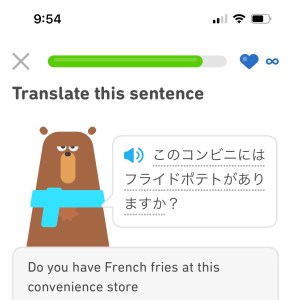
However, at times using Duolingo for Japanese has been a little frustrating, such as this question:
which I got wrong for (in my opinion) nitpicky reasons:
The problem is, in my opinion, not with Duolingo. It’s a terrific service and app, and I would recommend it to anyone. The trouble is how Japanese is taught, and by extension non-European languages are taught.
The way that Duolingo teaches Japanese strongly resembles the same college courses I took way back in college in the late 1990’s, when we memorized similarly staid phrases, and textbook-style sentences that aren’t really used. It’s grammatically correct to say このコンビニにはフライドポテトがありますか, but it’s not how it’s naturally used.
Japanese has a tendency to be very contextual compared to English. This drove me nuts for a long time until my listening skills caught up just enough to know what the gist of the conversation was, and I didn’t hvae to explicitly know who did what and where.
For example, using the sentence above, if the context is known, it’s perfectly fine to say ありますか which would mean “[this convenience store] are there [french fries] [here]?”.
But suppose the person at the counter didn’t know which item you were asking about. Is what thing here? In such a case, use the particle が (ga) to specify who, what, which or where. Is what thing here? French fries, are they here (e.g. do you carry french fries)? Hence フライドポテトがありますか If you’re talking to an employee at the convenience store, this would be sufficient because you’re obviously standing in the convenience store, and obviously not talking about some other store.
Suppose the listener doesn’t know which store you’re talking about. Then, you’d have to clarify what store you’re talking about, hence use the particles に (the target particle) and は (the subject of your sentence) together コンビニにはフライドポテトがありますか。Depending on context this can mean either “do convenience stores carry french fries” in general or “does the (mutually understood) convenience store carry french fries?”
Maybe you’re standing outside with a buddy and you’re wondering if this Lawson convenience store has fries, vs. that 7-11 across the street. Then after all we’ve discussed so far, you’d have to specify THIS store, to the exclusion of others, is the one you’re inquiring about. Hence このコンビニにはフライドポテトがありますか
You can see why a textbook sentence like this can feel really wordy to Japanese speakers. It makes sense in English, and probably other European languages as well,1 but feels pretty unnatural in Japanese.
Similarly, a normal conversation that I literally just had with my wife as I was typing this is:
Mrs: 今日は寒いね。 (today, compared to other days, is cold, isn’t it?)
Me: でも、暑くなると思う。 (but, [I] think it will get hot)
My wife did specify a topic (today’s weather), but if you notice I never said “I” anywhere in reply. Simply by context, using the word 思う (omou, “to think”), it’s obvious that i am stating my opinion.
It’s not limited to casual conversation either between spouses. A similar sentence in a more formal setting, such as with one’s boss might sound something like:
Boss: 今日は寒いね。 (today, compared to other days, is cold, isn’t it?)
Underling: でも、暑くなると思いますね。 (but, [I] think it will get hot)
The boss, being of higher social rank, is free to use more casual speech to his/her underlings, but the underling would reply back using more polite speech (思います, not 思う), and yet still would not need to specify “I” such as 私は or whatever.
This is the sort of thing that I really, really wish I had learned in Japanese classes ages ago, but hard to learn the hard way. Again, this isn’t informal, casual Japanese necessarily, it’s common-place skills you have to learn to speak Japanese and unlearn habits that happen with European languages: not specifying things you don’t know need (i.e. context matters), and being sensitive to social rank and politeness.
P.S. I’ve dabbled in Korean ages ago during the “KPop wave” a few years back, and I believe what I said above also applies to Korean as well.
1 I don’t know enough Ukrainian yet to know how accurately the “textbook” Ukrainian matches real life conversation, but thanks to Duolingo, I know more about “Auntie Toma” and her family than I ever wanted to know. 😅
My efforts in the past month to learn Ukrainian via DuoLingo have been steady and enjoyable, and it’s great to see words that I recognize from Twitter feeds, even if only a few.
But one aspect of the language that has caught me off-guard is the Cyrillic script. It is a beautiful script with a rich history in eastern Europe, and used in many languages today, however because of its overlap with the Roman alphabet, it’s also confusing me a lot.1 Unlike something entirely different like Korean hangeul or Japanese hiragana, when I try to read Cyrillic, and i am not paying attention, my brain jumps back to English readings and I tend to mispronounce words. The script itself is just as easy to learn, as any other script, but learning to undo habits as a native English speaker is a lot harder.
Here’s some examples of letters that overlap with English:
English Letter
Ukrainian Pronunciation
H
“en” as in “noodle”
B
“vee” as in “vest”
P
“ar” as in “road”
C
“es” as in “snake”
M
same as in English
X
a kind of throaty sound, like the “h” that you might hear in Arabic, Hebrew or Ancient Greek
Y
“oo” as in “food”
I
“ee” as in “feet”
K
same as in English
You can see how many look like English, and some even sound like English, but many others have entirely different pronunciation. Then there are letters that kind of look like English letters, but are not.
…and so on. Also, bear in mind that various Slavic languages that use Cyrillic use them in slightly different ways from one another.3 An old Russian friend of mine who’s also been learning Ukrainian to appreciate what’s happening (and not what propaganda says), told me that the “и” and “е” in Ukrainian are read differently than what he’s used to, and therefore confusing to him.
However, all hope is not lost. As I familiarize myself with basic Ukrainian vocabulary and start to see certain words over and over again, they are starting to internalize and I get mixed up a little less and less each time. It’s really strange when i try to read something in English, but as if it were a Ukrainian word. 🤪
But practice and patience are gradually paying off.
Cyrillic is a pretty fascinating and useful script to familiarize yourself with, but be prepared for confusion if your first languages uses the Roman alphabet.
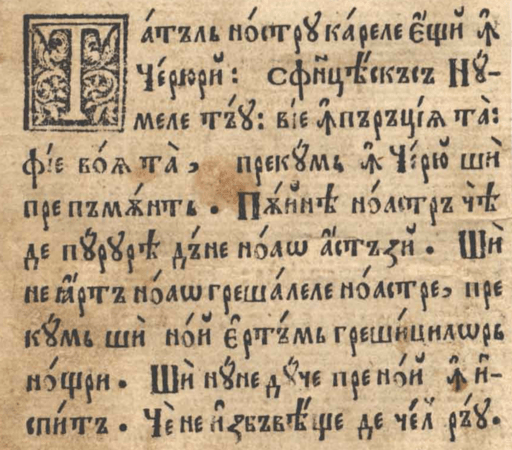
P.S. Featured image provided by Wikimedia Commons and shows an excerpt of the Lord’s Prayer from the 1780’s. Photo by Ioan Bob, Public domain.
1 I bet Ukrainian / Russian speakers feel similar frustration with learning English. 😄
2 when Ukrainian is romanized, this letter is expressed as “y” which is even more confusing.
3 Just as the Roman alphabet is applied to languages like English, French, Spanish and German in slightly different ways, with letters that appear in one but not others.
Lately, I started taking up the Ukrainian language, which is something very outside my comfort zone. In my younger years, I’ve studied Mandarin Chinese, Vietnamese for 2 years in college, and of course Japanese, so Asian languages tend to be familiar even if I am not fluent. I have also dabbled in Latin, Sanskrit and Ancient Greek over the years, but I am not particularly good at either one.1 Even so, I have zero experience with Slavic languages, so it’s been a totally new experience for me, and yet, to my surprise an oddly familiar one.
Having spent weeks on DuoLingo practicing basic, basic Ukrainian I started to notice some patterns.
For example, the phrase моя мати (moya matih) and мій кіт (miy kit). The first means “my mother” and the second means “my cat”. After a bit of sleuthing, I figured out that “my” will conjugate depending on the gramamtical gender of the noun. In this case мати is a feminine gender word, and кіт is masculine. There are “neuter” gender nouns as well.
Side note: the Ukrainian word for “samurai” is самураї (samurayi)
Grammatical gender? Ancient Greek,2 Latin, and Sanskrit all had masculine, feminine and neuter genders for nouns. Modern Western languages tended to drop the neuter gender (e.g. modern Spanish or French), but it’s fascinating to see that Ukrainian, and Russian evidentially, retain all three. You can also see grammatical gender with words like студент (“student”, male student) vs. студентка (“student”, feminine student).
But even more fascinating is that Ukrainian nouns have seven grammatical declensions:
nominative (“the student”)
genitive (“of the student”)
dative (“to or for the student”?)
accusative (“verb the student”)
instrumental (“with or by means of the student”)
locative (“on the student”?)
vocative (“hey, student!”)
Seven declensions? The only language I know that had that many was ancient Sanskrit (eight total, including ablative)! Latin had five, and Ancient Greek only had four. Adjectives also behave like Latin, Greek and Sanskrit in that they agree with the noun in case, number and gender.
I haven’t really gotten into verbs much yet, but I do notice that they inflect too, depending on who speaks it (I eat vs. you eat), so I wouldn’t be surprised if it fits a similar pattern to other European languages.
All this is to say is that Ukrainian language, and much of the eastern European Slavic language family represents a linguistic “cousin”, with fascinating relics from much earlier Indo-European languages, and yet full of innovations and adaptations as well.
1 I confess I dabble in language study a lot, but not very good at follow-through. Japanese is the only language I’ve really committed too long enough to develop any skill, but since I married into the culture, it’s been a worthwhile experience. I suppose that’s what really keeps one going: personal value in learning a language more so than just idle intellectual curiosity. On the other hand, even learning another language a little bit is a worthwhile experience. I dabbled in Korean at one point due to the KPop craze at the time, and it’s nice to still be able to real Hangeul, and to encounter the only other language I know that has any grammatical similarity to Japanese (through convergence, not genetic origin). Similarly, my time spent learning Vietnamese, which I don’t get to use much anymore, was a fascinating time when I got to study abroad in Hanoi, Vietnam. Plus it was fascinating to see how Chinese influenced Vietnamese in the same way that Chinese influenced Korean and Japanese even though they were all unrelated languages! In that sense, any foreign language study is a worthwhile investment.
2 The term “Ancient Greek” is kind of vague and nebulous. There’s Homeric Greek (e.g. the Greek of the Iliad), Classical Greek (e.g. Attic dialect), Koine Greek (e.g. the Hellenistic Period and the New Testament), Byzantine-era Greek and so on. There’s even Archaic Greek, which is poorly attested due to lack of sources. So, when people talk about “ancient Greek” it’s important to be clear which one. Greek as a language is a fascinating continuum from the archaic period all the way to modern times. One of my co-workers is Greek American and she loves to swap tips with me as she is also learning both ancient and modern Greek.
Lately, in my quest to prepare for the JLPT example, level N1, I have been observing that because the vocabulary list is so large, my Anki flashcard deck is getting bigger and more unmanageable. Today, I finally reached critical mass and gave up. That’s after only completing 12 vocab lessons out of 66, with my deck reaching 900+ cards already. 🤦🏽♂️
The problem isn’t Anki, nor is it JLPT sourcebooks I am using. The problem is that the flashcards themselves are becoming too many, and too much work to manage. I found that I am particularly struggling with the recognition side of cards. For example, words like 気さくな and 大らかな and both have similar meanings in English, so trying to make unique flashcards for each, and remember them three weeks later is turning into a headache. Similarly, 寛大な and 寛容な are functionally equivalent words, even in the Japanese dictionary, so is maintaining separate flashcard entries even worth it?
Another way of looking at it: my goal is learning all this vocabulary was to help with reading. The vocabulary portion of the JLPT exam isn’t worth many points, but the essay section is worth a lot more. This makes sense: you need to demonstrate that you can read and comprehend Japanese literature. That’s what matters if you plan on living and working there.
So, the real issue is: how do I improve my reading skills? The answer is probably just reading more Japanese! This is harder than it looks, based on personal experience, because finding good Japanese books is hard enough as it is (unless you live near a Japanese book store like I do), but also something appropriate to your level and interesting is harder than it looks. Sometimes you can just solve this by getting a hold of many different sources and just sorting out which ones you like better. Sometimes you get a manga and it’s actually crap. Sometimes you find a random book in a used bookstore and it’s actually a really fun thing to read.
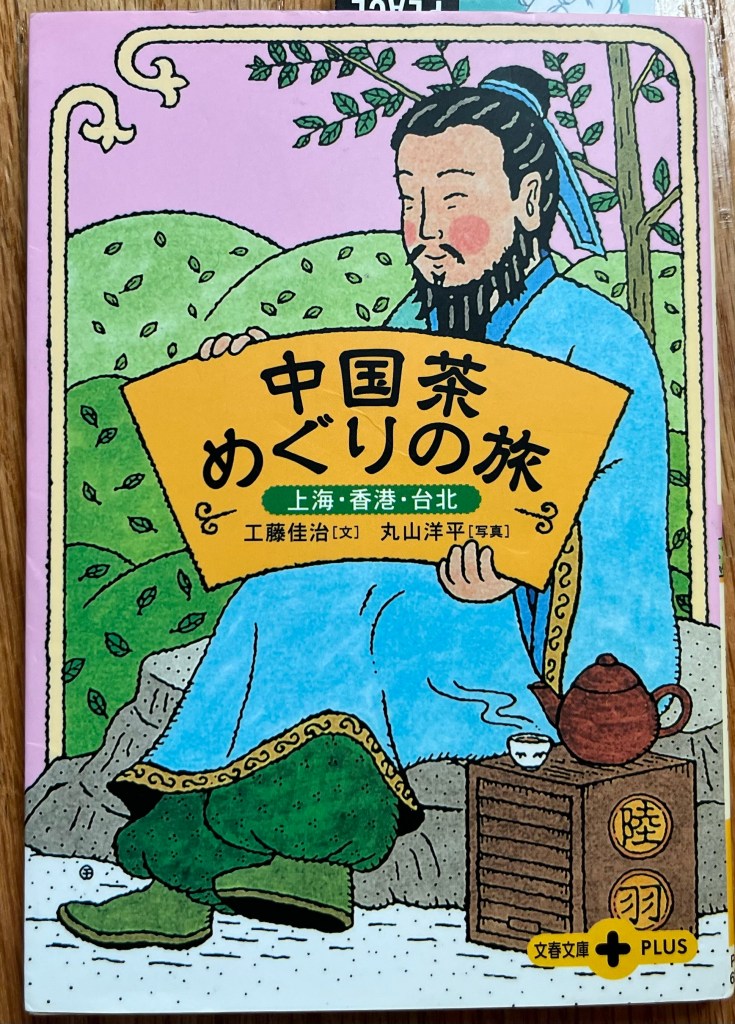
I found this book in a used-bookstore here in my neighborhood, and it was a travelogue of eastern China, with an emphasis on Chinese tea and Chinese food. It has been a pleasant read so far.
But I guess the real issue here is to keep using Japanese: through listening and reading. These are the two pillars to learning a language, I think. The rest is just mental games.
There are times when it’s good idea to make flashcards, though. I find cloze formatted cards helpful for learning proper usage of particles:
An example Cloze MCD card that I made for myself.
Also, sound-effect words (namely giongo + gitaigo words) such as めちゃくちゃ, or words that often come up in your reading are worthy of a flashcard. Originally before I took my the JLPT, my Anki flashcard desk was pretty used for this only. It was nice because it was smaller, leaner and words that I keep stumbling over, so it had immediate value.
If your deck grows beyond say 50-100 words, and you’re dumping vocabulary into there as I have been doing, it might be time to start trimming out words though.
I still plan on using my vocabulary book for the JLPT has it has been useful in expanding my vocabulary and making reading somewhat easier, but I need to think more carefully about how I use my flashcards as the effort to maintain is now becoming greater than the value I get out of them.
P.S. One other problem I didn’t mention: even after all the work you did to memorize vocab, you can still forget it months later when it appears again in your SRS flash card deck.
Woodblock print of Taira no Kiyomori, by Yoshitoshi, published in the One Hundred Aspects of the Moon. 月岡芳年, Public domain, via Wikimedia Commons
Near the end of the twelfth century in Japan, amidst decades of political meddling by the Fujiwara clan in Imperial court politics, an upstart samurai warlord named Taira no Kiyomori took control of his own clan, the Heike (平家) clan,1 in 1159. The Heike were one of several offshoots of Imperial offspring in last generation and hung around the Imperial Court as minor aristocrats, lowly samurai, etc.
By 1179 Kiyomori seized control of the capitol in a coup. The head of his hated rivals, the Genji (源氏) clan,2 was executed and his sons forced to live in separate provinces. The capitol was effectively under a military dictatorship under the guise of maintaining the Imperial Court, with Taira no Kiyomori pressuring the Emperor to award him the court rank of 1st rank junior (just under the Emperor). Kiyomori was said to wear brash clothing and flaunt Court etiquette. As he held onto power at the expense of the Emperor he could do what he wanted.
The Genji were now scattered, but not defeated. In time, starting with Minamoto no Yoritomo, they were able to gather allies, including a Heike-offshoot: the Hojo Clan. Further, the brothers of the Genji clan gradually reunited under Yoritomo, including the famous warrior Minamoto no Yoshitsune, and push back the Heike. This “Genpei War” culminated with the navel battle of Dan-no-ura, when the Heike were almost totally wiped out and a couple of the Imperial sacred treasures were reportedly lost.
But by the time of Dan-no-ura, Taira no Kiyomori was already dead. Taira no Kiyomori has become something of a power-hungry villain in Japanese lore since the Tales of the Heike, and subsequent media. His death is dramatized as coming from a terrible illness with a fever so hot that no one could approach him, while in his fever dream he was said to have seen the denizens of hell waiting for him including Enma the Judge of the Underworld.
Another woodblock print by Yoshitoshi dramatizing the illness and death of Taira no Kiyomori. Yoshitoshi, Public domain, via Wikimedia Commons
As the opening lines of the Tales of the Heike eloquently state, the powerful do not last long, and ultimately self-destruct. So it was with Kiyomori and the Heike.
P.S. The larger Heike clan persisted long after the Genpei War, mostly through off-shoots such as the Hojo, Miura, and so on. But Taira no Kiyomori’s ambitions were crushed and his immediately family and forces destroyed at Dan-no-ura. Minamoto no Yoritomo, for his part, wasn’t exactly a saintlyfigure either. Yoritomo’s own family and sons were hemmed in by the Hojo Clan who managed all the actual affairs of the new Kamakura Shogunate, relegating these new “warlords” to figurehead positions. Ah, politics. 🤦🏻♂️
1 Also called the Taira clan. The Chinese character 平 can be read as either hei or taira. Welcome to the world of Japanese kanji.
2 Same situation: 源 can be read as gen or as minamoto. They were another imperial offshoot clan with similar status to the Heike.
Since I recently gushed about the awesome Japanese historical drama, The Thirteen Lords of Kamakura, I wanted to share a quote from the real life epic, the Tales of the Heike, namely the opening line:
Japanese
Romanization
Translation
祇園精舎の鐘の聲、 諸行無常の響き有り。
Gionshōja no kane no koe, Shogyōmujō no hibiki ari.
The bells of the Gion monastery [Jetavana Grove] in India echo with the warning that all things are impermanent.
沙羅雙樹の花の色、 盛者必衰の理を顯す。
Sarasōju no hana no iro, Jōshahissui no kotowari wo arawasu.
The blossom of the sala trees teach us through their hues that what flourishes must fade.
驕れる者も久しからず、 唯春の夜の夢の如し。
Ogoreru mono mo hisashikarazu, tada haru no yo no yume no gotoshi.
The proud do not prevail for long but vanish like a spring night’s dream.
猛き者も遂には滅びぬ、 偏に風の前の塵に同じ。
Takeki mono mo tsui ni wa horobin(u), hitoeni kaze no mae no chiri ni onaji.
In time the mighty, too, succumb: all are dust before the wind.
Translation by Burton Watson in The Tales of the Heike (Translations from the Asian Classics)
Like one wave coming after another, it never really ends, and each wave that arrives is soon gone.
The phrase 諸行無常 (shogyō mujō) in particular is an example of a Buddhist yojijukugo phrase that is used even now in Japanese language. It essentially means the impermanence of all phenomena. I sometimes use this phrase half-jokingly with my kids or my wife when I drop dishes on the floor, throw away an old shirt, or whatever, but I do sincerely believe that all things are like waves in the ocean, arising briefly, or scattering blossoms in the wind.
P.S. Featured photo was something I took in early January of 2021 during a low point. There was much to be stressed out about at the time, but much of it has passed since.










 Gleanings in Buddha-Fields


You must be logged in to post a comment.