My studies of Ukrainian continue, albeit slowly, and as part of this, I’ve been working hard to learn the cursive script which differs from printed Cyrillic on some key ways, but also differs from American cursive (obviously). My approach has been to write out new sentences I encounter in Duolingo in my little notebook:
I decided to also use the opportunity to re-learn American cursive after decades of neglect, and found a great example video here:
Since I’ve been practicing handwriting for both Ukrainian and English, I figured maybe I should practice Japanese as well. However, it’s a bit different with Japanese. There is no cursive in the sense that European languages have, though older Japanese writing had a loose system called hentaigana (not to be confused with hentai … this isn’t that kind of blog). Tofugu has a nice write-up here.
Japanese does have a pretty sophisticated calligraphy tradition both inherited from Chinese culture, plus local innovations. Typically, when writing calligraphy in Japanese, there’s three broad styles to choose from:
Regular script (楷書 kaisho) – based on Chinese calligraphic tradition, this is just the standard way of writing Chinese characters.
Cursive (草書 sōsho) – as the name implies, this is the cursive form of Chinese characters, often done to abbreviate and write things more easily, while keeping the brush (wet with ink) on the paper. Just like Western cursive.
Semi-cursive (行書 gyōsho) – this was a particular style that flourished in Heian Period Japan onward, but also has its roots in Chinese tradition, and represents a halfway point between regular script and cursive.
You can also see a nice comparison of the three here:
My wife has training in Japanese calligraphy, and knows how to write in all three styles, but I can’t even write standard Japanese well:
Me practicing a sentence from my son’s Japanese textbook
But the point is is that as with any handwriting, practice makes perfect. Find a pen you like writing with, and don’t be afraid to practice a little every day. You’d be surprised how much easier it gets within a few days, weeks, etc. When I was self-studying Ancient greek, I kept writing sentences out, and after a time, my handwriting got pretty good:
The weird thing was that I wasn’t even trying to improve. I was so focused on studying and writing things out in my notes, that after a while it got easier, smoother, etc. Plus, it’s good stimulation for the mind, which is handy as you get older. 😏
So, whatever language interests you, pick up a pen and start writing out interesting sentences and see where it takes you.
As I wrote about recently, the end of the Heian Period in Japan (8th century to 12th century) represented a seismic shift in Japanese culture from a cultured aristocracy to a military society led by the samurai class. This finally stabilized Japan from decades of strife, but there was also a palpable sense of loss reflected in such works as the Hojoki (Ten Foot Hut) and other works of the time.
One of my favorite, and the best known from this era is a work called the Tsure-zure-gusa (徒然草) which is hard to translate in English.1 The most accepted translation of the title is “Essays in Idleness”, but this not the only one. It’s a classic that every kid in Japan studies in school, just as American kids might read Ivanhoe or something.2
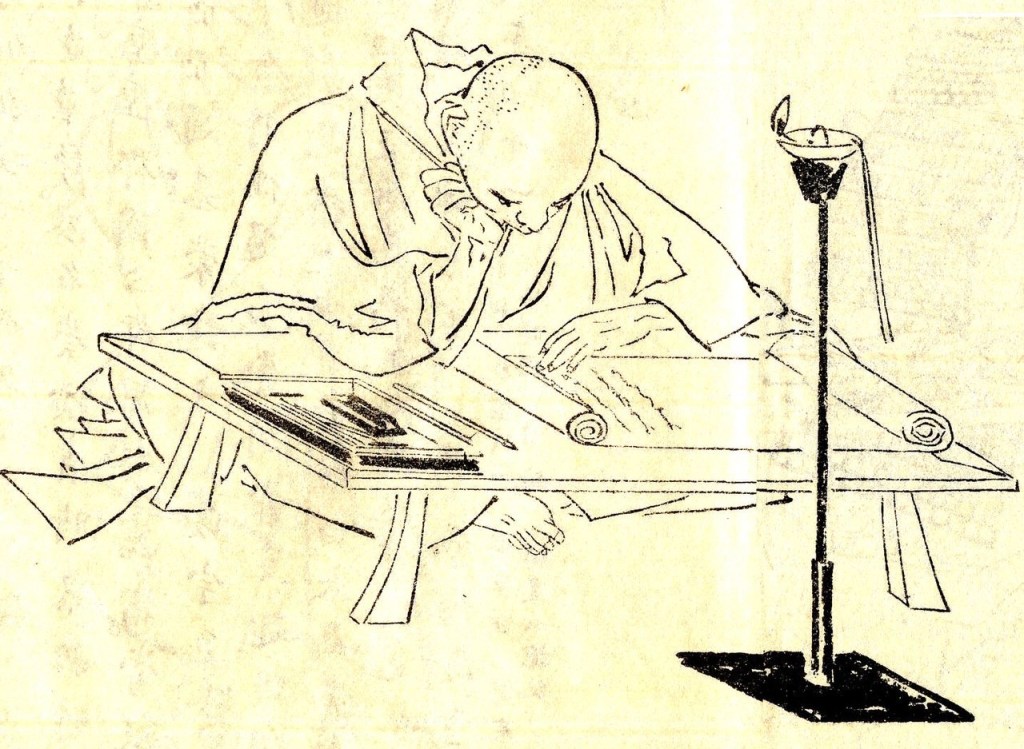
A depiction of Kenkō, drawn centuries later by Kikuchi Yōsai. Courtesy of Wikipedia Commons.
The Tsure-zure-gusa was written by a Buddhist monk of the Jodo-shu sect named Yoshida Kenkō (吉田兼好, 1283?–1350?). The text was composed between 1330 and 1332, and is a form of free-form writing. Kenko would just write down what he was thinking. Sometimes it was old anecdotes, or stories he had heard. At other times, he wrote deeper thoughts about life. Sometimes, he would just point out social faux-pas committed by others. There is no overarching messages in the text, but it covers many aspects of life, so it’s a fascinating look at Japan during the Kamakura Period (12th-14th century) as well as food for thought.
For example, here’s a commentary on fish:
119) The fish called katsuo is unequaled among those caught in the sea off Kamakura, and of late has been much in demand. An old gentleman of Kamakura told me, “When we were young, this fish was never served to persons of quality. Even the servants refused to eat the head. They cut it off and threw it away. It is typical of these degenerate times that such fish have become accepted.
Translation by Donald Keene
Interestingly, katsuo (known in English as bonito) is pretty universal in Japanese cuisine now as it is the most common ingredient of dashi (fish broth), as well as numerous dishes.
Another amusing example:
57) It is exasperating when discussions of poetry are devoted to bad poems. How, one wonders, could anyone with the smallest knowledge of the art have supposed such verses were worthy of discussion?
Even to an outsider, it is both embarrassing and painful to listen to someone discuss a subject — whatever it may be — that he doesn’t really know.
Translation by Donald Keene
One can imagine a bad TED Talk the same way too.
The text is at times surprisingly relevant to people living in the 21st century, though:
29) When I sit down in quiet meditation, the one emotion hardest to fight against is a longing in all things for the past. After the others have gone to bed, I pass the time on a long autumn’s night by putting in order whatever belongings are at hand. As I tear up old correspondence I should prefer not to leave behind, I sometimes find among them samples of calligraphy of a friend who has died, or pictures he drew for his own amusement, and I feel exactly as I did at the time. Even with letters written by friends who are still alive I try, when it has been long since we met, to remember the circumstances, the year. What a moving experience that is! It is sad to think that a man’s familiar possessions, indifferent to his death, should remain unaltered long after he is gone.
Translation by Donald Keene
It’s a pretty moving book to read, with all its random quips, reflections on an age now gone, plus deeper thoughts. The Donald Keene copy is hard to find now, but I have seen other good translations too, so don’t hesitate to pick one up if you can find it.
1 The phrase つれづれ (徒然 tsure-zure), pronounced as “tsoo-ray zoo-ray”, often appears in modern blogs or diaries as well in Japanese as a kind of introduction.
2 My wife recalls learning it, but just as reading Shakespeare without some guidance is hard for English speakers, reading the Tsure-zure-gusa to a native Japanese speaker is difficult since so many centuries have passed and the language has changed.
The challenge with learning a language is less about the grammar, which you can learn in a matter of months, but gobs and gobs of vocabulary which you must learn, and internalize. This is especially hard when you have to consider nuances: when things are said, how word X differs slightly from word Y and so on.
Courtesy of Pexels.com
However, if you’re studying for a language exam, such as the JLPT certification exam for Japanese, this means you have to learn a lot of vocabulary in a shorter, more compressed span of time, and chances are you’ll be rushed and unable to really learn the word properly, in context.
For example, while building up my flash cards for the N1 JLPT exam, I learned the word 迫力 (hakuryoku) meaning force or impact. That kind of makes sense, but even in English that’s a bit vague.
Then, later, while watching a certain Japanese documentary on Buddhist temples, the host said in Japanese while visiting the famous Nio-mon Gate (仁王門) at one temple: 「迫力のある仁王門ですね」
This sentence is pretty basic, but shows a nice native example, in context no less, how the word 迫力 is used. I then looked up the word in my favorite Japanese dictionary, and sure enough other sentences used the same pattern: 迫力のあるX (“X has a lot of impact, or intensity”).
The point here is that if I had not seen an actual example of this being used, I would not have learned the proper usage and context of this word. So, memorizing just isn’t enough. Even though it takes longer, you will not really master a language, including Japanese, if you don’t take the time to absorb words through media and most important in context. Then, you can make flash cards using the sentences you saw, in order to properly practice new information.
A photo of the Ten Verse Kannon Sutra from my sutra book, purchased as Asakusa Temple (a.k.a. Sensoji) in Tokyo Japan
In medieval Japanese Buddhism, you can find many interesting little innovations. One example is a popular liturgy called the jikku kan’on gyō (十句觀音經), or the “10 Verse Kannon Sutra”.
It is a popular, devotional chant in Japanese Buddhism toward Kannon Bodhisattva. You can find it in various Buddhist sects, Zen, Tendai, etc. My sutra book from Asakusa Temple (a.k.a. Sensoji) includes it since the temple’s deity is Kannon. The origin of the text is not entirely known, though it’s speculated that is was composed by a Tendai priest as a summation of the 25th chapter of the Lotus Sutra. The 25th chapter is sometimes chanted or recited in devotional services because it is dedicated entirely to Kannon Bodhisattva. However, it is challenging to recite due to its length, even if you just recite the verse section.
Assuming this is really was formulated as a summary, a lay person could recite this with the same intention as reciting the full chapter, but this would be a lot easier for someone of humble background who maybe cannot read all the complex Chinese characters in the original, let alone someone who has to work the fields all day. It is also short enough for someone to easily memorize and chant in its entirety.
It’s not technically a sutra in the sense that it does not purport to speak on behalf of the Buddha, but there are other examples in of sutras (such as the Platform Sutra in Zen) that fit this awkward category as well.
So, for those interested, I present the Ten Verse Kannon Sutra, with translation below:
Can’t read the characters?
If you’re having trouble reading the Kanji characters, you might have one or two problems with your computer:
Your computer may not have Asian fonts installed. In Windows you have to enable UTF8 and East Asian fonts under the Control Panel. Modern Mac computers are fully compatible already.
Your browser may be assuming the wrong character set. If you use a relatively modern browser and use UTF8 as character set, you should be able to read fine. IE, Firefox and Safari all read this fine as far as I can tell.
Even if not, then you can still use the romanized characters, and the (terrible) English translation.
Disclaimer and Legal Info
I hereby release this into the public domain. Please use it as you see fit, but if you attribute it to this site, greatly appreciated. Also, please bear in mind this is an amateur translation, and should not be taken too seriously, nor is it of academic quality.
Dedication
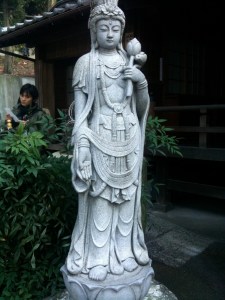
Kannon Bodhisattva. Taken at Daienji Temple in Meguro Ward, Tokyo, Japan in 2010
I dedicate this effort to all sentient beings everywhere. May all beings be well, and may they all attain perfect peace.
Namu Kanzeon Bosatsu
The 10 Verse Kannon Sutra
Japanese Text
Romanization
Кирилицею (in Cyrillic)
觀世音
Kan ze on
кан дзе он
南無佛
namu butsu
наму буцу
與佛有因
yo butsu u in
йо вуцу у ін
與佛有縁
yo butsu u en
йо вуцу у ен
佛法相縁
bup po so en
вуппо со ен
常樂我淨
jo raku ga jo
джьо раку ґа джьо
朝念觀世音
cho nen kan ze on
шьо нен кан дзе он
暮念觀世音
bo nen kan ze on
бо нен кан дзе он
念念從心起
nen nen ju shin ki
нен нен джю шін кі
念念不離心
nen nen fu ri shin
нен нен фу рі шін
Chanting Example
You can find examples of chanting of the Ten Verse Kannon Sutra on Youtube such as this one:
My Translation
At its heart, the Ten Verse Kannon Sutra is both a praise of Kannon Bodhsattva, but also gratitude for the karmic bond between oneself and Kannon (explanation here, albeit different Buddhist deity).
This translation below is something I made a while back, and is a rough translation only. Other translations is here and here. Big thanks to Reverend “E” for his excellent scholarship and assistance in this endeavor.
Kanzeon [Bodhisattva]!
Praise to the Buddha!
With the Buddha as cause,
With the Buddha as condition,
Through the Buddha, the Dharma and the Sangha
I attain eternal, blissful, self, purified of all defilements [nirvana].
In the morning, I recite “Kanzeon”.
In the evening, I recite “Kanzeon”.
Reciting and reciting arises from the awakened mind.
Reciting and reciting is not separate from [awakened] mind.
Enjoy and happy reciting!
P.S. The “Buddha” here I believe is the eternal Buddha, the Dharmakaya, not the historical Buddha, Shakyamuni
In a younger time of my life, I was obsessed with World War II movies, but my favorite was The Thin Red Line, a brilliant and psychological movie that takes place on the island of Guadacanal, one of the most important battles the Pacific Theatre.
One of the interesting things about the movie is that the Japanese dialogue was not translated and in my younger years I couldn’t understand it, including this tragic ending scene:
The translation and subtitles are excellent,1 and really change the scene a lot. Without understanding the Japanese, it seems like Pvt. Witt had no choice, but had he understood what they said, perhaps things would have been different.
It doesn’t take much for small misunderstandings to fester, and then grow into outright hostility. People aren’t particularly good at reading into others, and their minds naturally try to fill in the blanks with what they assume the other is thinking.
More often than not, that way lies danger.
1 Without the subtitles, I understand quite a bit more than I did years ago, but admittedly still not 100%. Always more to learn. 🤔
Recently, I wrote about my frustrations with using Anki to bulk-learn vocabularly for the JLPT, and my decision to focus more on reading. Since then, my thought has changed a bit.
Ultimately, your success in the JLPT lies in two basic skills: reading Japanese, and listening to Japanese conversation. The vocabulary helps to read, but I found that with my Anki flashcards, it tended to focus a lot on recall (e.g. “do you remember how to say a word in Japanese?”), not recognition (e.g. “do I remember what this means when I see it?”). This first one doesn’t help with reading very much, the second one does. Since Japanese uses so much kanji, you’re ability to recognize words smoothly makes the process of reading so much easier. The issue with recall I found was that there were many different, overlapping words for the same thing, and trying to remember which word was which wasn’t worth the effort. I just want to be able to read well. Further, recall didn’t help me know the context words are often used in.
But while focusing on reading Japanese manga lately, including the various books my kids and I have, I realized that I still need to learn some words, especially if they appear over and over again. Brute-force reading wasn’t quite enough. So, I still need some way of learning words through repetition, but I want to focus on recognition only.
So, I realized that if you want to use Anki flashcards for improving reading, and focus on recognizing words, and with the correct context I needed to revisit the MCD approach for making cards. In other words, make flashcards not with words, but with sentences.
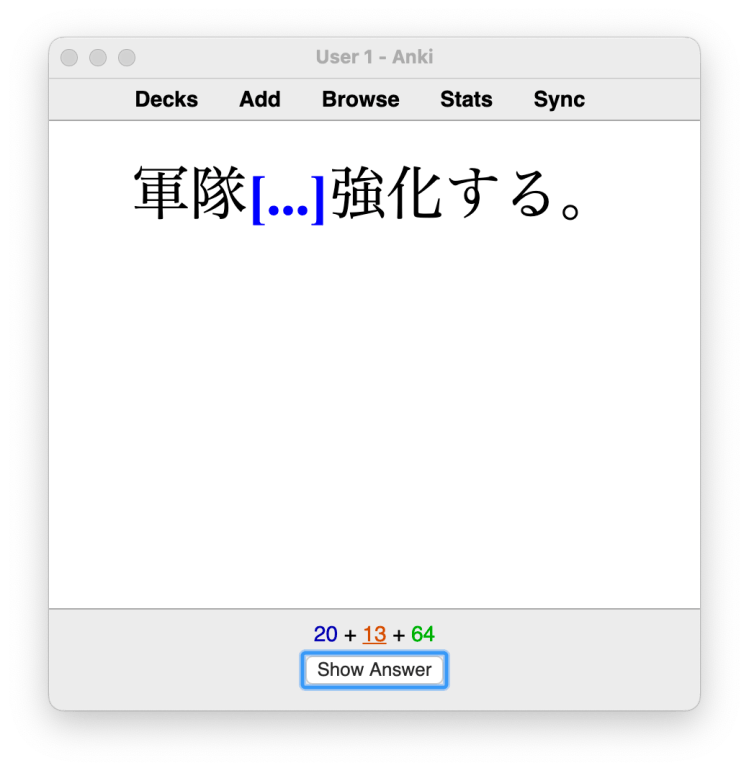
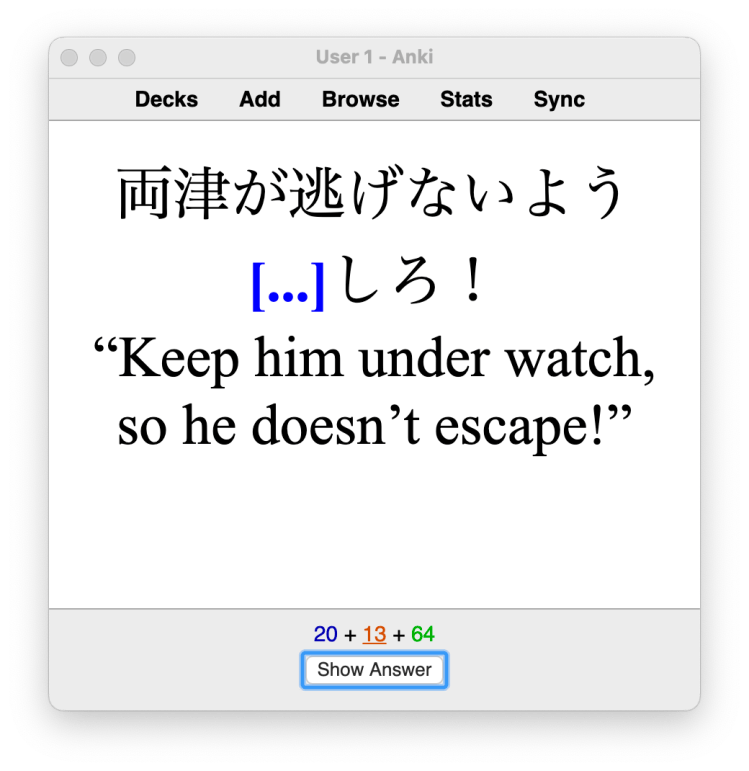
Here’s an example:
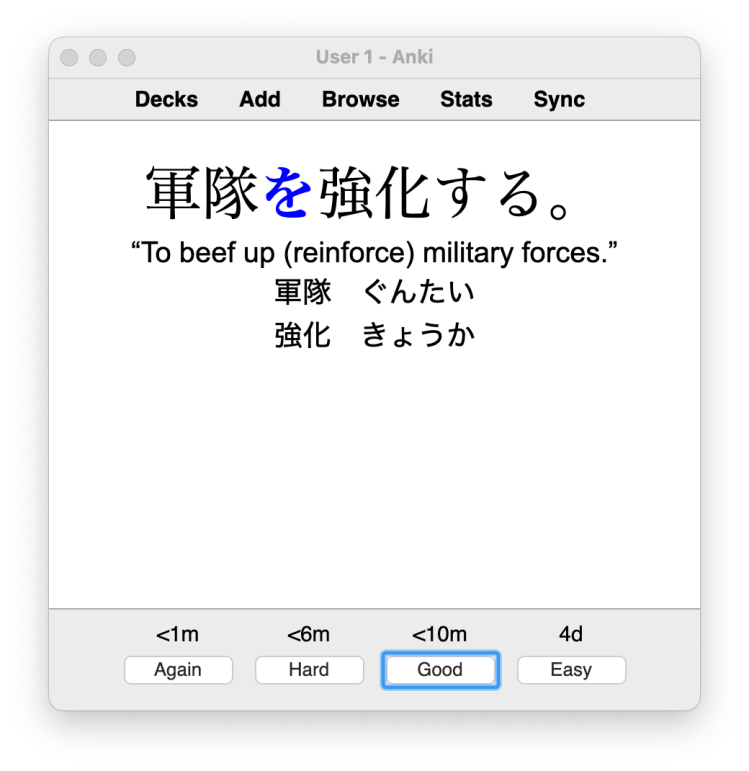
The word I wanted to focus on learning was the verb 強化する (kyōka suru) meaning to intensify or strengthen. So, rather than just throwing it in my flashcard deck, I looked it up on my favorite Japanese online dictionary and found an example sentence I liked. From there, I found an example sentenced I liked and put that in. Notice that I did not hide the word 強化する. I wanted to be able to read the word, not necessarily recall it, but I do need to be able to recall what particle it uses. In this case を, the direct-object marker. So, I hid that.
Under the notes section, I put in readings for each kanji word in there, in case I need a hint later. I also put the English translation under notes, not in the flashcard since I wanted to be able to suss out what the sentence meant without the English translation. However, it helps to sometimes put the English translation in the flashcard too if the helps:
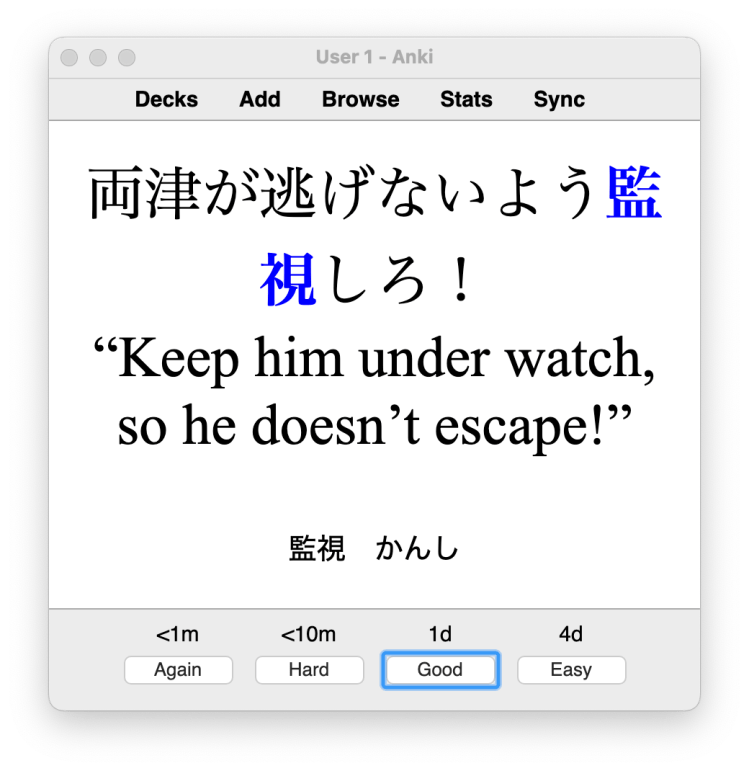
Here, I needed to learn the word 監視する (kanshi suru) meaning to observe or keep under watch. But the sentence I got from one of my manga was a bit awkward, yet useful in providing context. So I had to keep the English sentence in the flashcard.
The point here was: be flexible on a per card basis, and use what works, but doesn’t overburden you by making the card too difficult, or have too much guesswork. Your focus should be on reading, not recall.
Anyhow, does this work?
So, far, I’ve found the Anki flashcard experience a lot less painful than it was before, plus it incentives reading by finding more good sentences to put in.
I still need to be mindful about making too many flashcards, plus each flashcard takes more effort to make than it used to, but as long as I keep it flexible and lightweight, it’s easier to maintain and keep up.
Mantras are a strange beast within Buddhism. The tradition of mantras predates Buddhism and goes all the way back to the early “Vedic religion”, that is the ancient devotional practices around the Vedas (precursors to Hinduism as we know it), and they continue to occupy an awkward spot.
The Mantra of Light as shown in a Rinzai-Zen service book.
“Recitation” in Buddhism usually comes in the form of recitingsutras, which makes sense, because the tradition of passing down the teachings from teacher to student has existed from the beginning. Mantras do not fit this role since they are essentially obscure (not to mention mispronounced) Sanskrit phrases, with esoteric meanings. The esoteric traditions such as Vajrayana in Tibet, Shingon and Taimitsu (Tendai school) traditions in Japan all embrace them as a central practice,1 but in other non-esoteric traditions mantras are relegated to a backup “support” role, protecting the Buddhist disciple.
For example, here’s a certain mantra as found in a Rinzai Zen liturgy book I own. This is the famous Mantra of Light (kōmyō shingon, 光明真言), which reads in various languages like so:
Ǎn ā mó jiā wěi lú zuǒ nǎng mó hē mǔ nà luō me nǐ bō nà me rù mó luó bō luō wà duō yě hōng
Japanese:2
オン アボキャ ベイロシャノウ マカボダラ マニ ハンドマ ジンバラ ハラバリタヤ ウン
Japanese romanization
On abokya beiroshano makabodara mani handoma jinbara harabaritaya un
Here’s an example of how it’s chanted in Japan (notice the Siddham letters, too):
What makes the Mantra of Light somewhat unusual within the world of mantras and esoteric traditions in Buddhism is how widely it’s been adopted. You will find it in many Buddhist traditions, even ones that are otherwise not interested in esoteric practices.
In fact, for a time in the late Heian Period of Japan, the Mantra of Light was propped up as a rival practice to the nembutsu in the Pure Land tradition particularly by a monk named Myoe (明恵, 1173 – 1232).
At that time, there was an existing funerary practice of scattering sand blessed by the Mantra of Light on the deceased, but Myoe tried to popularize it further by playing up its benefits in helping one to be reborn in the Pure Land of Amitabha Buddha. This interpretation is largely Myoe’s, however.
It never quite worked as Myoe hoped, and the popularity of the nembutsu prevailed, but even today it’s common for Buddhist practitioners to chant both. I do this in my home service for example. I happen to like the Tendai-sect approach of “umbrella Buddhism” where meditation practices, Pure Land practices and esoteric practices are given roughly equal weight, with the Lotus Sutra as a kind of capstone.
Thus, reciting the nembutsu (pure land Buddhism) and the Mantra of Light (esoteric Buddhism) are both perfectly fine.3 For me at least, I chant the nembutsu for the benefit of others, and the Mantra of Light to reinforce my commitment to being a help to others (and be less of a dickhead). That may not be the correct approach, but it’s a start.
Speaking of which what does the Mantra of Light actually mean? Like all mantras, they’re infused with meaning in esoteric traditions, so a simple translation doesn’t tell the whole story. Furthermore, in esoteric traditions, mantras are supposed to be recited while visualizing a specific image and holding your hands in a specific “mudra”. This combination is thought to jar something deep inside, not at an intellectual level, but on an experiential level. Thus, the meaning of the mantra is something shared between teacher and student. So, I don’t have a good answer for this. If you really want to know, consult a trusted teacher in good-standing!
But it’s not necessary to know the exact meaning either. The act of recitation is more important, or so I have been told. So, if you chose to recite the nembutsu, Mantra of Light, both, neither, that’s fine. Buddhism has a large toolbox, so try what works, and enjoy!
1 Interestingly enough, the Japanese word “shingon” as in the Shingon school, literally just means “mantra”.
2 Mantras are usually written in Japanese using katakana, given that they’re technically foreign words, but for ease of readibility, hiragana is also used.
3 Meditation has always been my Achilles Heel, but I still meditate from time to time.
Every once in a while, I get some crazy boondoggle idea in my head, and it won’t let go until I am done.
A photo of a Buddhist sutra (okyō お経 in Japanese, or сутра in Ukrainian). I took this photo from one of my sutra books.
My latest boondoggle project started a couple weeks ago, when out of idle curiosity, I started exploring the Ukrainian-language Wikipedia and I noticed that articles about Japan and Buddhism were very few. The Russian Wikipedia site had a reasonable number of articles to offer, but the Ukrainian-language Wikipedia site had far less. Russian language is far more widely spoken than Ukrainian due to population size and history. As I learned later, Ukrainian people sometimes have to rely on Russian sources for more information, even if it’s not their first language.
Then, after meeting a Ukrainian co-worker who’s greatly interested in both Japanese culture and Buddhism, I decided it was time to try and start posting more content in Ukrainian? Am I fluent in Ukrainian? No. Am I competent in Ukrainian? No. I am just a beginner.
But I was motivated for a few reasons:
The current war highlights the fact that Russia is trying to subsume Ukrainian culture and language. This isn’t a new thing either. So, anything I could do to give Ukrainian language more credibility and clout is worth it.
Although Ukrainian culture is deeply influenced by its Orthodox roots, I realized through my co-worker that there are plenty of Ukrainians who might also be curious about Japanese culture and/or Buddhism. Since that’s practically the only thing I ever blog about, why not help share that information in their native language?
Finally, as someone who has admired Japanese culture since I was a kid in the 80’s, why not share it with other cultures if I can?
So, I started by making updates and edits to the Ukrainian article on the Heart Sutra. I added some photos, cleaned up some text, linked some things, etc. I had to cheat and use Google Translate, but hopefully a native speaker can then clean up what I typed. Better to make mistakes and get the information out there, than not provide any information at all, I figured.
Also, I know just barely enough Ukrainian now that I can kind of tell if the translator was right or not, plus I can check other articles in Ukrainian Wikipedia to make sure spelling and other details are right.
Then, I realized that there’s no chanting guide to the Heart Sutra at all in Ukrainian language. So, I made one. I first made an English language version chanting guide (using Japanese-style liturgy), then changed the chanting phonetic pronunciation to use Cyrillic. Fun fact, I also learned that there is a Cyrillic alphabet equivalent for Japanese romaji (Japanese romanization) called кірідзі (Kiriji).1
Thus, there is now a Ukrainian-language (Українською) chanting guide for the Heart Sutra in Japanese. It’s amateur work, and there’s still no translation of the text itself, but it’s a start.
Finally, this work, and the recent Juseige chanting guide I wrote, is still not great, but it is a growing effort to add more resources.
So, that’s all for now. I still have one more chanting guide I am making, this time to replace the Amitabha Sutra with a better version. Then I can go back to the other 12 projects I have sitting around. 😜
1 Some things are spelled slightly unusual. There’s no letter “j” in Cyrillic, as in “ji”, but apparently you can spell it in Cyrillic as дзі (lit. “dzi”) which is pretty close. Also, “wa” has no equivalent, so it is spelled as ва (lit. “va”).
This is a photo from a sutra book I frequently use for daily services. I bought this book years ago from the temple of Sensoji (a.k.a. Asakusa Temple) in Tokyo, Japan, a place that I have visited many times over the years.
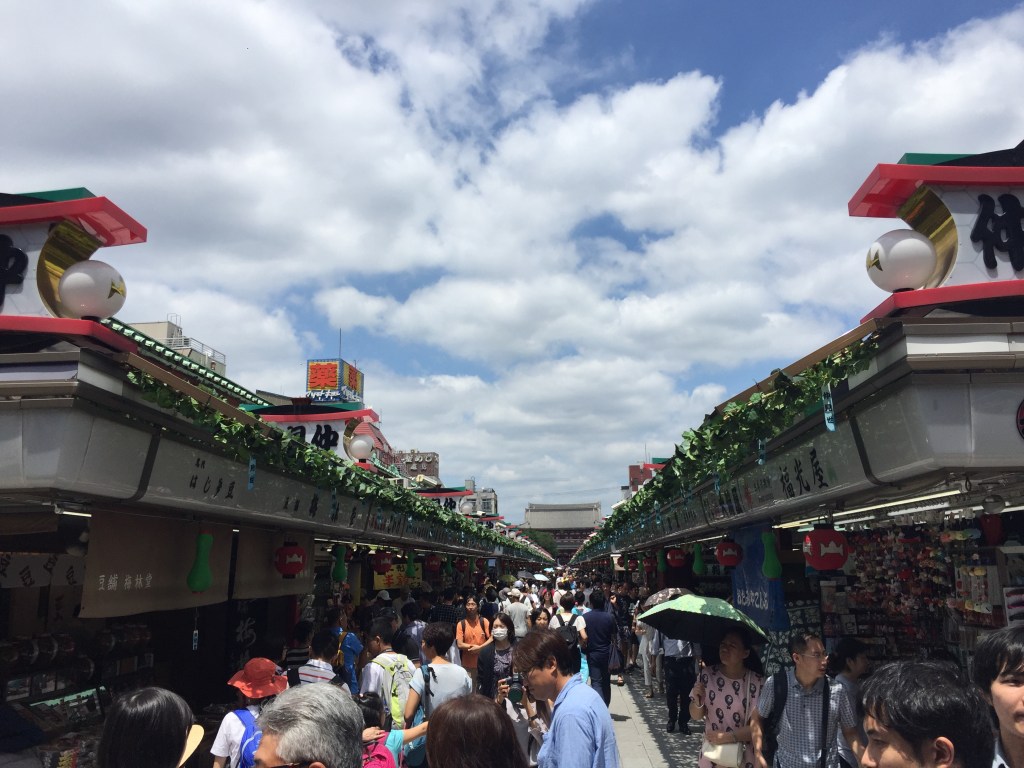
A photo I took in 2016 of the famous market of nakamise-dōri. The actual temple is way in the back.
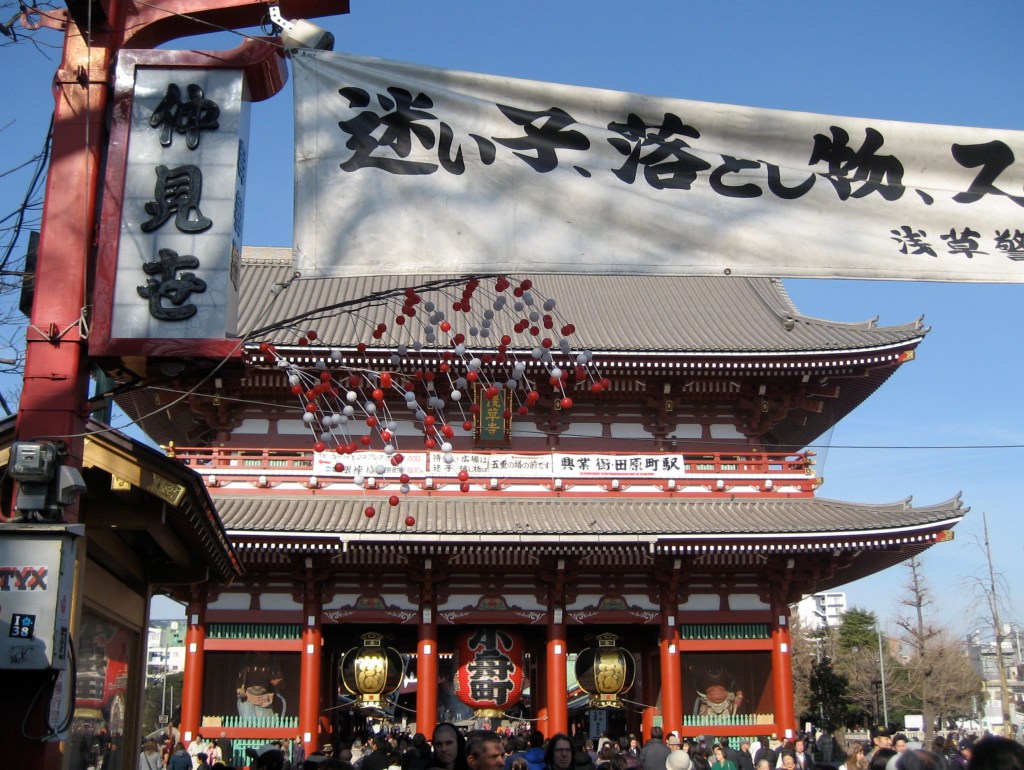
The temple just after New Year’s, taken in 2009.
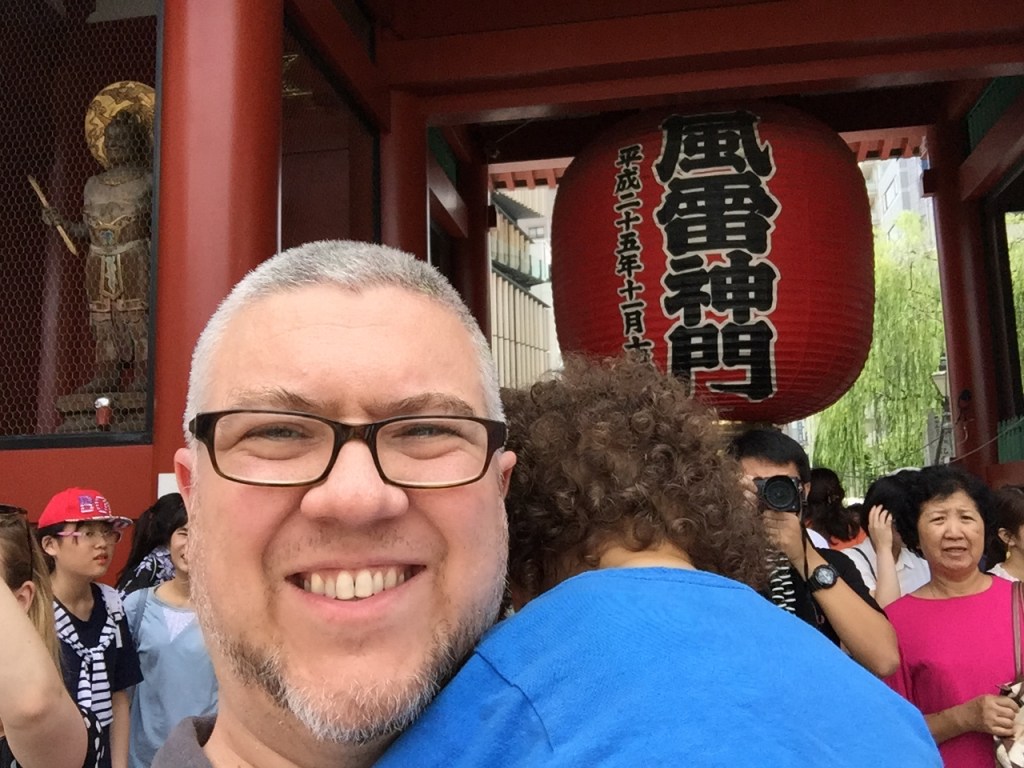
Me carrying one tired little boy at the iconic kaminari-mon gate in 2016. Note the giant red lantern in the back.
It is still one of my favorite temples, even if a bit touristy, and of the Buddhist sutra books I own this is still one of my favorite to use.1 This sutra book uses the traditional Classical Chinese with Japanese pronunciation guides (furigana), which is pretty typical of Japanese-Buddhist sutra books. As you can see, it’s not a long sutra to recite. It is probably the shortest sutra in the entire Buddhist canon.
Chanting the Heart Sutra is something many Buddhists in the Mahayana tradition (everything you see from Tibet to Japan, and overseas) do both in group services and in home services. People chant it in many languages and styles. Its simplicity, and general message about the nature of reality means that it tends to cut across sectarian lines and is popular in many sects and communities. Its cryptic and profound nature also means that for a one-page sutra it is the subject of intense study and research.
The sutra, for reference, is shown below. I used the standard Japanese liturgical form, recited in Zen temples, Tendai temples, Shingon temples, and so on, with only very minor differences per tradition. However, there are many ways and languages to recite the Heart Sutra.
kan ji zai bo satsu gyo jin han nya ha ra mi ta ji
When Avalokiteśvara Bodhisattva was practicing the profound Prajñāpāramitā,
照見五蘊皆空。
sho ken go un kai ku
he illuminated the Five Skandhas and saw that they were all empty,
度一切苦厄。
do is-sai ku yaku
and crossed over all suffering and affliction.
舎利子。色不異空。
sha ri shi shiki fu i ku
Śāriputra, form is not different from emptiness, and
空不異色。
ku fu i shiki
emptiness is not different from form.
色即是空。
shiki zoku ze ku
Form itself is emptiness, and
空即是色。
ku zoku ze shiki
emptiness itself is form.
受想行識亦復如是。
ju so gyo shiki yaku bu nyo ze
Sensation, conception, synthesis, and discrimination are also such as this.
舎利子。是諸法空相。
sha ri shi ze sho ho ku so
Śāriputra, all dharmas are empty:
不生不滅。
fu sho fu metsu
they are neither created nor destroyed,
不垢不浄。
fu ku fu jo
neither defiled nor pure,
不増不減。
fu zo fu gen
and they neither increase nor diminish.
是故空中。
ze ko ku chu
This is because in emptiness
無色無受想行識。
mu shiki mu ju so gyo shiki
there is no form, sensation, conception, synthesis, or discrimination.
無眼耳鼻舌身意。
mu gen-ni bi zes-shin i
There are no eyes, ears, nose, tongue, body, or thoughts.
無色声香味触法。
mu shiki sho ko mi soku ho
There are no forms, sounds, scents, tastes, sensations, or dharmas.
無眼界。
mu gen kai
There is no field of vision and
乃至無意識界。
nai shi mu i shiki kai
there is no realm of thoughts.
無無明。
mu mu myo
There is no ignorance
亦無無明尽。
yaku mu mu myo jin
nor elimination of ignorance,
乃至無老死。
nai shi mu ro shi
even up to and including no old age and death,
亦無老死尽。
yaku mu ro shi jin
nor elimination of old age and death.
無苦集滅道。
mu ku shu metsu do
There is no suffering, its accumulation, its elimination, or a path.
無智亦無得。
mu chi yaku mu toku
There is no understanding and no attaining.
以無所得故。
i mu sho tok-ko
Because there is no attainment,
菩提薩埵。依般若波羅蜜多故。
bo dai sat-ta e han nya ha ra mi ta ko
bodhisattvas rely on Prajñāpāramitā,
心無罜礙。
shin mu kei ge
and their minds have no obstructions.
無罜礙故。
mu kei ge ko
Since there are no obstructions,
無有恐怖。
mu u ku fu
they have no fears.
遠離一切顛倒夢想。
on ri is-sai ten do mu so
Because they are detached from backwards dream-thinking,
究竟涅槃。
ku gyo ne han
their final result is Nirvāṇa.
三世諸仏。
san ze sho butsu
Because all buddhas of the past, present, and future
依般若波羅蜜多故。
e han nya ha ra mi ta ko
rely on Prajñāpāramitā,
得阿耨多羅三藐三菩提。
toku a noku ta ra sam myaku san bo dai
they attain Anuttarā Samyaksaṃbodhi.
故知。般若波羅蜜多。
ko chi han nya ha ra mi ta
Therefore, know that Prajñāpāramitā
是大神呪。是大明呪。
ze dai jin shu ze dai myo shu
is a great spiritual mantra, a great brilliant mantra,
是無上呪。是無等等呪。
ze mu jo shu ze mu to do shu
an unsurpassed mantra, and an unequalled mantra.
能除一切苦。真実不虚故。説般若波羅蜜多呪。
no jo is-sai ku shin jitsu fu ko ko setsu han nya ha ra mi ta shu
The Prajñāpāramitā Mantra is spoken because it can truly remove all afflictions.
即説呪曰。
soku setsu shu watsu:
The mantra is spoken thusly:
羯諦羯諦波羅羯諦波羅僧羯諦菩提薩婆訶。
gya tei gya tei ha ra gya tei hara so gya tei bo ji so wa ka
gate gate pāragate pārasaṃgate bodhi svāhā3
般若心経
han nya shin gyo
The Heart Sutra
You can see a really nice example of this chanted here, courtesy of Koyasan Temple in Japan:
I have been reading Tanahashi’s book about the Heart Sutra and learning a lot about its various interpretations, how it’s conveyed in various languages, and various theories about its origin. I was fascinated to learn that there is a Mongolian version sometimes transcribed in Cyrillic. None of this is strictly necessary for the purposes of Buddhist practice, but it is fascinating. The example I showed above uses what’s called “Sino-Japanese”: Japanese pronunciation of the original Chinese characters it was composed with.2
As for chanting the sutra, I’ve been doing it for years, so I can more or less recite the Sino-Japanese version from memory, and am pretty comfortable doing it that way. I study the meaning of the sutra in English of course. I also have a PDF file for chanting in Sino-Japanese available for those interested.
I have also attended Zen centers on rare occasions (I tend to lean toward Pure Land Buddhism, to be honest) and seen the Heart Sutra recited using English. Learning the English meaning is very useful, but English chanting sounds a bit awkward to me. So, I prefer chanting in the original, and study the meaning separately.
But regardless of what language you use, the Heart Sutra, like all Buddhist sutras, has a funny tendency to gradually “sink in” over time. The meaning may not make much sense at first, but over the course of months and years, it takes on new meaning as you go through life, and see the sutra in a new light. I believe that’s the real value of Buddhist chanting: to internalize key Buddhist teachings in a way that you can carry with you throughout life.
As for me, these days, I tend to recite a Tendai-style home service,4 and as part of that I rotate between chanting this and a certain, small excerpt of the Immeasurable Life Sutra called the shiseige (四誓偈) or juseige (重誓偈) in Japanese Buddhism. When I finish one, I put it under the other sutra book, so I don’t forget which sutra to recite next time as I might go a week or two before reciting again. As a short, traditional liturgy, I am pretty content.
As with any Buddhist practice done over a long period of time, I believe that it gradually polishes the mind, and dispels one self-centered viewpoint. It’s super simple to do, but its benefits last a lifetime. To paraphrase Nichiren, when dying cloth in indigo, the more you do it, the deeper the color becomes.
Namu Amida Butsu Namu Kanzeon Bosatsu
Edit: I discovered in May 2025 some egregious mistakes in the formatting of the sutra above. This was not a problem with the translation, but with mistakes in how I copy-pasted into the blog post. I have since corrected these mistakes. Apologies to anyone who used the flawed copy of the sutra.
P.S. It’s tempting for some to look for an original “Sanskrit” version of the sutra, but alas, the best we know today is that the sutra was compiled originally in China, using excerpts from the much, much larger Prajña-paramita sutras. The story of how exactly that came to be is a much-discussed subject in Tanahashi’s book.
P.P.S. Fun fact: the version of the Heart Sutra used in Japan differs very slightly from the popular version attributed to Xuanzang. The Japanese version, popularized by the Shingon esoteric tradition, is called the rufubon (流布本) version. It has two extra Chinese characters (262 total) from Xuanzang’s 260, and uses slightly different characters for pronouncing the mantra at the end: 揭諦 instead of original 揭帝 for Sanskrit gaté.
1 Because it is devoted to Kannon Bodhisattva, this sutra book also includes (left in photo) a certain Japanese-Buddhist verse called the Jikku Kannon-gyō (十句観音経, “ten verse Kannon sutra”) popularized in the middle ages. I made a post here about it.
A nice explanation of the meaning and history of the ten-verse sutra can be found here.
2 It’s sometimes assumed that the sutra’s earliest composition was in a language like Sanskrit or something else from India, but research has long since proven that the Heart Sutra was a Chinese innovation, a summary of the much longer Perfection Wisdom Sutras, distilled into a very compact, chantable essence. The monk Xuan-zang later brought it back to India, where it later came to Tibet. Pretty clever actually.
3 I decided to leave the Sanskrit mantra untranslated, per esoteric-Buddhist tradition.
4 I like the Tendai approach to Buddhism because it encompasses all the things that are important to me, but avoiding a narrow, dogmatic approach that I found in the past and ultimately rejected.
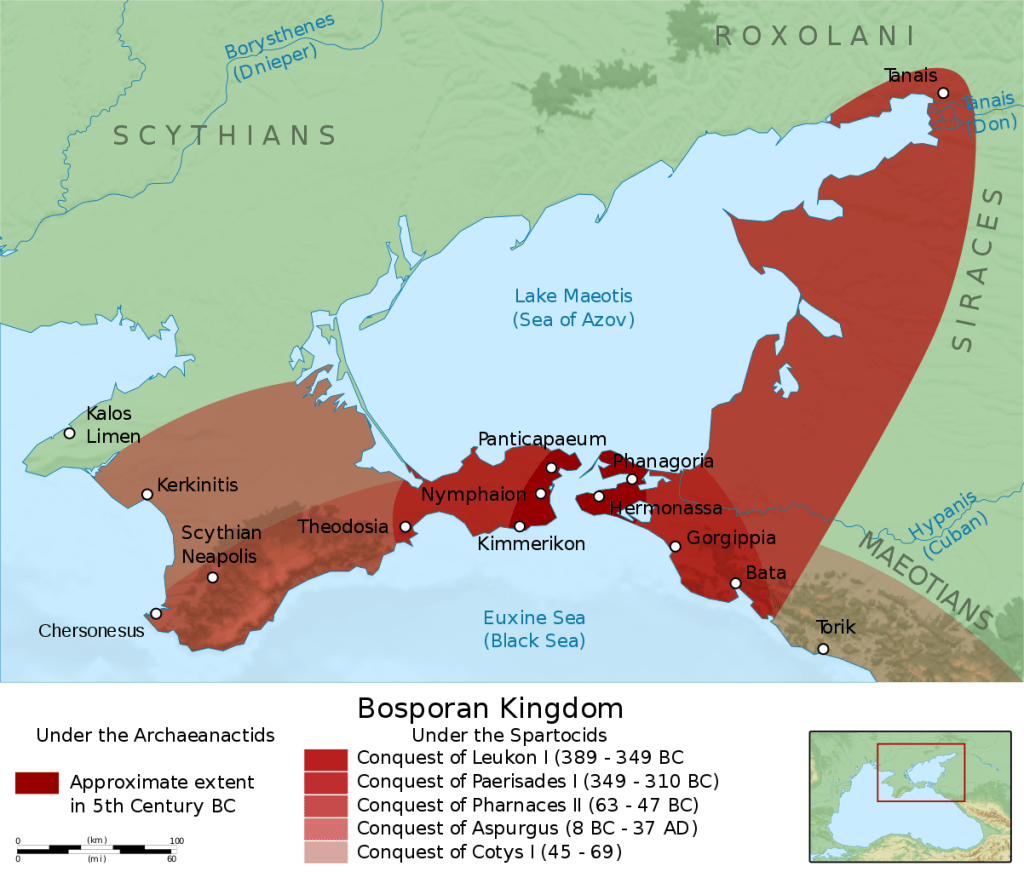
My continued read about the Scythians, especially the Scythians in the west, has lead to a fascinating period of time in early history, overlapping with the Hellenistic Period called the Kingdom of the Bosporus. The Kingdom of the Bosporus, later part of the Kingdom of the Pontus, survived in one form or another from the 5th century BC to the late Roman Imperial period in the year 370 AD (roughly 800 years). As you can see from the map, it started very small, just a collection of Greek colonies bound by mutual defense, and grew in size into a much larger kingdom that included the Crimean peninsula and parts of modern-day Ukraine.
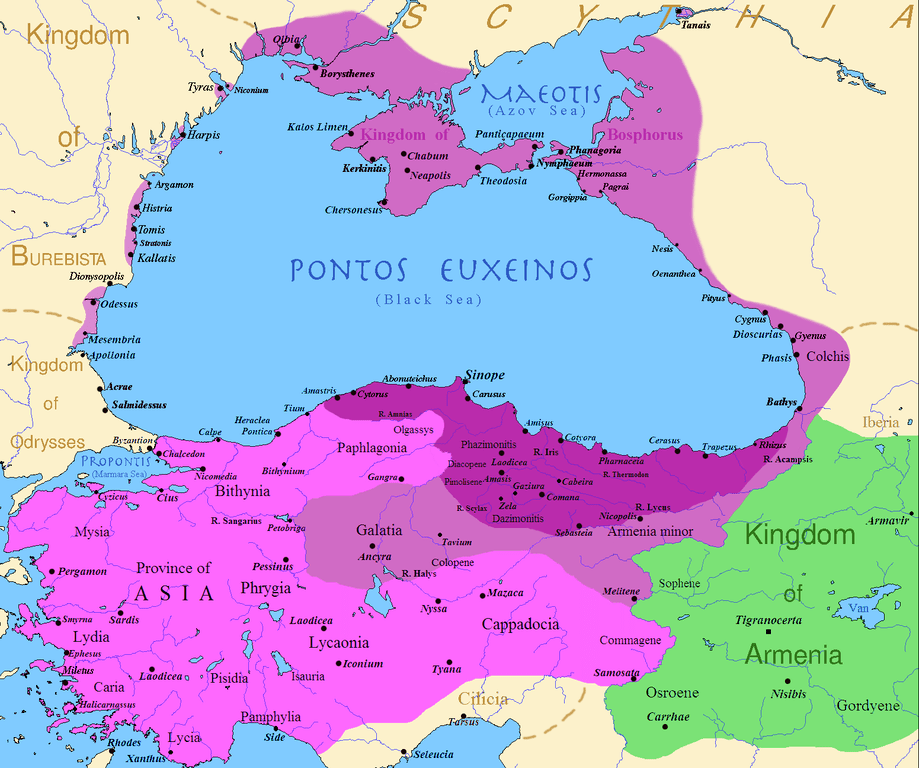
Later growing into a much later kingdom that went to war with Rome:
Javierfv1212, Public domain, via Wikimedia Commons
What makes the Kingdom of the Bosporus / Pontus fascinating is the convergence of Greek, Thracian, Scythian and other cultures, and the exchanges between them. Let’s take a brief look at each…
The Greek Colonies
The humble beginnings of the Kingdom of the Bosporus began as a hodge-podge of Greek colonies in the Black Sea. The ancient Greeks were prolific colonizers in the Mediterranean because the lands of Greece have low agricultural output, and as populations grew, they needed places to grow and stretch. Famous colonies include Syracuse on the island of Sicily (home of Archimedes!), southern Italy a.k.a. Magna Graecia, Cyrene in modern-day Libya, as well as countless colonies in Spain, southern France, Asia Minor and so on.
Colonies in the Black Sea, including the modern Ukrainian city of Odessa,1 mostly originated from the Greek city-state of Miletos which had been aggressively colonizing all around the Black Sea. Even now, old Greeks relics can be found. The Greeks were colonizing hostile territory, so they tended to build fortresses on off-shore islands, or just inland from a river. From the inland communities, the Greeks would get raw materials, grain and other foodstuffs to ship back to the Greek metropolises back home. In turn, they would bring wine (much prized by the Scythians), crafted luxury goods and spread Greek culture.
From the perspective of the Greek world, the Black Sea and colonies around the Crimean peninsula were the very edge of civilization. This was the frontier, where only the bravest, or the punished would go.
The Native Thracians
The Thracians are an influential people who lived north and east of Greece proper, but are not well-attested in history. Thracian culture shows considerable Greek influence, but they spoke a different language (now lost), and had a more loose, more tribal political structure than the classic Greek polis.
But the Thracians weren’t slouches either. They frequently combated with the northern Greeks, especially Phillip II of Macedon and his son, Alexander the Great, and the Odryzian Kingdom was a serious attempt by the Thracians to unify and challenge their Greek neighbors.
The Kingdom of the Bosporus, the subject of this post, was perhaps their most important contribution, though, because the founder of that kingdom was a man named Spartacus. No, not this Spartacus:
The name “Spartacus” is a distinctly Thracian name, and the founder of the ruling dynasty of the Bosporan Kingdom was a Thracian man named Spartokos I, first as the strongman or “tyrant” of the Greek colony of Panticapaeum (modern Kerch), and then gradually uniting the nearby colonies in a system of mutual protection.
The Steppe Warriors
Starting with the Cimmerians, steppe nomads would often encroach into the steppe lands of modern Ukraine and Hungary, the westernmost extent (as well as the most hospitable) of the Eurasian steppes. Having driven out the Cimmerians, they settled and lead a confederation of tribes that dominated the lands for centuries, until they were eventually defeated by the Sarmatians.
The nomadic Scythians were at first largely hostile to the settled Greco-Thracian cities along the coast, and there is evidence of war and violence at some places, hence the colonies banded together for mutual defence. Gradually, though, the different cultures learned to get along and began mutually beneficial trade. The Scythians liked Greek commodities and helped ship raw resources from other cultures further north down to the Greek settlements.
The kurgan tombs of Scythian warriors also began to show more Greek architectural influence, such as the great kurgan at Kul-oba, and a tomb at Bliznitsa near the colony of Phanagoria that depicted the goddess Demeter, hinting at the Eleusinian Mysteries.
Further, a number of famous Greeks have (often dubious) claim to Scythian ancestry such as the Athenian orator, Demosthenes, so intermarriage did occur between the colonists and steppe nomads. Herodotus’s historical accounts of his travels in these lands also provide invaluable information about the people of the Bosporan Kingdom, the Scythians beyond it, and more.
The Wider World
How the Bosporan Kingdom fit into the wider Hellenistic and Roman world is interesting too. Because of its location, it was luckily not involved much in the power struggles between Alexander the Great’s successors, nor did it tangle with the Roman Republic until much later during the Mithridatic Wars. All three of them.
Further, the mixed ethnic composition of the Bosporan Kingdom meant that it was an unusually cosmopolitan place, and held a certain mystique among the more urban residents of the Greeks and later Roman empire. When Ovid was banished there, though, he often whined about how hard and rustic the life was, but he would, wouldn’t he?
Anyhow, even when we watch the news about events in Ukraine, especially southern Ukraine, it’s helpful to remember that these lands have a long and fascinating, multicultural history, and we haven’t even gotten to Kievan Rus’ yet.
1 Which, as of writing, remains free thankfully. Слава Україні! 🇺🇦






 Gleanings in Buddha-Fields


You must be logged in to post a comment.