Making Sense of Japanese Verbs

Japanese language, like any language, uses verbs a lot. But verbs in Japanese differ considerably from Indo-European languages in how verbs are constructed, conjugated and so on. This makes them pretty tricky to learn at first glance, but the good news is that the internal structure and logic is actually fairly straightforward. You just need to unlearn your native language to avoid casual mistakes.

Warning: This post assumes you can read hiragana script. Hiragana takes a bit of work upfront, but you can master it quickly, and be reading Japanese fairly well after that (kanji notwithstanding). You can see my articles here, here and here about it.

The first thing to understand is that Japanese, especially in conversation, has a lot of implicit and contextual meaning. So, you can leave out many parts of speech because it’s already implied, or you just know from the context. But usually a sentence needs at least a verb.

A: [did you eat?]

B: ん、たべた
(yeah, I ate)

This is a perfectly normal sentence in conversation. No subject, object or anything, just the verb (to eat, past-tense).

Also, as I alluded to earlier, the conjugations and usages differ from European languages. Let’s look at some examples. This chart doesn’t cover everything but covers some of the most essential forms.

ConjugationUsageExample “Godan” Verb : 読む・よむExample “Ichidan” Verb : 食べる・たべる
Dictionary formDictionary listing of verb, also used for subordinate clauses, recurring actions (e.g. I eat X daily), and also future tense!読む・よむ食べる・たべる
Polite formUsed in polite, formal speech, especially at work, talking to teachers, or one’s elders. Also used for future tense!読みます・よみます食べます・たべます
“Te” formExtremely useful. Links verbs together in sequence, or allows for other grammatical forms.読んで・よんで食べて・たべて
Simple PastCasual, past tense form. Similar to dictionary form, but expresses past tense.読んだ・よんだ食べた・たべた
Passive formWhen something is being done to you. (e.g. I am being eaten)読まれる・よまれる食べられる・たべられる

Note that I divided verbs by Go-dan (五段), and Ichi-dan (一段) verbs. This is important as each one has a slightly different conjugation process. Ichi-dan verbs, sometimes called “ru-verbs” because the dictionary form always ends in る “ru”, however not all verbs that end in る are ichi-dan verbs. Everything else are go-dan verbs because the dictionary form has five (“go”) possible endings: う “u”, つ “tsu”, る “ru”, ぬ “nu”, and む “mu”.

Speaking from personal experience, people who are first learning Japanese often learn the textbook polite form since they’re talking with other adults, and don’t want to be rude.

However, it’s far more useful to learn the dictionary form and the “te”-form. The dictionary form is useful form many grammatical forms, and for more complex sentence. Note to mention it also expresses future tense in the right context. Similarly, the “te” form is the base of many other grammatical forms.

To conjugate the “te”-form from the dictionary form, change the verb endings like so:

Dictionary Verb
ending
Becomes…Example beforeExample after
う (u)って (tte)言う・いう (iu)言って・いって (itte)
つ (tsu)って (tte)持つ・もつ (motsu)持って・もって (motte)
る (ru)って (tte)切る・きる (kiru)切って・きって (kitte)
る (ru), ichidanて (te)食べる・たべる (taberu)食べて・たべて (tabete)
く (ku)いて (ite)書く・かく (kaku)書いて・かいて (kaite)
ぐ (gu)いで (ide)急ぐ・いそぐ (isogu)急いで・いそいで (isoide)
む (mu)んで (nde)読む・よむ (yomu)読んで・よんで (yonde)

Similarly for the simple past tense, just change the “te” to “ta” like so:

Dictionary Verb
ending
Becomes…Example beforeExample after
う (u)った (tta)言う・いう (iu)言って・いった (itta)
つ (tsu)った (tta)持つ・もつ (motsu)持って・もった (motta)
る (ru)った (tta)切る・きる (kiru)切って・きった (kitta)
る (ru), ichidanた (ta)食べる・たべる (taberu)食べて・たべた (tabete)
く (ku)いた (ita)書く・かく (kaku)書いて・かいた (kaita)
ぐ (gu)いだ (ida)急ぐ・いそぐ (isogu)急いで・いそいだ (isoida)
む (mu)んだ (nda)読む・よむ (yomu)読んで・よんだ (yonda)

Using these simple tricks, you can do more complex forms, like converting a passive form verb to past-tense (i.e. the sushi is being eaten -> the sushi was eaten), and so on.

In fact, I believe when learning Japanese verbs, it’s best to record and list them like so:

dictionary-form, te-form

examples:
読む、読んで
食べる、食べて
切る、切って
着る、着て

This not only helps you memorize the basic grammatical forms, but helps you remember if it is an ichidan verb vs. godan verb. “By their te-form, ye shall know them…1

Anyhow, that’s a brief look at Japanese verbs. It’s not necessary to learn all the forms and applications at first, but a good way to build solid fundamentals and branch into more advanced lessons more seamlessly.

Good luck and happy studying!

1 This was a trick, not to mention a joke, I learned recently while studying classic, Koine Greek. Nouns are recorded as a combination of nominative + genitive forms, while Greek verbs are listed by principal parts. There’s no reason why Japanese language tools can do the same, but I don’t see books really doing this. That’s a shame. Greek and Latin have been scrutinized and studied for centuries in the West, so the teaching tools and methods are very mature. Japanese language studies in the West are much newer, and lacking many of these handy mnemonics, tools, etc.

Ablution

A floor tile mosaic showing two peacocks flanking a foundatin. Above the fountain is the Greek palindrome "ΝΙΨΟΝΑΝΟΜΗΜΑΤΑΜΗΜΟΝΑΝΟΨΙΝ".

Recently, I have been dabbling in learning ancient Greek language for the first time in years. I polished off my old DVD copy of the Greek 101 course from The Great Courses which I bought during the Pandemic after my local library no longer had it available.1 It’s been fun to review old lessons, get reacquainted with such a gorgeous language, and so on.

Anyhow, something I wanted to share was a famous axiom in Koine Greek found throughout the Eastern Roman (a.k.a. the Byzantine) world:

ΝΙΨΟΝΑΝΟΜΗΜΑΤΑΜΗΜΟΝΑΝΟΨΙΝ
(Νίψον ἀνομήματα, μὴ μόναν ὄψιν)

“Wash your sins, not only your face.”

This is pronounced as Nipson anomēmata mē monan opsin. This is a famous palindrome (same forwards or backwards) that according to Wikipedia is attributed to one Saint Gregory of Nazianzus. I am not super familiar with the Orthodox tradition, but feel free to consult Wikipedia for more details. You can find it at many monasteries across the Eastern Roman world, including the holy font at the Hagia Sophia, the central church of Constantinople.

A floor tile mosaic showing two peacocks flanking a foundatin. Above the fountain is the Greek palindrome "ΝΙΨΟΝΑΝΟΜΗΜΑΤΑΜΗΜΟΝΑΝΟΨΙΝ".
A floor mosaic at the monastery of Panagia Malevi, image by Christina Kekka from Athens, GreeceLight correction by Basile Morin, CC BY 2.0, via Wikimedia Commons

In any case, the concept of ablution is also found in Buddhism and expresses a similar sentiment.

Buddhism has a popular custom whereby one performs some kind of ablution with water or incense before approaching a Buddhist altar to pray. It is not strictly required, but is commonly performed as a gesture of respect toward the Buddhist deity you are visiting by cleansing oneself at a superficial level. Within Japanese Buddhism, some sects encourage this more than others; from what I have learned Tendai Buddhism tends to emphasize this a lot, Pure Land Buddhist sects (e.g. Jodo Shu and Jodo Shinshu) do not. The emphasis varies, in other words.

But also ablution in Buddhism is not limited to the external ritual; we also the concept of repentance (e.g. “washing the soul”). This is not the same thing as Western religions, where someone begs God for forgiveness for transgressions committed. Instead, the Buddha strongly encouraged us to constantly evaluate our past conduct, and use the Dharma as a kind of yard-stick to measure them: were they skillful actions, or unskillful actions? Inevitably, one must confront their own unskillful actions. We all do. It is part of being a human being.

So, in Buddhism, many traditions have a ritual were people reflect on their past actions and renounce them, resolving to do better. It is encouraged to do this in front of a statue of the Buddha, and to repeat the liturgy out loud, not just in one’s mind:

All of the misdeeds I’ve committed in the past, are the result of my own greed [or craving], anger and delusion [or ignorance]. I renounce [or repent] these misdeeds.

Translations vary by community, this is just one example.

The idea is that by acknowledging and confessing one’s faults, one not only learns from one’s mistakes, one also potentially diminishes some negative karma that one has sown, and also prevents further self-harm (i.e. guilt, self-recrimination) by letting go and forgiving oneself.

So, just as the old Greek palindrome says, Buddhist practice is not only washing one’s face, but also one’s “soul”.2

Namu Shakamuni Nyorai

P.S. A common misunderstanding is the primary language in the Roman Empire was Latin. In fact, most of the population spoke Greek as their primary language, though this varied widely by region. This prevalence of Greek was both a leftover from the Hellenistic Age, but also because even Romans felt that Greek was a prestige language, and wealthy Romans hired Greek tutors for their children when possible. Julius Caesar’s famous “Et Tu Brute” quote was actually recited in Greek (Kai Su Teknon).

1 I prefer having hard copies of things, whenever possible.

2 Buddhism is somewhat unique among world religions in that it teaches the concept of “no-soul” (anatman), so by “soul” I don’t mean a literal soul, but the mind and one’s provisional self.

Japanese Learning: Going Back to School

I have been studying Japanese language, off and on, for many years, first for curiosity, then to converse with my in-laws, and later because it unlocked aspects of Japanese culture I couldn’t find in English. In the past, I took and passed the JLPT exam, level N2 (failed the N1 twice). And yet despite that certification, I still struggle with conversation, compared to my kids who are pretty bilingual. Of course kids pick up language more easily than adults, but after so many years it is sometimes disheartening to see that my Japanese is functional yet clunky.

Recently though, I stumbled upon one of my son’s old textbooks from Benesse. Benesse is a company in Japan that provides teaching aides for kids (including Japanese kids overseas), through a monthly subscription service. Kids get study materials appropriate for their grade, and submit work monthly by mail, earning special prizes and such. The teaching staff at Benesse grade the work, send friendly feedback, etc. Our kids both subscribed to the service until about the third grade when they got too busy to keep going.

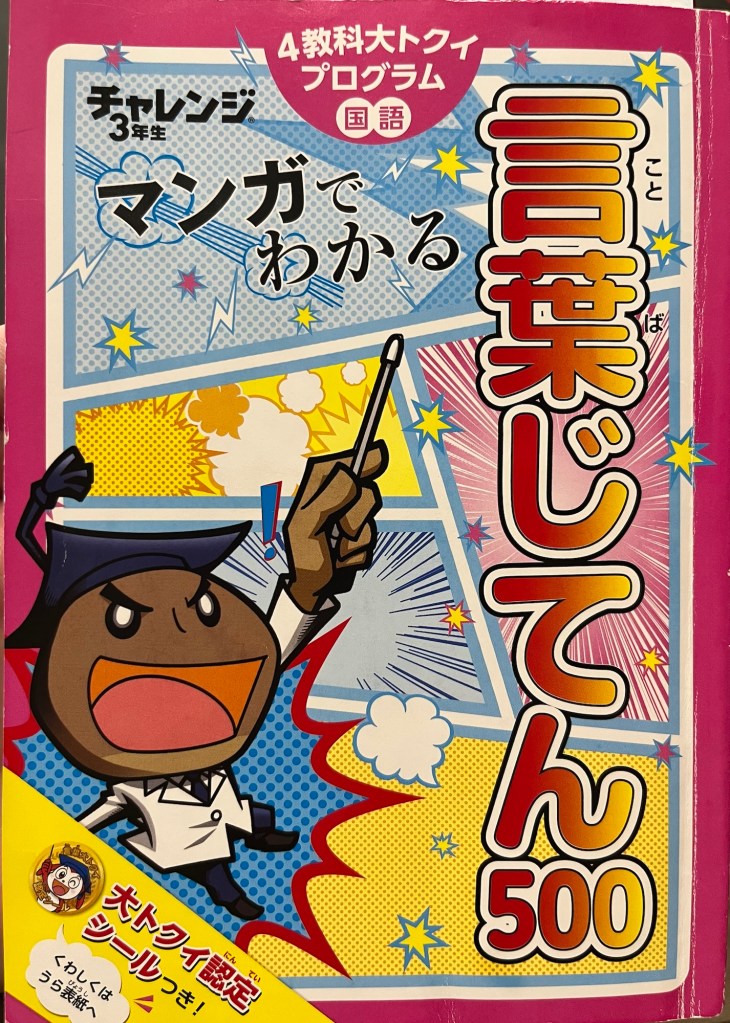
The cover of a textbook with Japanese written on it, where kids can learn 500 words using fun manga illustrations. The front cover features a cartoon character with a professor hat.
The cover of a textbook by Benesse featuring 500 words in Japanese for a 3rd grader to learn, using Manga.

Because of this, we have lots of old Benesse educational material lying around the house that the kids no longer need, and it turns out that even for an adult foreigner like myself, it’s really useful.

A while back, my kids’ local Japanese language teacher once remarked that if you are able to learn 3rd grade level Japanese, then you have a solid foundation. Forget college level or even high school level; just getting conversant at a third grade level is surprisingly useful.

Having seen the contents of the third-grade materials above I now believe it. I was surprised how many vocabulary words in the book were also in my JLPT study materials for the N2 and N1. Not only that, but they were presented in a fun, more engaging way for native speakers (kids). The explanations and examples were more natural and easier to grasp than my pricey JLPT study guides.

Even now, after years of study, I can pick up an old Doraemon comic and mostly be able to read it. And yet, I find I still have to look up words, and sometimes I learn new expressions and phrases in everyday Japanese. It’s not just learning the words, it’s learning in how people just say things. There’s more than one way to say “I’m impressed by something”, but they have slight nuances or differences in grammatical construction that just can’t be easily explained without context.

Doraemon is an old-timey comic for grade school kids and yet it’s clear that it still presents a good challenge for a language student.

All this is to say that if you are learning Japanese, or any language, jumping into adult material and concepts is somewhat counter-productive. It seems like the right thing to do, speaking as an adult, but grade school level language and material is surprisingly important and shouldn’t be overlooked. Everything beyond grade-school level is mostly just specialization in topics. If you focus on advanced materials too much you’ll be familiar with that topic but not much else. In others, you’ll have glaring gaps in your language skills. This essentially what happened to me, and only now am I starting to correct it.

But how does one approach this as a language student? Most students don’t have access to Benesse materials since it’s intended for Japanese audiences. You may have to get creative, but you can find children’s books, manga (including Doraemon), and study guides for Japanese kids online or in a Japanese bookstore. It doesn’t hurt to pick up such materials, and you may find them more challenging than you expected.

Remember: focus on getting to the third grade. However, you may have to start even lower level, first grade Japanese, second grade Japanese, etc.

It’s less about finding specific materials, and more about setting a realistic level of challenge, and then obtaining enough material (not just one book or two) until it becomes easy, innate. You can think of this as starting a new exercise routine, and setting realistic expectations. Just as kids starting learning basic language, and gradually increase in difficulty, language students should do the same. It’s seemingly slower at first, but builds a better foundation and avoids the painful need to go back and correct your Japanese later.

In any case, simply getting to a grade-school level will be surprisingly useful both in day to day interactions with Japanese people, and in passing the JLPT exams.

Introducing the Heart Sutra

Recently, I wrote a brief introduction to the Buddhist canon, the sutras. Sutras come in many shapes and forms, but I want to focus on one of the most famous, and most popular to recite: The Heart Sutra.

A sutra book from Japan showing the Heart Sutra, preserved in old Chinese, but with Japanese pronunciation guides.

The full name of this sutra is the Heart of the Perfection of Wisdom Sutra (般若波羅蜜多心經), and was one in a series of “perfection of wisdom sutras” that were published starting around 2nd century BCE. Starting with the “Perfection of Wisdom in 8,000 Verses Sutra“, the authors made longer and longer versions, culminating to a 25,000 verse version of hte same sutra. Then, they started making shorter versions, getting down to the Diamond Sutra, and finally the Heart Sutra.

Or, so the theory goes.

The Heart Sutra is believed to distill the essence or “heart” of the Perfection of Wisdom teachings to its smallest, most essential version. More on that soon. This version is very short, can be read in 1-2 minutes, and is pretty cryptic. Because it is so short, it is easy to learn and memorize, and thus easy to recite. Its utility for everyday Buddhists is among the reasons it has such lasting popularity. I have a copy of a translation of the 8,000 verse sutra,1 and while it is interesting, it is a tome. It is not practical for most Buddhists to read such a tome, so you can imagine why the Heart Sutra was composed, and why it is so much more popular.

But that gets to an interesting question: who composed it? This is a surprisingly difficult question to answer.

The traditional assumption was that it was composed in India, using Sanskrit language, and then brought to China like most other Buddhist sutras. And yet, a scholar named Dr. Jan Nattier proposed an interesting theory that the Heart Sutra in particular was composed in China, not India, and that it was translated back to Sanskrit, not from it, by our favorite wandering monk Xuan-zang when he visited India. There is considerable debate about this, and valid arguments for one or the other, but it’s an interesting idea that some plucky Chinese monk found a clever way to distill the Perfection of Wisdom teachings into a more bite-sized form.

That said, one of the interesting features of the Heart Sutra is that it does contain a genuine Sanskrit mantra at the end (a trend that continues with later Buddhist texts) in the Siddham script:

𑖐𑖝𑖸 𑖐𑖝𑖸 𑖢𑖯𑖨𑖐𑖝𑖸 𑖢𑖯𑖨𑖭𑖽𑖐𑖝𑖸 𑖤𑖺𑖠𑖰𑖭𑖿𑖪𑖯𑖮𑖯
ga te ga te pā ra ga te pā ra saṃ ga te bo dhi svā hā

For various reasons, this mantra was written in Chinese characters that approximated the pronunciation of the Sanskrit:

𑖐𑖝𑖸 𑖐𑖝𑖸 𑖢𑖯𑖨𑖐𑖝𑖸 𑖢𑖯𑖨𑖭𑖽𑖐𑖝𑖸 𑖤𑖺𑖠𑖰𑖭𑖿𑖪𑖯𑖮𑖯
羯諦 羯諦 波羅羯諦 波羅僧羯諦 菩提薩婆訶

So, what is the teaching of the Heart Sutra?

As I eluded to earlier, the Heart Sutra is the most condensed version of the Perfection of Wisdom teachings, or prajñā-pāramitā in Sanskrit. This was a teaching that provided an important foundation for Mahayana Buddhism (everything from Tibet to Japan). “Perfection of Wisdom” is hard to explain. But, roughly speaking you can think of it as the fundamental understanding of existence, which is sitting right in front of your face, but not obvious until you see it. Like the first time you noticed a small crack in the wall. Once you see it, you don’t “unsee” it.

But instead, the Perfection of Wisdom is about undoing the filters in one’s own mind, so you can see the world unvarnished. That’s easy to say, but extremely tricky to sincerely accomplish. Hence the extraordinary accomplishments of the Buddhas and Bodhisattvas.

The Heart Sutra talks a lot about “not this”, and “not that”, and like other similar sutras (e.g. the Diamond Sutra, another of the series), this is to try and undo the filters of one’s own mind. But, on its surface, the Heart Sutra is cryptic and vague. Yet, because it is so pithy, and so over time bits of it start to sink in, or something that didn’t make sense in the past finally clicks.

So, if you do pick up a copy of the Heart Sutra, don’t worry if it doesn’t really make sense. Recite it from time to time,2 study it with help sutras guides (there are many) and make it a part of your Buddhist life, regardless of what tradition you follow.

For a such tiny, little composition, it’s a pretty neat contribution to Buddhism.

1 Purchased years ago at Powell’s City of Books in Portland, OR. One of the best bookstores, and well worth a visit if you go there.

2 Some people recite in their native language, others recite in one or more “liturgical” languages. It doesn’t really matter. Pick something you can stick with. You can change it later.

Measure Words in Japanese

a path leading to a Japanese shrine, with stone lanterns to one side in a row.

Authors’s note: shifting gears a bit as I clear out the blog backlog. 😆

“Measure words” or “counting words” are an interesting phenomenon found in many East Asian languages, but less so in Indo-European languages. This leads to some challenges with counting things.

In English, we might say “one sheet of paper” or “two sticks of incense” or “a box of nails”. But we wouldn’t say “three things of fish”. We say “three fish”, or “three chickens” or “two cows”. People too: two senators, one customer, or three employees. So the use of counting words in English is limited. From what I recall of Classical languages such as Greek, Latin and Sanskrit, it doesn’t exist at all.1 In Japanese, there are counting words for all of them, and some of these counting words can be pretty obscure.

Let’s look at some examples, but first, let’s review basic numbers from one to five:

NumberJapanese WordHiraganaKanji
1Ichi
(ee-chee)
いち
2Ni
(nee)
3San
(sahn)
さん
4Shi, Yon
(yohn)
し、よん
5Go
(goh)

Four is a special case since there two words for “four”, but for counting stuff, the word “yon” is used.

Anyway, let’s start with good entry-level counting words. For paper, and other flat things like it Japanese counts them with the word “mai” (枚), so counting sheets of paper looks like so (using Kanji):

  1. 一枚 – ichi mai (one sheet)
  2. 二枚 – ni mai (two sheets)
  3. 三枚 – san mai (three sheets)
  4. 四枚 – yon mai (four sheets)
  5. 五枚 – go mai (five sheets)

By the way, it is PERFECTLY normal to use Arabic Numerals for counting too, especially for numbers beyond three.

  • 1枚 – ichi mai (one sheet)
  • 2枚 – ni mai (two sheets)
  • 3枚 – san mai (three sheets)
  • 4枚 – yon mai (four sheets)
  • 5枚 – go mai (five sheets)

Anyhow, the important thing to understand grammatically speaking, is that counting words like this are treated like adverbs, and adverbs in Japanese IMMEDIATELY precede the verb they modify, as in this sentence:

紙を二枚使ったよ。

かみをにまいつかったよ。

kami wo nimai tsukatta yo. “I used two sheets paper”.

In this case, the counting word “ni mai” comes right before the verb to use (使った). It took me a long time to realize this. I kept using the incorrect grammar of nimai no kami wo tsukatta. This is wrong, but is more similar to English, hence my mistake. DO NOT DO THIS. Put the counting word just before the verb and you’ll sound a lot better.

Anyhow, mai is a nice easy counting word and frequently used. Another common counting word is “hon” (本) used for long things, bottles, sticks, and so on:

  1. 一本 – ip-pon (one stick)
  2. 二本 – ni hon (two sticks)
  3. 三本 – san bon (three sticks)
  4. 四本 – yon hon (four sticks)
  5. 五本 – go hon (five sticks)

Wait a minute. Some of them aren’t pronounced as “hon”. Japanese, like many languages, has a grammatical feature called “Sandhi”3 where certain sounds change to make them smoother. English has lots of Sandhi rules, Japanese has relatively few, but one rule is that the “h” sound sometimes becomes a “b” or “p” sound in some cases: n + h = nb, for example. Another rule is that the “chi” or “tsu” sound sometimes becomes a small “tsu”.

Unfortunately, Japanese has a lot of little use-cases like this for counting. There’s no easy way to say this: you just have to memorize these oddities. Most of them make sense when you say them out loud because they evolved to be smoother for native speakers.

But I digress. We’ve learned mai (枚) and hon (本).

Let’s move onto people. This one is particularly tricky:

  1. 一人 – hitori (one person)
  2. 二人 – futari (two people)
  3. 三人 – san nin (three people)
  4. 四人 – yo nin not yon-nin (four people)
  5. 五人 – go nin (five people)

Here, some of the words are complete different, and don’t fit a pattern. This is a somewhat extreme example, but it shows how some common-use cases just don’t always follow a pattern. There are times when you just have to memorize how to count something.

Similarly, for “things” (generic), there is a similar way to count:

  1. 一つ – hitotsu (a thing)
  2. 二つ – futatsu (two things)
  3. 三つ – mittsu (three things)
  4. 四つ – yottsu (four things)
  5. 五つ – itsutsu (five things)

When all else fails, use the generic counter above (except on people!). There are many situations where that is sufficient. If you happen to know the correct, more specific counting word, use that instead.

Anyhow, let’s get back to specific counters. For animals, things get interesting because there are multiple counting words. To list a few that we saw at the top of this post:

  • hiki (匹) – small animals and fish: ip-piki, ni hiki, san biki, yon hiki
  • wa (羽)- birds and rabbits: ichi wa, ni wa, san wa, yon wa
  • (頭) – large, or hoofed animals: it-tō, ni tō, san tō, yon tō

So, two cows would be ni tō, while three chickens would be san wa, and three fishes would be san biki.

Let’s talk a bit about rarer counting words.

Tofugu has a great comprehensive list of all the counting words, and some of these are obscure even for Japanese people, but there’s a few worth calling out because they do come up.

You might think that chopsticks are counting using hon as we saw above, but it has its own counting word: “zen” (膳). A single pair of chopsticks is ichi zen (一膳), two pairs are ni zen (二膳), and so on. This counting word is ALSO used for bowls of rice, or bowls of beef and such.

Another example is “chō” (丁). The counting word is used for things like bowls of ramen and kitchen knives, among others. If you wanted to ask for three bowls of ramen, you could say:

ラーメンを3丁下さい。

ラーメンをさんちょうください。

Ra-men wo san-chō kudasai

This one is a bit obscure, but like “zen” (膳) it does come up from time to time, so it’s good to be aware of it.

As I alluded to earlier, this is not a comprehensive list. There are many counting words ranging from very common to very obscure, some even that day to day Japanese might not always know. There are a couple takeaways from this to be aware of as a language student:

  1. counting words behave like adverbs, which in Japanese means that they immediately precede the verb.
  2. some counting words have pronunciation that varies, in order to make smoother sounds. Some are just not pronounced the way you’d expected. You just have to know these, and memorize them.
  3. It is not necessary to know them all. Knowing the most common ones is a good start, and over time you might learn the obscure ones through experience.

Good luck and happy counting!

1 IIRC, numbers behaved like adjectives, so they would describe “two cows” as duas vaccas, since the adjective “two” must agree in case, number and (grammatical) gender with “cows”. English has very minimal inflection like this, so we just don’t do it. The Sanskrit version, btw, is dvau gavau because it still has a “dual” case between singular and plural. Ancient Greek dropped dual not long after Homeric Greek, I think. Sanskrit is thus a super old language, even compared to Greek/Latin because it retains some truly ancient grammar patterns.

2 Originally from the “Sandhi” rules in Sanskrit. Sanskrit has a complex series of rules for sound-changes, and linguists borrowed the term to describe the same phenomenon in other langauges. Sanskrit has a lot of rules, Japanese has relatively few.

Що таке буддизм чистої землі

(Dear readers, I wanted to try and summarize the Pure Land Buddhist teachings in Ukrainian. There isn’t much information, so I wrote this post for Ukrainian audiences. It summarizes teachings from other posts. Thank you for your patience)

Привіт, я радий мати українських читачів, які цікавляться буддизмом. Тому я хотів написати цей блог саме для українців. Зверніть увагу, я трохи вивчив українську, але точно недостатньо, щоб писати блог. Тому мені доводиться часто користуватися Google Translate. Вибачте за будь-які помилки. Насолоджуйтесь цим постом і слава Україні

Буддизм Чистої Землі є вірною традицією в буддизмі. Багато людей в Азії та світі дотримуються буддизму Чистої Землі. Це просто, легко зрозуміти та легко застосувати на практиці. Для цього не потрібен ні гуру, ні храм. Ви можете почати як зараз.

За словами Будди Шак’ямуні, життя подібне до річки. На цьому березі розбрат, розчарування, невігластво, страх і так далі. На іншому березі — мир, доброзичливість і задоволення. Таким чином, буддизм вчить, як перепливти цю річку на інший берег.

Photo by Oleg Magni on Pexels.com

Крім того, Будда Шак’ямуні навчив багатьох методів і «інструментів», щоб перетнути річку. Різні люди вважають за краще використовувати різні інструменти, але всі вони будують плоти, щоб переплисти річку. Буддизм чистої землі є одним із інструментів.

Буддизм Чистої Землі вшановує Будду Аміду (あみだ, 阿弥陀), Будду нескінченного світла.

Примітка: Про буддизм Чистої Землі я дізнався через японську секту «Джодо Шу» (じょうどしゅう, 浄土宗). Отже, я використовую японсько-буддійські терміни. Інші буддистські країни використовують інші терміни, але основне вчення те саме.

Аміда Будда — легендарний, або космічний, Будда, який обіцяє допомогти всім істотам дістатися іншого берега. Аміда Будда кличе людей зі своєї Чистої Землі, яка є притулком. Цей притулок доступний для всіх людей, ким би вони не були, якщо вони просто продекламують Нембуцу (ねんぶつ, 念佛).

Що таке нембуцу?

Нембуцу означає такі речі, як «думати про Будду» або «прославляти Будду» тощо. Зазвичай люди декламують нембуцу усно.

Японською мовою це вимовляється як наму аміда буцу (なむあみだぶつ, 南無阿弥陀仏).

У буддизмі існує священний текст під назвою Сутра безмежного життя, також відомий як Велика сутра Сухаватівюха. Ця сутра представляє Аміду Будду та його походження.

Давним-давно Аміда Будда був королем, який зустрів іншого Будду. Вчення Будди справило на нього таке враження, що він зрікся престолу і став буддійським ченцем. Він поклявся допомагати всім живим істотам, створивши безпечну гавань під назвою Сукхаваті («Остання радість»), а також став Буддою.

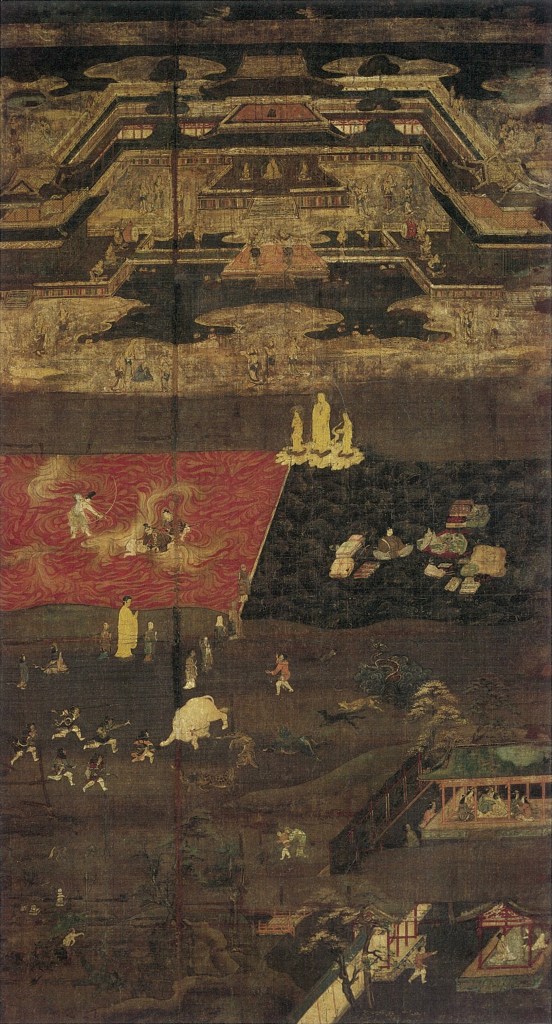
Це «Мандала Тайма», японсько-буддійський твір мистецтва VIII століття. Він показує Чисту землю Аміди Будди.

Цих обітниць насправді було 48 обітниць. 18-й обітниця є найважливішою. Це простий переклад:

Коли я стану Буддою, розумні істоти в усіх напрямках, які хочуть народитися в моїй Чистій Землі, повинні просто сказати моє ім’я принаймні 10 разів, і вони там народяться. Якщо це неправда, нехай я не стану Буддою.

Таким чином, якщо світ надто складний або людина не може слідувати традиційним буддійським шляхом, можна вибрати переродження в Чистій землі, промовляючи Нембуцу (наму аміда буцу). Це особистий вибір.

Засновник секти «Джодо Шу» Хонен (法然, 1133 – 1212) описав співчуття Аміди Будди як місячне світло. Він сяє скрізь, але лише деякі дивляться вгору:

ЯпонськоюКоваленко Переклад
月かげのцукі kaґе ноНемає такого села,
いたらぬ里はітарану сато ваде б не світило
なけれどもнакередомомісячне світло,
眺むる人のнаґамуру хіто ноале воно живе в серцях тих,
心にぞすむкокоро ні дзосумухто його бачить.

Так само в Сутрі безмежного життя є така цитата:

Якщо розумні істоти стикаються зі світлом Аміди Будди, їх три скверни усуваються; вони відчувають ніжність, радість і насолоду; і виникають добрі думки.

Але чим буддизм чистої землі відрізняється від християнства?

Фундаментальне вчення все ще є буддійським: живі істоти повинні «перепливти річку», щоб досягти короткого просвітлення. Аміда Будда просто допомагає на цьому шляху.

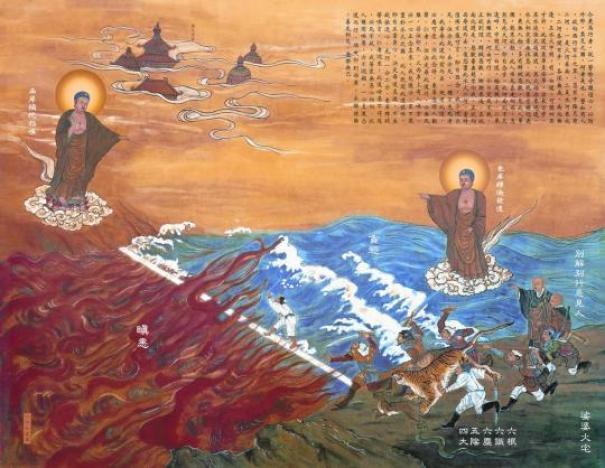
У VII столітті в Китаї жив чернець на ім’я Шандао (善導, 613–681). Він написав відому притчу під назвою «Притча про дві річки та білий міст». Ви можете побачити приклад ілюстрації нижче:

Підсумовуючи, притча вчить, що на цьому березі Будда Шак’ямуні вказує на міст. На іншому березі річки Аміда Будда кличе нас перепливти. Шлях вузький, але якщо ви прислухаєтесь до слів Будди Шак’ямуні та заклику Будди Аміди, ви пройдете безпечно.

Це базовий вступ до буддизму Чистої Землі, особливо до секти Джодо Шу. Якщо ви цікавитеся буддизмом, але відчуваєте розгубленість або самотність, просто спробуйте продекламувати Нембуцу. В якості основи використовуйте нембуцу.

У секті Джодо Шу існує традиція декламації нембуцу під назвою цзюнен (じゅうねん, 十念, «десять декламацій»). Звучить так:

наму аміда бу
наму аміда бу
наму аміда бу
наму аміда бу
наму аміда бу
наму аміда бу
наму аміда бу
наму аміда бу
наму аміда буцу
наму аміда бу

Дев’ята декламація має додаткове “цу” в кінці. Крім того, люди зводять руки разом у молитві, коли вимовляють нембуцу. Це називається «гасшо».

Ви можете побачити приклад тут, у храмі Зодзідзі в Токіо, Японія:

Вибачте, що мені довелося скористатися Google Translate, але я сподіваюся, що ви знайшли щось корисне, і я сподіваюся, що побачите світло Аміди Будди.

наму аміда буцу

Buddhist Chanting for Difficult Times

Daily writing prompt
What strategies do you use to increase comfort in your daily life?

I have never tried using these WordPress writing prompts, but I thought I’d try as a fun exercise today.

Life is stressful. That’s the First Noble Truth of Buddhism. More precisely life is marked with stress, unease, discontent, and so on, collectively called dukkha in Sanskrit. Put more succinctly, shit happens sooner or later. It is impossible to avoid, but at the same time, a well-trained even-keel mind can weather the storm and thereby help ease one’s life, but also make life better for those around you too.

Buddhism as a 2,500 year old religion comes with a really large toolkit of methods, practices, and liturgy that can help bring peace of mind.

Most people think of meditation first, but this is simply not always practical, especially if you are a working parent, busy college student, and so on. There are other practices available that can more easily be fit into a busy lifestyle, and are not difficult to learn.

The first is to take up the Five Precepts as a baseline for one’s conduct. This is a passive practice, but helps provide some guideposts to life, gradually smooths out our rough edges, and builds self-confidence as well.

The second is Buddhist chanting.

There are many, many things one can chant in Buddhism: mantras, excerpts of Buddhist texts (sutras), full Buddhist texts, or devotional phrases as well.

Mantras are very short, but esoteric phrases often used for chanting, recited originally in Sanskrit language, but filtered over time in other languages. One of the best known is the Mantra of Light, but you can find many mantras. People often recite these 3 or 7 or even 21 times, but traditions vary. Consult your preferred tradition if you are unsure. Keep in mind that many traditions within Buddhism simply don’t use mantras, or use very sparingly.

Buddhist texts (sutras), or even excerpts of Buddhist texts, are an almost universal chanting practice. They are longer than mantras, but also more commonly practiced, and have a nice habit of reinforcing important teachings within yourself. You can recite them in the old, liturgical language, or recite in your own language. It does not really matter.

By far the most popular Buddhist text to recite is the Heart Sutra. The Heart Sutra is somewhat unusual because you can recite the entire text, from start to finish, in about 1-2 minutes. It is profound, but also really pithy. Another common chanting text you can do from start to finish is the Metta Sutta in the Theravada tradition. Most other Buddhist sutras are a challenge to recite in one sitting (some are extremely long), so instead people traditionally recite key excerpts only. The Lotus Sutra is particularly quote-worthy; it has many verses and quotations that are chanted by themselves without chanting the entire chapter. There are other good quote-worthy Buddhist sutras as well.

When chanting Buddhists sutras (or excerpts), you can either do it in a chanting voice, or simply recite the same way you might read a poem aloud, or something like reciting the “Litany of Fear” in Dune. Personally, I find chanting in English sounds silly, so I recite with an even voice instead.

Finally, we have devotional phrases. Because Buddhist deities are many and varied, each embodying some essential truth or concept in Buddhism, people tend to gravitate toward one or another. This is fine, and perfectly normal in Buddhism. One might gravitate toward the historical Buddha, Shakyamuni. One might gravitate toward Guan-yin (aka Avalokiteshvara, Chenrezig, Kannon, etc). One might gravitate toward the Buddha of Infinite Light (aka Amitabha, Amida, etc). Over time, you might shift as well. Again, perfectly normal.

In any case, many of these deities will have some simple devotional phrase: “Hail to X”, or “Praise to Y”, and so on. These might overlap with mantras, but aren’t necessarily mantras. They are often exoteric (no subtle, hidden meaning), not esoteric. Sometimes mantras are used as devotional phrases too. It’s also common in some traditions to praise the Lotus Sutra itself, not as a deity, but as the embodiment of the highest and best Buddhist teachings.

All of these devotional phrases are short, simple, and easy to recite. People often recite in groups of three, but you can recite as little or as much as you like. Consult your preferred tradition if you are unsure.

When should one do Buddhist chanting?

Whenever appropriate. If you get up first thing in the morning and recite your chosen sutra, mantra or devotional phrase, that’s great. If you do it before going to bed, that’s great. If you are stressed out at work, and need a moment, go in a quiet spot, and recite something Buddhist. If you are moved by something spiritual, you can also recite something in the form of gratitude. There are many times and places to do Buddhist chanting. Find what works, experiment if needed, see what sticks in your life.

One thing to keep in mind though: always do it respectfully, solemnly, and without showing off. Intention and sincerity are important.

Why should one do Buddhist chanting?

There are many reasons why one takes up the practice. For some, it helps settle the mind, especially when stressed or worried about something. It tends to reinforce positive habits too. Sometimes it can also bring a flash of insight because one’s mind is settled and they meaning of the texts finally makes sense. It also helps generate good karma for the future, like planting seeds for later harvest. By settling the mind, it also helps disengage negative habits and avoid negative consequences later.

Coupled with the Five Precepts I mentioned above, the long-term effects are both peace of mind for yourself, but also others around you as the wholesome effects “rub off”.

The Five Precepts and Buddhist chanting are two practices that almost anyone can do almost anywhere under any circumstances. You might have to tailor things to make it sustainable in your life, but there’s plenty of wiggle-room to make it work. Also, don’t be afraid to make adjustments.

Good luck!

Separated by Centuries

This is another cool moment in Japanese history (previous post here) that I wanted to share while re-watching the drama Thirteen Lords of the Shogun. Shortly after the death of Kazusa Hirotsune, the head of the Genji (Minamoto) clan named Minamoto no Yoritomo, sought to finally take the fight to Heike (Taira) clan. The trouble was was that he had a rival within the Genji clan itself.

Yoshinaka as portrayed in woodblock print from 1866, source Wikimedia Commons.

The Genji clan was quite large by this time, going all the way back a few centuries to Emperor Saga in the early 9th century. By the time of the Genpei War (late 11th century), the clan had a number of sub-clans, domains and so on. One such branch was led by Yoritomo’s cousin, Kiso no Yoshinaka.1 Yoshinaka and Yoritomo initially worked together, and Yoshinaka even sent his son, Yoshitaka (木曽義高), in good faith as a hostage at Yoritomo’s court in the city of Kamakura. However, the relationship quickly became estranged, and they competed for who could get to the capitol of Kyoto first to rescue the Emperor under house-arrest from the Heike clan.

What Yoshinaka didn’t know was that the scheming Emperor, Go-Shirakawa, was already in league with Yoritomo. Go-Shirakawa expressed gratitude to Yoshinaka, and even bestowed the lofty title of Asahi Shogun, or “Asahi” Commander of the Armed Forces, and commanded him to take the fight to the Heike. And yet, Go-Shirakawa still threw in his lot with with Yoshinaka’s cousin Yoritomo. Things quickly went downhill as Yoshinaka, realizing that he was being double-crossed, seized the Emperor briefly, and battled his cousin’s forces. In the end, Yoshinaka and his army were wiped out. His son, Yoshitaka, did not survive much longer despite being wed to Yoritomo’s daughter O-hime. This part of the historical drama is really sad because it was clear that Yoshitaka did nothing wrong, but was simply a victim of politics.

In the historical drama, and in Japanese literature, Yoshinaka is portrayed as sincere and well-meaning, but out of his league compared to the scheming of the Emperor and of Yoritomo. He was a genuine warrior, loved by his vassals, but court politics were beyond his ability, and he was ultimately betrayed by the very forces he sought to help. Seeing a pattern with Yoritomo?

So, why bring this up?

Yoshinaka’s remains were interred at a small Buddhist temple named Gichū-ji2 in the city of Otsu, in Shiga Prefecture. Centuries later, the famous haiku poet, Matsuo Basho, visited the temple on one of this pilgrimages. Basho was evidentially an admirer of Yoshinaka and composed a haiku upon visiting the gravesite:

JapaneseRomanizedRough Translation2
義仲のYoshinaka noIs this not the mountain
寝覚めの山かMezame no yama kathat Yoshinaka woke up on?
月悲しTsuki kanashiThe melancholy moon.
2 any faults in the translation are my own

According to tradition, it is thought that one night while sleeping on a mountainside, Yoshinaka woke up and gazed at the moon. Here, on that same mountainside, the moon shines melancholy, still reflecting over the demise of Yoshinaka.

Later, when Basho passed away he was, according to his wishes, also interred at Gichū-ji so that he may rest alongside the admired warlord.

There’s a travel blog entry in Japanese that shows the temple grounds and the grave sites, while this page shows the temple.

It’s interesting that such a talented poet was so infatuated by this legendary, though ill-fated warlord that he would be buried alongside him despite the passage of centuries.

P.S. If you thought Yoritomo was a scallywag now, wait until you get to the murder of Yoritomo’s own half-brother, the talented general Yoshitsune.

P.P.S. Yoritomo also punished another branch of the Genji clan, the Genji of Kai province, by executing that lord’s young heir on suspicion of treason as well.

P.P.P.S. Yoritomo was, suffice to say, a cold-blooded ruler. Not surprisingly, the Shogunal military government he founded got off to a rotten foundation and struggled after his death. Unlike the video game character Edelgard, Yoritomo seemed to have no moral conviction. He wanted power and vengeance.

1 Fun fact: the actor who played Kiso no Yoshinaka in the historical drama was also in Godzilla Minus One. He appears in the opening scene as a runway mechanic, Tachibana, talking to the ensign.

2 The kanji characters 義仲 can be read as either “Yoshinaka”, as in Kiso no Yoshinaka’s name, or as “Gichū”, the name of the temple. Clever.

Making English Spelling Sensible: A Thought Experiment

This is an idea I’ve been noodling in my head for a long time, years even: how to make English Language more sensible. By “sensible” I mean more consistent, intuitive, and easier for people to learn.

The English Language suffers from a few challenges, not in how it’s spoken, but how it’s written:

  • Silent letters: knight, for example, only pronounces 3 letters (n i and t). The “l” in would is not pronounced either, nor is the “h” in ghost. Also, many words have a silent “e” at the end.
  • Sight Words: sight words are words that are core to the English language, but are spelled very differently than how they are pronounced: one, caught, could, use, and so on. These are high-frequency words, and crucial for basic English literacy, but as a former volunteer tutor for grade-school kids, they also cause lots of friction and considerable effort for children to learn. It shouldn’t be this hard.
  • Overloaded vowels: the letter “a” can be pronounced like “a” in father, “a” in cat, or “a” in rate (with a silent “e”). The letter “o” too: “o” as in hot or gone (the silent “e” is somehow ignored), “o” as in fork, or the “o” in sought.
  • Inconsistent consonant sounds: sometimes “c” is pronounced like an “s”, other times like a “k”: center vs. cat. Also “hard” g versus “soft” g.
  • Implicit sound combinations: that “ph” sounds like an “f” is , but where did “tion” (as in “shun”) come from? We don’t pronounce the “e” in -ed endings either.

There are great articles on the Internet that help to explain why English spelling has evolved the way it did, but I haven’t really found an ideas online about how to make the spelling more consistent and intuitive. People know that spellings and pronunciation have diverged over centuries, but how to make the spellings match the pronunciation again is a tough nut to crack.

In fact, if you look at Internet slang, some of these changes are already happening, using spellings like “wut”, “nao”, and “gurl”. They may seem frivilous at first glance, but it’s a sign that people are already developing more efficient and effective ways of communicating. A kind of “ground-up” reform.

The purpose of this post is to propose ways to reform the spelling of the English with the following self-imposed guidelines:

  1. No new writing systems: The Roman alphabet works fine, and many European languages have tailored it to meet their needs, reforming it over time as things change and evolve. English can do the same. No need to invent a whole new script.
  2. Intuitive for native speakers: if a writing system isn’t useful and intuitive for the people who need to use it, it’s not worth learning. So, spelling reforms have to be something that native speakers would naturally pick up.
  3. Minimize rules and exceptions: some cannot be avoided, but many others are just relics that can be simply dropped.
    • For example, I don’t believe it’s possible to change the first-person pronoun “I” to anything simpler (why is it even a capital letter?) even though its spelling is a bit non-standard.
  4. Make spelling consistent: in other words, make the writing system as WYSIWYG (what you see is what you get) as possible.

To that end, I have been playing around with different solutions for making English more intuitive and straightforward while trying to keep its essence as much as possible. This is a tricky balance, and for me it’s still an ongoing work. Some changes such as dropping silent letters are fairly easy to implement, others such as untangling vowel sounds, are much harder. Readers who find this page are welcome to adopt or reject these proposals as appropriate. Also, since the pronunciations are biased toward North American English, speakers of other English dialects would have to adjust as needed.

Disclaimer

This is just a thought-experiment, and not meant as serious academic endeavor. This is just a language nerd playing around with English. The ideas below probably are flawed, and would need further refinement before they became serious proposals for English spelling reform.

Consonants

Some easy fixes here, some a bit more difficult.

  • No silent E – we can use other ways to convey long vowel sounds (see below)
  • Replace final Y with other appropriate endings – Y only makes sense at the beginning or middle of a word.
  • Break up the letter C:
    • “Soft C” becomes S. This one feels pretty intuitive.
    • “Hard C” becomes K (or Latin C?) – The “K” spelling is more Germanic looking, while hard “C” is more like Latin spelling. Either choice can work. However, either choice will become awkward with some words: Kat versus cat. King versus cing. Killer vs. ciller, or komputer vs. computer. The “K” sound feels a bit more intuitive to me, but I admit I still like the Latin C for sentimental reasons.
  • Soft G becomes J – voyaj instead of voyage,
  • PH becomes F – Rafael instead of Raphael
  • KN becomes N – nife instead of knife
  • GHT just becomes T – weit instead of weight, thot instead of thought

More Consonant Changes

As above, some of these are fairly easy and sensible, some are a bit less intuitive.

  • TU becomes CHU – virchu instead of virtue
  • TURE becomes CHUR – overchur instead overture
  • Final S becomes Z – goez instead of goes
  • Final CE becomes S – chans instead of chance
  • Final LE becomes UL – incredibul instead of incredible
  • Final ED becomes D or T – fixt instead of fixed, calld instead of called
  • Final CK becomes K, or C – quic or quik instead of quick.
  • Final TION becomes SHUN – informashun instead of information

Short Vowels

I decided to keep the short vowels mostly unchanged. They are pretty intuitive already.

  • A as in “fat”, except AR as in “far”
  • E as in “get”
  • I as in “fish”
  • O as in “father”, except OR as in “or”
  • U as in “fun”, except UR as in “fur”

Long Vowels

As if things weren’t complicated already, trying to find a way to express long vowels without using a silent e or other tricks is one of the harder things to fix. We have five vowels in the English alphabet, but we have a lot more vowel sounds than we can fit onto 5 letters.

There are a few ways to approach this:

  • Latin-style diacritics: a is short, ā is long (as in rān for rain). Not all English-language software is equipped to handle diacritics, plus other challenges. This is the most WYSIWYG method, but also requires the most effort to re-learn.
  • Diphthongs: using two vowel-letter combinations to make each sound distinct. This doesn’t require substantial changes to software, and we already do this for some words (float, boat, through, avoid, etc). These are pretty distinct and visually look pretty good, but some diphthongs work better than others.
  • Vowel-Consonant combinations: instead of two vowels put together, maybe a vowel and a consonant? For example, day uses a + y, so we can apply that consistently to words like rayn, payn, informaytion and so on. Or the o+h combination for boht, goht and so on. Sometimes this work, but in practice I found this to be more awkward than expected.
  • A mixed solution: it might be best to simply use diphthongs where it seems intuitive, and vowel + consonant where it seems intuitive, as long as each combination is unique and sensible to native speakers.

I tested out all three options on my own, and I felt that diphthongs were the most intuitive and least effort to re-learn. For example:

  • AI as in “night”: nait, fait.
  • AE as in “day” or “rain”: dae, raen (alternatively, EI).
  • AO as in “now”: nao, paower, flaower
    • alternatively, “OW” might be sufficient here.
  • AU as in “law”: lau, rau
    • alternatively, Irish style “EA” (as in Sean) might work, or stick with “AW” instead.
  • EE as in “feed”: feed, same as before.
  • EI as in “weight” (alternatively, use AE): weit, dei
  • EU as in “few”: feu, geus, leus
  • OA as in “boat”: boat, soap, soap
  • OI as in “avoid”: avoid, boi
  • OO as in “good”: good, hood
  • OU as in “loose”: lous, foud

Conclusion

Theez ar just sum aideeuz I’v bounsd uraond, soa feel free tou trai them aot, see wut wurks, wut duzn’t, and drop a noat.

Take Two: What Is the Nembutsu?

For months, I’ve had on my to-do list to go and fix up the Wikipedia article about the nembutsu (or nian-fo in Chinese). I had started contributing to that article way back in 2006 shortly after I first got interested in Pure Land Buddhism, and occasionally update or add details. The article was flagged for some quality control issues recently, and I decided to help clean it up.

Some of my early contributions in Wikipedia way back in the day… can’t believe it’s been 18 years.

As I began to write some updates to the article, though, and trying to distill what the nembutsu is within the Pure Land tradition, I realized that this is a really tough question. There’s centuries of interpretations, layers of culture, and divergent viewpoints. I tried to summarize this in an older article, but after reading over that article, I realized that I didn’t quite hit the mark there either.

So, let’s try this again.

Pure Land Buddhism is a large, broad, organic tradition within Mahayana Buddhism (an even bigger tradition). It is not centrally-organized, but follows many trends and traditions across many places and time periods. However, these traditions all have a couple things in common:

  1. Reverence toward the Buddha of Infinite Light (a.k.a. Amitabha Buddha, Amida, Emituofo, etc.). The nature of who or what Amitabha Buddha is is open to interpretation though.
  2. Aspiration to be reborn (as in one’s next life) in the Pure Land of Amitabha Buddha. There have been many ways to interpret what exactly this means, but I am sticking to the most simple, literal interpretation for now.

In any case, these two things are what make the “Cult of Amitabha” what it is. By “cult” I mean the more traditional, academic definition, not the modern, negative definition. Amitabha is to Mahayana Buddhism, what the Virgin Mary is to Catholicism.

Every Pure Land tradition across Buddhist history is mostly focused on #2: how to get to the Pure Land. The early Pure Land Sutras spend much time describing how great Amitabha Buddha is, and how getting to the Pure Land is so beneficial towards one’s practice, but differ somewhat on how get reborn there.

One early sutra, the Pratyutpanna Sutra is one of the first to mention Amitabha and the Pure Land at all, but it very strongly emphasizes a meditative approach, in order to achieve a kind of samadhi. According to Charles B Jones, being reborn in the Pure Land wasn’t even mentioned in this sutra, nor Amitabha’s origin story. It was a purely meditate text. Nonetheless, this sutra was highly favored by the early Chinese Pure Land Buddhists, namely the White Lotus Society started in the 5th century by Lushan Huiyuan.

The main textual source for being reborn in the Pure Land is from the Immeasurable Life Sutra, also called the Larger [Sukhavati Vyuha] Sutra. This is where we see the famous 48 vows of the Buddha, including the most important, the 18th vow (highlights added):

設我得佛。十方衆生至心信樂。欲生我國乃至十念。若不生者不取正覺。唯除五逆誹謗正法

(18) If, when I attain Buddhahood, sentient beings in the lands of the ten quarters who sincerely and joyfully entrust themselves to me, desire to be born in my land, and call my Name, even ten times, should not be born there, may I not attain perfect Enlightenment. Excluded, however, are those who commit the five gravest offences and abuse the right Dharma.

translation by Rev. Hisao Inagaki

This is where things get interesting, in my opinion.

The Chinese character (niàn) was used to translate the Buddhist-Sanskrit term Buddhānusmṛti or “recollection of the Buddha”. But, according to Jones, the Chinese character 念 had multiple nuances in Chinese:

  • To mentally focus on something.
  • A moment in time.
  • Reciting the Confucian Classics aloud.

And in fact each one of these interpretations can be applied to the nembutsu (Chinese niànfó) because it means niàn (念) of the Buddha (, 佛).

But which is it: concentration, a moment of recollection, or verbal recitation?

Most of the early Chinese Buddhist teachers like Tanluan, Daochuo and Shandao all promoted a mix: usually visualization was the superior method, but verbal recitation was a fallback for people who couldn’t dedicate themselves to visualization-meditation and ritual. The earliest Buddhist teachers mostly emphasized the visualization-meditation approach, but by Shandao’s time (7th century) the verbal recitation was deemed the most effective method.

Later, in Japan, the monk Genshin (not to be confused with the game…) summarizes these various methods in his 10th century work, the Ojoyoshu. It was a high quality work and even praised by Chinese monks when it was sent over as part of Japan’s diplomatic missions. But Genshin came to the same basic conclusion: the nembutsu can be any one of the three.

Finally we get to Buddhist teachers like Honen (12th century), who taught that the verbal recitation was the only viable choice. Honen praised past methods, but his target audience was a mostly illiterate population, as well as monks whose monastic institutions had largely declined into corruption and empty ritual. So, for such people, better to rely on Amitabha Buddha’s compassion and recite the verbal nembutsu wholeheartedly.

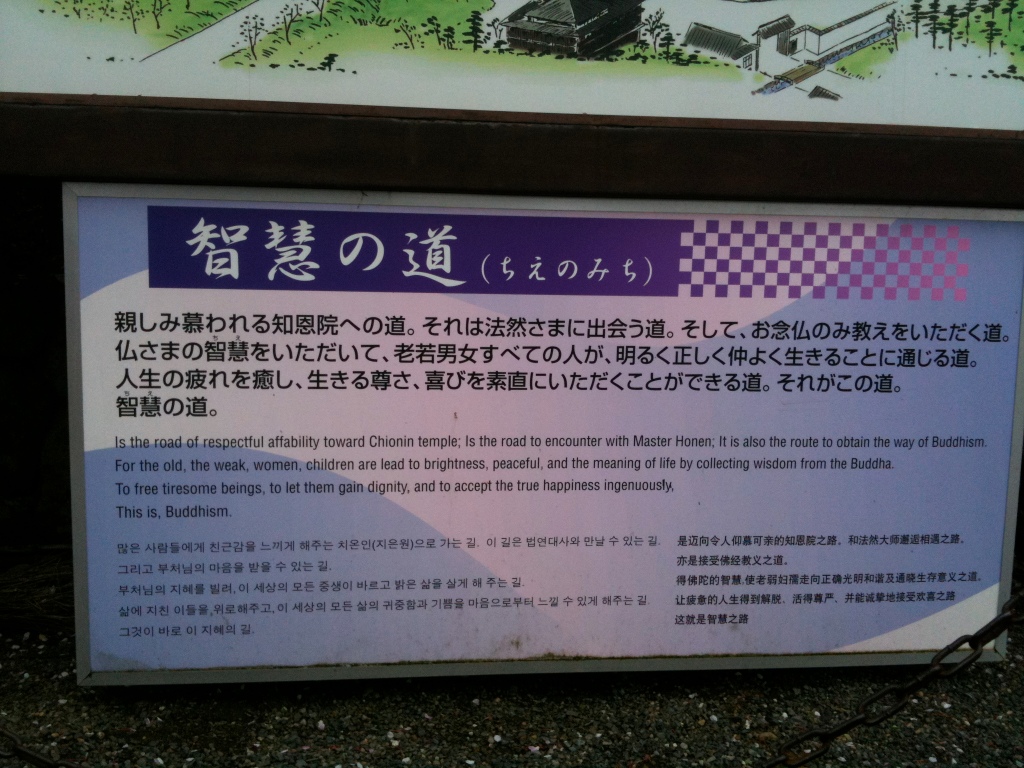
Multi-lingual sign at the temple of Chion-in in Kyoto, Japan where Honen’s mausoleum rests.

This approach isn’t that different from the Chinese approach which varied by teacher or patriarch but through Shandao’s influence had a parallel development. Some teachers emphasized the efficacy of simply reciting the nembutsu (much like Honen), others added the importance of concentration while reciting the nembutsu.

However, turning back to the Larger Sutra, let’s go back to the 48 vows. The 19th and 20th vows state:

(19) If, when I attain Buddhahood, sentient beings in the lands of the ten quarters, who awaken aspiration for Enlightenment, do various meritorious deeds and sincerely desire to be born in my land, should not, at their death, see me appear before them surrounded by a multitude of sages, may I not attain perfect Enlightenment.

(20) If, when I attain Buddhahood, sentient beings in the lands of the ten quarters who, having heard my Name, concentrate their thoughts on my land, plant roots of virtue, and sincerely transfer their merits towards my land with a desire to be born there, should not eventually fulfill their aspiration, may I not attain perfect Enlightenment.

So, taken together, the 18-20th vows cover the various interpretations of 念 we discussed above. All of them are included in Amitabha’s vows to bring across anyone who desires to be reborn there. The common theme is sincerity (至心 zhì xīn). If you look at the original Chinese text, all three include “sincerity”.

Further, when asked about how many times one should recite the nembutsu, Honen replied:1

“….believe that you can attain ojo [往生, rebirth in the Pure Land] by one repetition [of the nembutsu], and yet go on practicing it your whole life long.”

So, let’s get down to business: what is the nembutsu / niànfó ?

Based on the evidence above, I believe that the nembutsu is any of these Buddhist practices described above, taken under a sincere aspiration to be reborn in the Pure Land. It’s about bending one’s efforts and aspirations toward the Pure Land.

If you are calculating how to be reborn, or if your heart’s not 100% into it, then it may be a waste of effort.

Instead, if you feel unsure, study the Buddhist doctrines, get to know the Pure Land sutras, read about past teachers and if you feel fired up about, recite the nembutsu, or do whatever moves you. You will just know when. The more you put into it, the more you get out of it too.

Amitabha’s light shines upon all beings, like moonlight, and if you feel inspired by it, just know that you’re already halfway to the Pure Land.

Namu Amida Butsu

1 The site is long gone, sadly, but the Wayback Machine has an archive of the site. The updated Japanese-only site is here.