That Darn Japanese Pitch Accent

Japanese pitch accent map -en

Speaking Japanese language properly can be quite tricky for a native-English speaker because of the lack of stress accent, and a vague, often overlooked pitch accent.  My wife and kids often tease me about my accent when I speak Japanese, so I have learned this hard way. Allow me to share some tips.

Japanese language, when heard by an English speaker, tends to sound very robotronic.  Each hiragana syllabary is ONE, EQUAL beat in Japanese like so:

どうもありがとうございます

do-u-mo a-ri-ga-to-u go-za-i-ma-su

“thank you very much”

However, when a native English speaker pronounces it, it often sounds something like:

DOmo ariGAtou goZAImaSU

This can be hard (possibly even grating) for a native Japanese speaker to follow, so it helps to resist this urge to stress accents and smooth out the beats in each word.  A combination of getting enough exposure to Japanese conversation, and some good ol’ practice certainly help.

But that alone isn’t quite enough, because Japanese also has a subtle pitch accent.

To the casual Japanese student, it is not obvious what the difference in intonation between 切る (kiru, “to cut”) and 着る (kiru, “to wear”) but a native speaker will know the difference.  This is similar to how English native speakers can hear the difference between decent and descent, desert and dessert.  Japanese dictionaries do not specify what the proper intonation is either, since different dialects will use different pitch accent, and thus there’s no consensus.¹

However, even with “standard” Tokyo speech, the pitch accent is there, and it’s very helpful to be aware of it.  Even better to familiarize yourself with it.  If you listen to Japanese conversations enough, particularly if you have a background in music, you’ll start to develop an intuitive sense of pitch accent, but if you’re tone-deaf like me, this can take a while.

Using the examples above, the verb 切る sounds like ki‾ru while 着る sounds like kiru‾ .  By this, I mean that the pitch is a bit higher in the first syllable of 切る, but higher on the second syllable of 着る.  Other common examples:

  • Compare ha‾shi (箸 “chopsticks”) versus hashi‾ (橋 “bridge”)
  • The word for now (今) is pronounced i‾ma
  • The word for afternoon (午後) is pronounced go‾go
  • The word for seed (種) is pronounced ta‾né
  • Compare ka‾ki (牡蠣 “oyster”) with kaki‾ (柿, persimmon)
  • The word for  “key” (鍵) is pronounced kagi‾
  • Finally, the adjective for interesting (面白い) is pronounced omoshiro‾ii

Note that there is no stress accent, just a pitch accent. This difference can be hard for native English speakers to grasp, but in essence every syllable is one equal beat, yet the pitch will rise and fall sometimes.

Also, occasionally the pitch accent is lower too as in the word arigatō above, whereby the ga is a bit lower: ariga_tou.

By and large, the pitch accent in Japanese, coupled with the lack of stress accent, isn’t really that hard to pick up.  The biggest challenge is that it’s seldom explained or expressed in writing, dictionaries or anywhere.  It’s something that you, the language student, have to attune to, and learn to imitate.

But like G.I.Joe said: Knowing is half the battle.²

¹ For example, my wife’s extended family in Tochigi Prefecture pronounces the word for “mother” (okāsan お母さん) with a pitch accent in a different syllable than the standard Tokyo dialect.  Most other things are basically equal, just where pitch accent falls. Apart from local slang and terminology, this is frequently what separates most Japanese dialects from one another.

² Porkchop sandwiches!
Keigo: the Spice of Japanese Life

No study of Japanese language would be complete without learning how keigo (敬語) works. Ostensibly, keigo is just honorific speak, but it’s also a good window into Japanese culture as well and reflects a lot of unspoken, cultural rules.

Kinship Terms

One cultural/linguistic rule is how you address your own kin versus another person’s kin. When talking about your own older sister, you use the term ané (姉), but when talking about the listener’s older sister, you use onēsan (お姉さん).  Note that this is not keigo per se, but it is super important to familiarize yourself with to avoid being impolite.

Other kinship terms include:

Relative Self Other
Mother
haha
お母さん
okāsan
Father
chichi
お父さん
otōsan
Older brother
ani
お兄さん
onīsan
Grandmother 祖母
sobo
お婆さん
obāsan
Wife
tsuma
奥さん
okusan

For “wife” sometimes the term kanai (家内) is used for one’s own wife, but this is often sounds old-fashioned because it implies that the wife stays at home.

Honorific and Humble Words

Another unspoken rule is that, in some situations, you replace normal vocab words with either honorific terms when addressing another person or humble terms when describing yourself or people in your “inner circle”. The trick with such words is that, like a fine spice, a little bit goes a long way, while too much kind of ruins the flavor (not to mention sounds like you’re sucking up to people).

Good examples of people to whom you can/should address with honorific speech:

  • A customer (if you’re running a business)
  • Nobility
  • A teacher of your kids
  • Someone much older than you

But even here, it’s usually sufficient to use regular polite speech, and pepper keigo terms here and there.

Examples of honorific speech:

  • Instead of the verb する (suru, to do), replace with なさる (nasaru).
  • Instances of いる (iru), including when it is an auxilliary in te-form verbs, are replaced with いらっしゃる (irassharu).
  • The verb 言う (iu, to say) is replaced in all instances with おっしゃる (ossharu).
  • Many verbs can be made more honorific by changing to a noun-form, prepending with “o” and appending with “ninaru”. For example, with the verb 出かける (dekakeru, “to go out”) becomes お出かけになる (odekakeninaru).
  • A few verbs have more irregular honorific forms: 食べる (taberu, to eat) becomes 召し上がる (meshiagaru), 着る (kiru, “to wear”) becomes 召す (mesu), and so on. These just have to be memorized.

Similarly, examples of humble speech:

  • The verb 言う (iu, to say) is replaced with 申し上げる (mōshiageru).
  • The verb もらう (morau) is replaced with いただく (itadaku). This is often why Japanese say “itadakimasu” before eating a meal: it expresses humility in receiving the meal.
  • Similar to honorific speech, a few verbs have more irregular honorific forms: 合う (au, to meet) becomes お目に掛かる (omenikakaru), and 見る (miru, to see), is replaced with 拝見する (haiken suru) for example. These must be similarly memorized.

Passive Speech as Keigo

Another way to use Keigo, is to use passive speech when referring to someone.  Passive speech isn’t quite as polite as honorific speech, but it’s often sufficient for most situations and easier to use.  For example, instead of saying 帰る (kaeru) for “come home”, simply replace it with the passive form 帰られる (kaerareru), even if the sentence is not actually passive:

本を書く
hon wo kaku (to write a book)

本を書かれる
hon wo kakareru (to write a book, but more polite)

Polite Speech

As weird as it might sound, in Japanese there is a difference between keigo (honorific speech) and teineigo (polite speech).  Polite speech is, as the name implies, when you are speaking politely to another person, but still implies that you’re more or less on equal footing.  Honorific/humble speech overtly elevates someone else, which is why it’s sometimes out of place.

Polite speech is thus a more common and useful pattern of speech to use, and will work 85% of the time.

Chances are, you’ve probably learned polite speech before, but a few tips:

  • Verbs are expressed in masu-form: 食べる (taberu, to eat) becomes 食べます(tabemasu), 見る (miru, to see) becomes 見ます (mimasu), etc.
  • The conjunction が (ga) is often useful for connecting sentences.  It can either be a soft “but” or a soft “and”, depending on context.
  • Another conjunction なので・ので (nanode/node) is more polite than から (kara), but still implies “because” or “since”.
  • Remember those kinship terms above.  😉
  • Especially in business Japanese, regular verbs are often replaced with more formal sounding suru-verbs.  Instead of 答える (kotaeru, “to answer”) it’s more common to use 返事します (henji shimasu).

Conclusion

Part of your success in navigating Japanese culture and speech is being sensitive to hierarchy, and knowing the right amount of polite speech to use.  If you’re new to Japanese, you’re often tempted to either overdo it, or by force of habit, you might be simply too relaxed and forget your manners.  But, if you acclimate yourself to Japanese speech by listening to others’ conversations, you’ll gradually get a “feel” for what’s appropriate and when.

Good luck!

Japanese Sound Effect Words

Since I became a dad and we raised our kids to be bi-lingual in Japanese and English, I’ve come to incidentally learn a lot of “baby” Japanese words, but also a lot of sound-effect words too. Compared to English, Japanese has a large vocabulary of descriptive words for sounds, movement, moods and such. These are called giongo (擬音語) “sound effect words” and gitaigo (擬態語) “situational words” in Japanese.  It’s very common in daily conversation to use them when telling a story to a friend, or complaining about something, or in literature, though not so much in polite, formal conversation. Nevertheless, they’re very handy for conversational Japanese.

One challenge for learning such words most of these words have no direct equivalent in English and they’re often really situational. Instead, when learning such words, the English translation in dictionaries will be a verb or adverb.

Here’s an example list of words I’ve compiled, and their English meaning. If you’re learning Japanese, it is a good investment of time to learn them. Some of these words are mainly used by young children, but many are not:

  • niko niko – To grin, smile.
  • niya niya – Smiling evilly.
  • heta heta – To wither, wilt (vegetables).
  • poki-! – To snap (twig, pencil, etc).
  • hoka hoka – To be warm (drink, sweater, blanket, etc).
  • hai hai – Kids word for crawling on the floor.
  • pyun pyun – Kids word for moving fast.
  • kon kon – To pile up (snow flakes).
  • zara zara – Rough, gritty (sandpaper, dry skin).
  • pasa pasa – Dried out.
  • suka suka – Smooth surface.
  • kuta kuta – Exhausted, physically.
  • doki doki – To be startled, heart fluttering.
  • hira hira – Sound of a leaf falling, fluttering.
  • waku waku – The feeling of being excited about something.
  • kune kune – Winding, meandering (e.g. a road).
  • suta suta – Walking briskly.
  • soro soro – Momentarily, imminently.
  • somo somo – In the first place, to begin with.
  • dossan – To land on the ground with a thud.
  • gokkun – To swallow (food, drink, etc).

The big thing to remember about speaking Japanese is that less is more. Japanese language tends to omit previously understood parts of speech, unlike English where we like to make more precise descriptions using more words.1 In Japanese, it’s often ok to be succinct and vague.

For example, if you see a leaf falling, you might describe it like:

hanabira ga hirahira shiteiru (a blossom is fluttering down)

But in Japanese, you could even drop the verb:

hanabira ga hirahira

Or drop the subject (assuming the listener already knows) and say:

hirahira shiteiru

Hirahira in this context is a loaded word in Japanese, so to a native speaker it will evoke a mental image and say plenty.  That’s why it’s not always easy to translate into English.  Speaking from experience, this is far from an exhaustive list, and over time you just pick up more such words.  That’s why exposure to Japanese media and conversation is super helpful.  You’ll find such little gems from time to time.  🙂

Good luck!

1 Inexperienced Japanese speakers, as a result, often sound too wordy.  Time, practice and experience help address this by teaching more efficient, native ways to express the same thing.  🙂

Agamemnon Was A Total Dick

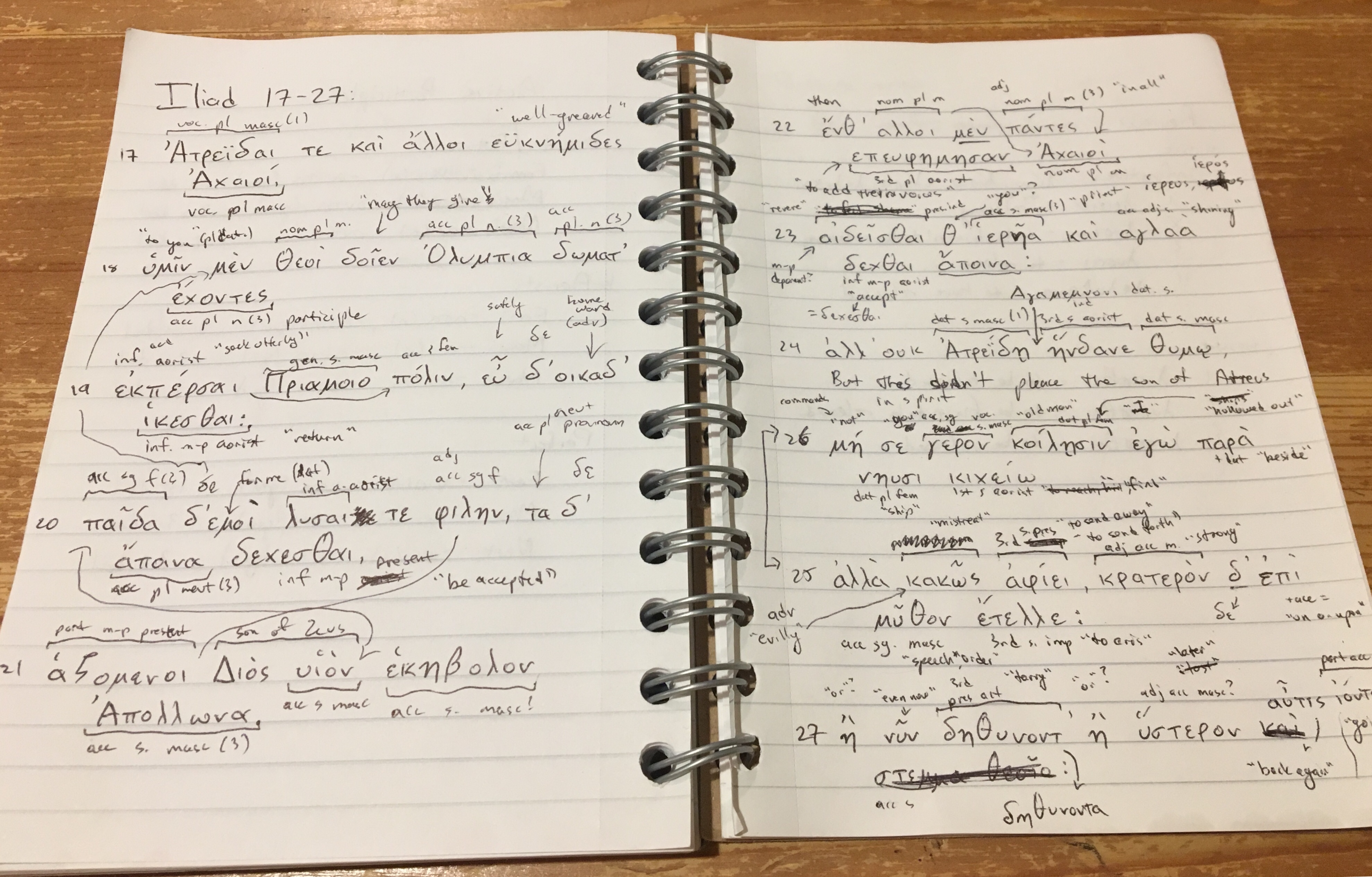
As my studies of Ancient Greek continue, thanks to the Greek 101 course available at The Great Courses, I have been translating small sections of ancient text, The Iliad, as part of the homework.  You can see my crazy chicken-scratch above for lines 17-27 in the first book.  For today’s post, I wanted to draw attention to lines 26-32 of Book 1 of the Iliad, wherein, Agamemnon lord of the Achaean Greeks, rebuffs the priest Chryses‘s efforts to ransom his daughter back.  The original Greek text below is provided in full in the  courtesy of Tufts University:

μή σε γέρον κοίλῃσιν ἐγὼ παρὰ νηυσὶ κιχείω
ἢ νῦν δηθύνοντ᾽ ἢ ὕστερον αὖτις ἰόντα,
μή νύ τοι οὐ χραίσμῃ σκῆπτρον καὶ στέμμα θεοῖο:
τὴν δ᾽ ἐγὼ οὐ λύσω: πρίν μιν καὶ γῆρας ἔπεισιν
ἡμετέρῳ ἐνὶ οἴκῳ ἐν Ἄργεϊ τηλόθι πάτρης
ἱστὸν ἐποιχομένην καὶ ἐμὸν λέχος ἀντιόωσαν:
ἀλλ᾽ ἴθι μή μ᾽ ἐρέθιζε σαώτερος ὥς κε νέηαι.

The 1898 translation by Samuel Butler translates this as:

“Old man,” said he, “let me not find you tarrying about our ships, nor yet coming hereafter. Your scepter of the god and your wreath shall profit you nothing. I will not free her. She shall grow old in my house at Argos far from her own home, busying herself with her loom and visiting my couch; so go, and do not provoke me or it shall be the worse for you.”

But there’s some wordplay here being left out of the translation (which I learned about more in the Greek 101 course) in line 31:

ἱστὸν ἐποιχομένην

Butler simply translates this as “working the loom”.  However, according to Tufts University online dictionaries, the word ἱστός (histos, 2nd declension masculine, expressed above in accusative form) can mean anything that is “upright”.  This can mean the beam of a loom, but other things too.  Further, ἐποίχομαι (epoikhomai, expressed above as a feminine-accusative participle) is a deponent verb meaning to “go over” or “ply”.  So, while in the literal sense it means “ply the loom”, it’s pretty obvious that Agamemnon is also making a lewd joke about Chryses’s daughter to her dad’s face.

Even by the standards of the day, when women were frequently captured in war and enslaved, this was pretty rude and obnoxious.  Other Greek myths outside the Iliad about Agamemnon do not paint a better picture.  In one story, Agamemnon offends the goddess Artemis prior to sailing off to the Trojan War, and different plays explain why: in Electra it is because he sacrificed a sacred animal to Artemis, and boasted of his own skill in hunting.  In the play Agamemnon, Artemis is angry at Agamemnon because he will throw many lives away for the sake of punishing the Trojans.

In any case, between the Iliad and the later Greek plays, it’s clear that King Agamemnon was the archetypal arrogant and powerful king who ignored the gods and the well-being of others, at his own peril.

In other words, Agamemnon was total ἱστός.

Part Three: Learning Hiragana Ain’t Hard!

In lesson one we covered basic concepts of Japanese hiragana writing and in lesson two we covered some more advanced features.  Today, we’ll focus more on how to learn hiragana.

If you’re studying Japanese, hiragana is a “learn once, learn early, use often” feature of the language.  The sooner you make the leap, the better.  I often meet beginning Japanese students who lament having to learn the 40+ characters (and the modifications), but once you’ve broken past that barrier, a lot of things open up in Japanese. Yes you need kanji (Chinese characters too), but with hiragana, you can’t even begin to read. Even if you know only 50-100 Chinese characters, as long as you know hiragana script, you’ll have a much easier time in Japan.

I have dabbled in a number of languages over the years including Sanskrit, Korean, Ukrainian, ancient Greek, and of course Japanese, and each one requires learning a new script, but there are certain patterns in study that help to adapt to a new script relatively quickly:

  • Read – reading words is the best way to get familiar with a new script.  If you find example words, or example sentences, read them, pick them apart in your mind and figure out how to pronounce it.  It’s a fun mental exercise, but also it just gets easier and easier over time.
  • Write – writing isn’t as useful as reading a new script, but it’s a good skill to adopt early to develop good habits, especially good handwriting.

I often see new students try to learn reading and writing at the same time, but it becomes a drag, and people get discouraged.  I believe they are two important, but not necessarily related skills, and of the two, reading is the one you should prioritize first with writing as a close second.

Further, people will spend money on smartphone apps to practice their handwriting, but they don’t really seem to accurate capture the motor skills necessary to write.  Instead, it would be better to download and print Japanese essay paper (genkōyōshi 原稿用紙) and just use that instead.¹  Just do an image search for 原稿用紙 and you’ll see plenty of options.

One of my favorite sources for me to practice reading Japanese hiragana was the Graded Reader series by White Rabbit Press.  These are now available as smart-phone apps, but I used them back when they were just printed books, and starting with the lowest level, I soon found I could follow the hiragana well enough.

From there, I delved into Japanese manga, and watching TV.  Neither was easy, but it didn’t take long to pick out and get used to the hiragana because they’re just so consistent.

As for writing, there are many such workbooks available, but I liked Kodansha’s Hiragana Workbook: A Step-By-Step Approach to Basic Japanese Writing. However, other such books are probably just as good.

Once you’ve gotten use to hiragana, learning katakana is worth investing the time, but don’t be afraid to branch out into kanji either.  I’ll cover that in a future post.

Good luck!  がんばって!

¹ Quick reminder: Japanese is often written from top to bottom, and right to left.  This will make more sense if you use proper Japanese-style practice paper.

Part Two: Learning Hiragana Ain’t Hard!

In part one we covered the basics of how Japanese Hiragana script works. In this post we’ll cover some of the more advanced concepts.

First let’s review the basic hiragana characters:

nwrymhntsk(blank) 
a
   i
  u
   e
 o

As we talked about last time, each hiragana “letter” is actually a syllable, you combine the consonant at the top with a vowel on the right to get the right kana syllable. The only exception was the final “n” sound ん.

Further, some of the characters can be modified to make somewhat different sounds. For example the “K” column above becomes a “G” column if you add ゛(double ticks) to the characters. か (ka) becomes が (ga) and き (ki) becomes ぎ (gi) and so on. Only certain columns above can be modified this way: the “K”, “S”, “T” and “H” columns.

Further, there is one other column to learn and that is the “P” column which is formed by taking the “H” column and adding a small circle ゜for sounds like ぱ (pa), ぴ (pi), ぺ (pe) and so on.

Together these look like so:

bdzg p
a
**i
*u
e
o

There are three characters to note here:

  • じ is pronounced as “ji”. This kinds of makes sense when you compare the “S” column as a whole with the “Z” column.
  • づ is pronounced as “dzu” or “zu” but is not commonly used.  Again, this kind of makes sense when seen as a whole.
  • ぢ is pronounced something like “dzi” or “ji”, but is even less commonly used.

Mini Hiragana

A few hiragana characters can be miniaturized to modify other hiragana. Namely や (ya) ゆ (yu) and よ (yo) which become ゃ ゅ and ょ. Literally, they’re a half-size smaller. How are they applied?

Think of the Japanese sound “sho”. You might be tempted to write it as しよ, but since hiragana are typically “what you see is what you get”, the end result would be “shiyo”, not “sho”. And yes, in Japanese there is a difference. A native speaker would have no trouble discerning the difference.

So, the key is to use the mini version of よ, ょ, as in しょ. Note that しよ and しょ look pretty similar, and depending on the typeface used a book or online, it can be pretty hard to tell the difference. Time and practice reading will help here, plus as you gain more experience with Japanese the context will obviously point to one or the other.

In any case, other sound combinations that can be made with these “mini hiragana” are sho, shu, sha, jo, ju, ja,¹ kyo, kyu, kya, gyo, gyu, gya, hyo, hyu, hya and so on.

Note that these are treated as a single syllable in Japanese, not two syllables. This is important when correctly pronouncing Japanese personal names like Ryo. It is a single syllable, so instead of saying “ree-yoh” or “rye-yoh”, it condenses together into just one syllable: “ryo”. Westerners have to take care when pronouncing such sounds to avoid making two syllables. Practice makes perfect! 🙂

Speaking of two syllable-sounds, the ゅ (yu) and ょ (yo) mini-hiragana will also be frequently followed by う (u) as a way to lengthen the sound.  This is something inherent in Japanese language where the “u” and “o” vowels sounds are often lengthened.  This counts a two syllables or two “beats” of sound.  So, using the example of the capitol of Japan, Tokyo, it is pronounced as four syllables: と う きょ う (to u kyo u).  Sometimes this extra “u” is written in Romaji as either “ou”, “uu” or “ō” and “ū”.

Also, be warned that not all “u” and “o” vowel sounds do this.  The word りょこう (ryokou, “travel”) for example.  The first syllable has no trailing “u”, while the second does.

Finally, there is the mini っ (tsu). Unlike normal つ, it actually has *no* pronunciation as such. Instead, it is frequently used to put a brief pause between syllables. The only equivalent in English this author is aware of is the double-k in “bookkeeping”.

Interestingly, the small っ does actually count as a syllable for the purposes of rhythm and spelling even if it doesn’t have a sound, and therefore it does change the spelling of words. Compare sekai せかい (world) with sekkai せっかい (incision). These are two entirely separate words, but the only spelling difference is the small っ. For the purposes of spelling and pronunciation, the word せかい has 3 betas, while せっかい has 4 beats and pronounced as “se (pause) ka i”.

In part three, we’ll talk more about how to get used to hiragana and ways to improve your reading skills.

For now, try reading these words:

  • しょうぎ – Japanese chess
  • きょうと – the old capitol of Japan
  • えんぴつ – pencil
  • ひゃく – hundred
  • ざぜん – sitting meditation (namely “Zen”)
  • きょうそう – a foot race
  • えんじる – to act (e.g. theater)
  • しょうが – ginger
  • けっかく – tuberculosis
  • しょっぱい – salty

Good luck!

¹ This leads to an interesting problem in romanization.  In one romanization scheme, these are written as syo, syu, sya, jyo, jyu, jya which is more “Japanese”.  In another scheme, sho, shu, sha, jo, ju, ja which is more “English”.  You may see one other the other, so be aware.  🙂

Part One: Learning Hiragana Ain’t Hard!

Recently a colleague expressed interest in learning Japanese language and asked me for advice.  I’ve been learning Japanese on my own for about 10 years ever since I married my wife, and have reached a point that, while certainly not fluent, I can still read Japanese without too much difficulty.

Japanese language seems difficult at first, but isn’t nearly as hard as it looks.  It’s different, but it has its own internal logic that, once you get the hang of, isn’t really any harder than any other language. Japanese is different, not hard.

The first thing to wrap your head around is the hiragana writing system.  Hiragana is oftentimes the first thing kids in Japan (or my own kids here) learn to read.  Technically speaking hiragana is not an alphabet but a syllabary.  This means that syllables in the Japanese language¹ are usually expressed as a single “letter” or symbol.  か always reads as “ka” and め always reads as “me” and so on.

Typically they’re arranged in a simple grid like so:

nwrymhntsk(blank) 
nwarayamahanatasakaaa
  ri mihinichishikiii
  ruyumuhunutsusukuuu
  re mehenetesekeee
 woroyomohonotosokooo

Kids in Japan (as well as my kids here) learn this table by starting from upper-right, reading vertically.

Here, you can see that the letters are formed by some combination of a consonant (the top row), and a vowel sound. ま is “ma” or “m” + “a”, for example. The only exception is ん which is just the final “n” sound for other syllables. It is never used at the beginning of a word.

There’s even a row for no-consonants for “a”, “i”, “u”, “e” and “o”. You can see that overall there’s a logical pattern to the setup though there are a few exceptions. First “tu” becomes “tsu” and “ti” becomes “chi”, while “si” becomes “shi”. These are probably just natural sound evolutions.

Another thing to notice is that a few spots are blank. These often refer to sounds that are archaic and don’t exist anymore, or to sounds that just never existed.

Now, if we replace the table above with that actual hiragana…

nwrymhntsk(blank) 
a
   i
  u
   e
 o

So, reading a phrase like:

にほんのなつはあつい
ni hon no na tsu wa atsui

This translates as “Japanese summers are hot” is as simple as reading each hiragana character and pronouncing its sound.

WYSIWYG: What you see is what you get!

Wait, what about は ? It’s supposed to read as “ha”, not “wa”! This is one of the rare exceptions to hiragana rules. When は is used to mark the subject, it’s read as “wa”. Otherwise, it’s “ha”. That’s the only such exception you have to remember. Interestingly, in modern Japanese, を (wo) is never used except as a marker for direct objects. Otherwise, you never see it.

In part two, we’ll cover some additional details to round out the lesson.

For now, try reading these words and places:

  • みかん – satsuma orange
  • すし – sushi
  • よこはま – city in Japan
  • なら – another city in Japan
  • くつ – shoe (or shoes)
  • ほとけ – a Buddha (not to be confused with the historical Buddha named “Shakyamuni”)
  • くるま – car
  • かるた – a fun game that many people in Japan play ( and some overseas ).

Hiragana may seem daunting at first, but because it’s so consistent, it’s something that you learn once, but use constantly in Japanese.

Good luck!

¹ Which is easier than some other languages.  Japanese has relatively fewer “sounds” than some languages which is part of the reason why it struggles to pronounce foreign words.