In a younger time of my life, I was obsessed with World War II movies, but my favorite was The Thin Red Line, a brilliant and psychological movie that takes place on the island of Guadacanal, one of the most important battles the Pacific Theatre.
One of the interesting things about the movie is that the Japanese dialogue was not translated and in my younger years I couldn’t understand it, including this tragic ending scene:
The translation and subtitles are excellent,1 and really change the scene a lot. Without understanding the Japanese, it seems like Pvt. Witt had no choice, but had he understood what they said, perhaps things would have been different.
It doesn’t take much for small misunderstandings to fester, and then grow into outright hostility. People aren’t particularly good at reading into others, and their minds naturally try to fill in the blanks with what they assume the other is thinking.
More often than not, that way lies danger.
1 Without the subtitles, I understand quite a bit more than I did years ago, but admittedly still not 100%. Always more to learn. 🤔
Recently, I wrote about my frustrations with using Anki to bulk-learn vocabularly for the JLPT, and my decision to focus more on reading. Since then, my thought has changed a bit.
Ultimately, your success in the JLPT lies in two basic skills: reading Japanese, and listening to Japanese conversation. The vocabulary helps to read, but I found that with my Anki flashcards, it tended to focus a lot on recall (e.g. “do you remember how to say a word in Japanese?”), not recognition (e.g. “do I remember what this means when I see it?”). This first one doesn’t help with reading very much, the second one does. Since Japanese uses so much kanji, you’re ability to recognize words smoothly makes the process of reading so much easier. The issue with recall I found was that there were many different, overlapping words for the same thing, and trying to remember which word was which wasn’t worth the effort. I just want to be able to read well. Further, recall didn’t help me know the context words are often used in.
But while focusing on reading Japanese manga lately, including the various books my kids and I have, I realized that I still need to learn some words, especially if they appear over and over again. Brute-force reading wasn’t quite enough. So, I still need some way of learning words through repetition, but I want to focus on recognition only.
So, I realized that if you want to use Anki flashcards for improving reading, and focus on recognizing words, and with the correct context I needed to revisit the MCD approach for making cards. In other words, make flashcards not with words, but with sentences.
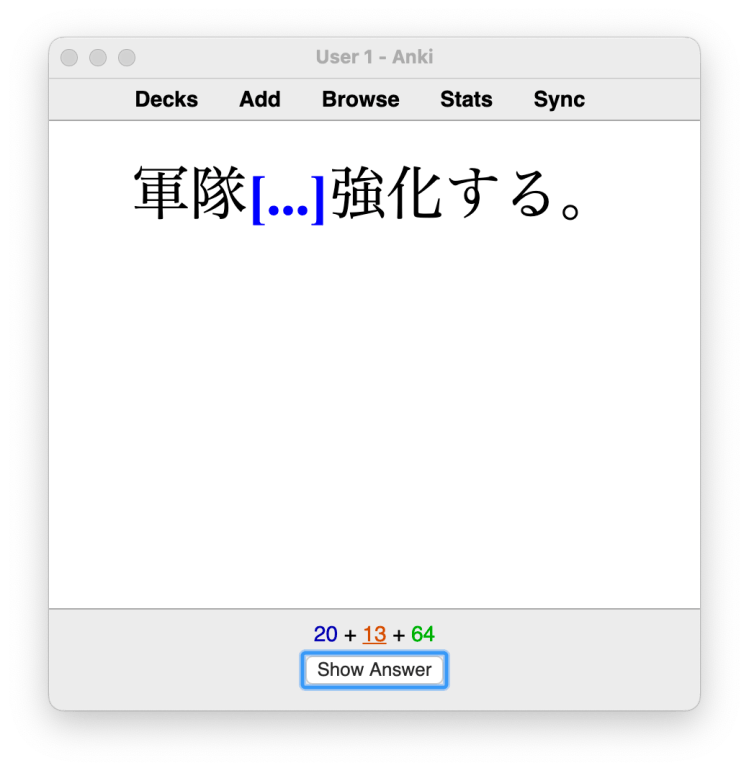
Here’s an example:
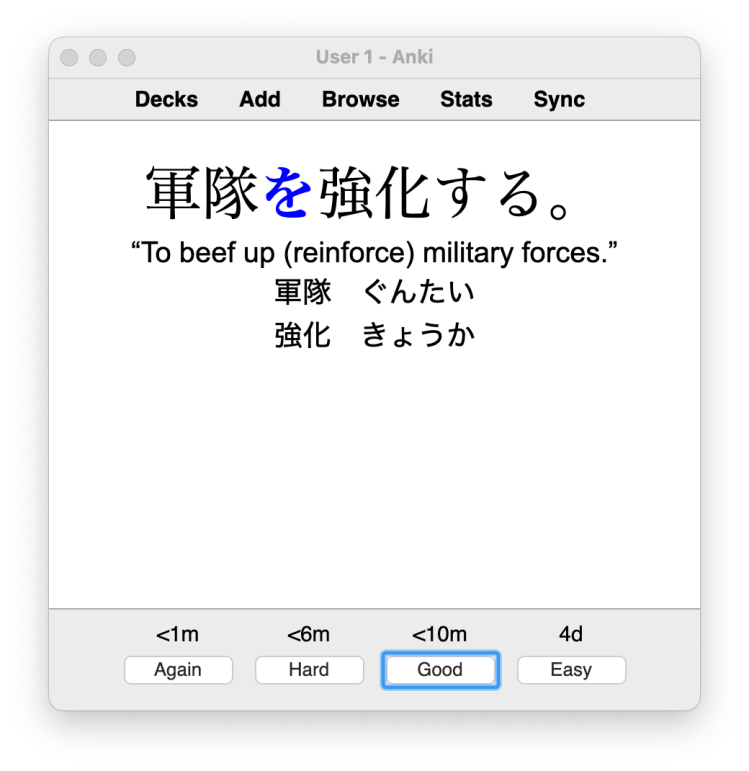
The word I wanted to focus on learning was the verb 強化する (kyōka suru) meaning to intensify or strengthen. So, rather than just throwing it in my flashcard deck, I looked it up on my favorite Japanese online dictionary and found an example sentence I liked. From there, I found an example sentenced I liked and put that in. Notice that I did not hide the word 強化する. I wanted to be able to read the word, not necessarily recall it, but I do need to be able to recall what particle it uses. In this case を, the direct-object marker. So, I hid that.
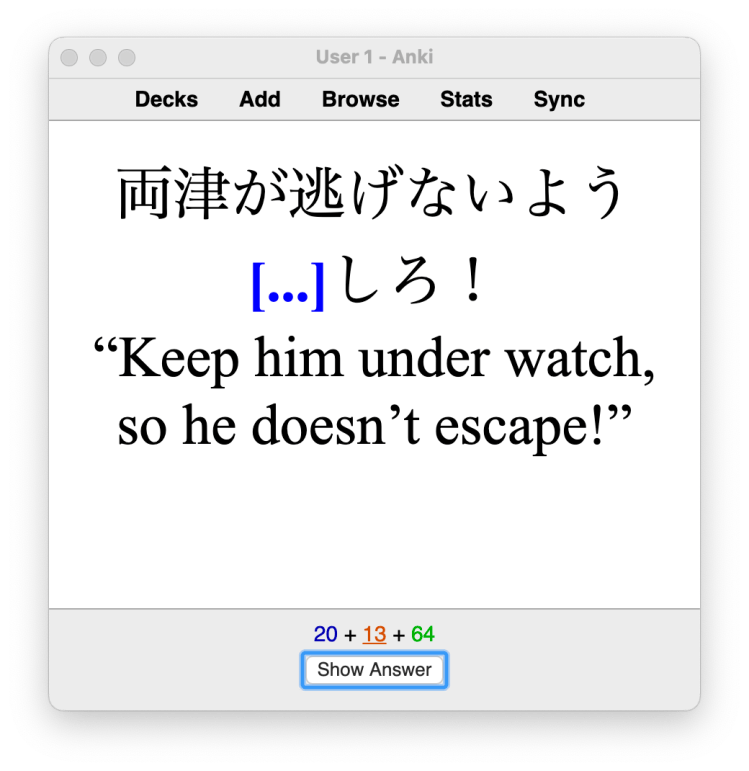
Under the notes section, I put in readings for each kanji word in there, in case I need a hint later. I also put the English translation under notes, not in the flashcard since I wanted to be able to suss out what the sentence meant without the English translation. However, it helps to sometimes put the English translation in the flashcard too if the helps:
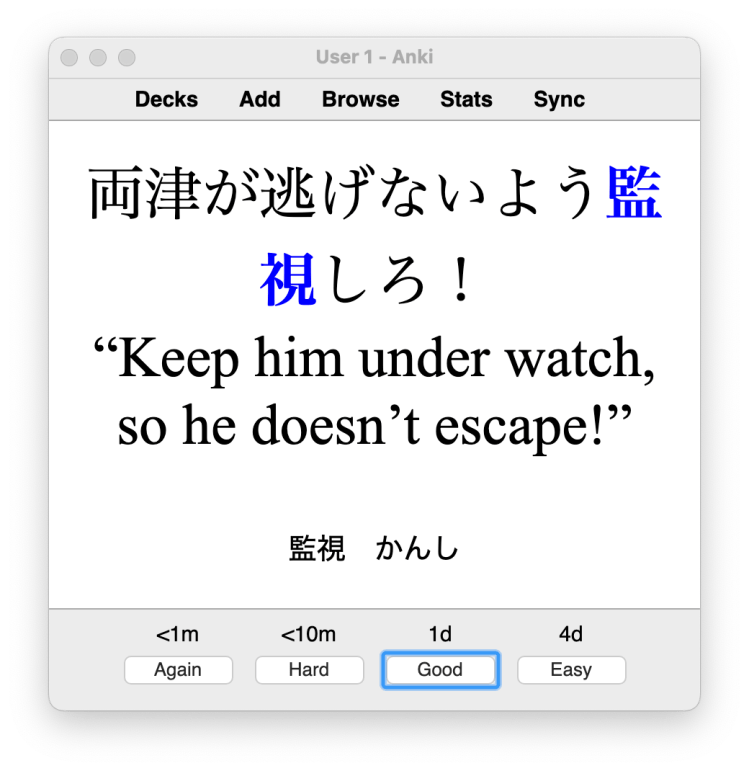
Here, I needed to learn the word 監視する (kanshi suru) meaning to observe or keep under watch. But the sentence I got from one of my manga was a bit awkward, yet useful in providing context. So I had to keep the English sentence in the flashcard.
The point here was: be flexible on a per card basis, and use what works, but doesn’t overburden you by making the card too difficult, or have too much guesswork. Your focus should be on reading, not recall.
Anyhow, does this work?
So, far, I’ve found the Anki flashcard experience a lot less painful than it was before, plus it incentives reading by finding more good sentences to put in.
I still need to be mindful about making too many flashcards, plus each flashcard takes more effort to make than it used to, but as long as I keep it flexible and lightweight, it’s easier to maintain and keep up.
This is a photo from a sutra book I frequently use for daily services. I bought this book years ago from the temple of Sensoji (a.k.a. Asakusa Temple) in Tokyo, Japan, a place that I have visited many times over the years.
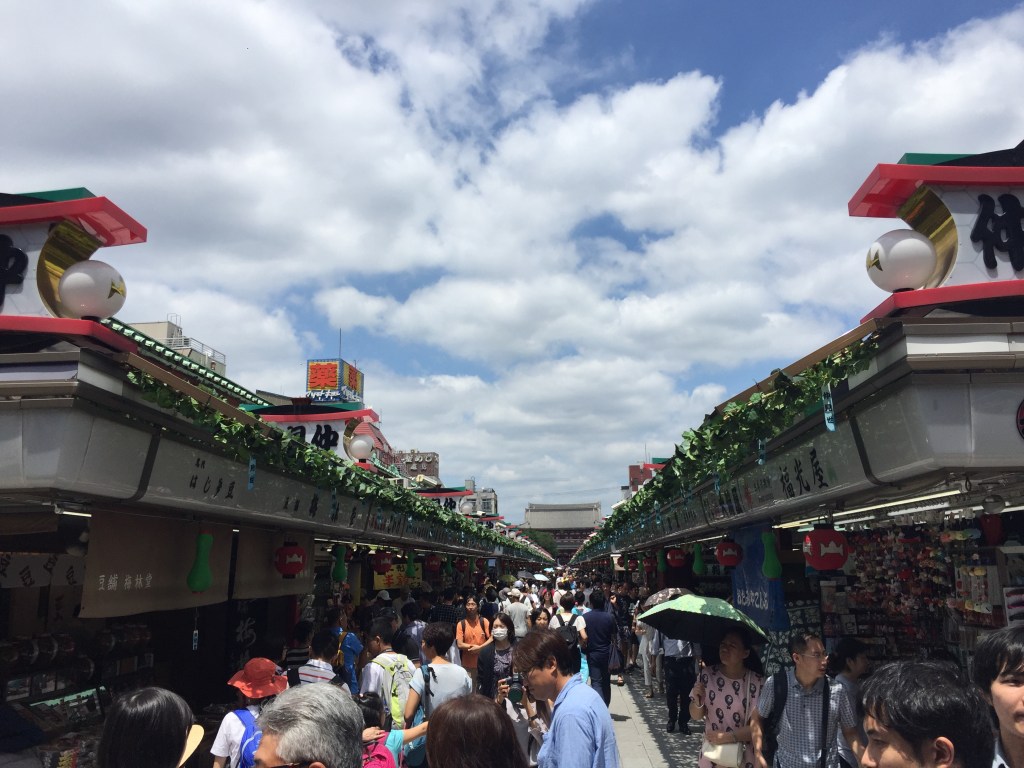
A photo I took in 2016 of the famous market of nakamise-dōri. The actual temple is way in the back.
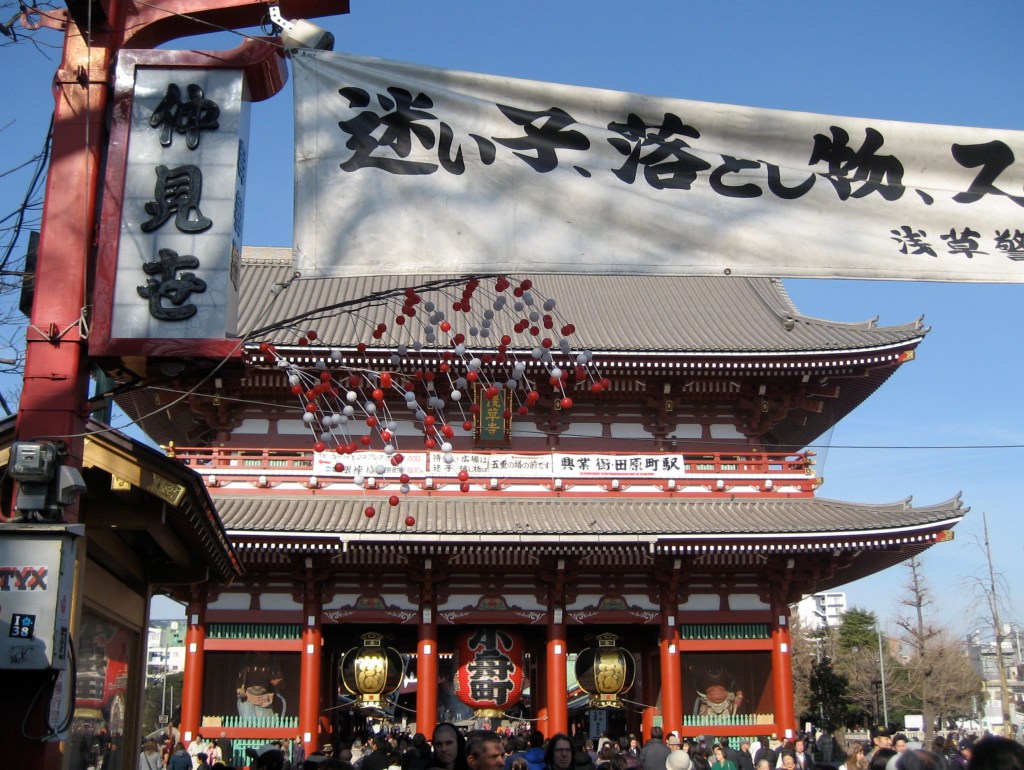
The temple just after New Year’s, taken in 2009.
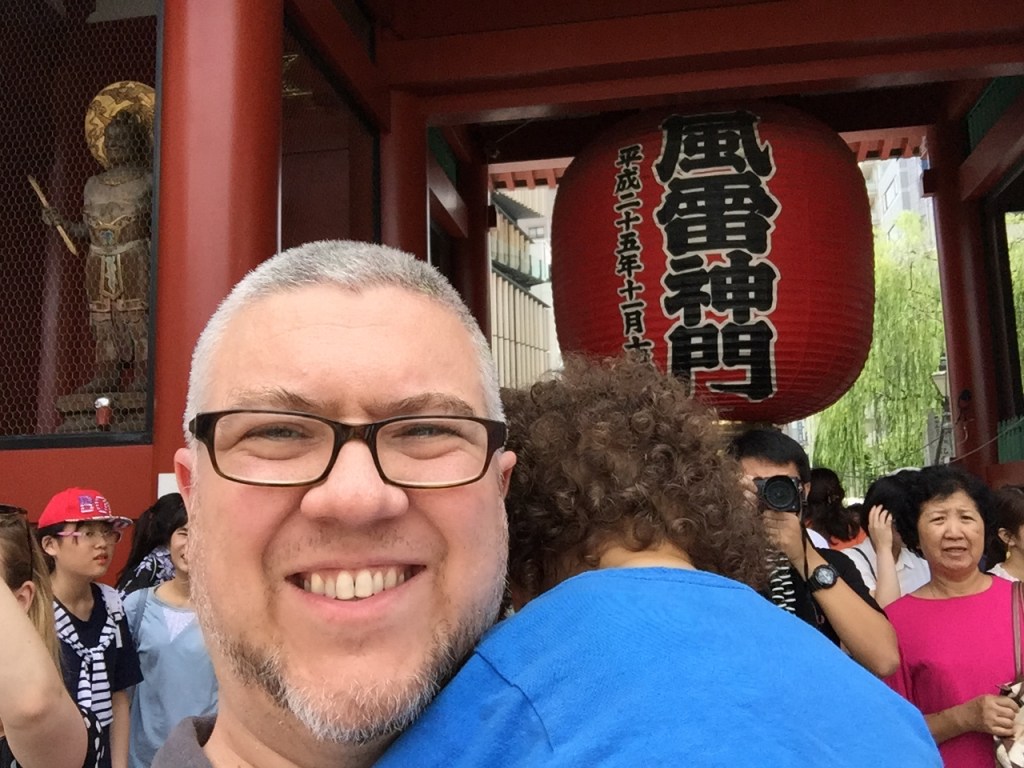
Me carrying one tired little boy at the iconic kaminari-mon gate in 2016. Note the giant red lantern in the back.
It is still one of my favorite temples, even if a bit touristy, and of the Buddhist sutra books I own this is still one of my favorite to use.1 This sutra book uses the traditional Classical Chinese with Japanese pronunciation guides (furigana), which is pretty typical of Japanese-Buddhist sutra books. As you can see, it’s not a long sutra to recite. It is probably the shortest sutra in the entire Buddhist canon.
Chanting the Heart Sutra is something many Buddhists in the Mahayana tradition (everything you see from Tibet to Japan, and overseas) do both in group services and in home services. People chant it in many languages and styles. Its simplicity, and general message about the nature of reality means that it tends to cut across sectarian lines and is popular in many sects and communities. Its cryptic and profound nature also means that for a one-page sutra it is the subject of intense study and research.
The sutra, for reference, is shown below. I used the standard Japanese liturgical form, recited in Zen temples, Tendai temples, Shingon temples, and so on, with only very minor differences per tradition. However, there are many ways and languages to recite the Heart Sutra.
kan ji zai bo satsu gyo jin han nya ha ra mi ta ji
When Avalokiteśvara Bodhisattva was practicing the profound Prajñāpāramitā,
照見五蘊皆空。
sho ken go un kai ku
he illuminated the Five Skandhas and saw that they were all empty,
度一切苦厄。
do is-sai ku yaku
and crossed over all suffering and affliction.
舎利子。色不異空。
sha ri shi shiki fu i ku
Śāriputra, form is not different from emptiness, and
空不異色。
ku fu i shiki
emptiness is not different from form.
色即是空。
shiki zoku ze ku
Form itself is emptiness, and
空即是色。
ku zoku ze shiki
emptiness itself is form.
受想行識亦復如是。
ju so gyo shiki yaku bu nyo ze
Sensation, conception, synthesis, and discrimination are also such as this.
舎利子。是諸法空相。
sha ri shi ze sho ho ku so
Śāriputra, all dharmas are empty:
不生不滅。
fu sho fu metsu
they are neither created nor destroyed,
不垢不浄。
fu ku fu jo
neither defiled nor pure,
不増不減。
fu zo fu gen
and they neither increase nor diminish.
是故空中。
ze ko ku chu
This is because in emptiness
無色無受想行識。
mu shiki mu ju so gyo shiki
there is no form, sensation, conception, synthesis, or discrimination.
無眼耳鼻舌身意。
mu gen-ni bi zes-shin i
There are no eyes, ears, nose, tongue, body, or thoughts.
無色声香味触法。
mu shiki sho ko mi soku ho
There are no forms, sounds, scents, tastes, sensations, or dharmas.
無眼界。
mu gen kai
There is no field of vision and
乃至無意識界。
nai shi mu i shiki kai
there is no realm of thoughts.
無無明。
mu mu myo
There is no ignorance
亦無無明尽。
yaku mu mu myo jin
nor elimination of ignorance,
乃至無老死。
nai shi mu ro shi
even up to and including no old age and death,
亦無老死尽。
yaku mu ro shi jin
nor elimination of old age and death.
無苦集滅道。
mu ku shu metsu do
There is no suffering, its accumulation, its elimination, or a path.
無智亦無得。
mu chi yaku mu toku
There is no understanding and no attaining.
以無所得故。
i mu sho tok-ko
Because there is no attainment,
菩提薩埵。依般若波羅蜜多故。
bo dai sat-ta e han nya ha ra mi ta ko
bodhisattvas rely on Prajñāpāramitā,
心無罜礙。
shin mu kei ge
and their minds have no obstructions.
無罜礙故。
mu kei ge ko
Since there are no obstructions,
無有恐怖。
mu u ku fu
they have no fears.
遠離一切顛倒夢想。
on ri is-sai ten do mu so
Because they are detached from backwards dream-thinking,
究竟涅槃。
ku gyo ne han
their final result is Nirvāṇa.
三世諸仏。
san ze sho butsu
Because all buddhas of the past, present, and future
依般若波羅蜜多故。
e han nya ha ra mi ta ko
rely on Prajñāpāramitā,
得阿耨多羅三藐三菩提。
toku a noku ta ra sam myaku san bo dai
they attain Anuttarā Samyaksaṃbodhi.
故知。般若波羅蜜多。
ko chi han nya ha ra mi ta
Therefore, know that Prajñāpāramitā
是大神呪。是大明呪。
ze dai jin shu ze dai myo shu
is a great spiritual mantra, a great brilliant mantra,
是無上呪。是無等等呪。
ze mu jo shu ze mu to do shu
an unsurpassed mantra, and an unequalled mantra.
能除一切苦。真実不虚故。説般若波羅蜜多呪。
no jo is-sai ku shin jitsu fu ko ko setsu han nya ha ra mi ta shu
The Prajñāpāramitā Mantra is spoken because it can truly remove all afflictions.
即説呪曰。
soku setsu shu watsu:
The mantra is spoken thusly:
羯諦羯諦波羅羯諦波羅僧羯諦菩提薩婆訶。
gya tei gya tei ha ra gya tei hara so gya tei bo ji so wa ka
gate gate pāragate pārasaṃgate bodhi svāhā3
般若心経
han nya shin gyo
The Heart Sutra
You can see a really nice example of this chanted here, courtesy of Koyasan Temple in Japan:
I have been reading Tanahashi’s book about the Heart Sutra and learning a lot about its various interpretations, how it’s conveyed in various languages, and various theories about its origin. I was fascinated to learn that there is a Mongolian version sometimes transcribed in Cyrillic. None of this is strictly necessary for the purposes of Buddhist practice, but it is fascinating. The example I showed above uses what’s called “Sino-Japanese”: Japanese pronunciation of the original Chinese characters it was composed with.2
As for chanting the sutra, I’ve been doing it for years, so I can more or less recite the Sino-Japanese version from memory, and am pretty comfortable doing it that way. I study the meaning of the sutra in English of course. I also have a PDF file for chanting in Sino-Japanese available for those interested.
I have also attended Zen centers on rare occasions (I tend to lean toward Pure Land Buddhism, to be honest) and seen the Heart Sutra recited using English. Learning the English meaning is very useful, but English chanting sounds a bit awkward to me. So, I prefer chanting in the original, and study the meaning separately.
But regardless of what language you use, the Heart Sutra, like all Buddhist sutras, has a funny tendency to gradually “sink in” over time. The meaning may not make much sense at first, but over the course of months and years, it takes on new meaning as you go through life, and see the sutra in a new light. I believe that’s the real value of Buddhist chanting: to internalize key Buddhist teachings in a way that you can carry with you throughout life.
As for me, these days, I tend to recite a Tendai-style home service,4 and as part of that I rotate between chanting this and a certain, small excerpt of the Immeasurable Life Sutra called the shiseige (四誓偈) or juseige (重誓偈) in Japanese Buddhism. When I finish one, I put it under the other sutra book, so I don’t forget which sutra to recite next time as I might go a week or two before reciting again. As a short, traditional liturgy, I am pretty content.
As with any Buddhist practice done over a long period of time, I believe that it gradually polishes the mind, and dispels one self-centered viewpoint. It’s super simple to do, but its benefits last a lifetime. To paraphrase Nichiren, when dying cloth in indigo, the more you do it, the deeper the color becomes.
Namu Amida Butsu Namu Kanzeon Bosatsu
Edit: I discovered in May 2025 some egregious mistakes in the formatting of the sutra above. This was not a problem with the translation, but with mistakes in how I copy-pasted into the blog post. I have since corrected these mistakes. Apologies to anyone who used the flawed copy of the sutra.
P.S. It’s tempting for some to look for an original “Sanskrit” version of the sutra, but alas, the best we know today is that the sutra was compiled originally in China, using excerpts from the much, much larger Prajña-paramita sutras. The story of how exactly that came to be is a much-discussed subject in Tanahashi’s book.
P.P.S. Fun fact: the version of the Heart Sutra used in Japan differs very slightly from the popular version attributed to Xuanzang. The Japanese version, popularized by the Shingon esoteric tradition, is called the rufubon (流布本) version. It has two extra Chinese characters (262 total) from Xuanzang’s 260, and uses slightly different characters for pronouncing the mantra at the end: 揭諦 instead of original 揭帝 for Sanskrit gaté.
1 Because it is devoted to Kannon Bodhisattva, this sutra book also includes (left in photo) a certain Japanese-Buddhist verse called the Jikku Kannon-gyō (十句観音経, “ten verse Kannon sutra”) popularized in the middle ages. I made a post here about it.
A nice explanation of the meaning and history of the ten-verse sutra can be found here.
2 It’s sometimes assumed that the sutra’s earliest composition was in a language like Sanskrit or something else from India, but research has long since proven that the Heart Sutra was a Chinese innovation, a summary of the much longer Perfection Wisdom Sutras, distilled into a very compact, chantable essence. The monk Xuan-zang later brought it back to India, where it later came to Tibet. Pretty clever actually.
3 I decided to leave the Sanskrit mantra untranslated, per esoteric-Buddhist tradition.
4 I like the Tendai approach to Buddhism because it encompasses all the things that are important to me, but avoiding a narrow, dogmatic approach that I found in the past and ultimately rejected.
This happy little mug comes from Language Mugs and includes a basic breakdown of Ukrainian conjugations and grammar. I got different mugs for my kids: French for my daughter who’s studying in school, and Japanese kanji for my son who loves learning it.
For your language nuts out there, I’ve learned a few things already from the mug;
Ukrainian nouns have seven declensions which is kind of a lot. Some repeat though, such as accusative and nominative.
Ukrainian adjectives conjugate based on grammatical gender, but are the same in plural (like German, for example).
I will be poring over its contents over the coming weeks just as I continue to pour homemade cold brew coffee.
Check out Language Mugs if you can. The mugs are great, and delivery was pretty fast.
In addition to using Duolingo for learning Ukrainian, I went back and dabbled in using it for learning Japanese. My Japanese is somewhere in an intermediate area where I can have conversations and read books, but I don’t do either one particularly well. So, any effort to shore up those skills is help, and Duolingo is frankly a pretty fun app to use. It doesn’t really help with my efforts toward the JLPT, but there’s no reason why I can’t do both (time permitting).
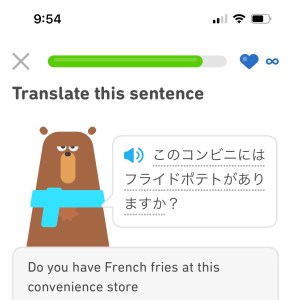
However, at times using Duolingo for Japanese has been a little frustrating, such as this question:
which I got wrong for (in my opinion) nitpicky reasons:
The problem is, in my opinion, not with Duolingo. It’s a terrific service and app, and I would recommend it to anyone. The trouble is how Japanese is taught, and by extension non-European languages are taught.
The way that Duolingo teaches Japanese strongly resembles the same college courses I took way back in college in the late 1990’s, when we memorized similarly staid phrases, and textbook-style sentences that aren’t really used. It’s grammatically correct to say このコンビニにはフライドポテトがありますか, but it’s not how it’s naturally used.
Japanese has a tendency to be very contextual compared to English. This drove me nuts for a long time until my listening skills caught up just enough to know what the gist of the conversation was, and I didn’t hvae to explicitly know who did what and where.
For example, using the sentence above, if the context is known, it’s perfectly fine to say ありますか which would mean “[this convenience store] are there [french fries] [here]?”.
But suppose the person at the counter didn’t know which item you were asking about. Is what thing here? In such a case, use the particle が (ga) to specify who, what, which or where. Is what thing here? French fries, are they here (e.g. do you carry french fries)? Hence フライドポテトがありますか If you’re talking to an employee at the convenience store, this would be sufficient because you’re obviously standing in the convenience store, and obviously not talking about some other store.
Suppose the listener doesn’t know which store you’re talking about. Then, you’d have to clarify what store you’re talking about, hence use the particles に (the target particle) and は (the subject of your sentence) together コンビニにはフライドポテトがありますか。Depending on context this can mean either “do convenience stores carry french fries” in general or “does the (mutually understood) convenience store carry french fries?”
Maybe you’re standing outside with a buddy and you’re wondering if this Lawson convenience store has fries, vs. that 7-11 across the street. Then after all we’ve discussed so far, you’d have to specify THIS store, to the exclusion of others, is the one you’re inquiring about. Hence このコンビニにはフライドポテトがありますか
You can see why a textbook sentence like this can feel really wordy to Japanese speakers. It makes sense in English, and probably other European languages as well,1 but feels pretty unnatural in Japanese.
Similarly, a normal conversation that I literally just had with my wife as I was typing this is:
Mrs: 今日は寒いね。 (today, compared to other days, is cold, isn’t it?)
Me: でも、暑くなると思う。 (but, [I] think it will get hot)
My wife did specify a topic (today’s weather), but if you notice I never said “I” anywhere in reply. Simply by context, using the word 思う (omou, “to think”), it’s obvious that i am stating my opinion.
It’s not limited to casual conversation either between spouses. A similar sentence in a more formal setting, such as with one’s boss might sound something like:
Boss: 今日は寒いね。 (today, compared to other days, is cold, isn’t it?)
Underling: でも、暑くなると思いますね。 (but, [I] think it will get hot)
The boss, being of higher social rank, is free to use more casual speech to his/her underlings, but the underling would reply back using more polite speech (思います, not 思う), and yet still would not need to specify “I” such as 私は or whatever.
This is the sort of thing that I really, really wish I had learned in Japanese classes ages ago, but hard to learn the hard way. Again, this isn’t informal, casual Japanese necessarily, it’s common-place skills you have to learn to speak Japanese and unlearn habits that happen with European languages: not specifying things you don’t know need (i.e. context matters), and being sensitive to social rank and politeness.
P.S. I’ve dabbled in Korean ages ago during the “KPop wave” a few years back, and I believe what I said above also applies to Korean as well.
1 I don’t know enough Ukrainian yet to know how accurately the “textbook” Ukrainian matches real life conversation, but thanks to Duolingo, I know more about “Auntie Toma” and her family than I ever wanted to know. 😅
Lately, in my quest to prepare for the JLPT example, level N1, I have been observing that because the vocabulary list is so large, my Anki flashcard deck is getting bigger and more unmanageable. Today, I finally reached critical mass and gave up. That’s after only completing 12 vocab lessons out of 66, with my deck reaching 900+ cards already. 🤦🏽♂️
The problem isn’t Anki, nor is it JLPT sourcebooks I am using. The problem is that the flashcards themselves are becoming too many, and too much work to manage. I found that I am particularly struggling with the recognition side of cards. For example, words like 気さくな and 大らかな and both have similar meanings in English, so trying to make unique flashcards for each, and remember them three weeks later is turning into a headache. Similarly, 寛大な and 寛容な are functionally equivalent words, even in the Japanese dictionary, so is maintaining separate flashcard entries even worth it?
Another way of looking at it: my goal is learning all this vocabulary was to help with reading. The vocabulary portion of the JLPT exam isn’t worth many points, but the essay section is worth a lot more. This makes sense: you need to demonstrate that you can read and comprehend Japanese literature. That’s what matters if you plan on living and working there.
So, the real issue is: how do I improve my reading skills? The answer is probably just reading more Japanese! This is harder than it looks, based on personal experience, because finding good Japanese books is hard enough as it is (unless you live near a Japanese book store like I do), but also something appropriate to your level and interesting is harder than it looks. Sometimes you can just solve this by getting a hold of many different sources and just sorting out which ones you like better. Sometimes you get a manga and it’s actually crap. Sometimes you find a random book in a used bookstore and it’s actually a really fun thing to read.
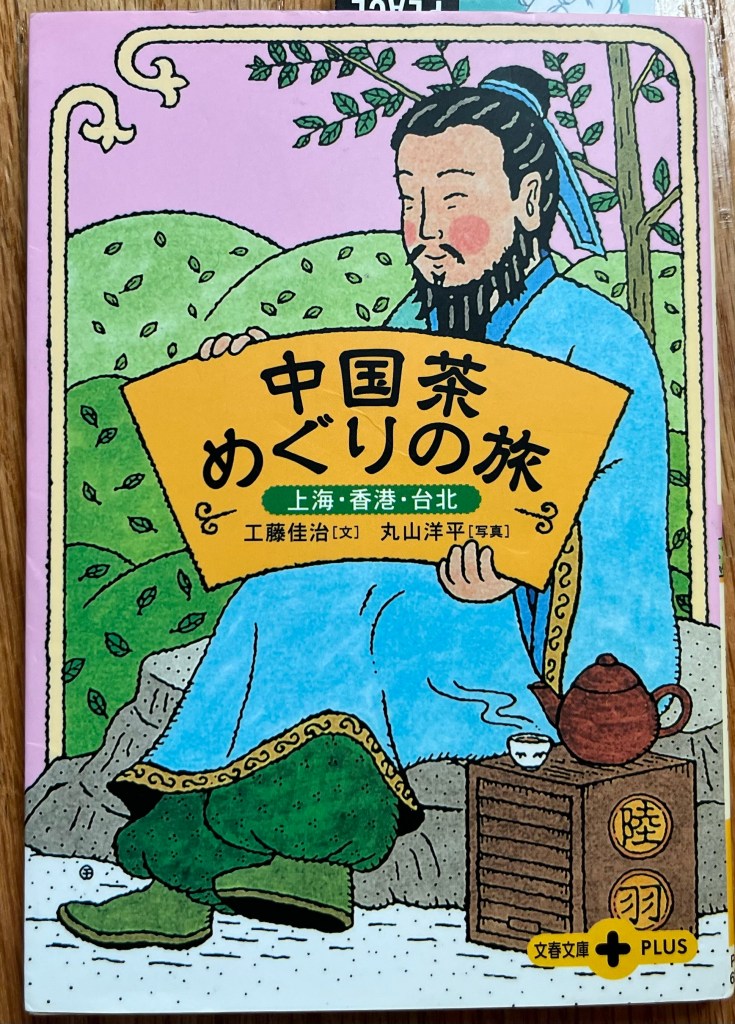
I found this book in a used-bookstore here in my neighborhood, and it was a travelogue of eastern China, with an emphasis on Chinese tea and Chinese food. It has been a pleasant read so far.
But I guess the real issue here is to keep using Japanese: through listening and reading. These are the two pillars to learning a language, I think. The rest is just mental games.
There are times when it’s good idea to make flashcards, though. I find cloze formatted cards helpful for learning proper usage of particles:
An example Cloze MCD card that I made for myself.
Also, sound-effect words (namely giongo + gitaigo words) such as めちゃくちゃ, or words that often come up in your reading are worthy of a flashcard. Originally before I took my the JLPT, my Anki flashcard desk was pretty used for this only. It was nice because it was smaller, leaner and words that I keep stumbling over, so it had immediate value.
If your deck grows beyond say 50-100 words, and you’re dumping vocabulary into there as I have been doing, it might be time to start trimming out words though.
I still plan on using my vocabulary book for the JLPT has it has been useful in expanding my vocabulary and making reading somewhat easier, but I need to think more carefully about how I use my flashcards as the effort to maintain is now becoming greater than the value I get out of them.
P.S. One other problem I didn’t mention: even after all the work you did to memorize vocab, you can still forget it months later when it appears again in your SRS flash card deck.
Woodblock print of Taira no Kiyomori, by Yoshitoshi, published in the One Hundred Aspects of the Moon. 月岡芳年, Public domain, via Wikimedia Commons
Near the end of the twelfth century in Japan, amidst decades of political meddling by the Fujiwara clan in Imperial court politics, an upstart samurai warlord named Taira no Kiyomori took control of his own clan, the Heike (平家) clan,1 in 1159. The Heike were one of several offshoots of Imperial offspring in last generation and hung around the Imperial Court as minor aristocrats, lowly samurai, etc.
By 1179 Kiyomori seized control of the capitol in a coup. The head of his hated rivals, the Genji (源氏) clan,2 was executed and his sons forced to live in separate provinces. The capitol was effectively under a military dictatorship under the guise of maintaining the Imperial Court, with Taira no Kiyomori pressuring the Emperor to award him the court rank of 1st rank junior (just under the Emperor). Kiyomori was said to wear brash clothing and flaunt Court etiquette. As he held onto power at the expense of the Emperor he could do what he wanted.
The Genji were now scattered, but not defeated. In time, starting with Minamoto no Yoritomo, they were able to gather allies, including a Heike-offshoot: the Hojo Clan. Further, the brothers of the Genji clan gradually reunited under Yoritomo, including the famous warrior Minamoto no Yoshitsune, and push back the Heike. This “Genpei War” culminated with the navel battle of Dan-no-ura, when the Heike were almost totally wiped out and a couple of the Imperial sacred treasures were reportedly lost.
But by the time of Dan-no-ura, Taira no Kiyomori was already dead. Taira no Kiyomori has become something of a power-hungry villain in Japanese lore since the Tales of the Heike, and subsequent media. His death is dramatized as coming from a terrible illness with a fever so hot that no one could approach him, while in his fever dream he was said to have seen the denizens of hell waiting for him including Enma the Judge of the Underworld.
Another woodblock print by Yoshitoshi dramatizing the illness and death of Taira no Kiyomori. Yoshitoshi, Public domain, via Wikimedia Commons
As the opening lines of the Tales of the Heike eloquently state, the powerful do not last long, and ultimately self-destruct. So it was with Kiyomori and the Heike.
P.S. The larger Heike clan persisted long after the Genpei War, mostly through off-shoots such as the Hojo, Miura, and so on. But Taira no Kiyomori’s ambitions were crushed and his immediately family and forces destroyed at Dan-no-ura. Minamoto no Yoritomo, for his part, wasn’t exactly a saintlyfigure either. Yoritomo’s own family and sons were hemmed in by the Hojo Clan who managed all the actual affairs of the new Kamakura Shogunate, relegating these new “warlords” to figurehead positions. Ah, politics. 🤦🏻♂️
1 Also called the Taira clan. The Chinese character 平 can be read as either hei or taira. Welcome to the world of Japanese kanji.
2 Same situation: 源 can be read as gen or as minamoto. They were another imperial offshoot clan with similar status to the Heike.
Since I recently gushed about the awesome Japanese historical drama, The Thirteen Lords of Kamakura, I wanted to share a quote from the real life epic, the Tales of the Heike, namely the opening line:
Japanese
Romanization
Translation
祇園精舎の鐘の聲、 諸行無常の響き有り。
Gionshōja no kane no koe, Shogyōmujō no hibiki ari.
The bells of the Gion monastery [Jetavana Grove] in India echo with the warning that all things are impermanent.
沙羅雙樹の花の色、 盛者必衰の理を顯す。
Sarasōju no hana no iro, Jōshahissui no kotowari wo arawasu.
The blossom of the sala trees teach us through their hues that what flourishes must fade.
驕れる者も久しからず、 唯春の夜の夢の如し。
Ogoreru mono mo hisashikarazu, tada haru no yo no yume no gotoshi.
The proud do not prevail for long but vanish like a spring night’s dream.
猛き者も遂には滅びぬ、 偏に風の前の塵に同じ。
Takeki mono mo tsui ni wa horobin(u), hitoeni kaze no mae no chiri ni onaji.
In time the mighty, too, succumb: all are dust before the wind.
Translation by Burton Watson in The Tales of the Heike (Translations from the Asian Classics)
Like one wave coming after another, it never really ends, and each wave that arrives is soon gone.
The phrase 諸行無常 (shogyō mujō) in particular is an example of a Buddhist yojijukugo phrase that is used even now in Japanese language. It essentially means the impermanence of all phenomena. I sometimes use this phrase half-jokingly with my kids or my wife when I drop dishes on the floor, throw away an old shirt, or whatever, but I do sincerely believe that all things are like waves in the ocean, arising briefly, or scattering blossoms in the wind.
P.S. Featured photo was something I took in early January of 2021 during a low point. There was much to be stressed out about at the time, but much of it has passed since.
As I mentioned in my previous post, as I build up my vocabulary for the JLPT exam, N1 level, the number of flash cards I have in Anki has exploded. In the last two months, I have built up more than 1200 cards in my Anki collection through studying vocabulary guides and reading Japanese manga we have lying around at home.
Because Anki is a spaced-repetition service (or SRS), the more you guess a card correctly, the less it appears. That benefits you by allowing you to focus more on cards you struggle with. But when you learn a lot of new vocabulary in a short span of time, even with SRS, daily practice can be a nightmare because a large number of cards can come in “waves” all on the same day. And if you don’t review those cards, more will soon pile up.
When you open your SRS tool and have 120+ cards to review and 20 new ones, and you are a working parent, this gets pretty discouraging. Plus, I am only one-sixth of the way through my vocabulary guide so this amount will grow a lot more in the coming months.
To deal with this madness, I learned a feature in Anki that lets me limit the number of new cards and cards to review per day:
This feature has been very helpful for me because it gives me a reasonable limit to practice daily, even though it slows down my progress. The idea is to break up the study into smaller, discreet chunks of time. It also smooths out “waves” of flashcards overwhelming me when too many of them are all due on the same day.
The question then is how much is the right amount? I’ve play around with a few values so far: 4 new cards + 45 reviews, 6 new cards + 60 reviews, 3 new cards + 30 reviews, and so on. In my experience, I found that smaller is better, so I’ve settled on 3 new cards a day and 30 reviews. If I have a slow day and more free time, I can do the Custom Study feature to learn extra cards, but if I complete my 30 reviews that’s good enough.
The difference in the long-run is small, and it’s mostly psychological, but smoothing out your study into small daily efforts helps in the long-run, I believe.
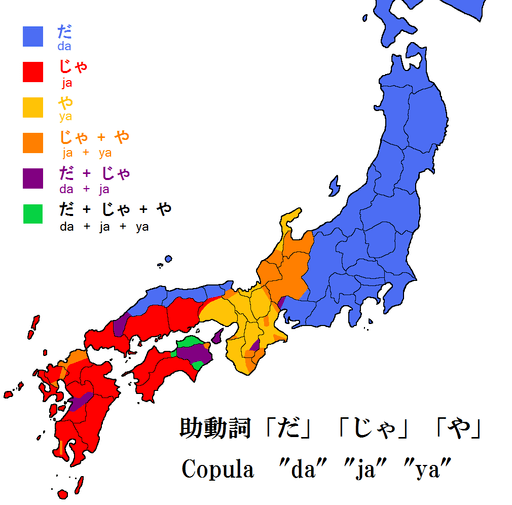
Japanese language has a number of dialects, called hōgen (方言), with the “standard” dialect being around the Tokyo area. Some dialects are based on region, some like the Kyoto dialect, are intrinsic to a city itself. But one of the most famous is the dialect found in the Kansai region of Japan around the Osaka area, called the Kansai dialect, or kansai-ben (関西弁).
Kansai dialect, like any Japanese dialect, is still Japanese language, especially where formal, polite speech is concerned. My wife’s extended family in northern Japan pretty much speaks the same language, the main difference is mainly intonation, plus a few odd words here and there (obscure enough that most language students wouldn’t care anyway). Kansai dialect though, like much of western-region Japanese, does have some notable differences:
Tokyo-region colloquial ending じゃん (jan), short for じゃない (ja nai) is said as やん (yan) in Kansai dialect.
The negative polite verbal ending ません (masen) becomes まへん (mahen).
Kansai dialect includes a few common phrases. For example, people often say “thanks” as おおきに (ōkini) and “really?” as ほんまに (honmani).
This blog is provides a much better overview of Kansai dialect.
Kansai dialect is a popular dialect in the entertainment industry, probably similar to how a New York accent or Texas accent is often found in American comedy. Part of this is also attributed to the image of Kansai-region Japanese people being more forthright and speaking their mind than the stuffy Kanto-region people around Tokyo area.
But yes, who knows where “Kansai Ben” is these days? Perhaps he’s hanging out with Chirashi Don (chirashi donburi the dish), Osaka Joe (Osaka Castle), or others. I guess we’ll never know.








 Gleanings in Buddha-Fields


You must be logged in to post a comment.