Ablution

A floor tile mosaic showing two peacocks flanking a foundatin. Above the fountain is the Greek palindrome "ΝΙΨΟΝΑΝΟΜΗΜΑΤΑΜΗΜΟΝΑΝΟΨΙΝ".

Recently, I have been dabbling in learning ancient Greek language for the first time in years. I polished off my old DVD copy of the Greek 101 course from The Great Courses which I bought during the Pandemic after my local library no longer had it available.1 It’s been fun to review old lessons, get reacquainted with such a gorgeous language, and so on.

Anyhow, something I wanted to share was a famous axiom in Koine Greek found throughout the Eastern Roman (a.k.a. the Byzantine) world:

ΝΙΨΟΝΑΝΟΜΗΜΑΤΑΜΗΜΟΝΑΝΟΨΙΝ
(Νίψον ἀνομήματα, μὴ μόναν ὄψιν)

“Wash your sins, not only your face.”

This is pronounced as Nipson anomēmata mē monan opsin. This is a famous palindrome (same forwards or backwards) that according to Wikipedia is attributed to one Saint Gregory of Nazianzus. I am not super familiar with the Orthodox tradition, but feel free to consult Wikipedia for more details. You can find it at many monasteries across the Eastern Roman world, including the holy font at the Hagia Sophia, the central church of Constantinople.

A floor tile mosaic showing two peacocks flanking a foundatin. Above the fountain is the Greek palindrome "ΝΙΨΟΝΑΝΟΜΗΜΑΤΑΜΗΜΟΝΑΝΟΨΙΝ".
A floor mosaic at the monastery of Panagia Malevi, image by Christina Kekka from Athens, GreeceLight correction by Basile Morin, CC BY 2.0, via Wikimedia Commons

In any case, the concept of ablution is also found in Buddhism and expresses a similar sentiment.

Buddhism has a popular custom whereby one performs some kind of ablution with water or incense before approaching a Buddhist altar to pray. It is not strictly required, but is commonly performed as a gesture of respect toward the Buddhist deity you are visiting by cleansing oneself at a superficial level. Within Japanese Buddhism, some sects encourage this more than others; from what I have learned Tendai Buddhism tends to emphasize this a lot, Pure Land Buddhist sects (e.g. Jodo Shu and Jodo Shinshu) do not. The emphasis varies, in other words.

But also ablution in Buddhism is not limited to the external ritual; we also the concept of repentance (e.g. “washing the soul”). This is not the same thing as Western religions, where someone begs God for forgiveness for transgressions committed. Instead, the Buddha strongly encouraged us to constantly evaluate our past conduct, and use the Dharma as a kind of yard-stick to measure them: were they skillful actions, or unskillful actions? Inevitably, one must confront their own unskillful actions. We all do. It is part of being a human being.

So, in Buddhism, many traditions have a ritual were people reflect on their past actions and renounce them, resolving to do better. It is encouraged to do this in front of a statue of the Buddha, and to repeat the liturgy out loud, not just in one’s mind:

All of the misdeeds I’ve committed in the past, are the result of my own greed [or craving], anger and delusion [or ignorance]. I renounce [or repent] these misdeeds.

Translations vary by community, this is just one example.

The idea is that by acknowledging and confessing one’s faults, one not only learns from one’s mistakes, one also potentially diminishes some negative karma that one has sown, and also prevents further self-harm (i.e. guilt, self-recrimination) by letting go and forgiving oneself.

So, just as the old Greek palindrome says, Buddhist practice is not only washing one’s face, but also one’s “soul”.2

Namu Shakamuni Nyorai

P.S. A common misunderstanding is the primary language in the Roman Empire was Latin. In fact, most of the population spoke Greek as their primary language, though this varied widely by region. This prevalence of Greek was both a leftover from the Hellenistic Age, but also because even Romans felt that Greek was a prestige language, and wealthy Romans hired Greek tutors for their children when possible. Julius Caesar’s famous “Et Tu Brute” quote was actually recited in Greek (Kai Su Teknon).

1 I prefer having hard copies of things, whenever possible.

2 Buddhism is somewhat unique among world religions in that it teaches the concept of “no-soul” (anatman), so by “soul” I don’t mean a literal soul, but the mind and one’s provisional self.

Rhythm in Japanese Language

Japanese language, on its own terms, isn’t that difficult a language to learn I believe, but it does have some things that are pretty different from English, and require re-learning. One of them, surprisingly, is rhythm and lack of stress accents. I’ve talked about the “flat” sound of Japanese, but I haven’t really talked about its rhythm before.

Since Japanese is usually written using hiragana syllabary, it’s important to note that each kana “letter” is actually a self-contained syllable, and represents one “beat”. So, if you take a word like the city of Yokohama, it has four beats:

Yokohama

Once you grasp this concept, and get familiar with hiragana, Japanese is fairly easy to spell. However, there is one wrinkle that’s really important to pay attention to.

In Japanese the letters ō and o are not the same. They both sound like “oh”, but one of them is two beats, and the other is a single beat. In Romanization, the sound ō is actually two beats, comprising of o, followed by u “ooh”. Many words in Japanese use this combination. For example, the city of Tokyo, is actually Tōkyō. If pronounced correctly, it actually has 4 beats, not 2:

きょ
Toukyou

It really helps if you clap to the beat to help you adjust to this. For a native English speaker, it’s really hard to tell the difference between ō and o in conversation, but a native Japanese speaker can and does. A good example is the word ryokō (旅行, “travel”) which has both:

りょ
ryokou

The “ryo” is pronounced as a single beat (not 2, as in English), while the kō is pronounced as two beats.

In Japanese, the ū and u, both pronounced as “ooh” as in “soup” similarly are distinguished by two beats vs. one. The word for shumi (趣味, “hobby”) has only two beats:

しゅ
shumi

But compare with shūmatsu (週末, “weekend”) which has two beats for shū (4 total):

しゅ
shuumatsu

This is also why relying on Romanization of Japanese is a bad idea: it’s hard to convey this. IF you can read hiragana, then the pronunciation is super obvious because it’s a WYSIWYG writing system: what you see is what you get. Take this book cover for example (which I talk about in my other blog):

I’ve highlighted in green the interesting characters. The word 百 is pronounced as ひゃく which is two beats:

ひゃ
hyaku

And the word 道 in this context is pronounced as しゅ (shu) which is a single beat, like English “shoe”. Romanization can convey this, but if you can read hiragana, it is just so much easier.

Slight tangent, but Korean Hangeul works much the same way: Romanization doesn’t convey the sounds very well, but like Japanese hiragana, native Hangeul is also a WYSIWYG system. My wife and I have a children’s book in Korean from a friend:

I’ve highlighted each Hangeul syllable, but as you can see, Hangeul neatly divides each syllable by blocks anyway. Thus, you can easily tell who to read each one:

seonraedonghwa

If you try to write the title in Romanized Korean: seonraedonghwa, it’s hard to distinguish syllables. Is “seon” actually “se” and “on”, or is it one syllable? If you write with spaces in between words, it’s still hard to tell what’s what.

Also, this need to learn the native script isn’t limited to Asian languages. Ukrainian is much easier to read and learn once you grasp the Cyrillic alphabet. It is a pain upfront due to overlap with English, but it also makes it much easier to read words like the surname of the current president: Зеленський. In Ukrainian, there is only one way to read/pronounce Зеленський, but in Romanized Ukrainian it is written as Zelenskyy, Zelensky or Zelenskiy. Close, but not quite. The same goes with reading Greek (both modern and ancient), and so on.

Think of learning Hiragana, Hangeul, Cyrillic, Devanagari, or Greek as a one-time investment. It seems like a hassle upfront, but once you get past that barrier, a whole new world opens up.

Anyhow, back to the original point of this post. When it comes to learning Japanese, it’s important to pay attention to rhythm, because your pronunciation will sound much better, and you’re likely to reduce your foreign “stress” accent in the process. It’s perfectly fine to have some lingering accent (that’s life as a foreigner in any country), but your ability to clearly convey what you want to say to native speakers will go a lot smoother, and be less tiring to the listener.

Good luck!

Ukrainian-Ukrainian, Russian-Ukrainian and Polish-Ukrainian: language and cultural influences

In recent weeks, as my study of Ukrainian language continues, I was fortunate to find a coworker at my company who is a native Ukrainian speaker, and happy to help me. As we’ve been talking, I’ve come to learn some interesting things about how various cultural influences have affected it.

The Saint Sophia Cathedral, in Kyiv, modeled after the Hagia Sophia cathedral in Constantinople at a time when Kyivan Rus and the Byzantine Empire had close relations. Rbrechko, CC BY-SA 4.0, via Wikimedia Commons

For example, the greeting I learned in Duolingo for “good morning” was добрий ранок (sounds like “dobree ranohk”), but then my Ukrainian co-worker explained that there are actually two common greetings. The first one is the aforementioned добрий ранок, and the other is доброго ранку (“dobroho ranku”). What’s the difference? The first one (добрий ранок) is a more Russian-style greeting, while the second (доброго ранку) is more native Ukrainian. Similarly, добрий день vs. доброго дня

To clarify, both are very common greetings in Ukraine, and no one would look at you weird for using either one. It’s just that one shows considerable Russian influence, while the other doesn’t. Also, since Ukraine is a relatively big country in Europe, it has some regional variation, so you might hear one more commonly in one regions versus another.

It turns out there’s a lot of this Ukrainian. There’s a lot of words and phrases that come from Russian, but not actually Russian-language, while other similar words and phrases show a more native Ukrainian background.

Another example my friend explained to me is how Ukrainian language frequently derives words from Russian, especially when translating from Russian sources. For the ongoing war, a common term is понесли втрати (ponesly vtraty, “suffered loses”), which derives from the similar Russian term понесли потери (poniesli potieri). However, in a more native Ukrainian way, you can also say зазнали втрат (zaznaly vtrat). The native, Ukrainian way is noticeably different than Russian, but it’s sometimes more expedient to use Russian-derived terms instead.

Sometimes this difference in phrasing reflects generational gaps too, with older generations often using more Russian-influenced terminology and phrasing versus the younger, post-Soviet generation more keen on using native Ukrainian more, to say nothing of the politics behind it all.

However, I didn’t want to just talk about Ukraine and Russia, another interesting thing that I found is that I noticed a lot of words that sounded vaguely like Latin to me, or Latin-derived. A prime example is Вино (sounds like vih-noh) for “wine”. This sounds fairly close to the Latin “vinum”, and not the Ancient Greek term οἶνος (“oinos”), which is surprising given how much closer Greece is to Ukraine. This may be due to influence from nearby Polish, a Catholic culture, despite its Orthodox heritage which derived from the Byzantine Empire.

Numbers, too, reflect some interesting patterns:

No.UkrainianLatinGreekRussianPolish
1один (odin)unusένα (ena)один (odin)jeden (ye-den)
2два (dva)duoδύο (duo)две (dve)dwa (dva)
3три (trih)tresτρία (tria)три (tri)trzy (tshih)
4чотири (chotihrih)quattuorτέσσερα (tessera)четыре (četyre)cztery (chte-rih)

The number four in Ukrainian, Russian and Polish more closely resembles Latin than Greek. Could this reflect some kind of eastward influence from the West? Honestly, I wish I knew more about the subject, but it’s fascinating how various cultural centers in Europe, both near and far, converged in places like Kyiv, and how the language reflects these layers of influence.

Early Ukraine History: Of Scythians, Thracians and Greeks

Hello Readers,

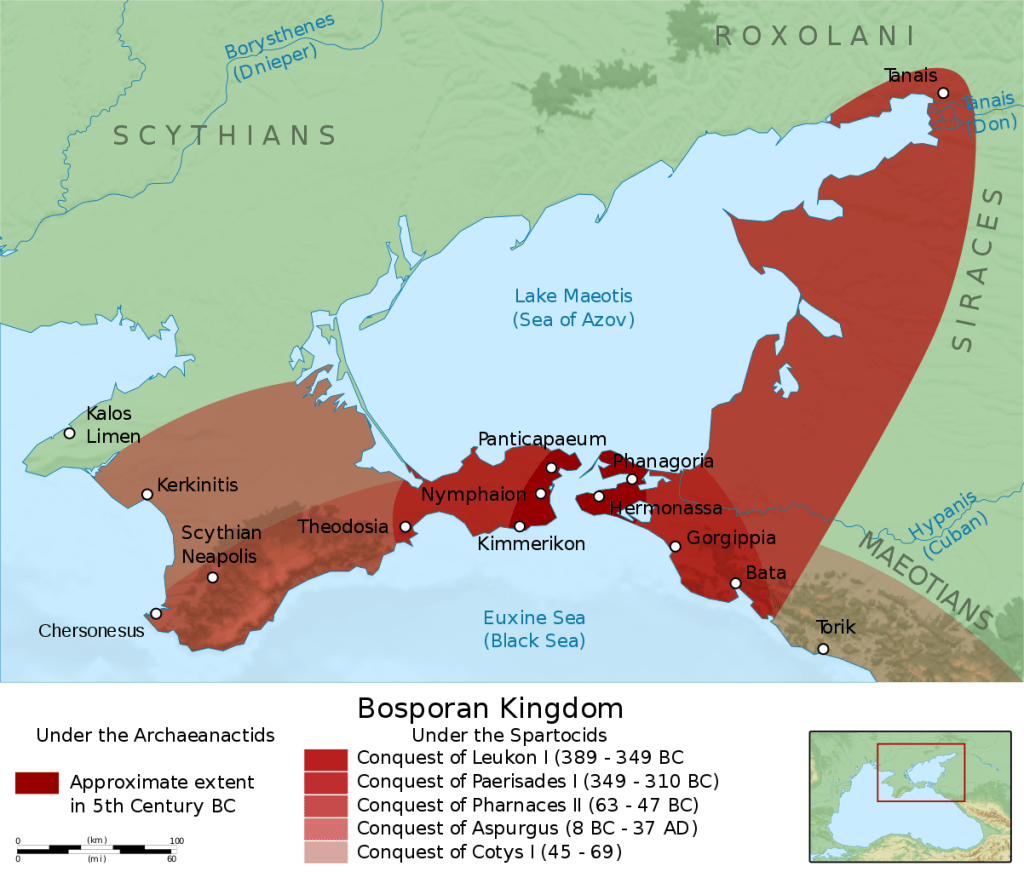
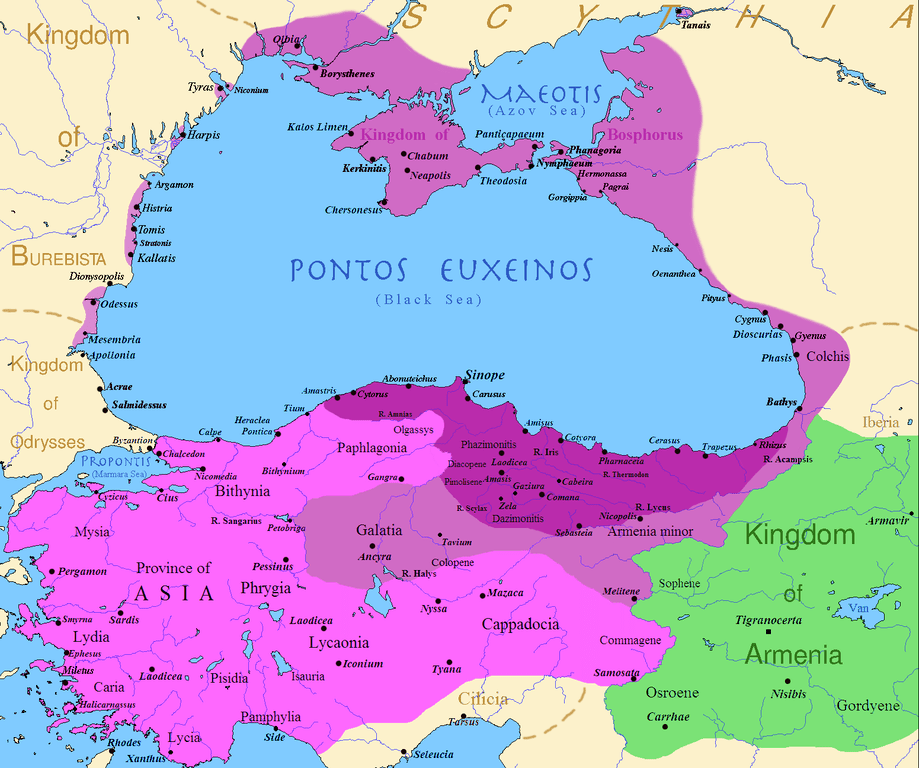
My continued read about the Scythians, especially the Scythians in the west, has lead to a fascinating period of time in early history, overlapping with the Hellenistic Period called the Kingdom of the Bosporus. The Kingdom of the Bosporus, later part of the Kingdom of the Pontus, survived in one form or another from the 5th century BC to the late Roman Imperial period in the year 370 AD (roughly 800 years). As you can see from the map, it started very small, just a collection of Greek colonies bound by mutual defense, and grew in size into a much larger kingdom that included the Crimean peninsula and parts of modern-day Ukraine.

The Bosporan Kingdom at various points in history, File:Bosporan Kingdom growth map-pt.svg: Sémhur (talk · contribs)derivative work: Morningstar1814 (talk · contribs), CC BY-SA 4.0, via Wikimedia Commons

Later growing into a much later kingdom that went to war with Rome:

Javierfv1212, Public domain, via Wikimedia Commons

What makes the Kingdom of the Bosporus / Pontus fascinating is the convergence of Greek, Thracian, Scythian and other cultures, and the exchanges between them. Let’s take a brief look at each…

The Greek Colonies

The humble beginnings of the Kingdom of the Bosporus began as a hodge-podge of Greek colonies in the Black Sea. The ancient Greeks were prolific colonizers in the Mediterranean because the lands of Greece have low agricultural output, and as populations grew, they needed places to grow and stretch. Famous colonies include Syracuse on the island of Sicily (home of Archimedes!), southern Italy a.k.a. Magna Graecia, Cyrene in modern-day Libya, as well as countless colonies in Spain, southern France, Asia Minor and so on.

Colonies in the Black Sea, including the modern Ukrainian city of Odessa,1 mostly originated from the Greek city-state of Miletos which had been aggressively colonizing all around the Black Sea. Even now, old Greeks relics can be found. The Greeks were colonizing hostile territory, so they tended to build fortresses on off-shore islands, or just inland from a river. From the inland communities, the Greeks would get raw materials, grain and other foodstuffs to ship back to the Greek metropolises back home. In turn, they would bring wine (much prized by the Scythians), crafted luxury goods and spread Greek culture.

From the perspective of the Greek world, the Black Sea and colonies around the Crimean peninsula were the very edge of civilization. This was the frontier, where only the bravest, or the punished would go.

The Native Thracians

The Thracians are an influential people who lived north and east of Greece proper, but are not well-attested in history. Thracian culture shows considerable Greek influence, but they spoke a different language (now lost), and had a more loose, more tribal political structure than the classic Greek polis.

But the Thracians weren’t slouches either. They frequently combated with the northern Greeks, especially Phillip II of Macedon and his son, Alexander the Great, and the Odryzian Kingdom was a serious attempt by the Thracians to unify and challenge their Greek neighbors.

The Kingdom of the Bosporus, the subject of this post, was perhaps their most important contribution, though, because the founder of that kingdom was a man named Spartacus. No, not this Spartacus:

The name “Spartacus” is a distinctly Thracian name, and the founder of the ruling dynasty of the Bosporan Kingdom was a Thracian man named Spartokos I, first as the strongman or “tyrant” of the Greek colony of Panticapaeum (modern Kerch), and then gradually uniting the nearby colonies in a system of mutual protection.

The Steppe Warriors

Starting with the Cimmerians, steppe nomads would often encroach into the steppe lands of modern Ukraine and Hungary, the westernmost extent (as well as the most hospitable) of the Eurasian steppes. Having driven out the Cimmerians, they settled and lead a confederation of tribes that dominated the lands for centuries, until they were eventually defeated by the Sarmatians.

The nomadic Scythians were at first largely hostile to the settled Greco-Thracian cities along the coast, and there is evidence of war and violence at some places, hence the colonies banded together for mutual defence. Gradually, though, the different cultures learned to get along and began mutually beneficial trade. The Scythians liked Greek commodities and helped ship raw resources from other cultures further north down to the Greek settlements.

The kurgan tombs of Scythian warriors also began to show more Greek architectural influence, such as the great kurgan at Kul-oba, and a tomb at Bliznitsa near the colony of Phanagoria that depicted the goddess Demeter, hinting at the Eleusinian Mysteries.

Further, a number of famous Greeks have (often dubious) claim to Scythian ancestry such as the Athenian orator, Demosthenes, so intermarriage did occur between the colonists and steppe nomads. Herodotus’s historical accounts of his travels in these lands also provide invaluable information about the people of the Bosporan Kingdom, the Scythians beyond it, and more.

The Wider World

How the Bosporan Kingdom fit into the wider Hellenistic and Roman world is interesting too. Because of its location, it was luckily not involved much in the power struggles between Alexander the Great’s successors, nor did it tangle with the Roman Republic until much later during the Mithridatic Wars. All three of them.

Further, the mixed ethnic composition of the Bosporan Kingdom meant that it was an unusually cosmopolitan place, and held a certain mystique among the more urban residents of the Greeks and later Roman empire. When Ovid was banished there, though, he often whined about how hard and rustic the life was, but he would, wouldn’t he?

Anyhow, even when we watch the news about events in Ukraine, especially southern Ukraine, it’s helpful to remember that these lands have a long and fascinating, multicultural history, and we haven’t even gotten to Kievan Rus’ yet.

1 Which, as of writing, remains free thankfully. Слава Україні! 🇺🇦

Gender in Ukrainian Language

As my studies of Ukrainian continues, one pattern that definitely appears over and over is the clear presence of grammatical gender. I’ve touched on this a bit in a recent post on how it relates to classical languages, but wanted to provide more context here.

Screenshot from my Duolingo session

The concept of grammatical gender is something that’s endemic to Indo-European languages (as far as I know),1 and is not related to the actual gender of a word. In Latin, the word miles means solider and is masculine (makes sense), but the Roman legion, legiō, had a feminine grammatical gender.

Modern western European languages such as Spanish and French tend to have shed and streamlined some aspects of grammatical gender. Neuter words no longer exist, so there’s only masculine and feminine genders left. Languages like English barely have any grammatical gender at all, even though it still exists in German to some degree.

Ukrainian language keeps the three classic genders: masculine, feminine and neuter, and like Spanish, French and Latin, nouns and adjectives have to agree with case (nominative, genitive, etc), number (singular and plural) and gender.

Here are three words:

Ukrainian (Romanization)MeaningGender
Кіт (kit)A male cat
(more on this later)
Masculine
машина (mashyna)A carFeminine
місто (misto)A cityNeuter

As far as I can tell, there is no definitely article like “the” or “a” in Ukrainian, but let’s use the word for “my/mine” in front of these and you can see how grammatical gender:

Ukrainian (Romanization)Meaning
Мий кіт (miy kit)My cat
Моя машина (moya mashyna)My car
Моє місто (moye misto)My city

You can see how in all three cases the same word, “my”, changes according to grammar, and it’s not a small change. In the screenshot above from my Duolingo session, you can see that the adjective “older” changes the same way depending on whether it’s a sister (feminine) or brother (masculine).

Another example of gender in Ukrainian where all the words in the sentence end in “а” because the word for daughter, донька (donka), is feminine.

Further, I was surprised that there are many words for living beings that are also divided by gender. For example кіт above means “cat”, but implies a male cat. The word for a female cat is кішка (kishka). For “friend” there are separate words for a male friend (друг, “druh”) and a female friend (подруга, “podruha”). Note that these are platonic friends, not boyfriend and girlfriend. There are separate words for those.

Also, from what I can tell, the plural friend has only one gender: друзі (druzi) means “friends” for example, though I am pretty fuzzy so far.

So far, I think I have only learned the nominative case (e.g. nouns as the subjects of sentences), so I suspect that these forms will also change depending on what part of the sentence a word is. This makes conjugation pretty tricky (just like Latin and Greek), but also means that you can upfront glean many details quickly once you get familiar with it.

Another example is in describing people. Ukrainian frequently identifies gender in a person through endings such as ець (ets) for masculine and ка (ka) for feminine. Thus, українець means a Ukrainian person, masculine, while українка means a Ukrainian person, feminine. Even words like “vegetarian person” have different endings: вегетаріанець (vegetarian, masculine) versus вегетаріанка (feminine).

P.S. I had my first actual conversation in Ukrainian recently, and I did a pretty lousy job. My mind blanked on words, and I mispronounced things. It’s been a long while since I learned a new language, and it’s easy to forget how little you actually know at first. But it also is a reminder to focus on fundamentals and nail those down before getting too hung up on the finer details. Easier said than done, but it’s been an interesting journey so far.

1 I have practically never seen any examples of it in languages like Japanese, Korean or Chinese or Vietnamese. Of course, there are gender-specific words, but inflections based on grammatical gender definitely do not exist. Bear in mind that the above Asian languages are in separate language families (despite being geographically next to one another).

Ukrainian Language: a Link To The Past

Lately, I started taking up the Ukrainian language, which is something very outside my comfort zone. In my younger years, I’ve studied Mandarin Chinese, Vietnamese for 2 years in college, and of course Japanese, so Asian languages tend to be familiar even if I am not fluent. I have also dabbled in Latin, Sanskrit and Ancient Greek over the years, but I am not particularly good at either one.1 Even so, I have zero experience with Slavic languages, so it’s been a totally new experience for me, and yet, to my surprise an oddly familiar one.

Having spent weeks on DuoLingo practicing basic, basic Ukrainian I started to notice some patterns.

For example, the phrase моя мати (moya matih) and мій кіт (miy kit). The first means “my mother” and the second means “my cat”. After a bit of sleuthing, I figured out that “my” will conjugate depending on the gramamtical gender of the noun. In this case мати is a feminine gender word, and кіт is masculine. There are “neuter” gender nouns as well.

Side note: the Ukrainian word for “samurai” is самураї (samurayi)

Grammatical gender? Ancient Greek,2 Latin, and Sanskrit all had masculine, feminine and neuter genders for nouns. Modern Western languages tended to drop the neuter gender (e.g. modern Spanish or French), but it’s fascinating to see that Ukrainian, and Russian evidentially, retain all three. You can also see grammatical gender with words like студент (“student”, male student) vs. студентка (“student”, feminine student).

But even more fascinating is that Ukrainian nouns have seven grammatical declensions:

  • nominative (“the student”)
  • genitive (“of the student”)
  • dative (“to or for the student”?)
  • accusative (“verb the student”)
  • instrumental (“with or by means of the student”)
  • locative (“on the student”?)
  • vocative (“hey, student!”)

Seven declensions? The only language I know that had that many was ancient Sanskrit (eight total, including ablative)! Latin had five, and Ancient Greek only had four. Adjectives also behave like Latin, Greek and Sanskrit in that they agree with the noun in case, number and gender.

I haven’t really gotten into verbs much yet, but I do notice that they inflect too, depending on who speaks it (I eat vs. you eat), so I wouldn’t be surprised if it fits a similar pattern to other European languages.

All this is to say is that Ukrainian language, and much of the eastern European Slavic language family represents a linguistic “cousin”, with fascinating relics from much earlier Indo-European languages, and yet full of innovations and adaptations as well.

1 I confess I dabble in language study a lot, but not very good at follow-through. Japanese is the only language I’ve really committed too long enough to develop any skill, but since I married into the culture, it’s been a worthwhile experience. I suppose that’s what really keeps one going: personal value in learning a language more so than just idle intellectual curiosity. On the other hand, even learning another language a little bit is a worthwhile experience. I dabbled in Korean at one point due to the KPop craze at the time, and it’s nice to still be able to real Hangeul, and to encounter the only other language I know that has any grammatical similarity to Japanese (through convergence, not genetic origin). Similarly, my time spent learning Vietnamese, which I don’t get to use much anymore, was a fascinating time when I got to study abroad in Hanoi, Vietnam. Plus it was fascinating to see how Chinese influenced Vietnamese in the same way that Chinese influenced Korean and Japanese even though they were all unrelated languages! In that sense, any foreign language study is a worthwhile investment.

2 The term “Ancient Greek” is kind of vague and nebulous. There’s Homeric Greek (e.g. the Greek of the Iliad), Classical Greek (e.g. Attic dialect), Koine Greek (e.g. the Hellenistic Period and the New Testament), Byzantine-era Greek and so on. There’s even Archaic Greek, which is poorly attested due to lack of sources. So, when people talk about “ancient Greek” it’s important to be clear which one. Greek as a language is a fascinating continuum from the archaic period all the way to modern times. One of my co-workers is Greek American and she loves to swap tips with me as she is also learning both ancient and modern Greek.

This One Trick Will Help You Learn Languages Faster

“Language teachers hate it when you do this!”

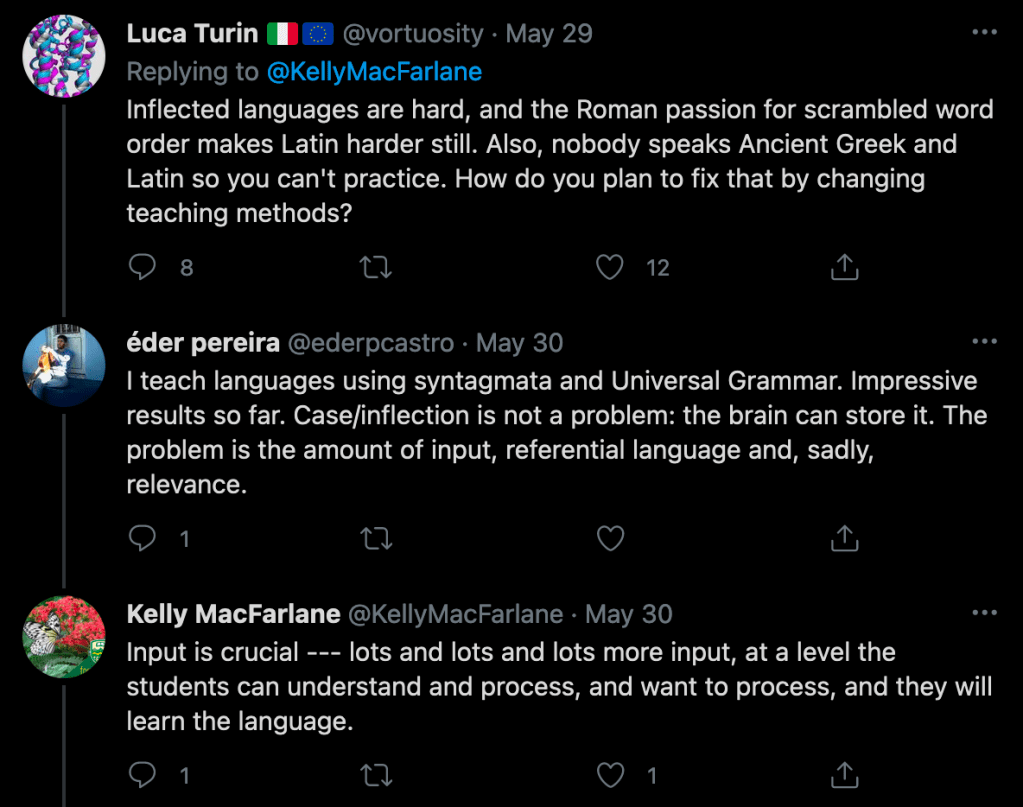
I couldn’t resist starting this post with some click-bait text. 😬 Recently I saw this post on Twitter:

This leads to a heated exchange on Twitter, including the following:

Basically, the point here is is that if you want to learn a language and communicate smoothly, you need A LOT OF INPUT. Like, a sustained, overwhelming amount of input. It will not make sense at first, but gradually you’ll start to piece together the ineffable patterns in a language, and without thinking, you’ll know how to correctly speak your mind, or respond to someone else’s words.

It took me a long time to realize this, after I had wasted countless hours cramming and studying. The studying does serve a purpose, in so far as it helps get you on your feet, but if you’re starting out on a language, the sooner you prioritize input, the easier you will pick it up and improve. It’s not only stimulating for your mind (great for old folks like me), but also it helps bridge the gap between the “textbook” examples you first learn and real life ones, and the real life ones are the ones you should be imitating the most.

What does input mean here? Any kind of exposure you can find: movies, podcasts (my personal favorite), TV shows, just listening to other people speak in real life, etc. Soak it up like a sponge, and don’t get discouraged if none of it makes any sense even after 3 months, or 6 months. If you are learning classic languages like Latin and ancient Greek, just keep reading. Bit by bit, it’ll all become second nature.

I realized that comprehending adult conversation in real time is like catching a school of fish. If you try to reach out and catch it with your bare hands, the fish will swim away, but if you relax and just let the fish swim around you, they’ll get closer and closer and you can easily catch them. Language comprehension works an awful lot like that.

Hard to explain, but if you’ve ever learned another language well, you’ll realize that you’re mind has somehow transitioned to a state where it fluently comprehends it without having to mentally translate from your own native language, which is what a lot of new students tend to do. No conscious thought here, just comprehension.

Enjoy and happy language learning!

Mortality

This is a very Buddhist sentiment, in my opinion. If you haven’t learned to confront your own mortality, then the rest of the Buddhist path is kind of meaningless. But maybe that’s just me. 🖖🏼

A Nerd Dad’s Review of Mythic Odysseys of Theros

Hi folks,

In addition to my recent adventures in adventure module writing, and gardening, I finally got a belated Father’s Day gift recently:

The Mythic Odysseys of Theros (MOoT) is a cross-over reference guide between Dungeons and Dragons and Magic: The Gathering, specifically the Greek-mythology inspired plane of Theros. Theros is a kind of idealized plane of what Greek mythology would be if taken out of historical context and allowed to run free. It is a world full of gods exerting a direct influence on the world, satyrs, minotaurs, city-states loosely modeled after ancient Greek city states, etc.

This leads to some interesting mechanics in MOoT that are worth sharing here:

  • Many of the typical “high-fantasy” character races that are found in D&D are not in Theros: elves, dwards, gnomes. They didn’t exist in classical Greek mythology (nor Magic the Gathering’s plane of Theros) and do not exist here. They are replaced by centaurs, satyrs, minotaurs, etc.
  • Unlike the usual, somewhat loose, mechanics between clerics and gods, the piety mechanics in MOoT provide clear benefits for characters who explicitly do things to advance their god’s agenda.
  • MOoT elevates the “hero” element1 of D&D by giving each character an extra starting ability totally outside of the standard Player’s Handbook. The ability is something that grows and develops as the hero accomplishes deeds.

All of these things mean that adventures on Theros aren’t always portable to other planes and campaigns (and definitely not Adventurers League legal), unless your DM allowed for such a transfer of abilities and deities. The fact that they even exist though makes a fun and interesting campaign in Theros, and likely one you’d play again with different characters, gods, etc.

Let me take a moment to talk about the book: it is gorgeous, even by the standards of D&D module books. The artwork is truly inspired, and I admit I enjoy thumbing through the book sometimes if nothing else than to just enjoy the art.

Also, the book is really well-organized in terms of getting started on building a character within Theros, and how they will relate to his/her deity of choice. There’s also an option for atheistic characters (some characters races are more inclined to this than others).

Theros as a module and as a plane lends itself more to “save the village, destroy monster” type adventures, than intrigue adventures (a la Eberron), but this also means that as a parent it’s probably easier to make stores for younger kids, which is part of the reason I got the book. I own the Eberron book, and it’s pretty interesting, but also poses some challenges which I’ll cover in a later post.

Also, in my case, as a promo I also received laminated map detailing several places on Theros, such as the Underworld, and so on. I don’t know easily available these are, but it may yet come in handy soon.

Anyhow, I am eager to try this out with the kids, especially my younger son who’s itching to battle monsters again.

1 Interestingly, the ancient Greek notion of a “hero” is not the same as the modern interpretation. Think of them more like obnoxious supermen with questionable moral judgment.

Life After COVID-19

A quotation from Book I of the Iliad

This month, June, is the third month in lockdown over COVID-19. It’s amazing that three months have already passed. At first, we were, like many others, in full panic mode, swinging between constant fear of getting ill and enjoying as much food, drink and home entertainment as we could. My sense of religious faith was pretty shaken back then, too.

Later, we struggled to get into a routine for home-schooling our kids, finding adequate facial coverage, and then losing my job. Finally, as I settled (thankfully) into a new job, and the family into a home-schooling routine, we’ve gotten used to life under lockdown. My spiritual faith renewed itself with greater dedication, too.

We miss our friends and family terribly, but we remain cautious yet hopeful we’ll see them again soon.

After lockdown, things are gradually shifting from pure survival to looking toward the future. We are making plans again (albeit pretty far into the future), and I look forward to the day that the kids can finally get out of the house and see their friends.

Still, as we are seeing a light at the end of the tunnel, it is a good time to reflect on those we’ve lost on the way. The deadly arrows of ἡ ἑκηβόλος (hé hekébolos), Apollo the Far-shooter as he was called in The Iliad, have rained down on our communities and it will take years before we fully return to a sense of normalcy. We’ve lost loved ones, businesses in our community, and so much else, and they won’t be coming back.

The character Caduceus Clay from the show Critical Role grew his tea leaves from the soil of the graveyard he previously tended, but he reminds us all that everything we enjoy is through other people:

Beau: You’re drinking dead people tea?

Caduceus: Aren’t we all?

Caleb: That is a very fair point.

Beau: Very true. But you’re cultivating dead people for good tea?

Caduceus: Aren’t we all?

https://criticalrole.fandom.com/wiki/Caduceus_Clay

So as we gradually reemerge from lockdown, let us not forget those who lost their lives, and let us not forsake those still struggling from this terrible pandemic. The next time you enjoy a BBQ this summer with friends, don’t hesitate to pour a libation too. 🖖🙏🏼

P.S. Featured image from the Netflix Witcher series, season 1.