The Many Names of The Nianfo

The nianfo (念佛) is widely recited across many cultures and languages by people who follow the Pure Land Buddhist tradition. In Japanese it is called the nembutsu (念仏), and that is the name I most often use on this blog. In Korean it is the yeombul (염불), and in Vietnamese it is the niệm phật. Just as the name differs by language, the phrase itself has changed pronunciation as it is adopted in other cultures and languages, just like the sutras did.

Let’s look at examples.

The original form of the nianfo (as far as I can tell) comes from Sanskrit language in India. In Sanskrit, “nianfo” was buddhānusmṛti (buddhānussati in Pāli language). The venerable site Visible Mantra states that it was recited like so:1

namo’mitābhāyabuddhāya

In the Siddham script, still used in some esoteric practices, this is written as:

𑖡𑖦𑖺𑖦𑖰𑖝𑖯𑖥𑖯𑖧𑖤𑖲𑖟𑖿𑖠𑖯𑖧

From here, Buddhism was gradually imported into China from India (a fascinating story in and of itself), and because Chinese language and Sanskrit are so different, this was no easy task. Nevertheless, the buddhānusmṛti was translated as nianfo (念佛) and written as:

南無阿彌陀佛

This was how the Chinese at the time approximated the sound of the Sanskrit phrase. In modern, Simplified Chinese characters this looks like:

南无阿弥陀佛

But how does one read these characteres? That’s a fun question to answer.

You see, Chinese has many dialects because of geography, regional differences, and migration of people. Thus, even though Chinese characters are written the same (with only modest regional differences), the way they are read and pronounced varies. Thanks to Wiktionary, I found a helpful list to illustrate:

Dialect or writing systemPronunciation
Mandarin, Pinyin systemNāmó Ēmítuófó or
Námó Ēmítuófó
Mandarin, Zhuyin (Bopomofo) systemㄋㄚ ㄇㄛˊ ㄜ ㄇㄧˊ ㄊㄨㄛˊ ㄈㄛˊ, or
ㄋㄚˊ ㄇㄛˊ ㄜ ㄇㄧˊ ㄊㄨㄛˊ ㄈㄛˊ
Cantonese, Jyutping systemnaam4 mo4 o1 mei4 to4 fat6
naam4 mo4 o1 nei4-1 to4 fat6
naa1 mo4 o1 mei4 to4 fat6, or
naa1 mo4 o1 nei4-1 to4 fat6
Hakka, Sixian or Phak-fa-su systemNà-mò Ô-mì-thò-fu̍t
Nà-mò Ô-nî-thò-fu̍t
Nà-mò Â-mì-thò-fu̍t
Eastern Min, BUC system
Nàng-mò̤-ŏ̤-mì-tò̤-hŭk
Puxian Min, Pouseng Ping’ing systemna2 mo2 or1 bi2 tor2 hoh7, or
na2 mo2 or1 bi2 tor2 huoh7
Southern Min (a.k.a. Hokkien), Peh-oe-ji systemLâm-bû O-bí-tô-hu̍t
Lâm-bû-oo-mì-tôo-hu̍t

Of these dialects, I am only familiar with Mandarin and (to a much lesser extent) Hokkien, so I can only trust the others based on Wikipedia.

Anyhow, China was a powerful, dynamic culture at the time, and it had a profound influence on its smaller neighbors such as the Korean peninsula, Japan, and northern Vietnam (a.k.a. Dai Viet). Just as the neighbors of the Romans (including the Byzantines) absorbed Roman culture, the neighbors of China did the same even though the languages were very different.

Thus, the nembutsu in these languages became:

LanguageHow to Recite
JapaneseKanji: 南無阿弥陀仏
Romaji: Namu Amida Butsu
KoreanHanja: 南無阿彌陀佛
Hangul: 나무아미타불
Romanization: Namu Amita Bul
VietnameseChữ Hán: 南無阿彌陀佛
Quốc ngữNam mô A-di-đà Phật2

What about Tibetan Buddhism? I am really unfamiliar with that tradition, so I might be wrong here, but my understanding is that Tibetan veneration of Amida Buddha stems from a different tradition, so instead of the nianfo, they recite appropriate mantras instead. Beyond that, I don’t know.

Anyhow, this is a brief look at how a simple Sanskrit phrase has evolved into so many traditions and ways to express veneration to the Buddha of Infinite Light. Thanks for reading!

𑖡𑖦𑖺𑖦𑖰𑖝𑖯𑖥𑖯𑖧𑖤𑖲𑖟𑖿𑖠𑖯𑖧
南無阿彌陀佛
Namu Amida Butsu

P.S. Another post despite my intended rest. The time off really has helped, so it’s been well worth it, but now I am eager to write again. 😌

1 As I’ve written before, writing Sanskrit in the more modern Devanagari script is kind of pointless since Sanskrit was never written in that until late in history, long after Buddhism in India was gone. Sanskrit does not have a native script either, so the Roman Alphabet is as god as any.

2 Brushing off my college Vietnamese, this is pronounced as “Nam-moe Ah-zee-dah-fut”.

Sacred Trees in Japan and Korea

Sometimes when you travel in Japan, especially outside of Tokyo, you may come across like this:

A large sacred tree at Kasuga shrine in Nara, Japan. Taken by me in July 2023.

This is a large tree that has been growing for centuries within the precincts of Kasuga Grand Shrine in Nara, Japan. The tree, as you can see, has a large rope tied around it with small paper streamers. If you ever saw the Studio Gibhli movie Totoro, you can see a big camphor tree with a similar rope around it.

Sometimes you also find rocks and other natural things with ropes around them too.

A “shimenawa” around an “iwakura” (sacred rock) at Meigetsuin, Buddhist temple in Kamakura, Japan, courtesy of Wikipedia.

This is a Shinto-religious custom using a special sacred, hempen rope called Shimenawa (注連縄). The little paper streamers called called Shidé (紙垂).

Shimenawa are sometimes used to section off a sacred space, but they’re also used to enshrine places thought to house a local kami, such as a tree or rock thought to be sacred. Sometimes you also see them hanging over home Shinto shrines (kamidana, 神棚). The idea is the same: the paper streamers help deliniate a sacred space (the inner sanctum of your home shrine in this case).

Interestingly, I discovered that a separate, but parallel tradition exists in Korea too. This blog shows that in Korean traditional culture, people would enshrine local guardian spirits by tying a rope (금줄, Geumjul) around them, and decorating with colored cloths (오색천, Osaekcheon) or white strips of paper. Such sacred trees (당산나무, Dangsan-namu) and sacred rocks (누석단, Nuseokdan), are collectively called Seonangdang. They are very similar in appearance to the ones in Japan, so it’s not hard to guess that there’s some common religious tradition between both cultures, though the Wikipedia article linked above also suggests a potential link to Mongol culture too.

Shinto as a religion exists only in Japan1 but it’s not hard to imagine that Shinto tradition drew from something much older that was shared across the Korean peninsula and Japan. Further, since it’s known that in early Japanese history that many Korean families migrated to Japan (the Imperial court sought their skills and technology), it’s quite possible the tradition was imported from Korea to Japan. Further, as this early Yamato court actively allied with the Korean kingdom of Baekche, it’s possible the cultural exchange went in that direction too.

Anyhow, it’s a fascinating example of how the two (or more) cultures have shared religious traditions for millenia, but few would notice.

1 Barring colonial efforts in the early 20th century to introduce it to other Asian countries, but these did not have a lasting impact culturally.

Making Sense of Zen Lineages

Recently, I found myself stuck in one of my usual nerd “rabbit holes” of trying to make sense of Zen lineages in Japanese Buddhism, but this led to a more complicated rabbit hole of making sense of the source “Chan” (Zen) lineages in China. This started after reading my new book on Rinzai Zen, which included a nice chart. At first, I tried to emulate and translate that chart in Canva, but then I realized it was missing some critical details, so I kept adding more. This is the result (click on the image for more detail):

Let’s go over this a bit so it makes more sense.

The premise behind all Zen sects regardless of country and lineage is that Zen started when the historical Buddha, Shakyamuni, supposedly held a flower up to his disciples and said nothing. Everyone was confused except his disciple Maha-Kashyapa who smiled in understanding. From here, according to tradition, the teachings were passed down from teacher to disciples for 28 generations in India, culminating in a monk named Bodhidharma who came to China.

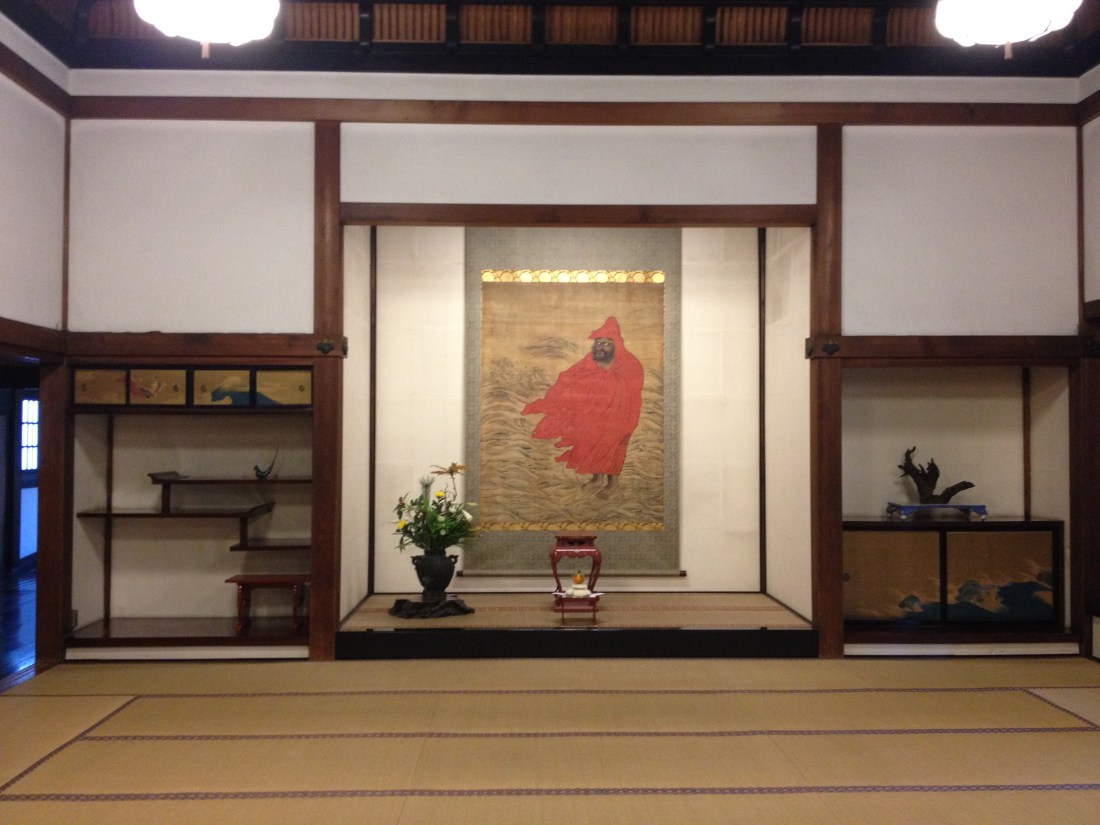
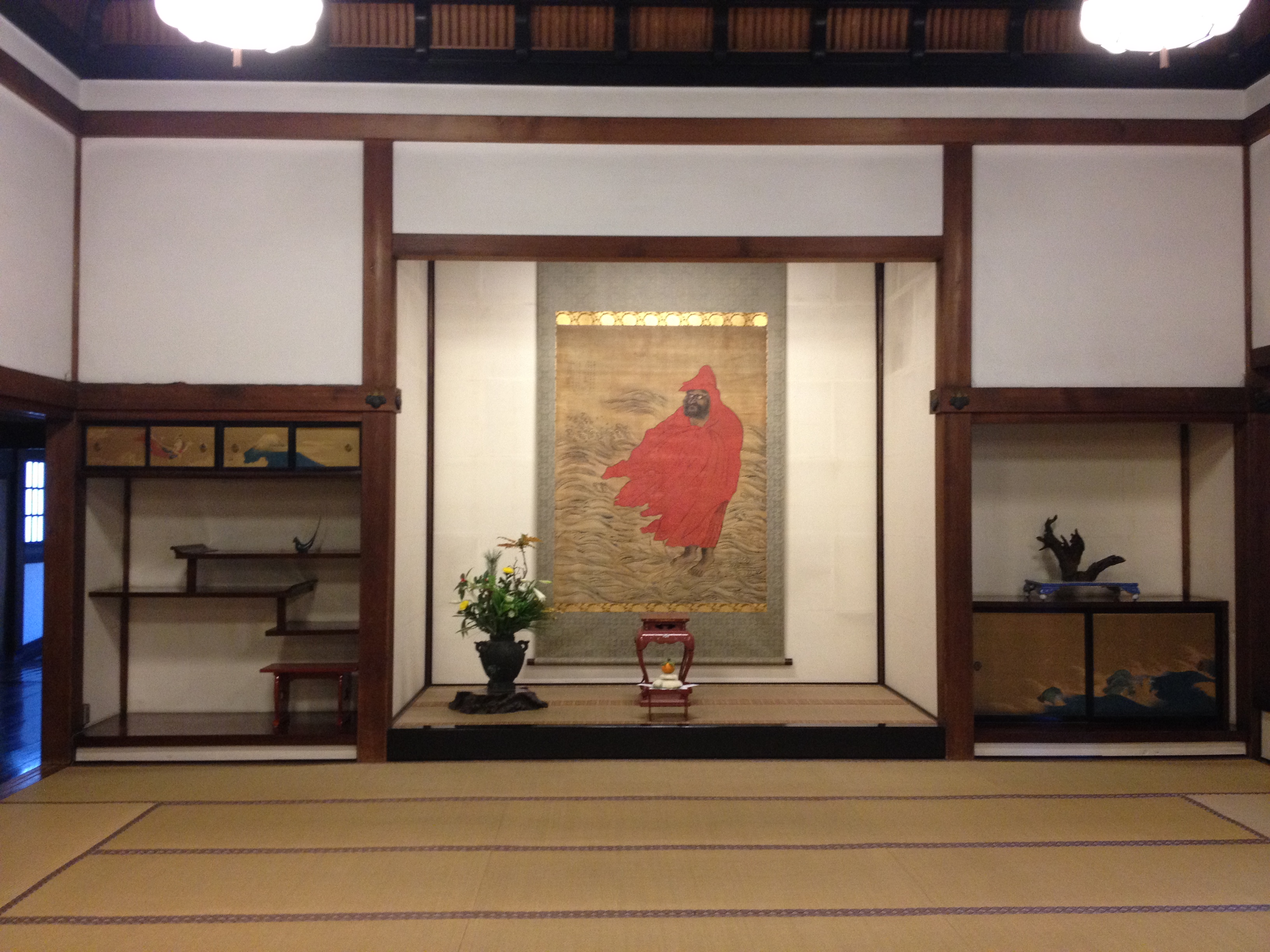
A painting of Bodhidharma at Sojiji temple (head of Soto Zen sect) in Kawasaki, Japan. Taken by me in 2010 (?).

The history up to this point is somewhat vague, and possibly apochryphal, but easy to follow.

This continues for a few more generations in China, until you get to a monk named Hui-Neng (Enō in Japanese)1 who is the supposed author of the Platform Sutra, a Chinese text. As the 6th “patriarch” of the lineage in China, he establishes what we know today as “Chan Buddhism” or Chinese Zen.

Things become more complicated a couple generations later as two descendants: Mazu Daoyi2 and Shitou Xiqian3 directly or indirectly found different schools of Chan Buddhism. This is known as the Five Houses of Chan period during the Tang Dynasty. Thus, the entire Chan/Zen tradition as we know it today is derived from Hui-neng and transmitted through these two men.

Out of the five houses, the Hongzhou,4 Lin-ji and Cao-dong5 all survive in some form. The others are gradually absorbed into the Lin-ji school, which in the long-run is what becomes the most widespread form of Chan Buddhism in China. The Cao-dong school is the one exception, while the Hongzhou school’s success in Korea helps establish 8 out of 9 of the “Nine Schools of Seon (Chan)”6 in Korea. It through Bojo Jinul’s efforts in Korea that these nine schools are unified into the Jogye Order (homepage) which absorbed other Buddhist traditions in Korea into a single, cohesive one.

Meanwhile, in Japan, the Lin-ji and Cao-dong schools find their way to Japan where the names are preserved, but pronounced different: Rinzai and Soto respectively. Rinzai’s history is particularly complicated because they were multiple, unrelated transmissions to Japan often spurred by the Mongol conquest of China. Of these various Rinzai lineages, the two that survive are the “Otokan” Rinzai lineage through Hakuin, and the “Obaku” lineage through Ingen, but eventually the Otokan lineage absorbed the Obaku lineage. Today, Rinzai Zen is more formally called Rinzai-Obaku, or Rinnou (臨黄) for short. This is a bit confusing because Rinzai came to Japan under a monk named Eisai, and his lineage did continue for a while in Japan especially in Kyoto, but the lineage from the rival city of Kamakura ultimately prevailed and absorbed other Rinzai lineages. Obaku Zen arrived pretty late in Japanese-Buddhist history, and as you can see from the chart has some common ancestry with Rinzai, but also some differences due to cultural divergence and history.

Soto Zen’s history is quite a bit more streamlined as it had only one founder (Dogen), and although it did grow to have rival sects for a time, Keizan was credited for ultimately unifying these though not without some controversy even into the 19th century.

Anyhow, to summarize, the entire tradition started from a legendary sermon by the Buddha to Maha-Kashyapa, and was passed on over successive generations in India to a legendary figure who came to China and starting with Hui-neng became a tree with many branches. Yet, the roots are all the same. Speaking as someone who’s relatively new to the tradition, I realize while specific liturgy and practices differ, the general teachings and intent remain the surprisingly consistent regardless of culture or label.

Hope this information helps!

P.S. I had trouble deciding which term to use here: Zen or Chan or Seon since they all literally mean the same thing, but are oriented toward one culture or another. If this all seems confusing, the key to remember is that the entire tradition of Zen/Chan/Seon (and Thien in Vietnam) is all one and the same tree.

P.P.S. I realized that I never covered the Vietnamese (Thien, “tee-ehn”) tradition, but there’s so little information on it in English (and I cannot read Vietnamese), that I will have to differ that to another day.

1 Pronounced like “hwey-nung” in English.

2 Pronounced like “ma-tsoo dow-ee” in English.

3 Pronounced like “shih-tow shee-chee-yen” in English.

4 Pronounced like “hohng-joe” in English.

5 Pronounced like “tsow-dohng” in English.7

6 The Korean word “Seon” is pronounced like “sawn” in English. It is how the Chinese character for Chan/Zen () is pronounced in Korean Language.

7 If you made it this far in the post, congrats! I had to put so many footnotes in here because the Pinyin system of Romanizing Chinese words is a little less intuitive than the old Wade-Giles system. Pinyin is not hard to learn. In fact, I think Pinyin is better than the old Wade-Giles system (more “what you see is what you get”), but if you don’t learn Pinyin it can be confusing.better This is always a challenge with a writing system that strictly uses ideograms (e.g. Chinese characters). How do you write 慧能 into an alphabetic system that foreigners can intuitively understand. Also, which foreigners? (English-speaking, French-speaking, Spanish-speaking, etc). Anyhow, if you are interested in learning Chinese, I highly recommend learning Pinyin anyway because it’s quick and easy to pick up. BTW, since I posted about Hokkien recently it also has two different Rominzation systems: Pe̍h-ōe-jī (old, but widespread) and Tâi-lô (Taiwan’s official revised system).

The Three Sacred Treasures of Japan

A few months ago, I touched on Japanese mythology and how it relates to the current Imperial family, but something I didn’t really cover were the three sacred treasures or Sanshu no Jingi (三種の神器).

These three treasures were said to be have been passed down to the first emperor of the Imperial family by their divine ancestor, Ninigi-no-mikoto. Some of these treasures are related to kami I mentioned in the mythology post and also represent ancient Japanese culture, even if their importance is more obscure now.

The three treasures are…

Kusanagi, the grass-cutting sword

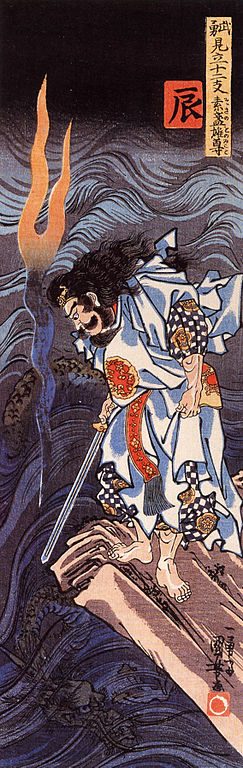
Woodblock print by Utagawa Kuniyoshi depicting Susano-o-no-Mikoto

The sword, kusanagi no tsurugi (草薙の剣), or “grass cutting sword”, was reputedly discovered by the kami Susano-o-no-Mikoto after he slew the massive serpent, Yamata-no-Orochi, embedded inside the monster’s tail. As I mentioned in the mythology post, Susano-o-no-Mikoto, the god of storms, was banished from the heavens, and while roaming the world he came upon a family that was preyed upon by the eight-headed serpent Yamata-no-Orochi. Susano-o-no-Mikoto battled the serpent and cut it into pieces. He found the tail too tough to cut up, and inside he discovered the sword, which he kept for his own.

The sword has a particularly checkered history as it was thought to have been lost at sea during the climatic battle between the Heike and Genji clans, but then is mentioned in accounts by people who have seen the sword centuries later. It’s not clear if the sword truly was lost, and a replica was made, or the sword was never actually lost at sea. In any case, the sword as it currently exists is stored in the Atsuta Shrine in Nagoya, Japan, and never revealed to the public. 

Another thing to note is that swords from that era are pretty different than the Japanese katana we normally think of. Swords in early Japanese history were thicker, straighter, similar to a Chinese jiàn sword.

Yata no Kagami, the Bronze Mirror

An array of polished bronze mirrors from Antiquity, taken by author at the Louvre in February 2024.

Mirrors in general are a sacred item in Japanese Shinto religion, and are often used in central altars, both at home (kamidana) and in major shrines, to represent the kami‘s presence. Originally, mirrors in Japan, China and beyond were made from polished bronze, but since have become replaced with polished silver, and/or glass.

The sacred mirror though is the bronze kind, and was said to be part of the legend surrounding the sun goddess Amaterasu-Ōkami, when she isolated herself. After a series of nasty arguments with her brother, Susano-o-no-mikoto (which later got him hockey out of Heaven, see above), she was fed up and retreated to a cave called the Ama-no-Iwayato (天岩屋戸). The world was plunged into darkness and all the other kami were distraught about what to do. They eventually hatched a plan to lure her out by pretending to have a party outside her cave as if nothing was wrong by her absence.

They hung a bronze mirror, the yata-no-kagami (八咫鏡), while the other kami engaged in wild song and dance. When the curious Amaterasu emerged, she was entranced by the mirror long enough that they grabbed her and sealed the cave, thus preventing her from hiding again.

During the aforementioned battle at sea between the Heike and Genji clans, the mirror was safely recovered.

Yasakani no Magatama

The final sacred treasure is an old magatama jewel called the yasakani no magatama (八尺瓊勾玉). Magatama jewels are something that were commonly used in very early Japanese history (later replaced by more Chinese style jewelry), so any such jewel tends to convey a sense of “primeval Japan”. Even in modern Japanese games, such as Zelda: Tears of the Kingdom, you see them prominently used to imply something of great power, but also great antiquity.

Queen Sonia wearing her magatama jewel around her neck. From Zelda: Tears of the Kingdom

Unlike the other two items, there is no particularly mythology associated with the jewel, instead it is a family heirloom, and is thought to have been passed down since the earliest days of the Imperial family. During the climactic battle between the Heike and Genji clans, the jewel and the sword were both thought lost, but later it is said the jewel was recovered.

P.S. featured photo shows the coronation of the previous emperor, the Heisei Emperor (Akihito), when the three sacred treasures were presented to him. The same ceremony was repeated by the current emperor. Photo by 首相官邸, CC BY 4.0, via Wikimedia Commons.

P.P.S. You probably noticed that kami names are quite long. These are often shortened for convenience in English, but this is somewhat inaccurate.

P.P.P.S. I started this post before my medical emergency, so it was nice to finally finish it. I have a few old drafts that are nearly done before I can move onto new content. 😏

Chanting The Kannon Sutra

Chapter 25 of the Lotus Sutra is a popular devotional text in East Asian Buddhism. It is often referred to as the “Avalokiteśvara Sutra”, or kannongyō (観音経) in Japanese, or more formally the kanzeon bosatsu fumonbongé (観世音普門品偈, “Chapter on the Universal Gate of Kanzeon Bodhisattva”).

Despite the name, it is not a stand-alone text, but simply a famous chapter in the larger Lotus Sutra. This particular chapter is the main introduction to one of the most popular Bodhisattvas in Buddhism: Avalokitesvara (Kannon in Japanese, Guanyin in Chinese, etc.). The chapter describes the attributes of Kannon that are familiar to Buddhists, such as their vows to help all beings who call on them, their ability to take on various forms to teach people, and their unwavering compassion to lead all beings to Enlightenment.

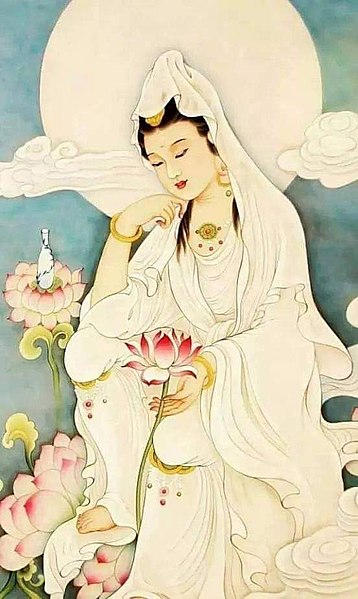
A more Chinese-style image of Kannon (a.k.a. Guan-yin) in her more motherly form, photo courtesy of Wikipedia.

The chapter as a whole is long and would be difficult to chant, so the verse section, not the narrative section, is frequently used for liturgical purposes. The Lotus Sutra often describes things in narrative form, then summarizes again in verse form. However, even the verse section alone is longer than the Heart Sutra, or the Shiseige, so just chanting the verse section is a bit challenging. In my experience it takes about 5-7 minutes.

For this reason, medieval Buddhists in Japan also devised an even shorter version called the Ten-Verse Kannon Sutra.

The sutra is frequently recited in both Zen and Tendai liturgies, among others, but it is not well known to Westerner lay-Buddhists. I had difficulty finding an online copy I could use as a reference here, even in Japanese, due to its length.

However, ages ago, I picked up a sutra book at the famous Sensōji temple in Tokyo, and once I figured out what the Kannon Sutra was, I copied it character by character to an old version of the blog, but then lost it later when I changed blogs. Recently, I was able to recover the text (not easily) from the original HTML I wrote, and posted it back on here with minor edits.

I have also provided a PDF version here if you want to print it out and use at home.

Also, special thanks to this website for providing much needed reference information on pronunciation and Chinese characters. My original, recovered text had a few errors, embarrassingly.

Examples

I found a few examples on Youtube that you can follow along if you are learning to chant the Kannon Sutra as shown below.

From Eiheiji temple (one of two home temples of Soto Zen). Note that they chant this at a pretty fast pace.
This example from Zenshoji Temple, a Shingon-sect temple, in Niigata Prefecture, has line by line annotation. The chanting pace is slower and easier to follow.

These examples are very similar, other than slight differences in pacing and pronunciation of certain Chinese characters. For people who are learning to recite the sutra, just pick what works until you get the hang of it.

Translation

I decided not to post the translation side-by-side with the text, the way I do with the Heart Sutra and such. This is due to formatting reasons on the blog, plus also length of the text makes this more difficult. I may revise this later.

For now, I highly recommend checking out a modern translation here by the excellent Dr Burton Watson. In that translation, the verse section starts after the phrase “At that time Bodhisattva Inexhaustible Intent posed this question in verse form“. The Buddhist Text Translation Society also has an excellent translation of the verse section here.

Disclaimer and Legal Info

I hereby release this into the public domain. Please use it as you see fit, but if you attribute it to this site, greatly appreciated. Also, please bear in mind this is an amateur work, and should not be taken too seriously.

Dedication

I dedicate this effort to all sentient beings everywhere. May all beings be well, and may they all attain perfect peace.

Namu Kanzeon Bosatsu

The Kannon Sutra, verse section

(2025 edition, with minor typo fixes)

Preamble

Original ChineseJapanese Romanization
妙法蓮華經
観世音菩薩 
普門品偈
Myo ho ren ge kyo
kan ze on bo satsu
fu mon bon ge

Verse Section

Original ChineseJapanese Romanization
世尊妙相具
我今重問彼 
佛子何因縁
名為観世音
Se son myo so gu 
ga kon ju mon pi
bus-shi ga in nen
myo i kan ze on
具足妙相尊
偈答無盡意 
汝聴観音行
善応諸方所
gu soku myo so son
ge to mu jin ni
nyo cho kan on gyo
zen no sho ho jo
弘誓深如海
歴劫不思議 
侍多千億佛
発大清浄願
gu zei jin nyo kai
ryak-ko fu shi gi
ji ta sen noku butsu 
hotsu dai sho jo gan
我為汝略説
聞名及見身 
心念不空過
能滅諸有苦
ga i nyo ryaku setsu
mon myo gyu ken shin
shin nen fu ku ka
no metsu sho u ku
假使興害意
推落大火坑 
念彼観音力
火坑変成池
ke shi ko gai i
sui raku dai ka kyo
nen pi kan on riki
ka kyo hen jo ji
或漂流巨海
龍魚諸鬼難 
念彼観音力
波浪不能没
waku hyo ru go kai
ryu go sho ki nan
nen pi kan on riki
ha ro fu no motsu
或在須弥峰
為人所推堕 
念彼観音力
如日虚空住
waku zai shu mi bu
i nin sho sui da
nen pi kan on riki
nyo nichi ko ku ju
或被悪人逐
堕落金剛山 
念彼観音力
不能損一毛
waku bi aku nin jiku
da raku kon go sen
nen pi kan on riki
fu no son ichi mo
或値怨賊繞
各執刀加害 
念彼観音力
咸即起慈心
waku ji on zoku nyo
kaku shu to ka gai
nen pi kan on riki
gen soku ki ji shin
或遭王難苦
臨刑欲寿終 
念彼観音力
刀尋段段壊
waku so o nan ku
rin gyo yoku ju shu
nen pi kan on riki
to jin dan dan ne
或囚禁枷鎖
手足被杻械 
念彼観音力
釈然得解脱
waku ju kin ka sa
shu soku bi chu gai
nen pi kan on riki
shaku nen toku ge datsu
呪詛諸毒薬
所欲害身者 
念彼観音力
還著於本人
shu so sho doku yaku
sho yoku gai shin ja
nen pi kan on riki
gen jaku o hon nin
或遇悪羅刹
毒龍諸鬼等 
念彼観音力
時悉不敢害
waku gu aku ra setsu
doku ryu sho ki to
nen pi kan on riki
ji shitsu bu kan gai
若悪獣圍繞
利牙爪可怖 
念彼観音力
疾走無邊方
nyaku aku shu i nyo
ri ge so ka fu
nen pi kan on riki
jis-so mu hen bo
蚖蛇及蝮蠍
気毒煙火燃 
念彼観音力
尋聲自回去
gan ja gyu fuku katsu
ke doku en ka nen
nen pi kan on riki
jin sho ji e ko
雲雷鼓掣電
降雹澍大雨 
念彼観音力
応時得消散
un rai ku sei den
go baku ju dai u
nen pi kan on riki
o ji toku sho san
衆生被困厄
無量苦逼身 
観音妙智力
能救世間苦
shu jo bi kon yaku
mu ryo ku hitsu shin
kan on myo chi riki
no ku se ken ku
具足神通力
廣修智方便 
十方諸国土
無刹不現身
gu soku jin zu riki
ko shu chi ho ben
jip-po sho koku do
mu setsu fu gen shin
種種諸悪趣
地獄鬼畜生 
生老病死苦
以漸悉令滅
shu ju sho aku shu
ji goku ki chiku sho
sho ro byo shi ku
i zen shitsu ryo metsu
真観清浄観
廣大智慧観 
悲観及慈観
常願常瞻仰
shin kan sho jo kan
ko dai chi e kan
hi kan gyu ji kan
jo gan jo sen go
無垢清浄光
慧日破諸闇 
能伏災風火
普明照世間
mu ku sho jo ko
e nichi ha sho an
no buku sai fu ka
fu myo sho se ken
悲體戒雷震
慈意妙大雲 
澍甘露法雨
滅除煩悩燄
hi tai kai rai shin
ji i myo dai un
ju kan ro ho u
metsu jo bon no en
諍訟経官処
怖畏軍陣中 
念彼観音力
衆怨悉退散
jo ju kyo kan jo
fu i gun jin chu
nen pi kan on riki
shu on shitsu tai san
妙音観世音
梵音海潮音 
勝彼世間音
是故須常念
myo on kan ze on
bon on kai jo on
sho hi se ken on
ze ko shu jo nen
念念勿生疑
観世音浄聖 
於苦悩死厄
能為作依怙
nen nen motsu sho gi
kan ze on jo sho
o ku no shi yaku
no i sa e go
具一切功徳
慈眼視衆生 
福聚海無量
是故応頂礼
gu is-sai ku doku
ji gen ji shu jo
fuku ju kai mu ryo
ze ko o cho rai

Conclusion

Original ChineseRomanization
爾時持地菩
薩即從座起
前白佛言世
尊若有衆生
ni ji ji ji bo
sa soku ju za ki
zen byaku butsu gon se
son nyaku u shu jo
聞是観世音
菩薩品自在
之業普門示
現神通力者
mon ze kan ze on
bo sa bon ji zai
shi go fu mon ji
gen jin zu riki sha
當知是人功
徳不少佛説
是普門品時
衆中八萬四
to chi ze nin ku
doku fu sho bus-setsu
ze fu mon bon ji
shu ju hachi man shi
千衆生皆發
無等等阿耨
多羅三藐三
菩提心
sen shu jo kai hotsu
mu to do a noku
ta ra san myaku san
bo dai shin

In the coming weeks, I hope to post a couple more such chants from the Lotus Sutra, as they are popular both in Tendai and Nichiren communities in particular, and I am learning to chant these too.

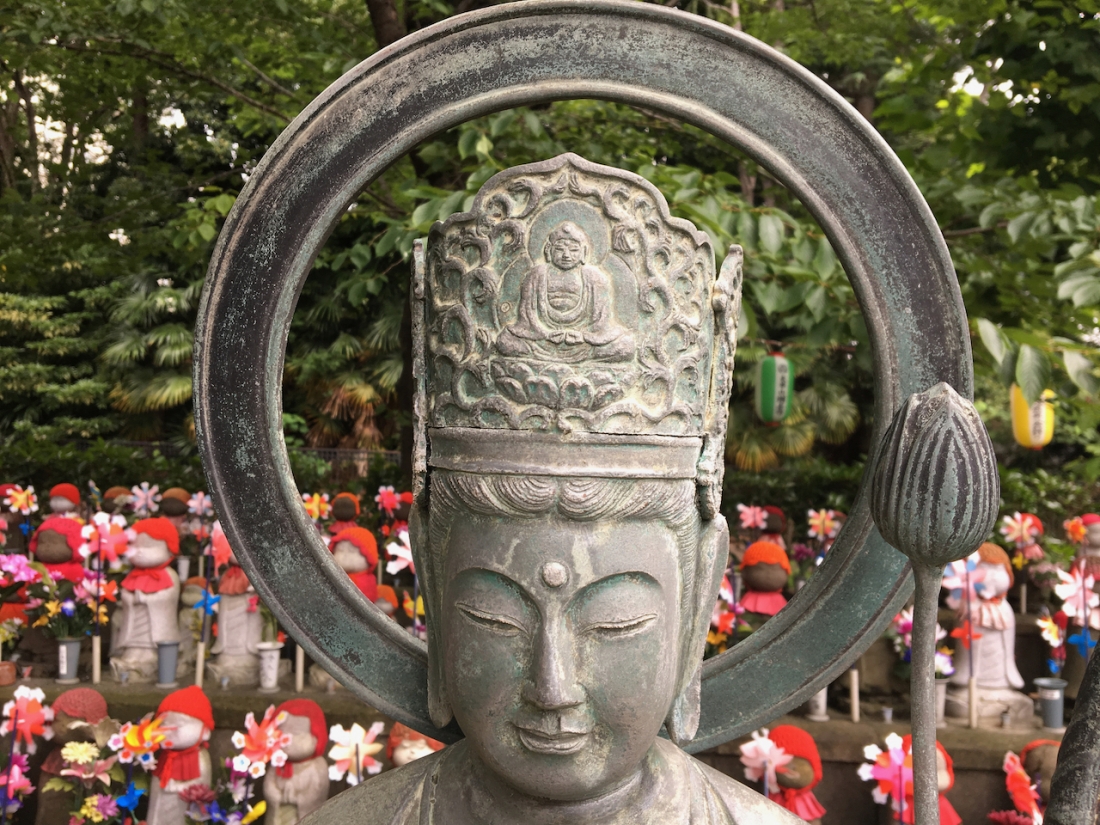
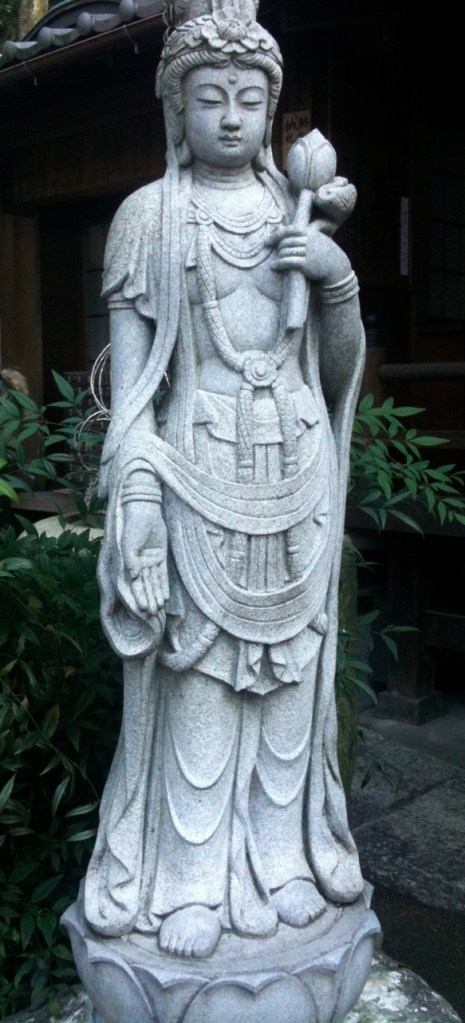
P.S. Featured photo was taken by me at Zojoji temple in Tokyo, Japan, with an image of Kannon Bodhisattva wearing a crown that features an image of Amitabha Buddha.

The Joseon Dynasty of Korea: death by factions

If political gridlock, government shutdowns due to budget fights, and rabid factionalism get you down, consider the case of the Joseon Dynasty of Korea (1392–1894). The Joseon Dynasty, also known as Joseon-guk in Korean (朝鮮國, 조선국) was the last and longest of royal dynasties of Korea. At 502 years long, it is also among the longest dynasties in world history.

After the rise of Buddhism in East Asia, Confucian teachings took a backseat for a time, until it re-emerged centuries later under a doctrine called Neo-Confucianism. Neo-Confucianism is a fascinating subject all by itself, but it’s a hard one to describe to Western audiences. It’s enough to know that it was an effort to reinforce early Confucian ethics with more philosophy and metaphysics, while avoiding mysticism.

This is important because Neo-Confucianism became the official state doctrine early the foundation the Joseon Dynasty, just as it had become Ming-Dynasty China and Tokugawa-era Japan. Schools of Confucian scholars would staff the elaborate bureaucracies used by each sovereign, and provide advice on policies, or criticism if the sovereign’s conduct was deemed inappropriate or immoral. As the beacon of a rational and orderly society, the sovereign was held to a very high standard, but also (in theory) commanded unwavering loyalty from his subjects. Because orderly and rational societies were valued by Confucian thinking, there was heavy emphasis on ritual, etc. Everyone had their place, and everyone was expected to carry out their moral obligations, putting the needs of society over their own profit.

On paper, this was how it all worked.

In reality, the Confucian bureaucracy (the yangban) of Korea grew very powerful, and different schools of Confucian thought began to compete with one another for dominance in the Joseon bureaucracy. Over generations, these rivalries grew very cutthroat, and worse they splintered into sub-factions, and sub-sub-factions, all vying with one another. Further, sons of bureaucrats had the wealth and resources necessary to ensure they’d pass the civil service exams and become bureaucrats themselves. The Iron Law of Oligarchy comes to mind.

Source: https://xkcd.com/1095

This might seem kind of silly at first glance, since it obviously contradicted basic Confucian ethics.

However, this all began when bureaucrats in the court would debate how to address policy issues at the time, or question certain political appointments. Inevitably reform and conservative wings developed with different views of how to address such issues, and the leading figures of each wing would try to then pack the bureaucracy with their own men.

Is this starting to sound familiar?

The back and forth by factions, starting with the Easterners (dong-in, 동인 or 東人) and Westerners (seo-in, 서인 or 西人) began over subtle ideological disagreements. Then, each of these factions broke up into different factions. The Westerns faction alone broke up into the Noron (노론, 老論) and Soron (소론, 少論) depending on whether you supported Confucian scholar Song Si-yeol‘s reformist policies (the Noron) or not (the Soron). The Easterner faction similarly split up into Buk-in (“northerners”, 북인, 北人) and Nam-in (“southerners”, 남인, 南人) factions.

The king’s response to each of these factions varied by sovereign. In some cases, a king would support one faction over another. But if that faction got too powerful or out of line, the losing faction could sometimes convince the king to purge them from the bureaucracy. Sometimes the purges became extremely violent, with many faction members executed such as the one in 1589.

Inevitably, once a faction was crushed or purged, another would take its place in the court and consoldiate power, requiring yet another purge. By 1545 there had already been four blood purges.

Portrait of King Yeongjo of Joseon, source

By the time of King Yeongjo (1694 – 1776, 영종, 英宗) the fighting between factions and the bloody purges had gotten so out of hand, that Yeongjo survived an assassination attempt in his youth.

Yeongjo tried to take the high-ground in the conflict, implementing a policy of Tangpyeong (탕평, 蕩平) or “great harmony”. Yeongjo tried to stay above the fray and remained somewhat successful. Barely. By the reign of the next king, his grandson Jeongjo, the bureaucrats were at it again and King Jeongjo fought off a coup by the Noron faction.

In spite of the coup, the Noron dominates the court after Jeongjo’s later (and mysterious) death until they were ousted for good, but by this time the functions of government were locked in by certain powerful families and from the 1800’s onward the Joseon became isolationist and dysfunctional at a time when Western and Japanese powers grew in strength and aggression. The reforms of 1895 were simply too little too late to save the Dynasty and Korea was annexed by Iapan in 1905.

Much like the Eastern Roman Empire (i.e. the Byzantines), the Joseon Dynasty survived and thrived at times when there was a powerful ruler who could push for reforms, and keep interests in check. But there were always sharks circling the water, and as soon as they smelled weakness there would be bloody infighting and this would reset the clock on any meaningful reforms. Paralyzed by internal strife, other more dynamic, external powers eventually pulled ahead and defeated them.

Portrait of Kim Yuk (1570 – 1658), source.

It also should be noted that were plenty of good, sincere Confucian scholars who made a genuine effort at good governance, such as Kim Yuk, but in the end, powerful men always felt they could do it better when they sensed an opportunity.

P.S. astute readers may have noticed that I keep posting the names using both Hangeul script and Chinese characters (Hanja). Until the modern era, both were used together in a kind of mixed fashion, especially when a person wanted to avoid ambiguity (the Chinese characters are more distinct). Compared to neighbors like Japan or China, Chinese characters were used comparatively less (Hangeul was usually sufficient and simpler), but remain an important part of the language and culture.

Kannon: the Genderfluid Bodhisattva

Kannon Bodhisattva (観音菩薩), also known by such names as Guan-Yin, Chenrezig, Avalokiteshvara, and so on, is one of the most popular bodhisattvas in all of Buddhism, and whose devotion cuts across many sectarian lines, but Kannon is also one of the most difficult figures in Buddhism to explain to someone who is not a Buddhist.

Older English translations describe Kannon as the Goddess of Mercy, but this is pretty far off the mark. First, bodhisattvas are not gods, though they are high revered figures in Buddhism.

Second, Kannon is somewhat unusual in how he/she is very fluid in gender.

The main Buddhist text that introduces Kannon is the 25th chapter of the Lotus Sutra. This chapter is sometimes colloquially known as the “Kannon Sutra“. In this sutra, it describes how Kannon takes whatever form is necessary to teach and inspire another being. Considering the following passage:

If they need a rich man to be saved, immediately he becomes a rich man and preaches the Law [the Buddha-Dharma] for them.

If they need a householder to be saved, immediately he becomes a householder and preaches the Law for them.

If they need a chief minister to be saved, immediately he becomes a chief minister and preaches the Law for them.

If they need a Brahman [a priest] to be saved, immediately he becomes a Brahman and preaches the Law for them.

If they need a monk, a nun, a layman believer, or a laywoman believer and preaches the Law for them.

If they need the wife of a rich man, of a householder, a chief minister, or a Brahman to be saved, immediately he becomes those wives and preaches the Law for them.

Translation by Burton Watson

Because of the fluidity of Kannon’s identity, he/she is portrayed different across many Buddhist cultures, and even in the same Buddhist culture under different forms.

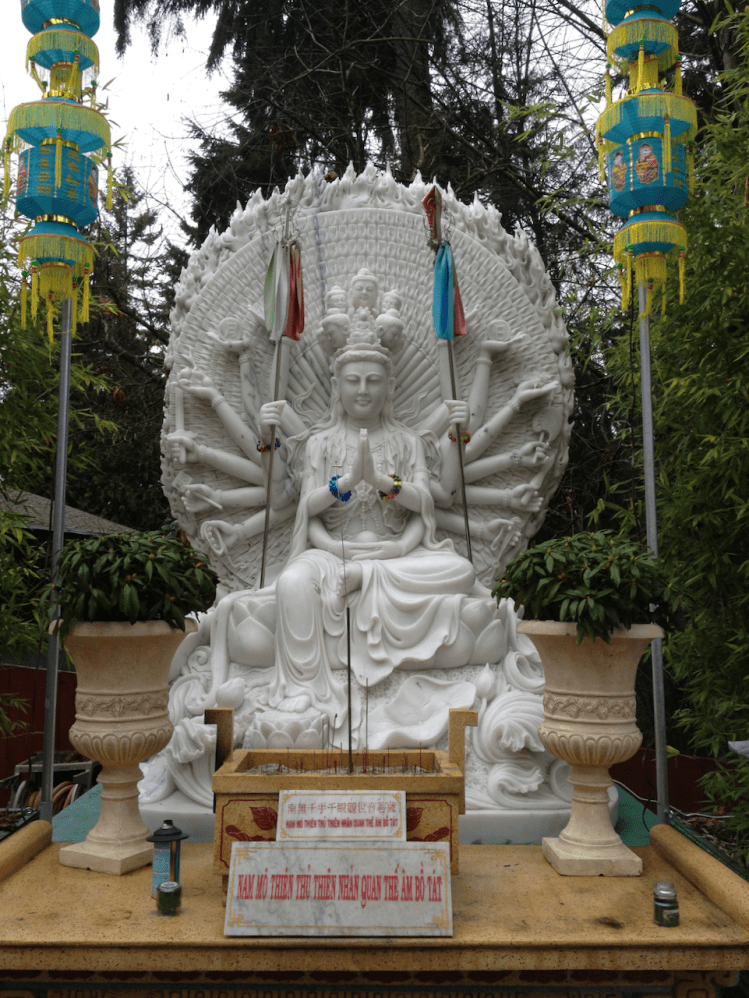
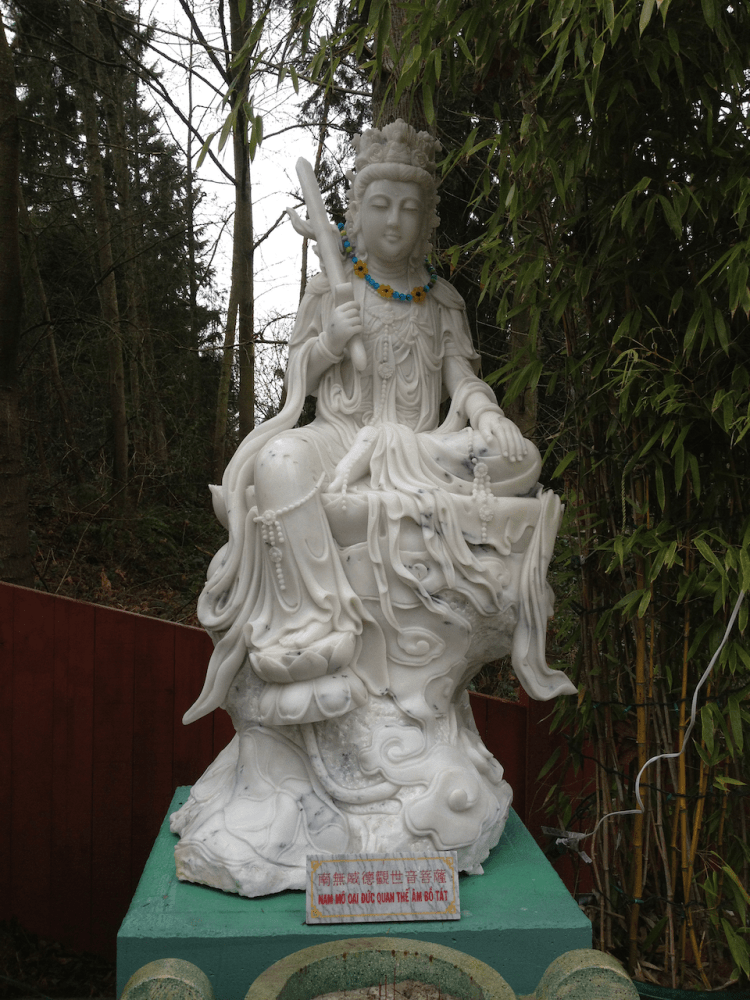
For example, when visiting a certain Vietnamese Buddhist temple near my home, I took a couple different photos of Kannon:

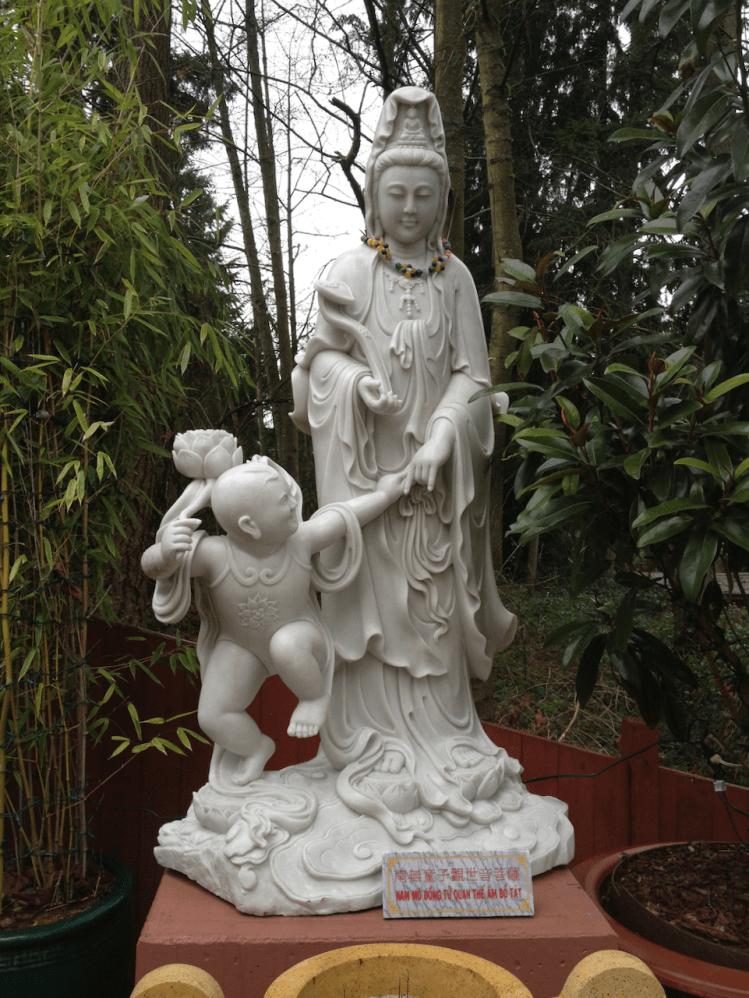
The picture on the left shows a more princely Kannon with 1,000 arms, each holding a different object. This version of Kannon symbolizes the countless ways and means of helping sentient beings. The statue of Kannon in the middle is a more masculine form symbolizing virtue and authority. Notice the sword. And finally, the picture on the right, depicts Kannon in a more motherly form, an embodiment of compassion. This final form, popularly depicted in Chinese culture is probably what gave rise to the notion of the “goddess of mercy” in English, despite its imprecise nature.

As we see in the Lotus Sutra, these are just some of the many forms Kannon Bodhisattva takes to inspire, teach and lead sentient beings to Awakening.

Namu Kanzeon Bosatsu

P.S. The 25th chapter of the Lotus Sutra is also thought to be the source of an even shorter devotional called the Ten Verse Kannon Sutra.

Korean Fan Poem

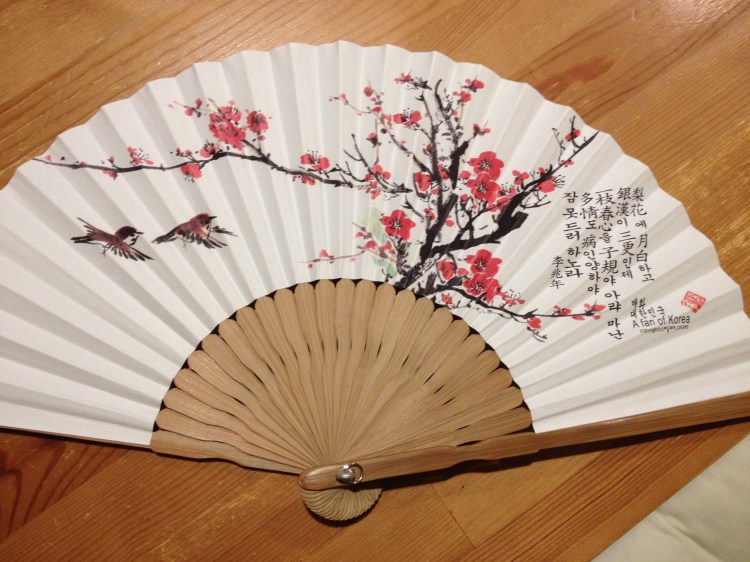
I don’t get to talk about Korean culture and literature every often, but a few years back I had a pretty hard-core KPop phase (SNSD, 2NE1, Brown Eyed Girls, etc). Coincidentally, one of my friends is Korean, one time she sent me this cool fan one time during her last trip home:

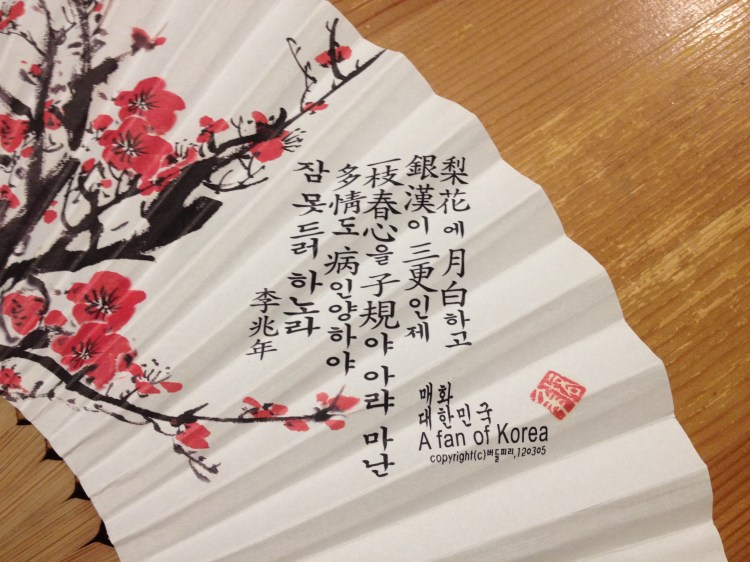
If you look carefully, the fan has a poem written on it that mixes Korean hangeul script and Chinese characters:

I got curious and did some investigating on what this poem was, translations, etc., and it turns out that this is a famous poem in Korea by Yi Jo-Nyeon (이조년, 李兆年, 1269∼1343) and utilizes a kind of popular poetic form called a sijo, a popular form of Korean poetry comprising of three lines of verse. Sadly, there is no English article about him on Wikipedia, but there is one in Korean.

Also, I found a translation here.

So, without further ado, here’s the poem on the fan, with the original text (with hangeul in parantheses, just like the fan), pronunciation and translation:

Original Text
(hangeul pronunciation in parentheses)
RomanizationTranslation
梨花(이화)에 月白(월백)하고 銀漢(은한)이 三更(삼경​​)인 제I-hwa e weol-baek hago eun-han i sam-gyeong injePear flowers illume moon-white, a galaxy in midnight
一枝春心(일지춘심)을 子規(자규)야 알랴 마난Ilji chunshim eul jagyu ya alrya mananThe sentiments of spring on that branch, does the cuckoo know?
多情(다정)도 病(병)인양 하여 잠 못 들어 하노라Dajeong do byeong inyang hayeo jam mot deuleo hanoraI sleep fitfully for this sickness, this tenderness of heart.
Translation by Jungmin Bae at https://cagibilit.com/in-translation-pear-flowers-illume-moon-white/

Pretty nice poem actually, and now you know some famous Korean poetry!

Korean Buddhist Rosary

Some years ago, a Korean friend traveled back home to see family and then brought back some gifts to us. For me, knowing I was a Buddhist (she is Catholic), she brought me this: a Korean-style Buddhist rosary.

I’ve written about Buddhist rosaries before, but in a Japanese context, so this is somewhat new to me. I don’t know if this is typical of most Korean Buddhists, or just tourists, but this rosary is interesting for a couple reasons.

First, if you look carefully, the beads have Chinese characters written on them. In fact, this is the text of the Heart Sutra written in Classical Chinese with different verses on each bead, read clockwise starting from left of the larger bead.

Speaking of the larger bead, it has Sanskrit lettering on it in red, which spells “om” as in the verse used for chanting. I think that this is written in Siddham script, but I might be wrong.

Finally this little rosary has one extra little surprise: the large bead in the middle opens up to reveal a tiny Buddhist statue!

It’s hard to be 100% certain who this is, but I believe it is Avalokitesvara Bodhisattva since he/she is the main speaker in the Heart Sutra. Anyhow, it’s a nice thought to be carrying Avalokitesvara around wherever I go.

Sadly, I don’t wear this too often. As with many Buddhist rosaries made in Asia, it is just a bit too tight on my wrist and gradually cuts off circulation. I have rarely found one that fits me, even when friends make one to custom order. So, sadly, it sits in its box except for special occasions when I wear it.

In any case for such a small rosary, it has a lot of neat stuff on it (and in it), and a nice way to see how religion is practiced in neighboring cultures.