Dragon Ball is a fun series because it blends a lot of Japanese-Chinese mythology, especially the early series, into a futuristic storyline. Goku is obviously based off of the famous legend of the Monkey King, Sun Wukong (Son Goku in Japanese). Another great example is the character Enma.
In Dragon Ball, Enma (sometimes spelled “Yemma” in English) presides the realm of spirits and behaves like a modern bureaucrat. In spite of the suit and tie, this Enma is definitely based on the original figure in Japanese mythology, named Enma Daiō (閻魔大王, “Great King Enma”).
The original Enma is a fascinating example of a “fusion” mythology, not a native Japanese one. Enma is originally based on the Hindu god Yama, lord of the dead.2 However, in China he was transformed into a Confucian-style bureaucrat and shoe-horned into Buddhist cosmology as a judge of the dead. Enma, along with other judges, determine the dead’s next destined rebirth within Buddhist cosmology. During certain Chinese funerary practices and festivals, you can see his visage on “ghost money” used to help the dearly departed coast through the trial process and ensure a smooth, lenient transition to their next life.
This Enma, a bureaucrat / judge of the dead, was how it was imported to Japanese culture in antiquity. He is even featured in classics such as the Tales of the Heike. When the warlord Taira no Kiyomori is dying from a terrible fever, he has a vision of Enma and his demonic attendants awaiting him. I’ve also heard of an old tradition where parents in Japan would scold their kids saying Enma would pull their tongue out if they told a lie. I have never heard this first-hand though, so I wonder if anyone ever says it anymore.
Anyhow, Dragon Ball’s spin on Enma, Goku and others is a fun look at Chinese-Japanese mythology, for a modern era.
RIP Toriyama Akira 🙏🏼
P.S. this post was also inspired after watching the Star Trek: Voyager episode “Barge of the Dead”. It’s a fun look at the Klingon afterlife.
1 growing up in the 1980’s my obsession at the time was Akira, which I still enjoy from time to time. 😄
2 if you ever pick up the book Lord of Light by Roger Zelazny, a wonderful blend of Hindu mythology and ultra-futuristic science-fiction with a lot of sass thrown in, the Yama depicted in that novel is quite an interesting character.
There is a persistent image in the West of samurai being adherents of Zen, that the “way of the warrior” (bushido)1 and Zen are somehow one and the same. One can imagine a samurai who has practiced swordsmanship to a finely honed skill, meditating under a waterfall, and writing Zen-like deathbed poetry before preparing to throw away their life in battle. In my first visit to Ryoanji temple (featured photo shown above), 28-year old me had a similar image in mind persisting all the way back when I was a naïve 16-year old white kid just reading about Zen for the first time. Looking back after almost 20 years of Buddhist-study and practice, I facepalm at myself a little, but it’s a very persistent image in media. (side note: Last Samurai is not my favorite movie)
So, did samurai really embrace Zen, and was Zen essentially a “samurai religion”? Turns out, it’s complicated, and most of the imagery was romanticized.
Even at the height of its influence in the last fourteenth century, Zen–including the more widely diffused Sōtō Zen–probably had still not replaced devotion to Kannon, Jizō [Bodhisattva], the Lotus Sutra [e.g. Nichiren Buddhism], or the Pure Land of Amida in the hearts of most ordinary, and many high-ranking, Japanese samurai.
page 80
Further:
Zen in the Kamakura and Muromachi periods can be called “the religion of the samurai” only in the sense that most patrons of Zen were samurai, not in the sense that it was practiced assiduously or exclusive by all, or even perhaps the majority, of those who would be described as warriors.
page 80
So where did the image come from? Let’s take a brief look at the history of Zen, especially Rinzai Zen, in Japan.
The Two Lineages of Zen in Japan
Japan has historically two sects of Buddhism, both descended from Chinese lineages: Soto and Rinzai Zen. The differences between the two are too big to cover here, and there’s plenty of information on the web that explore the two. Suffice to say, the two lineages came to Japan in the 12th century, but took pretty different trajectories.
Soto Zen, founded by Dogen after journeying to China, did not sit well with existing powerful Buddhist sects in Japan, because of Dogen’s unwavering commitment to his ideal of ideal Zen practice, and was pushed out to the countryside. For centuries it was obscure, and enjoyed little patronage beyond certain local samurai families, primarily for the sake of prestige. Its popularity grew later through the efforts of a monk named Keizan, who developed increasing patronage from (mostly) provincial samurai rulers, and cultivated more community support. Professor Bodiford’s book, Sōtō Zen in Medieval Japan, is an excellent overview of its history. In any case, all Soto Zen traditions in Japan (and beyond) trace back to Dogen.
Rinzai Zen, founded by Eisai, has a much more complicated history. Eisai was willing to compromise more when he returned from China with the Buddhist establishment, so early Rinzai Zen was more like a hybrid Zen-Tendai Buddhist institution with a lot of esoteric practices. It enjoyed further popularity under Enni Ben’en (圓爾辯圓, 1202 – 1280) in the capitol of Kyoto, but remained a relatively small sect, often conflated with existing Buddhist institutions at the time.
Zen really didn’t take off until the second-half of the Kamakura Period under the Hojo Clan regency. After the death of Sanetomo, the 3rd shogun, the subsequent shoguns, distant offshoots of the family, were installed but increasingly powerless against their own regents, the Hojo Clan. Under talented Hojo leaders such as Hojo Tokiyori and Tokimune, power was consolidated, and they became the effective rulers of Japan.
But there was a persistent issue: the Hojo Clan, while militarily powerful and based in Kamakura was seen as inferior to the old aristocracy (e.g. the Fujiwara) in Kyoto who had centuries of refinement to rely upon compared to the upstarts. The old Buddhist establishment was still closely allied to the aristocracy, and thus hostile to the Hojo Clan.
Enter the Mongols
When the Mongols finally destroyed the Song Dynasty in China, establishing the new “Yuan” Dynasty, the upheaval affected many monastic institutions. Some monks, including ardent Song-loyalists, decided to leave China and make the journey to Japan either to get away from Mongol authority, or possibly in some cases, to work as spies for the Mongols who later tried to invade Japan.
Starting with a monk named Lanxi Daolong (蘭溪道隆, 1213-1278), who came to Japan in 1246 for reasons not entirely clear, followed by Wuan Puning (兀庵普寧, 1197 – 1276) in 1260, a steady stream of Rinzai-lineage monks came to Japan. For the Hojo leadership, this new source of Chinese education, culture and religious teachings practically fell into their lap, and they quickly adopted these new monks, establishing a series of monasteries in the new capital of Kamakura starting with Kenchōji (website here) in 1253, and expanding to other temples such as Engaku-ji in 1282. These new temples in Kamakura Zen temples were different than the ones that Eisai and Enni Ben’en’s temples had established in Kyoto, designed to match Song Dynasty practices, with Chinese monks frequently serving as abbots.
Thus, Rinzai Zen in Japan was essentially established as two separate lineages2 albeit with a common ancestry: the first lineage established by Eisai and popularized in Kyoto by Enni Ben’en that incorporated more native Japanese-Buddhist practices, and the second lineage which came later driven by Chinese Zen monks during the end of the Song Dynasty who established a more “pure” form of Zen based on the Chinese model. It should be noted that the Chinese monks mentioned above did journey to Kyoto as well to update existing monasteries of the older lineage to modern (e.g. Song Dynasty) standards as well, but the temple of Kenchōji was the premiere Zen temple for centuries in Japan. Further, by the 14th century, and especially later, much of Rinzai Zen was more homogenized than the early communities.
The arrival of the Chinese-Buddhist teachers to Japan in the 13th century is important to note, though, because this is the point in time where the samurai class really start to interact with Zen communities.
The Hojo Clan had finally found a way to one-up their rivals in Kyoto by raising their own cultural credentials with the new immigrants from China, but also some Hojo family members really did embrace Rinzai Zen teachings. Hojo Tokiyori (北条 時頼, 1227 – 1263) and his son, Tokimune (北条 時宗, 1251 – 1284) both became avid students under Chinese teachers, patronized the new monastic communities in Kamakura, and encouraged its practice among their samurai vassals. Other regents of the Hojo Clan never took much interest. But now, Zen finally had the patronage it needed to expand and grow in Japan, yet as Collcut’s book shows, it was still largely adopted for cultural prestige, and also oftentimes due to obligation towards Hojo Clan. Many of these vassal clans later rose to be major powers centuries later (cf. Hosokawa, Takeda, Uesugi, Tokugawa, etc) with their own patronage to Zen temples in their provinces.
Later, as the Hojo Clan finally declined in power, and gradually replaced by the Ashikaga Clan (e.g the Muromachi Period), the pattern continued. Both the emperors of the time such as Go-Daigo and Hanazono, and the Ashikaga Shoguns patronized Rinzai Zen temples, but often times for political expediency. The “Five Mountains” monastic system developed at this time, borrowed from Chinese cultural, is a big topic, and worthy of its own post.
The high-point of “Zen-Samurai” culture as we know it can probably be traced to the 8th shogun of the Ashikaga Clan, Yoshimasa (足利 義政, 1436 – 1490) who while being a dismal military commander, was a brilliantinnovator of Zen aesthetics. Yoshimasa had a taste of artistic genius, and patronized Zen-influenced architecture, painting, poetry, and gardening, and so on, but also directly added his own spin. The “zen aesthetic” we all recognize is largely due to Yoshimasa who synthesized earlier Song-Dynasty culture through establishment of institutions by the Hojo Clan.
However, on a personal level, Yoshimasa recited the nembutsu and seldom meditated.
Conclusion
All this is not meant to detract from Zen teachings, or the contributions of Zen monks to Japanese culture, or to imply that there were no Zen-devotees among the samurai class, but as I alluded to in the beginning, the romanticized Zen-Samurai image mostly exists on paper or in the writings of its sincere devotees. It was the ideal at the time among enthusiasts, and this ideal has persisted into Western culture, including teachers and self-help gurus.
How samurai in Japan, or Japanese in general, interacted with Buddhism (including Zen) was complicated and very individual, and not always related to piety. When you look at other pre-modern cultures, you see similar patterns. The emperors of the Eastern Romans had a complex relationship with the Church, and usually were not interested in the deeper teachings, or various doctrinal conflicts of the Byzantine Orthodox church except when it interfered with political goals (cf. iconoclasm, schisms, etc), or were varying degrees of sincerity. Further, how they practiced religion would have been noticeably different than your typical Eastern Roman in the provinces or the streets of Byzantium.
Now, imagine the same in any other culture: Western medieval communities, people in the Islamic caliphate, Chinese Buddhists, etc.
In short, how people interact with religion, and how its romanticized, are two different things. The dynamic interaction of people, culture and religion is fascinating, but not very marketable. The romanticized form of religion is marketable, but is like a bag of potato chips: tastes good, but rarely provides anything meaningful.
1 Please, please, please: if you ever go visit Japan, do not wear a “bushido” shirt. It really pegs you as a tourist.
2 The third “Obaku” sect of Zen in Japan is in fact yet another Rinzai Zen lineage that came from China, this time from the Ming Dynasty. By this point, Pure Land Buddhism and Zen in China had largely reconciled, and Obaku Zen includes more elements of Pure Land than is found in other Rinzai lineages, while still retaining its core Zen element.
Recently I stumbled upon a neat bit of Buddhist liturgy in the Rinzai Zen tradition called the Hakuin Zenji Zazen Go-Wasan (白隠禅師坐禅御和讃), or more simply the Zazen Wasan (坐禅和讃). This means “The Hymn of Zazen [of Zen Master Hakuin]”. In English it is sometimes called the “Song of Zazen”.1
Rinzai Zen is a somewhat unusual sect in Japanese Buddhism because although it was founded in the 12th century by Eisai (栄西, 1141 – 1215, alternatively called “Yosai”), and flourished for centuries alongside other Buddhist sects, the Rinzai Zen we know today is due in large part to the 18th century Zen master Hakuin (白隠, 1686 – 1769). We might think of Hakuin as a kind of reformer, or second founder.
The Hymn of Zazen is an exposition of Hakuin’s beliefs, the virtues of zazen meditation practice (especially compared to other Buddhist practices), and the nature of one’s own mind. It is regularly recited as part of Rinzai Buddhist liturgy as shown below:
Since I have a copy in Japanese, I decided to post here as a reference for others. I’ve posted the text in the original Japanese with Romanized (e.g. romaji) text. I am using the excellent translation by Robert Aitken Roshi as well, originally found here, and some proof-reading of the Japanese text using this site.
Japanese
Romanization
Translation
衆生本来仏なり水と氷のごとくにて
Shujō honrai hotoké nari mizu to kōri no gotoku ni te
All beings by nature are Buddha, as ice by nature is water;
水を離れて氷なく衆生の外に仏なし
Mizu wo hanarete kōri naku shujō no hoka ni hotoké nashi
Apart from water there is no ice, apart from beings no Buddha.
衆生近きを不知らずして遠く求むるはかなさよ
Shujō chikaki wo shirazu shite tōku motomu hakanasayo
How sad that people ignore the near and search for truth afar,
譬ば水の中に居て渇を叫ぶがごとくなり
Tatoeba mizu no naka ni ite katsu wo sakebu gotoku nari
Like someone in the midst of water crying out in thirst,
長者の家の子となりて貧里に迷うに異ならず
Chōja no ié no ko to narite hinri ni mayō ni kotonarazu
Like a child of a wealthy home wandering among the poor.
六趣輪廻の因縁は己が愚痴の闇路なり
Rokushū rinne no innen wa onore ga guchi no yamiji nari
Lost on dark paths of ignorance we wander through the six worlds,
闇路に闇路を踏そへていつか生死をはなるべき
Yamiji ni yamiji wo fumisoete itsuka shōji wo hanarubeki
Sono shinaōki sho zengyō mina kono naka ni kisuru nari
the many other virtues—all rise within zazen.
一座の功をなす人も積し無量の罪ほろぶ
Ichiza no kō wo nasu hito mo tsumishi muryō no tsumi horobu
Those who try zazen even once wipe away immeasurable crimes—
悪趣何処にありぬべき浄土即ち遠からず
Akushu izuku ni arinu beki Jōdo sunawachi tōkarazu
where are all the dark paths then? The Pure Land itself is near.
辱なくも此の法を一たび耳にふるる時
Katajikenaku mo kono nori wo hitotabi mimi ni fururu toki
Those who hear this truth even once and listen with a grateful heart,
讃歎随喜する人は福を得る事限りなし
Santan zuiki suru hito wa fuku wo uru koto kagiri nashi
treasuring it, revering it, gain blessings without end.
いはんや自ら回向して直に自性を証すれば
Iwanya mizukara ekō shite jiki ni jijō wo shō sureba
Much more, if you turn yourself about and confirm your own self-nature—
自性即ち無性にてすでに戯論を離れたり
Jijō sunawachi mushō ni te sude ni keron wo hanaretari
that self-nature is no nature—you are far beyond mere argument.
因果一如の門ひらけ無二無三の道直し
Inga ichinyo no mon hiraké muni musan no michi naoshi
The oneness of cause and effect is clear, not two, not three, the path is put right;
無相の相を相として行くも帰るも余所ならず
Musō no sō wo sō toshite yuku mo kaeru mo yoso narazu
with form that is no form going and coming never astray,
無念の念を念として 謡うも舞ふも法の声
Munen no nen wo nen toshite utau mo mau mo nori no koé
With thought that is no thought singing and dancing are the voice of the Law.
三昧無碍の空ひろく 四智円明の月さえん
Zanmai muge no sora hiroku shichi enmyō no tsuki saen
Boundless and free is the sky of samadhi! Bright the full moon of wisdom!
此時何をか求むべ寂滅現前するゆえに
Kono toki nani wo ka motomu beki jakumetsu genzen suru yue ni
Truly is anything missing now? Nirvana is here, before your eyes,
当所即ち蓮華国此身即ち仏なり
Tōsho sunawachi rengekoku kono mi sunawachi hotoke nari
this very place is the Lotus Land, this very body the Buddha.
As Zen is not my forté, I admit I don’t fully understand the meaning of this hymn, and it’s interesting that Hakuin praises zazen in such a way that other Buddhist practices arise from it. This reminds me of Shinran’s teachings in Jodo Shinshu whereby the nembutsu encompasses all the virtues of other acts. To some degree, every Buddhist sects inevitably makes this assertion.
That said, I think it’s a very nice exposition of Rinzai Zen thought, and along with my experiences at Ryoanji Temple (a Rinzai temple) in Kyoto last year,2 it certainly inspires me to keep exploring Rinzai teachings further.
1 I am quibbling here, but wasan (和讃) is better translated as a hymn in my opinion, not a song (uta 歌), even though a “hymn” means something different in Buddhism than it would in Christianity. You can find examples of wasan in Jodo Shinshu Buddhism, composed by its founder Shinran, as well.
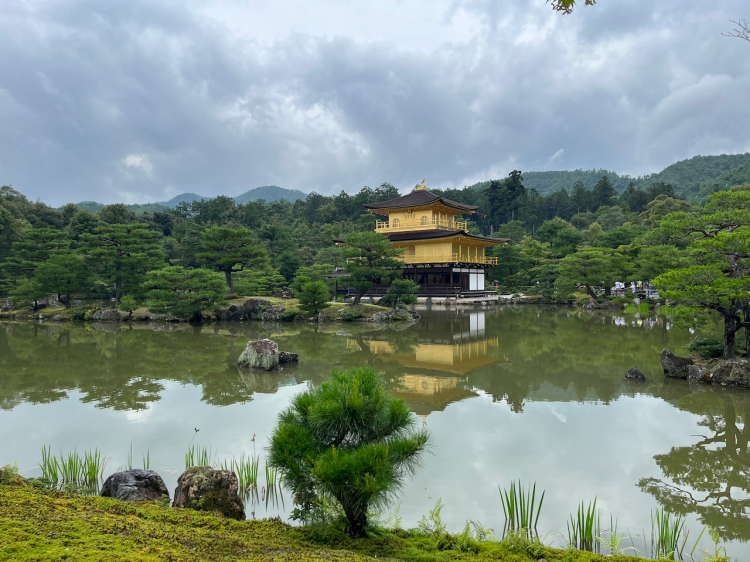
2 Technically, the Golden Pavilion, which we also visited, is also a Rinzai Temple too. I will probably write about the Five Mountains system of the Ashikaga Period soon, but I am brushing up on some old books first for research. It’s not a small topic.
Of the manytraditions in Japanese New Year (Jan 1st through 3rd, unlike Chinese New Year) is the first temple or shrine visit: hatsumōdé (初詣).
Japan essentially has two religions that have co-existed for many centuries: Shinto and Buddhism. Although they are very different on paper, on the ground, customs and traditions have blended as a result of this (mostly) peaceful coexistence and this includes New Year’s traditions.
People will try to go to their preferred Shinto shrine (jinja 神社) or Buddhist temple (otera お寺) within the first 3 days of the New Year, but most often on January 1st. You can visit any shrine or temple, there’s no pressure to “commit” to one or the other in Japanese culture. At times, we’ve visited Meiji Shrine in Tokyo, Kawasaki Daishi in Kawasaki city (a Shingon-sect Buddhist temple), Asakusa Temple in Tokyo, and Tsurugaoka-Hachimangu Shrine in Kamakura. The featured photo above is from Hatsumode at Asakusa Temple in 2009. We’ve also visited more local temples back home.1
Temples and shrines, especially famous ones, during this time are jammed packed with people trying to start off the new year with a blessing and maybe a few omamoricharms too. Old charms are often disposed of at this time too. Here’s an old photo from a past Hatsumode visit to Kawasaki Daishi in 2012:
This photo may not seem like much, but Kawasaki Daishi’s pagoda is visible way in the background, and the road leading up to the shrine is packed with people. It took maybe an hour to get through the procession to the temple itself.
For this year, 2024, we are at home, so I visited a small Shingon-sect Buddhist temple in the area. Shingon temples are pretty hard to find in the US, but somehow we have two temples in the area, and one of them offers a nice Hatsumode service. I don’t normally follow Shingon-sect Buddhism,2 but as I mentioned above, there’s no sense of commitment or obligation within Japanese religions: you can visit whatever service, and if you choose to follow more closely that’s up to you.
In our particular Hatsumode service, the priest led a series of Shingon-specific rituals to help cleanse any bad karma for the year, reciting the Heart Sutra (prominent in Shingon), and then a brief sermon based on the 60-year zodiac cycle. This year is apparently the year of kino-é-tatsu (甲辰), or wood-yang-dragon, which implies a lot of upheaval. After the last few years, that’s the sort of news I was not hoping to hear. 😒 Then again, shit happens.
I picked up a couple omamori charms for my daughter: a charm for success in studies since she is applying to college next year, and a charm for Yakudoshi since she is of the correct age (unlucky for her). I have learned the hard way not to laugh off Yakudoshi years.
Anyhow, like many Christians in the West during Christmas, Hatsumode might be the only time of the year when most Japanese visit a temple or shrine, but it’s an important time to reconnect and a break away from the usual bustle. I always enjoy this time, even with the crowds, freezing cold, and the hope that the next year will be better than the old one.
P.S. The history between Buddhism and Shinto in Japan is a great case study of two religions co-existing peacefully since they usually just operate at different levels. Shinto’s focus on there life now (and one’s connection to the kami) has little in common with Buddhism’s emphasis on the cycle of rebirth, and the eventual progress toward Buddhahood (e.g. Enlightenment). Chinese culture has a similar balance between Buddhism, and more native religions like Taoism. It’s only in Western religions that approach things with an “all or nothing” attitude that conflict tends to arise, but even then in traditional Christian cultures, native pagan beliefs tended to find a balance with Christian religion. They were not necessarily mutually exclusive, except on paper. Food for thought.
1 We used to visit Japan in the Winter so we could spend New Year’s in Japan with my wife’s family, but as our daughter grew up, and started going to school, we shifted the visits to Summer to avoid affecting attendance. We haven’t been back to Japan in Winter for almost a decade until 2022 and that was due in part to a funeral.
2 I am not against Shingon either, but I’ve found it difficult to commit to since it is an esoteric-only Buddhist sect, and I tend to be kind of an eclectic. It’s also why I frequently struggle with Zen and even Jodo Shu/Shinshu. Hence, my default “preferred sect” is Tendai due to its umbrella-approach to Buddhist practice. Still, due to available resources in my area, Shingon’s always been something I’ve considered.
Hello dear readers, and happy new year, or as they say in Japan akemashite omedetou gozaimasu!
My family and I took time off for Winter Break and are probably more exhausted now than when the break began.
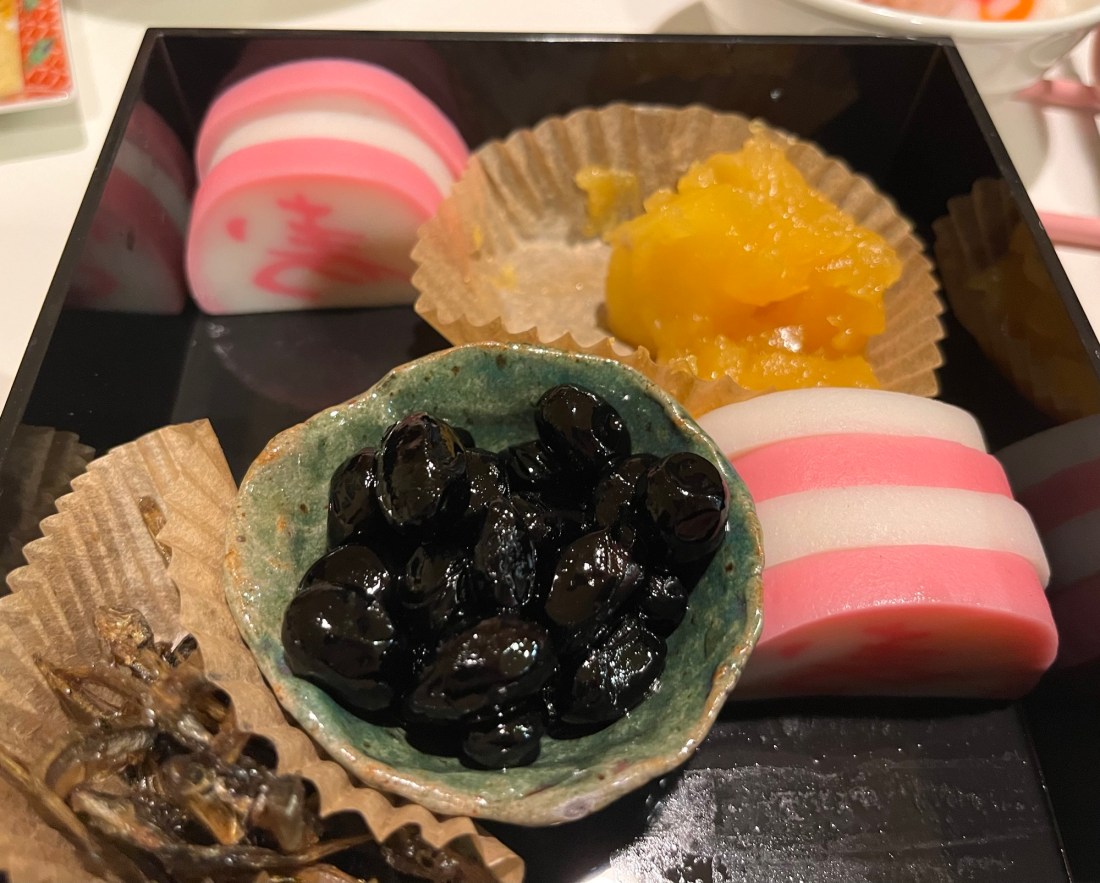
After enjoying New Year’s Eve with friends, we woke up this morning to eat Osechi (お節), which are traditional foods eaten in Japan for New Year for good luck. This is just one of many traditions found in Japanese New Year, also called oshougatsu (お正月).
I won’t list each one, but you can read here. These are foods thought to have auspicious meanings, and include things like shrimp, black beans, candied fish, chestnuts and so on. I like some more than others, but I try to have a bite of at least one of each. I like the pink and white kamaboko in particular. This year, we bought a brand that has the Chinese character 寿 (kotobuki) in it, meaning “felicitations” and such. The featured photo shows the Chinese character in reverse.
Also, in the photo above, our little ceremonial dishes feature the Seven Luck Gods too, and in the ozouni soup shown the naruto fish cakes feature Mount Fuji in front of a sunrise.
Later today, I will probably play some Karuta and then head for the local Japanese Buddhist temple for the first visit of the year, hatsumoude, and post on that soon.
Happy 2024 to everyone!
P.S. For us Star Trek fans, another thing to may be look forward to this year:
Recently I talked about the Pure Land Buddhist tradition, and in particular the Three Pure Land Sutras that are central to the tradition.
But then I realized that I’ve never really explained who Amida (Amitabha) Buddha is. Now that the English language site for Jodo Shu has been retired, I wanted to fill in some gaps in information, and explain Amida Buddha’s significance to the Buddhist religion at large.
Who Is Amida?
Amida (阿弥陀) Buddha is short for Amitabha Buddha: the Buddha of Infinite Light. Sometimes he is alternatively called Amitayus: the Buddha of Infinite Life too.
Amida Buddha is a cosmic, almost timeless Buddha who is said to dwell “very far” to the west in a realm called Sukhavati in Sanskrit, which means “Land of Bliss [or Joy]”. Over time, people just call it the Pure Land.
A reproduction of the Taima Mandala, an 8th century tapestry in Japan depicting the Pure Land
The Pure Land should not be confused with Heaven. It is a peaceful, safe refuge. In the Pure Land, people can escape difficult circumstances and be surrounded by many excellent Buddhist teachers. Even the very air and animals preach the Buddha-Dharma. Best of all, the sutras emphasize that one can be reborn there easily … if they so choose. It is not required in Buddhism, but it is available
The vast light of Amida Buddha (hence “Buddha of Infinite Light”) reaches out in all directions of the cosmos:
“The light of Amitāyus shines brilliantly, illuminating all the buddha lands of the ten directions. There is no place where it is not perceived. I am not the only one who now praises his light….”
The Sutra of the Buddha of Immeasurable Life, translation by Rev. Hisao Inagaki
and provides comfort to those who encounter it, inviting them to be reborn in the Pure Land:
“….If, sentient beings encounter his light, their three defilements are removed; they feel tenderness, joy and pleasure; and good thoughts arise. If sentient beings in the three realms of suffering see his light, they will all be relieved and freed from affliction. At the end of their lives, they all reach emancipation.”
The Sutra of the Buddha of Immeasurable Life, translation by Rev. Hisao Inagaki
This Buddha’s promise to rescue all beings, regardless of who they are, has been very attractive to people in difficult social circumstances: women (who were thought spiritually inferior in those days), the poor, and illiterate who toiled all day with no chance to invest in other spiritual development.
However many monks devote at least part of their time and effort toward Amida as well. As a Buddhist tradition, devotion to Amida is very broad and inclusive.
Further, everyone has a slightly different idea on who Amida Buddha is, what the Pure Land is, and so on. This is fine. There is no orthodox interpretation. Buddhism is more concerned with practice, so how one interprets this tradition up to them.
Some people devote themselves fully to Amida Buddha, others venerate Amida Buddha as one among a larger tradition. Again, it is up to the individual.
What Does Amida Look Like?
Amida Buddha is often depicted with gold color imagery, sometimes red. Compare with someone like the Medicine Buddha who is often depicted with lapis lazuli color (deep blue).
The gold color is based on the Pure Land Sutras that describe every person there, including the Buddha, as having gold-colored skin. Further, gold shines, so it fits the Buddha’s symbolism as a Buddha of light.
In some art, Amida is seated in meditation.
Amida Buddha statue at Sensoji (Asakusa Temple) in Tokyo, JapanAmida Buddha statue at Kamakura, Japan, also known as the Great Buddha (daibutsu) of Kamakura
In some art, Amida is standing, with his hands in specific gestures.
Amida Buddha welcoming the deceased, with his attendants, to the Pure Land. A medieval Japanese painting. A small home altar I purchased from Tsukiji Honganji in Tokyo about 10 years ago. A tiny, pocket image of Amida Buddha I purchased at Zojoji Temple near Tokyo Tower in Japan.
Buddhist statues are full of symbolism, they are not intended to be accurate portrayals. They convey meaning. The double-“OK” hand gestures used by Amida, one hand up, one hand down with palm up, means something like all beings are welcome.
Why Amida?
Someone learning about Buddhism will probably find this very confusing: why is there a “Buddhist Jesus” when the religion is supposed to be about meditation and finding enlightenment? Is this a sign of Buddhism’s decadence and decline?
Buddhism can be a tough religion to explain because it is really broad. Much broader than a “Buddhism for Dummies” book can explain.
The historical founder, Shakyamuni Buddha, was like a doctor describing the state of things (e.g. the Dharma), and providing a “prescription” (e.g. Buddhist practice) to help cure the “ills” of the world.
But within that, Shakyamuni Buddha gave people a lot of autonomy. He described the world as like a river with two shores: one shore full of strife and dissatisfaction, the other peace and wellbeing. He described the need to build a raft to cross from one shore to the other. But how exactly to build that raft is up to you.
He held students, especially monks, to high standards of conduct, but as for putting teachings into practice he tailored different practices to different audiences, or to suit the person. Contrary to popular conception there are various forms of meditation taught even in the earliest traditions, not just mindfulness.
Mahayana Buddhism, one of two major branches of Buddhism, really emphasizes this diversity of practices because it recognizes the concept of upaya (expedient means): whatever works at that time for that person and helps them stay in the Buddhist path is right for them.
It’s partly why there are so many Buddhist figures, so many chants and sutras, and so many different sects. Each of these represent a different “gate” for entering the Buddhist path.
Anyhow, the existence of Amida Buddha, along with other figures such as Kannon, helps fill in a gap where some Buddhist practices and regiments just aren’t practical for most people, and also provides a sense of assurance in an uncertain world (speaking from experience). Those who find the “mind-only” interpretation of Amida attractive can also take comfort that nurturing Amida Buddha in one’s own mind helps awaken the Buddha within. Further, a timeless Buddha like Amida avoids the challenges of the interpreting the historical Buddha, Shakyamuni, through various layers of culture and history.2
As Amida Buddha is a tradition within the larger tradition, some Buddhists gravitate toward Amida, and some do not. Each person according to their own path. Mahayana Buddhism is large enough to embrace them all.
Namu Amida Butsu
P.S. Featured photo is the famous “Black Amida” statue at Zojoji Temple near Tokyo Tower in Japan. This was the statue that was venerated by the Tokugawa Shoguns back in the day.
1 The use of light symbolism in Amida Buddha is thought to possibly borrow from Zoroastrianism, which is possible given the contacts between the Parthians and the Buddhist community. Light is central to Zoroastrianism, but not mentioned in early Buddhist culture. The concept of Amida Buddha is definitely Indian-Buddhist, but Buddhists in the northwest of India often borrowed artistic concepts from neighboring cultures. Another example is Greco-Buddhist art.
2 Early Mahayana Buddhism was a critic of the “pilgrimage” culture at the time in India, where there was increasing importance of the holy sites, and the holy relics of the historical Buddha. Mahayana shifted the emphasis toward the timeless Dharma, and Buddhas as embodying this Dharma.
It’s similar to how people in other religions split hairs over what the religious founder said, based on layers in interpretation, or how people try in vain to recreate the original community (again through layers and layers of interpretation).
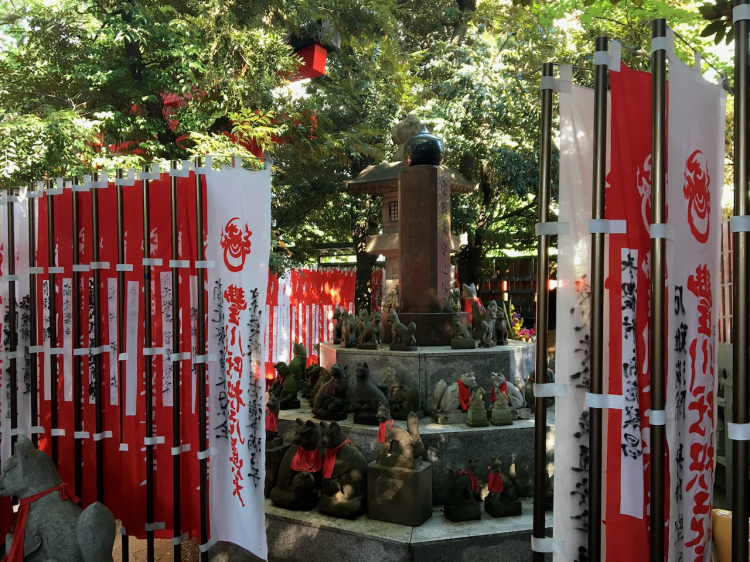
A little while back, during my post on Fushimi Inari Shrine in Kyoto, Japan, I alluded to how the native Shinto religion often blended with Buddhism up until the early modern period (e.g. the Meiji Period) when they were more forcefully separated.
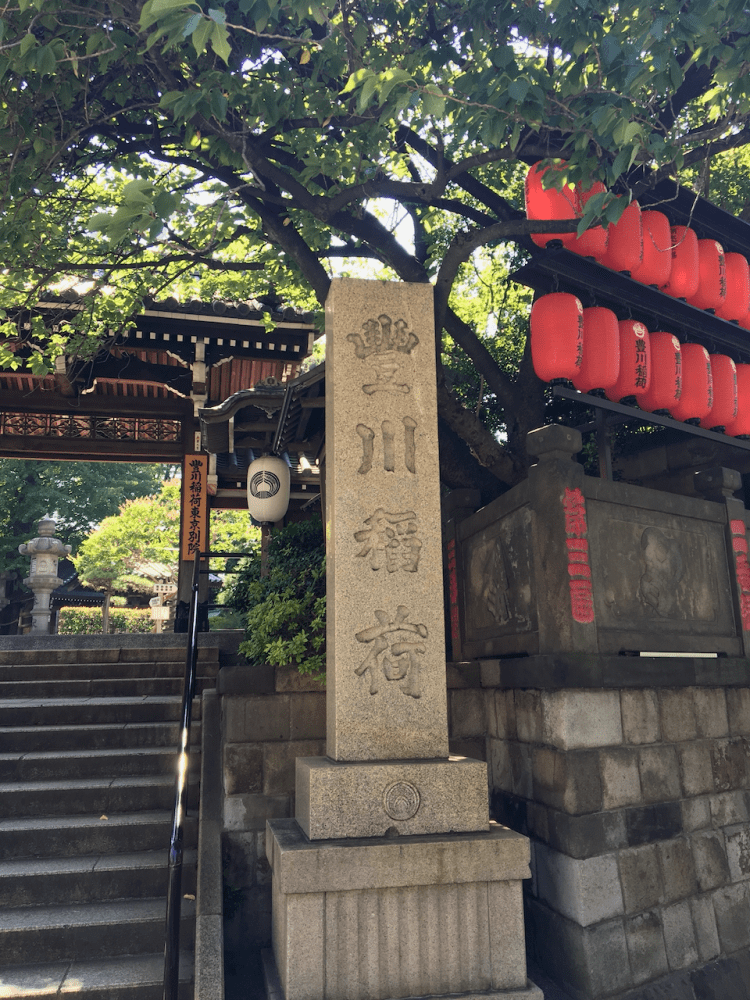
You can still see vestiges of this blending in some temples and shrines, but one great example is the Toyokawa Inari shrine right in the heart of Tokyo’s Minato Ward:
This Shinto shrine / Soto-Zen Buddhist temple venerates Dakini-ten (荼枳尼天), which is the Buddhist form of the Shinto kami Inari Ōkami.
Dakini-ten is based on the concept of Ḍākinī in esoteric (a.k.a. Vajrayana) Buddhism, but in Japan it blended with veneration of Shinto kami and thus took on a life of its own.
Inari Ōkami in his/her Buddhist form as Dakini-ten shining light upon a samurai warrior. Late medieval painting by Utagawa Kuniyoshi, source: Wikimedia
Anyhow, let’s talk about the temple itself. I visited the temple in 2018 and had little context back then, so I didn’t take as many good photos as I would have liked, but I will try to explain as best as I can.
Once you go past the main gate…
You come upon the main shrine to Inari Ōkami (colloquially known as “O-Inari-san”):
Another, small sub-shrine here:
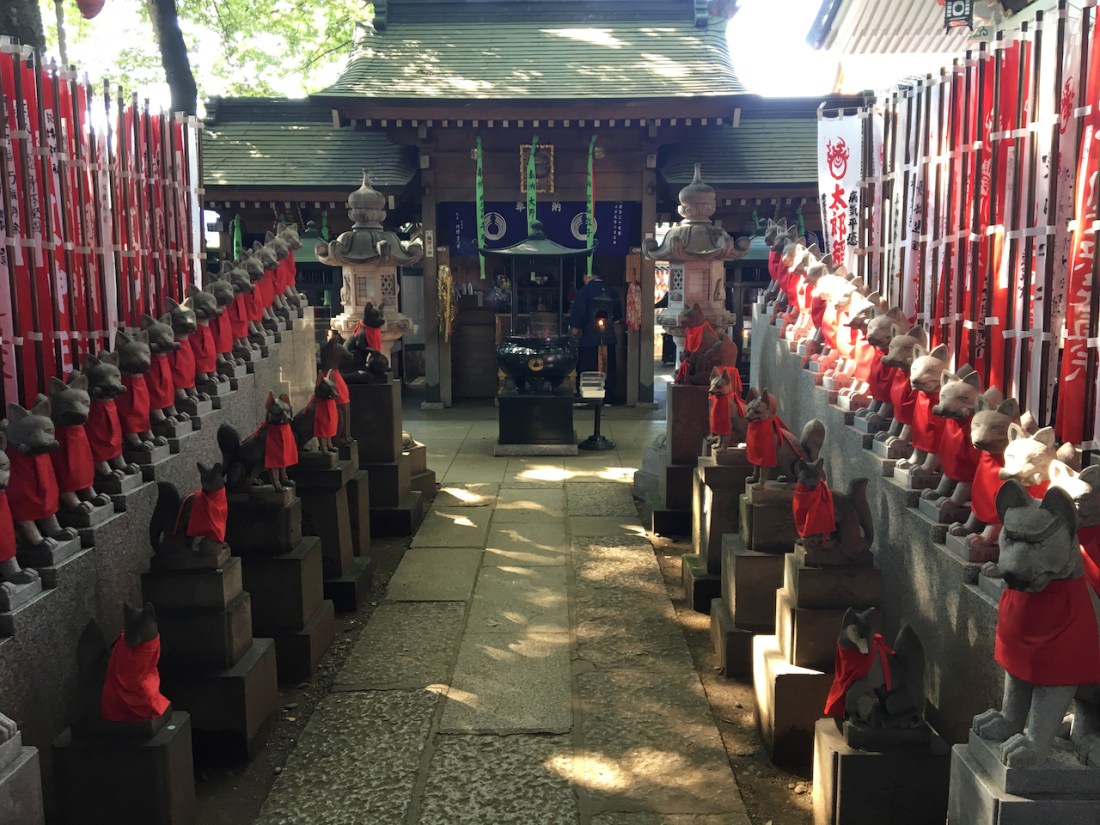
You can see fox statues all over the complex, due to their close association with Inari Ōkami.
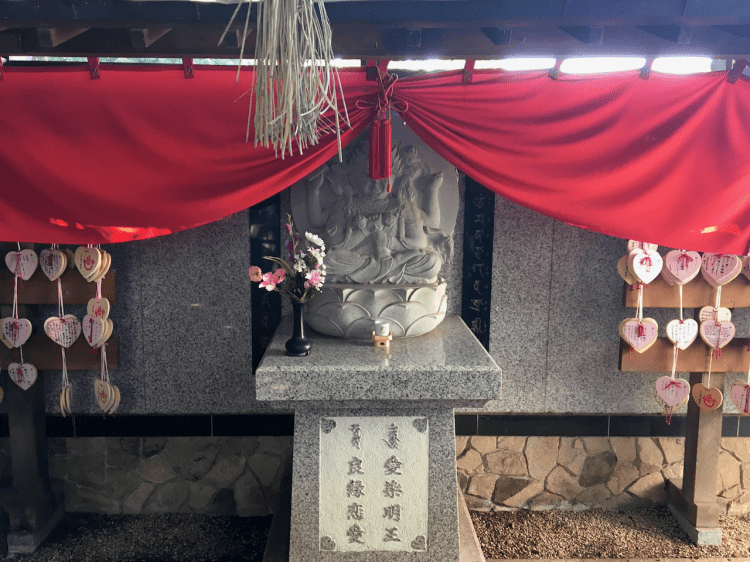
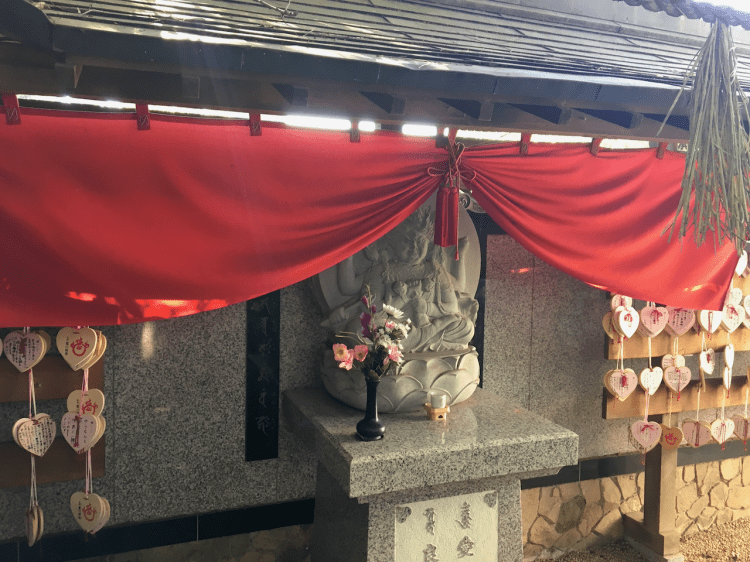
However, other deities, both Buddhist and Shinto are enshrined here too. For example, below is an esoteric-Buddhist (Vajrayana) deity named Aizen Myō-ō (愛染明王):
The fact that both Shinto deities like Benzaiten and Inari Ōkami reside in the same shrine as overtly Buddhist deities such as Kannon and Aizen Myō-ō is somewhat unusual, but really isn’t. This was normative for Japanese religion until the modern century. Japan has had two religions for a very long time, and they’ve co-existed for so long, that they often blended together.
If you look at American religion, pagan religion and Christianity co-existed for so long (even when paganism was officially repressed) that the two blended together. Things we take for granted such as Christmas trees, mistletoe, Easter eggs, and such are all examples where they have blended together to religion as we know it today. This might offend religious purists (to be fair everything annoys religious purists), but this is how societies absorb and adapt religions over generations. Japanese culture simply had different religions to work with.
Anyhow, fascinating stuff.
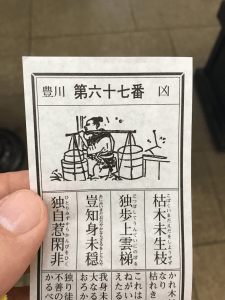
P.S. My omikuji fortune that visit was bad luck (kyō, 凶). I don’t remember having a particular bad year, especially compared to 2020 later, but it was surprising to get an overtly bad fortune for a change.
My son is in grade school and loves world mythology, especially Greek and Norse mythology (I did too at his age 🥰). But we’ve also been introducing him to Japanese mythology since it’s part of his heritage.
The trouble is is that Japanese mythology feels “scattered” and, due to cultural differences, hard to translate into English without a lot of explanation. Further, some of it just isn’t very kid-friendly.
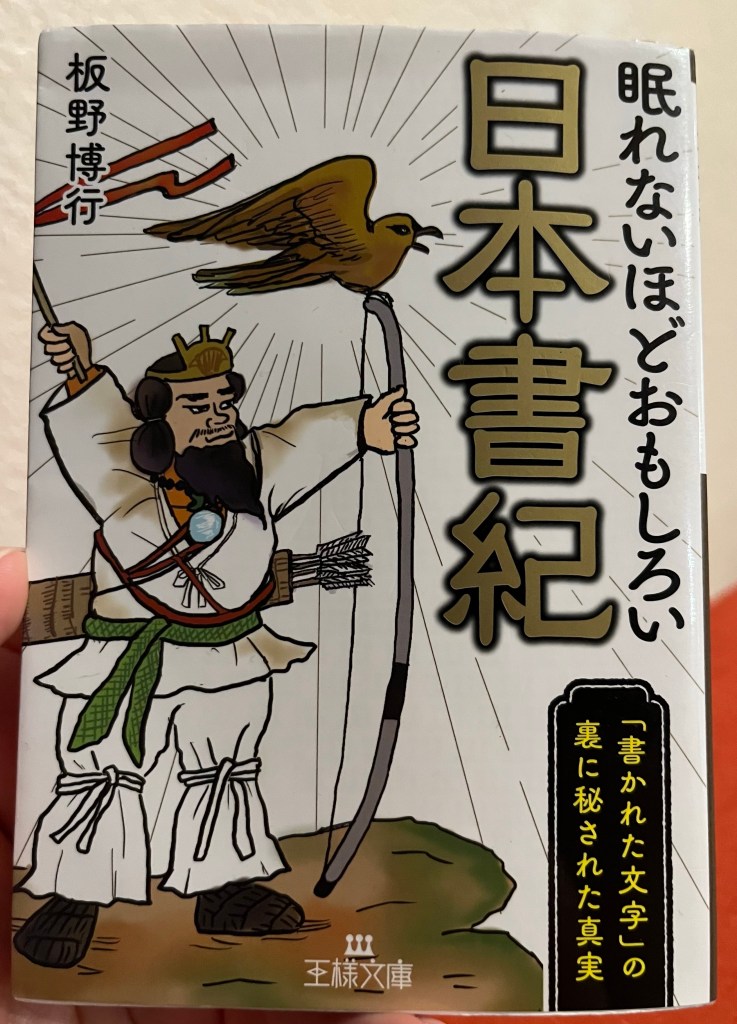
This post is meant to help make sense of Japanese mythology. I learned a lot about it after finding this book in Japanese about the Nihon Shoki (日本書紀), a legendary record of Japan’s foundation:
The Nihon Shoki is one of two records composed in the early 8th century about Japan’s history and origins. The other record is the Koijiki (古事記). Both were promulgated by Emperor Tenji, and both cover overlapping yet differing mythologies, so why are there two records?
The book above explains that the intended audiences were different.
The Nihon Shoki is a longer, more polished record of Japan’s foundation intended to impress Imperial China. It seamlessly transitions from mythology to the origins of the Japanese Imperial Family, legitimizing it in the eyes of their rivals in China, and even covers the life of Prince Shotoku. The Kojiki, by contrast, is shorter and includes more salacious details of some myths, and intended for domestic audiences only.
Even between the two records, some myths differ slightly, as we’ll see shortly.
In any case, much of what we know today about Japanese mythology derives from the Nihon Shoki and Kojiki, just as Greek mythology largely derives from only three sources: the Iliad and Odyssey attributed to Homer, and the Theogony by Hesiod.
The Founding Gods
The two gods credited with the founding of Japan are husband and wife Izanagi and Izanami. According to myth, they descended from the heaven realm, called Takama no Hara (高天原) and saw the primordial chaos of the world below. The Kojiki mentions 3 realms, by the way:
Takama no Hara (高天原) – the heaven realm
Ashihara no Nakatsukuni (葦原中国) – the earthly realm (e.g. Japan)
Yomi no Kuni (黄泉国) – the realm of the dead
According to my book above, the Nihon Shoki never mentions the second two, only the heaven realm. Also, if you’ve been playing Zelda: Tears of the Kingdom, you might notice some similarities….
Anyhow, Izanagi and Izanami stood over the primordial waters on a heavenly bridge called the Ama no Uki Hashi (天浮橋), dipped a spear or pike (literally hoko 矛 in Japanese, a kind of Chinese spear) into the water, and the salty water dripping from the spear tip encrusted and fell from the tip, forming the first island.
In the Nihon Shoki, they then fell in love with one another and wanted to have kids, but didn’t know how (being very new at this), and got advice from a Wagtail bird (lit. sekirei セキレイ in Japanese). Once they figured out how … the process works, they started giving birth to the “eight islands” of Japan (the Nihon Shoki and Kojiki differ slightly on what these islands are), as well as having many children, including some well-known kami :
Amaterasu Ōmikami (天照大神) – goddess (kami) of the sun, she was given dominion over the heavens. Her grandson, Ninigi-no-mikoto, is the progenitor of the Imperial family in Japan, according to the Nihon Shoki.
Susano-o-mikoto (須佐之男命) – god (kami) of storms, he was given dominion over the oceans. His son, Ōkuninushi, is a frequent figure in Japanese mythology especially relating to the founding of Japan.
Tsukuyomi-no-mikoto (月読命) – god or goddess (kami) of the moon, given dominion over the underworld. Their gender is unclear from the mythology.
However, in the Kojiki version, Izanami died when giving birth to the god of fire, and traveled to the underworld, leading to the myth shown below in the Youtube video.
The Nihon Shoki does not mention this myth, and simply states that they went on to create more gods and goddesses. In this Kojiki version, after Izanagi escaped the underworld, he purified himself under a waterfall, and from the droplets sprang more gods. In the Kojiki version, the three kami listed above were born from the water purifying Izanagi.
Sibling Rivalry
The rivalry between older sister Amaterasu Ōmikami (hereafter “Amaterasu”) and younger brother Susano-o-mikoto (hereafter “Susano-o”) drives a lot of the mythology found in the two records. Amaterasu did not like to lose, and Susano-o had a foul temper, so they often clashed.
In one story, they had a dare to see who had a pure heart (and who didn’t) by giving birth to more gods. In their minds, whoever gave birth to female goddesses had ulterior motives, while whomever gave birth to male gods did not.1 They sealed the agreement by exchanging items: Amaterasu gave her brother her jewels, and Susano-o exchanged his sword. Amaterasu gave birth to three female goddesses, and Susano-o gave birth to five male gods.
The Kojiki and Nihon Shoki differ on what happened next. In the Nihon Shoki, Susano-o cheered at first, but then Amaterasu pointed out that the male gods were born from her jewelry, thus she had the pure heart. In the Kojiki, Susano-o instead points out that the three goddesses were born from his sword, and being such sweet and kind goddesses, he obviously had the pure heart. Thus, depending on the source, different gods declared victory.
Side note: of the five male gods born, one of them, Ame-no-oshihomimi, is the reputed ancestor to the Imperial family. Of the female goddesses, they are still venerated a series of shrines in Fukuoka Prefecture (official homepage here).
In the Nihon Shoki version, Amaterasu won, but Susano-o had a huge tantrum and caused a ruckus, destroying many things, etc. Amaterasu was furious and hid herself in a cave, plunging the world into darkness. This famous myth is often depicted in Japanese artwork. The featured image above (source Wikipedia) depicts the efforts by the other kami to entice Amaterasu to leave her cave and thereby restore light to the world, including a risque dance by kamiAme-no-Uzume-no-Mikoto.
Descent to Earth
Fast-forwarding a bit for brevity, Susano-o, having been previously driven out of the heavens due to his behavior, undertakes some adventures, and rescues a maiden named Kushi-nada-himé from a massive serpent named Yamata-no-Orochi. From the serpents body came the mythical sword Kusanagi, one of the three sacred treasures (神器 jingi) of Japan by the way. The other two, the bronze mirror and jewel, were used in the aforementioned myth to draw Amaterasu out of her cave.
Susano-o and the maiden married, and their son, Ōkuninushi-no-kami (大国主神), who committed many great deeds that helped build and pacify Japan:
Interestingly, Ōkuninushi mostly only appears in the Kojiki.
Later, according to the Nihon Shoki, a kami named Takemikazuchi-no-kami (武甕槌神) was dispatched to inherit the country of Japan from Ōkuninushi who had been entrusted with its care. Interestingly, Takemikazuchi-no-kami is the patron god of the Fujiwara clan (originally the Nakatomi), and guess who helped compile the Nihon Shoki? Fujiwara no Fuhito.
Takemikazuchi demonstrated his power by sitting on a sword, point up, without losing his balance. Yes, that is as painful as that sounds. Needless to say Ōkuninushi was impressed. Ōkuninushi’s son, Takeminakata-no-kami (建御名方神) did not take this well and challenged Takemikazuchi-no-kami to a contest of strength, supposedly the first Sumo match ever, but Ōkuninushi’s son lost and fled elsewhere. Thus, Takemikazuchi-no-kami prevailed and inherited the country.
Later, Amaterasu’s grandson Ninigi2 descended from the heavens to the earthly realm with a retinue touching down at Mount Takachiho on the island of Kyushu.3 There are many versions of this myth. Sometimes Ninigi descends alone, in other versions he descends with various other kami who go on to found their own earthly clans. In some myths, he is obstructed by other kami, and in others he is bearing the aforementioned Three Sacred Treasures. In one myth, upon touching down, Ninigi jams a mythical spear, Ama-no-sakahoko (天の逆鉾) into the peak of the mountain, of which a replica exists today.
In any case, this is where the myths begin to transition to semi-legendary, semi-historical narrative, which is a tale for another day. It’s been fun to read about Japanese mythology in a more cohesive narrative, with humor and historical context thrown in, but I also read Japanese pretty slow, so it may take a little while to get to the next section.
Anyhow, I hope you enjoyed!
P.S. Thank you for your patience as I haven’t had much time to right articles lately. Outside of work and parenting, I have been working a lot on the other blog, plus enjoyingFire Emblem: Three Houses in what little spare time I have. I have more articles queued up and should hopefully get back on a regular cadence soon.
1 I wish I was making this up, but I am not. This kind of ritual to determine one’s heart was called Ukei (誓約) in Japanese, though in modern Japanese 誓約 is read as seiyaku and refers to oaths, vows or pledges in general.
2 More formally known as Amatsu-hikohikoho-no-ninigi-no-mikoto (天津彦彦火瓊瓊杵尊).
3 It’s interesting to note that many of the early myths, and older, more obscure kami in Shinto religion have some connection the island of Kyushu in particular, which is closest to mainland Asia.
As part of our trip this summer to Japan, including Kyoto and Nara, we visited the temple of Kiyomizu-dera (lit. “The temple of pure water”). We had visited this temple wayyyyyy back in 2005 during my first even trip to Japan, but in 18 years I have learned a lot about Buddhism in Japan and it was nice to come again with a more discerning eye, and a better camera. Unlike our last visit, which was in the middle of January, this last visit was in July when it was extremely hot and muggy, despite the seemingly cloudy weather.
This post is meant to be an updated tour of Kiyomizudera, but if you want more details about the temple, feel free to read the original post, or checkout the official website.
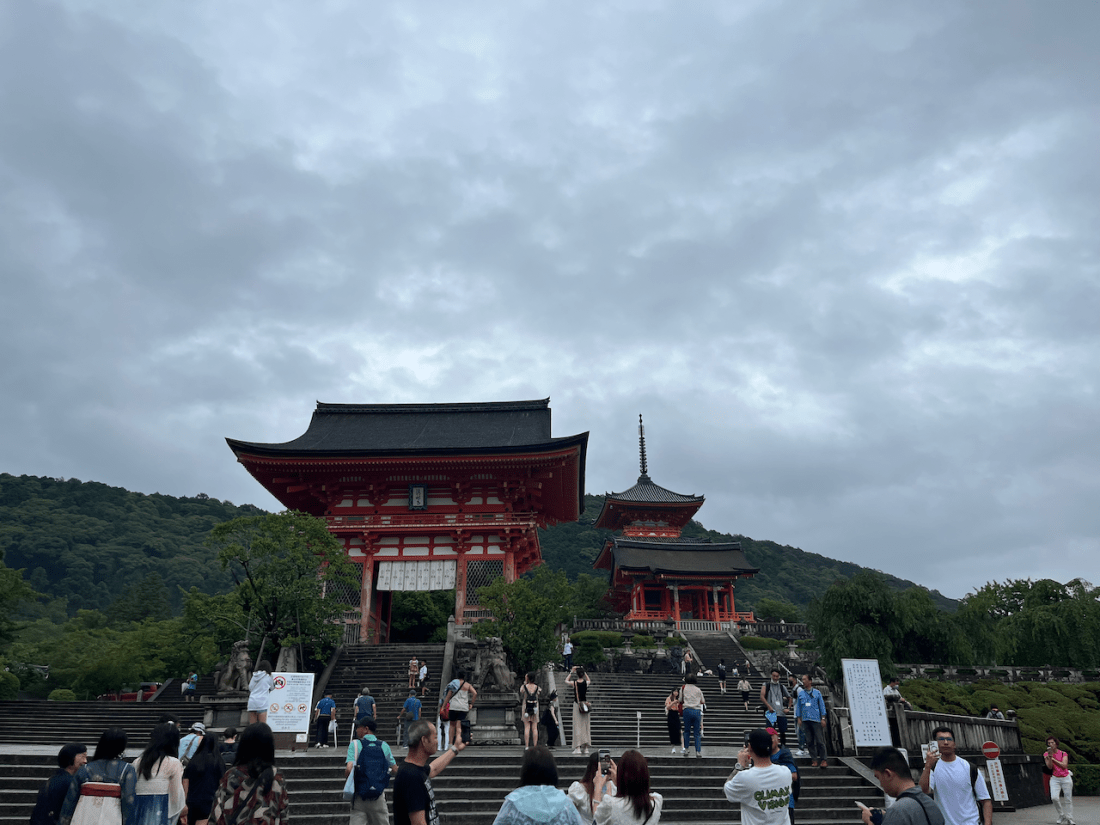
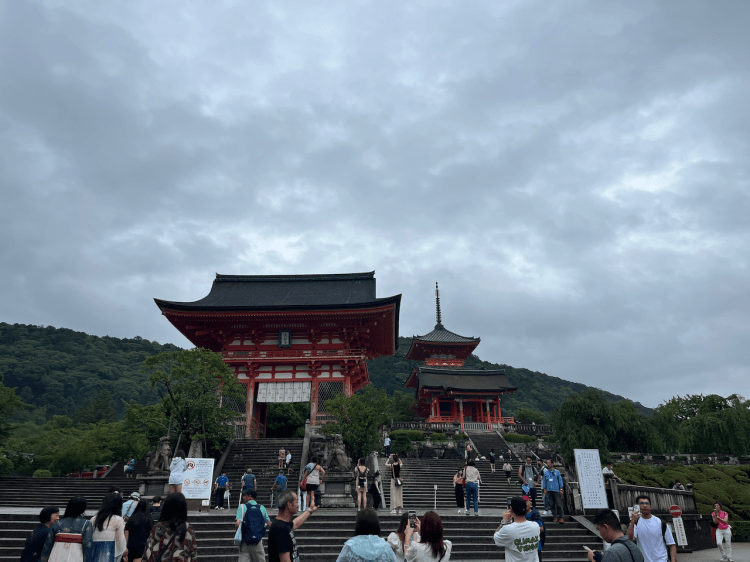
Anyhow, Kiyomizudera sits upon a hill toward the outskirts of Kyoto (which sits in a valley), and leads up to a path like so.
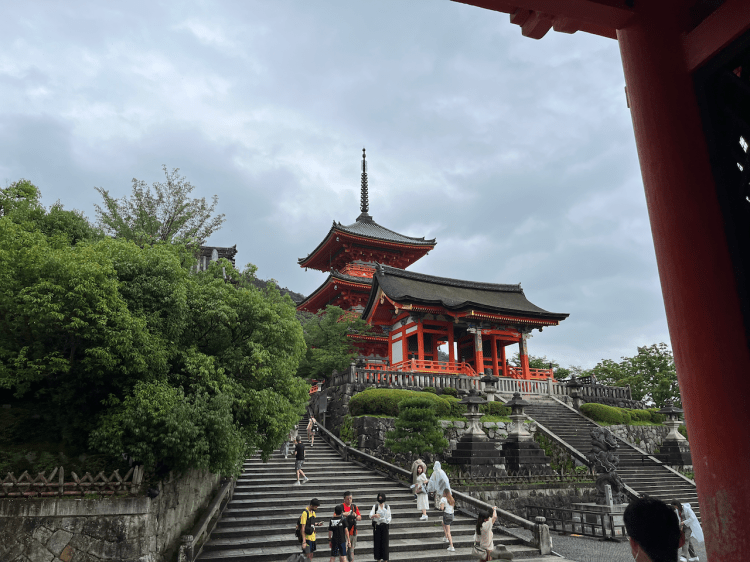
If you go up the stairs on the left, and pass under the gate, you will see the following
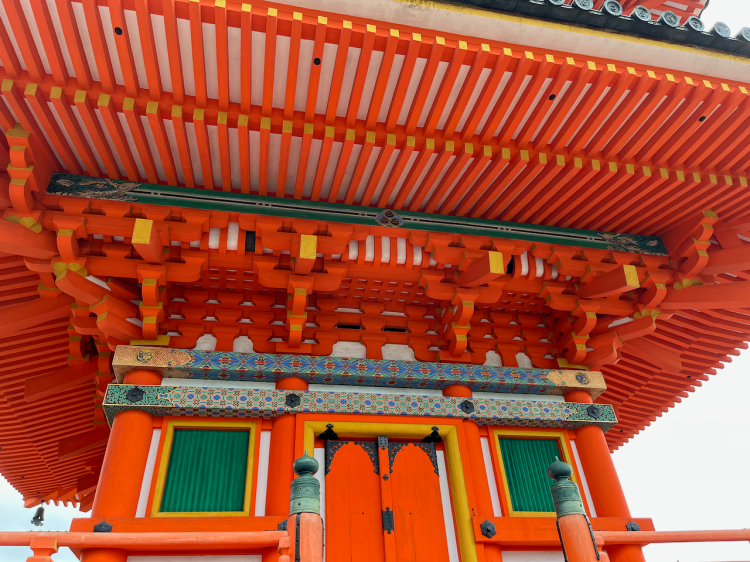
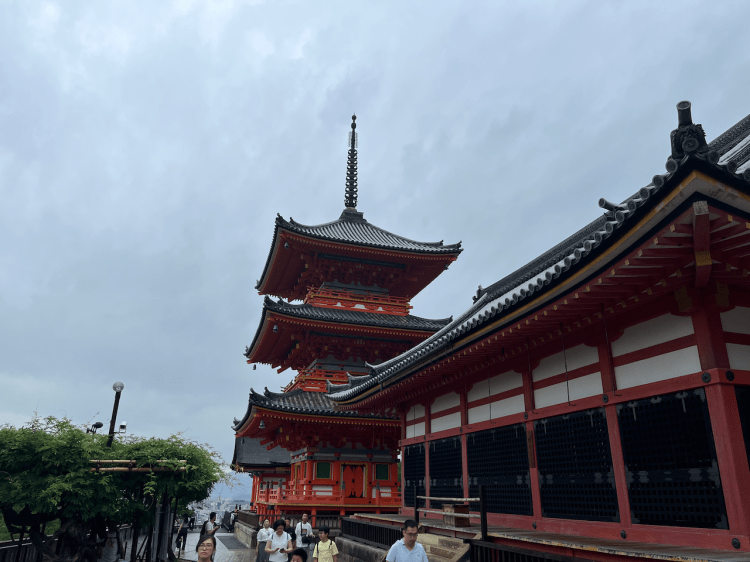
Up close, the tall pagoda (a Buddhist stupa) is very brightly colored. This reflects style used in early Japanese architecture, versus later more subdued color schemes.
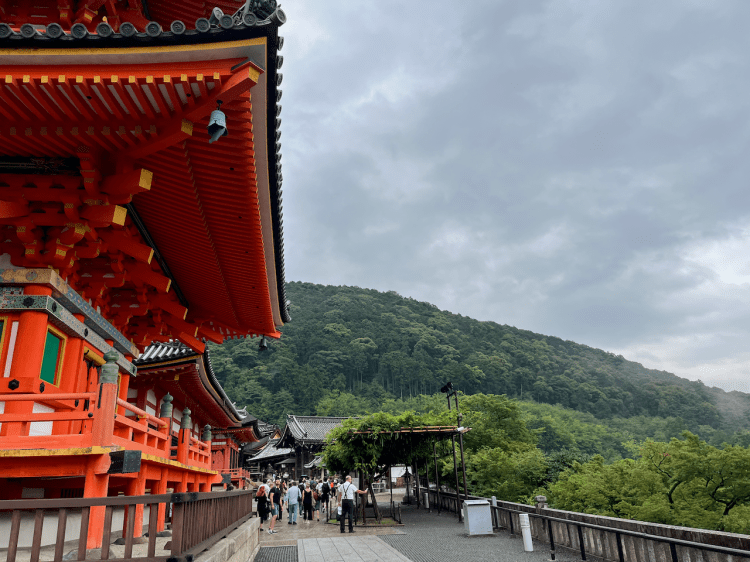
From a bird’s eye view, Kiyomizudera is laid out like an “L”, but flipped vertically. From the pagoda you can see a long veranda overlooking the famous drop-off to the right, and the main temple to the left (hard to see in this photo). Further back, the path turns right.
Looking backward…
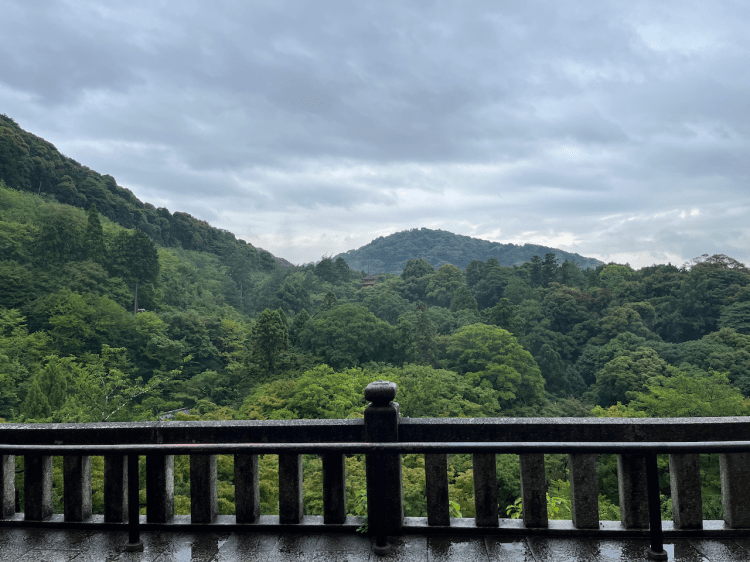
Here is the aforementioned drop-off which lets you look out over the hillside:
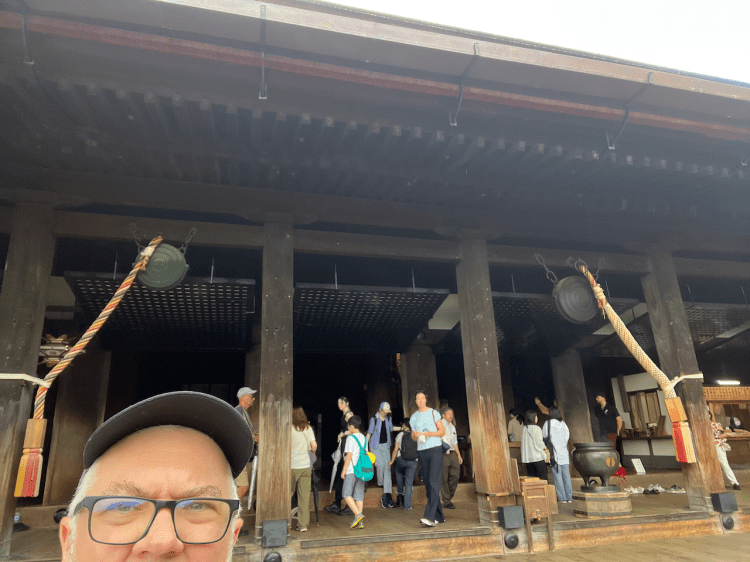
Directly behind the drop-off, is the main temple, devoted to the Bodhisattva Kannon. Unfortunately, photos are not allowed inside, so instead you can see my handsome face just outside. Inside, the statue of Kannon is shielded behind a wire mesh, with a large Buddhist bell that people can ring, offer veneration, etc. You can see the central figure on the official website here. This is a good example of the classic “1000-armed” Kannon, whose many arms express Kannon’s countless and varied efforts to help all beings. Kannon epitomizes many aspects of Mahayana Buddhism all in one nice image.
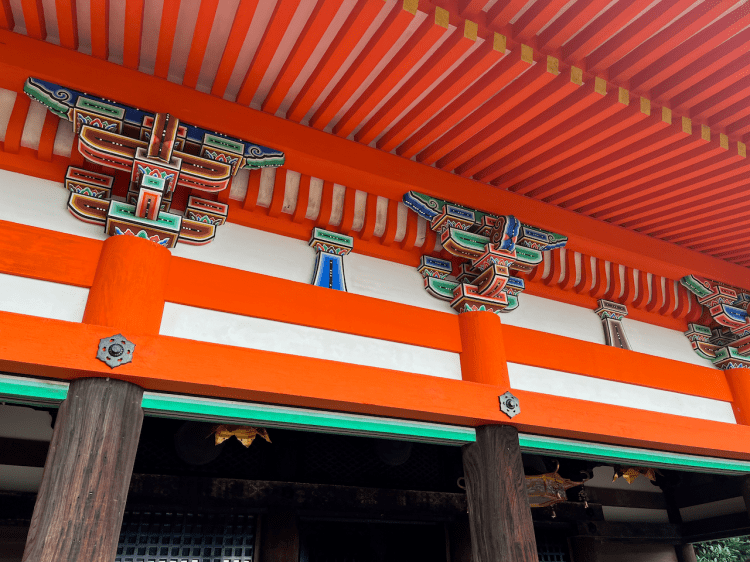
If you were to look up you can see some very pretty architecture.
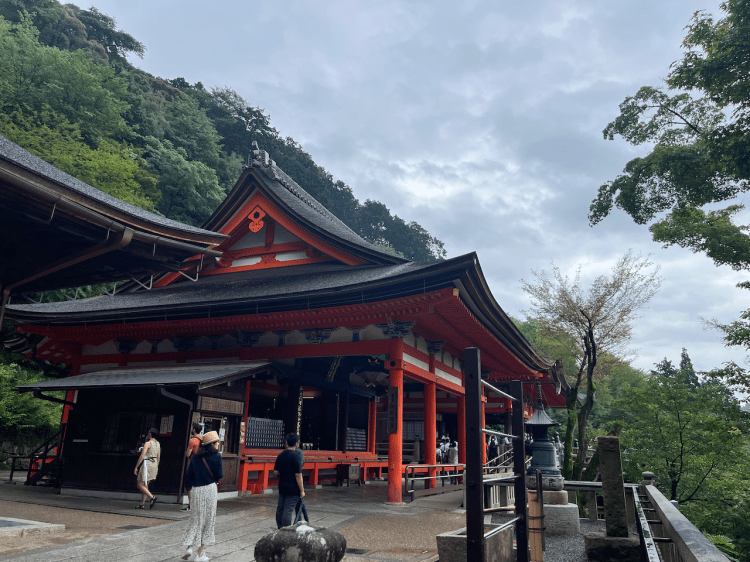
If you go further, around the “bend” of the “L”, to the right are a couple sub-temples:
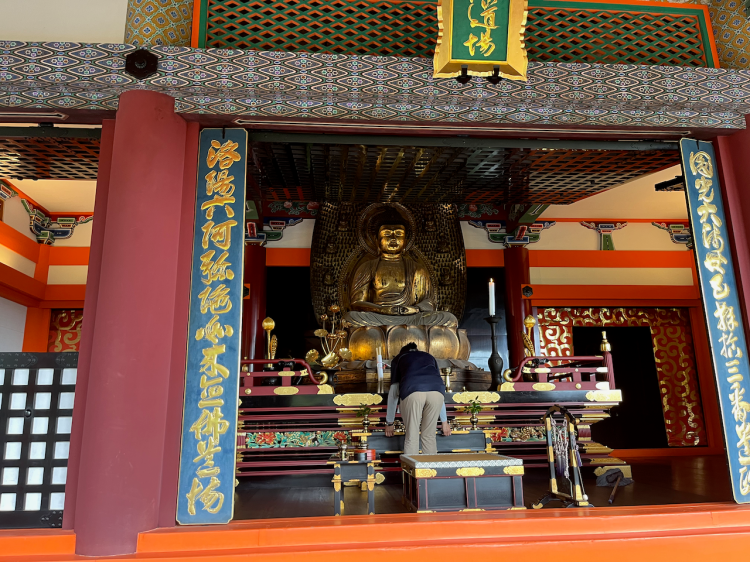
This sub-temple is devoted to Amitabha Buddha (e.g. Amida Buddha). Amida Buddha is the central figure of Pure Land Buddhism, which is prominent in the Tendai Buddhist tradition (of which Kiyomizudera is one such temple). Later Pure Land-exclusive sects all branched from Tendai: Jodo Shu, Jodo Shinshu, Ji-Shu, etc.
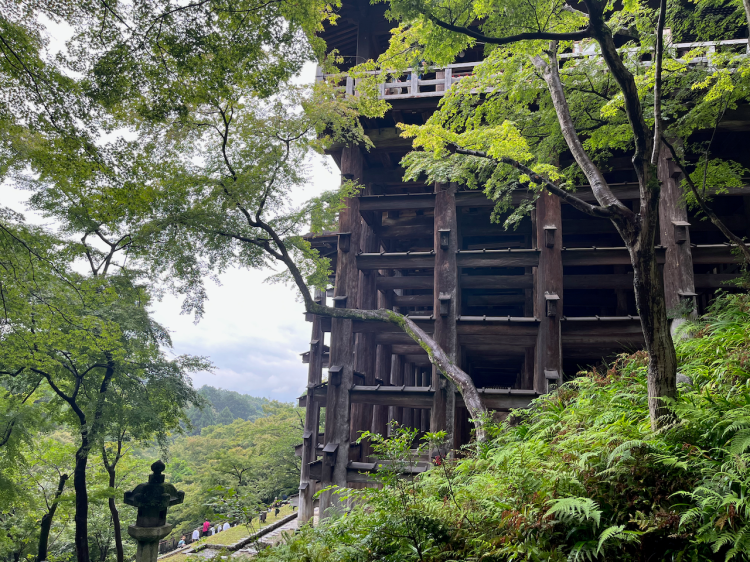
Near the bend of the “L”, there is a set of stairs that will take you down to the lower level. The drop-off I showed before was built entirely with wood, using pegs and no metal nails. Yet, as you can see, it is very well-constructed.
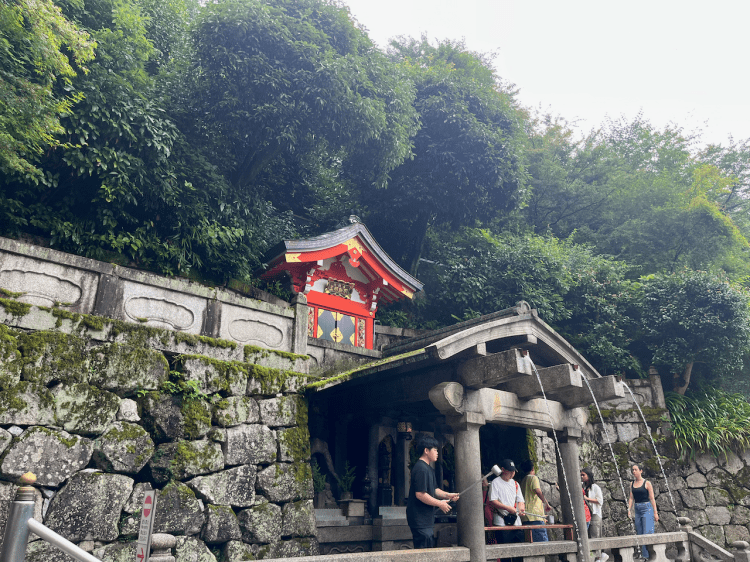
At the bottom is a small waterfall and spring from which the temple gets its name.
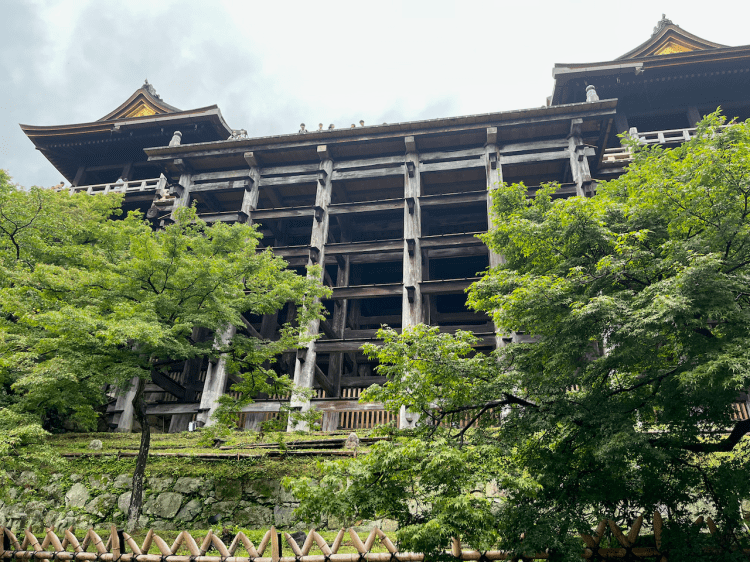
A view of the drop-off, from the bottom.
Kiyomizudera is a pretty neat temple, and as one of the oldest in Kyoto, it has seen countless, countless visitors of all kinds. It was nice to come once again, and pay respects to Kannon Bodhisattva here, and to better understand the layout and the significance of the temple with the benefit of experience and hindsight.
P.S. Been thoroughly busy these past weeks, and blogging a lot less than I used to. Most of this is related to holidays, but also work. Hopefully things will quiet down again soon.
This pagoda (Buddhist stupa) we saw in Kyoto near Kiyomizudera is among others attributed to Prince Shotoku.
The 6th century Prince Shotoku (Shōtoku Taishi, 聖徳太子) holds a revered place in Japanese culture not unlike Constantine the Great, Emperor Ashoka, or Good King Wenceslas. Even today, kids in Japan learn about Prince Shotoku through comic books, art and even the two-thousand yen bill. Even my son, who’s grown up in both Japanese and American culture has learned about the famous prince who was so smart that he could listen to ten conversations at once and recall each individually.
On a historical note, several famous Buddhist temples and pagoda (Buddhist stupa) are attributed to Prince Shotoku, including Horyuji. Further, he reorganized the Yamato court in a Confucian-style bureaucracy and is said to have composed an early Buddhist constitution.
But who was Prince Shotoku?
Prince Shotoku was part of a powerful triad at the time, consisting of Empress Suiko, a rare example of a powerful empress in Japanese history, Prince Shotoku as regent and advisor, and Soga no Umako, head of the powerful and reformist Soga Clan with strong connections to Korean and Chinese communities.
Japan at this time was emerging from geographic isolation and increasingly establishing cultural contacts with the Korean Peninsula, and with Tang-Dynasty China. This led to a power struggle between more conservative, nativist clans such as the Mononobé and Nakatomi, and reformist groups such as the Soga. The triad above were definitely reformist, and clashed with the conservative faction eventually leading to war.
According to the Nihon Shoki, on the eve of battle, Prince Shotoku prayed to the Four Heavenly Kings (a group of Buddhist guardian deities) for success. Upon crushing the Mononobe and their allies, Prince Shotoku built and dedicated the temple of Shitennnoji to the victory. The rest, as they say, is history.
Let’s talk about some of the things attributed to Prince Shotoku…
Buddhist Constitution
In 604, Prince Shotoku supposedly promulgated a seventeen article constitution based on Buddhist and Confucian principles: the jūshichijō kenpō (十七条憲法). Unlike a modern constitution, it was not legally binding, but more of a vague statement of governance, and was later replaced by the Ritsuryo System in the 8th century.
Translations of the 17 Article Constitution are hard to find, but you can see examples of it here and here.
Japan’s New Name
Names for Japan in early, early history varied and inconsistent. Chinese officials called it the land of Wa (倭), and Japan often called itself Wakoku (倭国) or Yamato (大和). However, the modern Japanese name for Japan, Nihon (日本) is attributed to a letter that Prince Shotoku wrote introducing his sovereign to the Sui Dynasty in China:
“From the sovereign of the land of the rising sun (hi izuru tokoro) to the sovereign of the land of the setting sun.”
The “land of the rising sun” evolved into Nihon (日本, lit. “where the sun comes from”).
Further, by putting the Emperor of Japan on equal footing as the Emperor of China, Prince Shotoku was not so subtly rejecting the Chinese-centric world view.
The Cap and Rank System
Prince Shotoku is also credited with establishing the first meritocracy in Japan in 603, inspired by Chinese Confucianism called the Kan’i Jūnikai (冠位十二階, “Twelve Cap and Rank System). The idea was to get out of hereditary government appointments, and promote ministers based on skill and talent, using a series of colored caps to correspond with rank (instead of lineage).
Promulgation of Buddhism
A copy of the Lotus Sutra said to be composed by Prince Shotoku. 日本語: 尾上八郎English: Hachiro Onoue, Public domain, via Wikimedia Commons
Prince Shotoku was said to be a great promoter of the Buddhist faith in Japan. We talked about the conflict with the nativist Mononobé clan earlier, who held to the Shinto faith, but after Shotoku’s victory, he continued to build temples such as Horyu-ji and stupas (like the one shown above), copy sutras, and so on.
Further, later generations of Buddhist teachers in Japan revered Prince Shotoku almost as a cult figure, often conflated with Bodhisattva Kannon. Even today, if you go to many Jodo Shinshu Buddhist temples, you will often see a scroll of Prince Shotoku to the side of the central altar due to the founder Shinran’s devotion to Shotoku.
Historicity
The historicity of Prince Shotoku is interesting though. While a historical figure named Prince Umayado (厩戸皇子) is thought to have really existed, and is thought to be the origin of Prince Shotoku, many of the stories and accomplishments attributed to him may have come from other sources.
Early Japan at this time was importing much mainland culture through the Korean kingdoms of Baekje and Silla, as well as China, and this often meant that immigrant families migrated to serve the early Japanese court. The Hata clan, for example, came from Silla.
The book Shotoku shows how certain subtle aspects of the Shotoku myth stories reflect cultural sources from Silla, via immigrant groups such as the Hata clan. This is through specific imagery used, coupled with archeological evidence from known sites in early Japan where immigrant groups habited, and their influence on local Shinto shrine practices.
For example, a famous story in the Nihon Shoki about Prince Shotoku and the Beggar of Kataoka reads as follows, with [my additions] and (additions from original author):
21st year, 12th month, 1st day.
The crown prince [Shotoku] made a journey to Kataoka. At that time there was a starving man who was lying at the side of the road. He asked for (the beggar’s) name, but he said nothing. The crown prince seeing this, gave him food and drink. He then took off his cloak, and covered the beggar with it, saying “lie there in peace.” He then made a song.
12th month, second day.
The crown prince sent a messenger to see the starving man. The messenger returned and said “The serving man is already dead.” The crown prince was greatly saddened by this and he therefore had them bury the man at that spot in a tomb that was firmly shut. Several days later [trimmed for brevity] he sent (another) messenger to look (at the tomb). The messenger returned and said “When I arrived at the tomb, (the earth) was firm and had not moved. (Yet) when I opened it and looked inside the corpse had already disappeared. There was only the clothing folded above the casket.”
At this the crown prince once again sent the messenger back to retrieve the clothing. He then wore it as he always had done. The people then all marveled at this and said “It is true that a sage knows a sage!”…
Shotoku, by Michael I Como, page 102
The story is hard for Western audiences, and even modern Japanese ones, to understand without additional context. Elements such as the dead resurrecting were motifs used by an immigrant community called the Wani clan from the Korean peninsula in their origin stories, and the notion of a “sage prince” was an idea imported from Chinese-Buddhist culture.
The book takes a very detailed an exhaustive look at the legends and stories of the time, but this example shows how the legend of Prince Shotoku was gradually constructed from obscure cultural trends and symbolism popular in antiquity, and conflated over generations. In later versions, for example, the beggar is the Indian monk Bodhidharma.


















 Gleanings in Buddha-Fields


You must be logged in to post a comment.