The Goma Fire Ritual

My family and I visit a certain Shingon-sect Buddhist temple in the area for New Years tradition, and also for Setsubun rituals (namely mamemaki bean-throwing, plus good luck). Neither my wife nor I follow the Shingon sect, but Japanese-buddhist temples for the Japanese community (not Westerners) are rare, so we are glad to visit despite the lengthy drive.

Shingon Buddhism, one of two “esoteric” (mikkyō, 密教) Buddhist traditions in Japan,1 relies on a complex array of ceremonies, rituals, symbolism, and mantra chants that help awaken one’s Buddha-nature not through words, but through a kind of non-verbal impact. This requires a trained teacher to guide one through it, hence it’s called “esoteric” Buddhism (a.k.a. Vajrayana Buddhism). Years ago, I attended a “moon meditation” sitting once where each one of us sat and meditated before a hanging scroll showing a full moon. It was an interesting experience.

Anyhow, one ceremony that’s very common in Shingon is called the Goma-taki (護摩炊き) ritual, or “fire ceremony”. This is often called Goma in English. This is a video provided by Koyasan Temple in Japan which shows a complete ceremony: a priest creates a pyre within a sacred space, often before a statue of Fudo-myo-o (不動明王). Throughout the ceremony, the priest recites certain chants and uses certain hand-gestures. The fire is thought to purify one’s mental defilements, burn away past karma too, and also certain sticks are added to the fire with people’s aspirations and wishes written on them.

At our temple here locally, the priest conducts the Goma ritual as well, and people receive blessings from the ceremony one by one, and we also receive small o-fuda talisman that we place next to our Buddhist altar at home for protection. These are larger than omamori charms, made of wood or cardboard, and usually enshrined, not carried on your person.

The origins of the Goma-taki ritual are taken from Indian religious practices of the past, but gradually underwent “Buddhification” (absorbing practices, and making them Buddhist) and this is why, I believe, that esoteric Buddhism arose in later generations of Buddhism in India.2 The deities portrayed in esoteric Buddhism also have origins in India, but transformed as they were brought through China to Japan.

Goma-taki rituals are frequently held for the public in larger Japanese temples, so you can easily drop and just observe, but be aware they can take up to an hour or more. But it is a pretty interesting experience and well worth observing.

Namu Daishi Henjo Kongo
(Praise to the Great Teacher Vairocana Vajra, a.k.a. Kukai / Kobo Daishi)3

1 the other is Tendai Buddhism, which calls it taimitsu (台密), not mikkyo. What are the differences? Not sure. Both lineages come from the same Chinese-Buddhist tradition of the time, but beyond that, no idea.

2 Seen from one perspective, the earliest texts and traditions in Buddhism did not feature any esoteric practices and rituals, so if you’re looking for “pristine” Buddhism then esoteric practices don’t fit this. From another point of view, Buddhism continued to innovate across generations, first Mahayana Buddhism, then esoteric practices, so in that light esoteric Buddhism solves problems of practice and teaching that earlier Buddhism struggled with. I don’t know which viewpoint is the right one, personally. I am a big proponent of easy, accessible Buddhist teachings and practices (hence the nembutsu, precepts, etc), and esoteric Buddhism doesn’t make this easy. And yet, it is surprisingly popular in Japan (2nd only to Pure Land Buddhism), so maybe there’s something there that I’ve failed to notice all this time? 🤷🏼‍♂️

3 This is often recited in Shingon tradition the way namu amida butsu is recited in Pure Land traditions in Japan.


The Onmyoji of the Heian Period

The Heian Period of Japanese history is a really fascinating period, both culturally and historically to me. I even made a whole side-blog devoted to it (15th anniversary this week!). When you read books like the Diary of Lady Murasaki or the Pillow Book, there are a lot of cultural allusions that are hard to translate into English, or even contemporary Japanese culture, and that includes the role of professional diviners called the Onmyōji (陰陽師).

The Onmyoji were not mere soothsayers, but were trained to read various signs and calculations, and compile calendars for the coming year to determine the movements of the gods, moon, stars, etc. This was then used by the aristocracy to make decisions, where to travel and so on.

Much of these calculations were based on practices imported from China: the Five Elements Theory, Yin-Yang philosophy, geomancy,1 and so on. When we think of elements: we think of earth, wind, fire and water,2 but in Chinese philosophy it was earth, wood, metal, fire and water. In the traditional calendar used today across Asia, these philosophies are still preserved. For example, this year (2026) is the yang-fire-horse: (丙午, hi-no-e-uma in Japanese)

The Crest of the famous Onmyoji, Abe no Seimei. The five points alluded to the Five Elements. Courtesy of Wikipedia.

But let’s look at a concrete example.

Onmyoji often calculated inauspicious directions of travel. The idea was that a certain Taoist god named Ten-ichi-ji (天一神) would wander in various cardinal directions. If you traveled in the direction that Ten-ichi-ji was dwelling on that particular day, you would suffer the wrath of that god and be cursed. Therefore, people had to avoid traveling certain directions on certain days. This would lead to convoluted efforts to reach your destination from another direction, a practice called katatagae (方違え). People would travel the night before (before it became inauspicious), or travel in a roundabout direction to get there.

In the Pillow Book, Sei Shonagon discusses the hassles of inauspicious directions:

[154] When Her Majesty [Empress Teishi] was in mourning for the previous Regent, she was required to leave the palace at the time of the Great Purification at the end of the sixth month. However, the Office of the Empress’s Household happened to be in a forbidden direction at the time, so she moved instead to the Aitadokoro [residence], which belonged to the Council of State.

Our first night there was hot and extraordinarily dark, and we spent it feeling cramped and rather anxious as we waited for the dawn.

Another example were abstinence days. Onmyoji calculated days that were highly inauspicious, called monoimi (物忌み), which required people to undergo a day of abstinence. People who were stuck at home on an abstinence days had to avoid anything impure: sex, travel, talking too loud, important work, certain foods, etc. They even had to wear special talisman in their hair or hat.

In the Pillow Book, Sei Shonagon recalls an incident with her lover Yukinari:3

[129] One evening, Secretary Controller Yukinari visited the Office of the Empress’s Household, and stayed talking far into the night. He finally left as dawn was approaching, remarking that he must return by the Hour of the Ox since he was obliged to stay at the palace all day owing to an Imperial abstinence.

Translation by Meredith McKinney

By the way, the passage above also contains Sei Shonagon’s famous poem which was later used in the Hyakunin Isshu (poem 62).

Further, she remarks how annoying abstinence days were:

[22] …. You’ve taken special care to send off a beautiful, carefully written letter, and you’re eagerly awaiting the reply — time passes, it seems awfully long in coming, and then finally your own elegantly folded or knotted letter is brought back, now horribly soiled and crumpled and with no signs reminaing of the brush stroke that sealed it. “There was no one in”, you’re told, or “They couldn’t accept it on account of an abstinence”. This is dreadfully dispiriting.

Onmyoji didn’t just make calendars, they also performed various purification rituals, and exorcisms that Buddhist or Shinto priests would not do. In the Diary of Lady Murasaki, the eponymous author4 writes about the commotion and rituals the Onmyoji would use to protect Empress Shoshi WHILE SHE WAS IN LABOR:

At the moment of birth what awful wails of anguish came from the evil spirits! Preceptor Shin’yo had been assigned to Gen no Kurõdo, a priest called Myoso to Hye no Kurõdo, and the Master of Discipline from the Hojüji to Ukon no Kurodo. Miya no Naishi’s enclosure was being overseen by Preceptor Chisan; he was thrown to the ground by the spirits and was in such distress that Preceptor Nengaku had to come to his aid with loud spells. Not that his powers were on the wane, it was just that the evil proved so very persistent. The priest Eiko, brought in to help Lady Saisho’s exorcist, became hoarse from shouting spells all night.

This mixture of Buddhist monks (trained in esoteric Buddhism) pairing with exorcists and mediums (Onmyoji) loud in yelling and chanting during a woman’s birth feels weird by today’s standards, but Shoshi’s father, the regent Fujiwara no Michinaga had everything riding on his daughter safely giving birth to a male who could inherit the Imperial Throne, so he spared no expense. Lucky for him, it worked.

Onmyoji gradually lost influence during later centuries of Japanese history, but never quite faded altogether. Technically, they were banned in the early-modern Meiji Period, but gradually reformed as a particular sect of Shinto to this day.

Title art for the anime Onmyoji on Netflix. I’ve watched a few episodes so far.

Next time, we’ll talk about a certain legendary Onmyoji named Abe no Seimei (shown above), who is a popular subject of Japanese movies, anime, manga, etc.

1 Geomancy (lit. “earth divination”) in Chinese culture today can be seen in practices like Feng Shui, the Ba Gua and so on. My wife is Japanese, not Chinese, but she does take an active interest in Feng Shui (called fūsui in Japanese). I am more ambivalent, but in spite of my “logical mind”, I am curious.

2 Or just Earth, Wind and Fire. 😁

3 See poem 62 of the Hyakunin Isshu.

4 See poem 57 of the Hyakunin Isshu.

Plum Blossom Season 2026

It’s hard to believe but in some places Plum Blossom season is already here! My wife sent me this post from Dazaifu Tenmangu Shrine in western Japan showing the first blooms of the year:

This is a famous Shinto shrine (homepage here) that venerates the God of Learning, Tenjin (天神), better known in history as Sugawara no Michizane.1 I have visited Kitano Tenmangu Shrine in Kyoto, and Yushima Tenmangu Shrine in Tokyo, but Dazaifu is in western Japan where Michizane died in exile and not easily accessible for me, though my sister-in-law somehow got me a charm from there last year. I’ve always liked Tenjin/Michizane, so if I had to pick a Shinto deity, he gets my vote.

Plum blossoms, which imported from China (unlike native cherry blossoms), were trendy among the elite of Japanese society as far back as the Manyoshu anthology (7th century):

Original ManyoganaModern JapaneseRomanizationRough Translation1
和何則能尓  我が園にWaga sono niPerhaps
宇米能波奈知流梅の花散るUme no hana chiruthe plum blossoms will
比佐可多能ひさかたのHisakata noscatter in my garden
阿米欲里由吉能天より雪のAma yori yuki nolike falling snow
那何久流加母流れ来るかもNagarekuru kamofrom the gleaming heavens
1 Amateur translation, apologies for any mistakes

Later, because of Michizane’s devotion to his old plum tree while in exile, plum blossoms became associated with his deified form of Tenjin, and thus Tenmangu shrines typically have some on the sacred grounds.

My own tree2 blooms in early-to-mid February and I look forward to it every year.

I hope you all get a chance to see some plum blossoms in your area too!

1 Elevating historical figures to the status of kami is not that unusual in Shinto religion.

2 Mine are more typical Thundercloud Plum trees (Prunus cerasifera), common here in the US, while Japanese umé (梅) are a somewhat different variety (Prunus mume). But I am happy with what I have.

The Four Holy Verses of Chan and Zen Buddhism

Hello readers,

In late 2025, by chance, I found an interesting book at the local Japanese bookstore titled 眠れなくなるほど面白い図解禅の話, “An explanation of Zen so interesting you can’t sleep”, which provides a nice overview for Japanese readers about Zen. It covers a lot of little details like different sects, founders, historical bits, cultural stuff, and so on, that are hard to find in English publications.

Anyhow, the book talks about something I’ve never heard before called the Shiseiku (四聖句) which can be translated as “The Four Holy Verses [of Zen]”. This is a set of verses, imported from Chinese Chan Buddhism and attributed to Bodhidharma, and distill what Zen is all about:

Chinese /
Simplified1
PinyinSino-JapaneseEnglish2
不立文字 /
不立文字
bù lì wén zìfu ryū mon ji“Buddha-nature cannot be expressed in words.”
教外別傳 /
教外别传
jiào wài bié chuánkyō ge betsu den“The teachings of Buddha-nature exist outside scripture.”
直指人心 /
直指人心
zhí zhǐ rén xīnjiki shi nin shin“The heart of the Buddha’s teachings are transmitted directly, person to person.”
見性成佛 /
见性成佛
jiàn xìng chéng fóken shō jō butsu“A person who sees their own true nature is a buddha.”
1 Rough translation by me, apologies for any mistakes

Let’s break these down.

The gist is that the deeper teachings of Buddhism cannot be expressed in words, but must be experienced first-hand. This is not an exclusive concept to Zen, by the way. Take a look at an early sutra of the Buddhist tradition:

“This Dhamma that I have attained is deep, hard to see, hard to realize, peaceful, refined, beyond the scope of conjecture, subtle, to-be-experienced by the wise.

The Ayacana Sutta (SN 6.1), translation by Ven. Thanissaro Bhikkhu

… among other places:

36. “When a monk’s mind is thus freed, O monks, neither the gods with Indra, nor the gods with Brahma, nor the gods with the Lord of Creatures (Pajaapati), when searching will find on what the consciousness of one thus gone (tathaagata) is based. Why is that? One who has thus gone is no longer traceable here and now, so I say.

The Alagaddupama Sutta (MN 22), translation by Nyanaponika Thera

Buddhism provides signposts, maps, or guides through the sutras, through Dharma talks (sermons), and such. However, sooner or later one has to apply the teachings themselves to fully grasp it. This includes one’s own “Buddha nature”: that capacity we have toward becoming buddhas ourselves.

Although Zen tends to have an anti-intellectual image, it’s important to understand that there is a genuine need for scriptural texts and references, especially as one starts out. The Buddha even warns us about making bad assumptions before fully grasping the Dharma, like trying to grasp a poisonous viper incorrectly.

But over the years, through practice this become less essential. Life is something to experience, to live, and to learn from. Even the really ugly shit. In the same way, imagine a pilot training to fly. Reading the manual isn’t enough; they must put in enough hours of “flight time” before they get a license.

But I digress.

The final verse (a buddha is one who sees their own nature) needs some extra explanation. What separates a buddha from a mundane human being is a degree of awakening, not supernatural powers. Or as Dogen Zenji explains in the Genjō Kōan:

To study the Buddha-Way is to study the Self. To study the Self is to forget the Self. To forget the Self is to be enlightened by all things. To be enlightened by all things is to drop off the body and mind of self and others.

In other words, through Buddhism, you see your own nature. By seeing your own nature, you drop the delusions and gain clear insight. By gaining clear insight, you awaken as a Buddha.

Easy? NO.

Possible? Yes.

Namu Shakamuni Butsu

1 For those unfamiliar, Chinese characters come in the traditional form and simplified form. The traditional form is what you mainly see outside of the People’s Republic of China. The simplified form is mostly used within the PRC. Interestingly, Japanese uses halfway solution: some characters are simplified, some are not. Anyhow, in most cases, the characters are the same, but you can probably spot a few differences.

2 This is my own translation. Apologies in advance for any mistakes.

Autumn Nanakusa

In the past, I’ve written about a certain obscure holiday in Japanese culture called Nanakusa (七草, “seven herbs”)1, which takes place every January 7th, just after the New Year.

While reading about the Diary of Lady Murasaki (discussed on my other blog) I discovered that there is a parallel Nanakusa tradition in Autumn as well. There is no designated holiday, but since antiquity, these flowers and herbs were prized during the season of Autumn.

Old Japanese NameModern NameEnglishScientific Name
女郎花 (おみなえし) 
ominaeshi
オミナエシ 
ominaeshi
Golden LacePatrinia scabiosifolia
尾花 (おばな) 
obana
ススキ 
susuki
Chinese Silver GrassMiscanthus sinensis
桔梗 (ききょう) 
kikyou
キキョウ 
kikyou
Balloon FlowerPlatycodon grandiflorus
撫子 (なでしこ) 
nadeshiko
カワラナデシコ 
kawaranadeshiko
Fringed PinkDianthus superbus
藤袴 (ふじばかま) 
fujibakama
フジバカマ 
fujibakama
Eupatorium fortunei
葛 (くず)
kuzu
クズ 
kuzu
KudzuPueraria lobata
萩 (はぎ)
hagi
ハギ 
hagi
Japanese bush cloverLespedeza
Courtesy of Wikipedia

This page shows some really nice visuals of each flower.

Some of these plants aren’t necessarily well-known today, but even as a foreigner, I recoginize a few of them. Susuki grass (a.k.a. Chinese silver grass) is an important part of Otsukimi, and Nadeshiko flowers are frequently used as a symbol of femininity in Japan. The national soccer/football team is named Nadeshiko Japan in fact. Hagi is used in Ohagi treats as well.

Regarding the reference in Lady Murasaki’s diary near the beginning is written the following text:

I look out from my room at the head of the corridor into the light morning mist. Dew is still on the ground, but His Excellency [Fujiwara no Michinaga, her benefactor] is already out in the garden ordering his attends to clear the stream of some obstruction. Plucking a sprig from a large cluster of maiden-flowers that blooms there on the south side of the bridge, he peers in over the top of the curtain frame…

Translation by Dr Richard Bowring

The “maiden flowers” according to the Japanese text are ominaeshi (golden lace) flowers. So, even in the 11th century, a thousand years ago, these flowers were prized among the aristocracy of Japan. Immediately after, Michinaga challenges her to compose a poem about the ominaeshi he plucked (a common practice back then), and she composes the following:

JapaneseRomanizationTranslation
女郎花OminaeshiNow I see the
さかりの色をSakari no iro wocolor of this maiden-flower
見るからにMiru kara niin bloom,
露のわきけるTsuyu no wakikeruI know how much the dew
身こそ知らるれMikoso shirarurediscriminates against me.
Translation by Dr Richard Bowring

Michinaga is impressed by her quick wit (it’s basically why he hired her as a handmaiden to his daughter), he responds with:

JapaneseRomanizationTranslation
白露はShiratsuyu waIt is not the dew
わきてもおかじWakitemo okajithat chooses where
女郎花Ominaeshito fall;
こころからにやKokoro kara ni yadoes not the flower choose
色の染むらむIro no somu ranthe color it desires?
Translation by Dr Richard Bowring

Such a poetic exchange for a single flower.

In fact, the Autumn list of flowers dates much further back than the 11th century. Take a look at these two poems from the Manyoshu anthology, poem 1537:

Original Manyogana2Modern JapaneseRomanizationRough Translation
秋野尓秋の野にAki no no niIn the autumn fields
咲有花乎咲きたる花をSakitaru hana woif you count the
指折指折りOyobi-oriblossoming flowers
可伎數者かき数ふればKakikazo furebaon your fingers:
七種花七種の花Nanakusa no hanathe flowers of Nanakusa
Other source: https://manyoshu-japan.com/12041/

and poem 1538:

Original ManyoganaModern JapaneseRomanizationRough Translation
芽之花萩の花Hagi no hanaHagi flowers
乎花葛花尾花葛花Obana kuzu hanaObana, kudzu flowers
瞿麦之花なでしこの花Nadeshiko no hanaNadeshiko flowers
姫部志をみなへしOminaeshiOminaeshi,
又藤袴また藤袴Mata fujihakamaand Fuji-hakama
朝皃之花朝顔の花Asagao no hanaAsagao flowers3
Other source: https://manyoshu-japan.com/12040/

… as you can see, these two poems are linked. It’s interesting that even as far back as the 7th century, these seven flowers were celebrated in poetry, and this tradition still persists in Japan today, the 21st.

Wishing you all a happy Nanakusa!

1 Not to be confused with the Colonel’s “eleven herbs and spices”. 😉 I have enjoyed Kentucky Fried Chicken in Japan, and we try to try to enjoy it for Christmas every year even in the US, per Japanese tradition.

2 Manyogana was an early Japanese script that used Chinese characters in a very phonetic way. This was eventually replaced by the simpler, short-hand form called hiragana. Only very early works of Japanese are recorded in Manyogana, but that does include the Manyoshu anthology.

3 A couple quick notes from the referenced website: the name Fujihakama has gradually changed pronunciation to Fujibakama. Also, apparently the Asagao flower referenced in the Manyoshu isn’t the same as the modern Asagao “morning glory” flower. It’s not clear what flower this referred to at the time. Finally, this flower isn’t the same as the kikyou flower that is now part of the seven flowers of Autumn Nanakusa.

Joya no Kane: A Japanese New Year Tradition

When people ask me about Japanese New Year (o-shōgatsu, お正月), I like to describe it as melding both Christmas and American Thanksgiving into one three-day holiday. It has its origins in Chinese Lunar New Year, but because of the change in calendar, it now takes place on January 1st through 3rd.

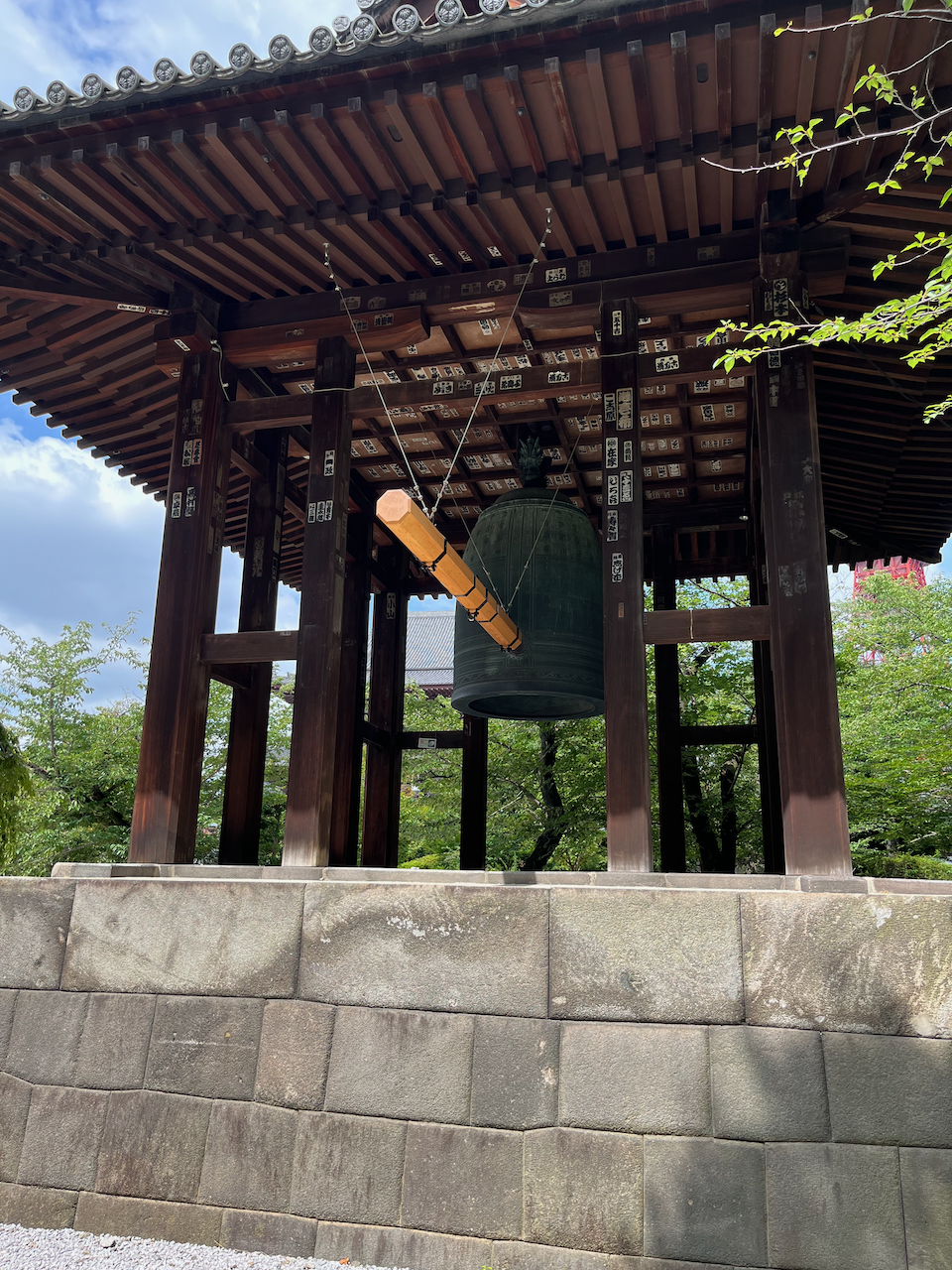
But New Year’s Eve, called Omisoka (大晦日), also has lots of traditions of its own. One of them is a tradition called Joya no Kané (除夜の鐘) which means ringing of the large temple bell, the bonshō (梵鐘). You can see an example of a Bonsho here from my last visit to Zojoji:

The tradition is that the bell is run 108 times before midnight. Why 108 times? This reflects the Buddhist concept that the mind has 108 defilements (bonnō, 煩悩). According to Wikipedia, the tradition actually began in China in the Chan (Zen) monasteries there, and there is a parallel tradition in Korea too, though they ring the bell 33 times.

Typically the ringing of the bell starts around 11pm, the local temple members line up, and each one takes turns rining the bell once, but pulling on the large beam that strikes the bell using a rope tied to it. Many temples will save the very last (108th) ringing until just after midnight. For this reason, the ceremony is often also called ni-nen mairi (二年参り, “two year crossing”).

This is a news clip from 2023 showing the ringing of the bell at Zojoji temple:

The temple of Chion-in (another favorite of mine) also has a dramatic bell-ringing ceremony too:

As for me, I’ve only attended one Joya no Kane in Japan in 2007, back when we used to visit family for New Years,1 my second visit there. My father in law owns a business that makes gravestones in Japan, so while he is not part of a particular Buddhist temple, he has many business partners that are Buddhist temples.

That particular year, he was invited to attend the Joya no Kane ceremony at a certain Jodo Shu-sect temple in the city. Because I was newly introduced to Jodo Shu Buddhism a few years earlier, I was excited to go. My father in law gave me this sutra book for Jodo Shu Buddhism, which I wrote about here. It was the first sutra book I ever owned, as far as I can recall.

I don’t remember which temple it was, but it was fairly large temple, and there were many people in attendance. The rest of the family wasn’t interested and stayed home to watch Japanese TV. My father-in-law and I sat for a brief Buddhist service, and a small sermon, then we started to line up for the temple bell ringing. I remember being somewhere near the middle of the line, maybe second half. The process took nearly an hour. It was late, cold, and waiting in line so long was a little tiring. When it was finally my turn, the moment went super fast so I barely remember what happened. The hanging beam was heavier than I expected, so I didn’t get a very good swing. Just enough to hit the bell and that was it.

We drove home after that, where my wife, daughter, and in-laws were all watching Kohaku Uta Gassen. All in all, it was a good night.

So, that’s my only memory of Joya no Kane, but I think it’s a near tradition and well worth attending if you ever get the opportunity.

Happy 2026 everyone and wishing you a wonderful new year.

1 When our firstborn was a little girl, we liked visiting in winter because there’s lots of fun things to do, but once she started grade school, we moved to summers. In either case, the winters in Japan are very cold, and the summers are extremely hot and humid.

The Many Names of The Nianfo

The nianfo (念佛) is widely recited across many cultures and languages by people who follow the Pure Land Buddhist tradition. In Japanese it is called the nembutsu (念仏), and that is the name I most often use on this blog. In Korean it is the yeombul (염불), and in Vietnamese it is the niệm phật. Just as the name differs by language, the phrase itself has changed pronunciation as it is adopted in other cultures and languages, just like the sutras did.

Let’s look at examples.

The original form of the nianfo (as far as I can tell) comes from Sanskrit language in India. In Sanskrit, “nianfo” was buddhānusmṛti (buddhānussati in Pāli language). The venerable site Visible Mantra states that it was recited like so:1

namo’mitābhāyabuddhāya

In the Siddham script, still used in some esoteric practices, this is written as:

𑖡𑖦𑖺𑖦𑖰𑖝𑖯𑖥𑖯𑖧𑖤𑖲𑖟𑖿𑖠𑖯𑖧

From here, Buddhism was gradually imported into China from India (a fascinating story in and of itself), and because Chinese language and Sanskrit are so different, this was no easy task. Nevertheless, the buddhānusmṛti was translated as nianfo (念佛) and written as:

南無阿彌陀佛

This was how the Chinese at the time approximated the sound of the Sanskrit phrase. In modern, Simplified Chinese characters this looks like:

南无阿弥陀佛

But how does one read these characteres? That’s a fun question to answer.

You see, Chinese has many dialects because of geography, regional differences, and migration of people. Thus, even though Chinese characters are written the same (with only modest regional differences), the way they are read and pronounced varies. Thanks to Wiktionary, I found a helpful list to illustrate:

Dialect or writing systemPronunciation
Mandarin, Pinyin systemNāmó Ēmítuófó or
Námó Ēmítuófó
Mandarin, Zhuyin (Bopomofo) systemㄋㄚ ㄇㄛˊ ㄜ ㄇㄧˊ ㄊㄨㄛˊ ㄈㄛˊ, or
ㄋㄚˊ ㄇㄛˊ ㄜ ㄇㄧˊ ㄊㄨㄛˊ ㄈㄛˊ
Cantonese, Jyutping systemnaam4 mo4 o1 mei4 to4 fat6
naam4 mo4 o1 nei4-1 to4 fat6
naa1 mo4 o1 mei4 to4 fat6, or
naa1 mo4 o1 nei4-1 to4 fat6
Hakka, Sixian or Phak-fa-su systemNà-mò Ô-mì-thò-fu̍t
Nà-mò Ô-nî-thò-fu̍t
Nà-mò Â-mì-thò-fu̍t
Eastern Min, BUC system
Nàng-mò̤-ŏ̤-mì-tò̤-hŭk
Puxian Min, Pouseng Ping’ing systemna2 mo2 or1 bi2 tor2 hoh7, or
na2 mo2 or1 bi2 tor2 huoh7
Southern Min (a.k.a. Hokkien), Peh-oe-ji systemLâm-bû O-bí-tô-hu̍t
Lâm-bû-oo-mì-tôo-hu̍t

Of these dialects, I am only familiar with Mandarin and (to a much lesser extent) Hokkien, so I can only trust the others based on Wikipedia.

Anyhow, China was a powerful, dynamic culture at the time, and it had a profound influence on its smaller neighbors such as the Korean peninsula, Japan, and northern Vietnam (a.k.a. Dai Viet). Just as the neighbors of the Romans (including the Byzantines) absorbed Roman culture, the neighbors of China did the same even though the languages were very different.

Thus, the nembutsu in these languages became:

LanguageHow to Recite
JapaneseKanji: 南無阿弥陀仏
Romaji: Namu Amida Butsu
KoreanHanja: 南無阿彌陀佛
Hangul: 나무아미타불
Romanization: Namu Amita Bul
VietnameseChữ Hán: 南無阿彌陀佛
Quốc ngữNam mô A-di-đà Phật2

What about Tibetan Buddhism? I am really unfamiliar with that tradition, so I might be wrong here, but my understanding is that Tibetan veneration of Amida Buddha stems from a different tradition, so instead of the nianfo, they recite appropriate mantras instead. Beyond that, I don’t know.

Anyhow, this is a brief look at how a simple Sanskrit phrase has evolved into so many traditions and ways to express veneration to the Buddha of Infinite Light. Thanks for reading!

𑖡𑖦𑖺𑖦𑖰𑖝𑖯𑖥𑖯𑖧𑖤𑖲𑖟𑖿𑖠𑖯𑖧
南無阿彌陀佛
Namu Amida Butsu

P.S. Another post despite my intended rest. The time off really has helped, so it’s been well worth it, but now I am eager to write again. 😌

1 As I’ve written before, writing Sanskrit in the more modern Devanagari script is kind of pointless since Sanskrit was never written in that until late in history, long after Buddhism in India was gone. Sanskrit does not have a native script either, so the Roman Alphabet is as god as any.

2 Brushing off my college Vietnamese, this is pronounced as “Nam-moe Ah-zee-dah-fut”.

The Japanese Way of Doing Things

My guide book on Japanese culture talks about a concept called sahō (作法), which in a mundane sense just means “instructions” for doing stuff. But the book explains that it also describes how things are done culturally:

… for example, in the case of the tea ceremony, every act is carefully choreographed, from where people sit, to how the water is boiled, to how the ea is prepared and so on.

Again, in the business world, one can observe sahō in action as the seller employs polite language and bows often as he shows various forms of respect to the buyer. Another case would be the social setting of a company, where a subordinate will use particular sahō with his boss.

Page 156

The book further explains:

For most Japanese, sahō is an ingrained pattern of behavior that affects their day-to-day actions without them even being aware of it. However, for people who come from overseas, some of these practices may appear puzzling. Why is someone bowing so many times in a particular setting? Or at another time, why is someone sitting ramrod straight? But for the Japanese, they are simply following the sahō that is appropriate for that place and circumstance.

I definitely experienced some of this confusion in the early years when I visited Japan with my wife. My in-laws kindly took me to a local Takashimaya department store and paid to get me a tailored suit. As a poor white kid in America, the experience was kind of awkward on a few levels: I wasn’t used to getting measured for a tailored suit, I wasn’t used to the very polite speech and mannerisms of the store employee, I wasn’t very good at speaking Japanese, and I wasn’t even used to owning my own suit.1

This concept of sahō isn’t limited to Japanese culture, of course. It is true, based on limited experience, that things can feel really choreographed in Japanese culture compared to American culture, but the idea of “how people do things” is universal. The American handshake is on example, the tendency for Russians not to smile during formal settings, the “pub culture” in Ireland and so on. There’s countless examples unique to each culture.

Even for a culture like Japan, where everything really is kind of choreographed, you do get used to it. The extra flourishes at the bookstore (wrapping the books, extra bowing, etc) were a bit confusing at first, but after a while, I don’t even really mind it anymore. Similarly, certain habits became ingrained more and more each time I visit.

So, when you encounter another culture, the important to bear in mind is that each culture has its own sahō, and it will be different than yours. Be observant, be flexible. If you do, you’ll quickly adapt and will succeed. People who stand like tall trees in the wind get blown down, but those who bend like grass prosper.

Food for thought.

P.S. Fun bonus post before Thanksgiving weekend! Happy Thanksgiving Day and Native American Heritage Day to readers in the US.

1 It is still the only suit I own, but I save it for important occasions only, such as my mother-in-law’s funeral. Speaking of sahō, funerals in Japan are very formal compared to American ones.

Amitabha: The Welcoming Buddha

During my wife’s latest trip to Japan (I stayed home this year for various reasons), she found this delightful patch/sticker:

This is an image of Amida Buddha, welcoming the deceased to the Pure Land. This is called raigō amida (来迎阿弥陀, “Amida welcoming the dead”). I talked about this before a little while ago, becuase it was a common artistic motif in medieval Japanese Buddhism, especially at a time where disease, warfare and death would often cut people’s lives short.

The imagery of Amida Buddha coming to greet the dead is found primarily in the Contemplation of Amitabha Sutra (a.k.a. “the Contemplation Sutra”). The last section of the sutra lists the nine grades of people who are reborn in the Pure Land, and the fourth grade (“highest level of the middle grade”) gives the following description, for example:

“When such a person is about to die, Amitayus [Amida] appears before him, surrounded by a host of monks and radiating a golden light. He then expounds the truth of suffering, emptiness, impermanence and no-self, and praises renunciation of the world as the way to escape from suffering.

“Seeing this, the aspirant greatly rejoices and finds himself seated upon a lotus-flower. He kneels down, joins his palms and worships the Buddha. Before he raises his head, he attains birth in the Land of Utmost Bliss, where his lotus-bud soon opens.

Translation by Rev. Hisao Inagaki

Depending on the grade of the aspirant, this welcome may be more or less elaborate, but all of them are reborn in the Pure Land somehow.

So, I like this patch because it’s a reminder of the goodwill Amida Buddha extends to all beings, and how everyone can be born in the Pure Land if they want to.

Namu Amida Butsu

P.S. I kept the patch in its wrapper for a long time, but finally decided to put it in a sutra book I’ve been making.

P.P.S. Accidental double-post. 🤦🏼‍♂️

Sacred Trees in Japan and Korea

Sometimes when you travel in Japan, especially outside of Tokyo, you may come across like this:

A large sacred tree at Kasuga shrine in Nara, Japan. Taken by me in July 2023.

This is a large tree that has been growing for centuries within the precincts of Kasuga Grand Shrine in Nara, Japan. The tree, as you can see, has a large rope tied around it with small paper streamers. If you ever saw the Studio Gibhli movie Totoro, you can see a big camphor tree with a similar rope around it.

Sometimes you also find rocks and other natural things with ropes around them too.

A “shimenawa” around an “iwakura” (sacred rock) at Meigetsuin, Buddhist temple in Kamakura, Japan, courtesy of Wikipedia.

This is a Shinto-religious custom using a special sacred, hempen rope called Shimenawa (注連縄). The little paper streamers called called Shidé (紙垂).

Shimenawa are sometimes used to section off a sacred space, but they’re also used to enshrine places thought to house a local kami, such as a tree or rock thought to be sacred. Sometimes you also see them hanging over home Shinto shrines (kamidana, 神棚). The idea is the same: the paper streamers help deliniate a sacred space (the inner sanctum of your home shrine in this case).

Interestingly, I discovered that a separate, but parallel tradition exists in Korea too. This blog shows that in Korean traditional culture, people would enshrine local guardian spirits by tying a rope (금줄, Geumjul) around them, and decorating with colored cloths (오색천, Osaekcheon) or white strips of paper. Such sacred trees (당산나무, Dangsan-namu) and sacred rocks (누석단, Nuseokdan), are collectively called Seonangdang. They are very similar in appearance to the ones in Japan, so it’s not hard to guess that there’s some common religious tradition between both cultures, though the Wikipedia article linked above also suggests a potential link to Mongol culture too.

Shinto as a religion exists only in Japan1 but it’s not hard to imagine that Shinto tradition drew from something much older that was shared across the Korean peninsula and Japan. Further, since it’s known that in early Japanese history that many Korean families migrated to Japan (the Imperial court sought their skills and technology), it’s quite possible the tradition was imported from Korea to Japan. Further, as this early Yamato court actively allied with the Korean kingdom of Baekche, it’s possible the cultural exchange went in that direction too.

Anyhow, it’s a fascinating example of how the two (or more) cultures have shared religious traditions for millenia, but few would notice.

1 Barring colonial efforts in the early 20th century to introduce it to other Asian countries, but these did not have a lasting impact culturally.