Years ago, when I was part of the local Jodo Shinshu Buddhist community, my minister told me a story about how Rennyo and Ikkyu, two famous Buddhist monks from 15th century Japan, were both good friends and would frequently test one another in their grasp of Buddhism. They were an unlikely pair of friends, given that they belonged to two very different Buddhist traditions, and yet they clearly had a rapport that you rarely find in Japanese-Buddhist history.
To be honest, I thought the story of them being friends was embellished, but I got curious recently poked around some Japanese sources on the Interwebs, and sure enough there were a number of famous anecdotes between Ikkyu and Rennyo. These anecdotes aren’t necessarily historically accurate, but they have been passed down through the generations and even show up in Japanese TV today.
But first, let’s introduce Ikkyu and Rennyo.
Ikkyu Sojun (一休宗純, 1394 – 1481) was a monk of the Rinzai Zen tradition,1 which was politically dominant at this time due to the Five Mountains System in Kyoto. He was disillusioned with the pomp and grandeur of the Zen community at that time, and left to live a more “authentic life” among the people. He is famous for his flashes of genius, and his artistic talents, but also his unorthodox behavior, including partying and sleeping with girls. Ikkyu left behind many excellent poems, paintings, and his genius image has made him a popular figure even in modern Japan.
Rennyo (蓮如, 1415–1499) was the eighth head of the ancestral Honganji Temple in Kyoto,2 which ostensibly was the head temple of the Jodo Shinshu sect. Trouble was, the movement was very fractured, with regional groups, rival powers, etc. And then there were the warrior-monks of Mount Hiei (head of Tendai sect) that wanted him dead. Rennyo had to flee Kyoto for a long while to the provinces, but used the time to unify the Jodo Shinshu groups into a more cohesive sect for the first time. His Letter on White Ashes, is a particularly inspired piece of writing.
Ikkyu was 20 years older than Rennyo, but in many anecdotes, they are making jokes with one another, or testing each other’s wisdom.
In one famous story (used in the “Ikkyu-san” cartoon), Ikkyu had put up a sign near a really crooked pine tree. The sign read whoever can see this pine straight, I will give them a kanmon of gold.
People were stumped, and brought this to Rennyo’s attention. Rennyo said, “pfft, more of Ikkyu’s mischief. I see this pine straight. I’ll get the cash.”
When Rennyo confronted Ikkyu about it, Ikkyu said, “Oh, it’s you. You don’t count. Look at the back of the sign.”
Sure enough, on the back of the sign was painted “EXCEPT RENNYO”.
When people ask Rennyo how he was able to see the crooked pine straight, Rennyo said that he saw it for what it was: a crooked pine. By seeing it for what it really was (a crooked pine), he saw it “straight”.
In another anecdote, for which I could find the original Japanese, Ikkyu had read the Amitabha Sutra and commented:
阿弥陀には まことの慈悲はなかりけり たのむ衆生のみぞ助ける
Amida Buddha has no true compassion; he only helps those who ask.
Rennyo is invoking the imagery of Amida Buddha’s compassion as moonlight, which we’ve seen before, and how it shines everywhere. But if water is in a container (has a lid on it), the moonlight will not reflect back.
Ikkyu tested Rennyo again:
極楽は十万億土と説くなれば 足腰立たぬ婆は行けまじ
If the Pure Land of Amida Buddha is indeed 10,000,000,000,000 lands away [as described in the sutras], then an elderly woman who is unable to stand cannot go there.
In another story, Ikkyu attended the 200th memorial of the founder of Jodo Shinshu (and Rennyo’s ancestor), Shinran. Of Shinran, Ikkyu wrote the following verse:
襟巻の あたたかそうな黒坊主 こやつが法は 天下一なり That black[-robed] monk with the warm [as in “kind”] head and scarf, his Dharma teachings are peerless.
There are a lot of other stores too, and I’ll try to share more as I find them, but I thought these were neat. Zen and Pure Land Buddhism are often treated as separated teachings, and separate sects, but I suspect that as with any Buddhist path if you get far enough along, you’ll start to run into people of the same mind.
That, in my humble opinion, is the power of the Lotus Sutra and its many gates.
1 Zen in Japan is divided into 3 schools: Soto, Rinzai and Obaku, all imported from China at various points in history. Rinzai and Obaku both have the same “ancestral lineage” in China, but arrived in Japan at different points. Soto comes from a different lineage entirely in China.
2 A few generations after Rennyo, the Honganji split into two temples: Nishi (West) Honganji, and Higashi (East) Honganji after a family split, plus politics. They are effectively equal, but different sub-sects.
In our last episode (… a few months ago 😓) Xuan-zang met the Qaghan of the Western Turkic Khaganate, and made a good impression, allowing him to travel safely further south and westward toward the city of Samarkand.
Map of Xuan-zang’s journeys from Tashkent to Balkh. Inkarnate put out a new version of its software while I was on break, so some things may look different than past maps. As always, this is an amateur map, and may contain geographic mistakes.
If you need to brush up on earlier episodes, click below:
Samarkand is a fascinating place: a fabulously old city, and a major hub on the Silk Road. All the way back in the time of Alexander the Great’s conquests in 329 BCE, 1,000 years before Xuan-Zang, the city was called Marakanda (Μαράκανδα) in Greek and was part of the Achaemenid Persian Empire before that. By Xuan-zang’s time the city was part of the Sassanian Persian empire, and still a major trading hub, known even to the Chinese, but I was unable to find a reliable source on the Chinese name at the time. Modern term is 撒马尔干 (sǎ mǎ ěr gàn ?). The city at this time was almost entirely populated by Sogdian Iranian people, whom we’ve also seen in past episodes. This far west from China, Xuan-Zang probably saw very few if any Chinese people, and instead encountered many people from other cultures and parts of the world. He was very much a “stranger in a strange land”.1
However, because this city was part of the Sassanian Empire, the official religion was Zoroastrianism, not Buddhism, and as Xuan-zang came to the city, he noticed that the Buddhist monasteries there were abandoned and neglected. Some of Xuan-zang’s followers went to pay their respects at these monasteries, but they were chased off by a mob of Zoroastrian followers with flaming brands. Later, the king heard what happened and arrested the mob leaders and was going to pass sentence to mutilate them. Xuan-zang begged for leniency, and so they were flogged and expelled from the city.
The king of Samarkand wasn’t particularly friendly to Xuan-zang, but their relations did improve. Further, it seems that later the king of Samarkand made friendly, diplomatic overtures to Tang-Dynasty China as a foil to the Western Turkic Khaganate, but these did not go very far. Decades later, Great Tang’s expansion reached all the way to Samarkand and they briefly ruled for a few decades until the Battle of Talas later. All this happened decades after Xuan-zang visited the city though.
In any case, Xuan-zang wisely did not stay long in the city and turned at least to towards the south.
Heading South
Up until now, Xuan-zang’s journey from the Yumen Pass in China to Samarkand, over the Tian Shan mountains and across two deserts, has mostly been a westerly journey. But this was as far west as Xuan-zang would go. The road to India was now in a south-southeasterly direction passing through places like modern Afghanistan, Pakistan, and Uzbekistan. These areas were not part of Sassanian Empire, and instead were local princes and minor rulers with complicated relations with regional powers. These areas were more Buddhist-friendly as well due to the legacy of Bactrian Greeks,2 but more importantly due to the Kushans who came later. Much of these lands were former Kushan territory, and their good governance and patronage of Buddhism at the time allowed things to flourish on the Silk Road.
The first obstacle Xuan-Zang and his party ran into was the famous “Iron Gates“.
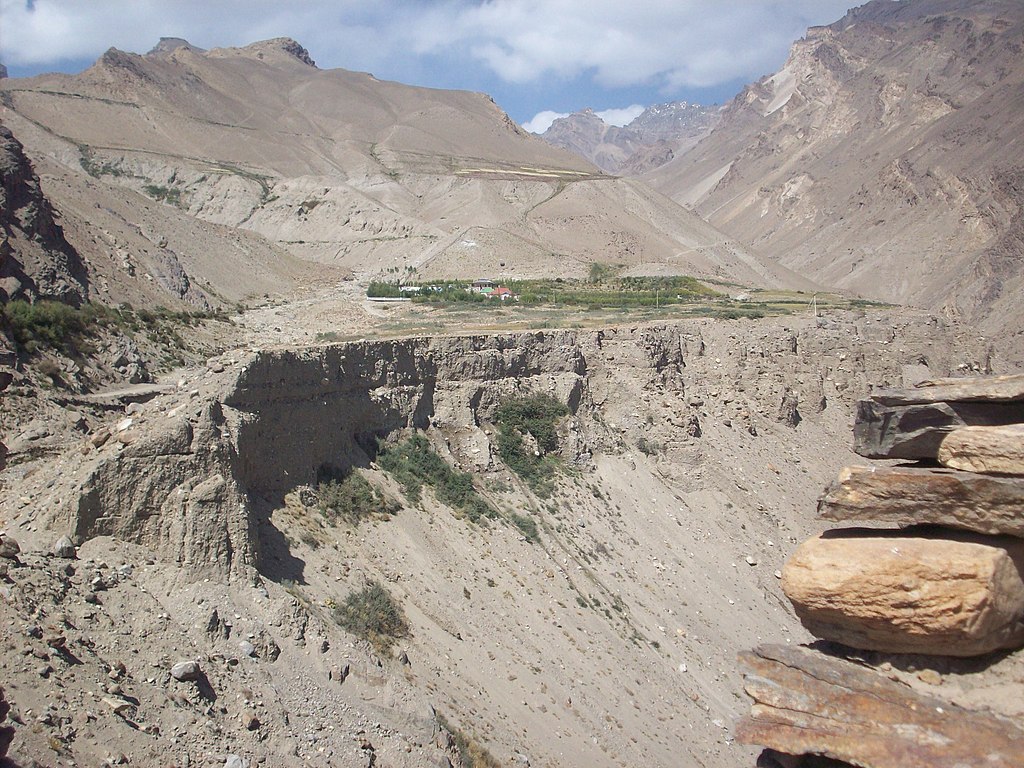
A valley in the Badakshan Province in Afghanistan, close to the where the Iron Gates would be. Photo by Zack Knowles, CC BY-SA 3.0, via Wikimedia Commons
Because this area was a choke-point for travel, it was often garrisoned, and he described “double wooden doors, strengthened with iron and furnished with bells”. In any case, Xuan-zang seemed able to pass through without much issue.
After crossing the Oxus River (now the Amu Darya), he returned to regions where Buddhism was still flourishing namely in the small city of Termez. Termez was once a major city of the Kushan Empire, but was much more diminished by the time Xuan-zang arrived. The Buddhist community here numbered about 1,000 monks. It was here that he saw the Ajina Tepe monastery and its excellent works of art.
In fact, from here Xuan-zang would behold some pretty amazing spectacles. Many people may not realize that the lands we now call Afghanistan were once bastions of Buddhism along the Silk Road, and boasted many treasures, monasteries, and a very eclectic culture.
But first, Xuan-zang had to deal with a series of problems in the city of Kunduz.
Xuan-zang’s visit to the city of Kunduz was no accident. After meeting the king of Turfan way back in episode one, and the Qaghan of the Western Turks in episode three, he had many letters of introduction to the Prince of Kunduz named Tardu. As rulers on the Silk Road, they were all related by family or marriage, so Xuan-zang had little trouble getting an audience with Prince Tardu.
Except for one problem: the Prince’s wife had recently died, and he was in mourning. Later, Tardu abruptly married another daughter of the king of Turfan (episode one), and she in turn plotted with his son from the first marriage. This is starting to sound like the plot of a historical K-drama, doesn’t it?
Before long, Prince Tardu was poisoned and died. The new queen married the prince, and ruled Kunduz thereafter.
Xuan-zang did his best to lay low, and stay out of the issue. His delays at Kunduz meant that he had time to get to know another Buddhist monk named Dharmasimha. Dharmasimha and Xuan-zang debated Buddhist thought and treatises for some time, but Xuan-zang felt Dharmasimha didn’t know as much as he was hyped up to. Dharmasimha for his part, acknowledged his shortcomings, and tried to stay humble about it.
Moving On
Before Prince Tardu’s death, he had encouraged Xuan-zang to visit another city named Balkh, also in modern Afghanistan. Balkh had quite a few sites to see, and since some Buddhist monks were already planning to head back there, Xuan-zang accompanied them. After passing through a city named Tashkurghan (modern Kholm, not related to a similar city in China), they reached the verdant lands of Balkh.
The city of Balkh, known to the Greeks of Alexander the Great as Baktra (Βάκτρα) and Baítíguó (白題國) in Chinese to Tang-dynasty China, was important since very far back in antiquity. Balkh was the traditional birthplace of the Zoroastrian religion, and an important cultural center to Persian people since very ancient times, rivaling cities further to the west such as Babylon and Ecbatana in importance. According to Buddhist tradition, the first two of the Buddha’s disciples also hailed from Balkh, and made the first stupa. Centuries later, it was here that Alexander had married a bride named Roxana, seeking to unify western Greek culture with the eastern Persian culture. Later in the Hellenstic Age, it was an important center of the Greco-Bactrian kingdom.
Needless to say, while few people have heard of Balkh today, it was a very important city across many centuries.
During Xuan-zang’s time, the lands around Balkh were still very fertile (desertification happened gradually later). Even with the widespread destruction the Hephthalities (a.k.a. “white huns”), the lands were still prosperous, if somewhat depopulated. There were two major monasteries in the area collectively known as the Nava Vihara, that belonged to the Sarvastivadin tradition of “Hinayana” (early Indian) Buddhism.3 There were tens of thousands of monks in attendance, and Balkh was one fo the remaining places where teachers were regularly installed from India. Similar to Bamiyan, the Naha Vihara boasted massive statues of the Buddha as well. Interestingly, even as far as the 8th century, long after Xuan-zang was dead, an Arab historian named Umar ibn al-Azraq al-Kermani recorded a place of worship here similar to the Kabaa in Mecca. But instead a Buddhist stupa was enshrined inside, with a cloth draped over it, in accordance with Persian custom of showing veneration.
Xuan-zang stayed at the Nava Vihara for a month, and became good friends with a monk there named Prajnakara. Xuan-zang seemed to finally find a monk of high-caliber, who had a good depth of understanding of Buddhist doctrine, even if he was a “Hinayana”, not Mahayana Buddhist. The two journeyed together further south to Bamiyan.
In our next episode, we’ll explore Xuan-zang’s visit to the great Buddha status of Bamiyan, and Xuan-zang is reaching the borders of India. But first, he has to cross the Himalayas…
3 Although the Sarvastivada school was not Mahayana Buddhism, Mahayana Buddhism inherited a lot from it anyway: canon of texts, certain viewpoints, etc. Another important early school that influence Mahayana were the Dharmaguptaka, who mostly gave their monastic traditions and rules to the Mahayana.
Author’s note: I reposted this from the other blog. There’s a lot of overlap here, and it just made sense to post in both blogs (probably the first I’ve ever done that in 11+ years!). If you’ve already read the other post, apologies for posting again.
In a lesser-known Imperial poetry anthology called the Shui Wakashu (拾遺和歌集), poem 1342, is recorded what is believed to be Lady Izumi’s1 final poem:
Japanese
Romanization
Translation
暗きより
Kuraki yori
The way I must enter
暗き道にぞ
Kuraki michi ni zo
leads through darkness to darkness —
入りぬべき
Irinu beki
O moon above the mountains’ rim
はるかに照らせ
Haruka ni terase
please shine a little further
山の端の月
Yama no wa no tsuki
on my path.
Translation by Jane Hirshfield and Mariko Aratani in The Ink Dark Moon.
This poem was addressed to a Buddhist monk named “Shoku” and includes several Buddhist allusions. The most important is the phrase “darkness to darkness”, which comes from chapter seven of the Lotus Sutra:
….from darkness they [living beings] enter into darkness, to the end never hearing the Buddha’s name [hear the Dharma].
This refers to the Buddhist notion of Samsara, the near-infinite, aimless wandering that living beings undergo lifetime after lifetime, like a cosmicrat race. Such beings, who have yet to hear the Dharma [the teachings] of the Buddha, will continue to wander lifetime after lifetime without rest.
Thus, Lady Izumi is asking Shoku to help shine a light in the darkness for her, so that she may find the way [follow the Buddhist path].
I had trouble deciding which blog to put this in, since it covers both themes, but I decided to originally post in the other blog since the poem was introduced in the new historical drama about Lady Murasaki, Izumi’s contemporary.
Lady Izumi was, to put it mildly, a complex woman. She had incredible talent, and found herself in one scandal3 after another as powerful men fell at her feet, plus she earned scorn from other women such as Lady Murasaki. And yet, she was also very kind, devout and struggled to balance both the religious and worldly aspects of her life, while raising her orphaned granddaughter.
Hirshfield and Aratani note that if this poem is indeed her last, the final word she ever wrote was tsuki (月), “moon”.
2 alternate translation by Murano reads: …they go from darkness to darkness, and do not hear of the names of the Buddhas.
3 this was a conservative, narrow, aristocratic society where men frequently had affairs, but it was much more scandalous if women did. The idea that women could want, and enjoy sex, was not something people really accepted at the time.
One of the most influential sacred texts in Buddhism is the Lotus Sutra.
The Lotus Sutra has had a tremendous influence on Buddhism as we know it today. Much of Buddhist culture as we know it either came from the Lotus Sutra, or was influenced by its ideas and teachings. Not everything, of course. But the influence is hard to ignore. If you know the Lotus Sutra, a lot of things about Buddhist culture make more sense.
A copy of the Lotus Sutra enshrined at a Vietnamese Buddhist temple. Taken at Ksitigarbha Temple in Lynnwood, WA in 2013.
Because the Lotus Sutra has been translated to many different cultures at different times, it has had many names:
Original language
Title
Romanization
Sanskrit
Saddharma Puṇḍarīka Sūtra
n/a
Chinese
妙法蓮華經
Miàofǎ Liánhuā Jīng
Vietnamese
妙法蓮華經 (Han Nom) Diệu Pháp Liên Hoa Kinh (modern)
n/a
Korean
妙法蓮華經 (Hanja) 묘법연화경 (Hangeul)
Myobeop Yeonhwa gyeong
Japanese
妙法蓮華経
Myōhō Renge Kyō
Tibetan
དམ་ཆོས་པད་མ་དཀར་པོའི་མདོ
Damchö Pema Karpo’i do
The full title in English is the Sutra on the White Lotus of the True Dharma, but usually we just call it the “Lotus Sutra”. Similarly, in other languages, the full title of the Lotus Sutra is shortened as well. For example, in Japanese, Myōhō Renge Kyō is shortened to Hokekyō.
But I digress.
The Lotus Sutra is not short, and for new Buddhists it is not easy to read. Composed in India in the first century CE, it is divided into 28 chapters, so it reads like a full book. Many of these chapters have a prose section, then repeats itself in one or more verse sections.1
Like all Buddhist texts, or sutras, it presents its teachings in the form of a sermon by the historical founder of Buddhism, Shakyamuni Buddha (“Shakyamuni” for short). Could the Buddha have given such a long, long sermon all in the span of one sitting? Probably not. But that’s how Buddhist sutras are usually presented.
Through the Buddha, the Lotus Sutra teaches many parables and similes to get its point across. Many of these parables took on a life of their own and frequently appear in Buddhist art or literature. Others are strange and obscure to modern readers. In fact, if you’re just reading the sutra for the first time, it really helps to have some kind of side-by-side guide to help make sense of it because if you tried to read it literally, you will get a headache. Thich Nhat Hanh’s book Opening the Heart of the Cosmos really helped me a lot.
For example, the chapter with the Sermon in the Sky, where a second Buddha named Prabhutaratna appears, and everyone flies up impossibly high to hear their sermon, and the Buddha projects himself across many worlds, is a difficult read. If you try to read at face-value, it reads like a fever dream.
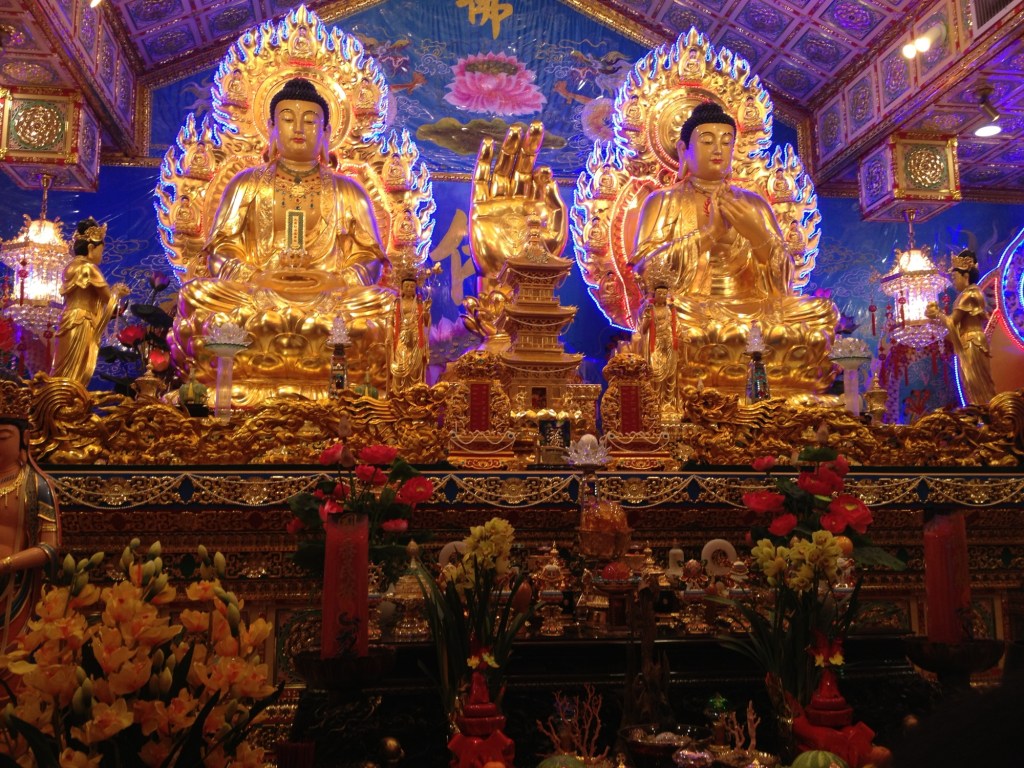
A mural from the Yulin Grotto in China. See page for author, Public domain, via Wikimedia CommonsAn altar revering the two buddhas, Shakyamuni and Prabhūtaratna, from the eleventh chapter of the Lotus Sutra, enshrined at a Vietnamese temple. Taken at Ksitigarbha Temple in Lynnwood, WA in 2013.
But the style of the Lotus Sutra isn’t to appeal to the head, it tries to appeal to the imagination. It is one thing to say that life is impermanent, it is another to describe the world as a great burning house, with people inside too distracted to notice. When the Buddha is shown projecting himself to countless worlds, it is just a colorful way of saying that the Dharma is everywhere, and there are countless buddhas across many worlds each preaching according to the environment. When the Buddha describes archetypal bodhisattvas in the later chapters, each one is meant to convey a different Buddhist virtue.
Deep stuff.
The Lotus Sutra was pretty radical for its time, and a core part of the larger Mayahana-Buddhist reform movement. The parable of the Dragon Princess, attaining enlightenment faster than any was obviously meant to blow the minds of the establishment, and challenge certain cultural prejudices about women, and so on.
A 12th century Japanese mural from the Heike Nokyo, depicting the Dragon Princess offering a jewel to the Buddha before transforming. Public domain, via Wikimedia Commons
Similarly, the chapter where countless streams of “bodhisattvas of the earth” emerge from the ground was meant to show how we didn’t need to rely on elite gurus, but that everyone had the capacity for being a bodhisattva too, if they just had the confidence.
I’ve talked about the main themes of the Lotus Sutra in an older post, but I wanted to cover two really important ones.
First, the most important teaching of the Lotus Sutra is probably the “One Vehicle” (Ekayāna) teaching. Previously, the reform Mahayana, or “great vehicle” Buddhists, bickered with the traditional Buddhist establishment (called Hinayana, or “small vehicle”), and traded barbs witih one another. You can see this is in some of the really early sutras composed by Mahayana Buddhists.
But then the Lotus Sutra took a step back and looked at the big picture, and taught that it was all just Buddhism (e.g. “one vehicle”) anyway. There were many places to start, and ways to move forward, but in time they would all converge, and the quality of one buddha was no different than another. What worked for one person didn’t necessarily work for another. There was no use bickering, any effort great or small was worth it.
Second, the other major teaching of the Lotus Sutra is that the Buddha was far, far older than history would tell us. The sutra implies that the Buddha would appear in some time and place, restart the Buddhist community, grow old and die, but that was just trick to keep people getting attached to the Buddha. This seems pretty disingenuous.
But what the sutra is trying to tell us is that the Buddha just personifies the Dharma (the teachings), and that the Dharma is the Buddha. Since the Dharma, the principle of existence, has always been around, in the same way one can see the Buddha also being around in one form or another, even in the darkest of times. Where does one begin, and the other end? I think the Mahayana Buddhists who composed it wanted people to stop getting hung up on the physical/historical Buddha, avoid a “cult of the Buddha”, and focus on the Dharma.
As a side note, the Lotus Sutra frequently promotes itself. It says that anyone who sincerely hears the Lotus Sutra, and praises it gets all kinds of benefits. But is not the Lotus Sutra as the written text from 1st century India. Like the “eternal Buddha”, this is the Lotus Sutra as the ultimate teaching (e.g. the Dharma) in its unvarnished form.
Thus, the Lotus Sutra is in some ways a very strange text because it is so dense with metaphor, simile and parables to get things across. But when you look at all the artwork and culture influenced by it, you can see that it gets something right. Rather than appealing to intellect, it conveys its messages through more impactful means. It is one of those texts that you keep referring back to over the years because it stands out so much.
Speaking from experience, it helps not to read it from cover to cover. Instead, focus on one chapter, try to suss out the meaning. Some chapters are, in my experience, a little bland, others are really moving. Sometimes a chapter won’t make any sense, then years later you will have an “ah ha” moment and you see it in a new light.
Speaking from experience. 😏
P.S. I probably own 3-4 translations of the Lotus Sutra, the Gene Reeves translation is probably the easiest for beginners in my opinion, but I like them all in their own way.
1 Researchers believe that the verses actually came first, and then the authors composed narrative around them.
A little while ago, when talking about Japanese mythology, I alluded to the belief in the divine origins of the Japanese imperial family through their reputed ancestor Amaterasu Ōmikami (Amaterasu for short), kami of the sun. This lineage and how they came to rule Japan is recorded in two very old historical texts: the Kojiki and the Nihon Shoki.
Since I have been reading a fun book in Japanese about the Nihon Shoki, we will focus on that one. Just know that the origin story in Kojiki is mostly the same.
The Nihon Shoki begins as a series of myths about the creation of Japan, followed by stories of different generations of kami, culminating in Amaterasu’s grandson, Ninigi-no-Mikoto who descends to earth. Next, Ninigi had a great-grandson, named Kamu-yamato Iware-biko no Sumeramikoto (神日本磐余彦天皇),1 and in time “Iware-biko” became the first emperor of Japan, the legendary Emperor Jimmu (jimmu tennō, 神武天皇).2 We’ll explore later why this is more myth than history, but for now, let’s continue the story as recorded.
In his youth, the future emperor grew up in what later became the province of Hyuga in southern Japan, also called Himuka (日向) in olden times. By the age of 45, he had married, had children, and took care of his brothers. Then one day, he proclaimed to his family that due to his divine lineage, it is his destiny to rule the lands to the east (central Japan) which are rich and verdant, and to establish his capital there.
From here, Iware-biko sets out with his kin to the island of Honshu, the main island of Japan, and begins the invasion of the “Yamato” region, starting at the bay of Naniwa (later Osaka). It is here they come into conflict with the a local chieftain named Naga-sune-hiko. Sadly, Iware-biko’s older brother was killed, and the newcomers were forced to retreat. Iware-biko then reasoned that by fighting eastward, facing the rising sun, they lost the battle. Thus, he decides to sail south around the Kii Peninsula, and then attack from the east (i.e. westward). Upon reaching the region Kumano, they encountered a huge crow named the Yatagarasu (八咫烏) where “ata” 咫 means a hand-span from the thumb to the middle finger, about 18cm. So, the crow was 8 hand-spans long. The Yatagarasu was dispatched by the kami Amaterasu to help her descendant as a guide.
Once again, Iware-biko and his clan battled Nage-sune-hiko long and hard. Then, a golden-colored kite (as in bird), called the kinshi (金鵄), mounted on Iware-biko’s bow (hence the depiction above), and its blazing glare blinded their enemies. They were defeated at last.
From here, Iware-biko pacified the region, and assumed the throne as the first Emperor, Jimmu, and proclaimed that his line would “last 10,000 generations” (lit. mansei ikkei, 万世一系). Further, according to the Nihon Shoki, the first Emperor then proclaimed the phrase hakkō ichi-u (八紘一宇), or more elaborately “all under Heaven [lit. the eight corners of the world] under one roof”. The idea was basically one of universal brotherhood.
Allegedly, this unification of Japan, and its founding by Emperor Jimmu, all happened in the year 660 BCE.
Fast forward to the year 1940, as in 1940 CE.
This period was the height of Japanese militarism in the modern era, and the Youtube show Extra History has a brilliant miniseries on it:
I highly recommend viewing the miniseries if you are curious, but it helps explain a lot.
Anyhow, by 1940, this trend of nationalist fervor reached a crescendo, and it was coincidentally 2,600 years since the mythical founding of Japan. When the Greater East Asia Co-Prosperity Sphere was promulgated in 1940 by the Prime Minister at the time,3 Prince Konoe Fumimaro, he repeated an ancient phrase said to have been spoken by Emperror Jimmu: hakkō ichi-u (八紘一宇, “Eight corners of the world under one roof”). However, in Fumimaro’s modern interpretation, Asia would be united in a union of brotherhood, with Japan at the center (i.e. under one Japanese roof). This was repeated during war times as a rallying slogan as well, and questioning the historicity of the Nihon Shoki at that time was illegal.
There’s a small problem with the original historical narrative about Emperor Jimmu, though: it’s unlikely he ever existed, and it’s very doubtful that Japan was founded in 660 BC.
There is basically no archeological evidence that the early “Yamato” kingdom existed in Japan during this time. In fact, the earliest emperor that has any reliable archeological evidence is Sujin the 10th emperor, who is thought to have died around 30 BCE, 600 years later. Sovereigns weren’t even called “emperors” (tennō, 天皇) at the time, but “great kings” (dai-ō, 大王) instead. The term Emperor was reputedly used by Prince Shotoku centuries later.
So, why 660 BCE, and why the mythical lineage that probably didn’t exist?
Because the Nihon Shoki was not written for Japanese audiences. It was written for Chinese audiences in order to introduce Japan and its history. The Kojiki, conversely, was written for domestic audiences. Many of the early dates and lineages don’t line up properly, have insufficient historical evidence, or have imperial reigns that are unnaturally long. Yet as a narrative it seamlessly transitions between a divine kami ancestor and the current reigning family, and helped provide legitimacy in the eyes of the much larger and more powerful China. Even the date 660 BCE, 1260 years before the Nihon Shoki was completed, fit seamlessly with the Taoist 60-year calendar cycle to imply an auspicious beginning.
People did live in Japan back then, but we know from archaeological evidence that these were mostly hunter-gatherers, and rulers might be local chieftains at best.
What the Nihon Shoki does tell us though, through its legendary stories, heroes and such, is that pre-historical Japan was a place of many tribes, communities and confederations, and that over time the “Yamato” group came to increasingly dominate or incorporate them. For example, the ancestral kami, Ninigi, had a son in the Nihon Shoki named Yamasachi-hiko whose name includes “mountain”. Yamasachi-hiko married Toyotama-hime, who was a daughter of a sea deity. The fusion of mountains and sea ancestries is not lost on scholars.
Further, my book explaining the Nihon Shoki shows how some myths include subtle allusions to rival confederations who were defeated (or absorbed) by the early Yamato rulers. One noteworthy rival were the people of Izumo, for example. So, the Nihon Shoki can tell us a lot of interesting things about how Japan was founded, but not necessarily in the way we expect.
1 Many early figures in Japanese mythology had extremely long, grandiose names, by the way. My book on the Nihon Shoki likes to give amusing nicknames for ease of reading.
2 Thus, Emperor Jimmu was five generations removed from Amaterasu. The Nihon Shoki coveres stories and myths of each generation in between, but they are too numerous to list here. Needless to say, once Ninigi-no-Mikoto descends to the earth, things got wild.
3 Ostensibly to kick European Colonialism out of Asia, but it mostly ended up replacing European colonialism with Japanese colonialism. Not surprisingly, after WWII, many South East Asian countries fought for independence when the Europeans tried to reassert control. Enough was enough.
I had a bit of free time today, and I finished up another episode of the Japanese historical drama, the Thirteen Lords of the [Kamakura] Shogun (discussed here), the episode where Minamoto no Yoshitsune has been killed at last, which I talked about in a recent post. It was a really heavy, dark episode, but also really moving. I really wish this show was available overseas.
As with every episode, the show has a nice segment at the end showcasing where these events actually took place in Japan, and some extra history as well. It seems that Yoshitsune died at a place called Takadachi (高館) near the village of Hiraizumi (平泉) in the old province of Oshu, but now modern Iwate Prefecture. Evidentially, the famous Haiku poet Matsuo Basho visited there centuries later in 1689 when Yoshitsune, and the Northern Fujiwara clan that protected (then betrayed) him, were nothing more than ancient history.
According to Basho’s own travel diary, the Oku no Hosomichi (おくのほそ道) or “The Narrow Road to the Interior”, when he visited the Takadachi, he composed this haiku:
Japanese
Romanization
My Amateur Translation
夏草や
Natsu kusa ya
Ah summer grass:
兵どもが
Tsuwamono domo ga
fleeting echos of
夢の跡
Yume no ato
great warriors past
Usually this haiku is translated as something like “Summer grass is all that remains of warriors’ ambitions” or something along those lines, and that’s what I first thought. However, then I found this site, which makes a convincing argument that the nuance is a little different. The key is the word yumé (夢) which means “dream”, much like in English. However, in Basho’s time, it was more narrowly used to refer to sleep only, not ambition.
Evidentially it is a common trope in Noh Theater where a character dreams about someone important who died, and their restless spirit is unable to move on to the afterlife. But then the character wakes up, and the spirit disappears. Since Basho was no doubt familiar with Noh drama and its iconic stories, the site above argues that it’s possible that Basho was referring to echoes of the past, not warrior’s ambitions. Maybe he dozed off and dreamt of Yoshitsune, Benkei his stalwart partner, and the lords of the Northern Fujiwara. Or maybe he still felt their lingering presence. Who knows?
That is why I translated it the way I did. The rhyming was coincidental, but kind of catchy so I kept it in there. Apologies for any mistakes or clumsiness of the translation.
Out of all the haiku I’ve read, I find this one particularly moving for some reason especially with the alternate interpretation.
Namu Amida Butsu
P.S. Another of Basho’s haiku, commemorating another slain member of the Genji (Minamoto) Clan.
I’ve talked about the first shogun of Japan’s new Kamakura government, Minamoto no Yoritomo and his betrayal of his vassals here and here, but I also alluded to his execution of his younger half-brother, Minamoto no Yoshitsune. Yoshitsune’s downfall is indeed a sad tale. But as we’ll see, Yoritomo’s own downfall, while slower, wasn’t much better.
Minamoto no Yoshitsune was a military genius and the youngest of nine sons of Minamoto no Yoshitomo (Yoritomo was the oldest). When Yoshitomo was executed by his rival, Taira no Kiyomori, the half brothers were all scattered in exile, but gradually reunited under Yoritomo. Out of these brothers, Yoshitsune was the most talented in warfare. Yoshitsune led the led against the Heike clan and eventually destroyed it in the battle of Dan-no-ura.
Yoshitsune has been celebrated throughout Japanese history as the ultimate warrior, who along with his companion Benkei, went on many adventures and fought many battles. Yoshitsune’s bravery and unconventional strategies, coupled with Benkei’s stalwart strength and loyalty have been the subject of many Noh and Kabuki plays, as well as many works of art.
The famous battle between Benkei and Yoshitsune on the Gojobashi bridge in Kyoto. Photo courtesy of Wikimedia Commons.
But one thing Yoshitsune was not good at was politics. Once the Heike were destroyed, tensions rose between the new military commander (shogun 将軍), namely his older half-brother Yoritomo, and the conniving emperor Go-Shirakawa. The Imperial family had lost power due to the Heike clan, and were eager to get it back. The Genji clan defeated the Heike and weren’t keen to hand over their hard-fought power.
Yoshitsune was caught between these two men, and used as a proxy for their struggle for power. The Emperor, grateful for Yoshitsune’s efforts appointed him Kebiishi (検非違使): the Sheriff of Kyoto the capitol. Accepting this position, however, meant that Yoshitune was now working under the Emperor, not his half-brother the Shogun, and Yoritomo was evidentially furious by this. From here on out, he began to suspect his baby brother of plotting to overthrow him. The historical drama, Thirteen Lords of the Shogun, implies that certain retainers, perhaps jealous of Yoshitsune, may have been whispering in Yoritomo’s ear, fanning his paranoia further. When Yoshitsune tried to return to Kamakura to talk to his brother directly, he was refused entry and had to idle in the nearby town of Koshigoé.
While staying at Koshigoe, Yoshitsune wrote the following letter to his older brother:
So here I remain, vainly shedding crimson tears….I have not been permitted to refute the accusations of my slanderers or [even] to set foot in Kamakura, but have been obliged to languish idly these many days with no possibility of declaring the sincerity of my intentions. It is now so long since I have set eyes on His Lordship’s compassionate countenance that the bond of our blood brotherhood seems to have vanished.
Painting of Shizuka from 1825 by Hokusai, Public domain, via Wikimedia Commons
Yoshitsune was unable to ease his older brother’s concerns, nor did he want to be under control of the Emperor either, so he bowed out, and retreated to the province of Ōshū way up north, where he had previously been exiled. It was familiar land, and the ruler of Oshu promised to watch Yoshitsune on behalf of Yoritomo, while also protecting him from Yoritomo. With his mistress, Shizuka,2 they moved there and things were quiet for a time.
However, Yoritomo wasn’t satisfied. When Yoshitsune’s keeper passed away, the keeper’s son hatched a plan with Yoritomo to allow Yoritomo’s troops to attack his Yoshitsune’s house.
Legends hype up this last stand by Yoshitsune (with Benkei defending), but in any case, Yoshitsune the famed military commander was killed by his own half-brother, and his head was preserved in a box with sake. Yoshitsune was later enshrined as a kami at Shirahata Shrine in Fujisawa.3
Yoshitsune died in 1189, and by 1192 Yoritomo was in full control of Japan since the Emperor had died as well. As the shogun, the supreme commander of military forces, no one could oppose Yoritomo any longer, the country had been pacified at last, and he had avenged his father for his wrongful death.
……..but, this came at a steep, steep price. Yoritomo had to dodge other assassination attempts, and spent the remaining years of his life constantly watching his back. He had paid for his power in blood and betrayal, and even after taking tonsure as a Buddhist monk,4 he never really found any peace. When he died at age 51, more than a few probably sighed in relief. Yoritomo was powerful, and crafty, but he was brutal and paranoid, and everyone around him spent their lives in constant fear. One can not help but see the similarities to certain dictators today.
P.S. if you go to Tsurugaoka Hachimangu shrine in Kamakura, Japan, you can see a tiny museum, just to the left of the inner sanctum, which has relics from Yoritomo’s life. It’s easy to miss, but tickets are cheap, and it’s amazing to see. We saw it in December 2022, just after watching the historical drama, and it was pretty amazing. The new, larger museum near the front entrance is also great. A visitor can easily spend half a day at Tsurugaoka Hachimangu, especially if you are a history nerd.
P.P.S. Official website for Shirahata Shrine in Fujisawa. No English, sorry, but it’s close to Fujisawa station if you’re in the neighborhood.
1 I couldn’t find a good translation of Kebiishi in English, but based on the duties, and based on varied definitions of “Sheriff” in English-speaking countries, this seemed the closest equivalent. Needless to say, being the sheriff of the capital city was a prestigious honor, but also comes with plenty of political strings attached.
2 Another revered character in the plays and art about Yoshitsune. Yoshitsune had married another one for political reasons, and Shizuka was technically his concubine, but they seemed to have genuinely loved one another and so she alone stayed with Yoshitsune at Oshu. She is often revered for her sincere, loving devotion, and for their doomed fate.
3 When we visit family friends in Japan, we often go to Fujisawa. It’s a nice seaside town, but I never knew that Yoshitsune was enshrined here. I might try to stop by one of these days and get a stamp for my book.
4 A Buddhist monk, as in an bhikkhu or renunciant. More on the terminology here. The practice of retiring to the monastic life was a common practice among the nobility in pre-modern Japan. His wife, Hojo no Masako, not only retired to the monastic life, but still took the reins of power after Yoritomo’s death becoming the famous “warlord nun“. Go-Shirakawa, the scheming emperor, had technically retired to the monastic life as well, but only as a means of dodging certain constraints on his power by the Fujiwara clan. Politics were…. complicated in those days, and few who retired truly let go of power, despite the Buddhist prohibition for Buddhist monks to be involved in politics. Then again, even now some monks fail to heed this prohibition either. Once again, politics and religion should not mix.
Also, at the risk of being sanctimonious, I wonder if Yoritomo’s Buddhist devotion did him much good in the afterlife, given how many people he had murdered. This is not unlike the ancient king in India, Ajatashatru, who while devoted to the historical Buddha Shakyamuni, had also murdered his way to the top. Because of the weight of his crimes, Ajatashatru’s devotion and progress on the Buddhist path was greatly hindered for many lifetimes to come according to Shakyamuni. I can’t help but think Yoritomo suffered the same fate. In other words, we all pay our debts some time.
In part one, Xuan-zang the famous Buddhist monk of the 7th century who crossed from China to India encountered the first cities of the Silk Road, crossed the Gobi Desert, and avoided bandits and overbearing monarchs. In part two, Xuan-zang journeyed to the famous city of Kucha and climbed the mountain pass near Tengri Khan losing many people in the dangerous crossing.
As Xuan-zang traveled further and further west, he was leaving Chinese political influence and going further into areas comprised of steppe nomadic tribes such as the Turkic people, as well as sedentary Iranian people such as the Sogdians.
But let’s talk about Turkic people for a moment.
As we’ve talked about in previous posts, the Silk Road was a fascinating mix of different cultures and people. This was very common in the nomadic world of the Eurasian Steppes because tribes were constantly moving around, encountering new tribes, subjugating new tribes, being subjugated by other tribes, or forming alliances. It was a very fluid, dynamic and extremely dangerous environment. We’ve seen examples in past blog posts with groups like the Scythians and Parthians.
The Turkic people were another such group. Like many steppe tribes, their origins are very obscure, but they were caught up in this cultural soup, and over time grew and grew into more powerful tribal confederations. As they spread and intermixed with other steppe tribes, they also took on increasingly regional differences among each other.
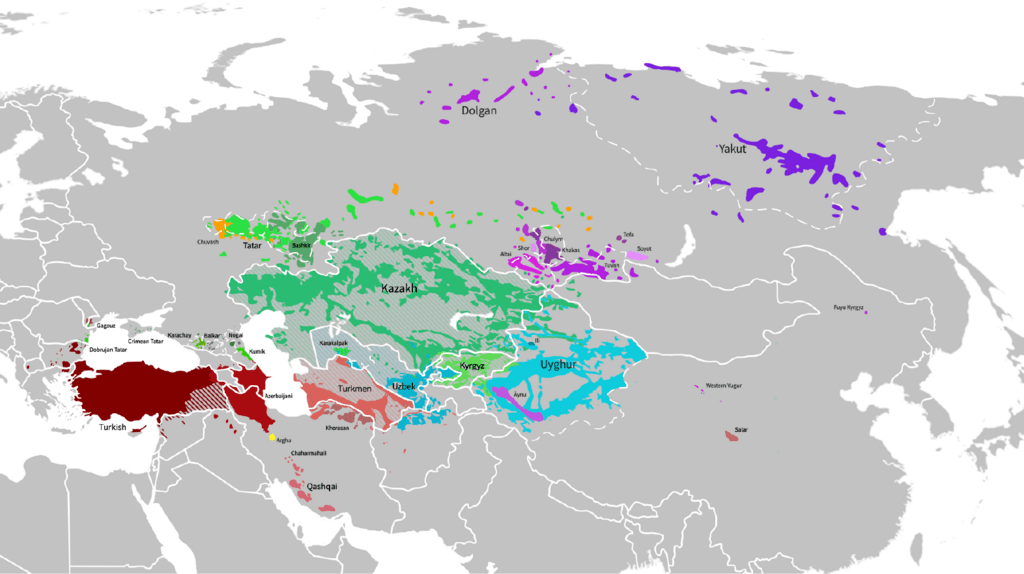
A map showing the distribution today of Turkic languages across Asia. Photo by GalaxMaps, CC BY-SA 4.0, via Wikimedia Commons
Thus, the Turkish people of the Republic of Turkey (a.k.a. modern Türkiye) and the Uyghurs of north-western China have common ancestry. Some of their ancestors migrated west and contended with the Eastern Romans (a.k.a. the Byzantines), while others fought with the Chinese Tang dynasty onward. Yet in some distant, remote past they began as just one steppe tribe out of countless others and over time grew into a family of ethnicities and languages that spread all over Asia.
In Xuan-zang’s time, the Turkic tribes had formed a powerful confederation on the Eurasian steppe called the Western Turkic Khaganate. They called themselves the On oq budun (𐰆𐰣:𐰸:𐰉𐰆𐰑𐰣) or “People of the Ten Arrows” implying they were a federation of tribes, ruled by a single Qaghan (alternatively spelled Khaghan). These “Göktürks“, and their empire, remnants of an even larger Turkic Khaganate, were spread out far enough to have contact with China, the Sassanian Persians and Eastern Romans all at once.
Great Tang (e.g. Tang Dynasty China) would come to rule this entire area at the zenith of its power in the decades ahead, and the Khaganate reduced to a puppet state, but in Xuan-zang’s time, it was still a land ruled by Turkic people.
Meeting the Khagan
The Chuy river valley, photo by Vmenkov, CC BY-SA 3.0, via Wikimedia Commons
As Xuan-zang and his party descended the Tian-Shan mountains they came near to the modern city of Tokmok in Kyrgyzstan. More precisely, Xuan-Zang came the ancient capital of Suyab, also called Ak-Beshim, just to the southwest. This region was fed by the Chu river and was a verdant land compared to the desert wastes elsewhere. The Khaganate used these lands as a resting place when not on the march.
The leader of the Khaganate, Tong Yabghu Qaghan (Tǒng Yèhù Kěhán, 统叶护可汗 to the Chinese) was eager to meet Xuan-zang and provided a fitting welcome. Xuan-zang, for his part, gave the Qaghan a letter of introduction from the king of Turpan.
Xuan-zang described the Qaghan thus:
[the Qaghan] was covered with a robe of green satin, and his hair was loose, only it was bound round with a silken band some ten feet in length, which was twisted round his head and fell down behind. He was surrounded by about 200 officers, who were all clothed in brocade stuff, with hair braided. On the right and left he was attended by independent troops all clothed in furs and fine spun hair garments; they carried lances and bows and standards, and were mounted on camels and horses. The eye could not estimate their numbers.
The Silk Road Journey with Xuan-zang, page 32
Tong Yabghu Qaghan’s “palace” was a great yurt, wherein a feast was held. The guests enjoyed such foods as wine, mutton, and boiled veal among other things. Since Xuan-zang was a Buddhist monk, he was forbidden to eat meat and drink alcohol, and thus he was served delights such as rice cakes, cream, mare’s milk, sugar, and honey instead.
Kyrgyz-style yurts, in Xinjiang region of China. Photo by katorisi, CC BY-SA 3.0, via Wikimedia Commons
Once everyone was settled down, Tong Yabghu Qaghan asked poor Xuan-zang to make a Buddhist sermon on the spot.
Xuan-zang had to be careful not to ruin the mood of the occasion, so he opted for a sermon on the need for goodwill (metta in Buddhism) towards all beings, and on the benefits of the religious life. The Qaghan was evidentially impressed. In fact, this wasn’t the Qaghan’s first encounter with a Buddhist monk. Apparently, some years earlier a Buddhist monk from India named Pabhakarmitras had journeyed through these lands on the way to China, and so the Qaghan was well-disposed to the religion. He even tried to convince Xuan-zang to stay among his people, but Xuan-zang declined. Unlike the king of Turpan, the Qaghan seemginly took no offense and offered to send a ethnically Chinese soldier to accompany Xuan-zang for part of the way.
More importantly, the Qaghan gave Xuan-zang both gifts and letters of introduction to share with the petty princes along the way, who were all vassals of the Qaghan.
Finally, it was time to leave.
To Fabled Samarkand
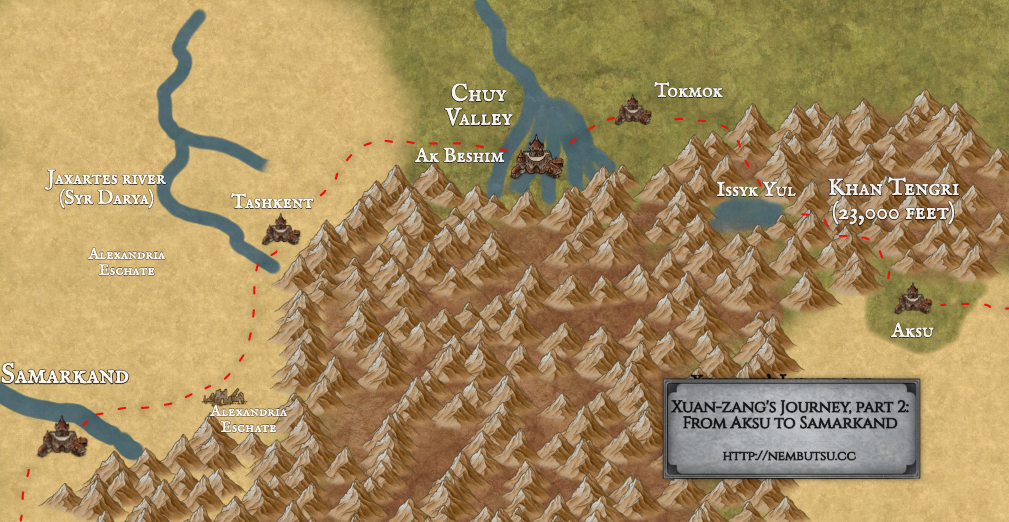
From the great yurt camp at Sayub, Xuan-zang was escorted by the Qaghan part of the way, but they eventually parted. After leaving the Chuy region, the land reverted back to desert, namely the Kyzylkum Desert, also known as the Desert of Red Sands. Xuan-zang’s party journey to the next city, the city of Tashkent (modern Uzbekistan) named Zhěshí (赭時) in Chinese at the time, proved difficult, but they did eventually reach it after crossing the Jaxartes River. Of the crossing, Xuan-zang describes the scenery.
North-west from this [river crossing] we enter on a great sandy desert, where there is neither water nor grass. The road is lost in the waste, which appears boundless, and only by looking in the direction of some great mountain, and following the guidance of the bones which lie scattered aboout, can we know the way in which we ought to go.”
The Silk Road Journey with Xuan-zang, page 34
Xuan-zang does not seem to spend much time in Tashkent (I wasn’t able to find much description of his time in my limited resources), and continued on in a more Westerly direction towards Samarkand.
Fun fact, after crossing the Jaxartes river and passing Tashkent, Xuan-zang and his party entered into lands once ruled by the Bactrian Greeks. To the south and west of Tashkent was the former outpost city of Alexandria Eschate, which had been the most northerly city of the Greeks. It was a strong fortress city under king Euthydemus I, but suffered constantly attacks by the native Iranian Sogdian peoples. By the 1st century AD, the city had reverted back to local control, and the Greeks retreated from the area. By Xuan-Zang’s time this was all a distant memory.
We’ll cover Samarkand in the next episode, because things take a dangerous turn in this output of the Sassanian Persians, and also from here, the road will turn back south toward India at last.
In part one of the journey, Xuan-zang braved the Gobi desert and contended with the overbearing monarch of Turpan, but also beheld many wonderful sites at that venerable city before moving on to Yanqi. After leaving Yanqi, Xuan-zang moved onto the city of Kucha, also called Kuchar in Uyghur (كۇچار) or Kùchē (庫車) in Chinese.
The Buddhist Kingdom of Kucha
Out of all the cities of the northern Silk Road surrounding the Tarim Basin, Kucha was the largest and most prosperous. As a powerful Buddhist kingdom, Kucha dominated the Silk Road trade in the area since at least the 4th century. Xuan-zang’s description of the city was as follows:
The soil is suitable for rice and grain…it produces grapes, pomegranates and numerous species of plums, pears, peaches, and almonds…The ground is rich in minerals-gold, copper, iron, and lead and tin. The air is soft, and the manners of the people honest. The style of writing is Indian, with some differences. They excel other countries in their skill in playing on the lute and pipe. They clothe themselves with ornamental garments of silk and embroidery….
There are about one hundred convents in this country, with five thousand and more disciples. These belong to the Little Vehicle [Hinayana]1 of the school of the Sarvastivadas. Their doctrine and their rules of discipline are like those of India, and those who read them use the same originals….About 40 li to the north of this desert city there are two convents close together on the slope of a mountain…Outside the western gate of the chief city, on the right and left side of the road, there are erect figures of Buddha, about 90 feet high.
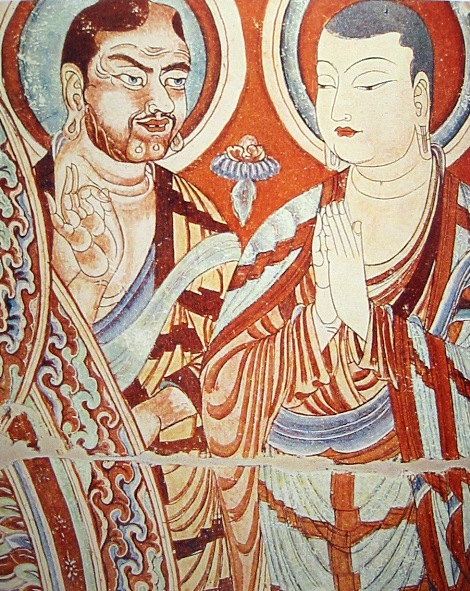
As with prior cities, Xuan-zang’s reputation had proceeded him, and he was greeted by the local ruler, which described as having “red hair and blue eyes”. The king of Kucha at the time was likely either ethnically Sogdian or Tokharian. We saw similar figures depicted in Buddhist art when we looked at the Bezeklik Caves in episode one. The Silk Road north of the Tarim Basin was a fascinating mix of different peoples and ethnicities and it could change from city to city. The Tokharians were distant relatives of other Indo-European people, and their language had some common elements to European languages such as English. Yet, the link between the Tokharians and Westerners is frankly pretty tenuous, but that did not stop researchers in the 19th century who had certain … racial theories, from hyping up their contribution to the Silk Road. It’s important to be cautious and not to draw too many conclusions. Hidden agendas make for bad research.
What’s more interesting to me is how the Tokharians lived alongside totally disparate groups such as Chinese, Turks, Uyghurs, Sogdians and so on, and at times they had friednly co-existence (the Tokharians evidentially revered the Sogdians in particular and tried to emulate them), and at other times they clashed. In other words, pretty typical human stuff. This intermix of cultures and people is what makes the Silk Road so fascinating.
But I digress…
Kucha had a lively material culture, thanks to runoff from the Tian Shan mountains providing plenty of water, and thus a wealth of food and agriculture grew here. It’s place on the Silk Road also ensured plenty of goods and materials were traded here too. Further, Kucha was famed for its music, and musicians from Kucha were highly sought after. A Kuchean orchestra was staffed at the court of Great Tang throughout the dynasty, and played for official ceremonies and celebrations. My book on Xuan-zang points out that famous songs they played included titles like “The Jade Woman Hands the Cup Around”, “Meeting on the Seventh Evening”, and “The Game of Hide the Buckle”.
Yet, for the Buddhist tradition as we now practice it today, Kucha was even more important for another reason: it was the hometown of Kumārajīva (344–413 CE) the translator.
Kumarajiva the Great Translator
Kumarajiva was the son of an Kashimiri-Indian father and a Kuchean mother, and was raised in Kucha. He studied Sarvastivadan-branch Buddhism, an influential pre-Mahayana Buddhist school whose monastic code was adopted by Mahayana Buddhist communities in China onward. However, at some point Kumarajiva converted to Mahayana Buddhism and by age 20 ordained as a Buddhist monk. His fame as a scholar reached China at the time, and he was sought out by the emperor. Our homeboy, Kumarajiva, was imprisoned at one point by a local warlord, but eventually was released by the Chinese emperor, and brought to the capitol of Chang-an (see prologue episode), and was feted.
Kumarajiva proved to be an excellent translator, and helped bring many Indian-Buddhists texts to mainsteam China. Because the Sanskrit originals were mostly lost in India, but preserved in Classical Chinese, these works, now core texts in many modern Buddhist traditions, help maintain the tradition today. To name a few that you probably already familiar with, Kumarajiva translated these sutras:3
The Shurangama Sutra, important in Chinese Buddhism, especially Zen
The Sutra of the Ten Stages (chapter 26 of the Flower Garland Sutra)2
…. among many others.
To reiterate this point: the English translations of these texts we use today come from the Classical Chinese editions that were originally translated from Sanskrit and prakrits by Kumarajiva.
Having said all that, let’s return, centuries later to Xuan-zang…
Staying at Kucha
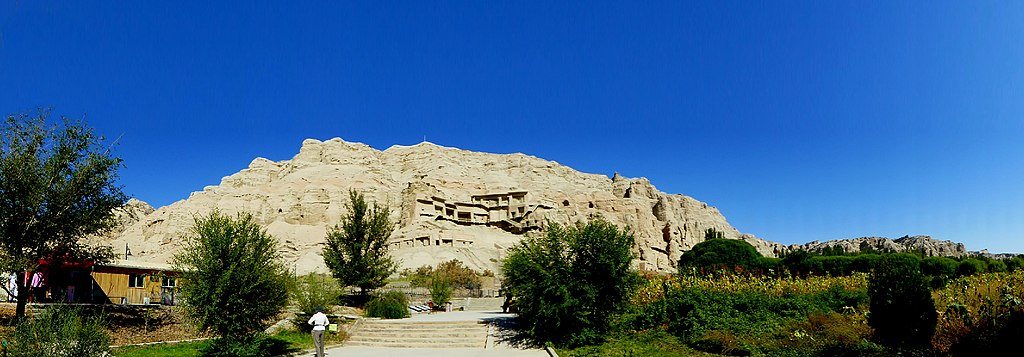
From Kucha, Xuan-zang would have to pass through Aksu before crossing over the Tian Shan mountains, but heavy snows in the passes mean that Xuan-zang had to stay in Kucha for two months. During this time Xuan-zang stayed out of trouble, and spent many days discussing Buddhist philosophy with the local community. This included the famous Kizil Caves:
The Kizil Caves (in Uyghur قىزىل مىڭ ئۆي) or Kèzī’ěr Qiānfú Dòng (克孜尔千佛洞, lit “1000 Buddhist Caves of Kizil”) are a massive cave complex and probably one of the earliest along the northern Silk Road used for Buddhist monasticism. The artwork here often shows strong influence from Buddhist-India, or more precisely, the Greco-Bactrian art of Gandhara. However, like the Bezeklik Caves we saw earlier, a combination of local religious iconoclasm, looting by European researchers,4 and subsequent tourism have greatly disturbed the artwork in the Kizil Caves. Here’s an example reconstruction from the so-called Peacock Room:
A representation of the Peacock Room layout, and what remains. Photo in public domain, courtesy of Wikimedia Commons
In any case, check out the Wikipedia article I linked above on the Kizil Caves. There’s simply too much to add here, but needless to say, Xuan-zang must’ve beheld some amazing art in his time, which we will sadly never see again.
Side note: the red haired, blue-eye ruler of Kucha that I mentioned earlier ran afoul of the Chinese emperor, Taizong, a few years later by pretending fealty, while also declaring his loyalty to the Western Turkic Khaganate (more on that soon). Needless to say, China did not take this lying down and soon conquered Kucha just as it did with Turpan. Xuan-zang would be long gone by this point though.
The Tian Shan Mountains
Once it was safer to travel, Xuan-zang’s caravan moved onto the city of Aksu, which in his time was called Baluka (跋祿迦, Bolujia in Chinese). Xuan-zang’s caravan was again ambushed by bandits along the way, but once again the bandits were full from another attack and quickly lost interest in Xuan-zang’s group. I’d say Xuan-zang was lucky, or the bandits were just lazy. 🤷🏼♂️
Anyhow, Xuan-zang stated that Aksu was very similar to Kucha in many respects, though according to Wikipedia, Xuan-zang noticed that the people of Aksu seemed to speak a different kind of Tokharian language. The Wikipedia article on Tokharian mentions that there were several dialects, all of them pretty different from one another. In any case, it doesn’t seem that Xuan-zang stayed at Aksu too long though and set out for the mountain passes over the Tian Shan mountains to reach Tokmok. There things took a dangerous turn.
The Tian Shan mountains, with Khan Tengri in the middle. Photo by Chen Zhao, CC BY 2.0, via Wikimedia Commons
The Tian Shan mountains are huge, cold and dangerous to traverse. The Khan Tengri mountain is more than 23,000 feet high, and the Bedel Pass near it is one of the few ways to cross over to the other side. Of the mountain, Xuan-zang wrote:
This mountain is steep and dangerous, and reaches to the clouds (lit. “heaven”). From creation the perpetual snow which has collected here in piles, as been changed into glaciers which melt neither in the winter nor summer; the hard-frozen and cold sheets of water rise mingling with the cloudes; looking at them the eye is blinded with the glare, so that it cannot long gaze at them. The icy peaks fall down sometimes and lie athwart the road, some of them a hundred feet high, and others several tens of feet wide.
The Silk Road Journey with Xuan-zang, page 31
It took eight days to traverse the pass, and Xuan-zang lost up to 30-40% of his men and countless horses and oxen. Imagine that famous scene from the movie Fellowship of the Ring when the good guys braved the mountain pass, but instead of turning back almost half the party freezes to death. That’s how serious it was.
Nonetheless, the survivors did reach the gorgeous lake of Issyk Kul, now in modern Kyrgyzstan. From here, the caravan would soon reach Tokmok and with it enter the lands of the powerful Western Turkic Khaganate….
Stay tuned!
1 Explained also in part one, the term Hinayana Buddhism is not related to Theravada Buddhism (it’s seems unlikely to me that they interacted with one another due to geography), but instead is a broad term for all pre-Mayahana Indian Buddhism. It’s still a somewhat pejorative term, but the relationship between early Hinayana Buddhism and Mahayana Buddhism is … complicated and not necessarily antagonistic.
2 I would love to talk about the Flower Garland Sutra some time, but it is a TOME, and I’ve only read very small parts of it. The Sutra of the Ten Stages deserves special attention though, and I have read it, but it’s challenge all by itself to explain in a blog post. Maybe some day.
3 one notable omission in this list is the Heart Sutra. The Heart Sutra is thought to have been compiled in China, not India, as a clever summary of much longer sutras. It gets to the “heart” of the matter, if you take my meaning. Xuan-zang, as we’ll see later, brings it back to India where it’s translated to Sanskrit, not from it.
4 The story of Albert Grünwedel is an interesting example of someone who was a dedicated archeologist, but also kind of unhinged too.
In the prologue, we introduced the Buddhist monk Xuan-zang and explored the world of Tang-dynasty China. Xuan-zang left this world behind, contravening imperial decree about leaving the country without a permit, to pursue Buddhist teachings in India.
However, once he left the Yumen Pass, he immediately ran into a major issue: the Gobi Desert.
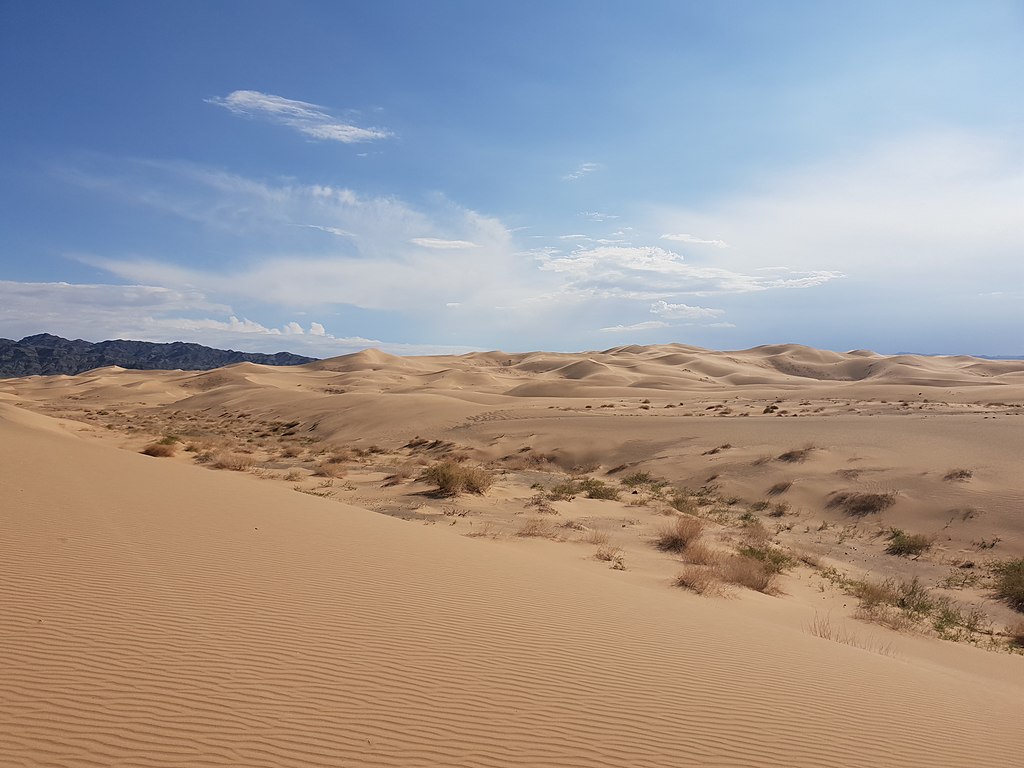
The road from the Yuman Pass to the next stop, the oasis at Hami, was barren, dry, with extreme heat and cold, and not well marked. Xuan-zang, who had little experience with this kind of travel, at one point lost his waterskin, became lost, and collapsed due to exhaustion. It is said that the bodhisattva Guan-yin guided him in his darkest hour to Hami.
The Hami Oasis
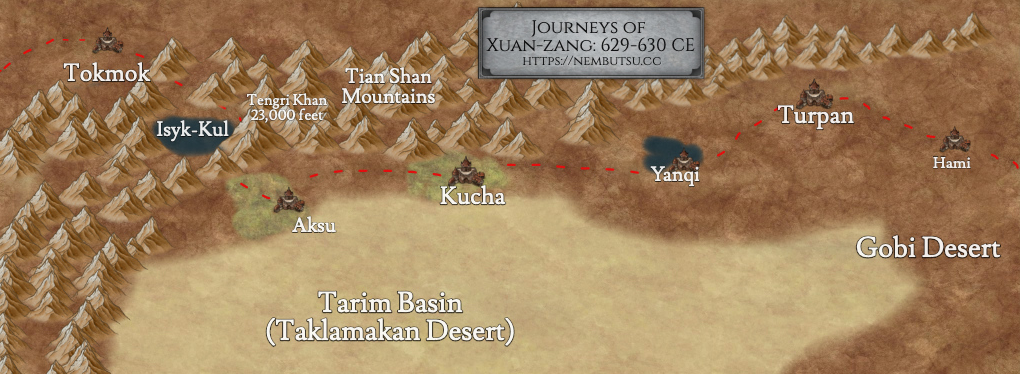
A map of the first part of Xuanzang’s journey. I made this using Inkarnate (a great online map tool). Apologies for any geographical mistakes. Free for non-commercial use.
The town of Hāmì (哈密), also known as Kumul (قۇمۇل) in Uyghur, was populated by a Chinese military colony since the Sui Dynasty, but had been cut off from China during turbulent times. At Xuan-zang’s time, it pledged loyalty to the regional Turk rulers while still maintaining diplomatic relations with the new Tang Dynasty. Some months after Xuan-zang left, Great Tang’s expansion absorbed Hami into its empire.
Here in Hami, Xuan-zang stayed at a Buddhist monastery where three Chinese monks lived. They were overjoyed to see a fellow monk, and offered him lodging. Xuan-zang did not stay too long here, and moved onto the larger city of Turpan.
The King of Turpan
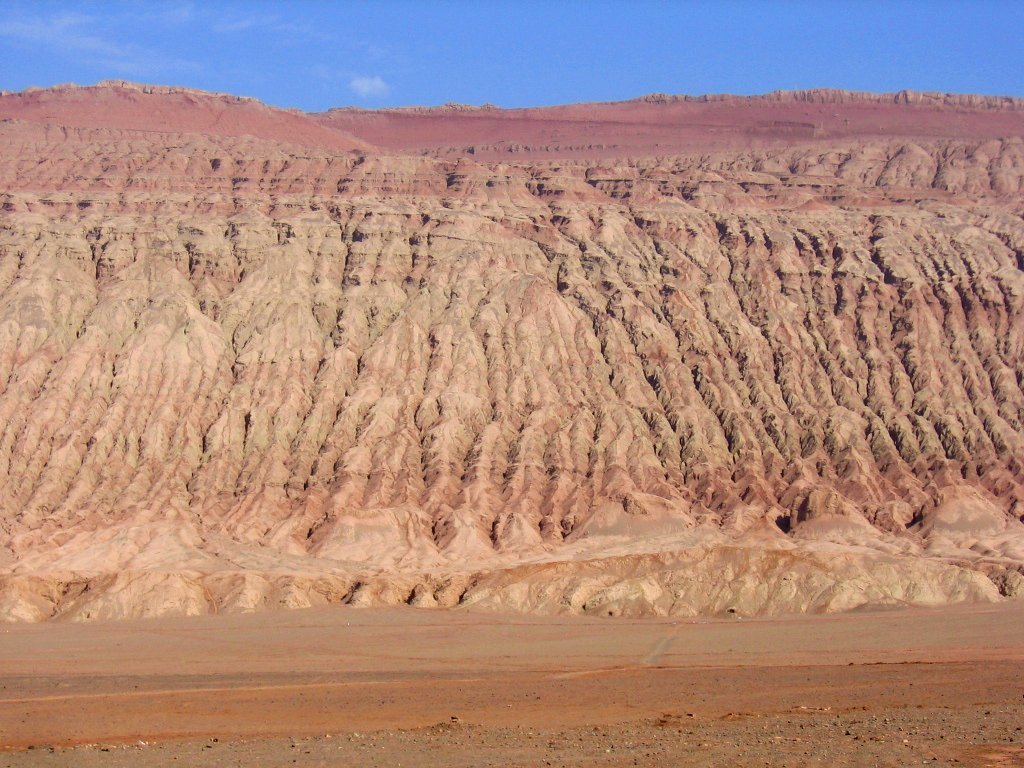
The “Flaming Mountains” near the city of Turpan on the Silk Road. Photo by es:User:Colegota, CC BY-SA 2.5 ES, via Wikimedia Commons
The city of Turpan (Uyghur: تۇرپان) also called Tǔlǔfān (吐鲁番) in Chinese was a prosperous city since ancient times, and changed hands often, but since antiquity had a large Chinese community, and considerable Chinese cultural influence, especially compared to cities further west.
The King of Turpan at this time was a devout Buddhist, and gave Xuan-zang a warm welcome upon his arrival, but also pressured him to stay rather than continue his journey. When Xuan-zang politely refused, the King of Turpan begged, cajoled, and threatened him. Xuan-zang was not allowed to leave, and he resorted to fasting to make his point. The king relented, and got Xuan-zang’s promise that he would stay for a month to preach to the people of Turpan, and would return later upon his return trip.
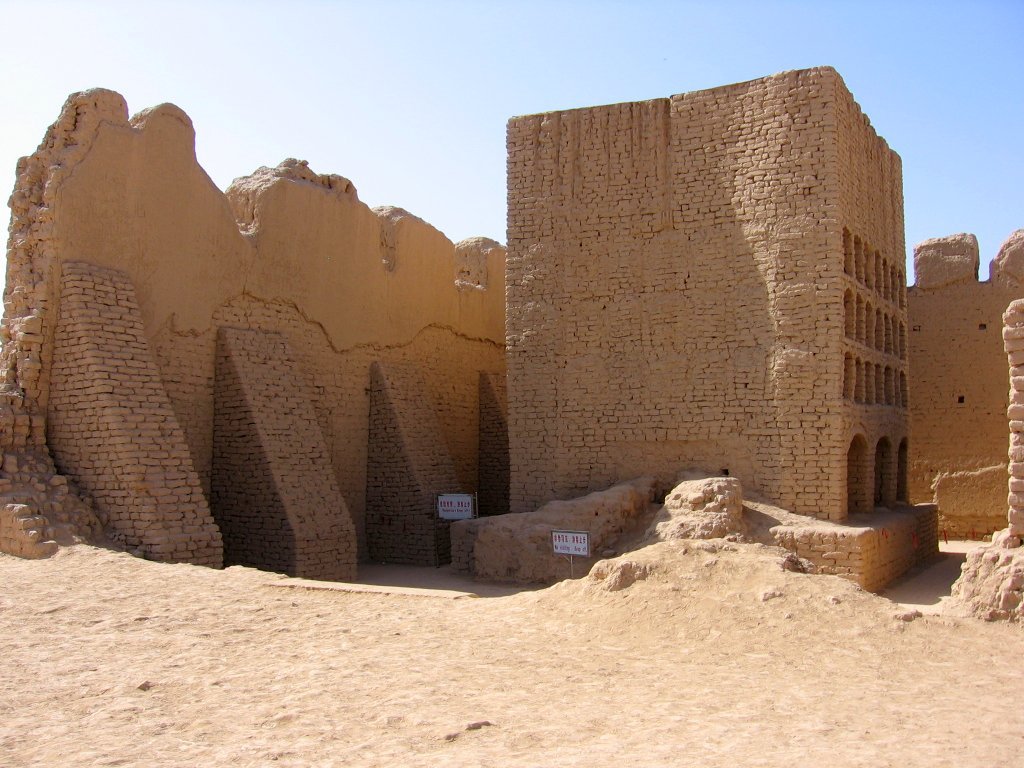
Once this agreement was reached, Xuan-zang stayed as promised. He used this time to explore the area, including the ancient city of Gāochāng (高昌), also known as Qocho, which was the former capital of a once-powerful kingdom, where he gave sermons to audiences there. Archeological excavations have show plenty of evidence of a vibrant Buddhist community at the time.
Remnants of a Buddhist stupa at Gaochang. Photo by Colegota, CC BY-SA 2.5 ES, via Wikimedia Commons
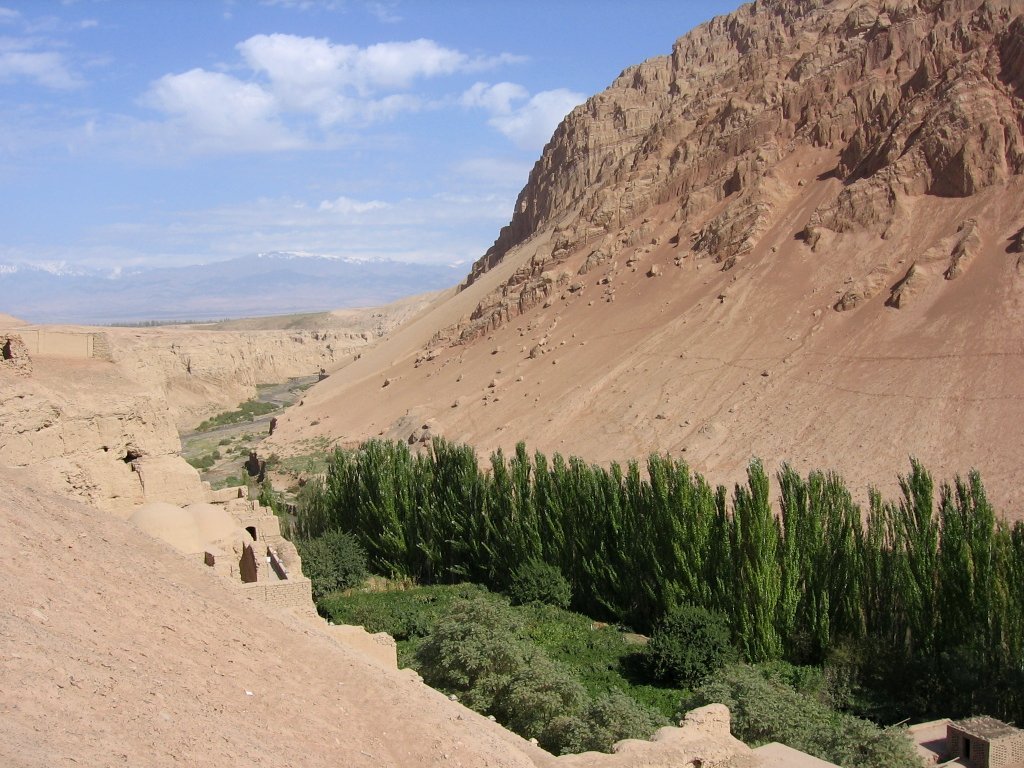
Xuan-zang also likely visted the nearby Bezeklik caves as well:
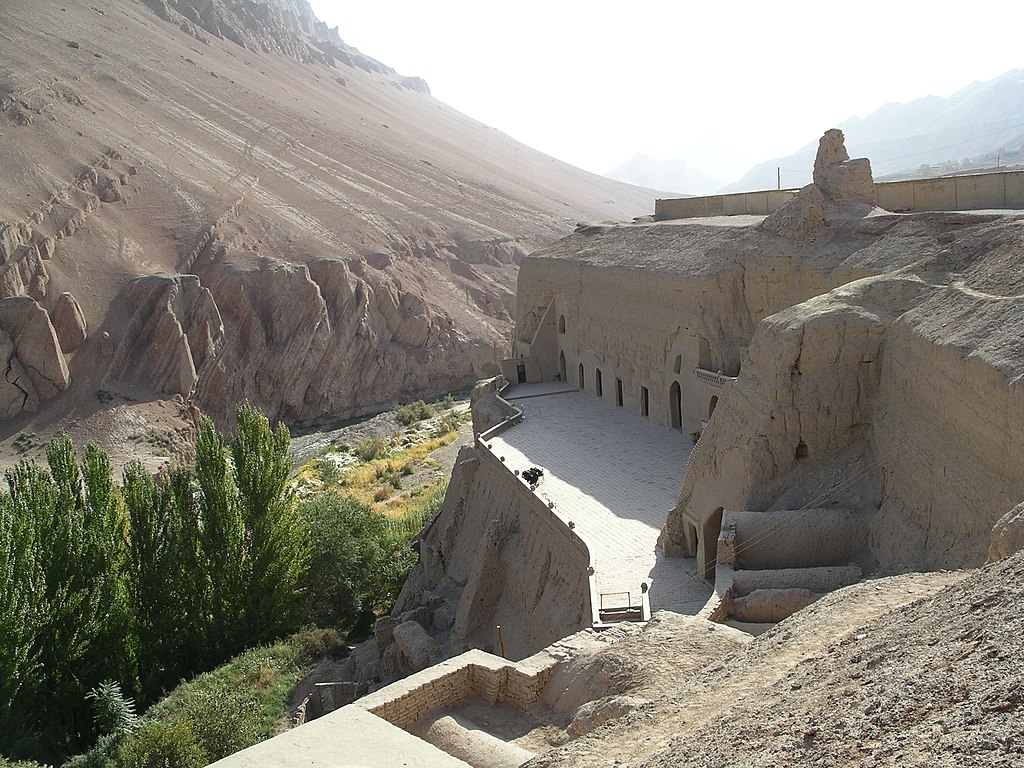
The Bezeklik Caves as seen from above. Photo courtesy of Wikimedia Commons.Photo by T Chu, CC BY 2.0, via Wikimedia Commons
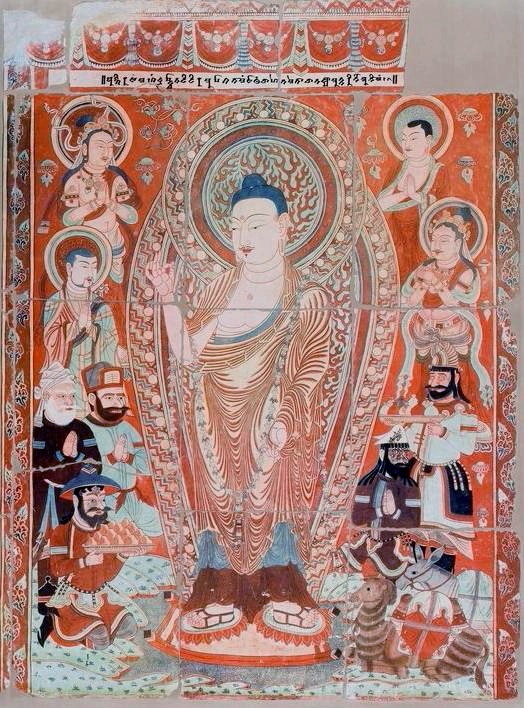
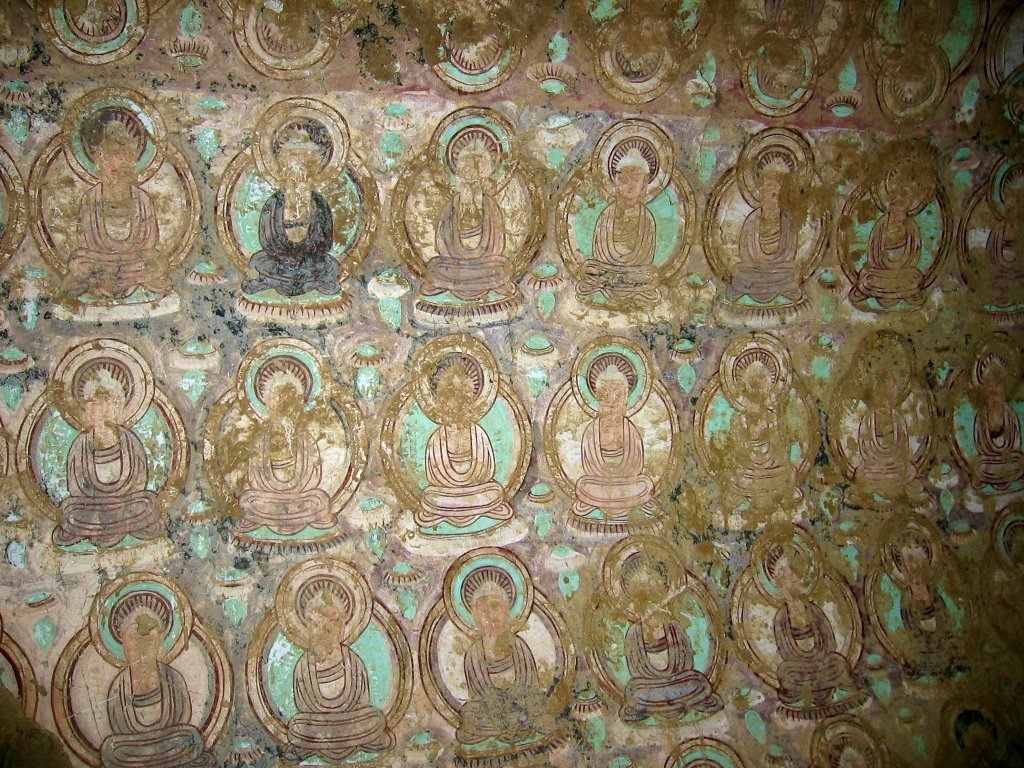
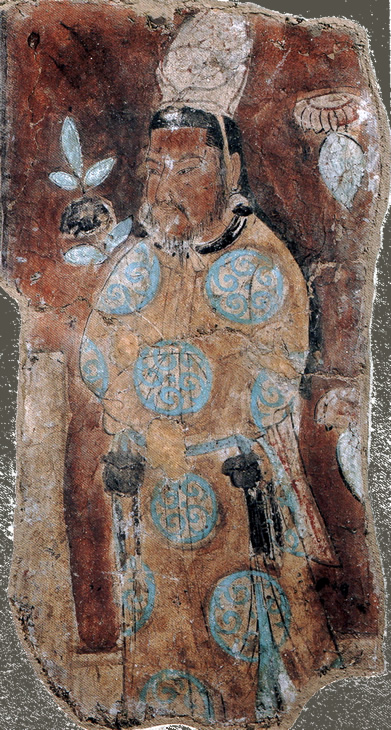
The Bezeklik caves are a massive grotto that served as a monastery for the local Buddhist monastic community. Many of the walls and ceilings were painted with frescoes of the Buddha, or other famous imagery, though in later generations, these were often defaced or damaged by locals for one reason or another (superstition, religious prohibition against human imagery, or simply raw materials).
Further, European archeologists looted the caves and brought many works of art back to Europe, only for them to be destroyed later in World War II. Thus, very little remains of the artwork now, but what does remain is simply spectacular, and a shining example of the fusion of cultures along the Silk Road at this time.
Bezeklik caves, Pranidhi scene 14, temple 9. Note the Sogdian men depicted in reverence of the Buddha. See page for author, Public domain, via Wikimedia Commons
Two Buddhist monks, one Eurasian (possibly Sogdian or Tokharian), and one East Asian. Public domain, via Wikimedia Commons
Once Xuan-zang’s month was completed, the King of Turpan made good on his word. He provided Xuan-zang with many goods, supplies and letters of introduction to the kings further along the road. He now traveled with a caravan toward the next city Yānqí (焉耆) known by many other names, including Karasahr (قاراشەھەر in Uyghur) or Agni from the old Tokharian name, but not before being robbed by bandits! Evidentially, the bandits had already killed and robbed an earlier caravan, and were content to be bribed by Xuan-zang’s party and left with no further violence.
Upon reaching the city of Yanqi/Karasahr/Agni, Xuan-zang was said to have received a warm welcome, and described a city with ten different monasteries, and with two thousand monks practicing Hinayana Buddhism.1 He did not have flattering things to say about the king of Yanqi though, and later in 643 when the king broke his allegiance with Great Tang, the emperor Taizong, whom we met in the prologue episode, steamrolled Yanqi’s army and took the king prisoner.
Xuan-zang for his part only stayed for one night and moved on toward the city of Kucha. Kucha is an important city in early Buddhist history, but as we’ll see in our next episode, it was caught in a game of political tug-of-war…
Until the next episode: the Western Turks!
1 The term Hinayana is a loaded term in Buddhism, and frequently misunderstood. It has also been used as a pejorative by Mahayana Buddhists too. Without getting lost in the weeds, think of “Hinayana” Buddhism as any pre-Mahayana Indian-Buddhist school. It is not the same as Theravada Buddhism (the other major branch of Buddhism) since both branches were geographically separate and had little interaction with one another.










 Gleanings in Buddha-Fields
.jpg)


You must be logged in to post a comment.