Lately, I’ve been re-watching The Mandalorian and while I enjoyed it the first time through, I enjoy it a lot more the second time around. I’ve been thinking about how I might make a Dungeons and Dragons character for Adventurer’s League that mirrors the Mandalorian, Din Djarin.
I wrote recently about hobgoblins in D&D and how they mirrored Klingons in some way, and at that time I made a character named Kargoth toward that end. I played a couple tier-1 sessions, and it was fun, but the character wasn’t as interesting as I would have liked.
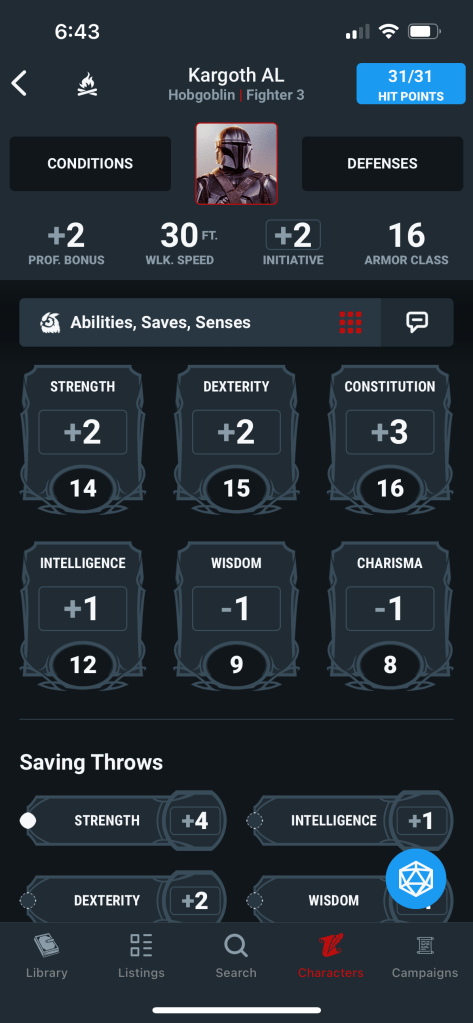
Then, after re-watching The Mandalorian, I got an idea. Since the new, season 11 rules allow for much easier rebuilding of characters, I decided to use the opportunity to rebuild Kargoth as a Mandalorian-style hobgoblin fighter, eldritch knight:
Kargoth’s backstory is that he was adopted after being a child on the losing side of a war by a fanatical cult of warriors (e.g. Children of the Watch), but hides his hobgoblin identity in public using a helmet, as well as following the religious ethos he was raised with. Helmet is cosmetic only and provides no additional armor class. Kargoth also has the hermit character background unsurprisingly.
Eldritch Knight as a subclass made surprising sense because first and foremost he would have to be a warrior anyway, but as an Eldritch Knight he would have many additional tricks up his sleeves that can be approximated as magic spells:
It’s fun to be a little creative here since every Mandalorian will be a little different anyway.
The real challenge is the hobgoblin racial character stats. A bonus to Intelligence helps with playing an Eldritch Knight, but the bonus to Constitution doesn’t have an overt benefit beyond more hit points.
I debated back and forth and opted to make Kargoth mostly a ranged fighter, to match the Mandalorian as a crack-shot. I gave him the Archery fighting style, equipped him with both a hand-crossbow (for later Crossbow feat) and a heavy crossbow. But, I also gave Kargoth enough Strength to handle melee combat too.
For armor I settled on Medium armor with the goal of getting good half-plate someday. The Mandalorian seems to wear half-plate rather than full-body armor and this allows me to continue focusing on Kargoth’s Dexterity based build.
Lastly, the kid. I debated using my “free spell choice” as an Eldritch Knight to cast _Find Familiar_ but a pet raven is a lousy substitute for Grogu (a.k.a. baby Yoda). So, for now Kargoth doesn’t have a sidekick … yet. Then again if I want to rebuild I can certainly do that too.
As I recently wrote, translating Dungeons and Dragons as a game into another medieval cultural setting can be a challenge. As someone who writes independent adventure modules for a Japanese-inspired setting on DMS Guild, I appreciate this point a lot. Nowhere is this more so a challenge than armor.
Originally, when I first made this setting, I tried using custom armor types, but in the end I found them of limited use, and hard to keep track in my head as a DM, so in the end I decided to compromise and make Japanese armor 1:1 equivalent to Western armor types where feasible. This might not be preferred by purists, but a busy DM has to work on limited time and resources, so I decided this way I could preserve the “flavor” of Japanese armor, while keeping the mechanics simple.
Dungeons and Dragons lists several kinds of armor from simple leather and hide armor, to plate armor worn by knights. Medieval Japan similarly had various types of armor used in warfare, including armor more familiar to a Western audience, but also some armor types that don’t have an obvious Western equivalent. This website, the Costume Museum of Japan, has great visuals on Japanese armor, if you would like to see many examples. I will be linking specific examples from the website throughout this page for easier visuals.
Anyhow, having done some homework, both in English and Japanese, I will try to breakdown the various armor types used in Japanese warfare and determine what an equivalent might be. This is just one DM’s interpretation, and your mileage may vary, but feel free to use the suggestions here and adapt as needed.
Basic Comparison
These charts are similar to the ones found in the Player’s Handbook but I left out certain armor types that are either seldom used (e.g. ring mail) or obviously the same across cultures (hide armor), or just not worth providing conversion for. The rest are listed here. If you’re looking for a quick-and-easy reference, please start here.
Light Armor Name
Japanese Equivalent
AC
Stealth
Leather
練革 (nerigawa)
11 + Dex modifier
—
Studded Leather
亀甲 (kikkō)
12 + Dex modifier
—
Medium Armor Name
Japanese Equivalent
AC
Stealth
Chain Shirt
腹当 (hara-até)
13 + Dex modifier (max 2)
Scale Mail
腹巻 (haramaki)
14 + Dex modifier (max 2)
Disadv
Breastplate
銅丸 (dōmaru)
14 + Dex modifier (max 2)
Half Plate
銅当世 (dō-gusoku)
15 + Dex modifier (max 2)
Disadv
Heavy Armor Name
Japanese Equivalent
AC
Min. Strength
Stealth
Chain Mail
畳具足 (tatami-gusoku)
16
13
Disadv
Splint
大鎧 (ōyoroi)
17
15
Disadv
Plate
当世具足 (tōsei gusoku)
18
15
Disadv
Let’s break these down in detail below…
First, O-sodé, Not Shields
One feature of Japanese armor and warfare is that shields were not used at all, and are simply not found. On the other hand, many of the armor types you see below came with an optional component called ō-sode (大袖, lit. “big sleeves”) which were large, square-shaped shoulder-guards that covered the shoulder-blades, upper-arms and such. They give some additional protection, while allow both hands to be free, so I converted them into a kind of “light shielding” like so:
Type: Shield
Cost: 10 gp
Weight: 6 lbs
An ō-sode is an extra shoulder-guard made from lamellar metal (older versions) or metal plate (newer versions) and is worn over both shoulders, toward the back. Players who are girded with ō-sode gain some additional shielding while keeping both hands free.
Name
Cost
Armor Class
Strength
Stealth
Weight
Ō-sode
10 gp
1
—
—
6 lbs
O-yoroi: splint mail
A woodblock print of Taira no Tsunemasa wearing O-yoroi armor from One Hundred Aspects of the Moon by Yoshitoshi, 19th century. Notice the ō-sode shoulder-guards too.
The 大鎧 (ōyoroi) armor shown here is the most iconic in Japanese culture, and was especially common during the earlier Kamakura and Heian periods of Japanese history (8th-13th century). It is a kind of heavy, box-shaped armor that includes several large, overlapping plates around the shoulders, leg greaves, helmet, and of course the torso. This is definitely a larger, more heavy armor and due to its interlocking “plates”. It was well-suited for horseback riders who attacked with spears and bows, but for hand to hand combat on the ground.
This is one of the harder ones to pin down in Dungeons and Dragons, because the shape and design have no obvious analog in medieval European armor, but for now I’ve tentatively called it splint mail due to its heavier, full-body design, and interlocking plates.
Domaru: breastplate
Source: Wikimedia Commons. Notice the ō-sode shoulder-guards here too.
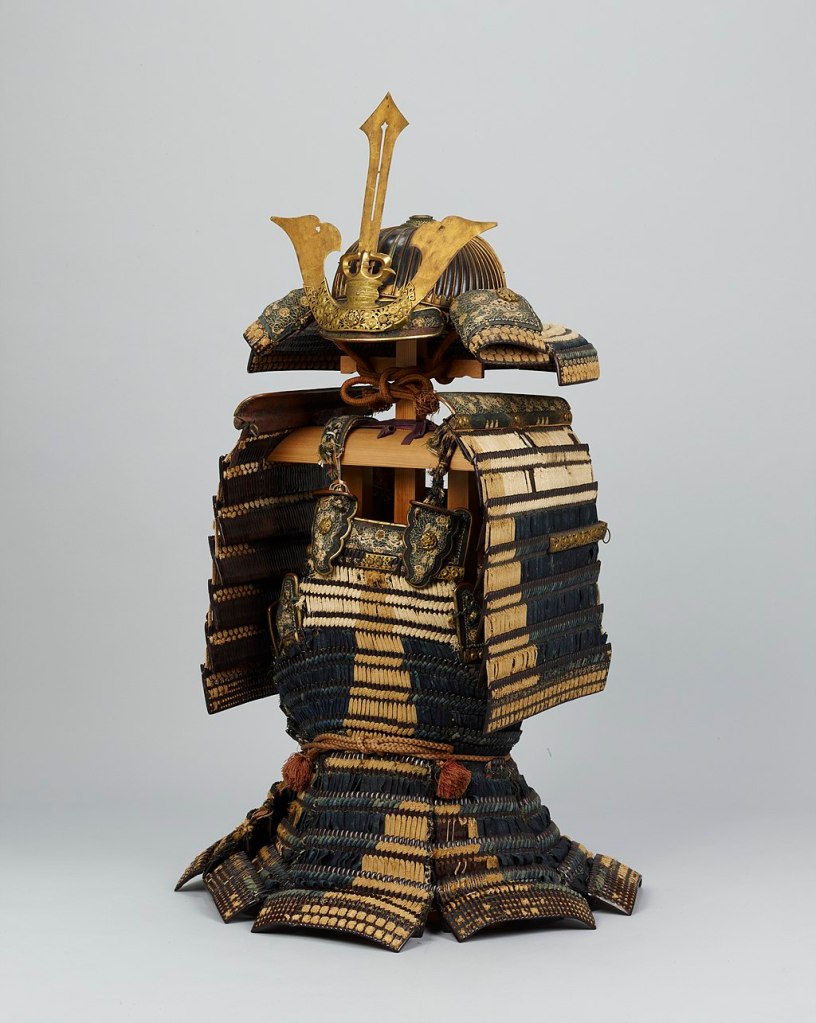
銅丸 (dōmaru) is another armor type from the same period, comprised of lamellar, but has a more tight-fitting, yet flexible design. An example can be seen here. Dōmaru is similar in design to the ōyoroi above, but covers only the upper half of the body, yet has improved maneuverability.
This is another one that’s hard to pin down and convert to European-style armor, but it does provide fairly comprehensive coverage of the upper body, even if still somewhat heavy and clunky. Breastplate is as appropriate as any armor type that I can think of.
The haramaki (腹巻) was a kind of armor that was often used by foot soldiers and lesser samurai compared to the expensive ōyori. As with dōmaru, it is mostly comprised of lamellar scales, and covers the torso only, but between its limited coverage, scaly design and cheaper price, I am tend to convert this to scale mail in Dungeons and Dragons.
An even lighter, simpler design from the same period is the hara-até (腹当) which covers less of the body, but like the examples above, offers flexibility. At first glance, this seems like a breastplate, but with the pieces stitched together in a lamellar format, chain shirt seems more appropriate. I went with chain shirt in this case.
From here on out, we move away from the older lamellar designs to gusoku (具足) design that was used in the later 15th century Warring States period onward. These designs may have been influenced by recent contact with Western explorers, as well as changes in warfare due to the introduction of firearms and other changes in tactics.
The 畳具足 (tatami-gusoku) is a lighter-weight, fold-able armor that was often used by foot soldiers, guards and lower-ranking samurai. The word tatamu (畳む) means to fold. Anyhow, this armor definitely looks like chain mail in the Western sense, so this is a pretty easy choice.
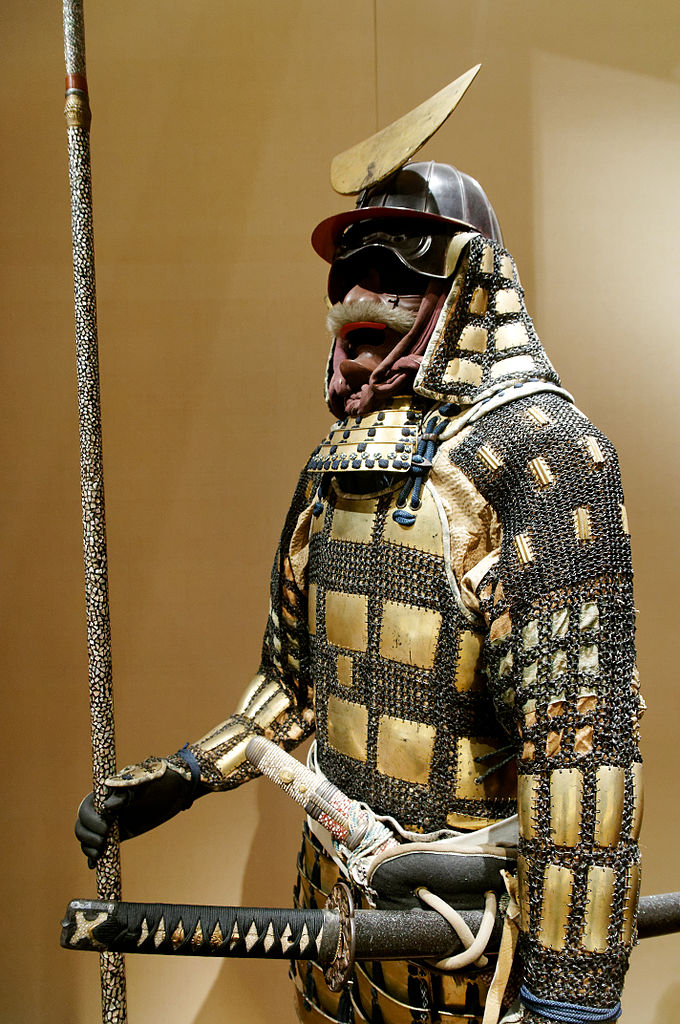
Another iconic form of armor invented in the 15th century Warring States period the 当世具足 (tōsei gusoku). The term tōsei (当世) by the way means “modern” as during this period it was newer technology compared to the older ō-yoroi armor of centuries past. You can see an example of it here. This replaces lamellar scales with larger, form-fitting metal plates, and definitely resembles full plate armor. This armor is full-body, completes with metal greaves, helmet, the works.
It is also the kind of armor that only samurai warlords and other high-ranking warriors could realistically afford.
Also, while “half-plate” armor wasn’t necessarily common, it’s reasonable for a player character to purchase only the upper half of this armor, which I believe is called 銅当世 (dō-gusoku).
What About Leather Armor?
I tried many times to look up what leather armor was in Japan, and the answer was surprisingly tricky. Many of the smaller, cheaper armor types listed above could be made using either iron or leather (called nerigawa 練革), especially older lamellar armor. So the coverage and shape would be the same, but the material of the scales would differ.
So, how would that work in D&D?
For our purposes, we can probably just call basic leather armor nerigawa, or even just “leather”.
On noteworthy example is kikko (亀甲) armor. Normally, kikko armor is treated as brigandine armor, but the design is basically a leather backing with small, hexagon-shaped metal scales, so that tends to roughly fit my definition of studded leather.
Conclusion
The examples shown here, and the attempt to map them to 5th-edition Dungeons and Dragon armor is, at best, a rough guide and should be taken with a grain of salt. In the end, a DM may decide to forgo the Japanese terms entirely and just use Western-English terminology while the appearance of the armor might better match Japanese flavor and appearance. On the other hand, some armor such as ō-yoroi and tōsei-gusoku are iconic armor and probably worth special-mention in a Japanese-setting campaign. As the DM you are empowered to make appropriate decisions that make the experience fun for your players.
Either way, I wish you good luck and happy adventuring!
P.S. It’s likely that I will be updating and modifying details as time goes on, so please feel free to check back here for updates.
Lately, I’ve been working on a secret project to make a new, expanded version of the Traveler’s Guide to the Hamato Islands gaming guide that I published last year on DMS Guild. Having “eaten my own dog food”, I realized that I need more stuff: encounter tables, expanded details on certain items, regional information, more treasure, etc. The sorts of resources a DM needs to make a proper campaign in a given setting.
So, while working on this new project, I have ran into an interesting cultural snag: A lot of magic items in D&D lore aren’t relevant (some don’t even exist) in a medieval Japanese setting, while other items in medieval Japanese culture don’t exist in any Dungeons and Dragons material.
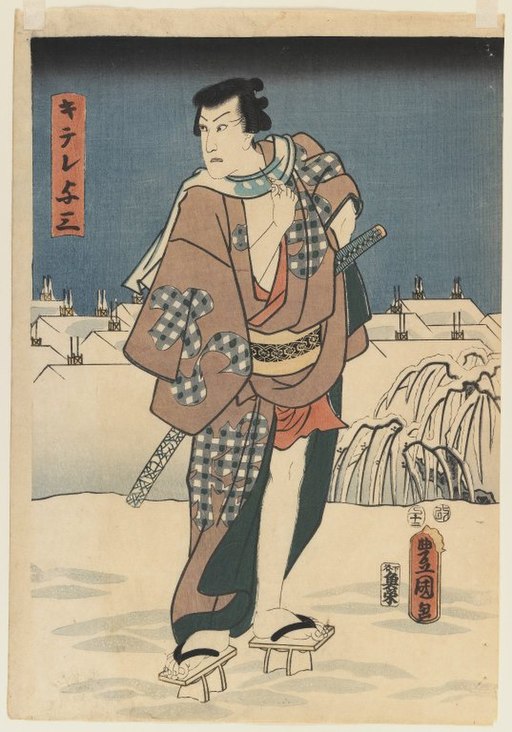
Mental exercise, how would you translate all the items this man is wearing into D&D equivalent items? Artwork by Utagawa Kunisada, Public domain, via Wikimedia Commons
Take shields for example. They were not used in medieval Japanese warfare. It doesn’t even make sense to provide them in such a setting. Similarly, boots as we know them in a medieval settings weren’t common in medieval Japan either, but Japan did have geta, zōri and waraji.
Another surprisingly tricky example is holy water, which is used in some spell components (e.g. Protection from Evil and Good) or as a weapon against the undead. The very concept of holy water is a very western, medieval-church concept that doesn’t really have a good equivalent in Japanese religious tradition. You could use salt, which was used to banish evil, or possibly use omiki (お神酒) which is rice-wine offered to the kami in Shinto religion.
Yet another example are magic wands. The very idea of a wizard in medieval Japan requires some careful thinking (onmyoji are a close equivalent, but definitely not the same), and even onmyoji were not depicted using anything like a magic wand. The very concept isn’t really found in Japanese culture until you look at foreign imports like Harry Potter. On the other hand, onmyoji “wizards” did rely on tools such as the luopan (raban in Japanese) for divination, ofuda to bind demons and evil spirits and so on.
Magic rings? Sorry Frodo! Ring-shaped jewelry just wasn’t used.
None of this is to blame anyone. The original creators of Dungeons and Dragons built the game for European medieval warfare, and what they knew culturally. It’s impossible to account for every religion and every culture in such game-design, but it also shows that as the game has evolved and grown, the original model for weapons, armor, and magic items doesn’t always fit seamlessly when dealing with other medieval cultures.
It’s a fascinating problem to solve, and my efforts in writing the Traveler’s Guide to the Hamato Islands have been to bridge this gap, to translate lore and items of one culture into something that works in another setting.
Here’s a few examples of how I’ve tried to solve this issue.
The Dungeon Masters Guide provides a good translation table for medieval weapons into Chinese/Japanese equivalents in its section on “Wuxia” adventure settings. Granted, Wuxia is specific to Chinese culture, but the conversion chart works pretty well and the only quibbles I have are too specific to be worth making separate weapons for. Longswords are katana, shortswords are (in the Traveler’s Guide) kodachi, and scimitars are wakizashi, greatswords are (in the Guide) nodachi and so on.
Armor is a tougher subject that I’ll treat in a separate post.
Magic wands can be substituted for Japanese shaku, which are in turn based on Chinese hù (笏). This is not a 1:1 comparison, but since this is a fantasy setting, it’s not unreasonable to make a magically enchanted version of a wooden scepter. Similarly rings can be substituted in the case of Japanese culture with ancient magatama jewelry (i.e. jewelry you wear that’s magically imbued). The Necklace of Prayer Beads might be equivalent to a Buddhist rosary. Other necklaces probably could go either way.
While staves largely stay the same, the Buddhist shakujo can be incorporated where appropriate, along with the Buddhist robes (okesa). The idea isn’t to exploit other religions and cultures, but get familiar enough with them that you can make reasonably accurate representations in your setting.
Spell components may need to be updated as well where relevant. Using the example of Protection from Evil and Good, we can substitute omiki for now, and the licorice root used in the Haste spell might get substituted with a local root plant such as daikon or burdock root. The “powdered corn extract and a twisted loop of parchment” for Rope Trick can be substituted for powdered rice and twisted loop of mulberry paper among other ideas, and so on.
Coinage in medieval Japan still breaks down in the basic units of gold, silver and copper, but the style of coinage, and the denominations don’t always map easily to Dungeons and Dragons. Then again, neither does medieval British coinage.
These are just a few examples, but hopefully it will help fellow gamers trying to expand their D&D settings to other cultures to take into account local trends and material culture to help create a more rich (not to mention accurate) representation for your players. It takes effort and research, but makes a pretty rewarding experience too for everyone!
My kids and I have been playing through an Eberron campaign since early 2021, and to my surprise my kids enjoy it more than our previous campaign, but as the DM I also have re-learn many things. Previously, I wrote about my review of the 5th edition Eberron sourcebook, and I’ve made good use of this book.
However, I also found a very handy set of videos interviewing Keith Baker, and how Eberron rethinks the traditional tropes of fantasy races:
As someone who frequently plays Elves, I found this video particularly handy:
But also what makes the Eberron setting so fascinating is how it is founded on a World War I-like historical event called the Last War, and how societies not only changed, but the nature of warfare as well:
Including the warforged race:
Indeed, the key to really getting the most out of Eberron as a backdrop is to think about how your characters were shaped by the war (even if they didn’t live through it), and also how nations were forged, or ruined, by it. But it also means learning to let go of existing high-fantasy tropes and redefine them more on a 1920’s style historical setting.
For our campaign, since my kids party is too small, I introduced a couple sidekick characters that have traveled with them throughout (making a party of four total):
Borsheg, son of Gorsheg. He is a cleric of Aureon, god of Knowledge, but secretly wanted to be a wizard. He has been learning lessons from a private mentor named “Dak”, but the kids (and Borsheg) are unaware that “Dak” is actually a Rakshasa (e.g. a Daelkyr) who is slowly corrupting him.
Malbus 414. Malbus is a former soldier of the 523rd platoon based in East Breland, and like the rest of his platoon was secretly conditioned by his gnomish creator to kill any member of a rival gnomish house if in proximity.
I have started painting miniatures for Malbus and Borsheg, too, featuring the emblems of our military unit or church affiliation.
The kids recently had a tearful moment as they paid an artificer in Sharn to undo the conditioning in Malbus 414, but it came at the cost of Malbus losing some of his memory and not remembering who they were.
Further, in another subplot, the kids were strong-armed in a smuggling operation of some powerful technology from the Last War, but disposed of it through some people they thought they could trust. However, little do they know that the technology has fallen into the hands of something much worse.
It has been a fun adventure so far, so I hope we can keep it up in 2022.
Due to the confusion of the term “monk” in English, which has become overloaded with multiple, conflicting meanings, I wanted to take a moment and explore how to build a character in Dungeons and Dragons that mirrors a Buddhist monk. I have posted this in my Traveler’s Guide to the Hamato Islands adventure guide on DMS Guild, but wanted to explore the rationale here in more detail. This is similar to posts I did in the past for samurai, ninja and sohei (paladin).
Historical Origins for a Monk
Setting aside Hollywood and fantasy, a Buddhist monk or bhikkhu in the old Pali language of India, is a mendicant: someone who has renounced worldly life in full-time pursuit of the Buddhist path. This is in contrast to the lay follower who may have one foot in the worldly life and one foot on the Buddhist path. Medieval Christianity had a similar tradition: some followers wished to (or were compelled to) pursue a life devoted to God full time and thus give up worldly life.1
In both examples, the Buddhist bhikkhu or Christian monk would be involved in community affairs: leading religious services, providing aid to the poor, and guiding rulers on ecclesiastical (or diplomatic) matters if called upon.
In this regard, a Buddhist bhikkhu is clearly fulfilling the role of a cleric: a religious intermediary.
But, then why does 5th Edition have a separate class for “monk“, a martial arts expert, as opposed to “cleric“? This is where things get kind of confusing.
The notion of a “monk” as a martial-arts expert originates from China specifically. No such tradition existed in India where Buddhism originated. Buddhist bhikkhus in China suffered attacks from bandits or local warlords and needed a way to defend themselves, but without violating precepts on taking life. So, hand-to-hand combat was developed to strike a balance between the two. This is how temples like the famous Shaolin Temple came to be.
Further, confusion arises when you compare Buddhism as a religion to more familiar traditions in the West such as Christianity or pagan, polytheistic religion. Buddhism doesn’t neatly fit into either one and I don’t have time to explain in full detail why, but suffice to say that deities (devas in Indian culture) as we know them are not a prominent aspect of Buddhism. They exist more like background-dancers in a band. On the other hand, Buddhism does have a strong devotional element to the Buddha (i.e. the historical teacher), as well as other celestial Buddhas and Bodhisattvas,2 so it is not quite correct to say that Buddhism is atheistic either.
First and foremost, Buddhism is a religion of the mind, the rest is there to support that. Thus, despite the same social role as a Christian monk, the religious underpinnings are different. That, coupled with the proficiency in hand to hand combat unique to Chinese Buddhist bhikkhus, is probably how the “monk” ideal began in Dungeons and Dragons.
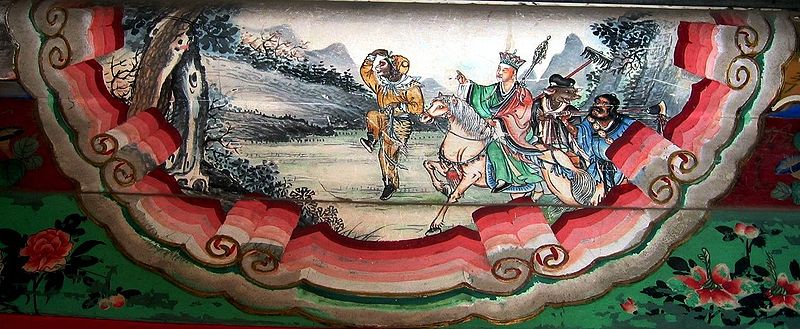
The character Tan Sanzang (pictured on a white horse), from the Chinese classic “Journey to the West” is a good archetypal example of a Buddhist monk adventuring. He in turn is based on the real-life Xuan-zang.
However, in writing the Hamato Islands series, and taking into account local Japanese-Buddhist history, I decided to keep the Buddhist monks firmly in the category of clerics, both for their social role, their lack of hand to hand combat training,3 and for the continued importance of religious devotion in Buddhism. A great literary example in Asian culture is that of the character Tan San-Zang from the classic novel Journey to the West. He journeys to distant lands with the monkey warrior Sun Wu-Zong and uses both powers and diplomacy to help his comrades. This is an excellent foundation for a D&D adventuring party, by the way (hint hint). 😉
Making a D&D Buddhist Monk Character
That’s all well and good, but with this in mind, how does one make a viable Buddhist cleric? I’ve had to play around with this a bit, but here is an example character named Genjo (玄奘. “Genjo” happens to be the Japanese pronunciation of Xuan-Zang the famous 7th-century Chinese monk. I even made an example character sheet in D&D Beyond:
For simplicity, I made this character pretty generic: 4th level, human cleric, but I used the Peace Domain from Tasha’s Cauldron of Everything. As with any cleric character, there’s quite a bit of variation on how you want to build it.
As for the deity, in the Hamato Islands series of adventures, I created a deity called the Great Sage, modeled after the Buddha. The Great Sage’s domains (written before Tasha’s was published) are Light, Life, Knowledge, and Grave. If your DM permits, you can also build a Buddhist monk using the Peace Domain instead.
Mechanically, since the Great Sage is an enlightened being, and not a magical deity, the spells and powers a cleric of the Great Sage receives are fueled not by divine power, but rather through the vast accumulated amounts of good karma that that Sage shares with others.4 But for the purposes of the game, the end-result would be the same: the cleric is entrusted with extraordinary powers to aid others, and to spread their deities teachings.
Update: for the 2024 ruleset, there are not too many changes to the Cleric class, though there are fewer domains offered in the Player’s Handbook. The default 2024 rules do allow you to play older domains not listed in the Handbook so long as you gain the abilities as level three, not level one.
For level one, you now have a simple choice of focusing on magic (thaumaturge) or combat (protector) as your Divine Order. See below for role playing suggestions.
Adding Flavor to Character
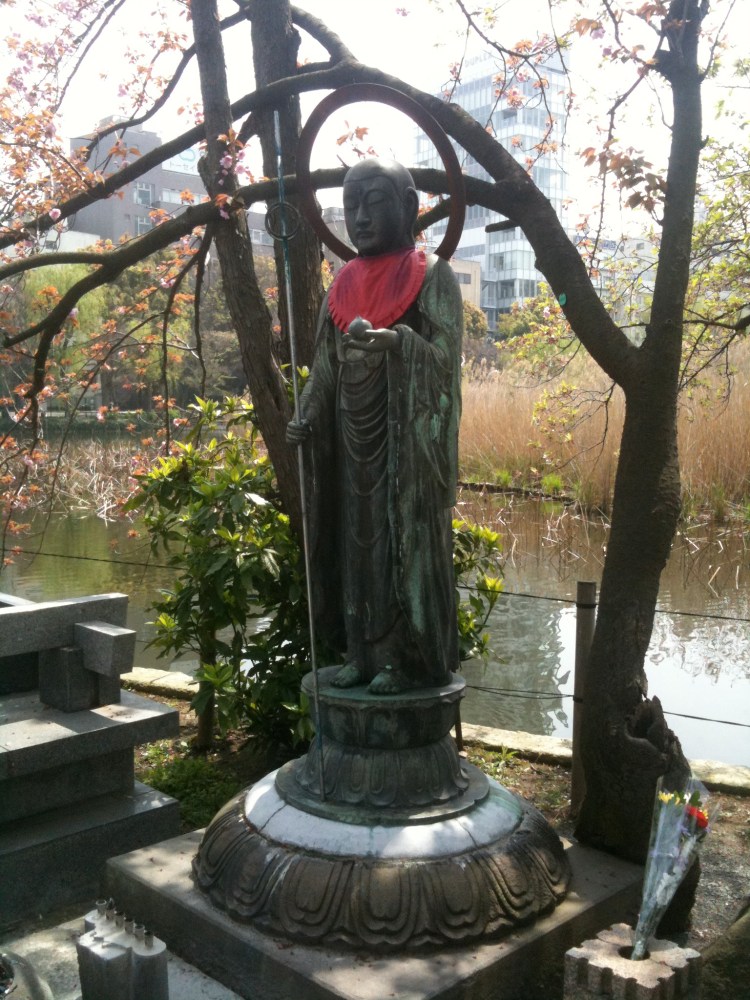
This is a photo of the Bodhisattva Jizo (Ksitigarbha) taken at Ueno Park, Shinobazu Pond. This statue is holding a shakujo staff.
Finally, let’s talk flavor. A generic cleric is OK, but let’s lean into the Buddhist archtype more. First, Buddhist monks in China, Japan and beyond frequently carried a special ringed quarterstaff. This is called a shakujō in Japanese or xīzhàng (pronounced shee-jong) in Chinese. Ostensibly, it was used to make noise and warn animals so that they would avoid being trampled on by a monk, but also came to have a sense of authority or power as well. One could even make a magical version of a shakujo staff:
Staff of the Sage
Staff, uncommon (requires attunement by a Cleric, or Druid)
This staff has 6 charges. While holding it, you can use an action to expend 1 or more of its charges to cast one of the following spells from it, using your spell save DC and spellcasting ability modifier: cure wounds (1 charge per spell level, up to 4th), lesser restoration (2 charges), or hold person (2 charges) or use the Destroy Undead cleric feature (4 charges).
The staff regains 1d4 + 2 expended charges daily at dawn. If you expend the last charge, roll a d20. On a 1, the staff vanishes in a flash of light, lost forever.
This is just one example where Buddhist iconography can be incorporated into Dungeons and Dragons. Another is the Necklace of Prayer Beads which can be modified more into a wrist-style Buddhist rosary (o-juzu in Japanese). The Traveler’s Guide that I published on DMS Guild has other such examples.
What about holy water? The western medieval notion of water blessed by a priest doesn’t really exist Buddhist cultures as much, but oftentimes salt does, as does sand blessed by a specific mantra. So, one can simply substitute holy water as a character item with blessed salt or sand. Mechanically, it works the same.
As for divine order in the 2024 ruleset, the historical Buddhist order is quite large and diverse, so some priests focused on esoteric magic an exorcism (i.e. a thaumaturge) while others might take up arms to protect their parish (i.e. protector). You can be a more fiery and incendiary cleric, or a pacifist, or a war-cleric, or a wandering healer. You get to decide which way your character leans. All of these archetypes did exist in medieval Japanese-Buddhist history.
Conclusion
These are just some examples of ways that one can adapt a Buddhist monk in a more traditional, clerical sense, rather than relying on the more martial-arts archetype, while drawing from traditional Asian-Buddhist culture. It’s a great way to learn more about the culture, and make a viable character for Dungeons and Dragons too.
Enjoy and happy adventuring!
1 Ideally, at least. In both Buddhism and Christianity, there are plenty of examples of monks and renunciants who still meddled in politics. People are people, afterall.
2 This presents a thorny issue for Westerners who are attracted to Buddhism for its non-theistic approach to things, but again it’s important not to conflate the two. The nature of Buddhas and Bodhisattvas, and veneration of them, has different underpinnings than the typical god or deity of worship. Again, it’s too long to explain but TL;DR it’s different.
3 Put another way: Japan and China are two different countries, two different (albeit neighboring) cultures with two different histories. The tendency to lump them together, along with other cultures such as Korea or Vietnam, is like lumping France, Spain and Germany together as “Europeans” without taking local cultural differences into account.
4 The precedent for this in Buddhism itself comes from such examples as Amitabha Buddha, the Buddha of Infinite Light, whose accumulated merit is so great that when one recites his name, Amitabha shares his good karma with others helping them to expunge their own negative karma from the past, and be reborn in his Pure Land someday.
Late last year, I picked up a copy of Tasha’s Cauldron of Everything, but with so much going on, I never got a chance to properly read through the book until last month (one year later 🤦🏽), which I now regret. What an excellent addition to the D&D canon.
Tasha, also known as Iggwilv, is a famous “witch” (more correctly an archmage) known as the Witch Queen in some sources. She is more of a chaotic character than the somewhat stodgy Mordenkainen, both her colleague and rival, and she has been known to consort with some demonic characters, but is not portrayed as evil either. One could draw some parallels with Liliana the planeswalker character from the Magic The Gathering series, but Tasha has a much longer history in the gaming world.1
The book is written from her perspective, and has some witty anecdotes from Tasha, and terrific artwork of Tasha herself. Mordenkainen never looked that good in heels. 😋
When I first bought the book, I wasn’t sure what to expect, apart from it seeming like a kind of “rules update” or reboot of some aspects of original Player’s Handbook. The book states off the bat that all the rules contained therein are entirely optional and meant to enhance the 5th-edition D&D experience, while also addressing some shortcomings with certain classes (rangers for example) or outmoded racial-character designs. But again, they are all optional.
Tasha’s focuses on four main areas, I feel:
Optional class options.
Spells and Magic items.
Additional tips and tools for world-building, including group patron options.
Custom background and character creation options
The first section struck me as the most immediately useful. My daughter, when she first played with me years ago, had a half-elf ranger with a beast master archetype. She loved that character, and her cougar companion, but as the adventures became more and more difficult, it was hard for her companion to keep up. This happened back before I (as the DM) knew about alternate house rules and such, so we played pretty closely to the book. Although she loved her animal companion, she couldn’t risk bringing it on adventures anymore, so she would often leave it in the care of NPCs and go off by herself.
But, using the new Tasha’s optional class features, the same animal companion gets a much needed improvement (as well as the rules for how to use it), and it properly scales with the character class.
In separate example, my elven forge cleric has Channel Divinity options that are seldom used in Adventurer’s League settings. Now, with the new Tasha’s options, I can choose to exercise that Channel Divinity option and regain spell slots (something clerics couldn’t previously do). Thus, he can stay on par with his wizard and druid party companions.
I also went back and made similar updates for my son’s Eberron halfling bard character, by allowing him to take some spell options he didn’t have previously through the Player’s Handbook. He enjoys his new Enlarge/Reduce spell.
For each character class, the optional updates from Tasha’s fall into two general types:
Options that replace older, less desirable class features.
Expanded options that you can chose to add alongside whatever you’re already playing.
The flexibility here is great, and works with D&D Beyond if you have purchased your book that way. Simply enable one or both of these options on the first page of your character creation:
I haven’t delved much into the magic items and spells, but I have seen a number of colleagues use them in Adventurer’s League games and my play-by-post group, and they seem pretty useful. The “summon” spells for each type of monster: celestial, fey, fiend, undead, etc. all seem pretty intriguing, and address some of the existing challenges of the classic summon spells. Other spells, like Tasha’s Mind Whip help fill a gap by allow more psychic magic options while staying roughly on par with other similar spells.
The custom background options in Tasha’s are also surprisingly useful in that they allow you to convert features of one background into another one using a simple conversion chart. This helps, for example, with my aforementioned elven forge cleric he may not necessarily spend his time in the woods, but perhaps in a more urbanized setting, so using a longbow seems a bit out of place for him, but perhaps a crossbow might. This gives plenty of options to customize the character the way you want, without negatively impacting the mechanics of the game or affecting character balancing.
All in all, Tasha’s Cauldron of Everything, just like the re-introduction of Tasha herself, gives 5th-edition Dungeons and Dragons a much needed breath of fresh air. I would be hesitant to call this 5.5th edition, but if heavily adopted, it does provide some far-reaching changes to a particular table. The flexibility of allowing DMs and players to adopt and implement the rules on an a la cart basis is an effective way to keep the classic look-and-feel of 5th edition, but also make updates where groups would like to see them. One can think of Tasha’s as an officially sanctioned set of house rules.
Having tried out the new rules, rather belatedly, my kids and I found some of them pretty handy, and look forward to trying other ones as the opportunities come up. Tasha is a welcome addition to the Dungeons and Dragons “Core Rulebooks”.
1 The trope of the independent, confident woman as a “bad girl” is kind of annoying in a way, and not limited to class TTRPG fantasy settings. You see it a lot in anime too. I won’t go into why I think it’s so prevalent, but suffice to say it’s nice to see women in fantasy settings standing on their own two feet, deciding their own fates and getting some representation. Tasha as a character still has a lot of baggage from older D&D versions and tropes, but it’s cool to see her get some updates as well.
Religion has always been a fascinating subject to me, and when I play Dungeons and Dragons (or build adventures for my kids), I spend a lot of time thinking about it.
By default, religion in Dungeons and Dragons is polytheistic, and mostly just a vehicle for clerical players. As a teenager, I remember way back in 2nd Edition Advanced Dungeons and Dragons reading the Deities and Demigods in my local gaming store, and thinking how cool it was that so many different deities from world cultures were represented, including Lao Tzu and such. The idea, I believe, was to allow characters plenty of options to choose which deity to follow, but this also tends to increase breadth while reducing depth.
For most players, this probably isn’t a big deal, but as someone who’s always been interested in religion, I often think about how to improve the depth and flavor of D&D religions so that players can delve more if they want to. Much of what you see in D&D represents a somewhat shallow understanding of ancient, polytheistic religions as seen through the lens of Western-Christian culture.
Coincidentally, I recently picked up another course from the Great Courses on pagan religion in ancient Rome and Greece (mostly Rome)1 for my birthday. The course is pretty dense, and Professor Muller really gets into some deep details about Greco-Roman pagan religion, which taught me a lot, and also deflated some false assumptions I had about such religions. Needless to say, religion, culture and politics are very complex subjects, but some fascinating things that I’ve learned so far:
First, contrary to modern understandings of the ancient Greek gods, ancient Greek deities were not represented consistently across the ancient world. For example, Apollo had many epithets, not just in the Iliad, but across each of the different city-states and cult centers. Each epithet represented a specific Apollo for that place and time, and something he did there. The same could be said of Artemis, Athena, etc. For the Roman god Jupiter, he had a ton of epithets, including (source Wikipedia):
Jupiter Fulgur (“Lightning Jupiter”), Fulgurator or Fulgens
Jupiter Lucetius (“of the light”), an epithet almost certainly related to the light or flame of lightning bolts and not to daylight.
Jupiter Optimus Maximus (“the best and greatest”). This was the Jupiter venerated in Rome’s most sacred temple.
Jupiter Pluvius, “sender of rain”.
…and by location:
Jupiter Laterius or Latiaris, the god of Latium, a region of central Italy.
Jupiter Parthinus or Partinus, under this name was worshiped on the borders of northeast Dalmatia and Upper Moesia, perhaps associated with the local tribe known as the Partheni.
Jupiter Poeninus, under this name worshiped in the Alps, around the Great St Bernard Pass, where he had a sanctuary.
Jupiter Solutorius, a local version of Jupiter worshiped in Spain; he was conflated with the local Iberian god Eacus.
Jupiter Taranis, Jupiter equated with the Celtic god Taranis.
While there was one commonly-understood and venerated deity, each cult center worshiped that deity somewhat differently, with different rites, epithets, etc. As there was no central religious authority for a given deity, the variation was startling, yet no cause for concern. This may also help to explain why Greeks and Romans were not adverse to linking their deities to similar deities from other cultures (Egyptian, Roman, Anatolian, etc). In the context of D&D, this would mean that a popular deity like Lathander, for example, might have many cult centers across Faerun, but each place would worship him in a very region-specific way, might call him different epithets, and hold different festivals, etc. Obviously, from a game-design standpoint, this would be hard to encapsulate in a reference guide, but DMs might be able to lean into this in their world-building.
Second, both the Romans and the Greeks (among others) had the notion of “state religion” and “family religion”. The particular city-state worked hard to maintain a healthy relationship with its deities and there was a lot of focus on both cultivating this relationship for success of the state, but also averting disaster if the gods were thought to be displeased (plagues, earthquakes, defeat in war, etc). Anything that could be perceived as a threat to this relationship, such as “renegade cults” (Bacchanalia, Christianity, etc) were also seen as a threat to the state. Obviously, when building settings in Dungeons and Dragons, a similar tension might apply.
Similarly, each family traditionally maintained their own family deities, rituals, etc. The head of the household (usually the father or oldest son) was the “chief priest” of the household religion, and each household might have slightly different rituals, deities, etc, from each other household. For the household deities, one might often see the same gods as the public, state religion, but their role/epithets were for mundane issues: Zeus of the storage grain, Zeus guarding the doorway, etc. It seems odd that the king of the gods also served as a “mini household deity” for all kinds of mundane needs. Again, depending on the role, time and place a deity may take on many aspects, both big and small. The state only cared about the macro-religion vs. the micro-religion. In the case of D&D, characters could similarly adopt a background or “flavor” in character’s daily religious rituals, family obligations, etc.
Thirdly, another thing I learned about ancient pagan religions was the myriad of ways that people employed divination. For example, augury, interpreting the flight patterns of birds, was a particularly popular form of divination among both Romans and Greeks. This would seem silly to modern audiences, but it was taken very seriously back then, and one could not start a senate meeting, or march the army without having consulted such things first. Oracles, such as the Pythia, among other places were also highly revered, but not always feasible to ask on short-notice.
Finally, the relationship to the gods was much more transactional than what modern audiences would be used to. This means that notions like theology, or deeper moral meanings weren’t clearly defined as they would be in modern religions. It’s not that people didn’t have any concept of morality, but the gods were part of this, not necessarily the source. So, for example, Isis was an extremely popular goddess across the Mediterranean during the Hellenistic period, but Isis’s cult didn’t necessary have a strong theological component, and as she was adapted by different cultures, the teachings varied somewhat to fit the parent culture where a particular cult center existed.
But what this means is that people would revere and petition a particular deity to address their needs: illness, success, warding off misfortune, etc. And, if the deity hears their petition, and provides the aid request, the person making a petition vows to repay the deity with a special offering of gratitude, or some other vow. This means that the typical relationship with a deity was, in order:
petitioning the deity
a vow if the deity meets their end of things, and
offerings and veneration if they do
This “transactional” approach might seem strange to us, but also presumably had the affect of building a deeper relationship with such-and-such deity as the cycle repeats over and over.
Also, though we might not want to admit it, modern people still do this. We might pray to God if we want our football team to win, for comfort if we’re in a jam, etc. It’s just that for ancient pagan religions,2 this was a perfectly normal thing to do, and not subject to embarrassment or shame as might be the case now.
Thus, when determining how to flesh out your typical polytheistic religions in a Dungeons and Dragons setting it helps to use ancient pagan religions as a source of inspiration and consider how relationships with a deity were more transactional in nature, varied considerably by locale, the importance of divination, and how it was often tightly-knit with state power (to say nothing about family religion).
None of this is required for the typical D&D player or DM. However, for any DM who likes to integrate more authentic polytheistic religions, or for player characters who (like myself) like to flesh out their character’s religions more, check out the awesome Great Courses class above, and spend some time learning about Roman and Greek religion from historians. There’s a lot of genuine interesting stuff, and much of it not obvious to modern audiences today.
1 The Great Courses often has flash sales and other deals, so if you can’t afford it now, keep an eye on it. 😉
2 Even some modern religions still tend to be transactional in nature, such as Japanese Shinto.
Recently, in our humble play-by-post group, which I’ve informally labeled Two Dwarves and an Elf, my colleagues and I got to talking about field rations.
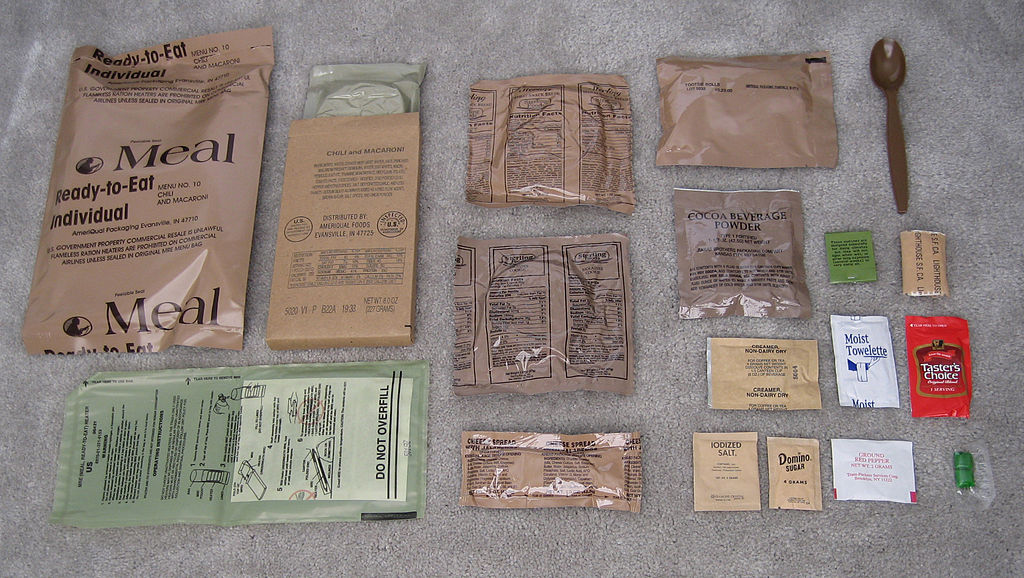
Iron Rations. What are they? Gygax was a war gamer. In WW1 they were 1 lb. preserved meat, 3 oz. cheese, 12 oz. biscuit, 5/8 oz. tea, 2 oz. sugar, 1/2 oz. salt, & 1 oz. meat extract. Total weight of 2.2 lbs per day.
Fifth edition Dungeons and Dragons invested a fair amount of design into the concept of traveling from point A to point B (hence some of the Ranger class skills, presumably), and in theory you’re supposed to be tracking field rations, water, food and such, but especially in Adventurer’s League, this gets frequently forgotten. It’s something you get allocated when you make your character and, along with arrows, are something people don’t always track.
One of my comrades shared this great link with me:
The link breaks down each character race, what their typical field rations might look like with photographs and recipes. The recipes might be a little fancier than the potatoes and lembas bread that Samwise Gamgee brought on their way to Mordor, so unless you’re just leaving home, I don’t know how realistic those recipes would be, but the style of food definitely makes sense. Plus the photos look gorgeous.
In any case, I really got to thinking with my PBP comrades: since our characters are different player races, what would their rations look like? Mechanically, the rations would be the same for each character, but in terms of flavor, each character would choose rations to suit their personal tastes and cultural background.
For my high elf forge cleric, Fenmaer Wasanthi, I have been somewhat conflicted about what his rations would look like.
For some reason, I tend to imagine that Elves are vegetarian, so I picture Fenmaer’s rations to mostly comprise of dried fruits, lentils and some kind of lembas bread. On the other hand, since Elves are often depicted as being more sensitive to nature, and living off the land, especially Wood Elves, they would probably engage in hunting and fishing too. Imagine a scene of Wood Elves in particular feasting on a boar roasted over a spit. On the other hand, I suppose that High Elves such as Fenmaer would have different dietary preferences than Wood Elves, being the more “refined” elf sub-culture of the two.
Anyhow, rations are one of those things that kind of gets neglected, especially in organized play, due to time constraints, but you can express a lot about your character by what they eat on the road. Sometimes the “flavor” of your character can speak volumes.
I wanted to take a moment to post a review of playing Dungeons and Dragons in the “Play By Post” format, since I have been actively playing since this post.
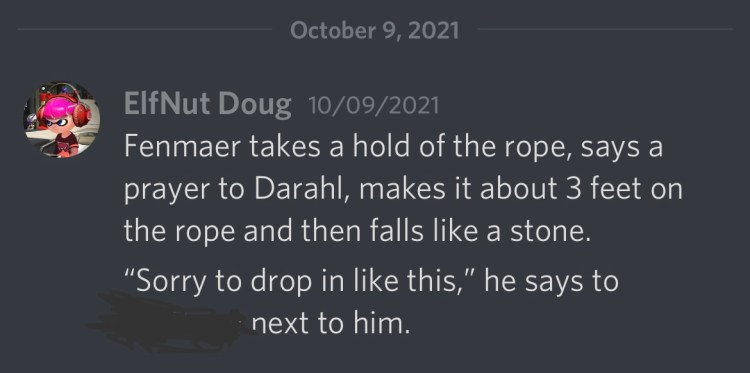
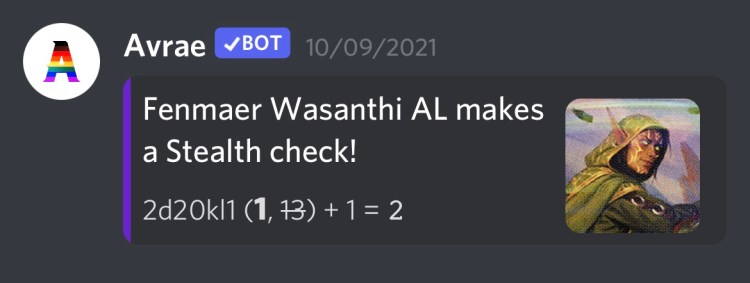
My character, Fenmaer, once again displaying deft Elvish agility
My group and I have been playing Adventurer’s League via play by post since April and have, as of writing, completed 3 modules in tier-1, and have begun another module from Season 2 (Elemental Evil). Our characters are all level 4. Each module has taken about 4-6 weeks to completed at our current pace in play-by-post. So, a back of hand calculation means that a 4-hour module takes about 4 weeks to complete.
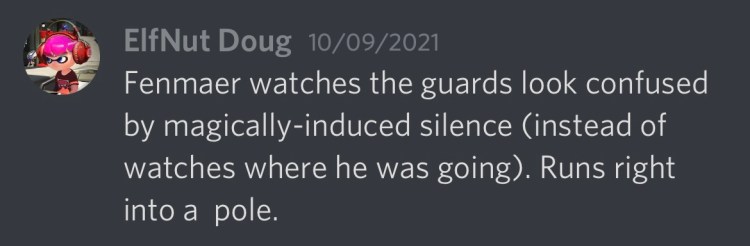
After casting my Silence spell, Fenmaer tries to sneak away. Tries.
All in all, I’ve enjoyed this experience and I really like my PBP party. However, as for play by post, let’s talk about pros and cons so far.
Pros: The pacing really helps busy folks enjoy their periodic fix of Dungeons and Dragons, especially us parents who can’t realistically block out 4-6 hours a week. I love being able to play a little bit every day, or a few times a week, and still feel that sense of progress. Once I got used to the slower pacing than a typical sit-down game, it’s been a nice background in my life.
Another big pro, particularly for Adventurer’s League, is that you can spent more time on the role-playing side of things. Normally, when you are playing AL modules, the time is fixed, the story rail-roads a little bit, and you don’t get to always delve into inter-character role playing as much. It’s nice to have the same 3 characters in our party get to know one another, and develop distinct personalities.
Finally, the Avrae bot really makes PBP work. It takes a while to get used to the commands, and you should have a command cheatsheet bookmarked somewhere.
Cons: The biggest challenge has been the combat maps. Avrae does a good job of keeping track of combat initiative, spell status, hp, etc. However, keeping track of position on a map, especially a 3-dimensional map, really requires some careful Theater of the Mind. Maps definitely help, but even then players forget where they are because they can’t see it. And if there are delays (more on that next), then it’s easy to lose track of player position vs. monsters. The Theater of the Mind issue is partially solved by being less stringent on distances and such, such as this helpful article explains, but it requires careful vigilance nonetheless. That doesn’t mean combat isn’t fun (it has been!), but depending on the map, things can get hairy.
The other issue is delays. PBP naturally has a slower place than a sit-down game, but sometimes life happens and players may not respond for a while. In some rare cases, they may not be able to respond for weeks. We had some incidents in the past months where a player had a genuine commitment or family issue that arose, and the adventure simply can’t continue without that player. For shorter delays, a little extra role-playing can tide you over, but this will eventually run out.
However, one can also argue that this is also a strength of PBP: when our missing players would return, we just picked up right where we left off without losing momentum. PBP can definitely tolerate downtime and interruptions a lot better than a committed, set campaign between friends, but you also have to learn to tolerate life interruptions, and a willingness to support fellow players who have genuine reasons why they can’t play. I am thankful to have a circle of players who have been mutually supportive, but then again every good campaign is built on mutual support.
Having a PBP campaign in the background of your life, especially the Pandemic Life, is a nice way to keep enjoying D&D, even when you don’t have an active campaign in the meat world.
A Prairie Schooner on the Cariboo Road or in the vicinity of Rogers Pass, Selkirk Mountains, c. 1887, by Edward Roper (1833-1909), Public domain, via Wikimedia Commons
Recently, in my play by post D&D group, my fellow players and I decided that after completing a few adventures, we could afford to upgrade to proper shelter and transportation. Up until now, we have been traveling from town to town, place to place either by walking, or asking our hapless druid character to Wild Shape into a horse.
Adventurer’s League modules don’t normally enforce things like travel, camping, etc, and so we could continue to gloss over that, but since we had been adventuring as a group for so long, it only made sense to make it more comfortable for our characters. Further, as one player wisely pointed out that it doesn’t really make sense for a character to walk 8-10 hours a day while wearing 55 lb of chain mail armor. My character, Fenmaer Wasanthi, would no doubt appreciate stowing that armor on a wagon instead.
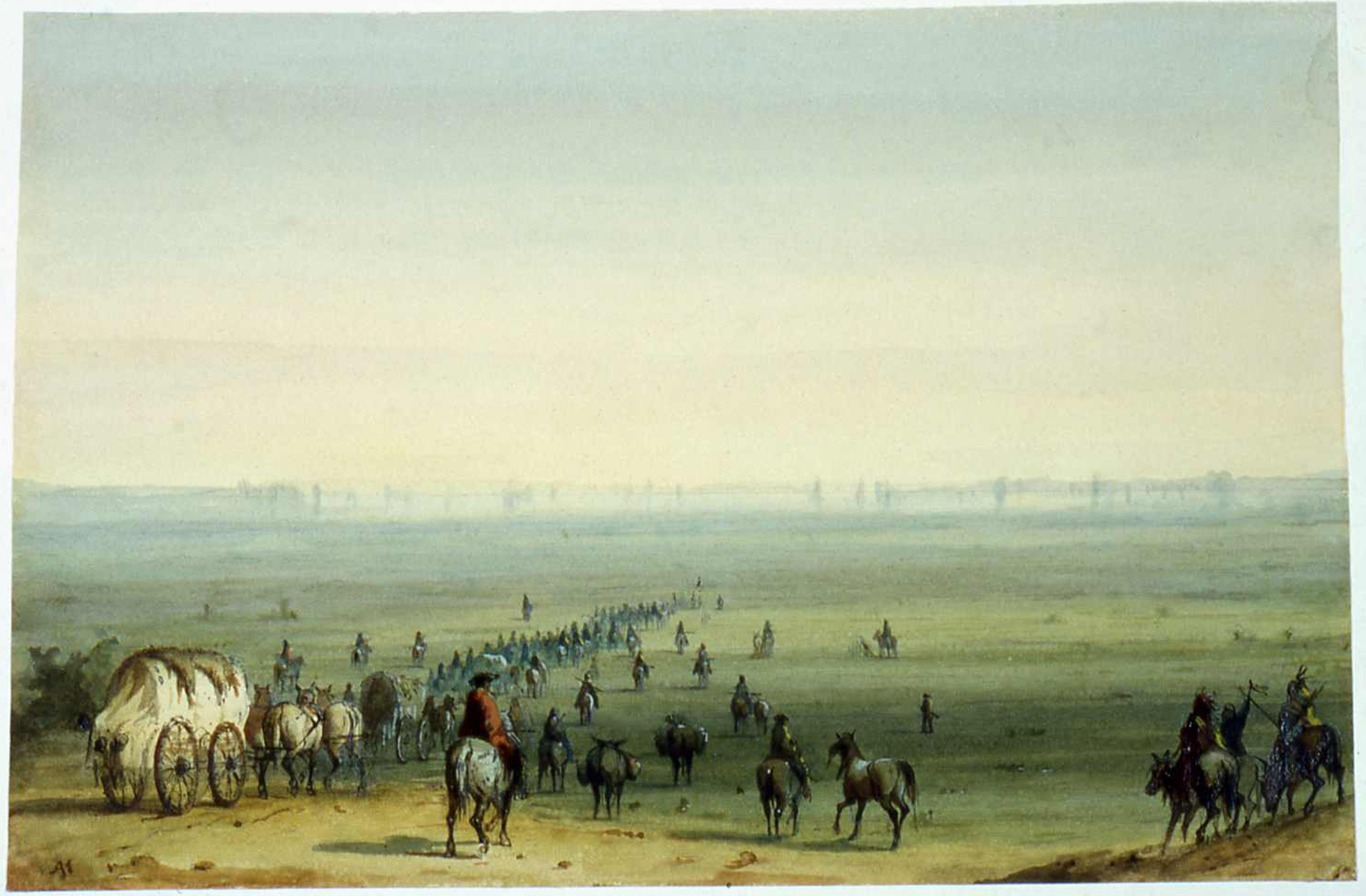
Alfred Jacob Miller (1810–1874)’s “Prairie Scene: Mirage”, Public domain, via Wikimedia Commons
Thus, the party decided to get a vardo wagon. More specifically, we purchased a carriage from the Player’s Handbook with “vardo” flavor, and two mules to pull it. Mules are inexpensive in the PHB, but have good carrying capacity and could easily pull a wagon. This gives our player characters both a place to use as shelter, but also transport our goods more easily.
So far so good.
Since my forge cleric character had some extra cash to spend, and nothing to really spend it on,1 I decided to also get a horse. Not a warhorse, but purely for riding and transportation. Having an extra horse, in addition to our mule-driven wagon, might also come in handy later.
However, then I realized that I had no idea what is needed to properly outfit a riding horse. I assume we need a saddle, but is that it?
I did some poking around on the web, and found a great discussion on Reddit here about outfitting a horse in Dungeons and Dragons. In short, the following equipment with cost are:
A riding horse (75gp), evidentially a pack horse is not necessarily trained to handle a human rider in real life, so a riding horse, though more expensive, makes sense.
A saddle (10gp), namely a riding saddle for a riding horse. Pretty simple. One could forgo the saddle, and Bronze Age horsemen often did, but not only is the saddle more comfortable, but in real life keep the rider from falling off.
Saddlebags (4gp), again not strictly required, but often a sensible idea.
A bit and bridle (2gp), this is how a rider directs and drives the horse, so it makes sense to have this.
Total cost: 91gp by my estimate. I didn’t factor in grass and feed as I assumed that the horse can reasonably find food while on the road, and lodging will be treated as needed. I may have to start factoring that in though in the same way my character manages rations.
In D&D Beyond, I also updated my character sheet, and added my riding horse under the “Extra” section, so that it’s stats would be reflected. I also customize the horse and renamed it Tantanel which sounded Elvish to me.
Given that I know nothing in real life about horses, I have to admit I learned a lot of basics about horse riding, what’s needed, what kind of horses work and what aren’t suitable for traveling. In medieval times, only the wealthy nobility could usually afford a horse, so it was certainly a luxury to have, but after surviving a few dangerous adventures, it seemed appropriate to finally invest in one. 🐴 😄
P.S. On the subject of wagons and animals to pull them, you can find many good resources, such as this one, based on historical records from the Oregon Trail. In real life, turns out mules have good carrying capacity and endurance, but are easily spooked compared to oxen. Strangely, oxen are not listed in the PHB.
1 Unlike wizards, clerics don’t need to add spells to a spellbook, they are endowed with their spells from their deity (Darahl Firecloak in Fenmaer’s case). Further, armor upgrades for Fenmaer are out of the question as his strength score is just too low, and at this time it isn’t worth increasing his strength score to compensate. Fenmear had already spent some money on necessary spell components as well, so the rest was just pocket change to spend.
















 Gleanings in Buddha-Fields


.jpg)


You must be logged in to post a comment.