In Praise of the Castlevania Series

Every Halloween, including this recent one, I like to stop whatever else I am doing (including Fire Emblem), and play through the old, classic Castlevania the game series: namely Castlevania 1, 2 and 3 for the NES and Super Castlevania for the Super Nintendo. There’s something really fun about journeying to Dracula’s castle, fighting hordes of evil, and enjoying the medieval-gothic ambience. For various reasons, I never really got around to playing the newer Castlevania games because I was in college, and had other priorities, so I missed classics like Symphony of Night until it came out much later for mobile devices.

In any case, the first few are really near and dear to my heart. So, this post is a tribute to those early games.

Castlevania

Of all the games listed below, I think this is my favorite box art.

The original Castlevania game, like many early NES games, was short, simple, and brutal. The game did not teach you very much, but instead threw you right into the game, and the difficulty level rapidly progresses beyond level 1 and 2. By the time you get to the Grim Reaper, the levels are quite difficult. The final level is a genuine gauntlet.

I never beat this game as a kid, and I only beat as an adult through a combination of save states and dedication. It’s a classic of its era, and fun to playthrough. Even Terminal Montage did a nice tribute to it:

Castlevania II: Simon’s Quest

For some reason, early NES sequels often followed a pattern of providing overland adventures to expand the world of the first game. The Legend of Zelda had Zelda II: Link’s Quest, Castlevania had Castlevania II: Simon’s Quest and so on. Castlevania II was the least popular of the NES games, but it is in a weird way my personal favorite.

You had to be there, though.

I was a bit too young to play the original Castlevania when it first came out, but I knew about it, and so when Nintendo Power magazine put out the issue (with the controversial cover) with exclusive coverage of Castlevania II, I was hooked. The full color map was so fun to look at:

Source: Nintendo Power Magazine

I still play this game regularly. I enjoy the slower place than other Castlevania games, and that it requires less feats of acrobatics (less falling off of stairs, like Castlevania III). I like to both 100% the game, and beat it within the 8 hours. However sometimes, I just enjoy taking my time and exploring every corner of Transylvania.

Of course, one other thing should be mentioned: the soundtrack. 8-bit games weren’t known for powerful music technology, but every once in a while, someone would compose something inspired. The Bloody Tears song, found on the overload during daytime, would go on to be a classic of Castlevania franchise, and rightly so.

One other interesting bit of trivia. The Dungeons and Dragons module, Ravenloft (I6), came out in 1983:

The box art for Castlevania II came out in 1987. Notice any similarities?

Castlevania III: Dracula’s Curse

Castlevania III: Dracula’s Curse is arguably the hardest of the early Castlevania games. It used the novel idea of featuring a different, earlier Belmont, than Simon, so it has a grittier, more medieval feel. Coupled with the spirit helpers, and multiple routes to choose from, this games was exciting and fun to replay.

This is also the first game where Adrian Tepeš, also known as “Alucard”, is introduced, though mechanically he is a fairly weak helper.

In fact, fans of the Netflix Castlevania series (such as myself), will see many references to Castlevania III, including the same cast of characters. I was a bit surprised that Grant Danasty wasn’t included in the series, other than a brief mention:

“that one guy with the horse-drawn sailboat on wheels that called himself the Pirate of the Roads…”

Trevor Belmon, Castlevania Netflix Series, S3E01

As for the game, I truly do enjoy it, though the punishing difficulty and frequency of “stupid fall deaths” does get a bit frustrating at times. I often like to take the difficult routes just because it’s fun to go all the way up through the basement of Dracula’s castle, more so than the ghost ship. The soundtrack was excellent and many classics from this game appear in later franchises too. Culturally speaking, Castlevania III is the most influential of the early games, and with good reason.

Super Castlevania IV
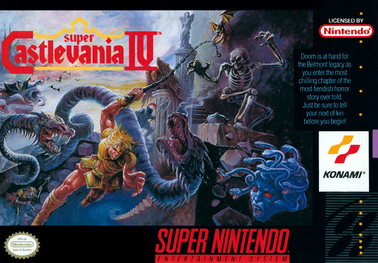
At last we come to the final game I played: Super Castlevania IV. This was the first game to be made for 16-bit Super Nintendo, versus older 8-bit Nintendo Entertain System. The improvement in graphics, sound and music reflect the improved hardware.

This game also finally allowed your character to whip in multiple directions, not just forward. I wish this feature had existed in earlier games, especially Castlevania II, since whipping the little slimes that were too short to hit was quite frustrating, as well as enemies on a lower platform.

The controls of this game are just so seamlessly smooth and the game levels are a good challenge without being excessive. The graphics of course were meant to show off new features of the 16-bit Super Nintendo, including rotating backgrounds, and other weirdness in Dracula’s castle. In fact, much of Dracula’s castle is just weird, but in a fun, gothic way. Fighting ballroom ghosts in one level, or gold skeletons in the treasure vault are all novel ideas, and lend to the old decadence of the villain.

Finally the music. The jazzier style music actually somehow enhances the mood of the game, rather than detracting from it. Composers definitely had some fun in this one, and I like to go back and listen to it occasionally on Youtube. Enhanced versions of classic Castlevania songs all sound great in this game.

One oddity is that this game is treated as non-canon in the Castlevania universe, since it is seen as a remake of the original Castlevania game.

Conclusion

I do regret not playing the later Castlevania games when they came out, especially Symphony of Night, so I missed out on a lot of the later lore until the Netflix series. However by this point, as an old school gamer, I had four classics under my belt, and was happy with what I had.

Making the Most of an Abjuration Wizard in D&D 5th edition

Recently, I dragged my first Adventurers League character, Qisandoral Arreistanus, out of a long, long retirement for another adventure in our play-by-post group. Qisandoral is a high elf wizard of the Abjuration school. You can think of him as Mr Spock in a fantasy setting.

“We reach”… with Otiluke’s Freezing Sphere!

Due to pandemic and other issues, I hadn’t played this character in literally years, but due to AL rules, he had jumped from level 9 to level 12 through accumulated downtime. Otherwise he sat idle. With the new 2024 ruleset, and the requirement in Adventurers League to rebuild a character that conforms with this ruleset, here is the latest, update character sheet (link):

Screenshot from DnD Beyond as of writing (link).

The tier-3 adventure module, from the Season 8 Waterdeep setting, took place in the underbelly of the city, where we fought a vampire cult worshipping Shar. With only three players, and no melee fighters, this was hugely risky. My memory of how to play Qisandoral was rusty, I had forgotten his abilities, and my spellbook choices were confusing and weird.1 During the big boss fight, I performed pretty terribly at first, and nearly wiped out my own party due to a poorly timed Otiluke’s Freezing Sphere. Further, our DM skillfully played the boss, a vampire mage, as it fought tooth and nail using every nasty trick in the book to survive. It took a huge effort to finally slay the abomination. At one point, I had to use Wall of Force to pin the vampire long enough for us to recover a couple rounds.2

The good news is that during play, I eventually dusted off the mental cobwebs and started playing my wizard more effectively. This post is to share some hard-learned lessons about playing an Abjuration Wizard in 5th edition Dungeons and Dragons. I think Abjuration wizards are really neat, and fit Qisandoral’s character concept (a dour, elf wizard who is very bland and likes routine) nicely, but they’re also a little different from other wizards as I learned the hard way.

Edit: with the 2024 Player’s Handbook, the rules for the Wizard class have changed considerably. You now choose your wizard subclass at level 3, but the abilities largely remain the same, and the advice remains unchanged. The level 10 ability in the 2024 ruleset has been greatly enhanced, and will certainly increase the power of this subclass at higher levels.

The Basics of Abjuration

First and foremost, Abjuration is about defense, cancellation and denial. Of course, an Abjuration wizard must also have some offense, but they will never excel at offense. Instead, an Abjuration wizard shines when they frustrate and shutdown the enemy.

Your 2nd level wizard ability, Arcane Ward, is your bread and butter. Simply by casting Mage Armor at the start of your day (which wizard’s do anyway), you gain a extra pool of hit points that will automatically absorb (afaik, you don’t get to choose, it just happens) a certain amount of damage before passing through. At low levels this pool is quickly used up, but at higher levels the pool of hit points gets pretty large.

Further, the pool recharges X hit points where X is 2 times the spell level. If I cast Shield, a 1st-level spell, my ward tops up by 2 hit points. If I cast Counterspell, a 3rd-level spell, it tops up the Arcane Ward by 6 hit points.

Later, when your character reaches 6th level, you can then project this ward as a reaction to absorb someone else’s damage. You have to be able to see that person, and they have to be within 30 feet, but otherwise it’s a handy way to keep teammates alive in a pinch (and I projected it a lot in the boss fight above).

Finally, the other big deal with Abjuration wizards is that for certain spells like Dispel Magic and Counterspell, you can boost your chance of success using your proficiency bonus. This does not work with Banishment sadly (I learned this the hard way).

Lastly, starting at 14th level, Abjuration wizards are highly resistant against spell attacks, which from a defensive standpoint is pretty neat and probably live-saving (sadly Qisandoral was 13th level during the aforementioned adventure).

What To Do And Not Do

An abjuration wizard needs to rely on their Arcane Ward a lot, so you should activate each day using Mage Armor or something suitable. Also, have a few cheap spells of the Abjuration school prepared to help recharge it as needed. The challenge is that many of those cheap spells are pretty niche:

  • Shield is always a good idea to have, but can only be used as a reaction (i.e. you’re being attacked). Further, shield gets less and less useful at higher levels as your AC struggles to keep up with enemy attack levels. You should always have it prepared just in case, but bear its limitations in mind.
  • Protection from Evil and Good can provide some help in some situations, but you can only cast it on one party member, even if you cast at higher level, and it requires concentration (yuck).
  • Counterspell only works when someone is casting a spell, and you can’t always stand around waiting for someone to do that.
  • Alarm is only useful outside of combat. Sneaky wizards know to cast this as a ritual over and over again (time permitting) to charge up the Arcane Ward.
  • Banishment is a high-level spell, and may fizzle if the saving throw succeeds. If it succeeds, you’re a target for opponents trying to break your concentration.
  • Globe of Invulnerability is very powerful, but it has a fixed location, so it will not move with the player.

Each of these is pretty niche spells, so if you want to maximize usage of the Arcane Ward, you prepare as many of these as you can to react to various situations.

On the flip side, the more of these you prepare, the fewer offensive spells and other utility spells you can prepare. In earlier adventurers, this was the problem I had with Qisandoral: in many fights, the best he could do was shoot Ray of Frost (a cantrip) half the time.

Thus if you want to have an Abjuration wizard with some offensive capability, you will have to choose your spells carefully, and strike a balance between the needs of your school, and the needs on the battlefield.

It’s best to pick spells that are generally useful in all situations. Magic Missile isn’t glamorous, but few monsters can resist force damage, and it just about always hits its target (unless they have a Shield spell). Even cantrips can be useful since they do scale up damage over time. Qisandoral has both Ray of Frost for distance, and Shocking Grasp for close range.3 Having a variety of offensive cantrips may help free up the need to use precious spell slots for other things, even if you are not a powerhouse.

Also, having a classic like Fireball or Freezing Sphere is good to have in your back-pocket as a kind of panic button.

On the utility side, spells like Misty Step are a great way to get in and out of the battlefield, and well as some common detection spells like See Invisibility or Detect Magic.

Combat

Since you’re default strategy is to leverage Arcane Ward to frustrate attacks, or use your spells to stop magic effects, you may be in combat doing mostly passive or reactionary moves while spending your turn making low-level attacks that don’t require commitment or concentration. The default strategy is one of observation, and being able to respond to threats as they come up, but still reasonably do your part to take out threats offensively.

If you do manage to Banish a creature that you intended too, then don’t hesitate to protect yourself using your own abilities otherwise intelligent monsters may decide to target you next to break concentration.

Finally, remember that if you use Globe of Invulnerability, make sure to put it in a strategic spot where you and party members can take cover for the rest of the battle. In other words, make it count.

Final Thoughts

If your goal is to make a wizard that decimates the battlefield with world-bending magic, an Abjuration wizard probably isn’t a suitable choice unless you want to charge your Arcane Ward once per day and maybe keep an abjuration spell or two handy.

If your goal is to disrupt the battlefield and frustrate your enemies, an Abjuration wizard excels at this, but it does require responding to various niche situations as they come up, and your damage output will be somewhat below average. Just remember you’re focusing on defense first, offense second.

Conversely, since so many Abjuration spells are situational don’t be surprised if you are in a situation where none of them are useful. Have a few generalist spells prepared for this situation.

Finally, as with every wizard, you can never quite prepare enough spells. It’s always a juggling act to balance various competing needs, and accept that you will sooner or later have failed to prepare the right spell for a particular situation. The vast breadth of spells a wizard has comes with the cost of lots of care and feeding.

I hope this was helpful. Good luck!

1 Thanks to simpler AL rules now, I probably should have just rebuilt him again from the ground up before the adventure, but I was in a hurry and busy.

2 I also had Hold Monster prepared, but failed to notice the stipulation that it does not work on undead monsters. 🤦🏼‍♂️ Word of advice for new players: read your spells carefully beforehand.

3 Shocking Grasp is also handy when your opponent has legendary actions, since a hit prevents them from taking reactions for a turn. This was something I could’ve done in our fight, but I failed to grasp this until too late. To be fair, our opponent was invisible most of the time anyway.

Yuki-Onna: A Japanese a Scary Story (sort of)

In the 19th-century book Kwaidan, a collection of strange and scary Japanese stories, one of the most famous stories is called Yuki-Onna (雪女, lit. “Snow Woman”). Unlike other stories that Lafcadio Hearn collected, he claimed that this one was told to him directly by a local who somehow passed on the tale. I’ve posted it here verbatim from Project Gutenberg.1

Unlike other stories in Kwaidan, Yuki-Onna is less of a scary story than it is a weird story, but also if you play D&D/Pathfinder, I think the idea of a beautiful snow spirit wandering the woods and killing people by stealing their warmth, would make an interesting, albeit short, campaign setting too.2

Of the stories in Kwaidan, it is one of the most popular, and frequently shows up in Japanese media. One of my favorite comedy shows did a 3-minute summary of it in Japanese (sorry, no English, but the animation is great), joking how the identity of “O-Yuki” was painfully obvious:

As this is Obon Season in Japan, it’s a great time to enjoy another scary story or two…

In a village of Musashi Province (1), there lived two woodcutters: Mosaku and Minokichi. At the time of which I am speaking, Mosaku was an old man; and Minokichi, his apprentice, was a lad of eighteen years. Every day they went together to a forest situated about five miles from their village. On the way to that forest there is a wide river to cross; and there is a ferry-boat. Several times a bridge was built where the ferry is; but the bridge was each time carried away by a flood. No common bridge can resist the current there when the river rises.

Mosaku and Minokichi were on their way home, one very cold evening, when a great snowstorm overtook them. They reached the ferry; and they found that the boatman had gone away, leaving his boat on the other side of the river. It was no day for swimming; and the woodcutters took shelter in the ferryman’s hut,—thinking themselves lucky to find any shelter at all. There was no brazier in the hut, nor any place in which to make a fire: it was only a two-mat[1] hut, with a single door, but no window. Mosaku and Minokichi fastened the door, and lay down to rest, with their straw rain-coats over them. At first they did not feel very cold; and they thought that the storm would soon be over.

The old man almost immediately fell asleep; but the boy, Minokichi, lay awake a long time, listening to the awful wind, and the continual slashing of the snow against the door. The river was roaring; and the hut swayed and creaked like a junk at sea. It was a terrible storm; and the air was every moment becoming colder; and Minokichi shivered under his rain-coat. But at last, in spite of the cold, he too fell asleep.

He was awakened by a showering of snow in his face. The door of the hut had been forced open; and, by the snow-light (yuki-akari), he saw a woman in the room,—a woman all in white. She was bending above Mosaku, and blowing her breath upon him;—and her breath was like a bright white smoke. Almost in the same moment she turned to Minokichi, and stooped over him. He tried to cry out, but found that he could not utter any sound. The white woman bent down over him, lower and lower, until her face almost touched him; and he saw that she was very beautiful,—though her eyes made him afraid. For a little time she continued to look at him;—then she smiled, and she whispered:—“I intended to treat you like the other man. But I cannot help feeling some pity for you, because you are so young... You are a pretty boy, Minokichi; and I will not hurt you now. But, if you ever tell anybody even your own mother—about what you have seen this night, I shall know it; and then I will kill you... Remember what I say!”

With these words, she turned from him, and passed through the doorway. Then he found himself able to move; and he sprang up, and looked out. But the woman was nowhere to be seen; and the snow was driving furiously into the hut. Minokichi closed the door, and secured it by fixing several billets of wood against it. He wondered if the wind had blown it open;—he thought that he might have been only dreaming, and might have mistaken the gleam of the snow-light in the doorway for the figure of a white woman: but he could not be sure. He called to Mosaku, and was frightened because the old man did not answer. He put out his hand in the dark, and touched Mosaku’s face, and found that it was ice! Mosaku was stark and dead...

By dawn the storm was over; and when the ferryman returned to his station, a little after sunrise, he found Minokichi lying senseless beside the frozen body of Mosaku. Minokichi was promptly cared for, and soon came to himself; but he remained a long time ill from the effects of the cold of that terrible night. He had been greatly frightened also by the old man’s death; but he said nothing about the vision of the woman in white. As soon as he got well again, he returned to his calling,—going alone every morning to the forest, and coming back at nightfall with his bundles of wood, which his mother helped him to sell.

One evening, in the winter of the following year, as he was on his way home, he overtook a girl who happened to be traveling by the same road. She was a tall, slim girl, very good-looking; and she answered Minokichi’s greeting in a voice as pleasant to the ear as the voice of a song-bird. Then he walked beside her; and they began to talk. The girl said that her name was O-Yuki;[2] that she had lately lost both of her parents; and that she was going to Yedo (2), where she happened to have some poor relations, who might help her to find a situation as a servant. Minokichi soon felt charmed by this strange girl; and the more that he looked at her, the handsomer she appeared to be. He asked her whether she was yet betrothed; and she answered, laughingly, that she was free. Then, in her turn, she asked Minokichi whether he was married, or pledged to marry; and he told her that, although he had only a widowed mother to support, the question of an “honorable daughter-in-law” had not yet been considered, as he was very young... After these confidences, they walked on for a long while without speaking; but, as the proverb declares, Ki ga aréba, mé mo kuchi hodo ni mono wo iu: “When the wish is there, the eyes can say as much as the mouth.” By the time they reached the village, they had become very much pleased with each other; and then Minokichi asked O-Yuki to rest awhile at his house. After some shy hesitation, she went there with him; and his mother made her welcome, and prepared a warm meal for her. O-Yuki behaved so nicely that Minokichi’s mother took a sudden fancy to her, and persuaded her to delay her journey to Yedo. And the natural end of the matter was that Yuki never went to Yedo at all. She remained in the house, as an “honorable daughter-in law.”

O-Yuki proved a very good daughter-in-law. When Minokichi’s mother came to die,—some five years later,—her last words were words of affection and praise for the wife of her son. And O-Yuki bore Minokichi ten children, boys and girls, handsome children all of them, and very fair of skin.

The country-folk thought O-Yuki a wonderful person, by nature different from themselves. Most of the peasant-women age early; but O-Yuki, even after having become the mother of ten children, looked as young and fresh as on the day when she had first come to the village.

One night, after the children had gone to sleep, O-Yuki was sewing by the light of a paper lamp; and Minokichi, watching her, said:—

“To see you sewing there, with the light on your face, makes me think of a strange thing that happened when I was a lad of eighteen. I then saw somebody as beautiful and white as you are now—indeed, she was very like you.”...

Without lifting her eyes from her work, O-Yuki responded:—

“Tell me about her... Where did you see her?”

Then Minokichi told her about the terrible night in the ferryman’s hut,—and about the White Woman that had stooped above him, smiling and whispering,—and about the silent death of old Mosaku. And he said:—

“Asleep or awake, that was the only time that I saw a being as beautiful as you. Of course, she was not a human being; and I was afraid of her,—very much afraid,—but she was so white!... Indeed, I have never been sure whether it was a dream that I saw, or the Woman of the Snow.”...

O-Yuki flung down her sewing, and arose, and bowed above Minokichi where he sat, and shrieked into his face:—

“It was I—I—I! Yuki it was! And I told you then that I would kill you if you ever said one word about it!... But for those children asleep there, I would kill you this moment! And now you had better take very, very good care of them; for if ever they have reason to complain of you, I will treat you as you deserve!”...

Even as she screamed, her voice became thin, like a crying of wind;—then she melted into a bright white mist that spired to the roof-beams, and shuddered away through the smoke-hole.... Never again was she seen.

Enjoy!

1 Note: This eBook is for the use of anyone anywhere at no cost and with almost no restrictions whatsoever. You may copy it, give it away or re-use it under the terms of the Project Gutenberg License included with this eBook or online at http://www.gutenberg.net

2 At least, it would make a good one-shot adventure?

Building a Sohei Warrior in Pathfinder 2e

Greetings role-players! A while back, I wrote a piece about making a sohei warrior, a Japanese soldier-monk, in Dungeons and Dragons 5th edition. Since I have transition away from D&D, I have been tinkering with a similar build concept in Pathfinder 2e, and wanted to share. This is just a suggestion, but it’s based on historical precedence as much as possible, while still retaining elements of high fantasy and heroism (important since sohei were often zealots and scallywags). Your mileage may vary, but I’ve enjoyed my character so far.

A statue of Benkei, the archetypal sohei warrior, in Tanabe city in Wakayama, Prefecture. shikabane taro, CC BY 3.0, via Wikimedia Commons

To recap my D&D post, sohei warriors were very similar to samurai despite name “monk” (which is an overloaded term anyway), but they were bodyguards and field-armies for powerful medieval Buddhist temples. In time, they attained a legendary status especially around a semi-legendary figure named Benkei. So many of modern tropes in Japan about sohei warriors are inspired by Benkei.

As soldiers, they frequently are depicted using naginata weapons (similar to a glaive) and katana, as well as wearing typical armor for the time underneath their white cowls. As devotees to a temple, they were not clerics and generally not ordained as priests, but did protect priests and temples, and further political/ecclesiastical issues as needed.

In a fantasy role-playing context, this feels like something akin to a Champion in Pathfinder 2nd-edition. For my character, I chose the Cause of the Paladin (lawful-good)1 since he would not only get Retributive Strike feat (very handy with a naginata), but also from a character-standpoint it made sense to be a protector figure, and also since Buddhism in real-life is a lawfully-inclined religion anyway. I play my character, Shinji, as a straight-laced, through trigger-happy and somewhat clueless character. He is blinded by his devotion at times, but means well.

Shinji as shown on the Nexus site. I couldn’t find the export link, and since the service is still in Beta, many things might change.

For the Retributive Strike feat, if you combine that with 2nd-level feat Ranged Reprisal, the 10-foot range of the naginata now becomes 15 feet.

As for equipment, shields in the Western sense were never really used in Japanese combat, so I didn’t equip Shinji with one, even if he has the option. Instead, I focused on offense by equipping with both a naginata and a katana. If you don’t have the necessary source books, the stats are freely available on Archives of Nethys links above. By second level, I equipped Shinji with scale mail armor.

In the current story, my kids and are playing a small 3-person party exploring the city of Absalom, and Shinji had been dispatched here from Minkai to protect a local priest at the branch temple in Absalom. However, upon arriving, the priest is nowhere to be seen, and the temple is barred shut. So, part of his side story is to unravel what happened, while finding something else useful to do in the meantime (i.e. helping my kids’ characters).

All the guidance above are build suggestions, but if you read the history of the sohei, it is probably (in my opinion), the closest fit I can come up with while still keep it fun for a high-fantasy setting. Your mileage may vary, but I hope you have fun and good luck building a sohei warrior of your own!

1 I know that in the latest Pathfinder updates the alignment system is being deprecated, but for simplicity’s sake, I am mentioning it here.

A Nerd Dad’s Review: Empires Triology

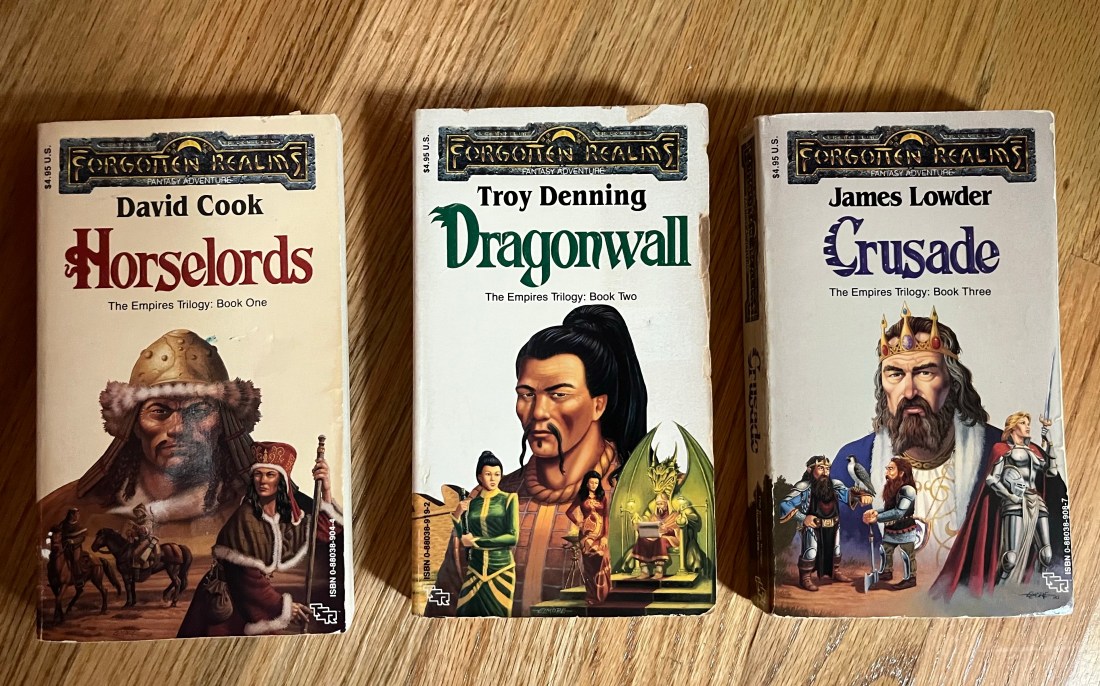
This post started with a surprise find at my local Half Price Books store. I often peruse the old fantasy paperback section, looking for Roger Zelazny novels that I haven’t picked up yet (see Spring Cleaning post), when I stumbled upon this old novel:

I suddenly remembered reading Horselords way back in the 1990’s in college, and although I didn’t remember the story much, I felt like re-reading it. It turned out to be a surprisingly good book. The story had surprisingly little to do with any Dungeons and Dragons lore apart from an odd mention here and there of magic, but instead was essentially a re-telling of the Mongol invasions of China, through a fantasy, fictional tribe called the Tuigan, headed by one Yamun Kahan. The book hints at some lore regarding the great Shou Empire, while the store is largely seen through the eyes of a foreign monk named Koja who is gradually brought into the inner-circle of Yamun Kahan. The story includes a lot of elements of the “noble savage” and “fish out of water” tropes, but overall it was a solid story as Koja gradually becomes more and more Tuigan in spite of himself. Even as his homeland is invaded by the Tuigan, Koja is a semi-willing participant in the invasion.

Having enjoyed the book, I decided to get the next two. I had never read them back in the day, not even sure if I knew they existed, but now, 30 years later, it was time to finish the series.

The second book, Dragonwall, was written by a different author, and was in many ways a different story entirely. The main character is a minor general named Batu Min Ho, who has Tuigan ancestry of his own, but was raised in Shou Lung. Through his tactical skill, he gradually rises through the ranks, earning the jealousy of some of the mandarins above him, culminating in a power struggle, and plenty of treachery that leaves his wife and children killed by the end.

Dragonwall overwhelmingly paints the Shou (fantasy Chinese) people of the Forgotten Realms in a negative light, as treacherous, back-biting, and decadent, which isn’t too surprising where court politics would be concerned but there’s little else to balance this contrast with the rest of Shou culture. This was probably meant to contrast the more brutal, yet honorable Tuigan culture, yet all the characters come off as one-dimensional and cartoonishly evil, especially the female antagonist. It plays into a lot of old, tired stereotypes about Chinese people.

Further, Batu Min Ho, having been discriminated and betrayed by the Shou, loses everything, goes rogue, literally using the Japanese term ronin (🤦🏻‍♂️)1 to describe himself, and joins Yamun Kahan’s horde.

The book ends with a lengthy divergence when the Tuigan under command of Batu Min Ho invade the fantasy realm of Thay briefly, which probably would’ve been interesting as a third story, rather than the end of this one.

In any case, this is where the third novel, Crusade, picks up, but once again, this book is written from the perspective of someone who is not Tuigan. This time the book is written through the perspective of the kingdom of Cormyr, a staple of the Forgotten Realms setting. This book, out of all three, has the most familiar fantasy setting since it is in a “Western” culture, so the author probably was on steadier ground and was able to afford fleshing out the characters more.

For me, Crusade, was a “slow burn” story: very slow start introducing an entirely new cast of characters with no interaction with the Tuigan. However, by the time of the climactic battle at the end, the book did an effective job of bringing everything together, including Batu Min Ho from the second book.

In spite of the rocky transition between settings across the series, shifting perspectives, and new characters each time, the final book did a rather admirable job wrapping up all the loose ends. The first book begins with a character named Koja and the third book essentially ends with him again. Coming full-circle was a nice conclusion.

The Empires Trilogy seems to have suffered from the same challenges that plagued the Star Wars sequels: No over-arching structure, and too many different “hands in the pot”, plus the stereotypical Asian characters, especially female characters, did not age well.

However, even with all the complaints, I still am glad to have finally finished the series. It was a bold attempt to make a semi-historical re-enactment of the Mongol invasions but through the lens of the Dungeons and Dragons Forgotten Realms setting. In spite of my complaints, I enjoyed the series and proudly keep it on my shelf now.

1 Western fascination of the lone warrior ronin is understandable, especially thanks to Kurosawa films, but it makes no sense for a Chinese character to use such a term, especially since it was not used for centuries later in the Edo period (17th century) when the story takes place in 12th century China.

Torii Gates in Japan

While making some maps on Inkarnate for a new Japanese-themed Ravenloft-domain I published on DMS Guild, I was reminded how these kind of Japanese gates often show up in unusual places in Western media, including fantasy media:

Torii gate for Tsurugaoka Hachimangu shrine in Kamakura, Japan. Taken in 2022.

But these gates aren’t just for decoration, they’re an important part of Japanese Shinto religion, called a torii (鳥居). They’re a feature only found at Shinto shrines, not Buddhist temples. Similar structures exist in other Asian cultures, but the torii in particular serves a religious function.

Shinto is a religion devoted to the kami, the native divinities of Japan, and in Shinto tradition ritual purity is important. The kami will not descend to ritually unclean places, nor hear the prayers of unclean people, so sacred places must be purified. A sacred space in this context can be as small as a tiny home shrine, a kamidana, or as large as the sanctum of a large shrine such as Meiji Shrine in Tokyo.

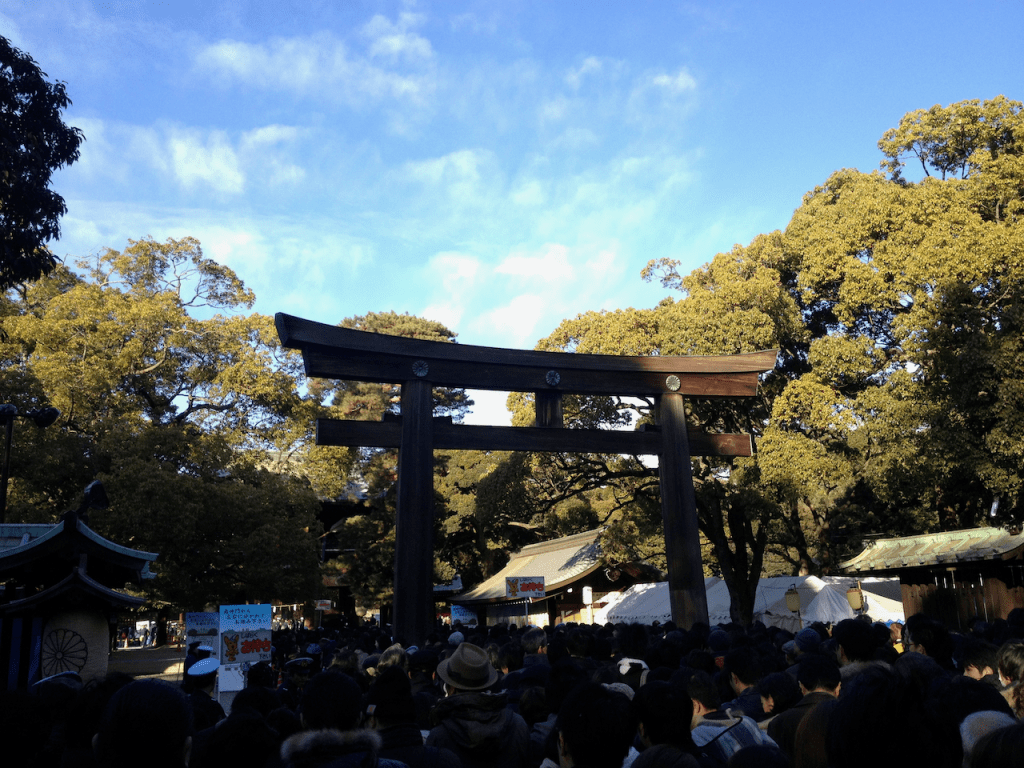
Torii gate for Meiji Shrine in Tokyo, taken in 2012 during Japanese New Year. The lines were amazingly long.

What matters is that there’s a sense of “boundary” between the mundane, outer world and the sacred, inner realm.

The torii thus acts as a gate between these two worlds. By passing through the gate you enter the sacred grounds of the shrine, or leave it. It’s also why taking away things from a shrine like pebbles or flowers is frowned upon.

Torii can be very small, or using the example of Meiji shrine, extremely large. There are many styles too. Some are bright red, others a more natural color. Sometimes a shrine will have a series of torii gates.

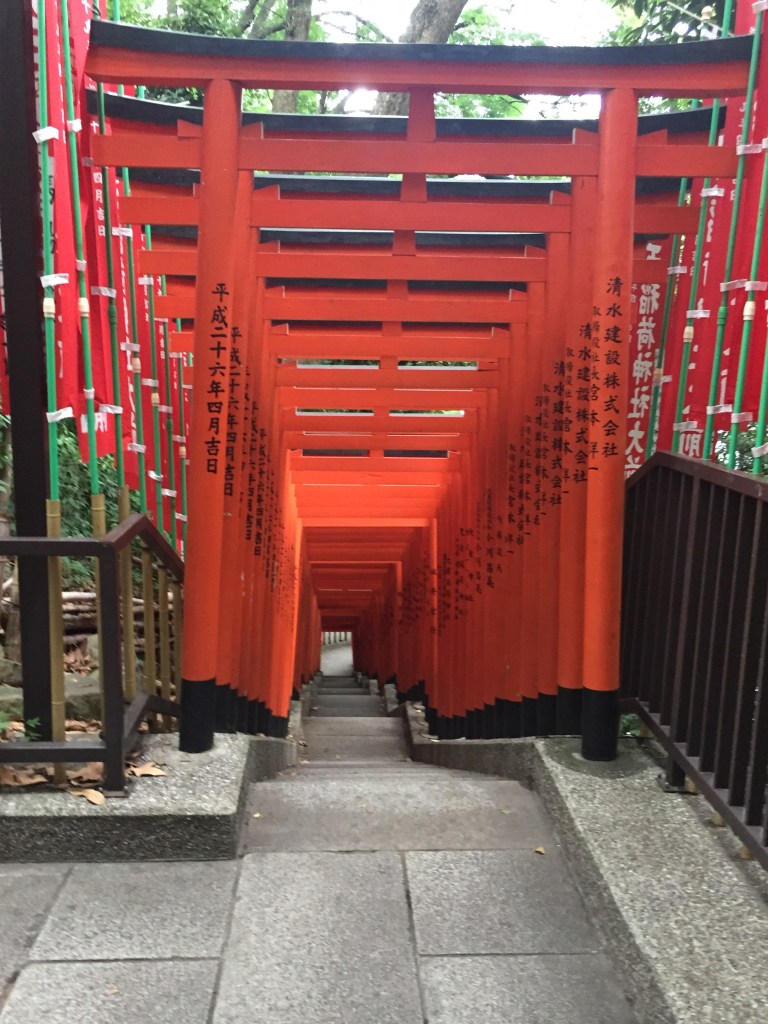
Torii gates at Hie Shrine in Tokyo, taken in 2017.

In the photo above, these gates were sponsored through donations by local businesses. As with many other aspects of Shinto, there’s a lot of local community involvement as well as give and take.

Anyhow, that’s a brief look at torii gates.

Learning Pathfinder 2e as a D&D Player

In the past couple of months, starting with the Beginner Box, I have been learning how to play Pathfinder, second edition, which came out in 2019. It is a successor to the original Pathfinder edition, which in turn was based on Dungeons and Dragons 3.5 through the Open Gaming License (the same one under attack recently by Wizards of the Coast).

Speaking from personal experience, Pathfinder has suffered from a bit of an image problem…

But I picked up the Core Rulebook lately, which has been a fun read. The artwork is top-notch, and the guide does a pretty careful job walking you through the rules. However, the sheer size of the rulebook makes it hard to mentally absorb all at once, so I found this excellent series of videos by Jason Buhlman, lead game designer, that walk through all the essential aspects of playing Pathfinder.

First lesson, character creation
Second lesson: understanding magic
Lesson three: designing encounters
Lesson four: combat

I enjoyed this series, and it really helped the rules Pathfinder 2e “gel” in my mind. It also made it easier to go back and make sense of the text in Core Rulebook without having to reread multiple times.

So, I went ahead and made a first-time character to get used to the new ruleset: Tharivol a Wood Elf Druid. Pathfinder does not yet have an equivalent online character sheet storage system like D&D Beyond, but it has been fun to make on paper.

Transitioning from D&D

But, what’s it like going from Dungeons and Dragons 5th edition, which I have played since 2017, to Pathfinder 2nd edition?

Mechanically speaking, many of the rules, especially combat rules, make a lot more sense in Pathfinder than they did in 5e. The feel is more or less the same, but when you get into the grey areas, the Pathfinder approach often makes more sense, and there’s usually a contingency for everything a player wants to do. Some rules look more familiar to old time players like me (for example the spell “slots”) who played older editions, others look like fresh design improvements over older games. It’s an interesting mix of complexity with novelty.

Weapons also make more sense. For example, I complained previously about the lack of Asian-style mundane items, weapons and magic items in 5th edition and I was surprised to find, for example katana weapon stats in Pathfinder right in the Core Rulebook. This means, my old elf-samurai character, if adapted for Pathfinder, would probably look a bit more realistic (as much as fantasy elves in a Japanese-style setting would 😅…) than before.

Speaking of character creation the Pathfinder system relies less on character “tracks” to follow as one levels up, and more on a kind of buffet where one picks feats over time. Sometimes, the feat choices and skill increases are limited in scope, but you still usually have room to choose. This makes it hard to create the same character twice, and means each one will have a bit more individuality.

In the Advanced Player’s Guide and Lost Omens: Ancestry Guide there are quiet a few more character races and classes to choose from beyond the Core Rulebook. I was surprised to see a more diverse set of options. My son who is half-Japanese, was excited to be able to play a Japanese-style kitsune (fey fox) character, for example.

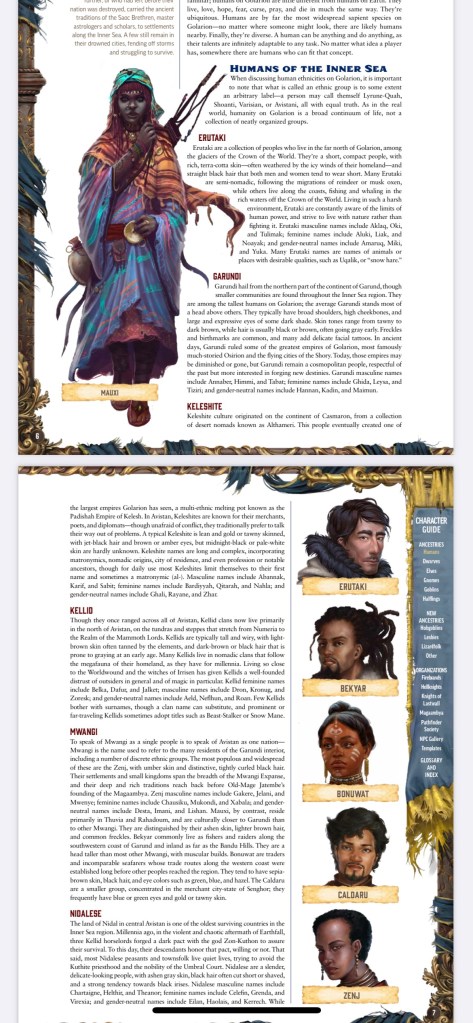
Even the human characters, unlike 5th edition Dungeons and Dragons, get a lot of attention and care and are a lot more compelling to play. The artwork alone depicting humans in Pathfinder is amazingly diverse and fascinating. Take a look at a couple pages from the Lost Omens: Character Guide

Holy cow, the amazing detail and artwork really brings the various cultures of Pathfinder to life, and makes it much easier to find cultures you can identify with. Paizo really needs to pat itself on the back for this effort. Speaking of artwork, the Lost Omens Travel Guide is simply amazing. The Guide is written as a travel guide for players who might venture in the default setting of Absalom and surrounding areas, but provides amazing detail about everything from fashion, to card games, and even recipes that you can try out in real life.

Speaking of which, the fact that Pathfinder is not limited to hardcover books (which are fairly expensive) and openly available online through PDFs, or just through official reference sites makes a lot of this easy to fit your budget level. You can start as you are and learn pretty quickly and cheaply, but if you’re like me and like physical books, you can easily order those either through your local game store or directly through paizo.com.

For all these wonderful aspects of Pathfinder, there is one area I have personally been frustrated and that’s the world building and lore.

A lot of the familiar old settings that I knew from Dungeons and Dragons, such as Eberron and Barovia, both of which predate 5th edition, simply don’t exist in Pathfinder. There are probably good reasons for this due to licensing issues, intellectual property, and so on, but the loss is definitely felt. Fan created conversions for such settings do exist, but they ran the gamut in terms of support and quality. It would have been nice if Pathfinder had found a way to provide more official versions that were maybe similar to the D&D settings, but obviously not carbon copies. Such things may exist, but it’s a bit hard to sift through all the different adventure packs and settings that are printed already.

Some of my Ravenloft novels, along with Sazh from Final Fantasy XIII.

It isn’t all that hard for an enterprising DM to also just convert 5th edition settings into Pathfinder ones, but I do miss being able to just have the reference books handy, for lore if nothing else. Pathfinder focuses on the Lost Omens setting as its introductory setting, and if you played 5th edition, this will feel in some ways like the classic Forgotten Realms Sword Coast. Beyond that though, things get a bit muddier in terms of lore that’s familiar to old D&D players.

Conclusion

In short, compared to Dungeons and Dragons, I have found that Pathfinder has more to learn up front due to slightly more complicated rulesets, and the vast array of books that Paizo has printed for 2nd edition already in the last 3-4 years. But Paizo recognizes this and provides a number of choices and options to help ease the transition. It took me about 2-3 weeks reading Core Rulebook and watching the videos in my spare time, but once I got past that initial hurdle, the rest of Pathfinder 2nd edition just made sense.

I’ve played a bit with my kids, but I would like to find other groups to play in the near future, but as with any TTRPG, finding players is…. challenging.

In any case, Pathfinder is dynamic, exciting and has a lot of offer. They are hungry for customers and are making great efforts to help educate people, and stay responsive to their needs. Where 5th edition has lost its luster for me, Pathfinder is a lot more exciting and compelling.

Of course I still enjoy 5th edition, and it has a lot of memories for me and the kids, but it also feels increasingly like it’s run it’s course, the corporate greed has homogenized the game to the point of being moribund.

A Nerd Dad’s Review of Pathfinder 2e Beginner Box

The recent fiasco by Wizards of the Coast (who owns Dungeons and Dragons) has left me pretty bitter toward 5th edition1 and the company that owns it. If Mordenkainen’s Tome of Foes wasn’t frustrating enough (“buy your $50 book again!”), this was the final straw.

I decided it was time to try Pathfinder again.

Again, you say? Allow me to explain.

Aeons ago, circa 2016, my coworkers and I played an after-work campaign of Pathfinder, 1st edition. The campaign lasted about 2-3 months but it was a miserable, stressful experience for me. The DM pushed us to optimize (e.g. “min-max”) our characters for awesome battles, using lots of custom 3rd party content, feats and builds that made really confused even as I was still to wrap my head around the basic rules. The DM knew the rules and feats like the back of his hand, but frankly wasn’t very empathetic to new players, and just wanted to host cool battles. Looking back, I believe the issue was more with the DM than with the game.2

I gave up, but I always felt someday that I should give it another try … someday.

Enter Pathfinder, 2nd edition (Pf2e): a major update to Pathfinder that came out in 2019. It streamlined and updated a lot of challenges with 1st edition, and includes a lot of good introductory material to help new players ease into this. A prime example is the Beginner Box which I ordered direct from Paizo.com after my local game store already sold out (believe me, I am not the only one locally who is mad at WotC).

My goal was to learn Pathfinder 2e properly, and at my own pace, so I could avoid the unnecessary stress of learning a new system, and actually keep things fun.

A week later, my box came in the mail:3 🎉

Yay, new package in the mail! Sadly, the little Starfinder figurine that was included was already smashed upon delivery.

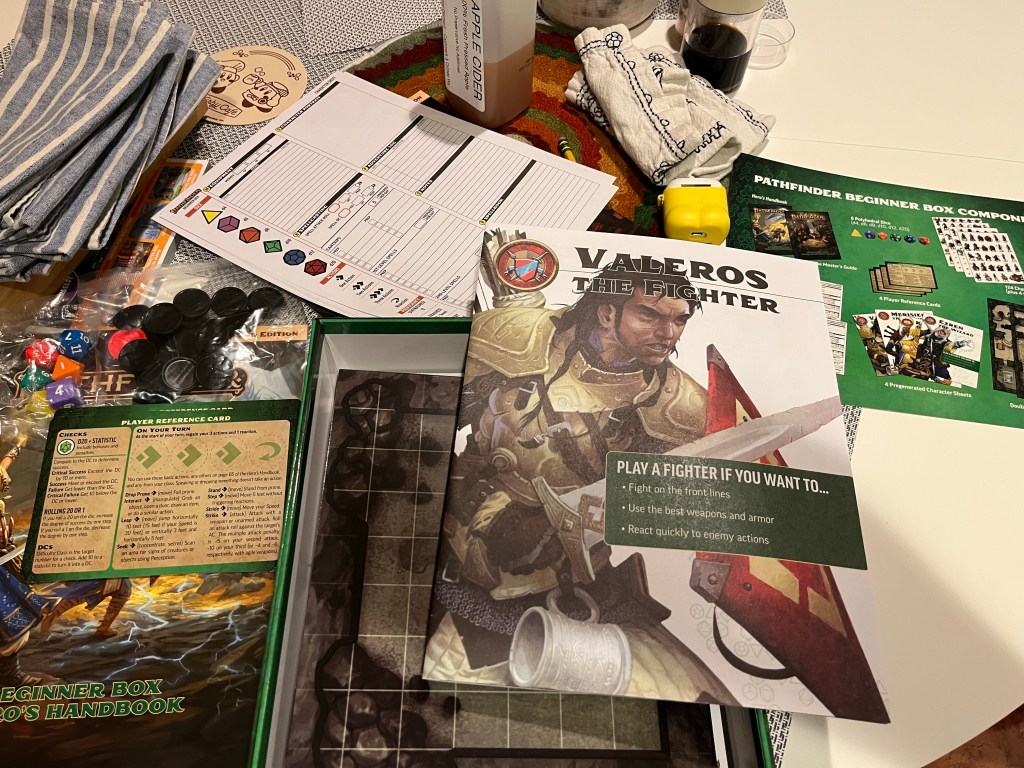
The Beginner Box contains everything you could possibly need for both a DM and a group of players to start from scratch:

  • a self-contained adventure (more on that later): Troubles in Otari.
  • a full set of dice, color-coded to match the symbols on the character sheets
  • pre-made character sheets with very easy to read stats, plus blank sheets if you still want to make your own. These look really nice by the way.
  • Two step by step guide adventure guide for Troubles in Otari, one for the DM and one for the players. These two books also function as a very slimmed down core Rulebook for Pathfinder 2e, including character building options, combat rules, etc.
  • fold-out adventure map for Troubles in Otari.
  • monster stand-up cardboard “tokens” for map, both a variety of player characters and all the monsters necessary for the adventure.
  • laminated “action cards” to help players decide what they can do during their turn
(please pardon the messy table…)

My kids, both experienced 5e players, were a bit hesitant to try Pathfinder since the only game system they knew and grew up with was D&D 5th edition, and as a busy parent I didn’t have much time to prepare Troubles in Otari either. So, both the kids and I essentially went into this first adventure blind.

I let my kids each pick from the pre-made character sheets for now, and I ran any character not chosen (Valeros the Fighter in my case) to ensure the party was rounded out. I read over the adventure guide for a couple minutes to get my bearings and off we went.

As a stand-alone adventure Troubles in Otari is a good, classic dungeon crawl. What makes it genius though is how each encounter teaches you another aspect of gameplay, each one slightly more advanced than the previous. So it is also a tutorial to the game.

The adventure guide for Troubles in Otari walks you through each step of the way: what happens if players do X, what happens if they hit a skeleton with Y, etc. Experienced DMs can gloss over if they want, but it helped me a ton in making the mental transition from 5th edition to Pf2e and keep things running along. I hand-waved a few spots for pacing, but what DM hasn’t?

Also, the DM and Players Guide both can standalone as introductions to Pathfinder 2e without having to invest in the Core Rulebook. Since it is a minimal introduction, a lot of character build options and combat details are missing, but this does ease new players up into the game, without having to read all the rules upfront.

My kids loved the “3-action” combat system, the change to perception rules, and the pre-made character sheets. Pathfinder 2e, as a whole, was familiar enough for kids who’ve played 5e to quickly adapt, but also fresh enough to keep their attention. The cardboard tokens were also popular as they made the combat fun, without investing a ton in figurines that I may or may not have.

We completed most of the 1st floor of Otari in about 2.5 hours before we got tired and took a break (my teenager also had homework to do). We will try to finish next weekend, and the kids are already looking forward to generating their own characters using the Core Rulebook (which I purchased at the same time, and will review separately).

As an introduction to Pathfinder, this was a pleasant experience and a useful teaching mechanism to myself and my kids. It was a far cry from the stress-inducing experience I had ages ago, and a fresh start to Pathfinder, as well as a great alternative to 5th edition Dungeons and Dragons.

Even if you are a pretty experienced TTRPG player, it really helps to have a nice hand-holding tool like the Beginner’s Box, to help with the mental transition in rules. Also, the materials included are re-usable in other contexts as well, so it’s not a one-and-done investment either.

P.S. Basic Liches did a really nice review of the Beginner Box here too, and it pretty much lines up with my experiences as well:

1 My kids had to talk me down from selling most of my D&D 5e books to the local used bookstore. It was a sunk cost, and doesn’t do much good to sell now, as we might still play in the future. Instead, we agreed that we’d buy no more D&D products for the foreseeable future. In any case, One D&D doesn’t interest me anyway, so I see little point in that either. My D&D Beyond subscription has already been cancelled too.

2 The same DM also took us through a D&D 5th edition play-through of the Mines of Phandelver, which started out well enough but eventually spiralled out of control too. So, there might have been a pattern.

3 Given that I live about 45 minutes by car from the Paizo headquarters, it’s quite amusing to watch my package go through an elaborate, Byzantine series of handoffs with one carrier to another before it finally arrived. In theory, I could have driven down to pick it up myself, and saved a week of waiting. I don’t blame Paizo for this, but I do blame the amazingly inefficient shipping process. Also, to be fair, I did pick the cheapest shipping option, and well, you get what you pay for…

Consulting Yi Jing the Dungeons and Dragons Way!

In my high school years, I was exploring many different facets of spirituality before I finally settled on Buddhism in my early twenties, and that included divination and other things. I dabbled in Tarot with a friend, but later took up the Yi Jing after finding a book at my local Waldenbooks bookstore. Even now I still consult it from every once in a while to kind of “check in” on my circumstances.

For those not familiar, the Yi Jing (易經, also spelled I Ching, or I Jing, etc) or “Book of Changes” is a very, very old divination book in Chinese culture that predates Confucianism, Buddhism, etc, and represents early Chinese religious thinking. Like many of the ancient classics from the Spring and Autumn Period of Chinese history, it was later re-interpreted by Confucius as the Four Books and Five Classics with an increasing philosophical and moral spin to it. But at its heart, the Yi Jing was a divination text, and remains so to this day.

As the name implies, the Book of Changes isn’t about specific predictions of the future (i.e. will I win the lottery?), but more about the changes and shifts around you. The central theme is the ebb of flow of Yang (陽) vs. Yin (陰). When consulting the Yi Jing, you create a hexagram, or 6 lines, from the bottom up, consisting of a combination of solid lines (yang) or broken lines (yin), forming such hexagrams as ䷑, ䷏, ䷋ and so forth. There are 64 possible combinations.

Also, if one or more lines is “old yang” or “old yin” that means it’s subject to change and thus you get two hexagrams, because the old yang line(s) become yin, and the old yin lines become yang. More on this later.

Anyhow, as I learned it, the key to consulting the Yi Jing is to form a question in your mind regarding a choice you’re going to make such as “what will happen if I do X?”, or alternatively, a question about the future such as “how will 2023 turn out?”. Also, as with any divination, don’t abuse it just to get the answers you want. Take what you get and make the most of it. Learn from it.

Anyhow, let’s talk specifics.

A bundle of 50 yarrow Achillea millefolium subsp. millefolium var. millefolium stalks, used for I Ching divination. Photo by CharlieHuang, CC BY-SA 4.0, via Wikimedia Commons

Traditionally, the Yi Jing is consulted using a bundle of 49 yarrow sticks, but the method is complicated, and most Westerners don’t have access to a bundle of yarrow anyway, let alone the experience in how to use them.

In my younger years, I used the “three coin” method by flipping three coins for each of the six lines, but mathematically this does not quite produce the same result as the yarrow stick method. It’s accessible, and easy to do, but if you want traditionally accurate results you need something else.

A few years back I found an article on Wikipedia that shows how Dungeons and Dragons can produce results that are the same as yarrow stalks, and as a player, I have plenty of the requisite dice,1 so I switched to that method instead.

The method I post here is based on the 3d4 method because it produces results the same as the yarrow stick method, and (according to above article) keeps the tradition association of yang with odd numbers, and yin with even. Plus, I love d4 dice in particular. 🥰

So, get three d4 dice like so:

And make your first roll, then add up the total.

Now draw the bottom line of the hexagram based on this criteria:

  • If it is odd, draw a solid line: ⚊ This is Yang.
  • If it is even, draw a line with a gap in the middle (a broken line): ⚋ This is Yin.
  • If your total was 7, also put a dot (or some other marker) besides the solid line. This is “old Yang”.
  • If your total was 4 or 12, also put a dot (or some other marker) besides your broken line. This is “old Yin”.

Now repeat these steps for the second line from the bottom, third line from the bottom, etc until you have 6 lines total. Traditionally, there is a larger space between the 3rd and 4th lines to make things easier to consult later.

Did your hexagram have any old Yang or old Yin? If so, draw a second hexagram in the same order, but convert any old Yang or old Yin into the other. A solid line becomes a broken line (⚊ → ⚋), a broken line into a solid (⚋ → ⚊). This implies your fortune will shift or change over time into something else. This is the Book of Changes after all. 😌

So, for example first the line of your hexagram (from the bottom) was old Yang, it would change to yin:

Anyhow, once you have your hexagram, or pair of hexagrams, you can consult your results. Using a chart from a book or online, look up the bottom pattern (the first 3 lines), followed the second pattern (top 3 lines). Together these form your hexagram listed in the Yi Jing. If you had a changing pattern and got two hexagrams consult them in that order.

Classical Chinese is a very difficult language to interpret due to its pithiness, and so quality of translations of the Yi Jing runs the gamut. I am not an expert, but I do notice some interpretations are just easier for me to read than others. As for accuracy to the source text, 🤷🏼‍♂️. I can’t recommend any particular version, either. You may need to look around and find one you like and make it your own.

Of course, even if you are not interested in using the Yi Jing as a means of divination, and yet do play Dungeons and Dragons, the methods and techniques outlined above make a perfectly fine fantasy roleplaying tool as well for whatever setting you might play, including my Hamato Islands series.

Anyhow, good luck!

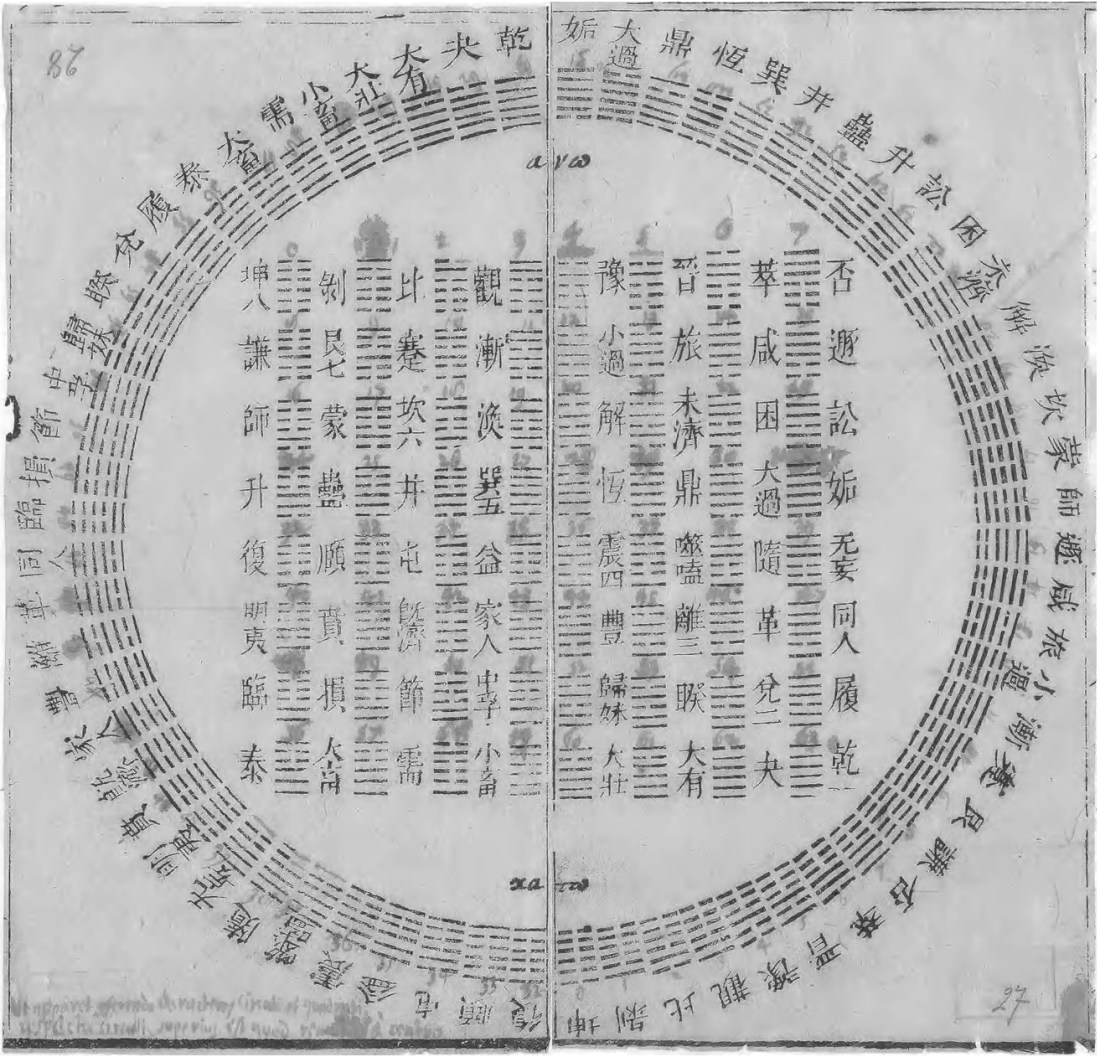
P.S. Featured photo is of a diagram of the Yi Jing hexagrams owned by Leibniz in 1701, source Wikimedia Commons.

1 If you need more dice, consult your friendly, local gaming store.

Designing Big Boss Encounters in D&D

Recently, my kids and I finished our long-term campaign in Eberron. The big climax to the campaign was a battle with the mad scientist who had transferred his consciousness to a great glass orb, and whose stat block was similar to a Beholder. But then, I started having misgivings, and was worried about the kids getting killed because the challenge rating was just on the edge of what the kids’ party could hope to defeat.

As one does…

I downgraded the stats and removed some bodyguards, but when the big battle came, it was clear that I had watered down the battle too much. The kids happened to roll well on saving throws, but also they quickly overwhelmed the boss and killed it.

Later my son (9) told me, “Daddy that was kind of easy.”

I remember years ago when my firstborn also played D&D with me, and we had the final boss battle then with a powerful, custom fiend, but the same problem occurred. The boss couldn’t do as much damage as the rest of the party.

So, it’s not enough to use encounter charts such as those in the Dungeon Master’s Guide and Xanathar’s Guide to Everything, to make a battle compelling you have to either go big or go wide.

Go Big, as the name implies to push the envelope of what the party can safely tolerate in combat. This means using the encounter charts above, but then increasing the difficult just a bit more. The goal as a DM is to foster a compelling challenge, not to kill the party. That does require the need to instill a genuine sense of threat, but also if the party is large, don’t let the boss sit around and just take a bunch of hits.

  • Consider using features like Legendary Actions, and Legendary Resistances.
  • Consider increasing hit points, or the armor class beyond regular statistics.
  • Consider adding some flare to some of attacks or spells used. These may simply be for dramatic flavor, but they do make a powerful impression on players.
  • Add some environmental difficulty, such as a force field to block the path, or environmental hazards such as lava.

Go Wide, on the other hand leaves the main boss largely unchanged, but adds more monsters to combat: soldiers, body guards, lair attacks and so on. This solves the problem of the heroic party having plenty of attacks to concentrate against one target, but on the other hand, it makes combat more difficult to manage. However, with so many potential threats, this can foster a sense of peril like above, through different means.

One other tip that might come in handy, which I regret not doing, is to rehearse the combat on your own time. Assuming you have the player character sheets (or a reasonable facsimile), you can simulate the battle in your own time and get a good sense of whether the battle is too easy, too long, or too deadly.

These are just some tips learned the hard way, but hopefully it will help. Good luck!