Recently, my family and I attended a wedding in my hometown for a relative of mine, who is marrying for the third time. The wedding took place at a famous golf course, which is situated on the top of a hill with a commanding view of the area.
It was a surreal experience for me. My sisters and I grew up with our single mom in slummy apartments just ten minutes away, and we never went to that golf course in our youth. Now, we were there many years later, surrounded by wealthy men in tailored jackets, holding brandy glasses, bragging loudly about business, surrounded by women with fake boobs, and cocktail dresses. As a Marxist-Buddhist with an Asian wife, we felt out of place.
But it was fascinating too. Here’s a group of people who live a completely different lifestyle than me. It wasn’t a question of class differences either. It was just a choice of lifestyles and values. When my relative comes to our house in a couple weeks for my daughter’s graduation party, they will no doubt find my lifestyle strange too.
I keep thinking about this quote from Stephen King’s book The Gunslinger, which I posted above. People might physically exist in the same proximity, but they might as well be living in different worlds.
If you have ever played the game Dungeons and Dragons, you are probably familiar with planes of existence called the Feywild and the Shadowfell. The setting of Dungeons and Dragons usually takes place on a plane called the Prime Material Plane: the normal world of stuff, people, etc. But in the D&D setting there are other worlds that closely mirror it, yet are subtly different.
The Feywild (which I wrote about ages ago) represents a version of the Prime Material Plane that is overflowing with life, change, chaos, hence it has many “fey” creatures (fairies, goblins, elves, etc). By contrast, the Shadowfell (another old post) is a colder, more static and gloomy version of the Prime Material Plane. In Dungeons and Dragons, objects and places in one of these planes will appear in some form in the other: a small castle on the Prime Material Plane might be a grand fairy palace in the Feywild, or an abandoned, gloomy fortress in the Shadowfell, and so on. If you’ve watched the Netflix series Stranger Things, it’s the same concept.
So, as I stood there watching the golf course employees serving drinks to wealthy men, it was like they were in different worlds. Some people there are unhappy and stuck in a rut, and might see things through the lens of the Shadowfell, while others are flitting from one party to another, like the fey of the Feywild. And then everyone in between, too.
This isn’t limited to Dungeons and Dragons either: if you look at Buddhism, and its many realms of rebirth (heaven, humans, warrior titans, animals, hell, hungry ghosts, etc), you can think of it the same way: we might occupy the same space, but we might as well be living in different worlds.
Most players of Dungeons and Dragons within the last couple of years are probably aware that an updated ruleset was on the horizon, to coincide with the 50th anniversary of the game. This new ruleset has included names such as “One D&D”, or jokingly “5.5 edition” and so on. Nonetheless, the new Player’s Handbook came out, and I got a limited edition copy at my local game store a couple weeks ago. My kids and I hadn’t really played any TTRPG in many months, both due to demanding schoolwork for the oldest, busy schedule for the family, malaise with Pathfinder Second Edition1 and just unhappiness with Hasbro shenanigans.
But we all agreed that we missed our old family D&D sessions during the early Pandemic, and my oldest child’s school schedule this year is much lighter now. So, we agreed to block out a time on weekends and start playing again.
We bought the alt-cover 2024 Player’s Handbook early, since FLGS’s were allowed to sell it a week before online release.
Further, my kids wanted to try the new rules, so I went to the local FLGS (friendly local gaming store), skimmed over the new 2024 Player’s Handbook, felt it was intuitive enough that I could adapt, and within a couple weeks, we were running a basic Forgotten Realms campaign, borrowing elements from R.A. Salvatore’s original Icewind Dale trilogy.2
I have my old copy of the Sword Coast Adventurer’s Guide to help with the world-building. old resource books for the Sword Coast. Also, before the game, I tested the new rules by creating a couple characters using 2024 rules to help provide sidekicks to our small party.
Our “session zero” with the new 2024 campaign.
The kids, having experience with 2014 5th Edition D&D quickly picked up the new rules and were able to get a couple fun characters created in an hour:
a dragonborn paladin (my son)
a tiefling cleric (daughter)
plus sidekicks I made: dwarf druid of the sea, and drow eldritch knight.
From there we’re back on familiar turf, having a good time, enjoying a classic bar fight opening and subsequently getting thrown out. Wulfgar and Regis from the Icewind Dale trilogy made a cameo too.
In short, getting up to speed with the 2024 rules was easier than expected. The character creation processed has definitely changed in a couple essential ways :
Character race no longer determines stats, it’s based on chosen background now. The result doesn’t really change the process all that much, but it is a philosophical shift.
The racial subclasses get net abilities to help with “flavor” more: elves for example are still divided by wood, high, and drow elves, but each one gets different innate spells at certain levels. Same with Tieflings, and so on. I found this change more fun than expected.
Many character class paths are homogenized to match other class paths. This means that clerics now choose their domain at level three, not level one for example. Wizards similarly choose school on wizardly later than before. However, even at level one there are choices you can make with character creation, so this isn’t as limiting as one might expect. However, clerics and wizards as of writing only have 4 subclasses only versus 8 previously.
Because classes and backgrounds are so strongly emphasized, these sections comprise most of the book by a long shot. The book covers species (character races), spells and equipment toward the end which is different from the classes 2014 PHB. The intro includes a nice, updated walkthrough of how a typical D&D session looks like so if you’re new to D&D, this is a good read.
Most of the other rules have not drastically changed, so in most cases they will feel familiar. There is a comprehensive list here as well.
Spells have often changed and take some careful reading to get re-acquainted. Many of these updates provide much-needed fixes and balance updates. For example the 3rd level Daylight spell now actually counts as sunlight for mechanics purposes (handy for vampires). The classic Cure Wounds spell heals 2d8 damage, not 1d8.
In short, some spells are weaker or more limited now than before. Spells that were seldom used such as Barkskin now have a new life. Again, if you played fifth edition before, you should definitely reread your spell list and familiarize yourself with the new spells.
All in all, despite my personal misgivings toward Hasbro, I must admit that the 2024 Player’s Handbook is a welcome update. It fixes a number of oddities, balance issues and deficiencies of the original while keeping its essence more than I expected. I can still use my old resource books without much effort to convert, which is greatly appreciated. Meanwhile, new players will have enough to get started with the PHB without needing to refer to older material.
I am eager to see what the 2024 Dungeon Master’s Guide brings as well.
Edit: I “butt-published” this too early. I had to write the last third of the post in a hurry. Apologies for the rushed effort. 🤦🏼♂️
P.S. another reason for investing in the 2024 PHB is that Adventurer’s League requires rebuilding characters to conform to 2024 rules anyway. I don’t play AL too often these days but I don’t want to get left behind.
1 While we did have a goodtime initially, especially with character creation, the biggest challenges with maintaining the Pathfinder campaign was a lack of coherent fantasy settings. Most of the research and prep I did as a DM was to pore over Wiki fan pages, which inevitably referred to modules I never bought (and weren’t interested in purchasing). There just wasn’t enough compelling lore, characters or story modules to get immersed in to replace classic D&D lore, plus they are scattered across so many books anyway that it was impossible to find anything. Plus the fatigue in keeping up with the constant stream of new classes, new ancestries, and so on. A TTRPG hobbyist has the time to keep up with this, but not a working parent who just wants to spend a weekend with the kids. Pathfinder 2e Remaster has good rules, and good design, but outside of this and the Beginner Box there is not enough support for more casual players especially those who have some nostalgia about classic TTRPG lore.
2 I’ve been reading the Icewind Daletrilogy shard to my son at night, after we finished the Lord of the Rings Trilogy, the Hobbit, and the original Dragonlance chronicles. LOtR was great, the Hobbit was great, Dragonlance wasn’t as good as I remember, but the Crystal Shard has been a solid read, though I have to skim over certain scenes that are inappropriate for younger audiences. He loves the main cast, even more so in teh second book Streams of Silver. It does feel like a D&D adventure for him, and he enjoys listening to the story, and (in his opinion), my voice acting.
Recently, I dragged my first Adventurers League character, Qisandoral Arreistanus, out of a long, long retirement for another adventure in our play-by-post group. Qisandoral is a high elf wizard of the Abjuration school. You can think of him as Mr Spock in a fantasy setting.
“We reach”… with Otiluke’s Freezing Sphere!
Due to pandemic and other issues, I hadn’t played this character in literally years, but due to AL rules, he had jumped from level 9 to level 12 through accumulated downtime. Otherwise he sat idle. With the new 2024 ruleset, and the requirement in Adventurers League to rebuild a character that conforms with this ruleset, here is the latest, update character sheet (link):
The tier-3 adventure module, from the Season 8 Waterdeep setting, took place in the underbelly of the city, where we fought a vampire cult worshipping Shar. With only three players, and no melee fighters, this was hugely risky. My memory of how to play Qisandoral was rusty, I had forgotten his abilities, and my spellbook choices were confusing and weird.1 During the big boss fight, I performed pretty terribly at first, and nearly wiped out my own party due to a poorly timed Otiluke’s Freezing Sphere. Further, our DM skillfully played the boss, a vampire mage, as it fought tooth and nail using every nasty trick in the book to survive. It took a huge effort to finally slay the abomination. At one point, I had to use Wall of Force to pin the vampire long enough for us to recover a couple rounds.2
The good news is that during play, I eventually dusted off the mental cobwebs and started playing my wizard more effectively. This post is to share some hard-learned lessons about playing an Abjuration Wizard in 5th edition Dungeons and Dragons. I think Abjuration wizards are really neat, and fit Qisandoral’s character concept (a dour, elf wizard who is very bland and likes routine) nicely, but they’re also a little different from other wizards as I learned the hard way.
Edit: with the 2024 Player’s Handbook, the rules for the Wizard class have changed considerably. You now choose your wizard subclass at level 3, but the abilities largely remain the same, and the advice remains unchanged. The level 10 ability in the 2024 ruleset has been greatly enhanced, and will certainly increase the power of this subclass at higher levels.
The Basics of Abjuration
First and foremost, Abjuration is about defense, cancellation and denial. Of course, an Abjuration wizard must also have some offense, but they will never excel at offense. Instead, an Abjuration wizard shines when they frustrate and shutdown the enemy.
Your 2nd level wizard ability, Arcane Ward, is your bread and butter. Simply by casting Mage Armor at the start of your day (which wizard’s do anyway), you gain a extra pool of hit points that will automatically absorb (afaik, you don’t get to choose, it just happens) a certain amount of damage before passing through. At low levels this pool is quickly used up, but at higher levels the pool of hit points gets pretty large.
Further, the pool recharges X hit points where X is 2 times the spell level. If I cast Shield, a 1st-level spell, my ward tops up by 2 hit points. If I cast Counterspell, a 3rd-level spell, it tops up the Arcane Ward by 6 hit points.
Later, when your character reaches 6th level, you can then project this ward as a reaction to absorb someone else’s damage. You have to be able to see that person, and they have to be within 30 feet, but otherwise it’s a handy way to keep teammates alive in a pinch (and I projected it a lot in the boss fight above).
Finally, the other big deal with Abjuration wizards is that for certain spells like Dispel Magic and Counterspell, you can boost your chance of success using your proficiency bonus. This does not work with Banishment sadly (I learned this the hard way).
Lastly, starting at 14th level, Abjuration wizards are highly resistant against spell attacks, which from a defensive standpoint is pretty neat and probably live-saving (sadly Qisandoral was 13th level during the aforementioned adventure).
What To Do And Not Do
An abjuration wizard needs to rely on their Arcane Ward a lot, so you should activate each day using Mage Armor or something suitable. Also, have a few cheap spells of the Abjuration school prepared to help recharge it as needed. The challenge is that many of those cheap spells are pretty niche:
Shield is always a good idea to have, but can only be used as a reaction (i.e. you’re being attacked). Further, shield gets less and less useful at higher levels as your AC struggles to keep up with enemy attack levels. You should always have it prepared just in case, but bear its limitations in mind.
Protection from Evil and Good can provide some help in some situations, but you can only cast it on one party member, even if you cast at higher level, and it requires concentration (yuck).
Counterspell only works when someone is casting a spell, and you can’t always stand around waiting for someone to do that.
Alarm is only useful outside of combat. Sneaky wizards know to cast this as a ritual over and over again (time permitting) to charge up the Arcane Ward.
Banishment is a high-level spell, and may fizzle if the saving throw succeeds. If it succeeds, you’re a target for opponents trying to break your concentration.
Globe of Invulnerability is very powerful, but it has a fixed location, so it will not move with the player.
Each of these is pretty niche spells, so if you want to maximize usage of the Arcane Ward, you prepare as many of these as you can to react to various situations.
On the flip side, the more of these you prepare, the fewer offensive spells and other utility spells you can prepare. In earlier adventurers, this was the problem I had with Qisandoral: in many fights, the best he could do was shoot Ray of Frost (a cantrip) half the time.
Thus if you want to have an Abjuration wizard with some offensive capability, you will have to choose your spells carefully, and strike a balance between the needs of your school, and the needs on the battlefield.
It’s best to pick spells that are generally useful in all situations. Magic Missile isn’t glamorous, but few monsters can resist force damage, and it just about always hits its target (unless they have a Shield spell). Even cantrips can be useful since they do scale up damage over time. Qisandoral has both Ray of Frost for distance, and Shocking Grasp for close range.3 Having a variety of offensive cantrips may help free up the need to use precious spell slots for other things, even if you are not a powerhouse.
Also, having a classic like Fireball or Freezing Sphere is good to have in your back-pocket as a kind of panic button.
On the utility side, spells like Misty Step are a great way to get in and out of the battlefield, and well as some common detection spells like See Invisibility or Detect Magic.
Combat
Since you’re default strategy is to leverage Arcane Ward to frustrate attacks, or use your spells to stop magic effects, you may be in combat doing mostly passive or reactionary moves while spending your turn making low-level attacks that don’t require commitment or concentration. The default strategy is one of observation, and being able to respond to threats as they come up, but still reasonably do your part to take out threats offensively.
If you do manage to Banish a creature that you intended too, then don’t hesitate to protect yourself using your own abilities otherwise intelligent monsters may decide to target you next to break concentration.
Finally, remember that if you use Globe of Invulnerability, make sure to put it in a strategic spot where you and party members can take cover for the rest of the battle. In other words, make it count.
Final Thoughts
If your goal is to make a wizard that decimates the battlefield with world-bending magic, an Abjuration wizard probably isn’t a suitable choice unless you want to charge your Arcane Ward once per day and maybe keep an abjuration spell or two handy.
If your goal is to disrupt the battlefield and frustrate your enemies, an Abjuration wizard excels at this, but it does require responding to various niche situations as they come up, and your damage output will be somewhat below average. Just remember you’re focusing on defense first, offense second.
Conversely, since so many Abjuration spells are situational don’t be surprised if you are in a situation where none of them are useful. Have a few generalist spells prepared for this situation.
Finally, as with every wizard, you can never quite prepare enough spells. It’s always a juggling act to balance various competing needs, and accept that you will sooner or later have failed to prepare the right spell for a particular situation. The vast breadth of spells a wizard has comes with the cost of lots of care and feeding.
I hope this was helpful. Good luck!
1 Thanks to simpler AL rules now, I probably should have just rebuilt him again from the ground up before the adventure, but I was in a hurry and busy.
2 I also had Hold Monster prepared, but failed to notice the stipulation that it does not work on undead monsters. 🤦🏼♂️ Word of advice for new players: read your spells carefully beforehand.
3Shocking Grasp is also handy when your opponent has legendary actions, since a hit prevents them from taking reactions for a turn. This was something I could’ve done in our fight, but I failed to grasp this until too late. To be fair, our opponent was invisible most of the time anyway.
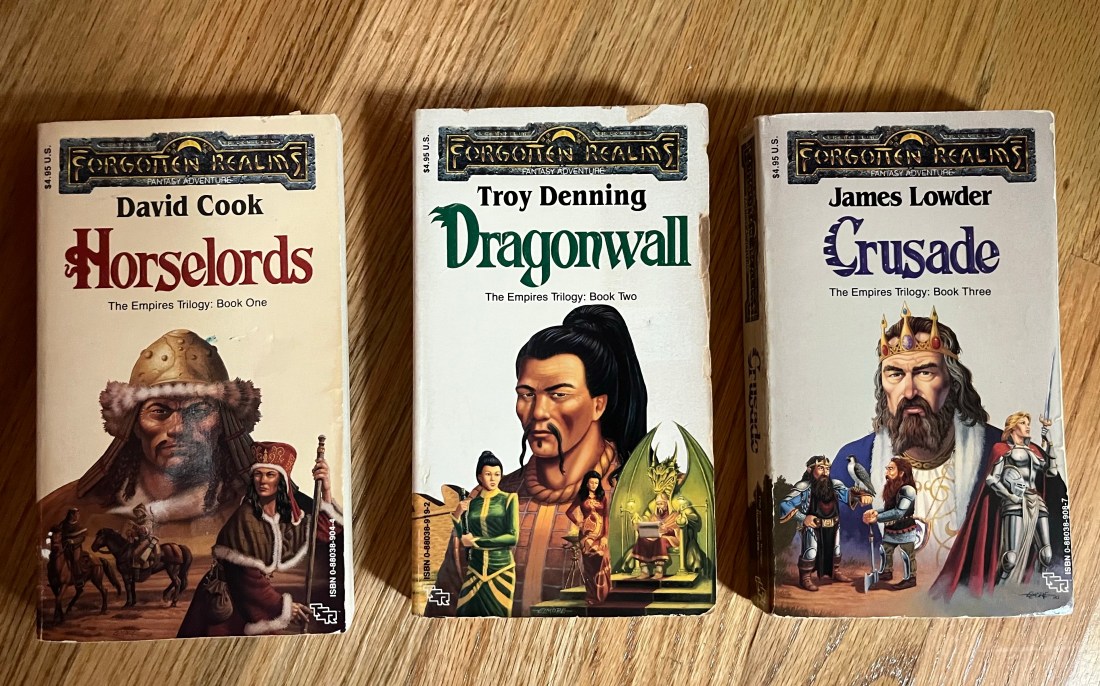
This post started with a surprise find at my local Half Price Books store. I often peruse the old fantasy paperback section, looking for Roger Zelazny novels that I haven’t picked up yet (see Spring Cleaning post), when I stumbled upon this old novel:
I suddenly remembered reading Horselords way back in the 1990’s in college, and although I didn’t remember the story much, I felt like re-reading it. It turned out to be a surprisingly good book. The story had surprisingly little to do with any Dungeons and Dragons lore apart from an odd mention here and there of magic, but instead was essentially a re-telling of the Mongol invasions of China, through a fantasy, fictional tribe called the Tuigan, headed by one Yamun Kahan. The book hints at some lore regarding the great Shou Empire, while the store is largely seen through the eyes of a foreign monk named Koja who is gradually brought into the inner-circle of Yamun Kahan. The story includes a lot of elements of the “noble savage” and “fish out of water” tropes, but overall it was a solid story as Koja gradually becomes more and more Tuigan in spite of himself. Even as his homeland is invaded by the Tuigan, Koja is a semi-willing participant in the invasion.
Having enjoyed the book, I decided to get the next two. I had never read them back in the day, not even sure if I knew they existed, but now, 30 years later, it was time to finish the series.
The second book, Dragonwall, was written by a different author, and was in many ways a different story entirely. The main character is a minor general named Batu Min Ho, who has Tuigan ancestry of his own, but was raised in Shou Lung. Through his tactical skill, he gradually rises through the ranks, earning the jealousy of some of the mandarins above him, culminating in a power struggle, and plenty of treachery that leaves his wife and children killed by the end.
Dragonwall overwhelmingly paints the Shou (fantasy Chinese) people of the Forgotten Realms in a negative light, as treacherous, back-biting, and decadent, which isn’t too surprising where court politics would be concerned but there’s little else to balance this contrast with the rest of Shou culture. This was probably meant to contrast the more brutal, yet honorable Tuigan culture, yet all the characters come off as one-dimensional and cartoonishly evil, especially the female antagonist. It plays into a lot of old, tired stereotypes about Chinese people.
Further, Batu Min Ho, having been discriminated and betrayed by the Shou, loses everything, goes rogue, literally using the Japanese term ronin (🤦🏻♂️)1 to describe himself, and joins Yamun Kahan’s horde.
The book ends with a lengthy divergence when the Tuigan under command of Batu Min Ho invade the fantasy realm of Thay briefly, which probably would’ve been interesting as a third story, rather than the end of this one.
In any case, this is where the third novel, Crusade, picks up, but once again, this book is written from the perspective of someone who is not Tuigan. This time the book is written through the perspective of the kingdom of Cormyr, a staple of the Forgotten Realms setting. This book, out of all three, has the most familiar fantasy setting since it is in a “Western” culture, so the author probably was on steadier ground and was able to afford fleshing out the characters more.
For me, Crusade, was a “slow burn” story: very slow start introducing an entirely new cast of characters with no interaction with the Tuigan. However, by the time of the climactic battle at the end, the book did an effective job of bringing everything together, including Batu Min Ho from the second book.
In spite of the rocky transition between settings across the series, shifting perspectives, and new characters each time, the final book did a rather admirable job wrapping up all the loose ends. The first book begins with a character named Koja and the third book essentially ends with him again. Coming full-circle was a nice conclusion.
The Empires Trilogy seems to have suffered from the same challenges that plagued the Star Wars sequels: No over-arching structure, and too many different “hands in the pot”, plus the stereotypical Asian characters, especially female characters, did not age well.
However, even with all the complaints, I still am glad to have finally finished the series. It was a bold attempt to make a semi-historical re-enactment of the Mongol invasions but through the lens of the Dungeons and Dragons Forgotten Realms setting. In spite of my complaints, I enjoyed the series and proudly keep it on my shelf now.
1 Western fascination of the lone warrior ronin is understandable, especially thanks to Kurosawa films, but it makes no sense for a Chinese character to use such a term, especially since it was not used for centuries later in the Edo period (17th century) when the story takes place in 12th century China.
In my high school years, I was exploring many different facets of spirituality before I finally settled on Buddhism in my early twenties, and that included divination and other things. I dabbled in Tarot with a friend, but later took up the Yi Jing after finding a book at my local Waldenbooks bookstore. Even now I still consult it from every once in a while to kind of “check in” on my circumstances.
For those not familiar, the Yi Jing (易經, also spelled I Ching, or I Jing, etc) or “Book of Changes” is a very, very old divination book in Chinese culture that predates Confucianism, Buddhism, etc, and represents early Chinese religious thinking. Like many of the ancient classics from the Spring and Autumn Period of Chinese history, it was later re-interpreted by Confucius as the Four Books and Five Classics with an increasing philosophical and moral spin to it. But at its heart, the Yi Jing was a divination text, and remains so to this day.
As the name implies, the Book of Changes isn’t about specific predictions of the future (i.e. will I win the lottery?), but more about the changes and shifts around you. The central theme is the ebb of flow of Yang (陽) vs. Yin (陰). When consulting the Yi Jing, you create a hexagram, or 6 lines, from the bottom up, consisting of a combination of solid lines (yang) or broken lines (yin), forming such hexagrams as ䷑, ䷏, ䷋ and so forth. There are 64 possible combinations.
Also, if one or more lines is “old yang” or “old yin” that means it’s subject to change and thus you get two hexagrams, because the old yang line(s) become yin, and the old yin lines become yang. More on this later.
Anyhow, as I learned it, the key to consulting the Yi Jing is to form a question in your mind regarding a choice you’re going to make such as “what will happen if I do X?”, or alternatively, a question about the future such as “how will 2023 turn out?”. Also, as with any divination, don’t abuse it just to get the answers you want. Take what you get and make the most of it. Learn from it.
Anyhow, let’s talk specifics.
A bundle of 50 yarrow Achillea millefolium subsp. millefolium var. millefolium stalks, used for I Ching divination. Photo by CharlieHuang, CC BY-SA 4.0, via Wikimedia Commons
Traditionally, the Yi Jing is consulted using a bundle of 49 yarrow sticks, but the method is complicated, and most Westerners don’t have access to a bundle of yarrow anyway, let alone the experience in how to use them.
In my younger years, I used the “three coin” method by flipping three coins for each of the six lines, but mathematically this does not quite produce the same result as the yarrow stick method. It’s accessible, and easy to do, but if you want traditionally accurate results you need something else.
A few years back I found an article on Wikipedia that shows how Dungeons and Dragons can produce results that are the same as yarrow stalks, and as a player, I have plenty of the requisite dice,1 so I switched to that method instead.
The method I post here is based on the 3d4 method because it produces results the same as the yarrow stick method, and (according to above article) keeps the tradition association of yang with odd numbers, and yin with even. Plus, I love d4 dice in particular. 🥰
So, get three d4 dice like so:
And make your first roll, then add up the total.
Now draw the bottom line of the hexagram based on this criteria:
If it is odd, draw a solid line: ⚊ This is Yang.
If it is even, draw a line with a gap in the middle (a broken line): ⚋ This is Yin.
If your total was 7, also put a dot (or some other marker) besides the solid line. This is “old Yang”.
If your total was 4 or 12, also put a dot (or some other marker) besides your broken line. This is “old Yin”.
Now repeat these steps for the second line from the bottom, third line from the bottom, etc until you have 6 lines total. Traditionally, there is a larger space between the 3rd and 4th lines to make things easier to consult later.
Did your hexagram have any old Yang or old Yin? If so, draw a second hexagram in the same order, but convert any old Yang or old Yin into the other. A solid line becomes a broken line (⚊ → ⚋), a broken line into a solid (⚋ → ⚊). This implies your fortune will shift or change over time into something else. This is the Book of Changes after all. 😌
So, for example first the line of your hexagram (from the bottom) was old Yang, it would change to yin:
Anyhow, once you have your hexagram, or pair of hexagrams, you can consult your results. Using a chart from a book or online, look up the bottom pattern (the first 3 lines), followed the second pattern (top 3 lines). Together these form your hexagram listed in the Yi Jing. If you had a changing pattern and got two hexagrams consult them in that order.
Classical Chinese is a very difficult language to interpret due to its pithiness, and so quality of translations of the Yi Jing runs the gamut. I am not an expert, but I do notice some interpretations are just easier for me to read than others. As for accuracy to the source text, 🤷🏼♂️. I can’t recommend any particular version, either. You may need to look around and find one you like and make it your own.
Of course, even if you are not interested in using the Yi Jing as a means of divination, and yet do play Dungeons and Dragons, the methods and techniques outlined above make a perfectly fine fantasy roleplaying tool as well for whatever setting you might play, including my Hamato Islands series.
Anyhow, good luck!
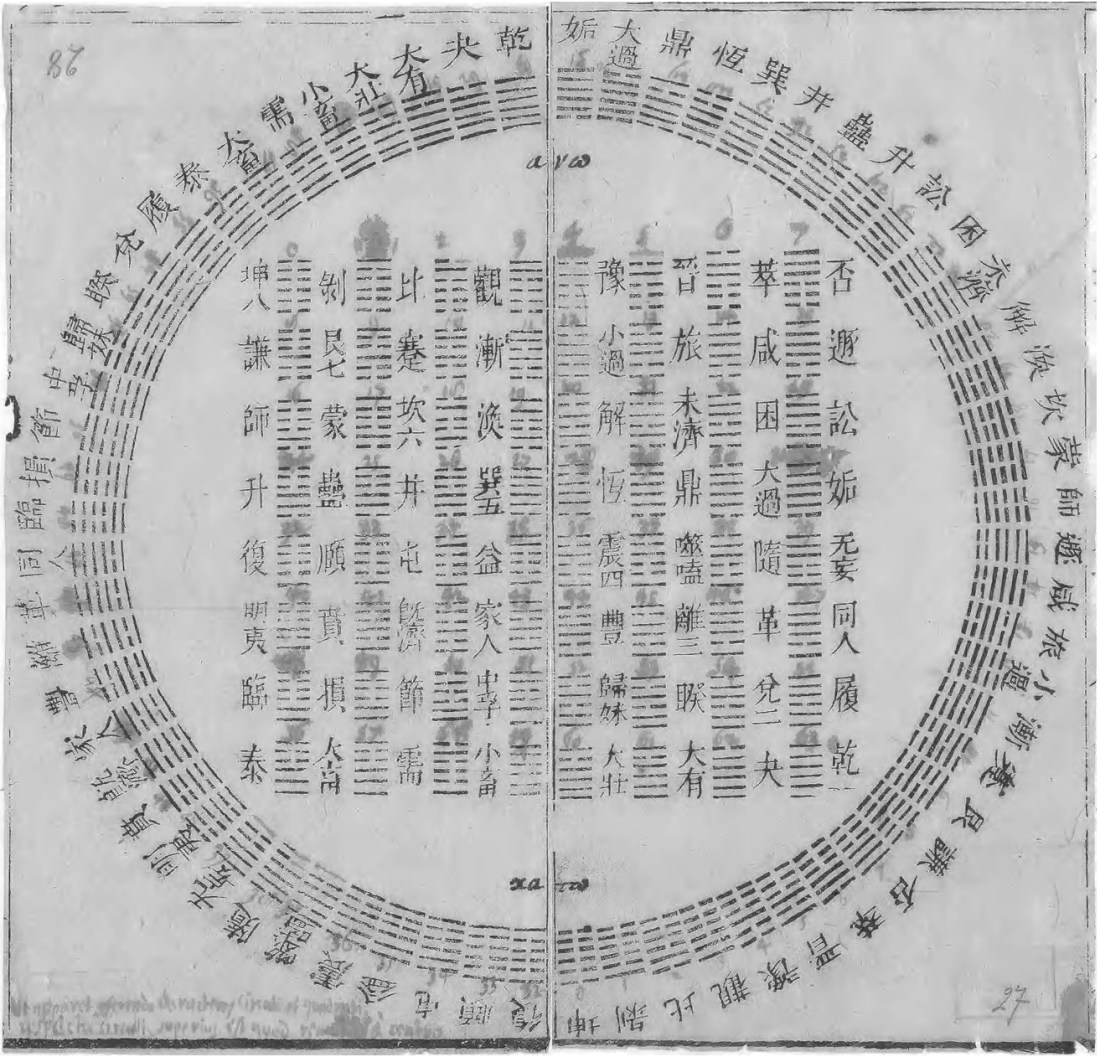
P.S. Featured photo is of a diagram of the Yi Jing hexagrams owned by Leibniz in 1701, source Wikimedia Commons.
1 If you need more dice, consult your friendly, local gaming store.







 Gleanings in Buddha-Fields


You must be logged in to post a comment.