Learning Pathfinder 2e as a D&D Player

In the past couple of months, starting with the Beginner Box, I have been learning how to play Pathfinder, second edition, which came out in 2019. It is a successor to the original Pathfinder edition, which in turn was based on Dungeons and Dragons 3.5 through the Open Gaming License (the same one under attack recently by Wizards of the Coast).

Speaking from personal experience, Pathfinder has suffered from a bit of an image problem…

But I picked up the Core Rulebook lately, which has been a fun read. The artwork is top-notch, and the guide does a pretty careful job walking you through the rules. However, the sheer size of the rulebook makes it hard to mentally absorb all at once, so I found this excellent series of videos by Jason Buhlman, lead game designer, that walk through all the essential aspects of playing Pathfinder.

First lesson, character creation
Second lesson: understanding magic
Lesson three: designing encounters
Lesson four: combat

I enjoyed this series, and it really helped the rules Pathfinder 2e “gel” in my mind. It also made it easier to go back and make sense of the text in Core Rulebook without having to reread multiple times.

So, I went ahead and made a first-time character to get used to the new ruleset: Tharivol a Wood Elf Druid. Pathfinder does not yet have an equivalent online character sheet storage system like D&D Beyond, but it has been fun to make on paper.

Transitioning from D&D

But, what’s it like going from Dungeons and Dragons 5th edition, which I have played since 2017, to Pathfinder 2nd edition?

Mechanically speaking, many of the rules, especially combat rules, make a lot more sense in Pathfinder than they did in 5e. The feel is more or less the same, but when you get into the grey areas, the Pathfinder approach often makes more sense, and there’s usually a contingency for everything a player wants to do. Some rules look more familiar to old time players like me (for example the spell “slots”) who played older editions, others look like fresh design improvements over older games. It’s an interesting mix of complexity with novelty.

Weapons also make more sense. For example, I complained previously about the lack of Asian-style mundane items, weapons and magic items in 5th edition and I was surprised to find, for example katana weapon stats in Pathfinder right in the Core Rulebook. This means, my old elf-samurai character, if adapted for Pathfinder, would probably look a bit more realistic (as much as fantasy elves in a Japanese-style setting would 😅…) than before.

Speaking of character creation the Pathfinder system relies less on character “tracks” to follow as one levels up, and more on a kind of buffet where one picks feats over time. Sometimes, the feat choices and skill increases are limited in scope, but you still usually have room to choose. This makes it hard to create the same character twice, and means each one will have a bit more individuality.

In the Advanced Player’s Guide and Lost Omens: Ancestry Guide there are quiet a few more character races and classes to choose from beyond the Core Rulebook. I was surprised to see a more diverse set of options. My son who is half-Japanese, was excited to be able to play a Japanese-style kitsune (fey fox) character, for example.

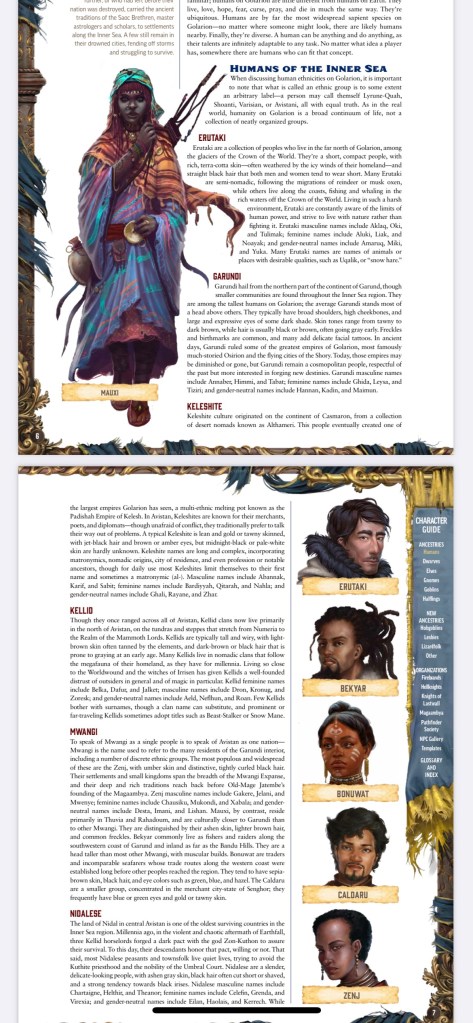
Even the human characters, unlike 5th edition Dungeons and Dragons, get a lot of attention and care and are a lot more compelling to play. The artwork alone depicting humans in Pathfinder is amazingly diverse and fascinating. Take a look at a couple pages from the Lost Omens: Character Guide

Holy cow, the amazing detail and artwork really brings the various cultures of Pathfinder to life, and makes it much easier to find cultures you can identify with. Paizo really needs to pat itself on the back for this effort. Speaking of artwork, the Lost Omens Travel Guide is simply amazing. The Guide is written as a travel guide for players who might venture in the default setting of Absalom and surrounding areas, but provides amazing detail about everything from fashion, to card games, and even recipes that you can try out in real life.

Speaking of which, the fact that Pathfinder is not limited to hardcover books (which are fairly expensive) and openly available online through PDFs, or just through official reference sites makes a lot of this easy to fit your budget level. You can start as you are and learn pretty quickly and cheaply, but if you’re like me and like physical books, you can easily order those either through your local game store or directly through paizo.com.

For all these wonderful aspects of Pathfinder, there is one area I have personally been frustrated and that’s the world building and lore.

A lot of the familiar old settings that I knew from Dungeons and Dragons, such as Eberron and Barovia, both of which predate 5th edition, simply don’t exist in Pathfinder. There are probably good reasons for this due to licensing issues, intellectual property, and so on, but the loss is definitely felt. Fan created conversions for such settings do exist, but they ran the gamut in terms of support and quality. It would have been nice if Pathfinder had found a way to provide more official versions that were maybe similar to the D&D settings, but obviously not carbon copies. Such things may exist, but it’s a bit hard to sift through all the different adventure packs and settings that are printed already.

Some of my Ravenloft novels, along with Sazh from Final Fantasy XIII.

It isn’t all that hard for an enterprising DM to also just convert 5th edition settings into Pathfinder ones, but I do miss being able to just have the reference books handy, for lore if nothing else. Pathfinder focuses on the Lost Omens setting as its introductory setting, and if you played 5th edition, this will feel in some ways like the classic Forgotten Realms Sword Coast. Beyond that though, things get a bit muddier in terms of lore that’s familiar to old D&D players.

Conclusion

In short, compared to Dungeons and Dragons, I have found that Pathfinder has more to learn up front due to slightly more complicated rulesets, and the vast array of books that Paizo has printed for 2nd edition already in the last 3-4 years. But Paizo recognizes this and provides a number of choices and options to help ease the transition. It took me about 2-3 weeks reading Core Rulebook and watching the videos in my spare time, but once I got past that initial hurdle, the rest of Pathfinder 2nd edition just made sense.

I’ve played a bit with my kids, but I would like to find other groups to play in the near future, but as with any TTRPG, finding players is…. challenging.

In any case, Pathfinder is dynamic, exciting and has a lot of offer. They are hungry for customers and are making great efforts to help educate people, and stay responsive to their needs. Where 5th edition has lost its luster for me, Pathfinder is a lot more exciting and compelling.

Of course I still enjoy 5th edition, and it has a lot of memories for me and the kids, but it also feels increasingly like it’s run it’s course, the corporate greed has homogenized the game to the point of being moribund.

Designing Big Boss Encounters in D&D

Recently, my kids and I finished our long-term campaign in Eberron. The big climax to the campaign was a battle with the mad scientist who had transferred his consciousness to a great glass orb, and whose stat block was similar to a Beholder. But then, I started having misgivings, and was worried about the kids getting killed because the challenge rating was just on the edge of what the kids’ party could hope to defeat.

As one does…

I downgraded the stats and removed some bodyguards, but when the big battle came, it was clear that I had watered down the battle too much. The kids happened to roll well on saving throws, but also they quickly overwhelmed the boss and killed it.

Later my son (9) told me, “Daddy that was kind of easy.”

I remember years ago when my firstborn also played D&D with me, and we had the final boss battle then with a powerful, custom fiend, but the same problem occurred. The boss couldn’t do as much damage as the rest of the party.

So, it’s not enough to use encounter charts such as those in the Dungeon Master’s Guide and Xanathar’s Guide to Everything, to make a battle compelling you have to either go big or go wide.

Go Big, as the name implies to push the envelope of what the party can safely tolerate in combat. This means using the encounter charts above, but then increasing the difficult just a bit more. The goal as a DM is to foster a compelling challenge, not to kill the party. That does require the need to instill a genuine sense of threat, but also if the party is large, don’t let the boss sit around and just take a bunch of hits.

  • Consider using features like Legendary Actions, and Legendary Resistances.
  • Consider increasing hit points, or the armor class beyond regular statistics.
  • Consider adding some flare to some of attacks or spells used. These may simply be for dramatic flavor, but they do make a powerful impression on players.
  • Add some environmental difficulty, such as a force field to block the path, or environmental hazards such as lava.

Go Wide, on the other hand leaves the main boss largely unchanged, but adds more monsters to combat: soldiers, body guards, lair attacks and so on. This solves the problem of the heroic party having plenty of attacks to concentrate against one target, but on the other hand, it makes combat more difficult to manage. However, with so many potential threats, this can foster a sense of peril like above, through different means.

One other tip that might come in handy, which I regret not doing, is to rehearse the combat on your own time. Assuming you have the player character sheets (or a reasonable facsimile), you can simulate the battle in your own time and get a good sense of whether the battle is too easy, too long, or too deadly.

These are just some tips learned the hard way, but hopefully it will help. Good luck!

Playing a Warforged in D&D

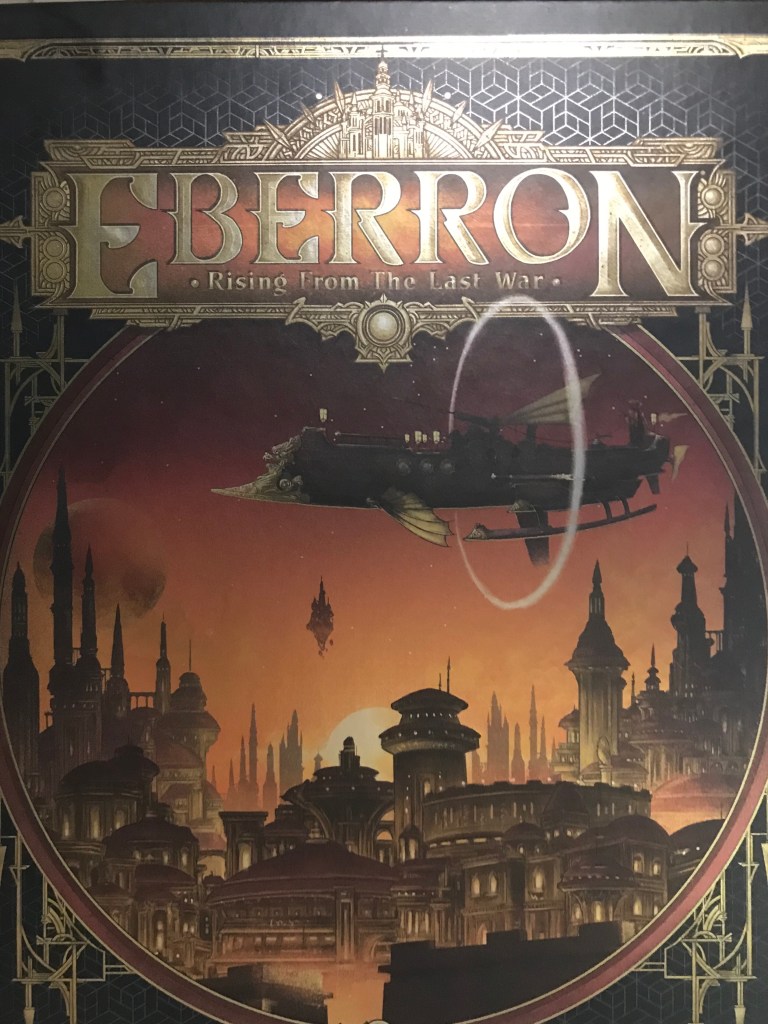
Front cover art for Eberron: Rising from the Last War, adapted from free wallpaper art (see link), all rights reserved

My kids and I have been playing a longer D&D campaign in the world of Eberron, a noir steam-punk magic setting for almost a year now, and the kids consistently seem to enjoy this setting more than other D&D campaigns we’ve run. Since we have only two players (my daughter and my son), the party consists of:

  • Daughter: Swiftstride shifter fighter / ranger, Latisse
  • Son: Halfling bard, Kirby1
  • Sidekick: Hobgoblin cleric (knowledge) / wizard, Borsheg
  • Sidekick: Warforged fighter (samurai), Malbus 414
  • Sidekick: Valenar (wood) elf fighter, Tantalus

I run the sidekick characters myself, and some have come in and others rotated out.2 The hobgoblin and warforged sidekicks have been with the party since the beginning and have been a pretty integral part of the story.

Our hobgoblin cleric’s backstory is that he secretly wanted to be a wizard instead and only did the cleric role out of familial obligation. However, since Borsheg was rejected by the wizards guild, he has since gotten private tutorship on the side with a shady teacher named “Dak” who, currently unknown to the party, is a Rakshasa.

Our Warforged has become the most central character to the party though. Originally, Malbus 414’s backstory was that he had, like all Warforged, fought in the Last War, particularly as part of the 523rd Battalion in East Breland. However, it became clear that his entire platoon had been secretly conditioned by their gnomish creator, Dr Vilnius Volrani Vishkik, to attack any gnomes from a certain rival house on sight. Eventually, the kids were able to find an artificer who could remove Malbus’s conditioning, and scrape up enough money to pay for it, but at the cost of partial memory loss. The kids really got choked up when they realized that Malbus wasn’t going to be quite the same.

Out of all the stories that I’ve teased in front of kids, including demonic cults, Borsheg’s evil tutor, smuggling jobs, etc, the kids have really attached themselves to Malbus’s and have since pursued Dr Vishkik (who unknown to the kids, is now a glorified brain-in-a-jar) across continent only to discover that he has reconstituted most of the old 523rd platoon, and means to take on the Lord of Blades in Cyre in order to become a new ruler there, assert dominance over all Warforged at large. Malbus is torn between his loyalties to his old platoon, but also his new purpose in stopping Dr Vishkik, especially where violence is required.

Mechanically speaking, a Warforged is an interesting character race since it’s fully artificial, yet is also a living being. According to the 5e guide, if you play a Warforged, you (among other things):

  • Gain a +1 bonus to Armor Class.
  • Have advantage on saving throws against being poisoned, and you have resistance to poison damage, and are immune to disease
  • Do not require sleep, but when you take a long rest, you must spend at least six hours in an inactive, motionless state, rather than sleeping. In this state, you appear inert, but it doesn’t render you unconscious, and you can see and hear as normal. Further, you don’t need to sleep, and magic can’t put you to sleep.

These things all come from the Warforged’s artificial nature. However, as a living sentient being, you can still benefit from things like healing magic, potions, etc., so you are not a construct either. It’s not entirely clear to what degree a Warforged is a machine vs. a living being, but I’ve mostly leaned toward the artificial, and focused on the “power core” as a source of their sentience and humanity.

The mechanics of a Warforged are fun, but the role-playing side of the Warforged is what I find most compelling. Because the Last War is over, Warforged are kind of superfluous now. Society doesn’t need them anymore, and they are no longer manufactured (at least in mass-production), so they have been tossed out on the street with no clear picture of what to do with themselves. This leaves plenty of room to decide how you would want to play a Warforged. Malbus 414 initially took mercenary jobs because war was the only thing he knew, but once he met the party during the initial session, he gradually took his life in a new direction with them.

The official interview with creator Keith Baker helps clarify this and is worth a watch:

I tend to roleplay Malbus 414 similar to Commander Data from Star Trek: The Next Generation, in that he is searching for his humanity, and trying to forge a new identity for himself bit by bit as something more than just a war machine. One could conceivably do the opposite and play a Warforged who never really left the Last War. The noir, brooding atmosphere of Eberron really lends itself to this, because of the heavier emphasis on character backstory, personal challenges, etc, but if you play a Warforged within the larger universe, such as Planescape or even the Forgotten Realms somehow, the brooding war backstory can still come into play and create a good starting point for the character.

Or you could just make a character like this one:

Comment posted in linked video above

I wish Warforged were more available in other settings, not just for its useful mechanical reasons, especially in Adventurer’s League, but I am happy to play one when the opportunity comes up. Its nature lends itself to good role-playing, and its mechanics allow for all kinds of interesting character / class options.

1 My son is a huge Kirby fan.

2 Our half-orc rouge-scout sidekick died a few weeks back in a random encounter, and the elf fighter replaced him since the party was near Valenar anyway. I keep a pool of sidekicks in the backlog in case I need to replace one. Still, the half-orc scout was a good character in his own right, and the kid and I kind of miss him already, even as we enjoy the new character.

Relearning D&D Through The Eberron Setting

My kids and I have been playing through an Eberron campaign since early 2021, and to my surprise my kids enjoy it more than our previous campaign, but as the DM I also have re-learn many things. Previously, I wrote about my review of the 5th edition Eberron sourcebook, and I’ve made good use of this book.

However, I also found a very handy set of videos interviewing Keith Baker, and how Eberron rethinks the traditional tropes of fantasy races:

As someone who frequently plays Elves, I found this video particularly handy:

But also what makes the Eberron setting so fascinating is how it is founded on a World War I-like historical event called the Last War, and how societies not only changed, but the nature of warfare as well:

Including the warforged race:

Indeed, the key to really getting the most out of Eberron as a backdrop is to think about how your characters were shaped by the war (even if they didn’t live through it), and also how nations were forged, or ruined, by it. But it also means learning to let go of existing high-fantasy tropes and redefine them more on a 1920’s style historical setting.

For our campaign, since my kids party is too small, I introduced a couple sidekick characters that have traveled with them throughout (making a party of four total):

  • Borsheg, son of Gorsheg. He is a cleric of Aureon, god of Knowledge, but secretly wanted to be a wizard. He has been learning lessons from a private mentor named “Dak”, but the kids (and Borsheg) are unaware that “Dak” is actually a Rakshasa (e.g. a Daelkyr) who is slowly corrupting him.
  • Malbus 414. Malbus is a former soldier of the 523rd platoon based in East Breland, and like the rest of his platoon was secretly conditioned by his gnomish creator to kill any member of a rival gnomish house if in proximity.
I have started painting miniatures for Malbus and Borsheg, too, featuring the emblems of our military unit or church affiliation.

The kids recently had a tearful moment as they paid an artificer in Sharn to undo the conditioning in Malbus 414, but it came at the cost of Malbus losing some of his memory and not remembering who they were.

Further, in another subplot, the kids were strong-armed in a smuggling operation of some powerful technology from the Last War, but disposed of it through some people they thought they could trust. However, little do they know that the technology has fallen into the hands of something much worse.

It has been a fun adventure so far, so I hope we can keep it up in 2022.

A Nerd Dad’s Review of Tasha’s Cauldron of Everything

Late last year, I picked up a copy of Tasha’s Cauldron of Everything, but with so much going on, I never got a chance to properly read through the book until last month (one year later 🤦🏽), which I now regret. What an excellent addition to the D&D canon.

Tasha, also known as Iggwilv, is a famous “witch” (more correctly an archmage) known as the Witch Queen in some sources. She is more of a chaotic character than the somewhat stodgy Mordenkainen, both her colleague and rival, and she has been known to consort with some demonic characters, but is not portrayed as evil either. One could draw some parallels with Liliana the planeswalker character from the Magic The Gathering series, but Tasha has a much longer history in the gaming world.1

The book is written from her perspective, and has some witty anecdotes from Tasha, and terrific artwork of Tasha herself. Mordenkainen never looked that good in heels. 😋

When I first bought the book, I wasn’t sure what to expect, apart from it seeming like a kind of “rules update” or reboot of some aspects of original Player’s Handbook. The book states off the bat that all the rules contained therein are entirely optional and meant to enhance the 5th-edition D&D experience, while also addressing some shortcomings with certain classes (rangers for example) or outmoded racial-character designs. But again, they are all optional.

Tasha’s focuses on four main areas, I feel:

  • Optional class options.
  • Spells and Magic items.
  • Additional tips and tools for world-building, including group patron options.
  • Custom background and character creation options

The first section struck me as the most immediately useful. My daughter, when she first played with me years ago, had a half-elf ranger with a beast master archetype. She loved that character, and her cougar companion, but as the adventures became more and more difficult, it was hard for her companion to keep up. This happened back before I (as the DM) knew about alternate house rules and such, so we played pretty closely to the book. Although she loved her animal companion, she couldn’t risk bringing it on adventures anymore, so she would often leave it in the care of NPCs and go off by herself.

But, using the new Tasha’s optional class features, the same animal companion gets a much needed improvement (as well as the rules for how to use it), and it properly scales with the character class.

In separate example, my elven forge cleric has Channel Divinity options that are seldom used in Adventurer’s League settings. Now, with the new Tasha’s options, I can choose to exercise that Channel Divinity option and regain spell slots (something clerics couldn’t previously do). Thus, he can stay on par with his wizard and druid party companions.

I also went back and made similar updates for my son’s Eberron halfling bard character, by allowing him to take some spell options he didn’t have previously through the Player’s Handbook. He enjoys his new Enlarge/Reduce spell.

For each character class, the optional updates from Tasha’s fall into two general types:

  1. Options that replace older, less desirable class features.
  2. Expanded options that you can chose to add alongside whatever you’re already playing.

The flexibility here is great, and works with D&D Beyond if you have purchased your book that way. Simply enable one or both of these options on the first page of your character creation:

I haven’t delved much into the magic items and spells, but I have seen a number of colleagues use them in Adventurer’s League games and my play-by-post group, and they seem pretty useful. The “summon” spells for each type of monster: celestial, fey, fiend, undead, etc. all seem pretty intriguing, and address some of the existing challenges of the classic summon spells. Other spells, like Tasha’s Mind Whip help fill a gap by allow more psychic magic options while staying roughly on par with other similar spells.

The custom background options in Tasha’s are also surprisingly useful in that they allow you to convert features of one background into another one using a simple conversion chart. This helps, for example, with my aforementioned elven forge cleric he may not necessarily spend his time in the woods, but perhaps in a more urbanized setting, so using a longbow seems a bit out of place for him, but perhaps a crossbow might. This gives plenty of options to customize the character the way you want, without negatively impacting the mechanics of the game or affecting character balancing.

All in all, Tasha’s Cauldron of Everything, just like the re-introduction of Tasha herself, gives 5th-edition Dungeons and Dragons a much needed breath of fresh air. I would be hesitant to call this 5.5th edition, but if heavily adopted, it does provide some far-reaching changes to a particular table. The flexibility of allowing DMs and players to adopt and implement the rules on an a la cart basis is an effective way to keep the classic look-and-feel of 5th edition, but also make updates where groups would like to see them. One can think of Tasha’s as an officially sanctioned set of house rules.

Having tried out the new rules, rather belatedly, my kids and I found some of them pretty handy, and look forward to trying other ones as the opportunities come up. Tasha is a welcome addition to the Dungeons and Dragons “Core Rulebooks”.

1 The trope of the independent, confident woman as a “bad girl” is kind of annoying in a way, and not limited to class TTRPG fantasy settings. You see it a lot in anime too. I won’t go into why I think it’s so prevalent, but suffice to say it’s nice to see women in fantasy settings standing on their own two feet, deciding their own fates and getting some representation. Tasha as a character still has a lot of baggage from older D&D versions and tropes, but it’s cool to see her get some updates as well.

A Buddhist Monk in Count Strahd’s Court

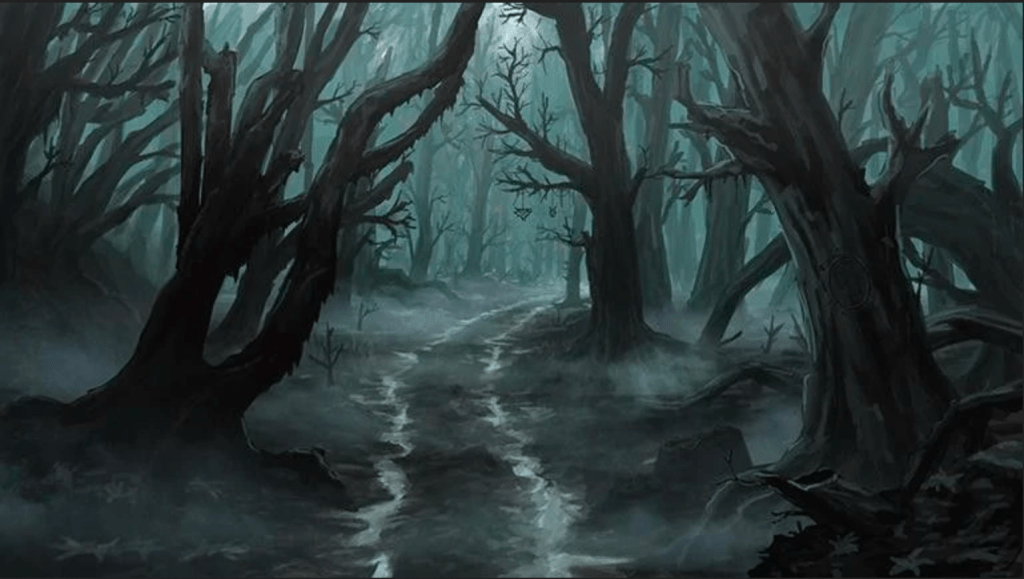
On the road to the Mists of Barovia

Having watched Netflix’s Castlevania series for probably the third time through, and as a way of “eating my own dog food” by applying my Dungeons and Dragons Hamato Islands setting to other environments, I started a recent thought-experiment: suppose I made a Japanese-style character, and suppose that character got transported to the classic gothic horror setting of Barovia from the Demiplanes of Dread. How would that look like?

Gothic horror, particularly the classic literature, arose from a specific time and place, so it’s inevitably tied to certain religious trends, cultural assumptions, monsters, etc. Dropping a samurai from, say, the 16th century Warring States period, or a Buddhist monk from the late 12th century Heian period into a such a setting would risk being nothing more than a “fish out of water story”. Fans might scoff and say “that would never happen”.

However, if you think about it, the demiplane Barovia, by its nature, keeps pulling people through The Mists to be trapped and fed off of by the vampire Dark Lord, Strahd von Zarovich. Strahd depends on a steady supply of incoming people because as a dark lord who’s been in power for many centuries, the native Barovians are broken spirits anyway and the land is practically devoid of life. As long as he brings more people through the mists, he could care less where they’re from; he just needs fresh blood, both literally and figuratively.

Strahd is a dark and brooding kind of guy

So, imagine some itinerant monk (cleric, Way of the Sage, in my setting) or a sohei warrior (probably a paladin, Oath of Vengeance) is traveling at night deep in the woods of some remote mountain path. Heavy mists close around him, and before he or she knows it, the forests look different. The fauna is ominous and unfamiliar and everything feels somehow threatening. Next he or she stumbles onto the next village only to find that it looks totally unfamiliar. The homes are sagging, timbers are rotten, the colors are faded and bleached, and the architecture is unfamiliar. The strange people gawking at him or her with haunted eyes look different. Worse, they probably wouldn’t speak the same language.1

Quite the culture shock, no?

But it goes further. The local deities would be unfamiliar for example. Such a character would probably not know the Morninglord (Lathander in Barovia), and might rely on their own deities instead even though they mysteriously can’t communicate with them. Since the Morninglord is the only non-evil deity in Barovia, would my cleric/sohei character try to find common ground, or would they hide their religion to avoid antagonizing the locals?

Folk customs, like garlic for vampires and holy water, would also differ. A character from another realm, such as medieval Japan, would use salt, sand blessed with a mantra, or chanting holy sutras to repel evil spirits. Would these religious practices work in Barovia?

If the character managed to survive long enough, I imagine that they would gradually encounter others who stand out. Such people might also hail from disparate lands: maybe from the tropical lands of Chult, the Al-Qadim setting (based on fantasy Arabic culture), or from the wider Asian-inspired lands of Kara-tur. Maybe even a Warforged from Eberron?

In spite of the diverse backgrounds, they’re all united by their common problem: they’ve been brought to the Demiplanes of Dread against their will, and they have to take Strahd2 down. Thus, I imagine the final showdown against Strahd would be a party composing of classic gothic figures like a priest of Lathander, a Simon Belmont like character, maybe a wizard or two, but also diverse characters from other lands. A kind of global super team.

Anyhow, this scenario probably isn’t interesting to other players, but it was just a fun thought-experiment about the challenges of dropping D&D characters from one culture into another culture, especially in a hostile environment.

P.S. Title inspired by Mark Twain’s Connecticut Yankee in King Arthur’s Court. I hope Mr Twain is not rolling over in his grave. 😅

1 The idea of one “Common” language in D&D that all humanoids know might work for a single contintent, but once we start spanning different continents in the Forgotten Realms, the idea seems less and less plausible. For that reason, I made up “Kara-Tur Common” and “Faerun Common” to account for linguistic differences between continental settings, while still having a reasonably common lingua franca among locals.

2 Or, a different Dark Lord, of course. With the new D&D book Van Richten’s Guide to Ravenloft, the other demiplanes are getting much needed attention and detail.

A Nerd Dad’s Review of Eberron: Rising from the Ashes

The alternate-art book we purchased last Thanksgiving weekend

Late last year during a fun extended Thanksgiving weekend, my kids and I picked up another D&D sourcebook: Eberron: Rising from the Last War. The setting of Eberron came out during Dungeons and Dragons 3.5, so I missed it completely until now,1 and wanted to try it out with the kids. Taking advantage of lockdown, I finally had some time to look into this book and start planning out a campaign for my kids.

Eberron, as a setting, seems to attract a pretty devoted audience due to its unusual magic-steampunk atmosphere which differs from the more typical high-fantasy of the Forgotten Realms or Greyhawk settings. If you like trains powered by lightning, flying ships powered by fire elementals, and plenty of noir atmosphere, there’s a lot to work with.

The sourcebook is dense even by the standards of D&D sourcebooks, and if you have never played Eberron before, the amount Eberron-specific lore in the book is pretty daunting. I feel pretty familiar with the Forgotten Realms setting, its lore and such, and almost none of it translates into Eberron. It is its own world, its own history, people and even terminology. I still have only a vague idea what Quori are, and who the Daelkyr were, but they feature prominently. Then there is a whole new pantheon of gods (which for some reason have no alignment defined in the sourcebook), new religions, etc.

The history of Eberron alone is amazingly detailed, as it covers various empires that have risen and fallen. Demonic kingdoms existed in antiquity, as did dragons, and later goblinoid empires. Then there’s the Last War which is what the current setting is pinned on: a great continental war that resulted in the total destruction of one of its kingdoms (Cyre) leaving behind a kind of magic post-apocalyptic nightmare. All of this makes for pretty fascinating backstory, and the richness of Eberron probably helps explain its enduring popularity.

However, for all this impressive backstory, culture and extra features (for example “dragonmarks”) a couple problems confront a new DM totally unfamiliar with Eberron:

  1. The learning curve for such material is kind of steep, and unless you’ve played in a campaign before, it might be hard to retain it all.
  2. Due to density, it’s hard to know what’s essential information, and what’s not. How much can you afford to cut out for a smaller campaign taking play in, say, Sharn, vs. the Shadow Reaches?

Another challenge presenting DMs who are making campaigns for kids is adapting the grim noir setting into something more lightweight and fun. My youngest is much too young to appreciate dark backstories, or the horrors of war, he just likes to fight cool monster battles. When I started out making a campaign for my kids, I sat there with an open notebook, read through a few chapters and hours later still had a blank notebook. I had no idea how to come up with quick intro-level adventure.2

Thankfully, Keith Baker, the genius behind Eberron wrote an article recently for D&D Beyond that helped address this very question. He suggested 4 possible types of adventures to start with, among others:

  • An urban adventure in Sharn, particular in the “underbelly” (literally and figuratively) of the city.
  • A wilderness adventure on assignment with the Clifftop Adventurer’s Guild.
  • A gritty, frontier adventure at the mining colony of Hope.
  • Go back a bit in time to the last days of the War and various adventure opportunities that presents.

The article helped me finally come up with a good starting adventure hook, and some much-needed context around the vast lore of Eberron: Rising from the Last War. My kids and I played a small two-episode campaign in the Shadow Reaches as a “contract” with Clifftop Adventurer’s Guild to clear some monsters, plus I added some sidekicks: a Warforged fighter (who, little do they know, has some Manchurian Candidate-style programming in his mind), and a Hobgoblin cleric of Aureon who longs to fit into high-society. Once things settled in, the campaign felt like any old fun adventure around the dinner table. It was D&D through and through, just with a different campaign. We’ve since started to branch off into a second adventure taking place in Sharn doing some relic scavenging.

As my family’s first experience with Eberron, once we got over the hurdle of absorbing a whole new world’s worth of lore, the rules and gameplay are just as fun as any other D&D game.

In closing, I think one of the biggest challenges of Eberron: Rising from the Last War is its format: dense, and not organized around getting started. My impression was that the target audience is the existing Eberron fanbase, and the interest in adapting Eberron in a more official 5th-edition capacity than before. Thus, as an official sourcebook for all things Eberron, this book passes with flying colors. As an onboarding guide for new players this book is a bit intimidating, but if you can work your way through it, it’s quite fun.

Good luck and happy adventuring!

P.S. I realize most D&D players are probably focused on the latest adventure book, Rime of the Frostmaiden, but I as a busy nerd dad, I move kind of slow. 😉

1 For those keeping score, my first experience with D&D was 2nd edition AD&D, which I played a bunch in high-school with friends. None of us knew what we were doing, but we had a lot of fun, I devoured books about Drizzt Do’Urden, and played some Dark Sun as well. By the time 3rd edition came out, though, I was in college and had forgotten all about D&D for a long time until _4th edition_ came out. I played one game of that and said no thanks. It wasn’t until 5th edition that I seriously played again. So, I missed everything related to D&D 3rd and 3.5 edition. I played Pathfinder for a bit as well, and I would be up for playing it again (especially Pathfinder 2), but I have just barely enough time for 5e as it is.

2 As other reviews have pointed out, there is an introduction adventure included in the book, but due to its density, I wasn’t able to find it. Descriptions of Sharn the City of Tower were nice and detailed, but how to turn this into a fun intro story weren’t readily apparent.

A Nerd Dad’s Review of Mythic Odysseys of Theros

Hi folks,

In addition to my recent adventures in adventure module writing, and gardening, I finally got a belated Father’s Day gift recently:

The Mythic Odysseys of Theros (MOoT) is a cross-over reference guide between Dungeons and Dragons and Magic: The Gathering, specifically the Greek-mythology inspired plane of Theros. Theros is a kind of idealized plane of what Greek mythology would be if taken out of historical context and allowed to run free. It is a world full of gods exerting a direct influence on the world, satyrs, minotaurs, city-states loosely modeled after ancient Greek city states, etc.

This leads to some interesting mechanics in MOoT that are worth sharing here:

  • Many of the typical “high-fantasy” character races that are found in D&D are not in Theros: elves, dwards, gnomes. They didn’t exist in classical Greek mythology (nor Magic the Gathering’s plane of Theros) and do not exist here. They are replaced by centaurs, satyrs, minotaurs, etc.
  • Unlike the usual, somewhat loose, mechanics between clerics and gods, the piety mechanics in MOoT provide clear benefits for characters who explicitly do things to advance their god’s agenda.
  • MOoT elevates the “hero” element1 of D&D by giving each character an extra starting ability totally outside of the standard Player’s Handbook. The ability is something that grows and develops as the hero accomplishes deeds.

All of these things mean that adventures on Theros aren’t always portable to other planes and campaigns (and definitely not Adventurers League legal), unless your DM allowed for such a transfer of abilities and deities. The fact that they even exist though makes a fun and interesting campaign in Theros, and likely one you’d play again with different characters, gods, etc.

Let me take a moment to talk about the book: it is gorgeous, even by the standards of D&D module books. The artwork is truly inspired, and I admit I enjoy thumbing through the book sometimes if nothing else than to just enjoy the art.

Also, the book is really well-organized in terms of getting started on building a character within Theros, and how they will relate to his/her deity of choice. There’s also an option for atheistic characters (some characters races are more inclined to this than others).

Theros as a module and as a plane lends itself more to “save the village, destroy monster” type adventures, than intrigue adventures (a la Eberron), but this also means that as a parent it’s probably easier to make stores for younger kids, which is part of the reason I got the book. I own the Eberron book, and it’s pretty interesting, but also poses some challenges which I’ll cover in a later post.

Also, in my case, as a promo I also received laminated map detailing several places on Theros, such as the Underworld, and so on. I don’t know easily available these are, but it may yet come in handy soon.

Anyhow, I am eager to try this out with the kids, especially my younger son who’s itching to battle monsters again.

1 Interestingly, the ancient Greek notion of a “hero” is not the same as the modern interpretation. Think of them more like obnoxious supermen with questionable moral judgment.