Big Cold, Little Cold

clean clear close up cold
Photo by Ir Solyanaya on Pexels.com

The traditional Japanese calendar tends to divide the calendar year into 24 parts, reflecting the changes of the season and so on.  One of the more memorable dates is something called daikan (大寒) or “great cold” as well as the lesser-known shōkan (小寒) or “little cold”.  If you look on a Japanese calendar, especially one of the more traditional ones, you’ll see both of these on there, about 2 weeks apart.  Daikan is supposed to mark the coldest day of the year, January 20th in modern calendars, however it also marks the period from that day until traditional coming of Spring, or risshun (立春) which in this context is February 3rd.

In reality, daikan doesn’t always reflect that actual coldest period of the calendar year since it was based on the Lunar calendar which shifted around, but also just due to local weather variations (to say nothing of climate change 😅).  Further, the 24 parts of the traditional calendar are originally from China (particularly the Yellow River region) and imported into Japan, and since both had differences in climate and weather, not everything translated 1:1.

Speaking of the 24 parts, the date of shōkan is two weeks before daikan, so January 6th, but like daikan, it reflects not just the date, but the intervening period until daikan.

However, daikan/shōkan were still useful culturally because they expressed the sense of deepening Winter before the coming of Spring.  Shortly after New Year, the weather starts to get even colder (shōkan), and colder (daikan) until it finally turns the corner and the first signs of Spring appear (risshun).

One other interesting note is something called daikan-tamago (大寒卵).  It was traditionally thought that eggs laid on or during daikan would confer good health to people who ate them, especially children.  Because chickens back then were raised more in outdoor coops, their egg-laying cycle wasn’t always year-round.  They might lay fewer eggs in the deep of winter hence the eggs were more special.

Anyhow, if you’re in the Northern hemisphere, stay warm and remember to enjoy a daikan-tamago if you can.  ;p

Big thanks to jpnculture.net for the helpful information!
Symbols for Japanese New Year

Japanese New Year (oshōgatsu お正月) has come and gone, and we’re now in the year 2020, but I took a photos around the house to show the kinds of symbols and accoutrements you’ll see this time of year.

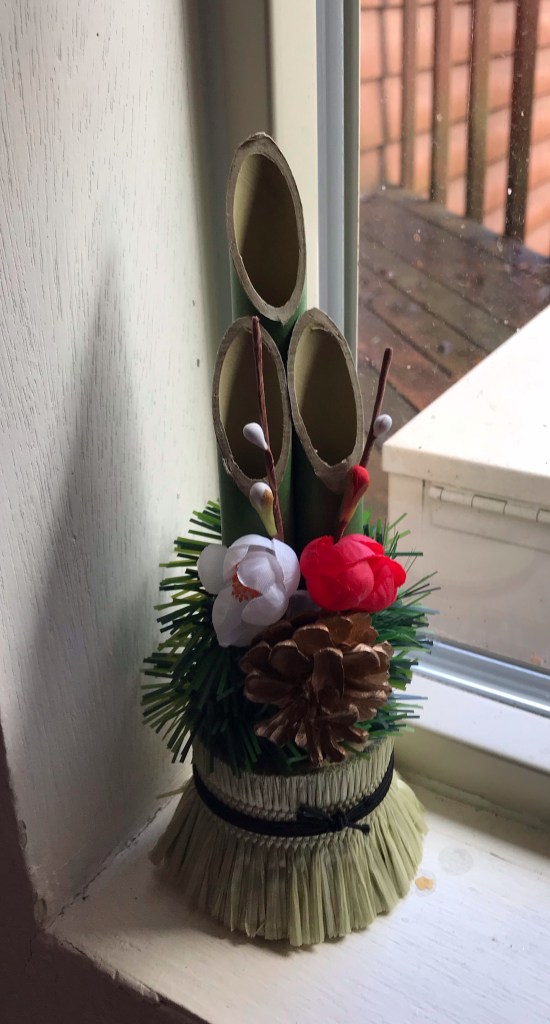
The first one is a kadomatsu (門松):

img_3847

This display, combines bamboo (竹), pine (松) and plum blossoms (梅), all auspicious plants, into a single ornament.  Similar to a Christmas wreath, it is usually displayed near the front entrance of the house, and is thought to “invite” good luck into the home for the rest of the year.  More specifically, it is thought to invite auspicious kami (Shinto religion deities) into the home who by their presence bless the home with good fortune and avoidance of calamity.

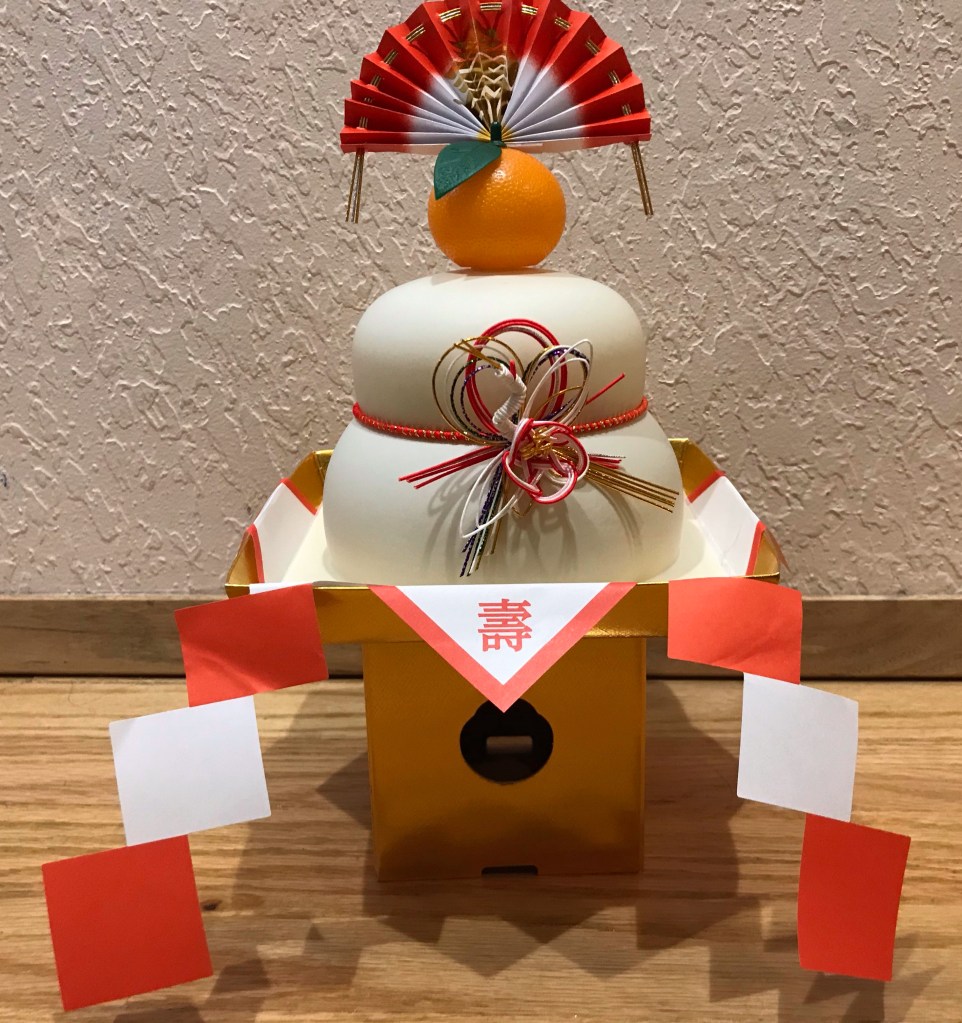
Another symbol is a kagami-mochi (鏡餅) or “mirror-mochi“:

img_3838

This is a basic one we bought at the local Asian supermarket, but consists of a small platform and two mochi rice-cakes piled onto one another with an orange above.  In our display, the mochi is actually hidden inside a plastic case, but more traditionally, the display really does use two round mochi cakes piled onto one another.  Mochi symbolize material wealth.  The orange, more specifically a bitter orange (daidai 橙 or alternatively 代々), is placed on top and symbolizes longevity because a bitter orange stays on the tree even in winter, but also because a bitter orange tree also bears many fruit.  Also, the word daidai (代々) is a homophone for “generations” which means prosperity of the family across generations.

At its core, the kagami-mochi is a kind of Shinto temporary “altar” (依り代 yorishiro) for kami to descend and bless the house with both material culture and longevity/prosperity across the generations, particularly a kami named toshigami-sama (年神様) which is the God of the Year.  At first when I reserached this in Japanese, I thought the term 年神様 was some kind of catch-all phrase for kami to that come at the end of the year, but apparently there really is in Shinto religion a kami specifically for “years” and in particular the New Year. 😄

One other tradition related to the kagami-mochi is that on the 11th day of the new year (January 11th), the mochi is cooked with sweet red beans, thus bringing good luck for the year.

Happy 2020 Everyone!

EDIT: Made some updates with respect to the kagami-mochi.

P.S.  My earlier post on Japanese New Year greetings.