This season is in the old Japanese calendar is known as hakuro (白露) or “white dew” due to increasing cool humidity in the mornings.1 The days are getting mild again, and the family and I had a terrific Labor Day weekend.
Something to share for today, a poem from the Hyakunin Isshu anthology. This is the first poem of the anthology, and the only one to really cover the life of the peasantry, but it also does a nice job capturing that early autumn mood.
Japanese
Romanization
English
秋の田の
Aki no ta no
In the autumn fields
かりほの庵の
Kariho no io no
the hut, the temporary hut,
苫のあらみ
Toma no arami
its thatch is rough
わが衣出は
Waga koromo de wa
and so the sleeves of my robe
露にふりつつ
Tsuyu ni furitsutsu
are dampened night by night with dew.
Translation by Joshua Mostow, more explanation of this poem here.
The theme of “dew” appears over and over again in Japanese literature and poetry, and even appears in kimono patterns for fall, known as tsuyu-shiba (露芝). You can see an example of it here.
1 Related post. The traditional calendar was subdivided into many smaller periods each covering the seasons, weather and so on. Because the lunar calendar is prone to moving around, the dates didn’t always reflect the actual weather, but it still captured the sense of progression from season to season, plus it’s very poetic.
The founder of the Jodo-Shu sect of Buddhism, a 12th-century Buddhist monk named Honen, once composed a poem titled tsukikagé (月かげ, “Moonlight”). What follows is a rough translation on my part:
Japanese
Romanization
Translation
月かげの
Tsuki-kagé-no
There is no village
いたらぬ里は
Itaranu sato wa
that the light of moon
なけれども
Nakeredomo
does not shine,
眺むる人の
Nagamuru hito no
but it dwells in the hearts
心にぞすむ
Kokoro ni zosumu
of those who see it.
The “light of the moon” here is meant to symbolize the light of the Buddha, namely Amida Buddha. Light is a common motif in Buddhist art, depicting both wisdom to banish away the darkness of ignorance, and also goodwill to all living beings.
Amida Buddha and his attendant bodhisattvas welcoming Chūjōhime, Taima Temple Mandala, University of Michigan Museum of Art, Artist Unknown, Japan, Public domain, via Wikimedia Commons
“The radiant light of the Buddha of Immeasurable Life is dazzling brilliant, illuminating all the buddha lands of the ten directions, and there is nowhere it is not heard of.”
From The Three Pure Land Sutras published by the Jodo Shu Research Institute, translation by Karen J. Mack
Further, the sutra explains in the previous section:
“Those sentient beings who encounter this light will have the three hindrances1 eliminated, become amenable in body and mind, leap with joy and their hearts will give rise to good. Should they suffer hardship in the three realms of defilement,2 when they see this radiant light, they will all attain relief and not again suffer this pain.”
Thus, the light of Amida Buddha shines everywhere, but people may not necessarily know it. Those who do encounter the light experience a transformation within. It may not be obvious at first, but it as one of Honen’s disciples once taught, it melts ice to become warm water.
Thus, Honen’s poem is about how Amida’s goodwill and wisdom reaches out to all beings and all places, and even if people do not see it, it is still there. Further, those who do see it are changed by it, even if they are not aware of it at first.
Namu Amida Butsu
1 The three hindrances in Buddhism are greed, hatred and ignorance.
2 The three realms of defilement is another term for lower states of rebirth that one might fall into: animals, hungry ghosts, and the hell realms.
Having watched Netflix’s Castlevania series for probably the third time through, and as a way of “eating my own dog food” by applying my Dungeons and DragonsHamato Islands setting to other environments, I started a recent thought-experiment: suppose I made a Japanese-style character, and suppose that character got transported to the classic gothic horror setting of Barovia from the Demiplanes of Dread. How would that look like?
Gothic horror, particularly the classic literature, arose from a specific time and place, so it’s inevitably tied to certain religious trends, cultural assumptions, monsters, etc. Dropping a samurai from, say, the 16th century Warring States period, or a Buddhist monk from the late 12th century Heian period into a such a setting would risk being nothing more than a “fish out of water story”. Fans might scoff and say “that would never happen”.
However, if you think about it, the demiplane Barovia, by its nature, keeps pulling people through The Mists to be trapped and fed off of by the vampire Dark Lord, Strahd von Zarovich. Strahd depends on a steady supply of incoming people because as a dark lord who’s been in power for many centuries, the native Barovians are broken spirits anyway and the land is practically devoid of life. As long as he brings more people through the mists, he could care less where they’re from; he just needs fresh blood, both literally and figuratively.
Strahd is a dark and brooding kind of guy
So, imagine some itinerant monk (cleric, Way of the Sage, in my setting) or a sohei warrior (probably a paladin, Oath of Vengeance) is traveling at night deep in the woods of some remote mountain path. Heavy mists close around him, and before he or she knows it, the forests look different. The fauna is ominous and unfamiliar and everything feels somehow threatening. Next he or she stumbles onto the next village only to find that it looks totally unfamiliar. The homes are sagging, timbers are rotten, the colors are faded and bleached, and the architecture is unfamiliar. The strange people gawking at him or her with haunted eyes look different. Worse, they probably wouldn’t speak the same language.1
Quite the culture shock, no?
But it goes further. The local deities would be unfamiliar for example. Such a character would probably not know the Morninglord (Lathander in Barovia), and might rely on their own deities instead even though they mysteriously can’t communicate with them. Since the Morninglord is the only non-evil deity in Barovia, would my cleric/sohei character try to find common ground, or would they hide their religion to avoid antagonizing the locals?
Folk customs, like garlic for vampires and holy water, would also differ. A character from another realm, such as medieval Japan, would use salt, sand blessed with a mantra, or chanting holy sutras to repel evil spirits. Would these religious practices work in Barovia?
If the character managed to survive long enough, I imagine that they would gradually encounter others who stand out. Such people might also hail from disparate lands: maybe from the tropical lands of Chult, the Al-Qadim setting (based on fantasy Arabic culture), or from the wider Asian-inspired lands of Kara-tur. Maybe even a Warforged from Eberron?
In spite of the diverse backgrounds, they’re all united by their common problem: they’ve been brought to the Demiplanes of Dread against their will, and they have to take Strahd2 down. Thus, I imagine the final showdown against Strahd would be a party composing of classic gothic figures like a priest of Lathander, a Simon Belmont like character, maybe a wizard or two, but also diverse characters from other lands. A kind of global super team.
Anyhow, this scenario probably isn’t interesting to other players, but it was just a fun thought-experiment about the challenges of dropping D&D characters from one culture into another culture, especially in a hostile environment.
P.S. Title inspired by Mark Twain’s Connecticut Yankee in King Arthur’s Court. I hope Mr Twain is not rolling over in his grave. 😅
1 The idea of one “Common” language in D&D that all humanoids know might work for a single contintent, but once we start spanning different continents in the Forgotten Realms, the idea seems less and less plausible. For that reason, I made up “Kara-Tur Common” and “Faerun Common” to account for linguistic differences between continental settings, while still having a reasonably common lingua franca among locals.
2 Or, a different Dark Lord, of course. With the new D&D book Van Richten’s Guide to Ravenloft, the other demiplanes are getting much needed attention and detail.
It is a bit early to celebrate for folks here in the US, but in Japan it is already March 3rd, which means it is already Girl’s Day (hinamatsuri ひな祭り)!
As readers may have noticed from past posts, I have posted about certain traditional Japanese holidays, called sekku (節句). Examples included Girls Day (March 3rd), Children’s Day (May 5th), Tanabata (July 7th) and Day of the Chrysanthemum (September 9th). The last holiday on my list is actually the first on the calendar: Nanakusa (七草) which literally just means “seven grasses / herbs”. More formally it’s called jinjitsu no sekku (人日の節句, “day of the human”) as we’ll see shortly.
This holiday is surprisingly old, with origins in ancient custom in southern China whereby people would cook seven herbs as a porridge on the 7th day after the Chinese new year. It also relates to the Chinese lunar calendar, where the first seven days of the year were designated as rooster, dog, boar, sheep, ox, horse and human, the first six being animals of the zodiac. Since the seventh day was (for some reason) marked as the day of the human, criminal punishments were not executed on this day.
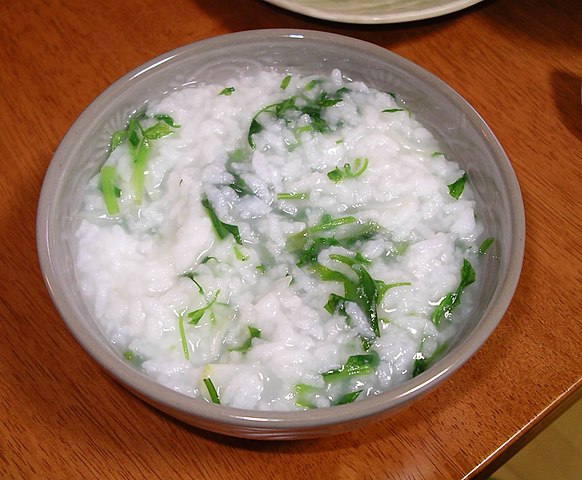
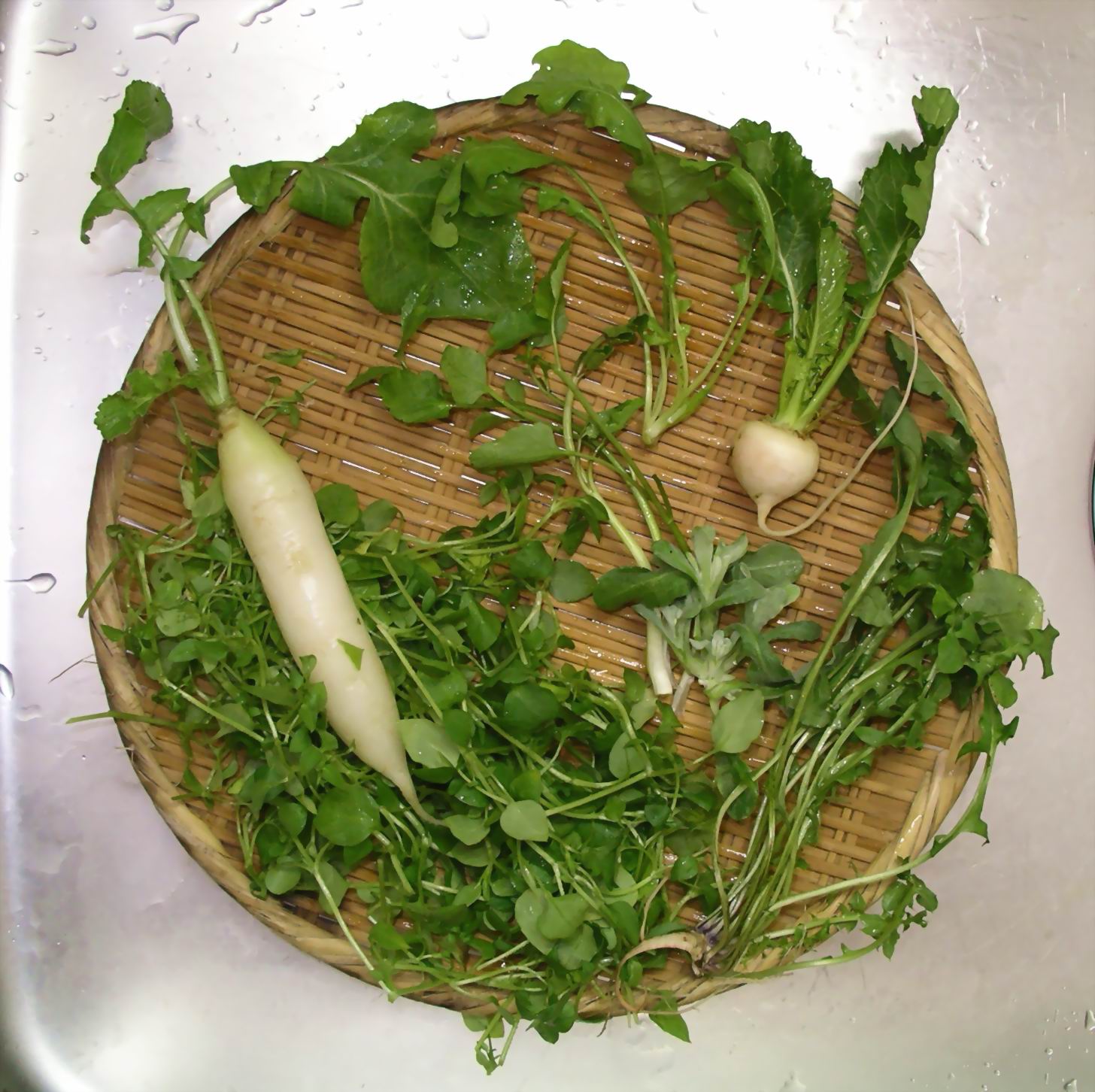
The custom of eating a seven-herb porridge carried over to Japan as nanakusa-gayu (七草がゆ), though in some households more than others. I had it once many years ago when we were first married, and visited my wife’s family home in December-January. I saw a bunch of roots and herbs in the kitchen, like the ones shown above, but didn’t give it much thought. The next day, we were served nanakusa-gayu porridge for breakfast. It has a pretty bland in taste, but that was how I learned about Nanakusa.
A bowl of rice porridge served during Nanakusa, Blue Lotus, CC BY 2.0, via Wikimedia Commons
According to the Wikipedia article, the seven herbs are:
Of these seven herbs, I’ve eaten turnips and Japanese daikon radish regularly, but the other five are pretty obscure to me. I doubt most Japanese would easily remember them off-hand either. Supposedly there is a song that is sometimes sung while facing the auspicious direction that year (same direction as for Setsubun, I suspect), but no one in my wife’s house sang it, or at least while I wasn’t around.
Edit: I found the song in a book recently:
せり Seri
なずな Nanazu
ごぎょう Gogyou
はこべら Hakobera
ほとけのざ Hotoke-no-za
すずな Suzuna
すずしろ Suzushiro
それは七草 Sore wa nanakusa (“That’s Nanakusa”)
Anyhow, that’s a look at Nanakusa. I joked with my wife if she’d make it this year, and she flatly refused. While it is a very traditional holiday, the porridge takes a lot of work, especially here in the US where the herbs might be hard to gather, and frankly isn’t great tasting. It’s a medicinal porridge more than comfort food. That said, it is a fascinating window into some very old Chinese traditions that still persist in Japan.
1 The adolescent in me giggles whenever I read this plant name. 😂
The harvest moon in Japan is celebrated with a small festival called o-tsukimi (お月見), which for 2020 is celebrated on October 1st. In the old Japanese calendar, this holiday is always observed on the 15th day of the 8th month, but with the modern solar calendar this day moves around.
Otsukimi literally just means “moon-viewing”, that’s what the holiday basically is. The family gathers outside, gazes up at the moon, and enjoys some dango pastries among other things.
Moonlit nights often remind me of a certain poem from the famous Japanese anthology, the Hyakunin Isshu, which I wrote a whole blog about. The poem, number 7, involves a certain official named Abe no Nakamaro (安部仲麿, 701-770) who had come to the Tang Dynasty Court in China as part of a diplomatic mission. It is said that Nakamaro gazed up at the moon the night before he was scheduled to sail back home and composed this poem:
Sadly, his return trip failed, and the ship was blown off course to the land of Annam, where he then trekked back to China and eventually passed away never seeing his homeland again. More on this poem in my other blog.
May readers enjoy a bit of moon-viewing and a bit of inspiration tonight!
September 9th (9/9) is the last of the yearly sekku (節句) or seasonal holidays in the old Japanese calendar, and is named kiku no sekku (菊の節句) or more formally chōyō no sekku (重陽の節句). The name means something like “Day of the Chrysanthemum”, and has its origins in a similar Chinese holiday called the Double Ninth Festival. The formal name chōyō (重陽) is the more Sinified name.
Because 9 is considered a “yang” number, the double 9 (September 9th) is thought to become “yin”, and thus can bring misfortune. So, like other sekku holidays, it was thought that celebrating a holiday on this day would avert disaster. Since 9 is the highest single-digit “yang” number, the “yin” misfortune was even worse. More on this in a future post.
The holiday, as the name implies, is devoted to Chrysanthemum flowers. In Heian Period Japan (8th-11th centuries), the golden age of the Imperial court, it was commonly believed that gathering the morning dew from chrysanthemums on this day, and applied to the face would keep ladies youthful looking. For example, in the famous Pillow Book by lady of the court, Sei Shonagon, she writes:
[7] … It’s charming when a light rain begins to fall around daybreak on the ninth day of the ninth month, and there should be plenty of dew on the chrysanthemums, so that the cotton wadding that covers them is thoroughly wet, and it brings out the flowers’ scent that imbues it.
translation by Meredith McKinney
People would also consume Chrysanthemum-infused rice wine, and go on picnics too.
Chrysanthemums are a popular subject for poetry as well. Sugawara no Michizane, who was later deified as the god of learning, Tenjin, wrote the following:
Modern day celebrations during Day of the Chrysanthemum still happen at local Shinto shrines, Buddhist temples and such, but compared to more well-known sekku such as Children’s Day or Girl’s Day, September 9th is a more low-key day. As someone who likes low-stress holidays, I think the concept is pretty neat, to be honest.
Summer in 2020 came and went probably like no summer in recent memory. Ignoring the painful facts for a moment that there’s a global pandemic, politics are pretty bat-shit crazy, and the economic woes, and my stress level was through the roof, it was a quiet and low-key summer. Hunkering down for the summer had a few silver linings, in that I got to see my kids a lot more, and some long-neglected things around the home got fixed. The kids had little “summer reading challenges” I gave them and I had personalprojectsof my own that I mostly got done.
Lately, I’ve been thinking about a certain poem from the ancient Japanese poetry anthology, the Hyakunin Isshu, which I have a whole blog devoted to. The poem, number 98, out of 100 reads:
This poem refers to a frequent ritual in Japanese Shinto religion called misogi (みそぎ or 禊) which is a kind of purification ritual through immersion in a river, waterfall or the sea. Shinto differs from Buddhism, among other ways, by its heavier emphasis on purification as contact with death, or trauma or other negative forces can weigh on a person and bring misfortune not to mention the mental burden. So, since antiquity, water immersion as a form of ritual purification was a way to “reset” the balance and avoid potential misfortune later.
Further, the 1st day of the 8th month in the old Japanese calendar (early September in modern times) is traditionally marked by a special ceremony called hassaku (八朔) where the first rice harvests of the season is dedicated to the gods in gratitude. Sometimes this is in the form of mochi rice cakes instead. It is still practiced even today by some.
Anyhow, looking forward to getting kids back into school (sort of), but also going to kind of miss the weirdest, yet quietest summer I can remember in my life.
A print of a kasa-obake (傘お化け, “umbrella ghost”) made around 1850.
For Westerners, the “scary” time of year (besides tax season) is Halloween, but Japan has a similar tradition, called Obon (お盆) season which arose from a totally different set of circumstances, yet is an interesting example of convergent (and yet divergent) cultural traditions. Obon season in Japan varies by region: in the eastern “Kantō” part of Japan it’s around July 15th, while in the western “Kansai” part of Japan it is around August 15th. The reasons for this are due to certain political/historical reasons we won’t get into here. Despite the differences in timing, the traditions are still basically the same.
Obon, which literally means “serving tray”, is loosely derived from a Buddhist sutra called the Ullambana Sutra (盂蘭盆経; urabon-kyō in Japanese) wherein one of Shakyamuni Buddha’s chief disciples, named Maudgalyayana (or Mogallana), experiences a vision during a deep state of meditation. In this vision, he sees his mother trapped in one of the many Hell realms.1 His mother, while doting on lil’ Maudgalyayana, tended to bad-mouth others and did a lot of negative things all for the sake of her son.2
Maudgalyayana felt terrible about this, and resolved to help get his mother out of Hell, so he consulted with Shakyamuni Buddha, who said that if Maudgalyayana made offerings to the rest of the monastic community and dedicated the good merit to his mother, his mother would be liberated and could move onto a better rebirth. As the story goes, Maudgalyayana carried out the Buddha’s advice (hence the “serving tray” referring to Maudgalyayana’s offerings to the other monks). Having accomplished this, he later had a vision of his mother being liberated from Hell as a result.
Thus, in China and Japan this story has served as an inspiration for late-summer festivities that revere the ghosts of ancestors, offering gratitude to them, and so on. It’s an interesting example of how Buddhist teachings intermingle with local beliefs to create a cultural tradition (much the same way that Halloween is a mix of pre-Christian Celtic + early-medieval Christian traditions). It’s also why ghost stories are popular around this time. The famous book Kaidan (older spelling Kwaidan) by Greco-Irish author Lafcadio Hearn is a rare English-language window into some of these classics ghost-stories. I’ll post a few such stories later this week.
In practical terms, Obon has a lot of parallels with the Mexican Day of the Dead festivities. Offerings are made to one’s ancestors in the family Buddhist altar (butsudan, 仏壇), and families will also visit ancestral graves to clean them up and make further offerings there (ohaka-mairi, お墓参り). People often take time off around this time, or companies have work holidays (obon-yasumi お盆休み) to allow people to return to their hometowns, relax and get in touch with family again.
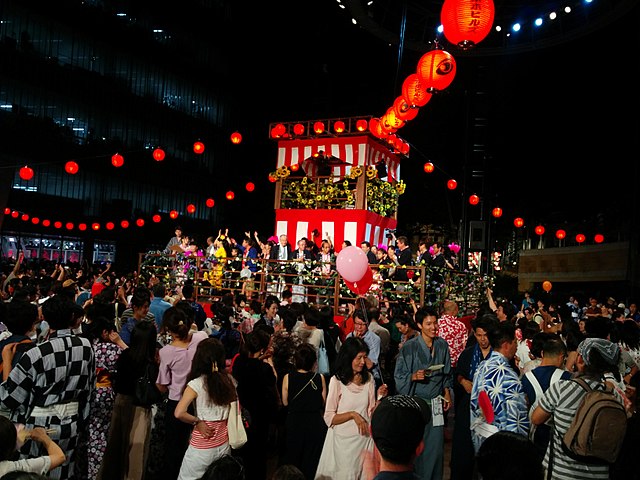
Bon-odori in Tokyo (Roppongi), courtesy of Wikipedia
The most well-known custom of Obon is the communal dance or bon-odori (盆踊り) which you’ll often find in overseas Japanese communities as well. I’ll post some videos or something soon of the Bonodori dances in my wife’s neighborhood, which we often visit around this time. My daughter, who’s now a teenager and knows a lot of the neighbors, helps volunteer at the local bonodori every year.
Anyhow, while Obon season is very much a Japanese tradition, it also has fascinating roots from both China and Buddhist India as well.
P.S. The July vs. August celebration of Obon happens not just between east and west, but can vary by region. Northern Japan also celebrates in August while the Tokyo area celebrates in July, and so on.
1 Buddhism, borrowing from earlier Indian cosmology, describes many hell realms and many heavenly realms. All of these are seen as temporary destinations on the even longer cycle of rebirth. For Buddhism, the larger goal is liberation from the near-infinite cycle of rebirth (Samsara, or “aimless wandering”) more than seeking out the “good” realms over the bad ones.
2 I think this often gets overlooked, but the Ullambana Sutra is a poignant reminder that not everything done for the sake of one’s kids is the right thing to do. Parents need to uphold good moral conduct in addition to good parenting. They’re not necessarily exclusive either. In simpler terms: don’t be a dick.
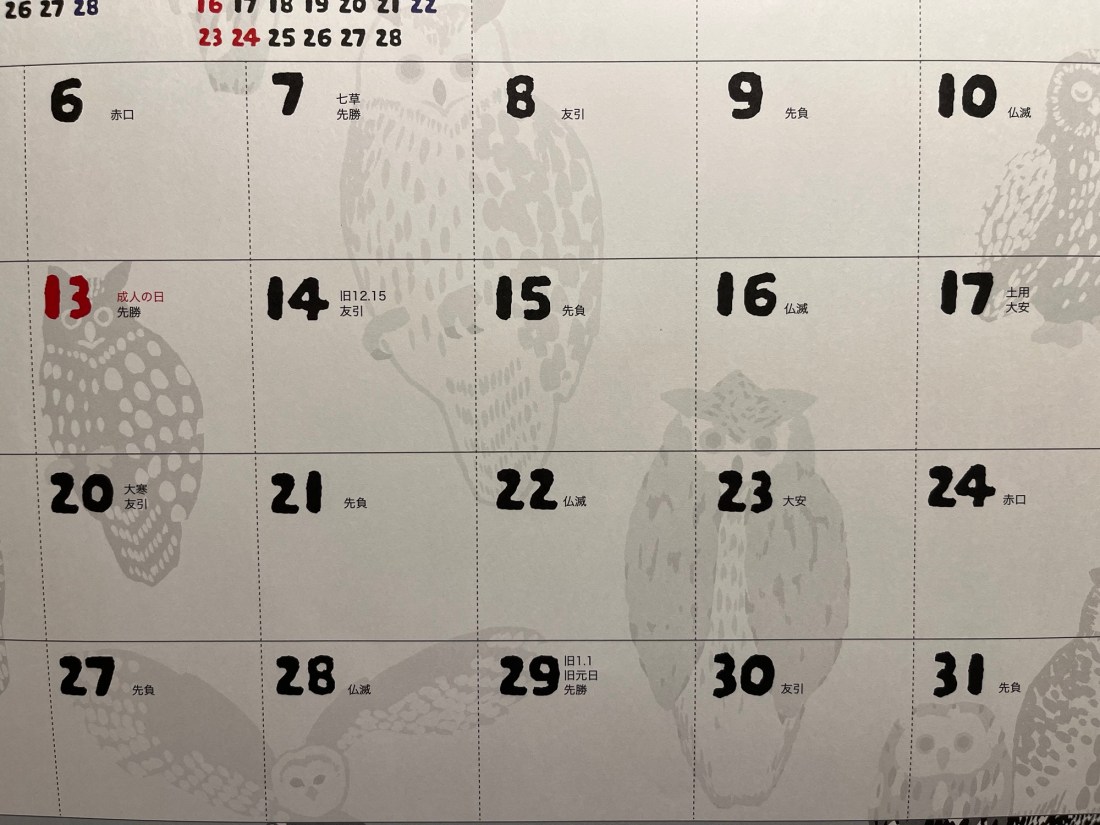
A Japanese calendar we got in 2025 from our local Japanese grocery
Recently, I talked about the Japanese calendar, and in particular the so called “six days” that repeat over and over. Today I wanted to step back and talk about the months of the Japanese calendar, which similarly have cultural significance.
In modern Japanese, the months of the calendar are simply numerical: ichigatsu (一月, lit. “First month, January”), sangatsu (三月, lit. “Third month, March”), jūnigatsu (十二月, “twelfth month, December”) and so on. But in the old Japanese calendar, patterned off the Chinese lunar calendar, the months had special names:
1 The “na” (無) in the name in modern Japanese means “not” or “without”, but its ancient usage in this context was more of a possessive particle (e.g. “of”) instead of “not”.
Some of these month names are still culturally familiar and appear in literature, advertisements, and so on. For example shiwasu is a month closely associated with the Japanese New year since priests (both Buddhist and Shinto) are quite busy preparing for year end/new year services. I’ve also seen yayoi also from time to time and probably others. Others are pretty obscure now and relate to the yearly farming cycle in Japan, which urban and suburban Japanese wouldn’t necessarily pay attention to.
Speaking of the yearly farming cycle, one of my favorite poems in the ancient anthology, the Hyakunin Isshu, is the very first poem, composed by Emperor Tenji:
This is another iconic poem about Autumn and also happens to be the first poem in the Hyakunin Isshu:
For more on the old Japanese calendar, I also recommend a certain mobile phone app called 72 Seasons (Apple, Google) for a look at how the ancient Japanese calendar tracked the seasons and seasons within seasons.
Old calendars are a great way to peer into the lives of people who lived them, and at the same time, how much has changed since then.








 Gleanings in Buddha-Fields
.jpg)


You must be logged in to post a comment.