The Japanese Way of Doing Things

My guide book on Japanese culture talks about a concept called sahō (作法), which in a mundane sense just means “instructions” for doing stuff. But the book explains that it also describes how things are done culturally:

… for example, in the case of the tea ceremony, every act is carefully choreographed, from where people sit, to how the water is boiled, to how the ea is prepared and so on.

Again, in the business world, one can observe sahō in action as the seller employs polite language and bows often as he shows various forms of respect to the buyer. Another case would be the social setting of a company, where a subordinate will use particular sahō with his boss.

Page 156

The book further explains:

For most Japanese, sahō is an ingrained pattern of behavior that affects their day-to-day actions without them even being aware of it. However, for people who come from overseas, some of these practices may appear puzzling. Why is someone bowing so many times in a particular setting? Or at another time, why is someone sitting ramrod straight? But for the Japanese, they are simply following the sahō that is appropriate for that place and circumstance.

I definitely experienced some of this confusion in the early years when I visited Japan with my wife. My in-laws kindly took me to a local Takashimaya department store and paid to get me a tailored suit. As a poor white kid in America, the experience was kind of awkward on a few levels: I wasn’t used to getting measured for a tailored suit, I wasn’t used to the very polite speech and mannerisms of the store employee, I wasn’t very good at speaking Japanese, and I wasn’t even used to owning my own suit.1

This concept of sahō isn’t limited to Japanese culture, of course. It is true, based on limited experience, that things can feel really choreographed in Japanese culture compared to American culture, but the idea of “how people do things” is universal. The American handshake is on example, the tendency for Russians not to smile during formal settings, the “pub culture” in Ireland and so on. There’s countless examples unique to each culture.

Even for a culture like Japan, where everything really is kind of choreographed, you do get used to it. The extra flourishes at the bookstore (wrapping the books, extra bowing, etc) were a bit confusing at first, but after a while, I don’t even really mind it anymore. Similarly, certain habits became ingrained more and more each time I visit.

So, when you encounter another culture, the important to bear in mind is that each culture has its own sahō, and it will be different than yours. Be observant, be flexible. If you do, you’ll quickly adapt and will succeed. People who stand like tall trees in the wind get blown down, but those who bend like grass prosper.

Food for thought.

P.S. Fun bonus post before Thanksgiving weekend! Happy Thanksgiving Day and Native American Heritage Day to readers in the US.

1 It is still the only suit I own, but I save it for important occasions only, such as my mother-in-law’s funeral. Speaking of sahō, funerals in Japan are very formal compared to American ones.

Autumn Nights in Japan: Otsukimi and Juya-E

In the old Chinese lunar calendar, on the 15th day of the 8th lunar month (i.e. full moon on the 8th month), many cultures across East Asia celebrate something called the Mid-Autumn Festival. This has various names depending on the country and language:

  • Zhōng-qiū-jié (中秋節) in Mandarin Chinese,
    • Tiong-chhiu-cheh in Hokkien, by the way
  • Tết Trung Thu in Vietnam, and
  • Chuseok (추석) in Korea

In Japan, this festival is called formally the Jūgoya (十五夜, “15th night”) festival, but in popular culture is known as Otsukimi (お月見, “moon viewing”). This year, due to the lunar calendar, Otsukimi falls somewhat late on October 6th. This festival is about viewing the moon with friends and family, while enjoying some dango (rice dumplings) using displays like so:

A stack of dango treats, photo by evan p. cordes, CC BY 2.0, via Wikimedia Commons

According to this excellent book on Japanese culture, people also decorate such displays with pampas grass (susuki, ススキ), edamamé beans and taro potatoes. Unlike cherry-blossom viewing, people do not usually get drunk.

Chinese moon cakes, called geppei (月餅) in Japanese, are sometimes eaten as well, though it’s more of an exotic treat. Here, moon cakes are easy to obtain, and quite delicious. Highly recommend. We also get the Korean version of dango (tteok, 떡) too.

In any case, Otsukimi is about relaxing, enjoying the autumn vibes with the ones you love. As my family and I live in the Pacific Northwest, weather here isn’t reliable, and so we often get stuck with cloudy weather. But the image of Otsukimi is still popular. You can even find an emoji for it: 🎑.

Also, fun fact: there are traditionally two days of moon-viewing in Japan. The main one is Jūgoya (十五夜, “15th night”), but traditionally there is also a Jūsanya (十三夜, “13th night”) viewing on the 13th night of the ninth (not eighth) lunar month. This year, 13th night falls on November 2nd. On the 13th night of the lunar month, people enjoy chestnuts instead. Traditionally, people felt you should view the moon on both nights, otherwise, according to my book, you only did katamitsuki (片見月, “one-sided viewing”), which wasn’t ideal.

By the way, there is one other tradition around this time that’s specifically Buddhist: Juya-é (十夜会, “ten nights ceremony”), which is ten nights of observance of Pure Land Buddhist practice, starting from October 5th to 14th in the Western calendar. I usually try to recite the nembutsu a full 1080 times using my old Jodo Shu rosary for ten nights. Easier said than done as a parent, but it’s nice to have a challenge from time to time. Traditionally, people try to attend temple services if possible, or just focus on good behavior.

Anyhow, wishing you all a fun Otsukimi, Mid-Autumn Festival, or Juya-e, etc., or all of the above!

Taoism and Numerology

Over the years, I’ve written about certain sekku (節句) or seasonal holidays in the traditional Japanese calendar. These are:

  1. Girl’s Day : March 3rd (3/3)
  2. Children’s Day : May 5th (5/5)
  3. Tanabata : July 7th (7/7), and
  4. Day of the Chrysanthemum (9/9)

Notice the dates of each holiday: odd-numbered month with matching odd-numbered day. Turns out that there’s a reason for this.

In Chinese Taoist numerology, numbers are divided into “yang” and “yin” numbers: odd numbers are yang (陽) because they are considered unstable and dynamic, while even numbers are stable and static, thus yin (陰). But because yin and yang depend on one another, and change into one another, if you add yang and yang together, you get yin. If you add yin and yin together, you get yang.

Thus, it was thought that dates on the calendar with double-yang numbers (7 and 7, 5 and 5, etc) would become yin and thus were inauspicious. Holidays were developed to counteract the yin effect, and that’s why seasonal holidays were held on double-odd dates.

Taoism is not a major influence in Japanese culture (at least in modern times), but it’s interesting so see how it still influences traditions, especially those from antiquity.

Anyhow, TIL. 😎

P.S. Learned all this from this excellent book. Highly recommend.

Zen Verses for Mealtime

As I write this post, I am in Dublin, Ireland on a short trip (business, not pleasure), helping my daughter get settled in for college. Thanks to timezone differences my daughter and I were awake at 11:30pm on a Friday and starving.

Taken near Trinity College and the main Bank of Ireland building (right).

Since a lot of pubs close their kitchens early, we went over to the local Supermac’s1 :

My daughter took this photo of her food. Mine is at the far end of the table (upper right corner).

It’s Friday night, so as we’re seated, people are stumbling in drunk looking for some cheap food, and there’s a steady stream of food delivery guys picking up orders. Still, even here, as I open my bag and eat my food, I try to still take a moment and appreciate the food, so I discreetly did gassho.

In Japanese culture, people will usually say itadakimasu before eating food, and gochisōsama deshita after finishing. The word itadakimasu is just the humble form of the verb “I receive”, and gochisōsama deshita means “It was a wonderful meal”.

But there’s also a set of verses that in the Zen tradition are recited before meals called the Shokuji Gokan (食事五観, “five observations at mealtime”). When I was watching a documentary recently, during mealtime, one of the Eiheiji monks walked the documentary host through the five verses. The five verses in Japanese for the Rinzai tradition are:

  1. 一つには、功の多少を計り、彼の来処を量る。
    hitotsu ni wa, kō no tashō wo hakari, kano raisho wo hakaru
  2. 二つには、己が徳行の全闕を忖って供に応ず。
    futatsu ni wa, onore ga tokugyō no zenketsu wo hakatte, ku ni ōzu
  3. 三つには、心を防ぎ、過貪等を離るるを宗とす。
    mitsu ni wa, shin wo fusegi, togatontō wo hanaruru wo shū to su
  4. 四つには、正に良薬を事とするは形枯を療ぜんが為なり。
    yotsu ni wa, masa ni ryōyaku wo koto to suru wa gyōko wo ryōzen ga tame nari
  5. 五つには、道業を成ぜんが為に、応にこの食を受くべし。
    Itsutsu ni wa, dōgyō wo jōzen ga tame ni, ō ni kono jiki wo uku beshi.

The verses in Soto Zen appear to be slightly different. I am fairly certain, these are descended from Chinese Chan Buddhism, but I wasn’t able to find much information.

There are a lot of fine English translations available, though for now I am using the one from Sotozen.net:

  1. We reflect on the effort that brought us this food and consider how it comes to us.
  2. We reflect on our virtue and practice, and whether we are worthy of this offering.
  3. We regard it as essential to free ourselves of excesses such as greed.
  4. We regard this food as good medicine to sustain our life.
  5. For the sake of enlightenment, we now receive this food.

In either case, the meaning is the same: before we take in the food, we should first reflect where it came from (and the countless people who made it possible),2 and whether we are living up to the practice or not. Finally, the verses remind us that food is essentially medicine (hence don’t be a pig), and that it helps us along the path toward Enlightenment. Even some chips (fries) at Supermac’s is something to be grateful for.

So, hello from Ireland, and will post more soon! 🇮🇪🖖🏼

1 The local version of McDonald’s, but ten times better.

2 The Jodo Shinshu tradition focuses on the concept of “gratitude“, so there’s a lot of overlap here.

Family

Ying Nan: You are a product of all who came before you. The legacy of your family, the good and the bad, it is all a part of who you are.

Shang-chi (2021)

My kids and I have been watching the Marvel MCU movies for years. My firstborn is particularly a Marvel fan since she was a little girl. Some of the movies are better than others (my personal favorite is Thor: Ragnarok),1 but we both really like the movie Shang-Chi and the Legend of the Ten Rings.

When my wife (who is Japanese) and I first dated, there was an immediate clash of cultures. I was a generic American white kid who grew up in an impoverished broken home with lots of issues, my wife grew up in a working-class Japanese family that was not overly traditional, but still very Japanese compared to American standards. The fact we were dating in the first place was a bit awkward for her and her parents, whereas I hardly ever talked to my own parents.

The good news is that over time, we learned to understand one another, and that means that I too learned to appreciate her viewpoint sometimes. For example, family.

Even when she disagreed with her parents, she still respected them, and understood her family obligations. This was something frankly new to me because I openly rebelled against my parents, told my dad off, and hardly paid them any heed. I gradually did reconcile with my parents to some degree as I got older (and a bit wiser), to a level where we can get along, but more importantly I learned to accept that I am who I am due to my family. Like the quote above says, you can’t deny your own heritage, both the good and the bad, and that it does shape who you are.

But also, through my wife and through parenting myself, I learned that I do owe some level of gratitude to my parents for what they did. I chose not to be like my parents in how I raise my kids, but even that is something I learned from them.2 Thus, the lesson I learned from my wife is that I also have to be humble, and respectful to my parents enough to acknowledge what they’ve done for me, even if I disagree with them. This is a very Confucian outlook, but I can see the value in this.3

It rubs against my American sense of individualism, but I’ve found it a valuable lesson over the years, and something I think we can all learn from.

P.S. Xu Wenwu, the father in Shang-chi, is a great example of a plausible chaotic-evil person in Dungeons and Dragons: he craves absolute power and yet is also capable of being in love, being a father, etc. Yet, he inevitably bends everything toward evil or ruin, including his lawful-good wife, Ying Li. Tony Leung Chiu-wai‘s performance was excellent.

1 The Thor movies do a really nice job of weaving science fiction with magic and myth, much like Roger Zelazny did in his books generations ago (Lord of Light, the Amber Series, Creatures of Light and Darkness, etc.). Put simply, I like weird, transcendent stuff more than the “grounded” story lines like Captain America or Black Widow.

2 In Japanese there is a four-character phrase for this: hanmen kyōshi (反面教師) meaning to learn from a bad example (i.e. what not to do).

3 This importance in family isn’t even limited to Confucian-influenced cultures. You can find it in many unrelated world cultures where family is emphasized, and respect towards one’s ancestors. For whatever reason, it is not emphasized in Western culture, and maybe to our detriment I think.

Hungry Ghosts are Among Us?

The Obon Season in Japan approaches, and so do ghost stories, and ceremonies around hungry ghosts. But what are Hungry Ghosts?

This is one of the traditional states of rebirth within Buddhism, on the never-ending cycle of people migrating from one life to the next. Rebirth as a hungry ghosts is seen as only one rung up from being in Hell, as it is a state of great suffering and hardship. Unlike hell, though, hungry ghosts are seen as beings that live among us, but only in the darkest shadows, living a precarious existence, constantly starving and thirsty, with no way to gain sustenance. They are often cursed to eat something awful, like garbage, or excrement, as punishment, or they are depicted in art as having emaciated bodies, with bloated bodies, and tiny throats that can’t swallow anything.

Although they are called preta1 in Indian Sanskrit language, in Japanese they are called gaki (餓鬼), which in modern slang is a rude expression for kids that means “a punk” (the Japanese meaning is harsher than the English one).

References to hungry ghosts go all the way back to early Buddhist texts such as the Pali Canon where the Buddha warns that among the hungry ghosts are probably some of your ancestors and kin:

Outside the walls they stand, & at crossroads.
At door posts they stand, returning to their old homes.
But when a meal with plentiful food & drink is served, no one remembers them:
Such is the kamma [karma] of living beings.

Tirokudda Kanda (Petavatthu 1.5), translation by Ven. Thanissaro Bhikkhu

Later, stories of hungry ghosts appear in Sanskrit anthologies such as the Avadanasataka, including the story of Mogallana and his mother (source of the Obon holiday), before a similar version of the story appears in the Mahayana text, the Ullambana Sutra, for which there is a handy translation here. In the Ullambana Sutra, you can see how Mogallana’s mother suffers in her state as a hungry ghost:

Mahamaudgalyayana [Mogallana] felt deep pity and sadness, filled a bowl with food, and went to provide for his mother. She got the bowl, screened it with her left hand, and with her right hand made a fist of food. But before it entered her mouth, it turned into burning coals which could not be eaten….

Source: https://www.cttbusa.org/ullambana/ullambana.asp, Buddhist Text Translation Society, part of City of Ten Thousand Buddhas

Scenes of hungry ghosts appear in old Buddhist art too:

A picture from the Gaki zōshi 餓鬼草紙 “Scroll of Hungry Ghosts”, circa 12th century, courtesy of the Kyoto National Museum, Public domain, via Wikimedia Commons

In this famous image, you can see emaciated hungry ghosts living among us, unseen, scrounging remains from human refuse and so on. Early Buddhist texts never described what hungry ghosts looked like, but this is how they are depicted in medieval artwork.

Because the hungry ghosts wander aimlessly through life endlessly starving, and some of them may include past ancestors and loved ones, Buddhism has developed certain ceremonies thought to help relieve the suffering of one’s ancestors, and by extension other hungry ghosts. In Chinese culture, this is exemplified in the Ghost Festival (中元節, zhōngyuánjié) of Chinese culture, Obon (お盆) in Japanese culture and the Segaki ritual in some Buddhist traditions.

It’s a fascinating example of how Buddhist teachings have suffused cultures, and how cultures have responded to concerns over family and the afterlife.

1 Alternatively peta in Pali language.

Zen for Everyone

Myoshinji Temple (English homepage) in Kyoto is one of the central temples of the Rinzai Zen tradition, especially after the reforms by Hakuin in the 18th century. Although I’ve never been there, it is a very scenic and seems like a worthwhile place to visit.

The website in Japanese lists a number of activities that one can partake in for experience Zen:

  • Learning zazen meditation
  • Sutra copying
  • Listening to a sermon
  • Singing Rinzai-Zen hymns1
  • Monastic training

What struck me is that Myoshinji Temple provides a variety of activities to suit different people. Not everyone is ready for Zen training or meditation, yet they can still get something wholesome out of the experience. I like this kind of inclusive Zen Buddhism.

In my limited experiences with western Zen temples, the focus is solely on meditation and practicing as monks do. This approach only works for certain lifestyles and certain temperaments. It’s not wrong, but through my experiences in Pure Land Buddhism, especially through immigrant communities, I feel that a more inclusive, more approachable Buddhism is really beneficial.

Just sitting around enjoying donuts and coffee with congregants after service, and talk about stuff, is really nice. This only works when new people don’t feel intimidated, and people aren’t trying to one-up each other.

So to me, Buddhism works best when it accommodates people as they are now, with a variety of practices and options, rather than being written off as “cultural accretions“. Just let people be people, come as they are, and soak in the Dharma at their own pace.

Someone who only listens to sermons today, prays to Kannon, or copy a sutra, may be inspired to pick up deeper practices later at the right time. You never know.

P.S. Happy Tanabata to readers!

1 Similar to Jodo Shinshu sect Buddhism, Rinzai Zen, at least at Myoshinji temple, has a lot of hymns. I don’t know much about these, and there is no information in English.

Happy Golden Week 2025

Happy Golden Week to readers!

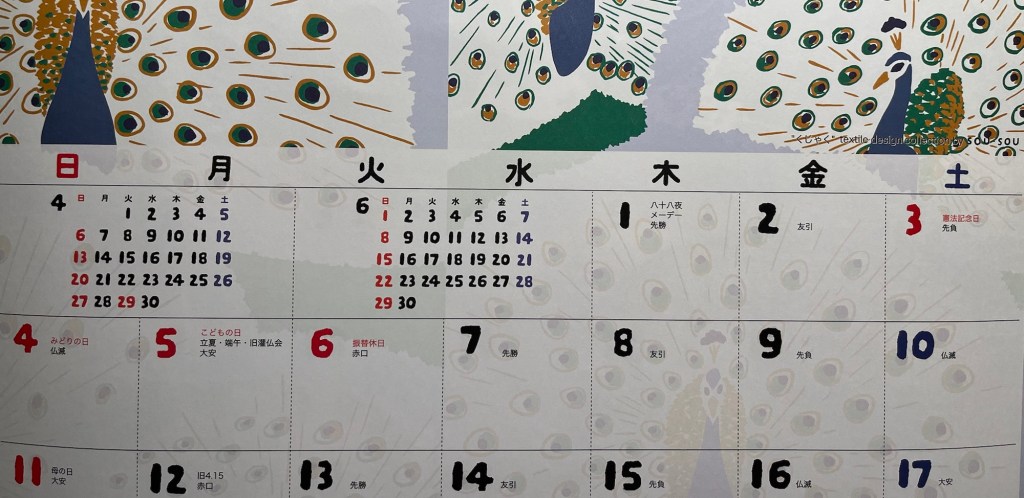
The first week of May in Japan has an interesting phenomenon in the modern calendar called Golden Week (gōruden uīku, ゴールデンウィーク): a series of national holidays that line up very closely. Thus, people often take vacations at this time (a rarity in Japanese business culture), and enjoy the fine weather before the monsoon comes. I wrote about Golden Week in more detail here.

You can see on our home calendar how the holidays (in red) line up:

My sister-in-law in Japan often takes this time off, as do many other Japanese business and white-collar workers. It may be the longest vacation they take in the year, apart from Japanese New Year.

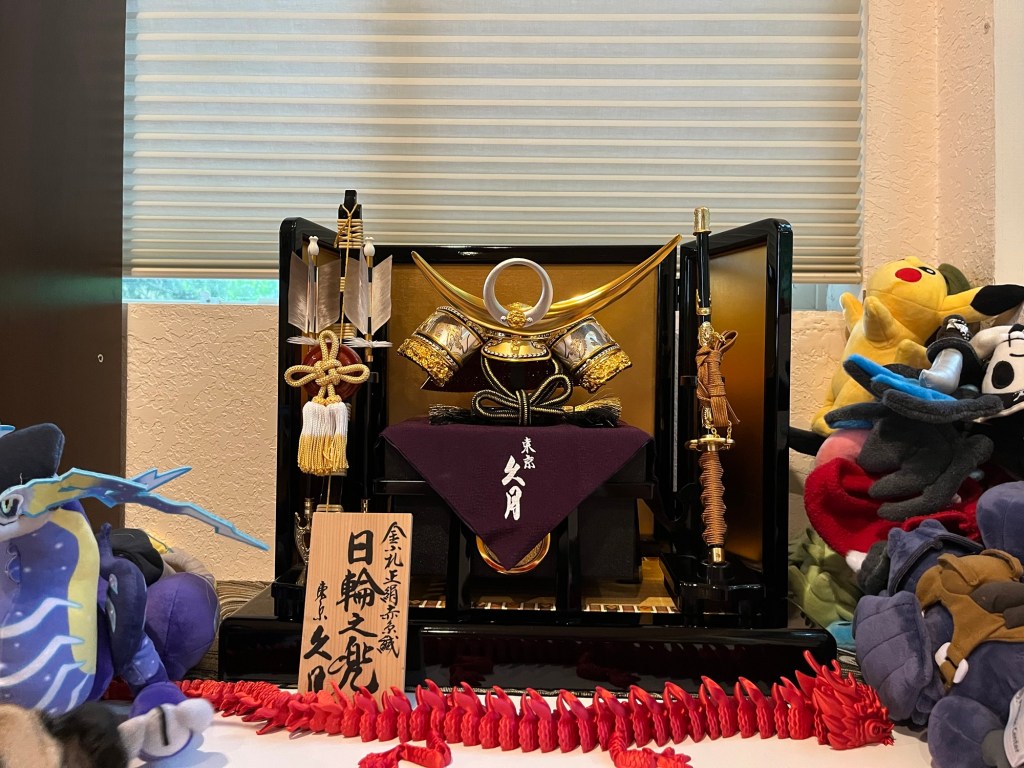
As part of Golden Week, Childrens Day, or Kodomo no Hi (子供の日) also takes place every May 5th. I’ve written about that as well. We have taken out our usual yoroi armor display:

The Pokemon toys and dragons are just my son’s toys (he should clean up more 😋).

I am not sure if we can get kashiwa-mochi this year, as Japanese goods are getting harder and harder to obtain lately, and our schedule is chaotic this week anyway, so I am not sure exactly how we will celebrate. I do know that we will go see the Minecraft movie for a third time in theaters, though. My son and I really enjoy it, and it’s nice to see all the kids yelling certain parts of the dialogue in unison.

I wish I could post more, but as alluded to earlier, I will be away for about a week, and haven’t been able to write more due to work and other competing priorities. However, I hope you all have a terrific Golden Week, and can enjoy the weather in some way. I have other great content coming up, both historical and Buddhist, so please stay tuned, and take care!

P.S. Golden Week also serves as a reminder that what many modern workers need isn’t just equitable pay, but also time off. Happy May Day! ✊🏼

Tolerance

I thought this was a neat dialogue between two of the characters in the game Fire Emblem: Three Houses. The older Seteth (green hair) is offering some advice to the young and prickly Felix:

This might seem self-evident, but because we only see the world through our own viewpoint, our own thoughts and experiences, it’s easy to forget that other people have other viewpoints and other experiences, and come to their own conclusions, right or wrong.

Different game, but I hope the sentiment makes sense. 😆 It’s also why Buddhism emphasizes unconditional goodwill so much.

Namu Amida Butsu

Segaki and Salvation for Hungry Ghosts

With Obon Season coming to Japan in late July and August, this is also the time of the Segaki (施餓鬼) ceremony in many Buddhist temples.

In Buddhism, one of the six (sometimes five or ten) realms of rebirth that brings undergo based on accumulated karma is the realm of the Hungry Ghosts, called preta in India, or gaki (餓鬼) in Japanese.

From a 12th century scroll depicting hungry ghosts living among us unseen, feeding on refuse, feces, water, etc. Courtesy of Wikipedia.

Hungry Ghosts are those whose past lives were defined by extreme vice and craving. This could be alcohol, drugs, women, money, etc. The usual. This craving carries over and they lived as hungry shades, unseen by the living, surviving off of scraps in the shadows. Further, the foods they are forced to eat, garbage, feces, blood, etc, are never enough, so such ghosts are constantly hungry and living in misery. It is the second-worst realm of rebirth apart from the hell realms in the Buddhist cosmology.

Thus, the segaki ritual, practiced in all Buddhist sects except Jodo Shinshu, is meant to help alleviate their craving, at least for a short while, also in hopes (depending on sect) that they can be reborn in the Pure Land of Amitabha Buddha next.