The Obon Season in Japan approaches, and so do ghoststories, and ceremonies around hungry ghosts. But what are Hungry Ghosts?
This is one of the traditional states of rebirth within Buddhism, on the never-ending cycle of people migrating from one life to the next. Rebirth as a hungry ghosts is seen as only one rung up from being in Hell, as it is a state of great suffering and hardship. Unlike hell, though, hungry ghosts are seen as beings that live among us, but only in the darkest shadows, living a precarious existence, constantly starving and thirsty, with no way to gain sustenance. They are often cursed to eat something awful, like garbage, or excrement, as punishment, or they are depicted in art as having emaciated bodies, with bloated bodies, and tiny throats that can’t swallow anything.
Although they are called preta1 in Indian Sanskrit language, in Japanese they are called gaki (餓鬼), which in modern slang is a rude expression for kids that means “a punk” (the Japanese meaning is harsher than the English one).
References to hungry ghosts go all the way back to early Buddhist texts such as the Pali Canon where the Buddha warns that among the hungry ghosts are probably some of your ancestors and kin:
Outside the walls they stand, & at crossroads. At door posts they stand, returning to their old homes. But when a meal with plentiful food & drink is served, no one remembers them: Such is the kamma [karma] of living beings.
Tirokudda Kanda (Petavatthu 1.5), translation by Ven. Thanissaro Bhikkhu
Later, stories of hungry ghosts appear in Sanskrit anthologies such as the Avadanasataka, including the story of Mogallana and his mother (source of the Obon holiday), before a similar version of the story appears in the Mahayana text, the Ullambana Sutra, for which there is a handy translation here. In the Ullambana Sutra, you can see how Mogallana’s mother suffers in her state as a hungry ghost:
Mahamaudgalyayana [Mogallana] felt deep pity and sadness, filled a bowl with food, and went to provide for his mother. She got the bowl, screened it with her left hand, and with her right hand made a fist of food. But before it entered her mouth, it turned into burning coals which could not be eaten….
Scenes of hungry ghosts appear in old Buddhist art too:
A picture from the Gaki zōshi 餓鬼草紙 “Scroll of Hungry Ghosts”, circa 12th century, courtesy of the Kyoto National Museum, Public domain, via Wikimedia Commons
In this famous image, you can see emaciated hungry ghosts living among us, unseen, scrounging remains from human refuse and so on. Early Buddhist texts never described what hungry ghosts looked like, but this is how they are depicted in medieval artwork.
Because the hungry ghosts wander aimlessly through life endlessly starving, and some of them may include past ancestors and loved ones, Buddhism has developed certain ceremonies thought to help relieve the suffering of one’s ancestors, and by extension other hungry ghosts. In Chinese culture, this is exemplified in the Ghost Festival (中元節, zhōngyuánjié) of Chinese culture, Obon (お盆) in Japanese culture and the Segaki ritual in some Buddhist traditions.
It’s a fascinating example of how Buddhist teachings have suffused cultures, and how cultures have responded to concerns over family and the afterlife.
Having travelled in a westerly direction for a long time, and finally turning south at Samarkand, the 8th century Buddhist monk Xuan-zang is finally approaches the hinterlands of India, birthplace of the Buddha.
A map of northern India including the Gandhara region in the northwest (modern Pakistan and Afghanistan). Created using Inkarnate, apologies for any mistakes.
In our last episode, Xuan-zang had gone as far as the city of Balkh (modern Afghanistan) and was deep in “Buddhist country” northwest of India. Times are very different now, but it was a major bastion of Buddhist learning at the time. From here, Xuan-zang moves to Bamiyan and the famous statues there.
Journey to Bamiyan
While staying in Balkh (part 4), Xuan-zang befriended a local monk named Prajñakara. Prajñakara was, according to Xuan-zang, a follower of Hinayana Buddhism (instead of Mayahana Buddhism), and yet Xuan-zang respected him so much they decided to journey the next leg together to India: Bamiyan.
These two besties, along with their caravan, had to traverse the Hindu Kush mountains to reach Bamiyan.
Not unlike the crossing of the Tian Shan mountains (part 2), the overload route was extremely dangerous. Xuan-zang reported snow drifts up to 20-30 feet tall, and the weather was a constant blizzard:
These mountains are lofty and their defiles deep, with peaks and precipices fraught with peril. Wind and snow alternate incessantly and at midsummer it is still cold. Piled up snow fils the valleys and the mountain tracks are hard to follow. There are gods of the mountains and impish sprites which in their anger send forth monstrous apparitions, and the mountains are infested by troops of robbers who make murder their occupation.
page 45, The Silk Road Journey with Xuanzang by Sally Hovey Wriggins
Thankfully the more experienced Xuan-zang and his team crossed safely and with fewer casualties than past mountain crossings. In time they reached Bamiyan (بامیان in Dari language).
Bamiyan and the Great Buddhas
Bamiyan, since antiquity, has been an oasis town residing where the Hindu Kush and Koh-i-Baba mountain ranges meet, and is a high-altitude, cold-desert climate. Nonetheless, Xuan-zang described Bamiyan as producing wheat, fruit and flowers, as well as pasturage for cattle and such. Due to the climate, Xuan-zang stated that people wore fur and coarse wool, and their personality was similarly coarse and uncultivated. Yet he praised their sincere religious faith.
Up until 2001, the town of Bamiyan was dominated by several sites, including two massive Buddha statues which were built during the reign of the so-called “White Huns” or Hephathalites. The Huns themselves were not Buddhist, but allowed Buddhist worship to continue and devout local patrons helped fund the statues perhaps as an act of piety. Interspersed between the statues were monasteries and grottoes carved into the cliffside.
Of the two “great Buddha” statues, the “eastern” statue depicts Shakyamuni Buddha, the historical founder, measuring 38-meters, while the western statue depicts Vairocana Buddha1 measuring 55-meters. Sadly these no longer exist, as they were destroyed by the Taliban in 2001. In Xuanzang’s time, the status were painted and decorated. The western statue was painted red, while the eastern was white. Both had blue-orange robes, and adorned with gold. This coloration lasted at least until the 12th century.
Interestingly, Xuan-zang described a third, reclining statue of the Buddha at Bamiyan, but no evidence has been found yet of this statue.
In any case, Xuan-zang was greeted by the king of Bamiyan and the local monks, adherents to an obscure sect of “Hinayana Buddhism” that taught that the Buddhas transcended “earthly laws”, took Xuan-zang and his party on a tour of the monastery and valley. My book and online research doesn’t clarify which sect or what this means.
Despite the warm reception, it doesn’t appear that Xuan-zang stayed all that long, and eventually moved on through the Hindu-Kush mountains to Kapisi next.
Kapisi and the Chinese Prince
Next through the Hindu Kush mountains was the city of Kapisi (also known as Kapisa, Chinese: 迦畢試 Jiapishi), which was the capitol of the local Kapisi Kingdom near the modern city of Bagram. Xuan-zang reports that once again, the weather was very difficult, and they even got lost at one point, but some locals helped guide them safely to Kapisi.
Storm clouds part, offering a rare glimpse through the crisp air at Bagram Air Field, Afghanistan, Dec. 18, 2008. The high altitude of the Hindu Kush mountain range creates a harsh climate ranging from more than 100 degrees Fahrenheit in the summer to below-freezing temperatures in the winter. Photo by U.S. Air Force photo by Staff Sgt. Samuel Morse (Released), Public domain, via Wikimedia Commons
As with Bamiyan, Xuan-zang received a cold reception from the people, but was greeted by the local king whom he described as “intelligent and courageous”, and ruled over the neighboring areas.
Bamiyan and Kapisi are both places that have seen countless historical events. Alexander the Greats army marched through Kapisi in the spring of 329 BCE, and the Kushan Empire established Kapisi at its first capital in the first century CE. It was the Kushans in particular who were instrumental in helping Buddhism spread to East Asia (and now the world) especially under the great Emperor Kanishka (reigned 127 – 150 CE).
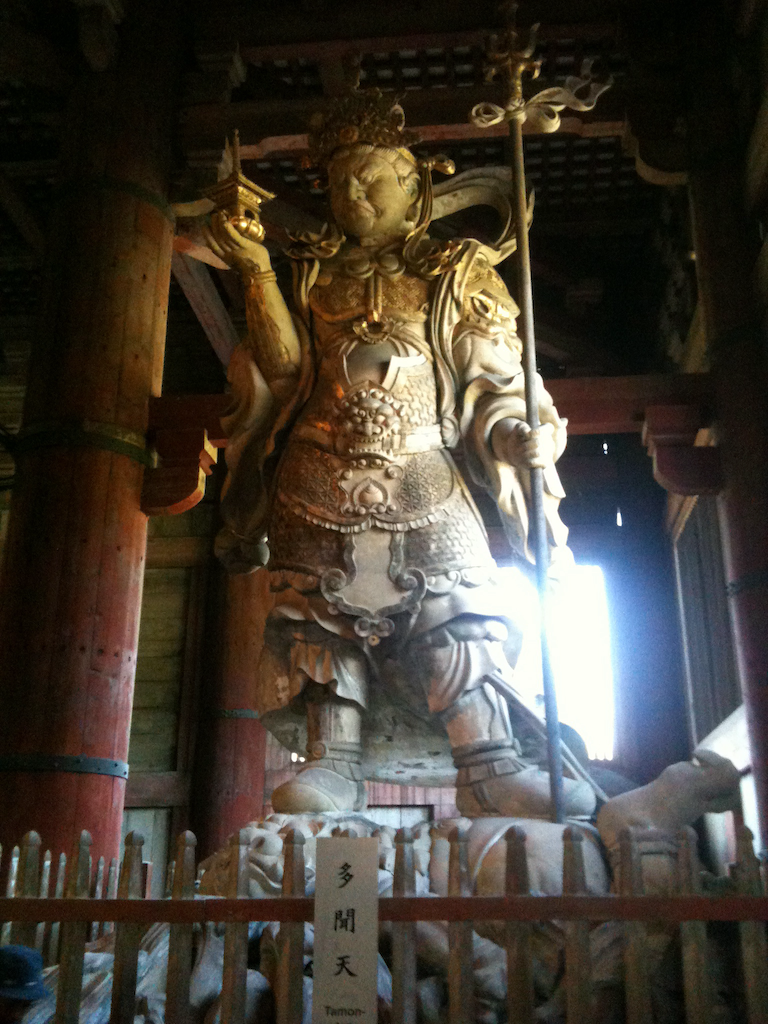
During the reign of Kanishka, a Chinese prince had resided in a monastery in Kapisi as a political hostage. When the prince returned home, he sent gifts and offerings to the monastery in gratitude. Centuries later during the 7th century CE, Xuan-zang paid homage to this prince at the monastery (called the “Hostage Monastery”), where it as thought that the prince’s treasure was buried. According to Xuan-zang’s account, he suggested they dig under a statue of the Buddhist deity Vaiśravaṇa,2 and after a time, the treasure was discovered. Because Xuan-zang was also Chinese, like the prince, it was assumed that his fellow countrymen from the past helped guide them to the treasure.
Later, Xuan-zang was invited by the king of Kapisi to preside over a religious debate amongst the Buddhist clergy, and (again based on Xuan-zang’s account) he was well-versed in the Buddhist doctrines and won, while his opponents only knew their own limited doctrine. One cannot help but roll their eyes slightly. 🙄
Finally, Xuan-zang ran into Hindu ascetics for the first time. Hinduism as we know it, arose roughly the same time as Buddhism and developed in parallel, not one from the other. A common and incorrect statement is that Buddhism descended from Hinduism; they drew from the same cultural and religious well, but arrived at different conclusions. At this time in history, Hinduism was on the rise as Buddhism began a slow decline. Since Hinduism had never reached China, Xuan-zang was not aware of it and spoke ill of the ascetics he encountered, describing them as decadent, untrustworthy, and selfish. It’s unclear why he had such a negative first impression though. Later, in India, he would invest much time debating against them in philosophical contests.
However, Xuan-zang’s joruney was not done. He needed to reach the next destination before crossing into India: Jalalabad.
…. which we’ll talk about in our next post. Thanks for reading!
1 Vairocana is a “cosmic Buddha” that first appears in a Mahayana version of the “Brahma Net Sutra” (the Pali Canon/Theravada version is unrelated). Vairocana, the “Buddha of the Sun” is also the great Buddha statue at Nara, Japan, and is particularly important in the esoteric Buddhist tradition where it is called Maha-Vairocana.
A photo taken by me in 2010 of the central image of the great hall at Todaiji Temple in Nara, Japan: Vairocana Buddha.
2 Vaiśravaṇa, known in Japanese Buddhism as Bishamonten (毘沙門天), can be seen at the famous temple of Todaiji in Nara. I took this photo back in 2010 when visiting there.
A photo of a statue of the Buddhist deity Vaiśravaṇa, known as either Bishamonten, or Tamonten, in Japanese Buddhism. Photo taken at main hall at Todaiji Temple in Nara, Japan.
Indeed, what we see today of Buddhism in Japan and beyond is directly related to the things that Xuan-zang saw along the Silk Road, even if the connection is not obvious at first sight.
In our last episode (… a few months ago 😓) Xuan-zang met the Qaghan of the Western Turkic Khaganate, and made a good impression, allowing him to travel safely further south and westward toward the city of Samarkand.
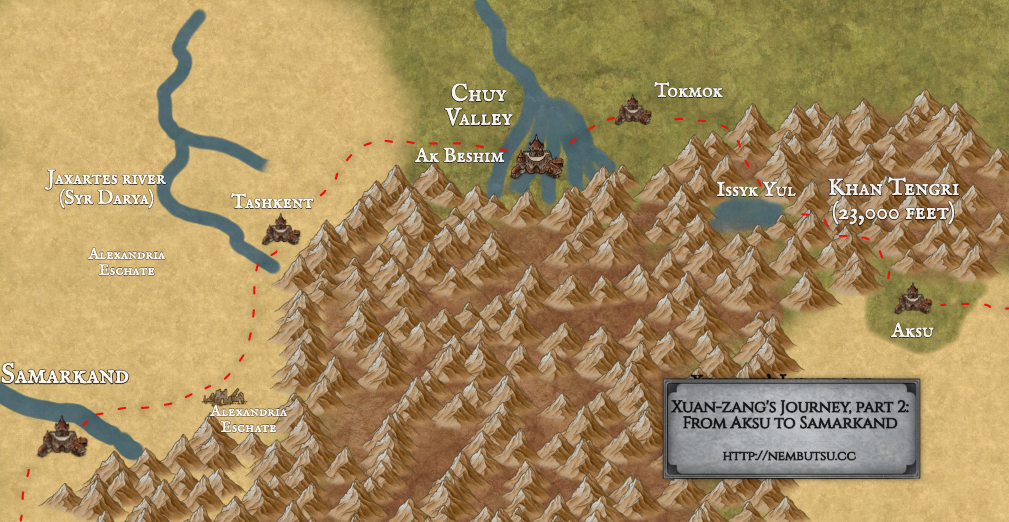
Map of Xuan-zang’s journeys from Tashkent to Balkh. Inkarnate put out a new version of its software while I was on break, so some things may look different than past maps. As always, this is an amateur map, and may contain geographic mistakes.
If you need to brush up on earlier episodes, click below:
Samarkand is a fascinating place: a fabulously old city, and a major hub on the Silk Road. All the way back in the time of Alexander the Great’s conquests in 329 BCE, 1,000 years before Xuan-Zang, the city was called Marakanda (Μαράκανδα) in Greek and was part of the Achaemenid Persian Empire before that. By Xuan-zang’s time the city was part of the Sassanian Persian empire, and still a major trading hub, known even to the Chinese, but I was unable to find a reliable source on the Chinese name at the time. Modern term is 撒马尔干 (sǎ mǎ ěr gàn ?). The city at this time was almost entirely populated by Sogdian Iranian people, whom we’ve also seen in past episodes. This far west from China, Xuan-Zang probably saw very few if any Chinese people, and instead encountered many people from other cultures and parts of the world. He was very much a “stranger in a strange land”.1
However, because this city was part of the Sassanian Empire, the official religion was Zoroastrianism, not Buddhism, and as Xuan-zang came to the city, he noticed that the Buddhist monasteries there were abandoned and neglected. Some of Xuan-zang’s followers went to pay their respects at these monasteries, but they were chased off by a mob of Zoroastrian followers with flaming brands. Later, the king heard what happened and arrested the mob leaders and was going to pass sentence to mutilate them. Xuan-zang begged for leniency, and so they were flogged and expelled from the city.
The king of Samarkand wasn’t particularly friendly to Xuan-zang, but their relations did improve. Further, it seems that later the king of Samarkand made friendly, diplomatic overtures to Tang-Dynasty China as a foil to the Western Turkic Khaganate, but these did not go very far. Decades later, Great Tang’s expansion reached all the way to Samarkand and they briefly ruled for a few decades until the Battle of Talas later. All this happened decades after Xuan-zang visited the city though.
In any case, Xuan-zang wisely did not stay long in the city and turned at least to towards the south.
Heading South
Up until now, Xuan-zang’s journey from the Yumen Pass in China to Samarkand, over the Tian Shan mountains and across two deserts, has mostly been a westerly journey. But this was as far west as Xuan-zang would go. The road to India was now in a south-southeasterly direction passing through places like modern Afghanistan, Pakistan, and Uzbekistan. These areas were not part of Sassanian Empire, and instead were local princes and minor rulers with complicated relations with regional powers. These areas were more Buddhist-friendly as well due to the legacy of Bactrian Greeks,2 but more importantly due to the Kushans who came later. Much of these lands were former Kushan territory, and their good governance and patronage of Buddhism at the time allowed things to flourish on the Silk Road.
The first obstacle Xuan-Zang and his party ran into was the famous “Iron Gates“.
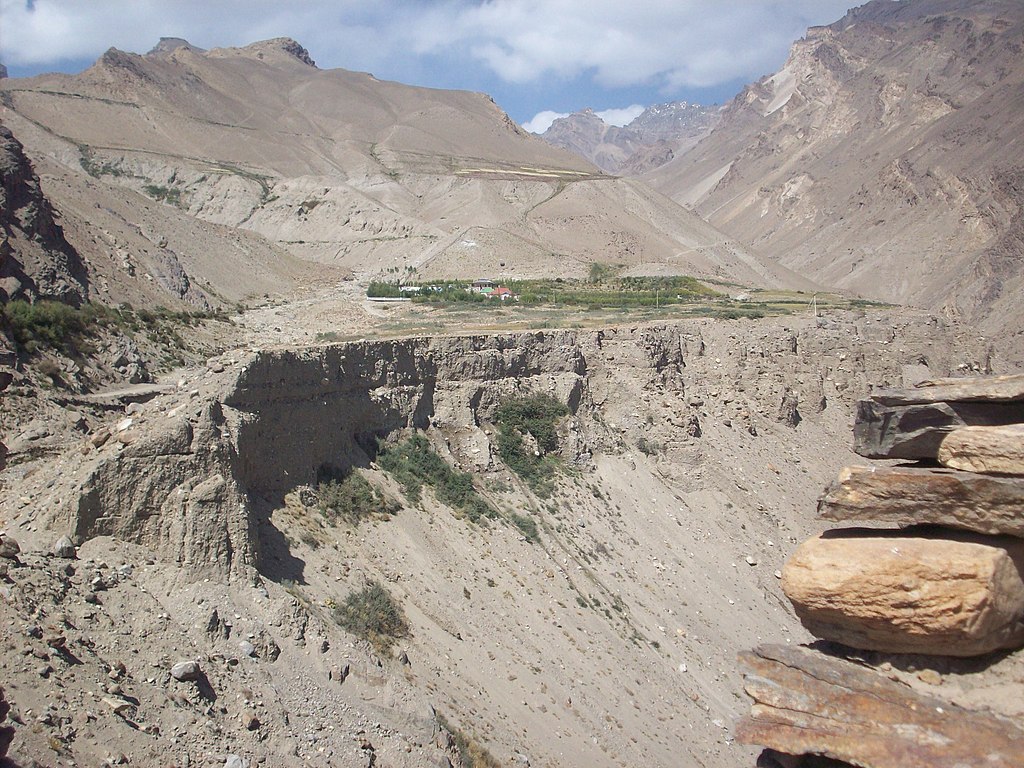
A valley in the Badakshan Province in Afghanistan, close to the where the Iron Gates would be. Photo by Zack Knowles, CC BY-SA 3.0, via Wikimedia Commons
Because this area was a choke-point for travel, it was often garrisoned, and he described “double wooden doors, strengthened with iron and furnished with bells”. In any case, Xuan-zang seemed able to pass through without much issue.
After crossing the Oxus River (now the Amu Darya), he returned to regions where Buddhism was still flourishing namely in the small city of Termez. Termez was once a major city of the Kushan Empire, but was much more diminished by the time Xuan-zang arrived. The Buddhist community here numbered about 1,000 monks. It was here that he saw the Ajina Tepe monastery and its excellent works of art.
In fact, from here Xuan-zang would behold some pretty amazing spectacles. Many people may not realize that the lands we now call Afghanistan were once bastions of Buddhism along the Silk Road, and boasted many treasures, monasteries, and a very eclectic culture.
But first, Xuan-zang had to deal with a series of problems in the city of Kunduz.
Xuan-zang’s visit to the city of Kunduz was no accident. After meeting the king of Turfan way back in episode one, and the Qaghan of the Western Turks in episode three, he had many letters of introduction to the Prince of Kunduz named Tardu. As rulers on the Silk Road, they were all related by family or marriage, so Xuan-zang had little trouble getting an audience with Prince Tardu.
Except for one problem: the Prince’s wife had recently died, and he was in mourning. Later, Tardu abruptly married another daughter of the king of Turfan (episode one), and she in turn plotted with his son from the first marriage. This is starting to sound like the plot of a historical K-drama, doesn’t it?
Before long, Prince Tardu was poisoned and died. The new queen married the prince, and ruled Kunduz thereafter.
Xuan-zang did his best to lay low, and stay out of the issue. His delays at Kunduz meant that he had time to get to know another Buddhist monk named Dharmasimha. Dharmasimha and Xuan-zang debated Buddhist thought and treatises for some time, but Xuan-zang felt Dharmasimha didn’t know as much as he was hyped up to. Dharmasimha for his part, acknowledged his shortcomings, and tried to stay humble about it.
Moving On
Before Prince Tardu’s death, he had encouraged Xuan-zang to visit another city named Balkh, also in modern Afghanistan. Balkh had quite a few sites to see, and since some Buddhist monks were already planning to head back there, Xuan-zang accompanied them. After passing through a city named Tashkurghan (modern Kholm, not related to a similar city in China), they reached the verdant lands of Balkh.
The city of Balkh, known to the Greeks of Alexander the Great as Baktra (Βάκτρα) and Baítíguó (白題國) in Chinese to Tang-dynasty China, was important since very far back in antiquity. Balkh was the traditional birthplace of the Zoroastrian religion, and an important cultural center to Persian people since very ancient times, rivaling cities further to the west such as Babylon and Ecbatana in importance. According to Buddhist tradition, the first two of the Buddha’s disciples also hailed from Balkh, and made the first stupa. Centuries later, it was here that Alexander had married a bride named Roxana, seeking to unify western Greek culture with the eastern Persian culture. Later in the Hellenstic Age, it was an important center of the Greco-Bactrian kingdom.
Needless to say, while few people have heard of Balkh today, it was a very important city across many centuries.
During Xuan-zang’s time, the lands around Balkh were still very fertile (desertification happened gradually later). Even with the widespread destruction the Hephthalities (a.k.a. “white huns”), the lands were still prosperous, if somewhat depopulated. There were two major monasteries in the area collectively known as the Nava Vihara, that belonged to the Sarvastivadin tradition of “Hinayana” (early Indian) Buddhism.3 There were tens of thousands of monks in attendance, and Balkh was one fo the remaining places where teachers were regularly installed from India. Similar to Bamiyan, the Naha Vihara boasted massive statues of the Buddha as well. Interestingly, even as far as the 8th century, long after Xuan-zang was dead, an Arab historian named Umar ibn al-Azraq al-Kermani recorded a place of worship here similar to the Kabaa in Mecca. But instead a Buddhist stupa was enshrined inside, with a cloth draped over it, in accordance with Persian custom of showing veneration.
Xuan-zang stayed at the Nava Vihara for a month, and became good friends with a monk there named Prajnakara. Xuan-zang seemed to finally find a monk of high-caliber, who had a good depth of understanding of Buddhist doctrine, even if he was a “Hinayana”, not Mahayana Buddhist. The two journeyed together further south to Bamiyan.
In our next episode, we’ll explore Xuan-zang’s visit to the great Buddha status of Bamiyan, and Xuan-zang is reaching the borders of India. But first, he has to cross the Himalayas…
3 Although the Sarvastivada school was not Mahayana Buddhism, Mahayana Buddhism inherited a lot from it anyway: canon of texts, certain viewpoints, etc. Another important early school that influence Mahayana were the Dharmaguptaka, who mostly gave their monastic traditions and rules to the Mahayana.
A long, long time ago in college, I studied abroad in Hanoi, Vietnam for a summer for preparation for grad-school. I was, frankly, a pretty terrible student, skipped classes a lot and then dropped out of grad school in the US before I even took a single class.1
While there, I spent a lot of time goofing around in Hanoi, hanging out at Internet cafes, and talking with the local rickshaw drivers who played Chinese Chess during their downtime.
My Chinese Chess set, courtesy of Yellow Mountain Imports. The pieces are not quite arrange properly; I just snapped this photo for fun.
Two years of college-level Vietnamese courses meant that I could do basic communication but was certainly not fluent. Still, the drivers were happy to let me join in and play. Playing against the young American probably was something to break up the routine. Of course, I lost handily. They had been playing one another for years and were quite good, and I was getting a crash course in the game. Even though I was terrible, Chinese Chess was something I really enjoyed, and played as much as I could.
That was more than twenty years ago.
Sadly, I never played Chinese Chess since returning from Vietnam. Later, I learned to play Japanese Chess (shogi), but the two games are fairly different, each with their own virtues. I always kind of missed playing Chinese Chess, and I was happy to discover that one can buy good, quality sites online at places like Yellow Mountain Imports.
Yellow Mountain Imports includes some excellent instructions for non-native players to learn quickly. Chinese Chess, more properly called Xiang-qi (象棋)2, is another variant of Chess, in the same family as Western Chess, or Japanese Shogi. The basic premises is the same for all three: move your pieces, capture opponents pieces and defeat the opponent by trapping their king/general into an attack that they cannot escape from.
But each game has notable differences. In Shogi, you can replay pieces you capture, plus it includes multiple kinds of generals, each with unique moves. In xiangqi, the pieces have some unusual moves, but also terrain is more prominent: some pieces change their moves after cross the “river” in the middle, and some are unable to move outside their own “palace”.
Xiangqi, based on my limited experience, is a leaner, faster game than Chess or Shogi, because it has comparatively fewer pieces, and the many pieces have large movesets. Some pieces are strictly defensive too, so the actual pieces you use to attack are comparatively few. This makes for a game where every move really starts to count. So while the endgame is faster, there’s lots of “head games” about where to put your pieces, especially when you consider tricky combinations with the cannon. Using one or both cannons, you can do some complicated combinations to attack your opponent’s general. And since the general can’t move very far, you have to be extra careful where you put yours because a checkmate can happen surprisingly easy if you are careless in guessing your opponents moves.
I enjoy Chess, Xiangqi and Shogi each in their own way (honestly, I am probably best at Shogi, but even then I am a lousy player). Each one has its own vibe, but Xiangqi is especially nostalgic for me because I played it so much in Vietnam.
I taught my daughter to play a bit of Xiangqi with me, and I was surprised to see that she enjoyed it too. So I am glad to put this set to use.
Even for Westerners who can’t read Chinese characters, everything is simple enough, and visual enough that you can quickly learn the game, and begin playing.3 Like all good games, it’s simple enough to learn, but complex enough to keep you playing for a long time.
P.S. the Vietnamese name for Xiangqi is cờ tướng, or in old Hán-Nôm style: 碁將
1 Needless to say, I was immature, cocky and unprepared for life outside the US. There were many positives too, but plenty of regrets too. If I could still speak Vietnamese well, I would like to go back and visit, now older and wiser. But I doubt I will have the opportunity any more. I should post some of my old photos one of these days, though.
2 Pronounced like Shyong-chee.
3 I do find it fascinating that the Chinese characters on each side are not always the same. For example the elephant on the red side is 相 and the green side is 象, or the advisor is 士 (red) and 仕 (green). I am unclear why these are different, while other characters such as 車 are the same.
In part one, Xuan-zang the famous Buddhist monk of the 7th century who crossed from China to India encountered the first cities of the Silk Road, crossed the Gobi Desert, and avoided bandits and overbearing monarchs. In part two, Xuan-zang journeyed to the famous city of Kucha and climbed the mountain pass near Tengri Khan losing many people in the dangerous crossing.
As Xuan-zang traveled further and further west, he was leaving Chinese political influence and going further into areas comprised of steppe nomadic tribes such as the Turkic people, as well as sedentary Iranian people such as the Sogdians.
But let’s talk about Turkic people for a moment.
As we’ve talked about in previous posts, the Silk Road was a fascinating mix of different cultures and people. This was very common in the nomadic world of the Eurasian Steppes because tribes were constantly moving around, encountering new tribes, subjugating new tribes, being subjugated by other tribes, or forming alliances. It was a very fluid, dynamic and extremely dangerous environment. We’ve seen examples in past blog posts with groups like the Scythians and Parthians.
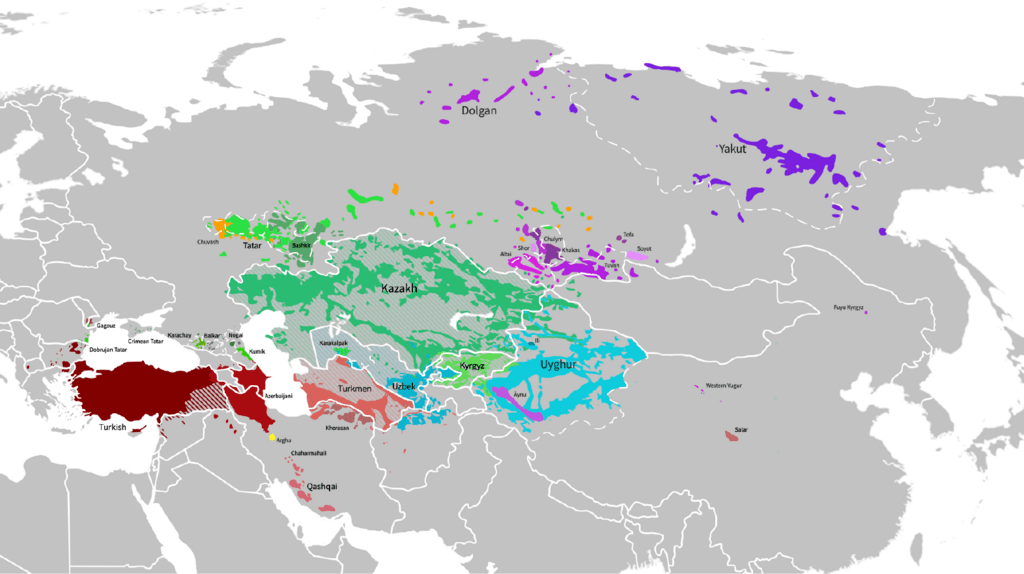
The Turkic people were another such group. Like many steppe tribes, their origins are very obscure, but they were caught up in this cultural soup, and over time grew and grew into more powerful tribal confederations. As they spread and intermixed with other steppe tribes, they also took on increasingly regional differences among each other.
A map showing the distribution today of Turkic languages across Asia. Photo by GalaxMaps, CC BY-SA 4.0, via Wikimedia Commons
Thus, the Turkish people of the Republic of Turkey (a.k.a. modern Türkiye) and the Uyghurs of north-western China have common ancestry. Some of their ancestors migrated west and contended with the Eastern Romans (a.k.a. the Byzantines), while others fought with the Chinese Tang dynasty onward. Yet in some distant, remote past they began as just one steppe tribe out of countless others and over time grew into a family of ethnicities and languages that spread all over Asia.
In Xuan-zang’s time, the Turkic tribes had formed a powerful confederation on the Eurasian steppe called the Western Turkic Khaganate. They called themselves the On oq budun (𐰆𐰣:𐰸:𐰉𐰆𐰑𐰣) or “People of the Ten Arrows” implying they were a federation of tribes, ruled by a single Qaghan (alternatively spelled Khaghan). These “Göktürks“, and their empire, remnants of an even larger Turkic Khaganate, were spread out far enough to have contact with China, the Sassanian Persians and Eastern Romans all at once.
Great Tang (e.g. Tang Dynasty China) would come to rule this entire area at the zenith of its power in the decades ahead, and the Khaganate reduced to a puppet state, but in Xuan-zang’s time, it was still a land ruled by Turkic people.
Meeting the Khagan
The Chuy river valley, photo by Vmenkov, CC BY-SA 3.0, via Wikimedia Commons
As Xuan-zang and his party descended the Tian-Shan mountains they came near to the modern city of Tokmok in Kyrgyzstan. More precisely, Xuan-Zang came the ancient capital of Suyab, also called Ak-Beshim, just to the southwest. This region was fed by the Chu river and was a verdant land compared to the desert wastes elsewhere. The Khaganate used these lands as a resting place when not on the march.
The leader of the Khaganate, Tong Yabghu Qaghan (Tǒng Yèhù Kěhán, 统叶护可汗 to the Chinese) was eager to meet Xuan-zang and provided a fitting welcome. Xuan-zang, for his part, gave the Qaghan a letter of introduction from the king of Turpan.
Xuan-zang described the Qaghan thus:
[the Qaghan] was covered with a robe of green satin, and his hair was loose, only it was bound round with a silken band some ten feet in length, which was twisted round his head and fell down behind. He was surrounded by about 200 officers, who were all clothed in brocade stuff, with hair braided. On the right and left he was attended by independent troops all clothed in furs and fine spun hair garments; they carried lances and bows and standards, and were mounted on camels and horses. The eye could not estimate their numbers.
The Silk Road Journey with Xuan-zang, page 32
Tong Yabghu Qaghan’s “palace” was a great yurt, wherein a feast was held. The guests enjoyed such foods as wine, mutton, and boiled veal among other things. Since Xuan-zang was a Buddhist monk, he was forbidden to eat meat and drink alcohol, and thus he was served delights such as rice cakes, cream, mare’s milk, sugar, and honey instead.
Kyrgyz-style yurts, in Xinjiang region of China. Photo by katorisi, CC BY-SA 3.0, via Wikimedia Commons
Once everyone was settled down, Tong Yabghu Qaghan asked poor Xuan-zang to make a Buddhist sermon on the spot.
Xuan-zang had to be careful not to ruin the mood of the occasion, so he opted for a sermon on the need for goodwill (metta in Buddhism) towards all beings, and on the benefits of the religious life. The Qaghan was evidentially impressed. In fact, this wasn’t the Qaghan’s first encounter with a Buddhist monk. Apparently, some years earlier a Buddhist monk from India named Pabhakarmitras had journeyed through these lands on the way to China, and so the Qaghan was well-disposed to the religion. He even tried to convince Xuan-zang to stay among his people, but Xuan-zang declined. Unlike the king of Turpan, the Qaghan seemginly took no offense and offered to send a ethnically Chinese soldier to accompany Xuan-zang for part of the way.
More importantly, the Qaghan gave Xuan-zang both gifts and letters of introduction to share with the petty princes along the way, who were all vassals of the Qaghan.
Finally, it was time to leave.
To Fabled Samarkand
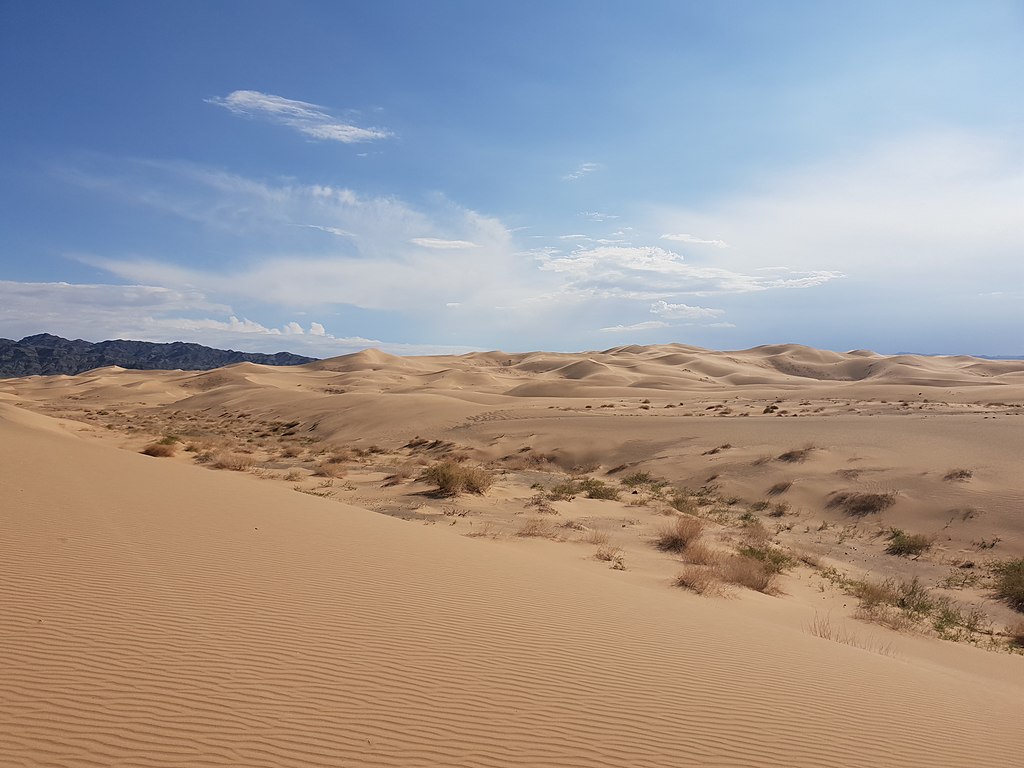
From the great yurt camp at Sayub, Xuan-zang was escorted by the Qaghan part of the way, but they eventually parted. After leaving the Chuy region, the land reverted back to desert, namely the Kyzylkum Desert, also known as the Desert of Red Sands. Xuan-zang’s party journey to the next city, the city of Tashkent (modern Uzbekistan) named Zhěshí (赭時) in Chinese at the time, proved difficult, but they did eventually reach it after crossing the Jaxartes River. Of the crossing, Xuan-zang describes the scenery.
North-west from this [river crossing] we enter on a great sandy desert, where there is neither water nor grass. The road is lost in the waste, which appears boundless, and only by looking in the direction of some great mountain, and following the guidance of the bones which lie scattered aboout, can we know the way in which we ought to go.”
The Silk Road Journey with Xuan-zang, page 34
Xuan-zang does not seem to spend much time in Tashkent (I wasn’t able to find much description of his time in my limited resources), and continued on in a more Westerly direction towards Samarkand.
Fun fact, after crossing the Jaxartes river and passing Tashkent, Xuan-zang and his party entered into lands once ruled by the Bactrian Greeks. To the south and west of Tashkent was the former outpost city of Alexandria Eschate, which had been the most northerly city of the Greeks. It was a strong fortress city under king Euthydemus I, but suffered constantly attacks by the native Iranian Sogdian peoples. By the 1st century AD, the city had reverted back to local control, and the Greeks retreated from the area. By Xuan-Zang’s time this was all a distant memory.
We’ll cover Samarkand in the next episode, because things take a dangerous turn in this output of the Sassanian Persians, and also from here, the road will turn back south toward India at last.
In part one of the journey, Xuan-zang braved the Gobi desert and contended with the overbearing monarch of Turpan, but also beheld many wonderful sites at that venerable city before moving on to Yanqi. After leaving Yanqi, Xuan-zang moved onto the city of Kucha, also called Kuchar in Uyghur (كۇچار) or Kùchē (庫車) in Chinese.
The Buddhist Kingdom of Kucha
Out of all the cities of the northern Silk Road surrounding the Tarim Basin, Kucha was the largest and most prosperous. As a powerful Buddhist kingdom, Kucha dominated the Silk Road trade in the area since at least the 4th century. Xuan-zang’s description of the city was as follows:
The soil is suitable for rice and grain…it produces grapes, pomegranates and numerous species of plums, pears, peaches, and almonds…The ground is rich in minerals-gold, copper, iron, and lead and tin. The air is soft, and the manners of the people honest. The style of writing is Indian, with some differences. They excel other countries in their skill in playing on the lute and pipe. They clothe themselves with ornamental garments of silk and embroidery….
There are about one hundred convents in this country, with five thousand and more disciples. These belong to the Little Vehicle [Hinayana]1 of the school of the Sarvastivadas. Their doctrine and their rules of discipline are like those of India, and those who read them use the same originals….About 40 li to the north of this desert city there are two convents close together on the slope of a mountain…Outside the western gate of the chief city, on the right and left side of the road, there are erect figures of Buddha, about 90 feet high.
As with prior cities, Xuan-zang’s reputation had proceeded him, and he was greeted by the local ruler, which described as having “red hair and blue eyes”. The king of Kucha at the time was likely either ethnically Sogdian or Tokharian. We saw similar figures depicted in Buddhist art when we looked at the Bezeklik Caves in episode one. The Silk Road north of the Tarim Basin was a fascinating mix of different peoples and ethnicities and it could change from city to city. The Tokharians were distant relatives of other Indo-European people, and their language had some common elements to European languages such as English. Yet, the link between the Tokharians and Westerners is frankly pretty tenuous, but that did not stop researchers in the 19th century who had certain … racial theories, from hyping up their contribution to the Silk Road. It’s important to be cautious and not to draw too many conclusions. Hidden agendas make for bad research.
What’s more interesting to me is how the Tokharians lived alongside totally disparate groups such as Chinese, Turks, Uyghurs, Sogdians and so on, and at times they had friednly co-existence (the Tokharians evidentially revered the Sogdians in particular and tried to emulate them), and at other times they clashed. In other words, pretty typical human stuff. This intermix of cultures and people is what makes the Silk Road so fascinating.
But I digress…
Kucha had a lively material culture, thanks to runoff from the Tian Shan mountains providing plenty of water, and thus a wealth of food and agriculture grew here. It’s place on the Silk Road also ensured plenty of goods and materials were traded here too. Further, Kucha was famed for its music, and musicians from Kucha were highly sought after. A Kuchean orchestra was staffed at the court of Great Tang throughout the dynasty, and played for official ceremonies and celebrations. My book on Xuan-zang points out that famous songs they played included titles like “The Jade Woman Hands the Cup Around”, “Meeting on the Seventh Evening”, and “The Game of Hide the Buckle”.
Yet, for the Buddhist tradition as we now practice it today, Kucha was even more important for another reason: it was the hometown of Kumārajīva (344–413 CE) the translator.
Kumarajiva the Great Translator
Kumarajiva was the son of an Kashimiri-Indian father and a Kuchean mother, and was raised in Kucha. He studied Sarvastivadan-branch Buddhism, an influential pre-Mahayana Buddhist school whose monastic code was adopted by Mahayana Buddhist communities in China onward. However, at some point Kumarajiva converted to Mahayana Buddhism and by age 20 ordained as a Buddhist monk. His fame as a scholar reached China at the time, and he was sought out by the emperor. Our homeboy, Kumarajiva, was imprisoned at one point by a local warlord, but eventually was released by the Chinese emperor, and brought to the capitol of Chang-an (see prologue episode), and was feted.
Kumarajiva proved to be an excellent translator, and helped bring many Indian-Buddhists texts to mainsteam China. Because the Sanskrit originals were mostly lost in India, but preserved in Classical Chinese, these works, now core texts in many modern Buddhist traditions, help maintain the tradition today. To name a few that you probably already familiar with, Kumarajiva translated these sutras:3
The Shurangama Sutra, important in Chinese Buddhism, especially Zen
The Sutra of the Ten Stages (chapter 26 of the Flower Garland Sutra)2
…. among many others.
To reiterate this point: the English translations of these texts we use today come from the Classical Chinese editions that were originally translated from Sanskrit and prakrits by Kumarajiva.
Having said all that, let’s return, centuries later to Xuan-zang…
Staying at Kucha
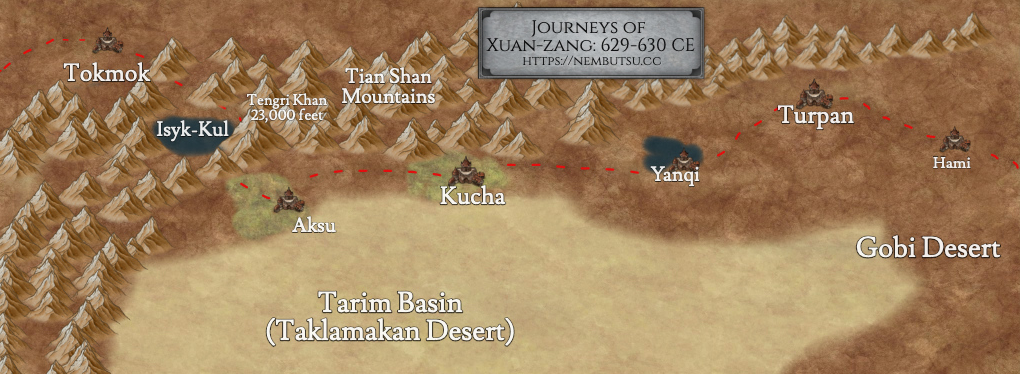
From Kucha, Xuan-zang would have to pass through Aksu before crossing over the Tian Shan mountains, but heavy snows in the passes mean that Xuan-zang had to stay in Kucha for two months. During this time Xuan-zang stayed out of trouble, and spent many days discussing Buddhist philosophy with the local community. This included the famous Kizil Caves:
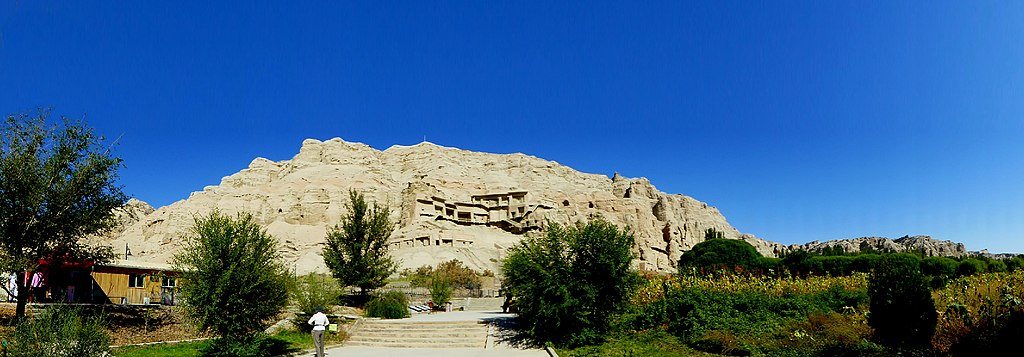
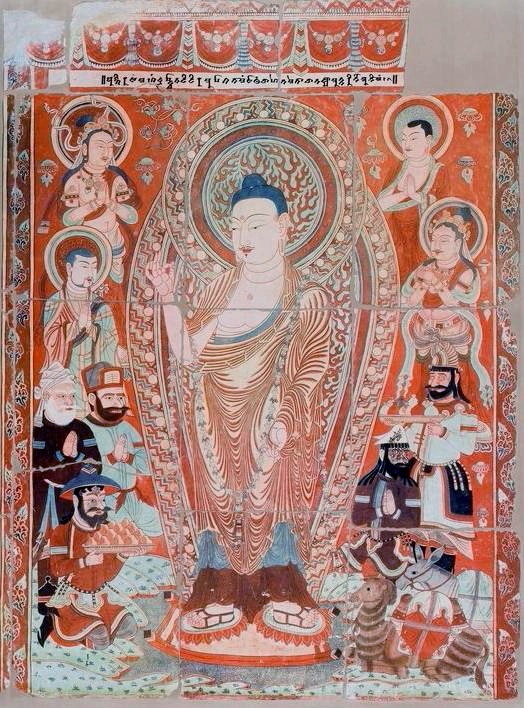
The Kizil Caves (in Uyghur قىزىل مىڭ ئۆي) or Kèzī’ěr Qiānfú Dòng (克孜尔千佛洞, lit “1000 Buddhist Caves of Kizil”) are a massive cave complex and probably one of the earliest along the northern Silk Road used for Buddhist monasticism. The artwork here often shows strong influence from Buddhist-India, or more precisely, the Greco-Bactrian art of Gandhara. However, like the Bezeklik Caves we saw earlier, a combination of local religious iconoclasm, looting by European researchers,4 and subsequent tourism have greatly disturbed the artwork in the Kizil Caves. Here’s an example reconstruction from the so-called Peacock Room:
A representation of the Peacock Room layout, and what remains. Photo in public domain, courtesy of Wikimedia Commons
In any case, check out the Wikipedia article I linked above on the Kizil Caves. There’s simply too much to add here, but needless to say, Xuan-zang must’ve beheld some amazing art in his time, which we will sadly never see again.
Side note: the red haired, blue-eye ruler of Kucha that I mentioned earlier ran afoul of the Chinese emperor, Taizong, a few years later by pretending fealty, while also declaring his loyalty to the Western Turkic Khaganate (more on that soon). Needless to say, China did not take this lying down and soon conquered Kucha just as it did with Turpan. Xuan-zang would be long gone by this point though.
The Tian Shan Mountains
Once it was safer to travel, Xuan-zang’s caravan moved onto the city of Aksu, which in his time was called Baluka (跋祿迦, Bolujia in Chinese). Xuan-zang’s caravan was again ambushed by bandits along the way, but once again the bandits were full from another attack and quickly lost interest in Xuan-zang’s group. I’d say Xuan-zang was lucky, or the bandits were just lazy. 🤷🏼♂️
Anyhow, Xuan-zang stated that Aksu was very similar to Kucha in many respects, though according to Wikipedia, Xuan-zang noticed that the people of Aksu seemed to speak a different kind of Tokharian language. The Wikipedia article on Tokharian mentions that there were several dialects, all of them pretty different from one another. In any case, it doesn’t seem that Xuan-zang stayed at Aksu too long though and set out for the mountain passes over the Tian Shan mountains to reach Tokmok. There things took a dangerous turn.
The Tian Shan mountains, with Khan Tengri in the middle. Photo by Chen Zhao, CC BY 2.0, via Wikimedia Commons
The Tian Shan mountains are huge, cold and dangerous to traverse. The Khan Tengri mountain is more than 23,000 feet high, and the Bedel Pass near it is one of the few ways to cross over to the other side. Of the mountain, Xuan-zang wrote:
This mountain is steep and dangerous, and reaches to the clouds (lit. “heaven”). From creation the perpetual snow which has collected here in piles, as been changed into glaciers which melt neither in the winter nor summer; the hard-frozen and cold sheets of water rise mingling with the cloudes; looking at them the eye is blinded with the glare, so that it cannot long gaze at them. The icy peaks fall down sometimes and lie athwart the road, some of them a hundred feet high, and others several tens of feet wide.
The Silk Road Journey with Xuan-zang, page 31
It took eight days to traverse the pass, and Xuan-zang lost up to 30-40% of his men and countless horses and oxen. Imagine that famous scene from the movie Fellowship of the Ring when the good guys braved the mountain pass, but instead of turning back almost half the party freezes to death. That’s how serious it was.
Nonetheless, the survivors did reach the gorgeous lake of Issyk Kul, now in modern Kyrgyzstan. From here, the caravan would soon reach Tokmok and with it enter the lands of the powerful Western Turkic Khaganate….
Stay tuned!
1 Explained also in part one, the term Hinayana Buddhism is not related to Theravada Buddhism (it’s seems unlikely to me that they interacted with one another due to geography), but instead is a broad term for all pre-Mayahana Indian Buddhism. It’s still a somewhat pejorative term, but the relationship between early Hinayana Buddhism and Mahayana Buddhism is … complicated and not necessarily antagonistic.
2 I would love to talk about the Flower Garland Sutra some time, but it is a TOME, and I’ve only read very small parts of it. The Sutra of the Ten Stages deserves special attention though, and I have read it, but it’s challenge all by itself to explain in a blog post. Maybe some day.
3 one notable omission in this list is the Heart Sutra. The Heart Sutra is thought to have been compiled in China, not India, as a clever summary of much longer sutras. It gets to the “heart” of the matter, if you take my meaning. Xuan-zang, as we’ll see later, brings it back to India where it’s translated to Sanskrit, not from it.
4 The story of Albert Grünwedel is an interesting example of someone who was a dedicated archeologist, but also kind of unhinged too.
In the prologue, we introduced the Buddhist monk Xuan-zang and explored the world of Tang-dynasty China. Xuan-zang left this world behind, contravening imperial decree about leaving the country without a permit, to pursue Buddhist teachings in India.
However, once he left the Yumen Pass, he immediately ran into a major issue: the Gobi Desert.
The road from the Yuman Pass to the next stop, the oasis at Hami, was barren, dry, with extreme heat and cold, and not well marked. Xuan-zang, who had little experience with this kind of travel, at one point lost his waterskin, became lost, and collapsed due to exhaustion. It is said that the bodhisattva Guan-yin guided him in his darkest hour to Hami.
The Hami Oasis
A map of the first part of Xuanzang’s journey. I made this using Inkarnate (a great online map tool). Apologies for any geographical mistakes. Free for non-commercial use.
The town of Hāmì (哈密), also known as Kumul (قۇمۇل) in Uyghur, was populated by a Chinese military colony since the Sui Dynasty, but had been cut off from China during turbulent times. At Xuan-zang’s time, it pledged loyalty to the regional Turk rulers while still maintaining diplomatic relations with the new Tang Dynasty. Some months after Xuan-zang left, Great Tang’s expansion absorbed Hami into its empire.
Here in Hami, Xuan-zang stayed at a Buddhist monastery where three Chinese monks lived. They were overjoyed to see a fellow monk, and offered him lodging. Xuan-zang did not stay too long here, and moved onto the larger city of Turpan.
The King of Turpan
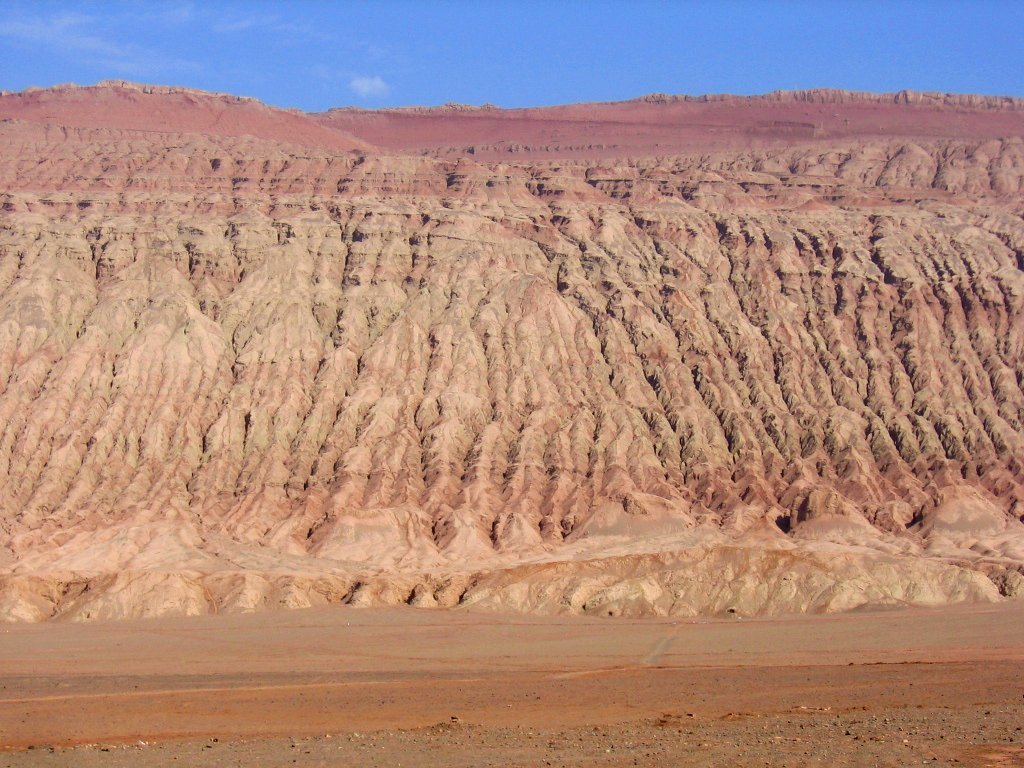
The “Flaming Mountains” near the city of Turpan on the Silk Road. Photo by es:User:Colegota, CC BY-SA 2.5 ES, via Wikimedia Commons
The city of Turpan (Uyghur: تۇرپان) also called Tǔlǔfān (吐鲁番) in Chinese was a prosperous city since ancient times, and changed hands often, but since antiquity had a large Chinese community, and considerable Chinese cultural influence, especially compared to cities further west.
The King of Turpan at this time was a devout Buddhist, and gave Xuan-zang a warm welcome upon his arrival, but also pressured him to stay rather than continue his journey. When Xuan-zang politely refused, the King of Turpan begged, cajoled, and threatened him. Xuan-zang was not allowed to leave, and he resorted to fasting to make his point. The king relented, and got Xuan-zang’s promise that he would stay for a month to preach to the people of Turpan, and would return later upon his return trip.
Once this agreement was reached, Xuan-zang stayed as promised. He used this time to explore the area, including the ancient city of Gāochāng (高昌), also known as Qocho, which was the former capital of a once-powerful kingdom, where he gave sermons to audiences there. Archeological excavations have show plenty of evidence of a vibrant Buddhist community at the time.
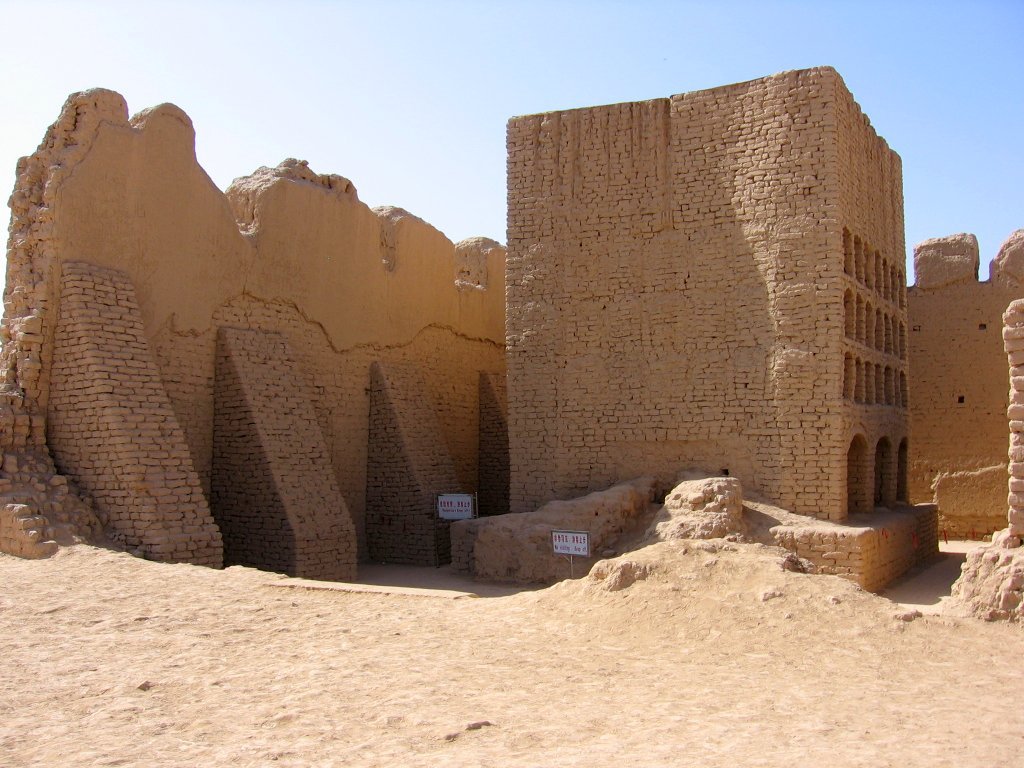
Remnants of a Buddhist stupa at Gaochang. Photo by Colegota, CC BY-SA 2.5 ES, via Wikimedia Commons
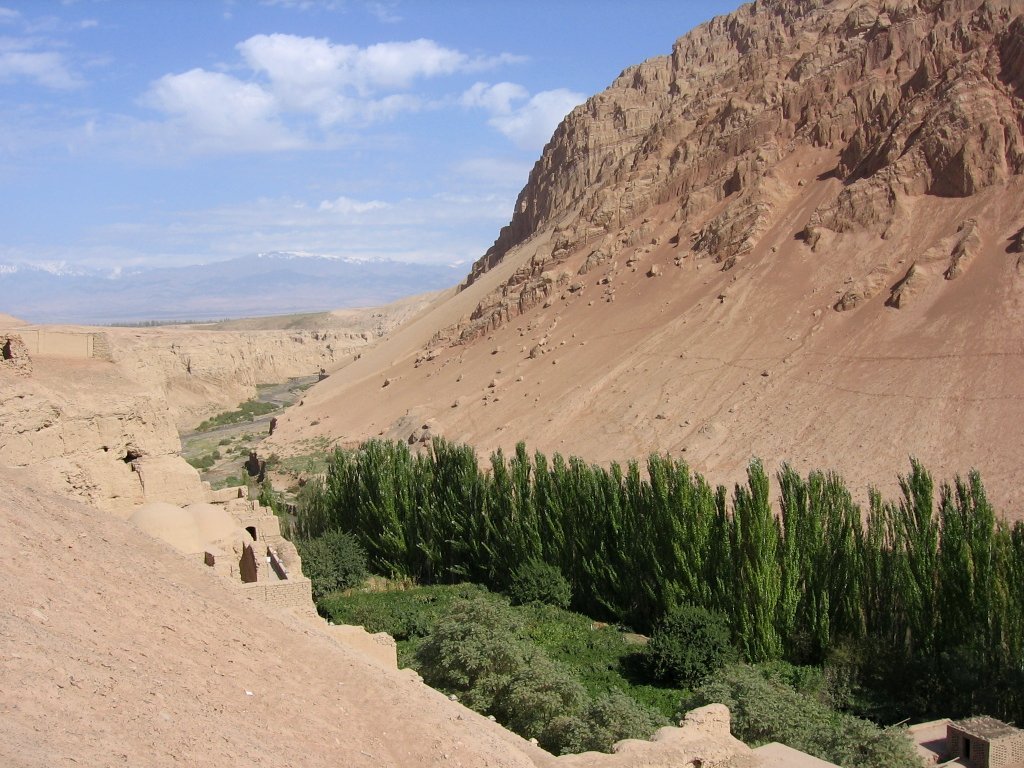
Xuan-zang also likely visted the nearby Bezeklik caves as well:
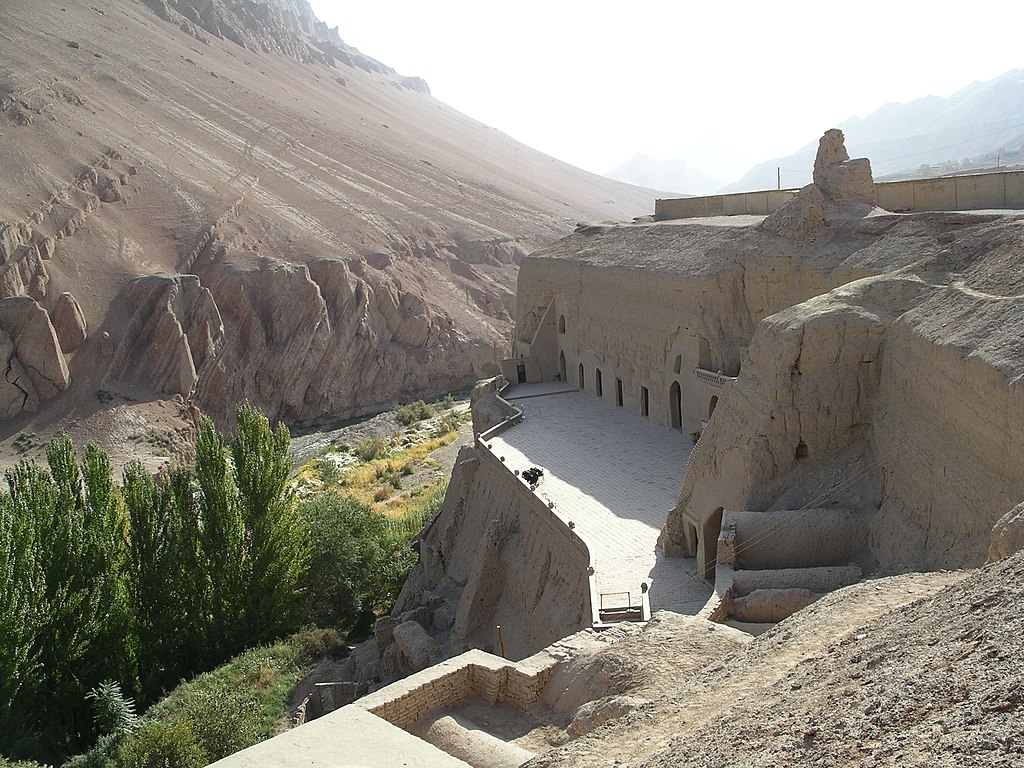
The Bezeklik Caves as seen from above. Photo courtesy of Wikimedia Commons.Photo by T Chu, CC BY 2.0, via Wikimedia Commons
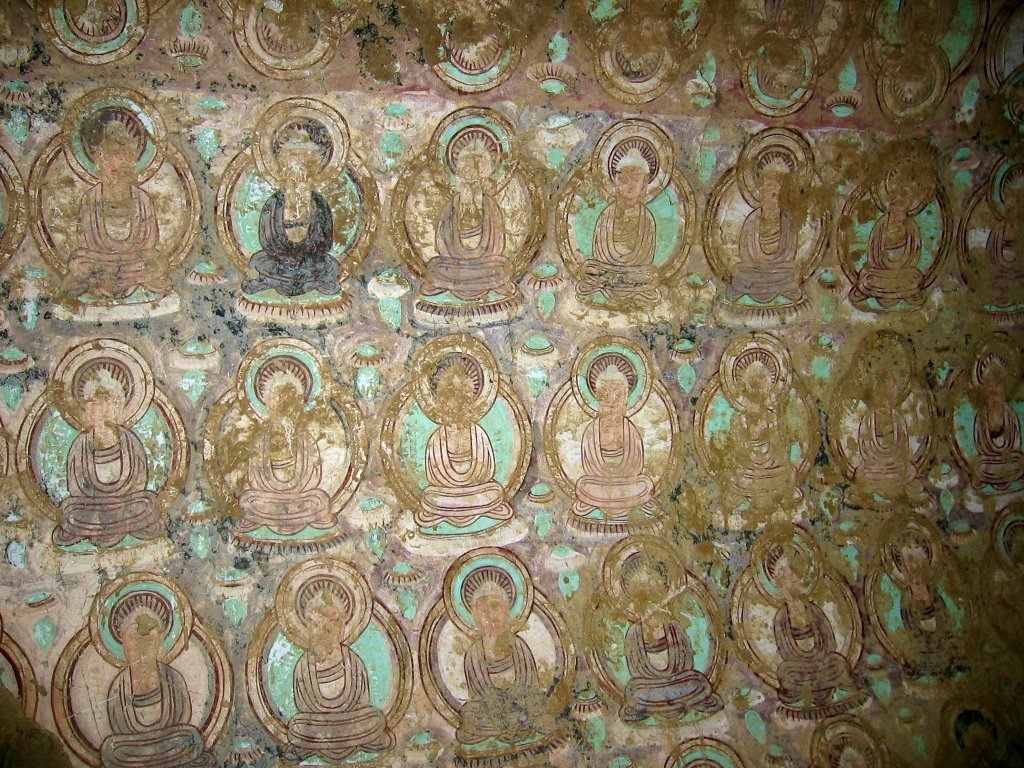
The Bezeklik caves are a massive grotto that served as a monastery for the local Buddhist monastic community. Many of the walls and ceilings were painted with frescoes of the Buddha, or other famous imagery, though in later generations, these were often defaced or damaged by locals for one reason or another (superstition, religious prohibition against human imagery, or simply raw materials).
Further, European archeologists looted the caves and brought many works of art back to Europe, only for them to be destroyed later in World War II. Thus, very little remains of the artwork now, but what does remain is simply spectacular, and a shining example of the fusion of cultures along the Silk Road at this time.
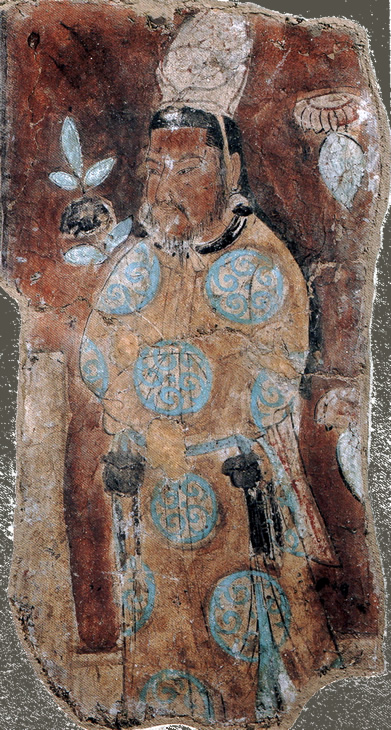
Bezeklik caves, Pranidhi scene 14, temple 9. Note the Sogdian men depicted in reverence of the Buddha. See page for author, Public domain, via Wikimedia Commons
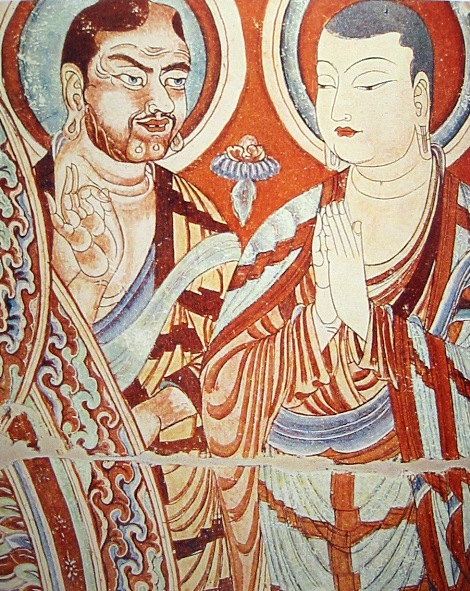
Two Buddhist monks, one Eurasian (possibly Sogdian or Tokharian), and one East Asian. Public domain, via Wikimedia Commons
Once Xuan-zang’s month was completed, the King of Turpan made good on his word. He provided Xuan-zang with many goods, supplies and letters of introduction to the kings further along the road. He now traveled with a caravan toward the next city Yānqí (焉耆) known by many other names, including Karasahr (قاراشەھەر in Uyghur) or Agni from the old Tokharian name, but not before being robbed by bandits! Evidentially, the bandits had already killed and robbed an earlier caravan, and were content to be bribed by Xuan-zang’s party and left with no further violence.
Upon reaching the city of Yanqi/Karasahr/Agni, Xuan-zang was said to have received a warm welcome, and described a city with ten different monasteries, and with two thousand monks practicing Hinayana Buddhism.1 He did not have flattering things to say about the king of Yanqi though, and later in 643 when the king broke his allegiance with Great Tang, the emperor Taizong, whom we met in the prologue episode, steamrolled Yanqi’s army and took the king prisoner.
Xuan-zang for his part only stayed for one night and moved on toward the city of Kucha. Kucha is an important city in early Buddhist history, but as we’ll see in our next episode, it was caught in a game of political tug-of-war…
Until the next episode: the Western Turks!
1 The term Hinayana is a loaded term in Buddhism, and frequently misunderstood. It has also been used as a pejorative by Mahayana Buddhists too. Without getting lost in the weeds, think of “Hinayana” Buddhism as any pre-Mahayana Indian-Buddhist school. It is not the same as Theravada Buddhism (the other major branch of Buddhism) since both branches were geographically separate and had little interaction with one another.
I had an idea recently while flipping through my book on the journeys of the Buddhist monk Xuan-zang (pronounced like “Shwan-tsong”). Xuan-zang was the famous Buddhist monk who walked to India in order to bring back more information and texts in order to help develop Buddhism in his native China. In my old post, I covered some of the trials and tribulations of this amazing journey, and even made a fun song. However, looking back the post felt incomplete. I realized that many of these places that Xuan-zang traversed are obscure and forgotten now despite their central importance to Buddhist history, and the journey was so long that it’s too much to really explore in a single post.
So, this is the start of a series of posts meant to help retrace Xuan-zang’s journey, explore places of significance and how they tied into larger history. I don’t have a schedule yet (these posts take a while to write), but I am working on the next few drafts already.
Today’s post is the prologue episode, covering China at this time, and why Xuan-zang left.
Quick note: because this episode in particular uses a lot of Chinese names, for the sake of accuracy and modern readers, I am using the pinyin-style accent marks where relevant, and also using Simplified Chinese characters. I also put in lots of hyphens to help with pronunciation.
The Tang Dynasty
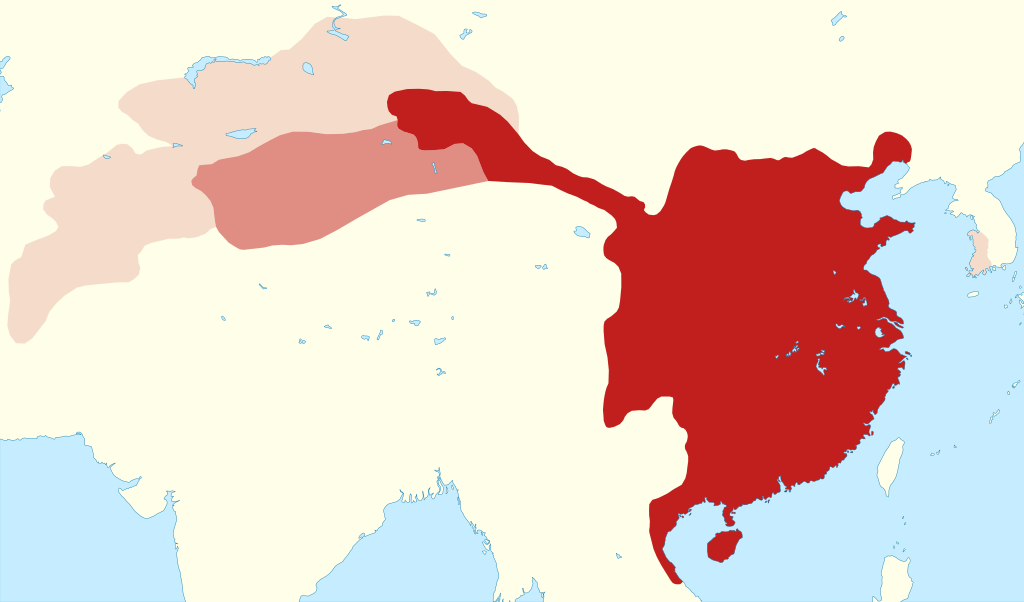
Great Tang at its largest extent in 661, map courtesy of Kanguole, CC BY-SA 4.0, via Wikimedia Commons
Chinese history, until the Republican era (1912 onward) had seen a series of kingships followed by imperial dynasties. Although, we usually call the country “China”, the name used by Chinese people in antiquity, and by their neighbors, was often taken from the current ruling dynasty.
Dynasties came and went. Some were fairly short-lived such as the Sui, others were incredibly powerful and long-lasting such as the Ming. Some were constantly fighting for their existence, such as the Song, others were fractured into a series of “mini-dynasties” that only exerted control over a region and were unable to unify China.
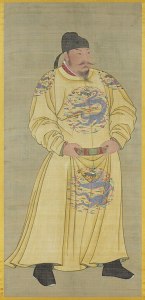
A portrait of Emperor Tai-zong, painted centuries later in the Ming Dynasty. National Palace Museum, Public domain, via Wikimedia Commons
Xuan-zang lived during the last days of the Suí Dynasty, and the early days of the Táng Dynasty (唐). “Great Tang” (大唐) as it called itself, lasted from 618 – 907, and was one of the high points of Chinese civilization. The empire expanded very far to the west, along the Silk Road (more on that in future posts) and actively imported all kinds of art, people, ideas, religions and material culture from Central Asia. Compared to earlier dynasties, Great Tang was much more cosmopolitan and less insular.
Xuan-zang lived primarily during the reign of the second Tang emperor Tài-zōng (太宗), who was an incredibly powerful, dynamic ruler. Chinese history still reveres him as of the greatest rulers. Tai-zong aided his father, the first emperor, in overthrowing the previous dynasty. Further, he was a powerful, expansionist ruler with a strong sense of administration, which helped provide stable foundations for Great Tang.
The capital of Great Tang was the city of Cháng-ān (长安) in the western part of China. The city was a massive, cosmopolitan center of administration, commerce and culture. Chang-an at its height grew to 30 square miles, which was massive compared to Rome which occupied only 5.2 square miles. The population by 742 was recorded as 2,000,000 residents and of these 5,000 foreigners.
Chang-an was easily one of the world’s greatest cities at the time, and it had a great influence on its neighbors as well: the layout for the capital of Japan, Kyoto, was intended to resemble Chang-an, and great Buddhist masters such as Saicho’s rival, Kukai, studied there extensively. It was here that many Buddhist texts that came from the Silk Road were translated here as well.
As the easternmost point of the Silk Road, it was here that many journeys began or ended…
Buddhism in Great Tang
The Tang Dynasty is often regarded as one of the high points of Chinese civilization, but also for Buddhism. Buddhism had emerged in China centuries earlier but its spread was slow at first. The native Confucian community particular resented the foreign Buddhist teachings as un-filial, unproductive (since monks did not work fields), and a drain on national resources.
In spite of the criticisms, it spread nonetheless. Wave and wave of teachings, newly translated texts, and schools of thought were imported from the Silk Road, allowing Buddhism to gradually take root, articulate its teachings better over successive generations, and develop natively Chinese schools of thought such as Tiān-tāi, Huá-yán, and Pure Land alongside imported schools of thought from India such as Fǎ-xiàng (Yogacara) and Sān-lùn (Madhyamika). By the time of the Tang Dynasty, massive temple complexes had arisen around Chang-an and other major cities.
This was a rare time when there was still a connection between Buddhist India and China, allowing a free flow of information. Later, when Buddhism fell in India, and the Silk Road was no longer safe to travel due to warfare, China was cut off.
Emperor Tai-zong himself had a distant relationship with Buddhism in his early reign. He kept it at arm’s length and strictly regulated. Further, travel in and out of China was tightly restricted, so that while there was commerce and trade, one could only do so with official permissions. More on this shortly.
Enter Xuan-Zang
Xuan-zang was the second son of his family. His older brother had ordained as a Buddhist monk, and Xuan-zang decided to follow in his footsteps at a young age. During the collapse of the Sui Dynasty, both brothers came to Chang-an where it was safe, and undertook further Buddhist studies. Since Xuan-zang proved to be a promising student, he was soon given access to advanced Buddhist texts and eventually ordained as a full monk in 622.
As to why Xuan-zang decided to journey all the way back to India, he is quoted as stating the following:
The purpose of my journey is not to obtain personal offerings. It is because I regretted, in my country, the Buddhist doctrine was imperfect and the scriptures were incomplete. Having many doubts, I wish to go and find out the truth, and so I decided to travel to the West at the risk of my life in order to seek for the teachings of which I have not yet heard, so that the Dew of the Mahayana sutras would have not only been sprinkled at Kapilavastu, but the sublime truth may also be known in the eastern country.
During his studies, Xuan-zang had noticed copyist errors, corruptions of texts, missing texts and other textual issues that prevented a thorough understanding. Thus, he resolved to journey to India, much like a monk named Fa-xian (法显) had done centuries earlier. He was particularly interested in the writings of Vasubandhu and his half-brother Asanga , who were crucial to the development of Mahayana Buddhism as we know it. Xuan-zang and some like-minded monks petitioned the Emperor Tai-zong to be allowed to journey to India, but never received an answer. He made his preparations, possibly learning some Tokharian language (commonly spoken along the Silk Road at that time) from the foreign quarters at Chang-an, then went west.
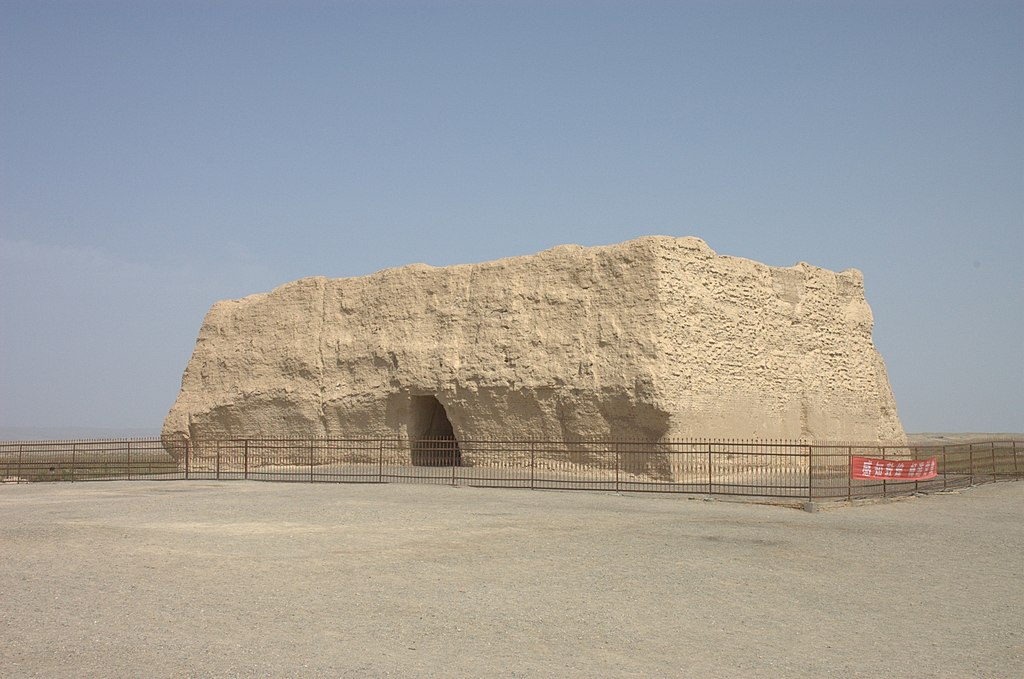
Ruins from the Yumen Pass, photo courtesy of 张骐, CC BY-SA 3.0, via Wikimedia Commons
By the time Xuan-zang reached the Yumen Pass (Yùmén Guān 玉门关) at the western end of Great Tang, he had attracted some unwanted scrutiny by authorities, and wasn’t permitted to leave. By this point, his companions had lost their nerve, but Xuan-zang was determined to continue. With some help from a sympathizer, Xuan-zang defied imperial orders and snuck around the Yumen Pass to leave China. He was now a criminal, and he was alone with a vast desert ahead of him.
The Buddhist religion has a very old tradition originally called Uposatha1 or Upavasatha,2 that is vaguely similar to the Jewish sabbath.
In traditional Theravada-Buddhist countries (e.g. Myanmar, Thailand, etc), monks and nuns recite the old monastic code on the full and new moons. Devout lay Buddhists will undertake the Eight Precepts (more detailed explanation here) and in essence live like a monk for a day.
In Mahayana-Buddhism much of the same traditions are observed depending on the country. In China, the tradition is called bù sà (布薩) for monastics, and liù zhāi rì (六齋日) for the lay community. The latter means “six days of fasting [or abstinence]”. These terms became fusatsu (布薩) and rokusainichi (六齋日) respectively in Japanese. I did some digging and I learned that these traditions are also upheld in Vietnamese and Korean Buddhism too. Much like the Theravada tradition, the 8th, 14th, 15th, 23rd, 29th, and 30th days of the lunar calendar are used to undertake the Eight Precepts, while monastic communities recite the monastic code.
However, I am unclear how many lay Buddhists in traditional countries actually uphold this tradition. It’s not something people really talk about it in daily conversation, and of course everyone’s situation is different.
Over the years, I have tried to observe the Uposatha tradition. I even put calendar reminders too:
A reminder on my phone. Also, trying to listen to the HyakuninIsshu as well in my spare time to improve my listening skills when playing karuta. Photo was taken at the Skagit Valley Tulip Festival in 2024. We go every year, and take lots of photos.
My reminder is set for the 8th, 14th, 15th days, etc. for each calendar month. I just substituted the Western calendar for the lunar calendar, and for the month of February I simply moved the 29th and 30th to March 1st and 2nd. It’s not perfect, but it is predictable and easy to manage.
However, reality tends to catch up with me. My ability to undertake, let alone uphold the Eight Precepts is very inconsistent, and most of the time I am so busy as a working parent that I forget Uposatha entirely. Alternatively, I have to pare it down to something very simple that I can fit into my schedule, such reading a sutra out loud, reciting the nembutsu, etc.
But even when I fail, I think there’s still value in setting aside certain dates like this for Uposatha. You could just pick a certain day every weekend, or a certain day of the week,3 or stick with the lunar calendar. You can choose to follow the “gold standard” and undertake the Eight Precepts, or find another sustainable practice, or some combination. Planning ahead like this also helps work it into your schedule.
You can also just start small, do something sustainable, and then intensify practice after a few weeks or months (or even years). Once it becomes habit you have established a good foundation.
1 This is the Pāli language term.
2 The Sanskrit language term. If you’re looking for pronunciation help, check out my other post. Also, for reasons that are unclear, there appear to be two different Sanskrit words: Uposadha or Upavasatha. I am unclear which one is correct, but what little I could find suggests that Upavasatha is the more commonly used term. 🤷🏼♂️
3 I used to set aside Tuesday nights every week to “live like a monk”. Like a “half-Uposatha” or something.
Dragon Ball is a fun series because it blends a lot of Japanese-Chinese mythology, especially the early series, into a futuristic storyline. Goku is obviously based off of the famous legend of the Monkey King, Sun Wukong (Son Goku in Japanese). Another great example is the character Enma.
In Dragon Ball, Enma (sometimes spelled “Yemma” in English) presides the realm of spirits and behaves like a modern bureaucrat. In spite of the suit and tie, this Enma is definitely based on the original figure in Japanese mythology, named Enma Daiō (閻魔大王, “Great King Enma”).
The original Enma is a fascinating example of a “fusion” mythology, not a native Japanese one. Enma is originally based on the Hindu god Yama, lord of the dead.2 However, in China he was transformed into a Confucian-style bureaucrat and shoe-horned into Buddhist cosmology as a judge of the dead. Enma, along with other judges, determine the dead’s next destined rebirth within Buddhist cosmology. During certain Chinese funerary practices and festivals, you can see his visage on “ghost money” used to help the dearly departed coast through the trial process and ensure a smooth, lenient transition to their next life.
This Enma, a bureaucrat / judge of the dead, was how it was imported to Japanese culture in antiquity. He is even featured in classics such as the Tales of the Heike. When the warlord Taira no Kiyomori is dying from a terrible fever, he has a vision of Enma and his demonic attendants awaiting him. I’ve also heard of an old tradition where parents in Japan would scold their kids saying Enma would pull their tongue out if they told a lie. I have never heard this first-hand though, so I wonder if anyone ever says it anymore.
Anyhow, Dragon Ball’s spin on Enma, Goku and others is a fun look at Chinese-Japanese mythology, for a modern era.
RIP Toriyama Akira 🙏🏼
P.S. this post was also inspired after watching the Star Trek: Voyager episode “Barge of the Dead”. It’s a fun look at the Klingon afterlife.
1 growing up in the 1980’s my obsession at the time was Akira, which I still enjoy from time to time. 😄
2 if you ever pick up the book Lord of Light by Roger Zelazny, a wonderful blend of Hindu mythology and ultra-futuristic science-fiction with a lot of sass thrown in, the Yama depicted in that novel is quite an interesting character.











 Gleanings in Buddha-Fields

.jpg)


You must be logged in to post a comment.