
Golden Week is fast approaching in Japan, which comprises a handful of small holidays including one called Constitution Day (kenpō kinenbi, 健保記念日).
The concept of founding a nation with a fundamental set of laws, and not on the authority of a person or dynasty, is a relatively new phenomenon. There are precedents in the past, such as the Code of Justinian in 529, or Prince Shotoku’s Seventeen-Article Constitution in 604, but modern legal documents as we know it date to the Enlightenment era.
Technically speaking, Japan has had three constitutions including the Seventeen-Article Constitution mentioned above. However, Prince Shotoku’s document was not legally-binding, more of a statement of beliefs. The Taika Reform of 645 was probably closer to a legal code reform as we know it and to some degree or another lasted until the Meiji Restoration of 1868.
But once the Meiji Restoration completed, Japan went shopping for modern Western institutions: railroads, military technology, systems of government, etc. Constitutions, too. By this time, multiple Western countries had developed into republics or constitutional monarchies, so Japan had multiple sources to choose from.
The Meiji Constitution of 1889
Ultimately, Japan elected to adopt a modified form of the Prussian constitution, which had a strong central monarchy and a weaker national Diet (congress). We now call this the Meiji Constitution and it was adopted in 1889.

A few notes about the Meiji Constitution worth examining for non-legal experts like myself.
- The monarchy was sacred, and thus lese majeste laws were in force.
- The Emperor was the supreme commander of the armed forces, not the civilian government.
- The constitution granted conditional rights such as:
- private property
- freedom of movement
- freedom of speech
- right to assembly
Such rights could be taken away if the government felt there was a risk to national security, but this style of constitution was not unusual for European monarchies at the time. In fact, the Imperial court of Japan reformed its own peerage system into something that matched European-style aristocracies with titles from the pre-Meiji period were converted to barons, dukes, and so on.
But the Japanese constitution was a bit unusual in that everything rested upon the Emperor. The civilian government had no authority over the military.
Nonetheless, at first this seemed to work really well. The Meiji government pursued a European-style colonial model, and absorbed neighboring countries such as Korea, Taiwan, and parts of northwestern China, while also defeating other colonial powers such as Russia.
But starting in the 1920’s this system started to break down. The Extra History series does a really nice coverage of this era:
A combination of economic problems, low education, and a death-special of hyper-nationalism triggered the military to take actions into its own hands. Since the civilian government couldn’t stop them, the violence and assassinations spun out of control, and rogue elements in the military would take action in China, seizing more territory under flimsy pretenses. The Second Sino-Japanese War began in 1937, and eventually led to the Pacific Theater of World War II.
The Constitution of 1947
During the US Occupation of Japan after World War II, occupation forces decided that the Japanese government needed a serious reform to avoid falling into a similar pattern in the future. Thus, the American forces proposed a new draft constitution, which was ultimately adopted (with considerable Japanese input) in 1947. This is the constitution that governs Japan to this day. You can see the full text in English here.
Note that the constitution of 1947 does not abolish the 1889 one, it is technically a big amendment to it.
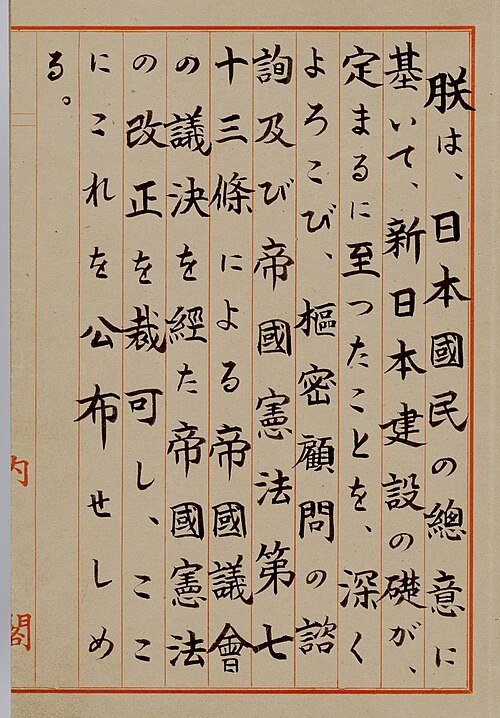
Its preamble states that:
Government is a sacred trust of the people, the authority for which is derived from the people, the powers of which are exercised by the representatives of the people, and the benefits of which are enjoyed by the people.
Compared to the 1889 constitution, the source of power shifted from the Emperor to the people. So far, this is pretty similar to the preamble of the US Constitution (170 years notwithstanding). Further, the Emperor was now a figurehead, similar to other democratic systems, and civilian governments hold power over the military.
Further, what’s fascinating about this US-drafted constitution is that in many ways it’s far more progressive than the US Constitution itself. To be fair, they are about 170 years apart. In the 1947 Constitution, human rights have been reinforced and include things that are not found in the US one:
- Slavery is explicitly abolished.
- The right to privacy.
- The right to work and to vote regardless of ethnicity, gender, etc.1
- Equal rights for women (yes, the US still technically doesn’t have this)
Further the Japanese constitution enforces term limits and age limits, something the US constitution does not do.
Finally, the most noteworthy feature of the Constitution of 1947 is the total renunciation of war, also known as Article 9. The official translation states that:
Aspiring sincerely to an international peace based on justice and order, the Japanese people forever renounce war as a sovereign right of the nation and the threat or use of force as means of settling international disputes.
In order to accomplish the aim of the preceding paragraph, land, sea, and air forces, as well as other war potential, will never be maintained. The right of belligerency of the state will not be recognized.
In other words, Japan renounces the right to start wars with others. This leads to some interesting challenges that go beyond this blog post, but (as far as I know) this was the first of its kind in legal history.
But as this article points out, simply having a progressive and innovative constitution isn’t enough. Japan struggles with right-wing forces that seek undermine some of the provisions, just as happens in the US.
It often comes down to people’s willingness to uphold a constitution.P.S. I started writing this in November
1 Side note: in the 1990’s, I actually met Beate Sirota Gordon, one of the ladies who helped draft these articles of the Japanese constitution. She gave a talk at my university and shared anecdotes from that time. Very fascinating women, and even today many people benefit from her contributions. RIP. 🙏
Discover more from Gleanings in Buddha-Fields
Subscribe to get the latest posts sent to your email.
 Gleanings in Buddha-Fields
