
Recently, I talked at length about the role-playing game called The One Ring, and I wanted to explore one aspect of it, and its origins in Tolkien’s Lord of the Rings trilogy, namely “Shadow”.

Because the Enemy, Sauron, is growing in strength in the Lord of the Rings setting, his dark influence can be felt (even if only a little) everywhere, even in happier, safer places like the Shire, the Grey Havens, Rivendell, etc. Sauron’s forces attack some places in Middle-Earth, in other places his spies infiltrate, and even in friendly places, the mere mention of his name fills others with dread. His “shadow” grew longer and longer across Middle Earth. There was no place in Middle Earth that doesn’t feel the influence of Shadow. Sound familiar?
In the role-playing game, when player characters experience negative events, despair, or trauma can accumulate “shadow points”. These points are long-term, hard to remove, and if too many accumulate, a character can become miserable (affecting many other aspects of the game), or worse can eventually have fits of madness, like when Boromir tried to take the One Ring from Frodo. Such player characters may be forced to leave the game, or a player may choose to retire the character before it is too late. The longer one uses a certain character in the game, the greater and greater risk for accumulating too many shadow points and thus meeting a bad end.
Further, when confronted with Shadow different player characters react differently. A treasure hunter may fall into “dragon sickness”, like Thorin in The Hobbit, a warden may fall into despair (“is anything I am doing making a difference?”), or a captain may crave power, etc.
Similarly, in the original Lord of the Rings trilogy, the different peoples of Middle-Earth reacted to the growing Shadow differently. Elves withdrew, longed for the past, or fled across the sea. Dwarves became insular and greedy. Men became desperate and power-hungry.
Boromir thought he was helping his home of Gondor by trying to take the One Ring from Frodo. That’s how Shadow made him go mad: playing into his anxieties, making him feel hopeless and thus taking desperate measures. The Rohirrim nearly gave up too, as Gríma Wormtongue kept feeding lies and despair to their king, Théoden. Gollum’s mind was shattered by the ring and he could barely remember who he had been, and believed he was too wretched to be redeemable.
This is what Shadow does to people: it breaks people down.
But the reason that Sauron was defeated in the Lord of the Rings trilogy was that some people didn’t give up.
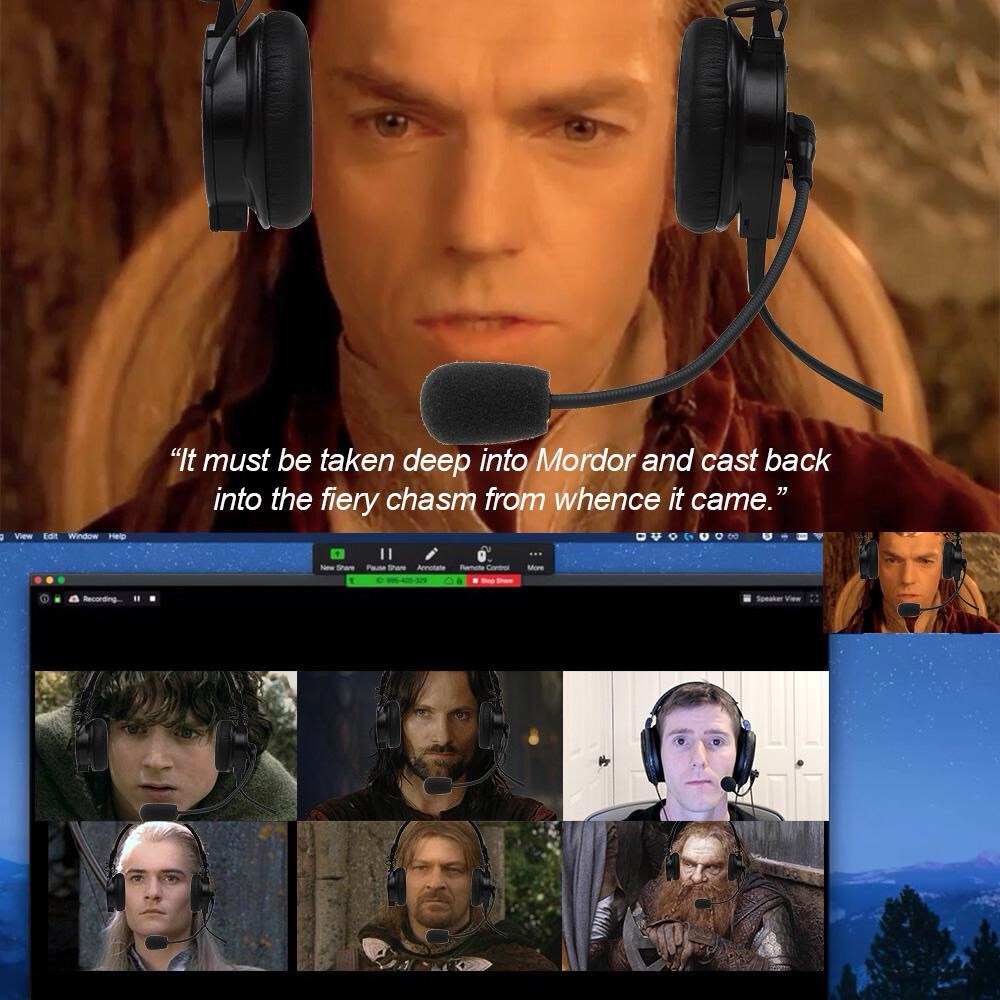

Rather than fighting alone, those who resisted Sauron worked together. Individually they were too weak to resist (even Elrond), but when they worked together, they could draw on each other’s strength, and help each other when discouraged. In the books we see Samwise Gamgee doing this countless times for Frodo, or Legolas, Gimli and Aragorn racing through Rohan to save Pippin and Merry. Not everyone in the Lord of the Rings trilogy was a hero, but everyone did something, however small, to contribute to the effort.
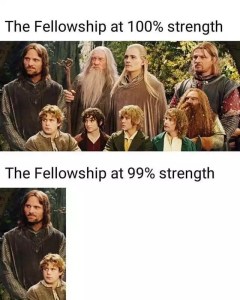
Further, even in the darkest hour, people kept going. They didn’t quit, they took another step forward, and another, and another. The goal seemed miles away, literally, but each step brought them closer, even if only a little.
In The One Ring game, during a “fellowship phase” (downtime), you can spend part of your time healing the scars of shadow. According to the core rulebook, dwarves will spend time forging to “burn away frustration”, hobbits will engage in gardening or painting, humans and elves will play or recite songs and poetry. In the books, characters such as Sam and Frodo occasionally stop to enjoy lembas bread, or Pippin and Merry enjoy a good puff of pipeweed after a major battle. It may not seem like much, but taking those moments of downtime do much to lift the soul, especially when it is weighed down by Shadow.
There is much we can learn from this.
P.S. There’s a whole Reddit channel just for LoTR memes. It’s a treasure-trove of silliness.
Discover more from Gleanings in Buddha-Fields
Subscribe to get the latest posts sent to your email.
 Gleanings in Buddha-Fields