
This is the last in a series of Japanese-Buddhist sutra books that I wanted to share. I talked about this Soto Zen sutra book, a Rinzai Zen book and a Jodo Shu sutra book. Today, I wanted to share the sutra book I purchased at Asakusa Temple in Tokyo, Japan.
Asakusa Temple (more properly Sensoji Temple, 浅草寺)1 is super famous, and chances are if you have visited Tokyo, you probably went to Asakusa Temple. Asakusa is technically its own Buddhist-sect now, but for much of its history it was a Tendai Buddhist temple that enshrined a legendary statue of Kannon Bodhisattva that supposedly washed up on shore and enshrined in the year 645. This is called the Yanagi no Miei (柳御影, roughly translated “the [sacred] willow image”). The featured photo above shows where it is enshrined at Asakusa Temple.
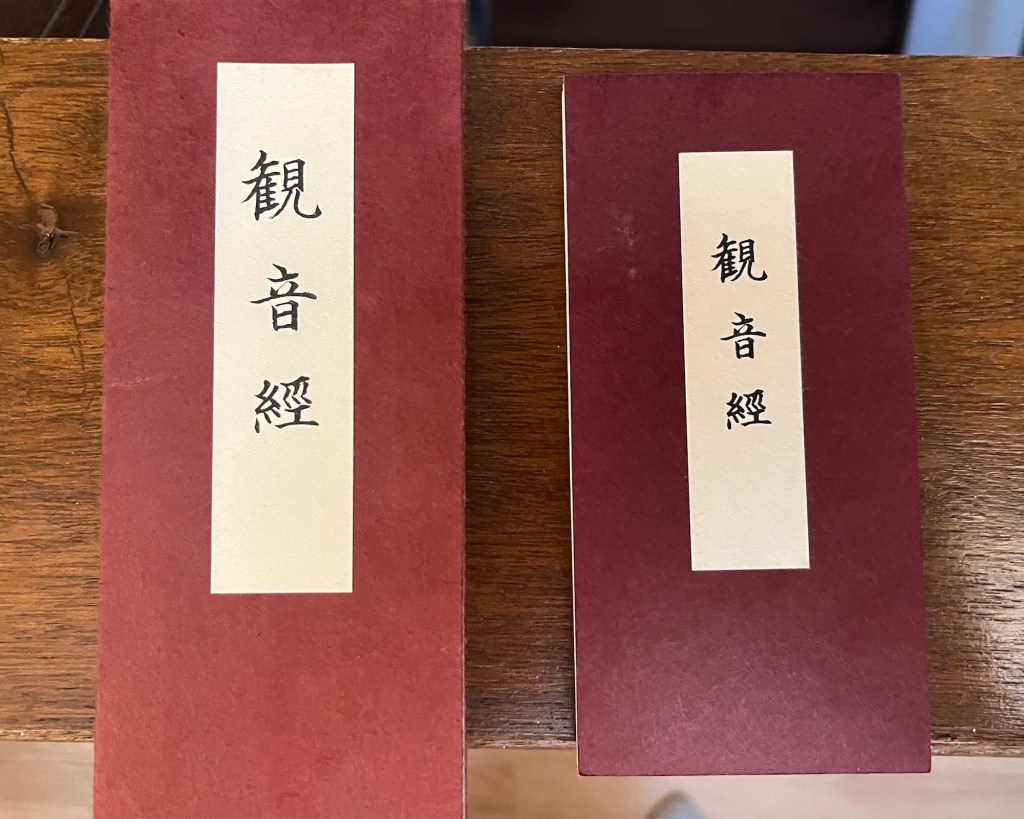
Not surprisingly, the sutra book’s liturgy focuses on Kannon-related chants. This sutra book is sold in two sizes, but the contents are the same:
The illustration inside the cover depicts the legendary statue :
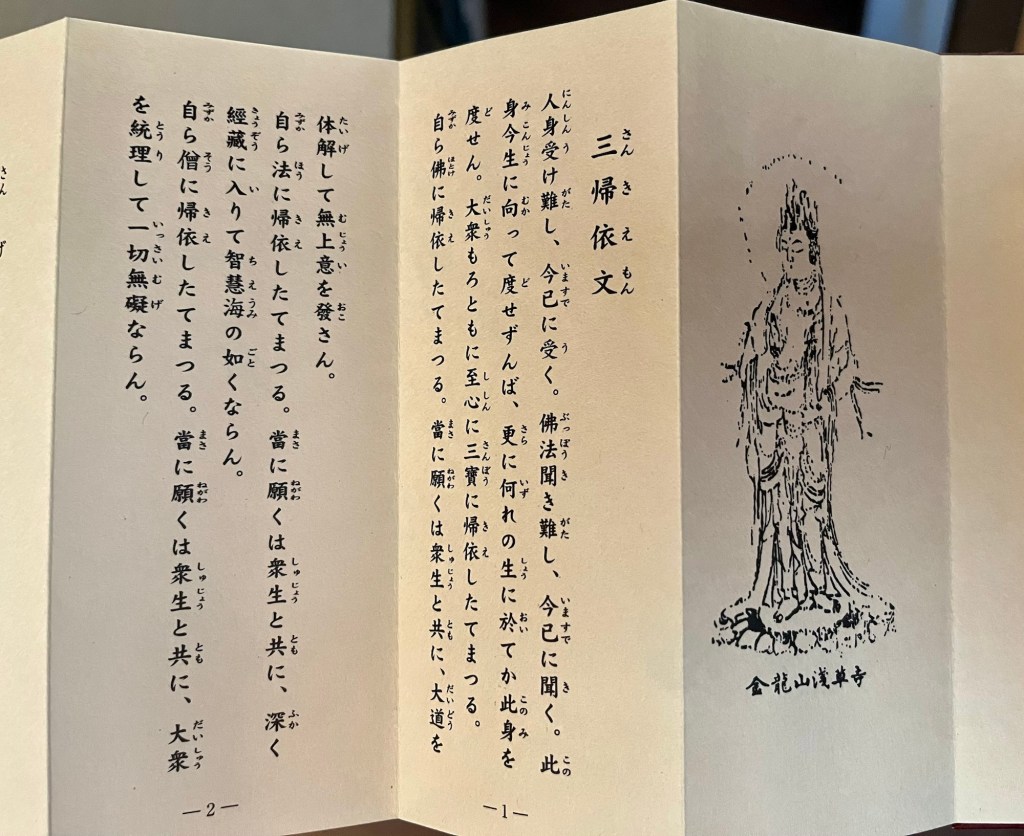
The liturgy to the left of the illustration is a form of Taking Refuge in the Three Treasures (san-ki-é-mon, 三帰依文) done in a more native-Japanese style, than the Sino-Japanese version I posted here. Both versions are perfectly valid and are chanted.
More examples below are chants that we’ve seen in older posts in right to left order:
- the Sangémon (repentance) on the right,
- Kaikyoge (verses for opening the sutra) second page from right, and
- the Kannon Sutra itself on the left half.
Unlike other examples I’ve seen, this sutra book posts the entire Kannon sutra, not just the verse section. It’s about 3 times as longer than usual.

Next, we see a classic: the Heart Sutra. This makes sense since the Heart Sutra was spoken by Kannon Bodhisattva, not Shakyamuni Buddha. So. it fits the theme.

And last but not least, after the Heart Sutra is the Ten Verse Kannon Sutra (second from right), and Dedication of Merit verse.
Finally on the far left page is a simple recitation chant of devotion to Kannon Bodhisattva: namu kanzeon bosatsu (南無観世音菩薩). I’ve often used that to sign off blog posts, and unlike more esoteric mantras, this is a very common statement of devotion, much like the nembutsu for Amida Buddha. Feel free to chant it in your Buddhist practice!

Anyhow, this sutra book is something visitors to Asakusa Temple would probably overlook without the necessary background (or religious inclination), but it’s a fascinating look at Tendai Buddhist liturgy, but in a way that’s adapted to a particular temple, and to a particular deity.
Namu Kanzeon Bosatsu
P.S. That covers all the sutra books I wanted to cover here in the blog. I own a few more, but they’re not interesting or unique enough to justify another blog post. If I pick up another sutra book, I’ll post again. But if you did enjoy this mini-series, thank you for reading!
1 The words “asakusa” and “senso” are literally just two different ways to read the same Chinese characters.
Discover more from Gleanings in Buddha-Fields
Subscribe to get the latest posts sent to your email.
 Gleanings in Buddha-Fields