
I have been studying Japanese language, off and on, for many years, first for curiosity, then to converse with my in-laws, and later because it unlocked aspects of Japanese culture I couldn’t find in English. In the past, I took and passed the JLPT exam, level N2 (failed the N1 twice). And yet despite that certification, I still struggle with conversation, compared to my kids who are pretty bilingual. Of course kids pick up language more easily than adults, but after so many years it is sometimes disheartening to see that my Japanese is functional yet clunky.
Recently though, I stumbled upon one of my son’s old textbooks from Benesse. Benesse is a company in Japan that provides teaching aides for kids (including Japanese kids overseas), through a monthly subscription service. Kids get study materials appropriate for their grade, and submit work monthly by mail, earning special prizes and such. The teaching staff at Benesse grade the work, send friendly feedback, etc. Our kids both subscribed to the service until about the third grade when they got too busy to keep going.
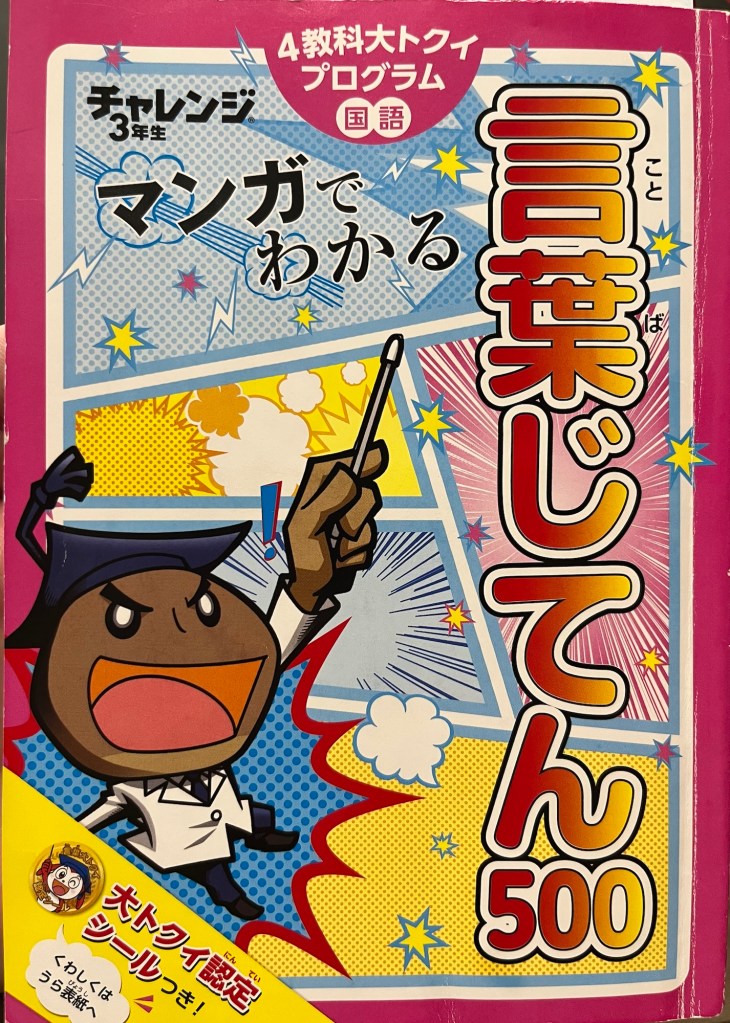
Because of this, we have lots of old Benesse educational material lying around the house that the kids no longer need, and it turns out that even for an adult foreigner like myself, it’s really useful.
A while back, my kids’ local Japanese language teacher once remarked that if you are able to learn 3rd grade level Japanese, then you have a solid foundation. Forget college level or even high school level; just getting conversant at a third grade level is surprisingly useful.
Having seen the contents of the third-grade materials above I now believe it. I was surprised how many vocabulary words in the book were also in my JLPT study materials for the N2 and N1. Not only that, but they were presented in a fun, more engaging way for native speakers (kids). The explanations and examples were more natural and easier to grasp than my pricey JLPT study guides.
Even now, after years of study, I can pick up an old Doraemon comic and mostly be able to read it. And yet, I find I still have to look up words, and sometimes I learn new expressions and phrases in everyday Japanese. It’s not just learning the words, it’s learning in how people just say things. There’s more than one way to say “I’m impressed by something”, but they have slight nuances or differences in grammatical construction that just can’t be easily explained without context.
Doraemon is an old-timey comic for grade school kids and yet it’s clear that it still presents a good challenge for a language student.
All this is to say that if you are learning Japanese, or any language, jumping into adult material and concepts is somewhat counter-productive. It seems like the right thing to do, speaking as an adult, but grade school level language and material is surprisingly important and shouldn’t be overlooked. Everything beyond grade-school level is mostly just specialization in topics. If you focus on advanced materials too much you’ll be familiar with that topic but not much else. In others, you’ll have glaring gaps in your language skills. This essentially what happened to me, and only now am I starting to correct it.
But how does one approach this as a language student? Most students don’t have access to Benesse materials since it’s intended for Japanese audiences. You may have to get creative, but you can find children’s books, manga (including Doraemon), and study guides for Japanese kids online or in a Japanese bookstore. It doesn’t hurt to pick up such materials, and you may find them more challenging than you expected.
Remember: focus on getting to the third grade. However, you may have to start even lower level, first grade Japanese, second grade Japanese, etc.
It’s less about finding specific materials, and more about setting a realistic level of challenge, and then obtaining enough material (not just one book or two) until it becomes easy, innate. You can think of this as starting a new exercise routine, and setting realistic expectations. Just as kids starting learning basic language, and gradually increase in difficulty, language students should do the same. It’s seemingly slower at first, but builds a better foundation and avoids the painful need to go back and correct your Japanese later.
In any case, simply getting to a grade-school level will be surprisingly useful both in day to day interactions with Japanese people, and in passing the JLPT exams.
Discover more from Gleanings in Buddha-Fields
Subscribe to get the latest posts sent to your email.
 Gleanings in Buddha-Fields