
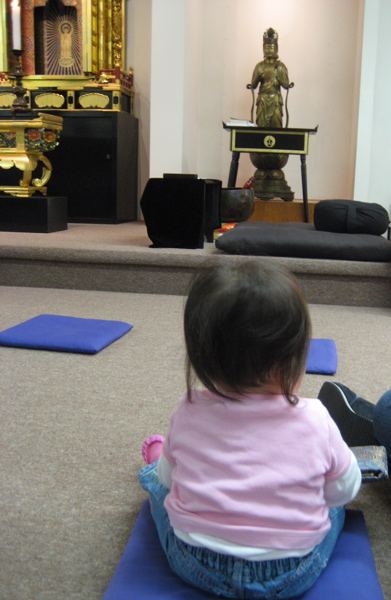
Way back in 2008, I wrote a blog post (now deleted) about my 1-year old daughter (codenamed “baby”) and teaching her about Buddhism, especially Jodo Shinshu Buddhism which we practiced at the time. I reposted excerpts of it here, with some updates in formatting and such, but also trimmed for brevity.
My 1 year-old daughter, “Baby”, likes to play with the Buddhist rosaries (o-nenju お念珠 in Japanese) we have around the house. Thankfully, most are well-made and can take a good beating from a one-year-old. She likes to chew on them as well, as it helps relieve the itching from teething. I am not sure if this is disrespectful to the rosary, but given that it makes Baby happy and helps with teething, I think it’s for the better.
We’ve been teaching Baby how to do gassho, which is a gesture of respect in Buddhism where we put the hands together close to the heart. We use the Japanese phrase namu namu (南無 南無) when teaching her how to do it. It literally means “hail, hail” or “praise, praise”, but is meant as a gesture of gratitude and respect. In Japanese Buddhism you see/hear phrases like:
- Namu amida butsu – Praise to Amida Buddha
- Namu myoho renge kyo – Praise to the Lotus Sutra
- Namu kanzeon bosatsu – Praise to Kannon Bodhisattva
When I visited Japan in 2005, we visited my wife’s friend, whose family are practicing Shingon Buddhists. In Japan, before eating you are supposed to say itadakimasu (いただきます), which is a very humble form of the word “I am receiving”. In effect, you’re saying grace, Buddhist-style. So, my wife’s friend would tell her three-year old to “namu namu”, or to put her hands together and give thanks. The little girl promptly put her hands together and in her tiny voice said “itadakimasu”. It was really touching to see.
So, with that in mind, we teach the same wholesome habit to Baby as well. Baby is one year old, not three, so she still doesn’t really understand it yet. However, Sunday night she surprised me by draping the rosary over her arm, and waving it around, so I had to take a picture. She’s clearly learning good habits from us, and that’s what makes good parenting so important. Children need good influences or they will have a much harder time in life.
It’s hard for many Western Buddhists, especially those with kids, to know how to raise them as Buddhist. It’s hard too since a lot of people approach Buddhist from an intellectual/philosophical point of view. I am lucky because my wife comes from a Buddhist culture, so I learn a lot of this through her beyond the philosophical side. But for most people who don’t have Asian spouses, how do you develop a Buddhist-family lifestyle?
I think the key is to promote positive values to your kids:
- Respect for others, your parents, teachers, etc.
- Humility and gratitude knowing we depend on others for what we have. Who makes your food for example?
- Kindness, kindness, kindness! In Buddhism, we toss around the word “compassion” a lot, but that’s too abstract for kids. Kindness on the other hand, is a lot easier to convey and just as good.
- Plenty of research shows that kids like routine, so taking them to a Buddhist service regularly, or having a home routine is good. Meditation retreats on the other hand are a bad idea. Most are not suitable for children anyways.
- Be a good example for your kids. My wife and I are pretty strict about not swearing or yelling in front of the kids. Sometimes we make mistakes, but we really try.
You get the idea. Most of this stuff is good parenting advice you can apply to any child, Buddhist or not, but the routine with “namu namu” and such is something that kids can understand, and helps convey difficult Buddhist concepts in simple terms. Raising kids is a lot of fun, especially watching them grow into adults who will carry happy memories of their childhood for the rest of their lives.
So, why did I repost this? Sixteen years have passed, and “baby” is now applying for college. It’s amazing to look back and realize how much one’s children have grown. As a teenager, my daughter has never shown any interest in Buddhism at all. We found a couple decent Buddhist books for teens, but I doubt she read them, and sometimes when I mentioned Buddhist teachings, she showed little or no interest.
And yet, when she asked me to proofread her college application essay, I was surprised to see that she was quoting something I often say in Japanese: sho-gyō-mu-jō (諸行無常). This phrase is quoted from the famous 12th century war-epic the Tales of the Heike, and means something like the “impermanence of all phenomena”. The English translation is clunky, and since my kids were raised bi-lingual anyway, I just say sho-gyo-mu-jo.1
For example, when someone in the house broke a cup, or something breaks down, I usually just say “no big deal, sho-gyo-mu-jo“, and so on. The kids never really said anything about it, and yet when my daughter wrote her college essay, it’s clear that she really was listening and had processed this teaching as she grew up and matured. I was genuinely impressed, and a bit choked up.
The key, as my original post said, is to keep the teachings simple, set a good personal example, and let kids ease into it on their own. Hitting kids over the head with religious teachings just has the opposite effect. Kids need some kind of moral compass, but they aren’t always mature enough to understand the value of it. By setting a good example, and giving them space to figure things out, they will eventually internalize and process such teachings and figure out how to apply them to their own lives.
It’s also a reminder that good personal conduct really does have a positive impact on others, even if you can’t see the effect.
Namu Amida Butsu
1 Japanese four-character phrases (yojijukugo) are numerous, and only a small number are commonly used, but many educated Japanese have their favorite phrase or two that they will use in writing on conversation. Sometimes you see these in dramas too. It’s also a mark of education (e.g. which ones do you know?), as shown in an episode (season 1, episode 16) of the anime Chihayafuru where the characters quiz one other. Many are taken from Buddhist sources but popularized into common Japanese, others come from Chinese literature.
Discover more from Gleanings in Buddha-Fields
Subscribe to get the latest posts sent to your email.
 Gleanings in Buddha-Fields
This is awesome, Doug. I’m looking for ways to incorporate “lessons.”
LikeLiked by 1 person
You me both.
LikeLiked by 1 person
Now this was a rather interesting post.
I have two younger kids here in West Japan, and this piece really gave me something to ponder.
Thanks and keep them coming
Oliver
LikeLiked by 1 person
I bet it’s a little easier in a country and culture that’s naturally Buddhist, whereas being in the West it’s a constant feeling of being an “odd man out”.
LikeLike
In a sense it sure is, although my interest in things Buddhist is largely personal and my family is probably hardly aware of it, although I have a habit of stopping by temples (which they probably find a bit odd)
And Buddhism is of rather limited (and diminishing) importance in modern Japan, so even here people with open interest are very rare, as far as I can judge.
LikeLiked by 1 person
That is certainly true though I do meet people from time to time.
Then again, a non-religious culture comes as part of a prosperous post-industrial society, so I guess it’s par for the course.
LikeLike
That’s for sure.
Thanks again for the.post, already looking forward to the next one.
LikeLiked by 1 person