
A few months ago, I touched on Japanese mythology and how it relates to the current Imperial family, but something I didn’t really cover were the three sacred treasures or Sanshu no Jingi (三種の神器).
These three treasures were said to be have been passed down to the first emperor of the Imperial family by their divine ancestor, Ninigi-no-mikoto. Some of these treasures are related to kami I mentioned in the mythology post and also represent ancient Japanese culture, even if their importance is more obscure now.
The three treasures are…
Kusanagi, the grass-cutting sword
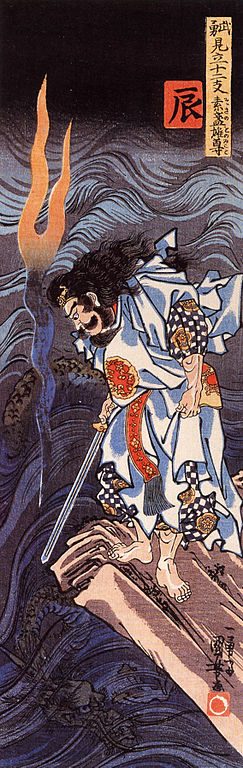
The sword, kusanagi no tsurugi (草薙の剣), or “grass cutting sword”, was reputedly discovered by the kami Susano-o-no-Mikoto after he slew the massive serpent, Yamata-no-Orochi, embedded inside the monster’s tail. As I mentioned in the mythology post, Susano-o-no-Mikoto, the god of storms, was banished from the heavens, and while roaming the world he came upon a family that was preyed upon by the eight-headed serpent Yamata-no-Orochi. Susano-o-no-Mikoto battled the serpent and cut it into pieces. He found the tail too tough to cut up, and inside he discovered the sword, which he kept for his own.
The sword has a particularly checkered history as it was thought to have been lost at sea during the climatic battle between the Heike and Genji clans, but then is mentioned in accounts by people who have seen the sword centuries later. It’s not clear if the sword truly was lost, and a replica was made, or the sword was never actually lost at sea. In any case, the sword as it currently exists is stored in the Atsuta Shrine in Nagoya, Japan, and never revealed to the public.
Another thing to note is that swords from that era are pretty different than the Japanese katana we normally think of. Swords in early Japanese history were thicker, straighter, similar to a Chinese jiàn sword.
Yata no Kagami, the Bronze Mirror

Mirrors in general are a sacred item in Japanese Shinto religion, and are often used in central altars, both at home (kamidana) and in major shrines, to represent the kami‘s presence. Originally, mirrors in Japan, China and beyond were made from polished bronze, but since have become replaced with polished silver, and/or glass.
The sacred mirror though is the bronze kind, and was said to be part of the legend surrounding the sun goddess Amaterasu-Ōkami, when she isolated herself. After a series of nasty arguments with her brother, Susano-o-no-mikoto (which later got him hockey out of Heaven, see above), she was fed up and retreated to a cave called the Ama-no-Iwayato (天岩屋戸). The world was plunged into darkness and all the other kami were distraught about what to do. They eventually hatched a plan to lure her out by pretending to have a party outside her cave as if nothing was wrong by her absence.
They hung a bronze mirror, the yata-no-kagami (八咫鏡), while the other kami engaged in wild song and dance. When the curious Amaterasu emerged, she was entranced by the mirror long enough that they grabbed her and sealed the cave, thus preventing her from hiding again.
During the aforementioned battle at sea between the Heike and Genji clans, the mirror was safely recovered.
Yasakani no Magatama
The final sacred treasure is an old magatama jewel called the yasakani no magatama (八尺瓊勾玉). Magatama jewels are something that were commonly used in very early Japanese history (later replaced by more Chinese style jewelry), so any such jewel tends to convey a sense of “primeval Japan”. Even in modern Japanese games, such as Zelda: Tears of the Kingdom, you see them prominently used to imply something of great power, but also great antiquity.
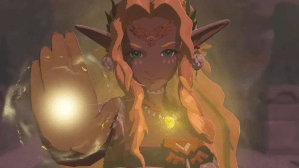
Unlike the other two items, there is no particularly mythology associated with the jewel, instead it is a family heirloom, and is thought to have been passed down since the earliest days of the Imperial family. During the climactic battle between the Heike and Genji clans, the jewel and the sword were both thought lost, but later it is said the jewel was recovered.
P.S. featured photo shows the coronation of the previous emperor, the Heisei Emperor (Akihito), when the three sacred treasures were presented to him. The same ceremony was repeated by the current emperor. Photo by 首相官邸, CC BY 4.0, via Wikimedia Commons.
P.P.S. You probably noticed that kami names are quite long. These are often shortened for convenience in English, but this is somewhat inaccurate.
P.P.P.S. I started this post before my medical emergency, so it was nice to finally finish it. I have a few old drafts that are nearly done before I can move onto new content. 😏
Discover more from Gleanings in Buddha-Fields
Subscribe to get the latest posts sent to your email.
 Gleanings in Buddha-Fields
