
Just as early American history is replete with strange or weird stories such as Rip Van Winkle, and the Legend of Sleepy Hollow and its headless horseman, all composed by Washington Irving, Japan has a collection of weird and strange stories compiled in a book called Kwaidan (怪談), which in modern Japanese is Kaidan.
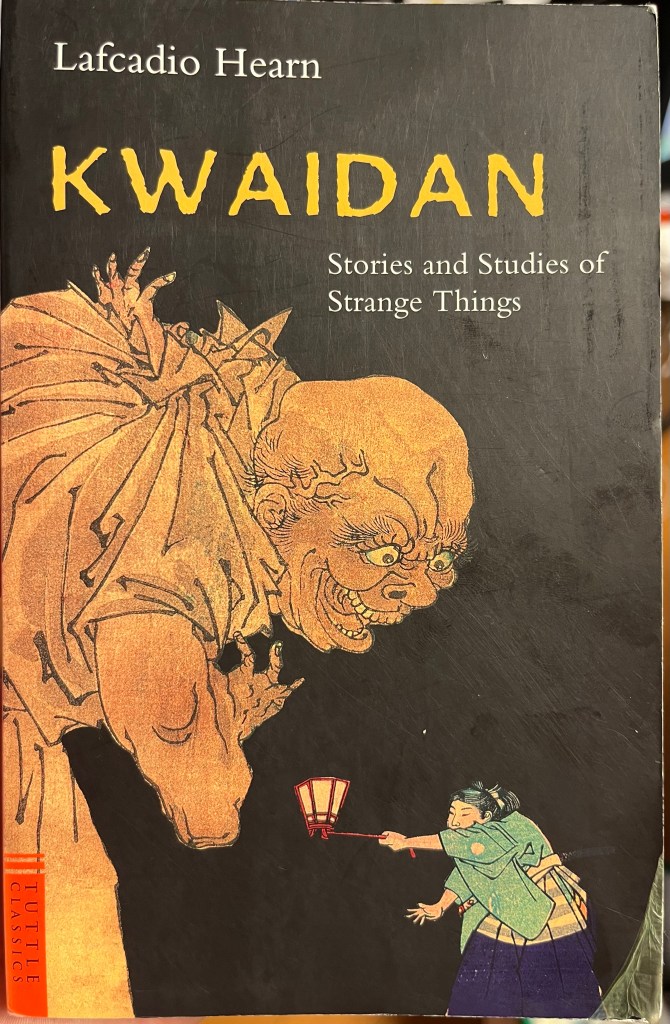
The full title is Kwaidan: Stories and Studies of Strange Things and was written by Greco-Irish author Lafcadio Hearn (1850-1904). Hearn had worked in journalism in the US for several years before moving to Japan, and settling down there, taking a Japanese wife and Japanese name, Koizumi Yakumo (小泉八雲), and writing many about early-modern, Imperial Japan.
Kaidan (using the modern spelling from here on out), Hearn admits in the foreword, is compiled from earlier Japanese sources, but it was the first of its kind published in English, and is even popular among Japanese audiences because it’s such a good compilation of disparate stories that have floated around Japanese culture for centuries. In the same way, the stories of Washington Irving drew on older European tales, but retold in an early American colonial setting.
By today’s standards, the stories in Kaidan, just like those of Irving, are pretty tame, more spooky or just plain weird. But they are full of vivid imagery that remains popular to this day. When Obon Season comes in Japan, usually starting around July 15th (not October like in the US), it is a popular time to relive these stories in TV and other media.
Because Kaidan is so old it is available for free on places like Project Gutenberg. If you like a physical copy though, you can easily find used ones online.
I have linked a few stories from Kaidan that I previously posted in the past.
- Mujina
- A Dead Secret
- Earless Hoichi
- Yuki-Onna, an example of a story from Kwaidan that’s less scary, and more weird.
One other aspect of the book not usually covered is the last section where Hearn shifts entirely to observations about insects in Japan, namely butterflies, ants, and mosquitoes. He then applies Japanese-Buddhist moral interpretations to them. Hearn, who was deeply fascinated by Buddhism, makes a few pointed comments about Christianity, while carefully any hint of criticism to his Western audience at the time. No doubt, at the time, this was probably a touch scandalous.
Hearn’s writings about Japan, and his understanding of Japanese culture and language (“honorable” this, and “honorable” that 🤦🏼♂️), don’t necessarily age well, but he was also one of the very first Westerners to be immersed and so I tend to give him a pass on many things (his publisher’s comments about Japanese women in the introduction are a bit cringey, though).
I tend to think of Hearn as something of a kindred spirit, separated by 120 years of time.
Maybe there’s something weird about that too. 😉
P.S. I learned from the Japanese Wikipedia article that the “Kw” in Kwaidan is probably a feature of the Izumo-dialect of Japanese that Hearn was immersed in the town of Matsue in Western Japan where he lived.
P.P.S. There was also apparently a film based on the book in 1965, though I have never seen it. I enjoy the written version more, perhaps.
Discover more from Gleanings in Buddha-Fields
Subscribe to get the latest posts sent to your email.
 Gleanings in Buddha-Fields