
Recently, archaeologists have uncovered a statue of the Buddha, not in India or Asia, but in ancient Egypt! The statue, according to the Egyptian government, was uncovered as part of a temple dedicated to Isis, and crafted by a local Indian Buddhist community during the early Roman Imperial age, the Principate.
The cult of Isis was a fascinating example of religion in the Hellenistic Period, and inherited later when the Romans took over the eastern Mediterranean. During the Hellenistic Period, a period of constant political rivalries, and large movements of Greek people, and expansion of Greek culture through colonies, the old Olympian religion had increasingly proved unable to help people through difficult times. The old Olympian religion was focused on public cults in a kind of “contractual” religion where people of a city-state publicly worship a particular god, and get something out of it. For more personal needs, there just wasn’t much substance.
Thus, mystery religions such as the Cult of Demeter and others arose. These provided more personal relationships with the gods, and clearer undersetanding of the afterlife, and how one might secure a better fate than just being an empty shade wandering in Hades (cf. Homer’s Odyssey).
When the Macedonian Ptolemy family took over Egypt, they had to reform Greco-Egyptian society into something they could rule legitimately, so certain gods were reinvented or elevated. Egyptians had done this too, but the Ptolemies tapped into this and elevated two gods in particular:
Isis’s role in particular grew far beyond the original Egyptian religion and her cults spread across the Roman world. Her status also grew in that she wasn’t just a mother goddess, but the mother goddess: embodying wisdom, magic, maternal love and so on. Other goddess figures from disparate cults were sometimes viewed as just more manifestations of Isis. There are even
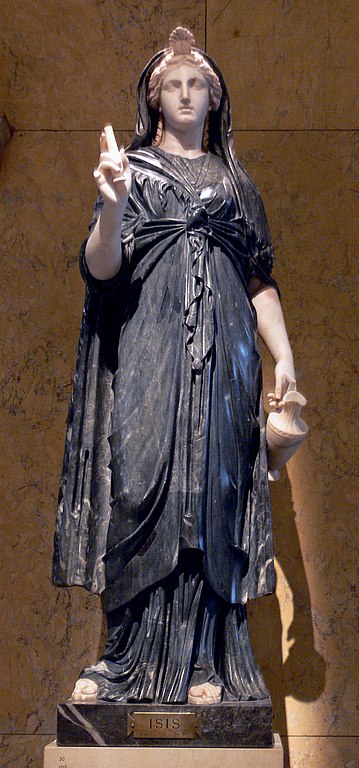
Isis’s religion wasn’t organized according to the kind of doctrine or dogma we associate with modern religions, it was still very much a form of personal, devotional worship,1 rather than an “one-size fits all” religion to explain everything. Roman society at large was still a marketplace of religions, but the religions had changed from mostly public ritual (e.g. the Olympian gods) to more internal, personal religion.
So, how does the Buddha fit into all this? That part is still being researched, but given Isis’s status as a goddess of wisdom, putting a statue of the Buddha, a figure also associated with wisdom, in her temple was probably a useful cultural prop. Indian merchants, had a trade colony in Egypt at the time, and the Buddhist religion in India reached a high-water mark at the time, so at least some of the Indian people living in Egypt would know of it, or might even be devotees.
Does that mean that there were Buddhist communities in Roman Egypt? Evidence is very scant. Even if there were, their presence was likely limited to the Indian expat community.
Still, the cultural cross-over is pretty fascinating.
P.S. This is the last post before the family and I head to Japan. When next we meet, I’ll post updates from
1 Similarly, worship of Mithra, a Zoroastrian deity imported into Roman culture, enjoyed widespread devotion among soldiers and other figures. People worshipped the god or goddess they tended to feel most affinity with.
Discover more from Gleanings in Buddha-Fields
Subscribe to get the latest posts sent to your email.
 Gleanings in Buddha-Fields
