
Like so many others, I am enjoying The Legend of Zelda: Tears of the Kingdom, but I am not just enjoying the game-play, I am subtly enjoying how certain Japanese cultural concepts shine through even in a medieval fantasy adventure. In a previous post, I talked about Japanese-religious influences in Breath of the Wild, and today, I wanted to revisit the subject for Tears of the Kingdom (hereafter TotK), since one aspect really stands out: the sky realm and the world below.
In early Indian Buddhism, the world was described in a complex cosmology involving devas (forerunners of the Hindu gods), and various hell realms not unlike Dante’s Inferno, plus many other states of rebirth such as hungry ghosts, asuras (titans) and so on. Many of these were inherent to Indian culture, but as Buddhism moved to other cultures, China and beyond, things gradually shifted in emphasis, or merged with native religious traditions. I don’t mean this in a sense of corruption, or loss of authenticity though. Just simply changing times, changing places.
In any case, by the time of late 12th century, medieval Japan, and especially through the writings of monks like Genshin, the cosmology from India had gradually streamlined in popular culture to essentially two realms of rebirth: Hell and the Pure Land. Other realms still existed on paper (i.e. religion tradition), but in the minds of most Japanese at the time, either you were destined to Hell or through the Buddha’s compassion you might be get fortunate to be reborn in the Pure Land.
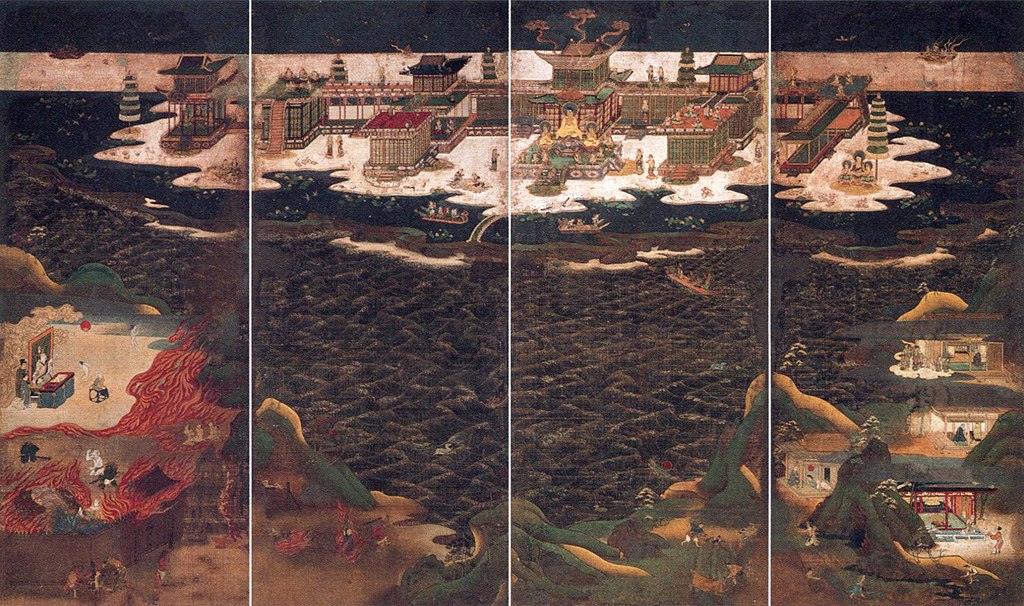
As Pure Land Buddhism gained in popularity during the Heian Period (8th-12th centuries), you see an increase of artwork depicting Amida Buddha welcoming the deceased to paradise,1 sometimes juxtaposed with images of Hell.2 Years ago I attended a local art exhibit in Kamakura, Japan, next to Tsurugaoka-Hachimangu shrine which displayed a gallery of such art from local temples and it was fascinating to see such a stark world-view, much like medieval Christianity, yet also very different under the hood, theologically.
Anyhow, getting back to the Legend of Zelda: TotK, the kingdom of Hyrule has expanded to include a sky realm, and a dark world underground. This is imagery that’s pretty universal in many cultures, but the details reflect Japanese-religious traditions.
Let’s look at the sky world first.

The sky world has placid ponds with lotus blossoms, and frequently uses a gentle golden color.

Compare with this passage from a Buddhist text, the Amitabha Sutra (阿弥陀経, amida-kyō in Japanese):
“In the pools [of the Pure Land] are lotuses as large as carriage wheels: green colored of green light, yellow colored of yellow light, red colored of red light, white colored of white light, subtly, wonderfully fragrant and pure….Moreover, Shāriputra, in that Buddhaland there is always heavenly music and the ground is yellow gold.”
Translation by City of Ten Thousand Buddhas
The beautiful and rare birds also reflect another passage in the same sutra:
“Moreover Shāriputra, in this country there are always rare and wonderful varicolored birds: white cranes, peacocks, parrots, and egrets, kalavinkas, and two-headed birds.
Translation by City of Ten Thousand Buddhas
Compare the imagery above with this recent tweet from the Twitter feed from Toshidaiji Temple in Nara:
Thus, we can see that sky world in TotK reflects imagery associated with Buddhism, especially the Pure Land of Amida Buddha. This may be entirely an arsthetic choice, but it still reflects Japanese-religious culture.
Now, let’s look at the world below:
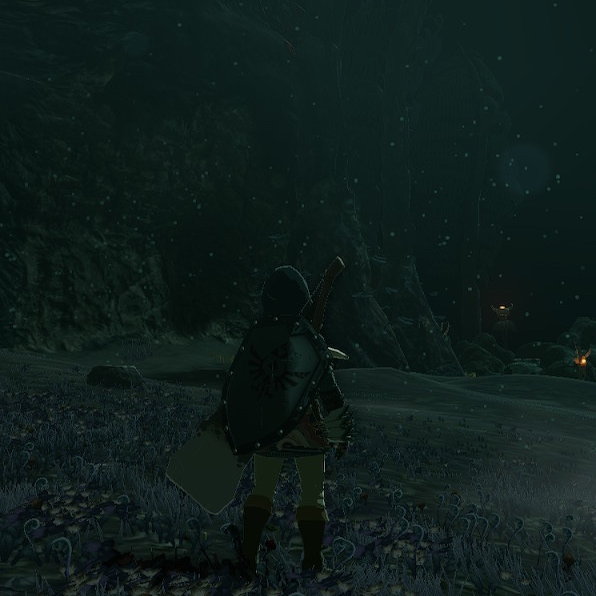
The world below is a world of darkness and misery. There is little life here, primarily predatory life, or creatures toiling away mining Zonaite minerals, and the air is stifling with spores (or ash?) in the air.
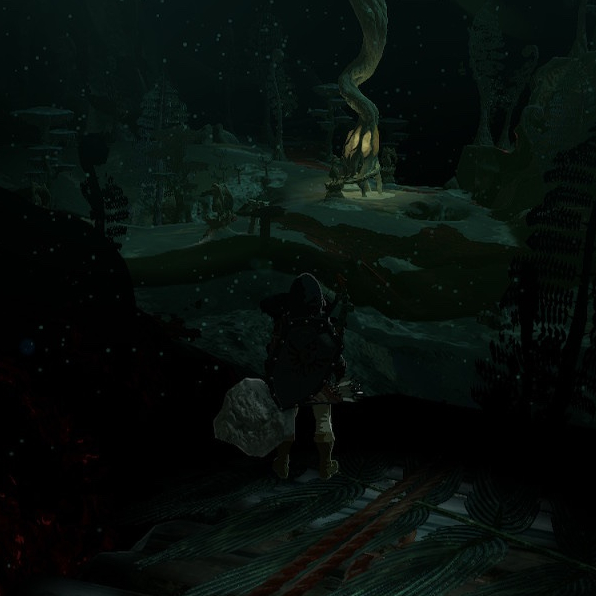
The imagery here does not fit neatly into the elaborate Buddhist hells as described in a Buddhist text such as the Earth Store Bodhisattva Sutra.
Instead, it more neatly fits a more Shinto (not Buddhist) depiction of the Land of Yomi, the Land of the Dead. Yomi, like the world below in TotK, is also accessible from the mundane world through various entrances, and similar to the Greek concept of Hades, it includes shades and shadows of former lives.
But again, in popular religious tradition, the Buddhist concept of Hell, and the native Shinto concept of Yomi blend together. This was very common in pre-modern Japanese culture where the two religions blended, and were virtually indistinguishable. In medieval Europe, Christianity blended with pagan and local folk traditions in the same way to the point where it was hard to see where one ended, and the other began.
And it’s fascinating to see the imagery applied to modern gaming as well.

Namu Amida Butsu
P.S. All Zelda screenshots here are by me.
1 Called amida shōju raigōzu (阿弥陀聖衆来迎図) in Japanese.
2 Called jigoku gokuraku-zu (地獄極楽図) in Japanese.
Discover more from Gleanings in Buddha-Fields
Subscribe to get the latest posts sent to your email.
 Gleanings in Buddha-Fields
