
Recently I had an interesting encounter with someone who had a Japanese o-butsudan displayed behind them on a Zoom meeting. An o-butsudan (お仏壇) is a kind of Buddhist altar in Japanese culture, usually a tall cabinet with doors. They can be small cabinets that fit in one’s home, or much larger, ornate ones found in temples like the one below:
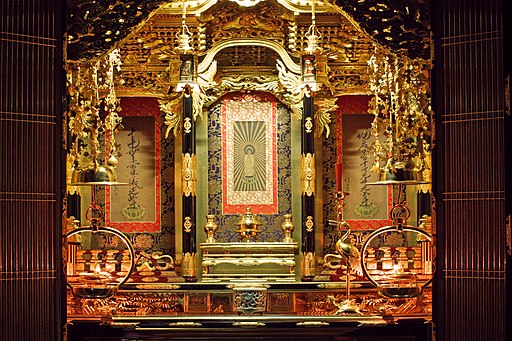
I assumed the person was a fellow Buddhist like myself, so afterwards I asked about it, and it turns out they had inherited it from a Japanese friend who had passed away. The obutsudan was open in the Zoom meeting, revealing a gohonzon central image, marking it as a Nichiren-Buddhist altar of some kind. I didn’t have a chance to follow up, though, and learn more about her relationship with the o-butsudan.
Buddhist shrines of some form or another are pretty universal across many cultures. They also come in many shapes or sizes. For example, if you go to a Thai restaurant, you’ll see often see a small, elevated alcove with a small statue of the Buddha there for example. The Buddha is often revered as a special guest or venerable teacher in such altars. For a Buddhist, maintaining an altar has many benefits towards one’s Buddhist practice (more on this in a future post), and it’s also a kind of sacred space too. In the case of Japanese culture, depending on the particular sect, relatives who passed away might have a photo enshrined below the Buddha of course, or funerary tablets (ihai, 位牌) which are based on Chinese funerary traditions. Offerings are also made during Obon Season as well.
It’s not a sacred icon in quite the same way as the Holy Host or the Torah, but it is a sacred space within Buddhist tradition, it’s very personal, and very specific to one’s sect or tradition. If you think of a Buddhist altar as a mirror for oneself and one’s practice, then regardless of what it looks like, the care you put into it is what matters.
For my part, I inherited a small o-butsudan from a Japanese-American family in my old temple community whose grandmother passed away. They did not need the obutsudan, and it fit nicely in a cubby in my bookshelf, so we adopted it, and installed it in there. I was surprised to learn later that the grandmother had been in the internment camps during WWII.
I wish I knew about Buddhist altars in non-Japanese cultures, but unfortunately, I don’t.
While homes in Japan often have an o-butsudan, or Buddhist altar cabinet, these are less common in the West. They are not strictly necessary either. Many Japanese don’t have them either due to cost or space. Also, if you’re new to Buddhism, you don’t need an elaborate Buddhist altar. As long as you have an image of the Buddha, a statue, or even a scroll of some kind, that’s a good start.
Cabinet or not, per tradition usually comprise of at least four objects:
- An central image, hanging scroll, or statue of a Buddha. Any one of these is fine. You can see some traditional examples in Japanese Buddhism listed by sect here.
- A small candle holder. I like using LED candles personally because they are safer and more environmental.
- A small flower vase, and flowers. I use a small glass vase, and fake flowers that I got from my local arts and craft store.
- A small incense holder and incense. I got mine at a local Asian market, but there’s plenty of options here.
- Optional: a small Buddhist bell. These are usually small, bowl-shaped metal objects with a cloth or wooden striker.
- Optional: a Buddhist rosary of some kind.
As for placement: the central image is elevated slightly above the rest. The other objects are placed in front of it, in order: flowers (left), incense (center), and candle (right). The sutra book and bell would be somewhere in front of that, space permitting.
Discover more from Gleanings in Buddha-Fields
Subscribe to get the latest posts sent to your email.
 Gleanings in Buddha-Fields
