
For this year’s fall Ohigan season, I wanted to provide a brief introduction to fascinating and highly influential school of thought within Mahayana Buddhism called Yogacara (as in “yoh-ga-cha-ra”), also known as “Conscious-Only Buddhism”.
I first encountered Yogacara Buddhism through a book that was translated from Japanese by Professor A. Charles Muller titled Living Yogacara: An Introduction to Consciousness-Only Buddhism. The book was written by head of the temple Kofukuji, Rev. Shun’ei Tagawa. Kofukuji Temple, a place I happened to visit in 2010, is one of the last temples in Japan of the once powerful Yogacara, or Hossō-shū (法相宗), sect in Japan. It once dominated political and religious thought in Japan until about 10th century, when it was increasingly eclipsed by the Tendai sect, while its political entanglements with the powerful aristocracy eventually led to its downfall.
However, the Yogacara tradition extends all the way back to when Buddhism flourished in India, starting with two half-brothers Vasubandhu and Asaṅga in the 4th century CE, who wrote the first treatises in the region of Gandhara (a place mentioned here, here, here), where modern Pakistan is now. It was one of the many innovations in Buddhism that happened in Gandhara that then traveled the Silk Road to China and beyond. The famous Chinese monk, Xuan-zang, who journeyed all the way back to India to collect more teachings was also a Yogacara monk. What we read and enjoy today is due to the efforts of all these monks and teachers.
But enough about history. What is Yogacara Buddhism?


In the book, Rev. Shun’ei Tagawa bluntly summarizes the Yogacara teaching that reality is:
“nothing but that which has been transformed by consciousness.”
translation by A. Charles Muller
Further Rev. Shun’ei then quotes a famous poem that encapsulates the teachings:
| Japanese | Meaning |
|---|---|
| 手を打てば | At the clapping of hands, |
| 鯉はえさと聞き | The carp come swimming for food; |
| 鳥は逃げ | The birds fly away in fright, and |
| 女中は茶と聞く | A maiden comes carrying tea — |
| 猿沢の池 | Sarusawa Pond. |
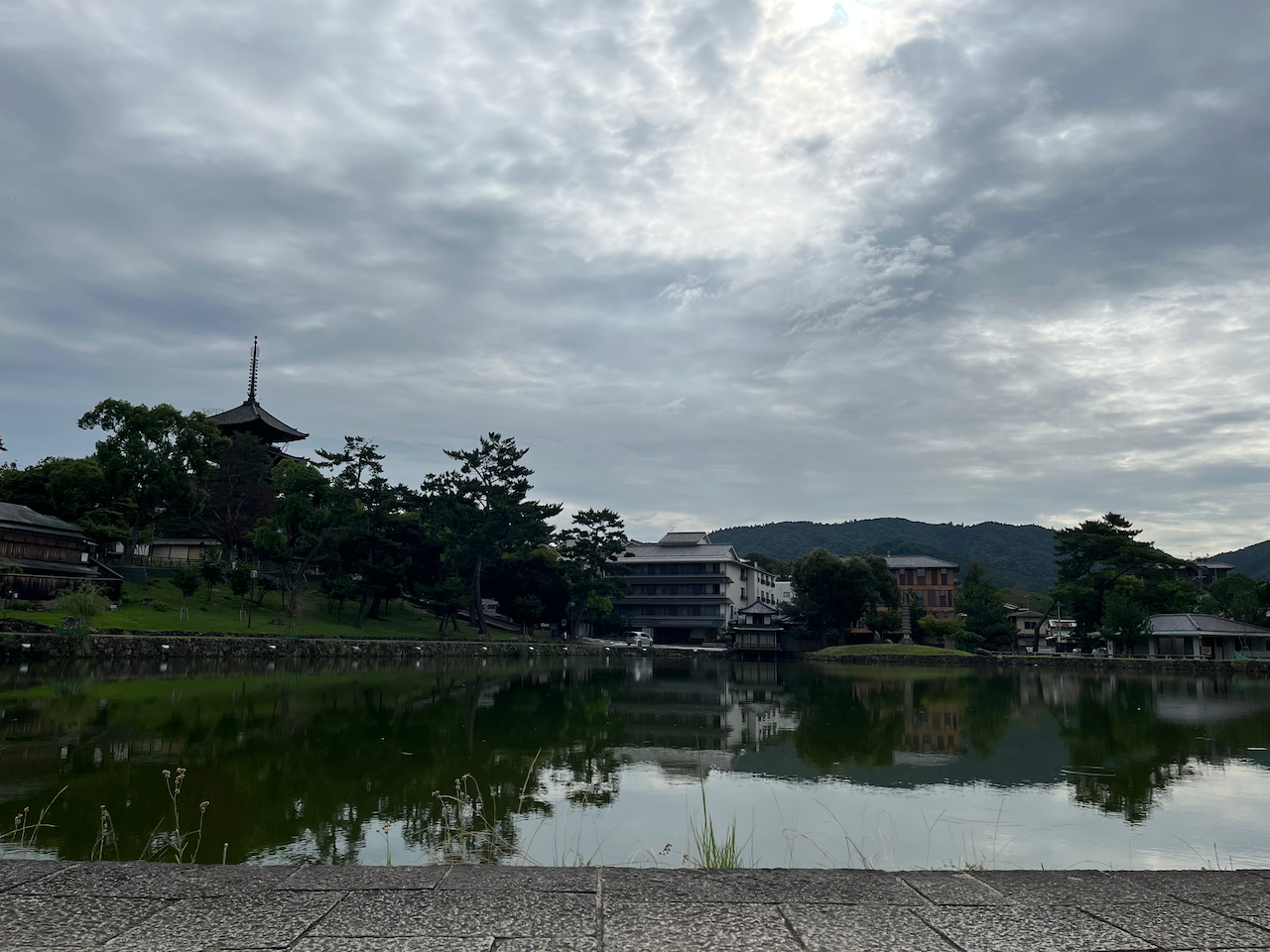
The idea is that with a simple noise like the clapping of hands, each creature (or person) responds differently according to their background or how they view the world.
Using a more modern example from the book, imagine two people looking at a mountain together. One is a mountain climber, another is a painter. As a pile of rocks and magma formed by geological processes, a mountain is just a mountain. And yet, each person will perceive the mountain differently from one another. And such people will also interpret it differently than a goat on the mountain. It’s not a conscious effort either, it’s how our mind naturally works. Sort of a bubble of perception that we each live in, colored and reinforced by the constant feedback of our own thoughts, feelings and actions on the bubble’s inner surface.
Yet another example might be a fresh pair of jeans you bought and started wearing. Depending on what you do, or how you live your life, the jeans will absorb that. If you spend a lot of time in bars, your jeans start to smell like tobacco (or puke), if you work in a fast-food place your jeans smell like french fries, and if you visit Buddhist temples a lot, it will smell like incense. Your conduct, how you live your life and such, all play into a feedback loop that tends to reinforce itself, and in so doing “filter” your perception of the world. And this dynamic process is still ongoing every moment of your life.
Through this process, we also unknowingly isolate ourselves from the world around us, because, whether we are aware of it or not, we see ourselves as the center of the universe. This is why later Buddhist schools, such as the Zen Buddhists would use terms like the “mind as mirror” and such: what we perceive, we transform and filter in our conscious and project back out. We project ourselves back out onto the world around us all the time.
What makes Yogacara Buddhist so fascinating is not just the concept, or its surface-similarity to Western philosophical ideas like Idealism, but how the early Yogacara Buddhists analyzed the “how” and “why” living beings do this, and further, how to apply this toward the Buddhist path toward liberation. Later Buddhist schools, I believe, applied Yogacara Buddhist teachings in their own ways, but the teaching remains more or less the same to this day even if couched in different language.
Anyhow, we’ve only scratched the surface here, but it’s a fascinating thing to look at, and hopefully I’ll be posting more content from Shun’ei Tagawa’s book.
Hope you’re all safe and well this Ohigan season, that the weather is pleasant, and you can take a moment to breathe easy and take it all in. Take care!
P.S. In the Chrono Trigger screenshots above, if you’re curious what the original Japanese text is (because you’re a big nerd like I am), it is:
あんたの目に見えてる世界とアタシの目に見えてる世界とはまったくちがうものなのかもね。
いい?宇宙の生命の数だけ存在するわ。見えるもの、さわれるものだけが本当と思っちゃダメよ。
The English translation is spot-on.
Discover more from Gleanings in Buddha-Fields
Subscribe to get the latest posts sent to your email.
 Gleanings in Buddha-Fields