

Samurai, as well as Ninja, have left a strong impression on Western culture as two kinds of warriors in medieval Japanese culture: the samurai as a brave and powerful “knight” to the secretive and cunning ninja. But there’s a third side of warfare in Japan that is often misunderstood: the Sohei (僧兵, pronounced “so-hey”) or soldier-monks. You can see a great visual example here (no English, sorry).
History of the Sohei
The emergence of the soldier-monks, unusual in Buddhist culture where monks are supposed to refrain from all violence and to avoid taking life, is something peculiar to the late 11th century Japan. Major, urban temple complexes were getting increasingly tangled in political battles. Because high-ranking monks, roughly analogous to medieval bishops or abbots, were appointed from noble families, this created friction when rival families would instigate conflicts about the succession of abbots of such and such temple. Similarly, disagreements with the reigning emperor meant that Sohei armies would march on the capitol to express their opinion.
Here’s a historical example. Within the powerful Tendai sect, based on Mt Hiei, two rival factions called the Jimon (寺門, “temple gate”) and Sanmon (山門, “mountain gate”) began to fight over the role of the abbot (zasu, 座主 ) of the Tendai Order.
Over generations, this struggle grew into armed, physical conflict and the Jimon were driven out. The Sanmon took over Enryaku-ji Temple on Mt Hiei and massed a huge army to defend their claim. Meanwhile, the defeated Jimon retreated to another major Tendai temple, Mii-dera, and massed their own army. Later, during in the 12th century these two armies clashed because they were on opposite sides of the struggle between the Genji and Heike samurai clans.
But it wasn’t just the Tendai who assembled armies. Rival sects to the Tendai, such as the Hosso sect (based at Kofukuji temple) fielded major armies of their own, and use them to intimidate rival temple complexes, and even the government, such as their protest to the reigning Emperor over the religious efforts of Honen, who spread new Buddhist teachings to the masses. The sohei army of Enryraku-ji Temple (Mt Hiei) even desecrated the grave of former-monk Honen in the early 12th century due to his perceived heresy. They later intimidated the newly arrived Zen monasteries in the capitol due to loss of patronage. Mount Hiei was the closest thing to a religious “mafia” at the time.
This chaos lasted until the 15th century Warring States Period, when the warlord Oda Nobunaga destroyed the Sohei by besieging Mt Hiei and setting it on fire, and the Sohei as an army finally ended.
Sohei as RPG Characters
In spite of their shady backstory, Sohei are still an object of fascination in contemporary Japanese culture, and as part of my adventure writing, I figured it would be good to find a place for them in the Hamato Islands setting. Question is, what are they?
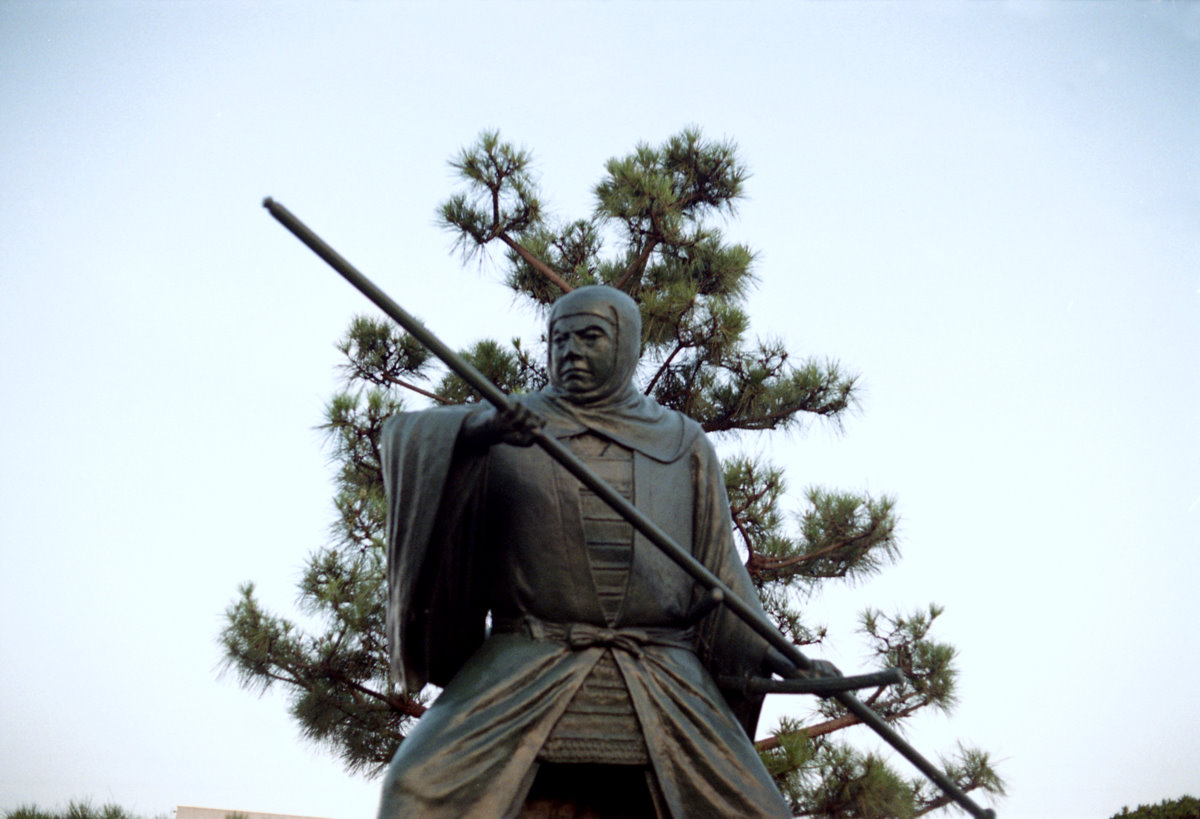
Sohei are most often depicted as armed warriors with naginata (glaive) weapons, and usually a katana blade (equivalent in the Dungeon Master’s Guide to a longsword) as backup, while frequently depicted wearing a white cowl. But are they fighters, clerics, fighter-clerics, paladins? I played around with several options and ultimately settled on Sohei being the Japanese equivalent to a paladin. Here’s why.
Despite their devotion to a particular temple, Sohei had little or no actual ordination. The Buddhist orders at this time still closely followed the traditional ordination rules, the Vinaya, dating all the way back to the time of the historical Buddha. Soldier-monk, by their violent nature and political entanglements, would have violated quite a few precepts.
Further, full monastic ordination required years of training and practice. Instead, the monasteries had to field armies quickly, so they needed warriors more than monks. The Sohei might received some kind of provisional ordination, if even that, but not ordination as true Buddhist monks. Buddhist “monks” would be analogous to clerics, of course.
But their religious fanaticism and martial training can’t be denied. They are neither run-of-the-mill soldiers, nor samurai due to the loyalty to temples, not warlord. So to me, the paladin class makes sense. A fighter-cleric combination, based on my trial and error, was just a bit too clumsy to make it work and still look like a sohei warrior. A paladin-class warrior fits the two aspects of combat and religion more seamlessly, and like the European knightly orders, the sohei could field large armies if required.
Building a Sohei Paladin
As stated above, in many respects, a Sohei works best as a Paladin that is just flavored for a medieval Japan setting:
- Weapons flavored for Japan setting: Naginata for Glaive, Katana for longsword
- No use of shields (shields were not used in Japanese warfare).
- Rudimentary, combat-focused magic.
Next, what Oath would a sohei / paladin take? Using the Player’s Handbook as a starting point, I settled on these interpretations:
- Oath of Vengeance – destroy heretics, or supernatural evil depending on one’s inclination. I feel like there’s enough for a player character to find a suitable “calling” while adhering to this Oath, and thus this seems like the best fit to me.
- Oath of Devotion – possible, though a bit more of a stretch due to dubious history of the sohei. One could still be devoted to a religious order, while also protecting the community. Such a “white knight” sohei probably takes the religious precepts more seriously (especially given Buddhism’s encouragement to not take life).
- Oath of the Ancients – this one just felt like a stretch to me. I can imagine a sohei that’s somehow tied to Japan’s other religion, Shinto, where the Oath of the Ancients fits really nicely, but I am unaware of any historical precedence of sohei serving major Shinto shrines. Then again, in a fantasy setting, anything is possible.
Thus, playing around with a few options in DnD Beyond, I made an example character here:1

A few things to note, some pretty self-explanatory:
- I chose basic Human just because I like the general stats bonuses, but I could choose Variant Human in order to get the Polearm Master feat right away. Either option is fine, and there’s no shame in branching out and trying other things too.
- Having a paladin’s proficiency in all martial weapons means that wielding a longsword / katana is no issue either. However, in this case, I decided to arm him with both a naginata (glaive) and a daikyū (longbow). D&D Beyond allows me to customize mundane weapons and equipment with new names, while keeping the mechanics the same.
- Shields were not used in medieval Japan, so to compensate I plan to give him the Defense Fighting Style at level 2. He uses chain armor for now, though I’ll probably upgrade to Splint later later.
- A Sohei using some divine magic, especially for war, makes sense in a fantasy theme, so the existing paladin spell list is pretty suitable, though perhaps with some flavor adjustments.
- For backstory, I gave him the soldier’s background, and backstory (reflecting history) that he comes from a rural, peasant background from a family that lived and worked on farmland owned by a powerful temple. A serf’s family. Recruited at a young age, he fought in a number of battles between his temple and a local warlored until the temple was destroyed. Now, Shinji is trying to atone for his part in the war, through adventuring in the wider world.
So, that’s my first-pass effort at making a sohei character for Dungeons and Dragons. I’ll let you all know how it goes.
1 In keeping with Japanese custom, I originally named him Moritomo Shinji, with the family name, Moritomo, coming first and the given name second. However, because VTT and online D&D games have limited text space, I shortened to just “Shinji” later.
Discover more from Gleanings in Buddha-Fields
Subscribe to get the latest posts sent to your email.
 Gleanings in Buddha-Fields

