
In the past, I’ve touched on the subject of Shinto religion, and its vast number kami (神) who range from great deities (similar to the Greek gods) to little more than nature spirits and revered historical figures. This is a pretty common feature of polytheistic religion in ancient times, across many cultures: gods were quite diverse in both size and roles.
In Japanese Shinto there is a saying: ya-o-yorozu no kami (八百万の神) which means “the Eight Million kami (of Japan)”. It is not meant to be literal, but simply means that there are many, many kami within Shinto. But outside the short-list of well-known kami, such as Inari Okami, most of this pantheon is pretty obscure, even to Japanese people. Many are so local, that there might be only one or two shrines associated with them. Some are not even named, they are just thought to occupy a particular sacred space, so you might find a tiny roadside shrine somewhere to a particular kami and that’s it. Compare this with the ancient Greek daimon, Arabic djinn, or Roman genius.
But I digress a bit. Let’s talk about one particular kami who has been particular interest of mine lately since I started writing adventure modules for Dungeons and Dragons, and delving more and more into Shinto mythology.1 She is in one sense important to Japanese mythology, but also obscure, and fascinating too. Her name Konohana-no-sakuyahime-no-mikoto (木花之佐久夜毘売命). She is often called Konohana-no-sakuya-bimé for short and is both a goddess of volcanoes, and of cherry blossoms:
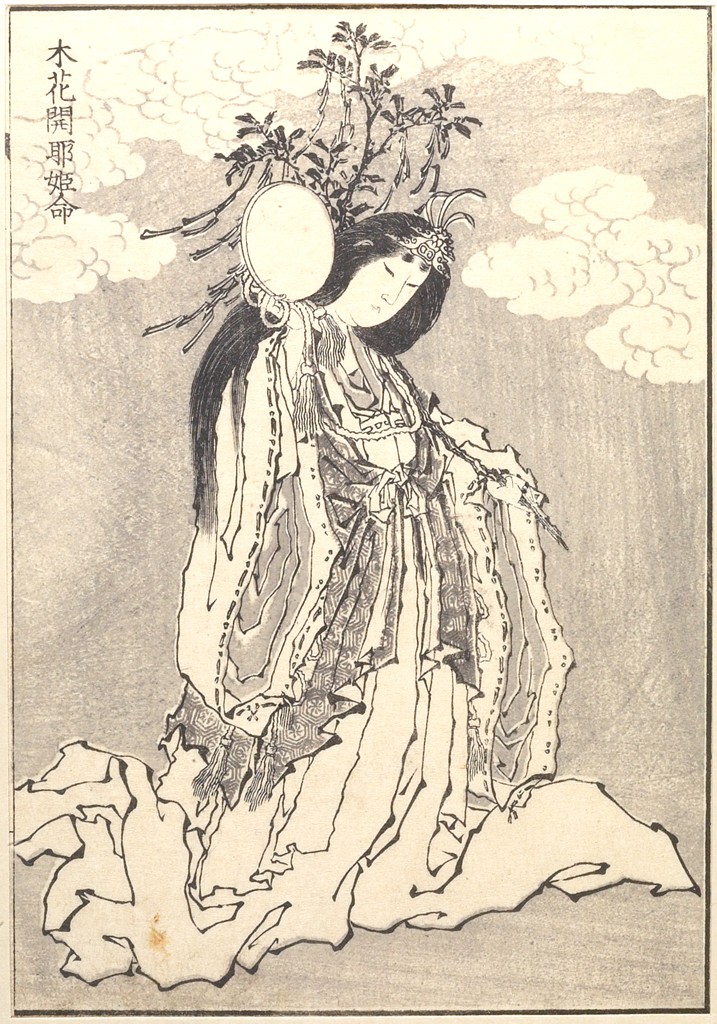
Konohana-no-sakuya-bimé is probably best known as the goddess of Mount Fuji itself. You can read more about it on the English-language page of the official shrine of Mount Fuji. The mountain is treated as her form, and thus the mountain is considered sacred ground. Konohana-no-sakuyahime is also the kami of volcanoes in general, not just Mount Fuji.
Like many obscure kami in the Shinto religion, Konohana-no-sakuya-bimé appears mostly in ancient texts such as the Kojiki and the Nihon Shoki.2 These two texts are semi-mythical origin stories for Japan, but also contain many myths from antiquity and are the most common sources for Japanese mythology.3
In one such myth, found in both the Kojiki and Nihon Shoki (online here) Konohana-no-sakuya-bimé is described as the goddess of cherry blossoms and is married to Ninigi, grandson of Amaterasu and ancestor of the Japanese imperial family. Before long, she becomes pregnant. Hononinigi is suspicious of her being pregnant so fast, and she vows that if the child is born safely, it belongs to Hononinigi. To prove her point, she shuts herself in a home and sets her house on fire, then delivers the baby in the middle of the blaze. Actually, she delivers three sons. All are safe and unharmed by the blaze, and thus proving that they are Ninigi’s children after all.
In another story, posted in Wikipedia, Konohana-no-sakuya-bimé is disguised as a little girl who helps guide a villager to a stream whose waters have healing powers, and can save his village from a plague. The villager carries out the instructions of the little girl, and the village is saved. When he returns to thank the little girl, he comes to realize that the little girl is in fact the goddess herself.
To be reiterate, such kami are also obscure to most Japanese people as well. A deep understanding of a certain kami or even the pantheon as a whole isn’t really required anyway. Instead, I would argue that the whole point of Shinto is more about deepening one’s “spiritual tie” or goshin’en (御神縁 or ご神縁) with a particular kami4 than grasping a deeper teaching. It’s not that Shinto doesn’t have its spiritual truths, but it doesn’t explore complex cosmology or theological issues the way Buddhism does. It tends to have a more practical, “this-worldly” focus.
Still, the fact that a goddess of both volcanoes and cherry blossoms exists is kind of fascinating to me, and one of those examples of how very little of Shinto has been properly conveyed (not to mention translated) to English audiences.
1 Although, my background with Japanese religion is definitely more Buddhist than Shinto, I still have my personal favorite kami, and always happy to visit shrines when I can.
2 Sadly, translations of the Kojiki and Nihon Shoki in English are by and large terrible. Like, really bad. I have heard that the “Phillipi translation” (ISBN: 0691648905) is the best, but it’s also out of print and hard to find. The only sources that sell it are quite expensive too. I hate Amazon’s third-party pricing model, btw. 😦 So, I’ve turned to Japanese sources instead, but obviously this isn’t feasible for everyone.
3 In the same way, Greek mythology mostly derives from two ancient sources: Homer’s Iliad and Odyssey, and Hesiod’s Theogony.
4 The word for this is musubu (結ぶ) which means to tie something. In this case, it’s a spiritual tie though rather than tying one’s shoelaces. 😌
Discover more from Gleanings in Buddha-Fields
Subscribe to get the latest posts sent to your email.
 Gleanings in Buddha-Fields
