
In Japanese culture, certain years are considered inauspicious based on the year you were born and are called yakudoshi (厄年).
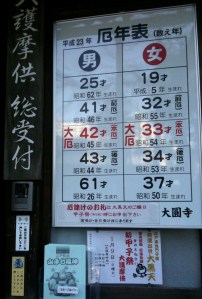
The logic behind these particular years comes from Chinese homophones (words that sounds alike). According to this helpful book, the years listed can also be homophones for bad things. For example “42”, if you say the numbers “4” and “2”, you get shi ni (四二). The word “shini” is also a homophone for “death”, (死に). For 33, it can be read as sanzan (三三), which also happens to sound like a word for “disaster” (散々). You see a lot of this in Japanese/Chinese culture not just with auspicious/inauspicious years and numbers, but other events like holidays and so on.
Out of all the yakudoshi years, the worst of the worst year (taiyaku, 大厄) is 42 for men, and 33 for women per homophones shown above.
Further, each yakudoshi year also have a “before” year (maeyaku, 前厄) and “after” year (atoyaku, 後厄) that are somewhat inauspicious but less severe. Thus, it’s a three year-span: maeyaku, honyaku (“main calamity”, 本厄) and then atoyaku.
Finally, the particular yakudoshi years differ between men and woman, and are calculated based on the year of one’s birth. However, in Japanese culture, these are usually based on Imperial reign dates. For example, I am born in 1979 according to the Western calendar, but in Japan, I would be born in year 54 of the Showa Period (shōwa 54 nen, 昭和54年). A kid born in 2004 would be year 16 of the Heisei Period (heisei 16 nen, 平成16年). So, if you wanted to calculate whether the coming year is inauspicious or not, you must look up by the Japanese-style Imperial year.
You can see a good example of this on this temple website, though it’s Japanese-only. As of 2025, according to the website, the inauspicious years are for men:
| Maeyaku (before calamity) | Honyaku (main calamity) | Atoyaku (after calamity) |
|---|---|---|
| Heisei 13 (2001) | Heisei 12 (2000) | Heisei 11 (1999) |
| Showa 59 (1984) | Showa 58 (1983) | Showa 57 (1982) |
| Showa 41 (1966) | Showa 40 (1965) | Showa 39 (1964) |
And for women:
| Maeyaku (before calamity) | Honyaku (main calamity) | Atoyaku (after calamity) |
|---|---|---|
| Heisei 19 (2007) | Heisei 18 (2006) | Heisei 17 (2005) |
| Heisei 5 (1993) | Heisei 4 (1992) | Heisei 3 (1991) |
| Showa 41 (1966) | Showa 40 (1965) | Showa 39 (1964) |
Anyway, when you are in the middle of a Yakudoshi year, many Japanese choose to undergo a ritual purification called yakuyoke (厄除け). This process doesn’t differ much depending on whether it’s done through a Shinto shrine or a Buddhist temple (since Japan has two religions).
In the of Shintoism, much revolves around the notion of purification. In Shinto if the shrine is not sufficiently purified, physically and spiritually, a kami spirit might not descend for a ritual. Also, when one has encountered calamities such as death, one should be purified as well. So, for Yakudoshi, this is no exception. The particular ritual in Shinto that is applied toward purification for Yakudoshi is called yakubarai (厄払い), which is intended to exorcise any negative spirits that might take advantage of this inauspicious year.
In the case of Buddhism, similar rituals exist, though the interpretation is more about exorcising negative karma and such. In her youth, my wife went to Kawasaki Daishi, a Shingon-Buddhist Temple that has a positive reputation for this kind of thing. Update: our daughter, who’s had a yakudoshi year, did something similar at a Japanese-Buddhist temple in the US. She was worried about college applications, and since it was a yakudoshi year for her, we opted to pay for the full ritual.
So, it just comes down to personal preference.
As for me, my taiyaku year recently ended (2019 as of writing), and it definitely had some hiccups, but overall it wasn’t a particularly bad year. No one got seriously ill, finances were better than past years, and work plods on like usual. I was by no means a great year, but it certainly didn’t live up to the moniker of “year of suffering”. However, full disclosure, I did undergo a purification ritual at a certain Buddhist temple, and paid extra for the ritual protection just to go the extra mile. Update: had a bad experience at the very tail end of the yakudoshi year.
On the other hand, I like to think that the Buddha-Dharma was better protection in that regard. ;-p
Either way, life goes on.
Discover more from Gleanings in Buddha-Fields
Subscribe to get the latest posts sent to your email.
 Gleanings in Buddha-Fields
One thought on “Yakudoshi? More Like Yaku-no-shi!”