
With the Chinese New Year recently concluded, I got to thinking about the traditional 60-year zodiac in Japanese culture. The Japanese calendar was originally based off the Chinese Lunar calendar, though this changed in the late 19th century when Japan moved toward rapid Westernization and industrialization. However, the 12-animal zodiac, or jū-ni-shi (十二支), is still an important part of the culture. In Japanese culture, like Chinese culture, the calendar is divided into a 12-animal cycle that rotates year after year. Even hours of the day were divided by these same animals, with the time starting at midnight, the hour of the rat, and noon being the hour of the horse.
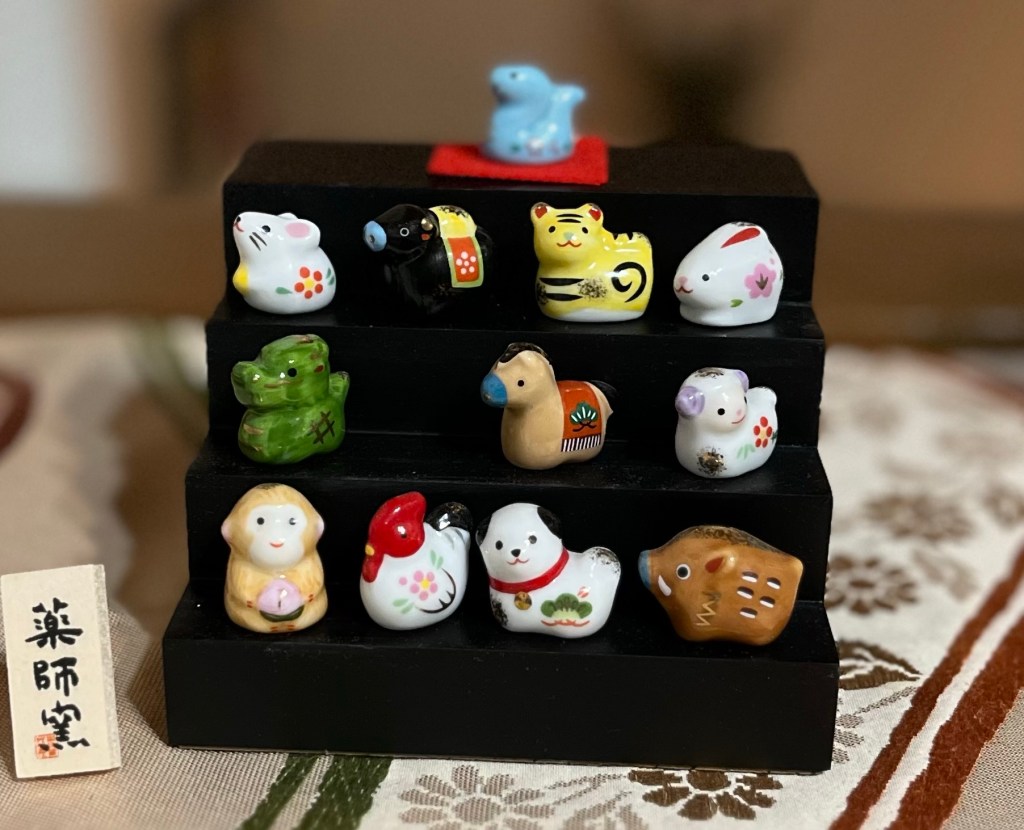
The animals, their names and kanji (Chinese characters) are listed as follows:
| Animal | Japanese | Kanji |
|---|---|---|
| Rat | Ne | 子 |
| Ox | Ushi | 丑 |
| Tiger | Tora | 寅 |
| Rabbit | U | 卯 |
| Dragon | Tatsu | 辰 |
| Snake | Mi | 巳 |
| Horse | Uma | 午 |
| Goat/Sheep | Hitsuji | 未 |
| Monkey | Saru | 申 |
| Rooster | Tori | 酉 |
| Dog | Inu | 戌 |
| Boar | I | 亥 |
A few things to note:
- Unlike the Chinese calendar, the “pig” has been replaced by a “boar”, which are common in the mountainous areas of Japan, even today.
- The Kanji for these characters are quite different than the ones in daily use. The regular Kanji for Dog is 犬 but in the zodiac it’s 戌.
- Some of the animals also have different readings than daily use. Compare the snake, “hebi” in daily use, with “mi” in the zodiac.
Things can be divided further and further though. You can divide these by five elements: earth, fire, water, air and metal. These can then be divided even further into a pair of “stems”, for a total of ten stems. The stems related to the notion of yin/yang, or inyō in Japanese (陰陽). Japanese “in” (陰) is yin, while yō (陽) is yang. Often times these are referred to as big brother, or “e” (兄), and little brother, or “to” (弟), as well. These are called jikkan (十干) and are organized like so, with pronunciations added:
| Element | Reading | Yin or Yang | Chinese Character |
|---|---|---|---|
| Wood: 木 | ki | Yang (é) | 甲 |
| Yin (to) | 乙 | ||
| Fire: 火 | hi | Yang (é) | 丙 |
| Yin (to) | 丁 | ||
| Earth: 土 | tsuchi | Yang (é) | 戊 |
| Yin (to) | 己 | ||
| Metal: 金 | kane (ka) | Yang (é) | 庚 |
| Yin (to) | 辛 | ||
| Water: 水 | mizu | Yang (é) | 壬 |
| Yin (to) | 癸 |
A few notes here as well:
- Each of the corresponding Yin or Yang Chinese characters is unique (10 total), each representing a unique combination element plus yin or yang (e.g. Yang Fire, Yin Water, etc).
- All the Yin/Yang Chinese characters also happen to show up elsewhere in regular Japanese, but here they take on different meanings, readings.
So, how do you read this? If someone is born as the element wood (木, ki) and the yin stem (乙, to), this is read as ki no to. If yang stem, then ki no é. That’s why I mentioned “e” and “to” above under yang and yin. The only exception to this rule is “metal” which sounds awkward if you say kane-no-e or kane-no-to, so it gets shortened to ka-no-e or ka-no-to.
Now, putting this altogether, add the animal sign from above. For 2019, the horoscope is the Earth Yin Boar or tsuchi-no-to-i (己亥). For 2024, it is Wood Yang Snake or ki-no-é-mi (甲巳), and so on.
Namu Amida Butsu
Namu Kanzeon Bosatsu
Discover more from Gleanings in Buddha-Fields
Subscribe to get the latest posts sent to your email.
 Gleanings in Buddha-Fields